Eye Diagnosis (Yan Zhen) Meridian Diagnostics: Governing Five Wheels and Eight Boundaries, Scleral Microvascular Differentiation, and Ocular Visceral Reflection in Traditional Chinese Medicine
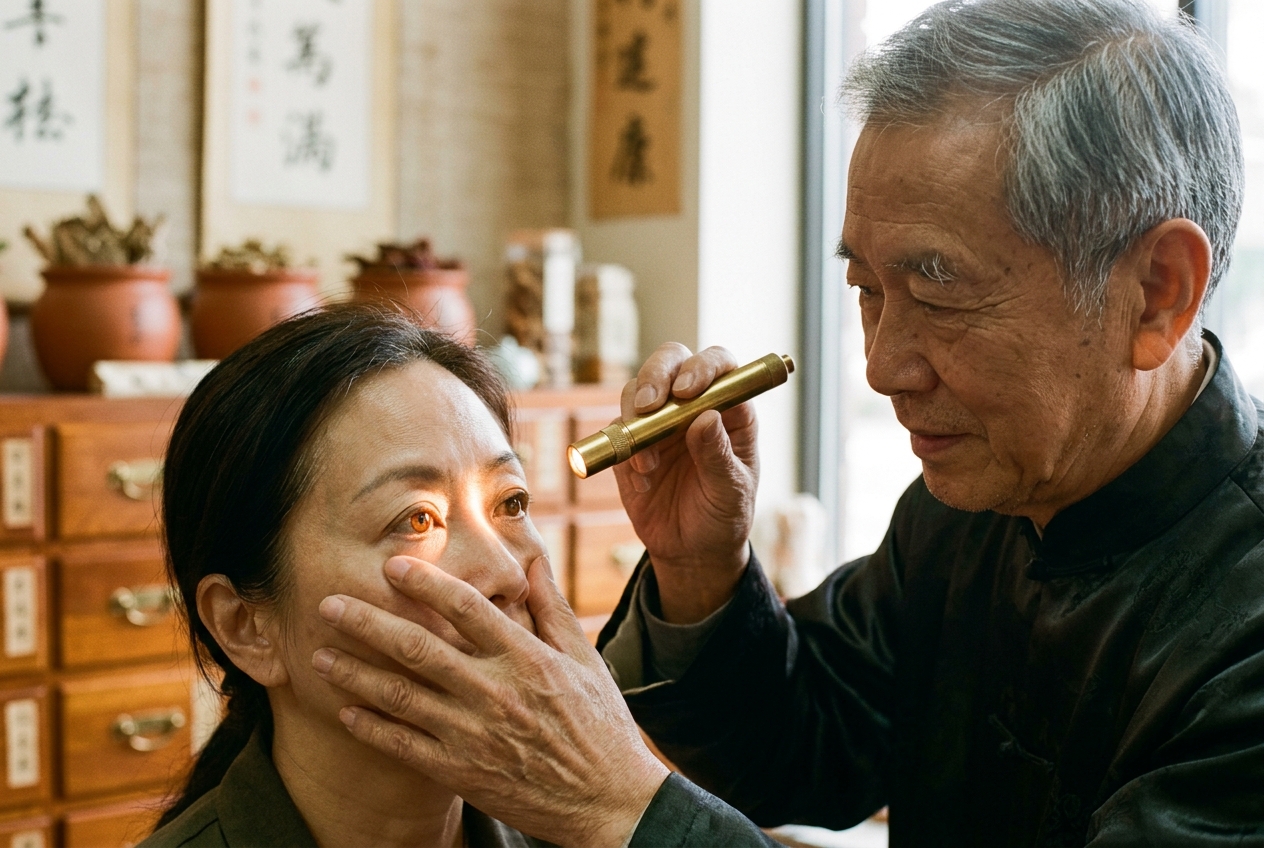
In the cold, unforgiving light of a bathroom mirror at dawn, you lean in to examine your reflection. You might be searching for the subtle lines of fatigue after a week of broken sleep, but your gaze snags on something more granular: a singular, tortuous filament of crimson threading its way across the nasal quadrant of the sclera, terminating in a dusky, purple-tinged bifurcation. Beside it, the white of the eye is not the immaculate porcelain of youth, but faintly clouded with an ochre sheen, framed by lower eyelids that sag with fluid retention.
To the untrained modern observer, this is merely "tired eyes"—an inconsequential nuisance resolved with vasoconstrictor drops or digital detox. Yet to the physician trained in the classical traditions of Traditional Chinese Medicine (TCM), this visual tableau is a live somatotopic readout of your internal physiological architecture.
+-----------------------------------------------------------------------------------+
|                        THE OCULAR SOMATOTOPIC COMPASS                             |
|                                                                                   |
|                           Upper Eyelid: Flesh Wheel (Rou Lun)                     |
|                                [Spleen / Stomach]                                 |
|                                                                                   |
|     Outer Canthus:                                          Inner Canthus:        |
|    Blood Wheel (Xue Lun)     Iris: Wind Wheel (Feng Lun)  Blood Wheel (Xue Lun)   |
|         [Heart]                    [Liver / Wood]                [Heart]          |
|                                                                                   |
|             Sclera: Qi Wheel (Qi Lun)       Pupil: Water Wheel (Shui Lun)         |
|                 [Lung / Metal]                    [Kidney / Water]                |
|                                                                                   |
|                           Lower Eyelid: Flesh Wheel (Rou Lun)                     |
|                                [Spleen / Stomach]                                 |
+-----------------------------------------------------------------------------------+
The eye is not an isolated optical device; it is the anatomical crossroad where every major energetic channel intersects. In the Huangdi Neijing Lingshu (The Yellow Emperor's Inner Classic: Spiritual Pivot, c. 1st Century BCE), it is asserted that "The essence of the five Zang and six Fu organs ascends to infuse the eyes, making them the palace of the spirit." When internal homeostasis destabilises—whether through microvascular blood stasis (Xue Yu), chronic visceral heat, or cellular fluid accumulation—the micro-vessels and structural zones of the eye register the event long before macroscopic pathology emerges in blood work. This diagnostic science is known as Yan Zhen (眼诊, Ocular Inspection).
2. What This System Does: The Classical Architecture of Yan Zhen
The epistemological foundations of classical ocular diagnosis reached their zenith during the Tang and Song dynasties, codified in foundational treatises such as the Yan Ke Long Mu Lun (眼科龙木论, Nagarjuna's Treatise on Ophthalmology) and later systematically synthesized in the Ming Dynasty masterpiece Yin Hai Jing Wei (银海精微, The Exhaustive Vision of the Silver Sea, traditionally attributed to the Daoist scholar-physician Sun Simiao). In these texts, the ocular globe is conceptualized as the "Silver Sea" (Yin Hai), an interconnected ecosystem divided into two primary diagnostic frameworks: the Five Wheels Theory (Wu Lun, 五轮) and the Eight Boundaries System (Ba Kuo, 八廓).
====================================================================================
           THE FIVE WHEELS (WU LUN) DIAGNOSTIC MAPPING IN OCULAR ANATOMY
====================================================================================
 Wheel Name     | Classical Zone        | Zang-Fu Organ Pairing | Five Element Phase
----------------+-----------------------+-----------------------+-------------------
 Rou Lun (肉轮)  | Eyelids & Subcutis    | Spleen & Stomach      | Earth (Tu)
 Xue Lun (血轮)  | Canthi (Medial/Lat.)  | Heart & Small Int.    | Fire (Huo)
 Qi Lun (气轮)   | Sclera & Bulbar Conj. | Lung & Large Int.     | Metal (Jin)
 Feng Lun (风轮) | Cornea & Iris         | Liver & Gallbladder   | Wood (Mu)
 Shui Lun (水轮) | Pupil & Deep Media    | Kidney & Bladder      | Water (Shui)
====================================================================================
The Five Wheels Theory (Wu Lun)
The Five Wheels model assigns the five morphological layers of the eye to the five Yin (Zang) and Yang (Fu) organ networks:
-
The Flesh Wheel (Rou Lun, 肉轮) — Eyelids and Periorbital Tissue (Spleen/Stomach - Earth): * Physiological Role: Governed by the Spleen, which regulates muscular tone and the transformation and transportation of physiological fluids. * Pathological Correlates: Ptosis, flaccidity, or weakness of the upper lid reflects Spleen Qi deficiency. Edematous lower palpebral swelling (infraorbital puffiness) denotes Spleen-Kidney Yang deficiency failing to metabolize fluid. Scleral xanthelasma or blepharitis points to unresolved Damp-Heat (Shi Re) simmering in the Stomach channel.
-
The Blood Wheel (Xue Lun, 血轮) — Medial and Lateral Canthi (Heart - Fire): * Physiological Role: The inner and outer corners of the eye house dense capillary networks governed by the Heart, which commands blood circulation and houses the Shen (Consciousness). * Pathological Correlates: Intense erythema, engorgement, or telangiectasia of the caruncles indicates Heart Fire blazing upward. A pale, blanched canthal bed signifies Heart Blood deficiency, often correlating with systemic anemia and insomnia.
-
The Qi Wheel (Qi Lun, 气轮) — Bulbar Conjunctiva and Sclera (Lung - Metal): * Physiological Role: The vast, white expanse of the sclera is governed by the Lungs, masters of Qi and the superficial defensive perimeter (Wei Qi). * Pathological Correlates: Because the sclera is avascular and white, it serves as the ultimate high-contrast canvas for observing the microvascular arborization of systemic blood vessels. Pathological changes here reflect respiratory inflammation, systemic toxic heat, or deep microvascular blood stasis.
-
The Wind Wheel (Feng Lun, 风轮) — Cornea and Iris (Liver - Wood): * Physiological Role: The Liver "opens into the eyes" and stores the Blood that moistens the visual apparatus. The clarity, structural integrity, and chromatic uniformity of the iris reflect Liver Yin and Liver Blood abundance. * Pathological Correlates: Corneal arcus (Arcus Senilis, or classical Feng Lun Yun Quan) indicates lipid turbidity and phlegm-stasis arising from Liver-Spleen dysregulation. Structural fraying of the iris stroma reflects Liver Yin depletion and constitutional exhaustion.
-
The Water Wheel (Shui Lun, 水轮) — Pupil and Deep Ocular Media (Kidney - Water): * Physiological Role: The pupil, lens, vitreous, and retina correspond to the Kidneys, the root of Jing (Congenital Essence) and Primordial Yin/Yang. * Pathological Correlates: Sluggish pupillary light reflexes, mydriasis without pharmacological cause, or crystalline lenticular opacities (cataracts / Nei Zhang) denote the exhaustion of Kidney Yin and depletion of Kidney Essence.
The Eight Boundaries System (Ba Kuo)
Complementing the concentric layers of the Five Wheels is the radial coordinate system of the Eight Boundaries (Ba Kuo, 八廓), which projects the Bagua (Eight Trigrams of the Yijing) across the bulbar sclera. This energetic compass divides the sclera into eight functional sectors:
- Qian (Heaven - Northwest): Lung and Large Intestine boundary.
- Kun (Earth - Southwest): Spleen and Stomach boundary.
- Zhen (Thunder - East): Liver and Gallbladder energetic axis.
- Xun (Wind - Southeast): Wind-pathway and Gallbladder collateral sector.
- Kan (Water - North): Kidney and Bladder energetic deep axis.
- Li (Fire - South): Heart and Pericardium vascular convergence.
- Gen (Mountain - Northeast): Upper burner and chest cavity projection.
- Dui (Lake - West): Lower burner and pelvic cavity reflection.
When evaluating a localized microvascular abnormality, the practitioner cross-references its concentric layer (Wheel) with its radial sector (Boundary) to pinpoint both the diseased organ system and the energetic nature of the disharmony.
3. How You Can Feel and See It: Scleral Microvascular Alterations and Pathognomonic Rubrics
Ocular micro-inspection requires focused natural or halogen light, minimal magnification (2x–4x loop or slit-lamp equivalent), and systematic manual retraction of the eyelids. The clinician examines four primary vascular characteristics: Coloration, Vessel Morphology, Spatial Trajectory, and Pigmentary Deposits.
+-----------------------------------------------------------------------------------+
|               DIAGNOSTIC RUBRIC: SCLERAL VESSEL CHROMATIC SPECTRUM                |
+-----------------------------------------------------------------------------------+
|  Vessel Color      | Pathophysiological Mechanism    | Clinical Manifestation     |
+--------------------+---------------------------------+----------------------------+
|  Bright Crimson    | Acute Exterior/Interior Heat    | Active inflammation, fever,|
|  (Xian Hong, 鲜红) | Acute vascular dilation (Hyperemia) headaches, acute surge   |
+--------------------+---------------------------------+----------------------------+
|  Dusky Purple      | Blood Stasis (Xue Yu)           | Chronic localized pain,    |
|  (Zi An, 紫暗)     | Venous congestion, micro-thrombi| microcirculatory ischemia  |
+--------------------+---------------------------------+----------------------------+
|  Pale Pink / Gossamer | Qi and Blood Deficiency      | Chronic fatigue, systemic  |
|  (Dan Hong, 淡红)  | Capillary rarefaction/ischemia  | anemia, postural dizziness |
+--------------------+---------------------------------+----------------------------+
|  Muddy Yellow Halo | Damp-Heat (Shi Re)              | Hepato-biliary congestion, |
|  (Huang Ni, 黄泥)  | Bilirubin/Lipid transudation    | metabolic syndrome, nausea |
+--------------------+---------------------------------+----------------------------+
Microvascular Morphology and Architectural Signatures
-
Vessel Tortuosity and Kinking: Straight, linear scleral vessels reflect healthy, laminar vascular dynamics. When vessels display corkscrew spiraling, sharp angulations, or s-shaped redundancies, it indicates chronic collateral obstruction (Luo Mai Yu Zu). In contemporary microvascular science, this corresponds to elevated shear stress and endothelial remodeling.
-
Branching Morphologies: * Tree-Branch Arborization: Diffuse, dendritic spreading across the Qi Wheel indicates active, expanding Heat toxins. * Reticular Webbing (Network Formations): Dense, interlocking capillary meshes represent deep-seated visceral stasis or long-standing inflammatory exudation. * Spear-Head (Arrow) Terminations: A vessel that terminates abruptly in a swollen, club-like punctate bulb signifies a focal microvascular thrombus or acute localized blood stasis in the corresponding Zang-Fu organ.
-
Pigmentary Deposits and Structural Macules: * Silver-Gray or Slate-Blue Patches: Known classically as Shen Zhi Ban, these circumscribed scleral macules point to congenital Qi weakness or past parasitic and heavy-metal burdens. * Brown/Black Melanin Puncta: Focal deposits sitting directly at the terminus of a tortuous vessel indicate chronic Blood Stasis that has solidified over years, often observed in patients with deep structural adhesions, pelvic endometriosis, or chronic degenerative joint diseases.
                  SCLERAL MICROVASCULAR ARCHITECTURES

      Linear (Healthy)        Tortuous (Blood Stasis)       Spear-Head (Focal Stasis)
      -----------------              _   _                      ----------* (Bulb)
                                    / \ / \
                                   /   V   \                    Branching (Toxic Heat)
                                                                     \   /
                                                                      \ /
                                                                       |
Bridging Classical Heuristics with Modern Microcirculation Science
Modern investigative medicine validates the core premise of Yan Zhen: the ocular conjunctival microvascular bed is the only vascular network in the human body directly accessible to non-invasive in vivo observation.
Published studies indexed in NCBI PubMed demonstrate that alterations in bulbar conjunctival microvasculature—specifically capillary diameter, flow velocity, and vessel tortuosity—directly mirror generalized endothelial dysfunction, microangiopathy, and systemic atherosclerosis (see Microvascular Assessment via Conjunctival Imaging).
Furthermore, neuro-ophthalmic research on Autonomic Pupillary Dynamics reveals that the pupil's resting diameter and light-reflex latency provide an immediate real-time metric of central autonomic balance: * Sympathetic overactivity (analogous to Liver Yang Rising or Heart Fire) triggers pupillary dilation and spontaneous micro-oscillations (hippus). * Parasympathetic decline (analogous to Kidney Yin/Yang Deficiency) manifests as sluggish constriction velocities and impaired resting tone.
The systemic integration of traditional medicine frameworks has also gained international validation through the World Health Organization Traditional Medicine Strategy, which advocates for standardized diagnostic heuristics uniting traditional observational metrics with clinical biomarkers.
4. Qigong & Somatic Movement Practice: Cleansing the Silver Sea (Ming Mu Dao-Yin)
To actively regulate the ocular vascular bed, disperse microvascular stasis, and restore the smooth flow of Liver Qi and Kidney Essence to the eyes, practitioners employ the classical Daoist ocular regimen known as Ming Mu Dao-Yin Gong (Bright Eyes Guiding and Pulling Skill).
====================================================================================
               MING MU DAO-YIN: STEP-BY-STEP PRACTICE PROTOCOL
====================================================================================
 Phase           | Primary Action                  | Breath Timing   | Duration
-----------------+---------------------------------+-----------------+--------------
 I. Grounding    | Neutral Wu Wei Stance           | Diaphragmatic   | 2 Minutes
 II. Orbital     | Horizontal & Vertical Glides    | Inhale/Exhale   | 12 Cycles
 III. Figure-8   | Continuous Infinity Rotations   | Deep, Unhurried | 8 Repetitions
 IV. Accommodate | Near-to-Far Focal Shifts        | Rhythmic 4-Sec  | 10 Cycles
 V. Thermo-Palm  | Thermal Conduction Over Orbits  | Complete Rest   | 3 Minutes
====================================================================================
Step-by-Step Instructions
1. Starting Position and Structural Alignment
- Stand or sit upright with your spine lengthened, tailbone gently tucked, and shoulders dropped away from the ears.
- Relax the jaw, placing the tip of your tongue against the upper hard palate to unite the Conception (Ren) and Governing (Du) vessels.
- Soften your gaze into the middle distance.
2. Phase I: Cardinal Orbital Glides (Si Fang Yun Yan)
- Inhale deeply into the lower Dantian (lower abdomen), maintaining head stability while smoothly elevating your gaze to the highest vertical point without straining.
- Exhale completely, sweeping your gaze down to the lowest vertical point, engaging the inferior rectus and orbicularis muscles.
- Inhale, gliding the eyes across the horizontal horizon to the extreme left.
- Exhale, sweeping smoothly across to the extreme right.
- Repetitions: Complete 12 continuous, fluid cycles. Move slowly; avoid saccadic jumping.
3. Phase II: The Infinite Silver Sea Glide (Ba Zi Yun Jing)
- Trace a slow, sweeping figure-eight ($\infty$) across your visual field with both eyes.
- Synchronize the movement with your breath: inhale during the upward and lateral curves; exhale as your gaze crosses through the central intersection.
- Repetitions: 8 cycles clockwise, followed by 8 cycles counter-clockwise.
4. Phase III: Ciliary Muscle Accommodation (Yuan Jin Diao Jiao)
- Extend your right thumb 6 inches in front of the tip of your nose.
- Focus with intense clarity on the nail bed of the thumb for a count of 4 seconds (Inhale).
- Instantly release your focal point, projecting your vision to the furthest horizon or distant tree line for a count of 4 seconds (Exhale).
- Repetitions: 10 alternating cycles to reset intraocular pressure and exercise the ciliary muscle apparatus.
5. Phase IV: Thermo-Palming and Energetic Infusion (Wen Ying Zhen)
- Vigorously rub your palmar surfaces together for 15–20 seconds until intense friction heat (Lao Gong, PC-8) is generated.
- Cup your warm palms softly over the closed ocular orbits, excluding all ambient light without exerting physical pressure on the globes.
- Inhale slowly through the nose, visualizing warm, golden Qi radiating from the centers of your palms through the Five Wheels, dissolving vascular knots and replenishing Kidney-Water.
- Duration: Hold for 3 minutes until the heat dissipates completely.
5. Acupressure Points You Can Try Today
Targeted somatosensory manual stimulation of specific neuro-vascular nodes around the orbit and along corresponding meridians can instantly modulate local microcirculatory perfusion and clear stagnation.
                         PERIORBITAL ACUPRESSURE NODES

                                 (BL-2 Zanzhu)
                                      ___
                                    /     \
                (BL-1 Jingming) -> * ( O ) * <- (EX-HN5 Taiyang)
                                    \ ___ /
                                       |
                                (ST-2 Sibai)
1. Jingming (BL-1, 睛明) — "Bright Eyes"
- Anatomical Location: Situated in the depression 0.1 cun superior to the inner canthus, just medial to the medial palpebral ligament.
- Biomechanical Vector & Technique: Close your eyes. Place the index or thumb tip precisely on the bony margin of the inner orbital rim. Apply light, perpendicular pressure directed slightly upward toward the root of the nose. Do not compress the eyeball. Maintain firm, continuous, non-pulsatile pressure while breathing deeply.
- Duration: 1 to 2 minutes.
- Clinical Indications: The primary crossing point of the Bladder, Small Intestine, Stomach, Gallbladder, and Triple Burner channels with the Yin and Yang Heel Vessels (Qiao Mai). Instantly clears Qi Wheel vascular engorgement, relieves dry-eye discomfort, reduces ocular redness, and lifts mental fogginess.
2. Taiyang (EX-HN5, 太阳) — "Greater Yang"
- Anatomical Location: Located in the tender temporal depression approximately one finger-width posterior to the midpoint between the lateral canthus and the lateral extremity of the eyebrow.
- Biomechanical Vector & Technique: Place the pads of your middle fingers into the bilateral temporal depressions. Apply gentle, circular kneading in an upward and backward vector with moderate pressure.
- Duration: 2 to 3 minutes.
- Clinical Indications: Clears Liver Fire, dispels exterior wind-heat, relieves temporal and cluster headaches, reduces intraorbital tension, and enhances cerebral and ophthalmic microcirculatory perfusion (see Microcirculation and Vascular Endothelial Function).
3. Guangming (GB-37, 光明) — "Bright Light"
- Anatomical Location: Located on the lateral aspect of the lower leg, exactly 5 cun (approximately seven finger-widths) superior to the prominence of the lateral malleolus, on the anterior border of the fibula.
- Biomechanical Vector & Technique: Using the thumb pad, apply deep, perpendicular static pressure until a distinct, dull, aching sensation (De Qi) radiates upward along the outer leg. Maintain this pressure while gently flexing and extending the ankle.
- Duration: 2 minutes per limb.
- Clinical Indications: As the Luo-Connecting point of the Gallbladder Meridian, GB-37 connects directly with the Liver channel. It is the premier distal point for all ocular disorders, resolving visual fatigue, night blindness, light sensitivity, and chronic migraine associated with Liver-Blood deficiency and Liver-Yang flare.
6. Food & Lifestyle: Small Changes to Nourish the Ocular-Vascular Axis
Preserving the clarity of the "Silver Sea" requires a systemic strategy aimed at clearing metabolic Damp-Heat, tonifying Liver Blood, and protecting the vascular endothelium from oxidative stress.
====================================================================================
                NUTRITIONAL ENERGETICS FOR OCULAR MICROCIRCULATION
====================================================================================
 Category     | Therapeutic Additions             | Pathogenic Reductions
--------------+-----------------------------------+---------------------------------
 Infusions    | Ju Hua (Chrysanthemum), Gou Qi Zi | Energy drinks, excessive coffee
 Leafy Greens | Lacinato kale, spinach, watercress| Refined, deep-fried carbohydrates
 Bioactives   | Wild bilberries, black sesame seeds| High-fructose corn syrups
 Whole Foods  | Steamed carrots, pasture-raised egg| Ultra-processed cured meats
 Lifestyle    | 20-20-20 visual hygiene, sleep by 23:00| Late-night blue light exposure
====================================================================================
Foods and Phytochemicals to Emphasize
- Chrysanthemum and Goji Berry Infusion (Ju Qi Cha): Steep 5g of dried Wild Chrysanthemum flowers (Ye Ju Hua, which clears Wind Wheel heat and brightens vision) alongside 8g of Lycium berries (Gou Qi Zi, which tonifies Kidney Jing and enriches Liver Blood). Drink daily between 13:00 and 15:00 during the Small Intestine/Bladder diurnal peak.
- High-Lutein & Zeaxanthin Botanical Matrices: Consume lightly steamed dark leafy greens (kale, spinach, dandelion greens). These phytochemicals accumulate directly in the macular stroma, filtering short-wavelength blue light and neutralizing reactive oxygen species.
- Black Sesame Seeds (Hei Zhi Ma) and Walnuts (Hu Tao Ren): Deeply nourish Kidney-Yin and lubricate the Blood, preventing dry-eye syndrome and brittle scleral microvasculature.
- Omega-3 Long-Chain Fatty Acids: Wild-caught cold-water fish (mackerel, sardines, salmon) improve the meibomian gland lipid layer, preventing premature tear-film evaporation.
Habits and Foods to Reduce
- Late-Night Blue-Light Irradiation: Prolonged blue spectrum exposure after 22:00 damages retinal pigment epithelial cells and stimulates the sympathetic nervous system, depleting Liver Blood and preventing deep hepatic regenerative recovery.
- Deep-Fried, Acrid, and Greasy Foods: Excessive intake of trans-fats and high-glycemic meals generates chronic Spleen-Stomach Damp-Heat, which rises along the Yang channels to manifest as eyelid edema (Rou Lun swelling), scleral lipid arcs, and chronic blepharitis.
- Excessive Vasoconstrictor Eye Drops: Over-the-counter anti-redness drops provide cosmetic relief through superficial alpha-adrenergic vasoconstriction. This masks underlying metabolic stasis while causing rebound hyperemic vasodilation and worsening endothelial hypoxia.
7. Clinical Synthesis, Diagnostic Vignettes, and Today's Takeaway
+-----------------------------------------------------------------------------------+
|               DIAGNOSTIC WORKFLOW: TRI-METHOD DIFFERENTIAL SYNTHESIS              |
+-----------------------------------------------------------------------------------+
|                                                                                   |
|      [ Yan Zhen: Eye Inspection ]                                                 |
|      - Wheel identification (Zone)                                                |
|      - Vessel morphology & chroma                                                 |
|                     |                                                             |
|                     v                                                             |
|      [ She Zhen: Tongue Inspection ]  <--->  [ Mai Zhen: Radial Pulse Palpation ] |
|      - Body color, shape, sublinguals         - Depth, speed, tension, volume     |
|                     \                                 /                           |
|                      \                               /                            |
|                       v                             v                             |
|                   +------------------------------------+                          |
|                   |  DIFFERENTIAL SYNDROME (ZHENG)     |                          |
|                   +------------------------------------+                          |
+-----------------------------------------------------------------------------------+
Diagnostic Case Vignettes
Case 1: The Corporate Executive with Migraines and Scleral Telangiectasia
- Ocular Findings (Yan Zhen): Marked, tortuous, crimson vessel running from the lateral canthus (Blood Wheel / Heart) across the temporal sclera into the Zhen Boundary (Liver sector), terminating in a dusky spearhead bulb. Irises (Wind Wheel) dry and lusterless.
- Tongue Findings (She Zhen): Red body, especially along the lateral margins; thin, dry, yellow coating; distended, dark sublingual veins.
- Pulse Findings (Mai Zhen): Wiry (Xuan Mai), rapid (Shuo Mai), forceful on the left Guan (Liver) position.
- Diagnostic Synthesis: Liver Fire Flaring with Blood Stasis in the Upper Orifices. The crimson, tortuous scleral vessel in the Liver/Heart sector indicates long-standing emotional frustration and sympathetic overactivity creating localized microvascular stasis.
- Therapeutic Principle: Clear Liver Fire, soothe Wood, invigorate Blood, and resolve stasis using points like Taiyang (EX-HN5), Taichong (LR-3), and Xingjian (LR-2) alongside herbs like Dan Zhi Xiao Yao San with Chuanxiong.
Case 2: The Postpartum Mother with Extreme Fatigue and Ocular Pallor
- Ocular Findings (Yan Zhen): Scleral micro-vessels are faint, pale pink (Dan Hong), thin as gossamer threads, and sparse. Lower palpebral conjunctiva blanched white (Flesh Wheel). Sclera lacks luster, appearing dull and chalky.
- Tongue Findings (She Zhen): Pale, flabby body with scallops/teeth marks on the margins; thin, moist white coating.
- Pulse Findings (Mai Zhen): Thready (Xi Mai) and weak (Ruo Mai), particularly at the right Guan (Spleen) and Cun (Heart) positions.
- Diagnostic Synthesis: Dual Deficiency of Qi and Blood (Qi Xue Liang Xu) with Spleen Weakness. The pale, blanched Flesh and Qi Wheels confirm inadequate microvascular perfusion resulting from deficient production of post-natal essence.
- Therapeutic Principle: Tonify Spleen Qi and nourish Heart-Liver Blood utilizing Ba Zhen Tang (Eight Treasure Decoction), with direct acupressure on Zusanli (ST-36), Sanyinjiao (SP-6), and Jingming (BL-1).
+-----------------------------------------------------------------------------------+
|                            TODAY'S 5-MINUTE TAKEAWAY                              |
+-----------------------------------------------------------------------------------+
|  Before stepping into your day, perform the "5-Minute Silver Sea Reset":          |
|                                                                                   |
|  1. Close your eyes and apply gentle, upward static pressure to BL-1 (Jingming)   |
|     for 60 seconds while taking 4 deep diaphragmatic breaths.                     |
|  2. Knead the temporal depressions at EX-HN5 (Taiyang) in slow backward circles   |
|     for 60 seconds.                                                               |
|  3. Vigorously rub your palms together until hot, and cup them over your closed   |
|     eyes for 3 minutes, resting in warm darkness.                                 |
|                                                                                   |
|  This simple routine decongests the periorbital microcirculation, resets the      |
|  ciliary muscle apparatus, and calms the autonomic nervous system—giving your     |
|  eyes the clarity they need to navigate the visual demands of the day ahead.      |
+-----------------------------------------------------------------------------------+