Extraordinary Acupoints (Jing Wai Qi Xue) Meridian Dynamics: Governing Empirical Loci, Non-Channel Somatosensory Modulation, and Targeted Clinical Interventions in Traditional Chinese Medicine
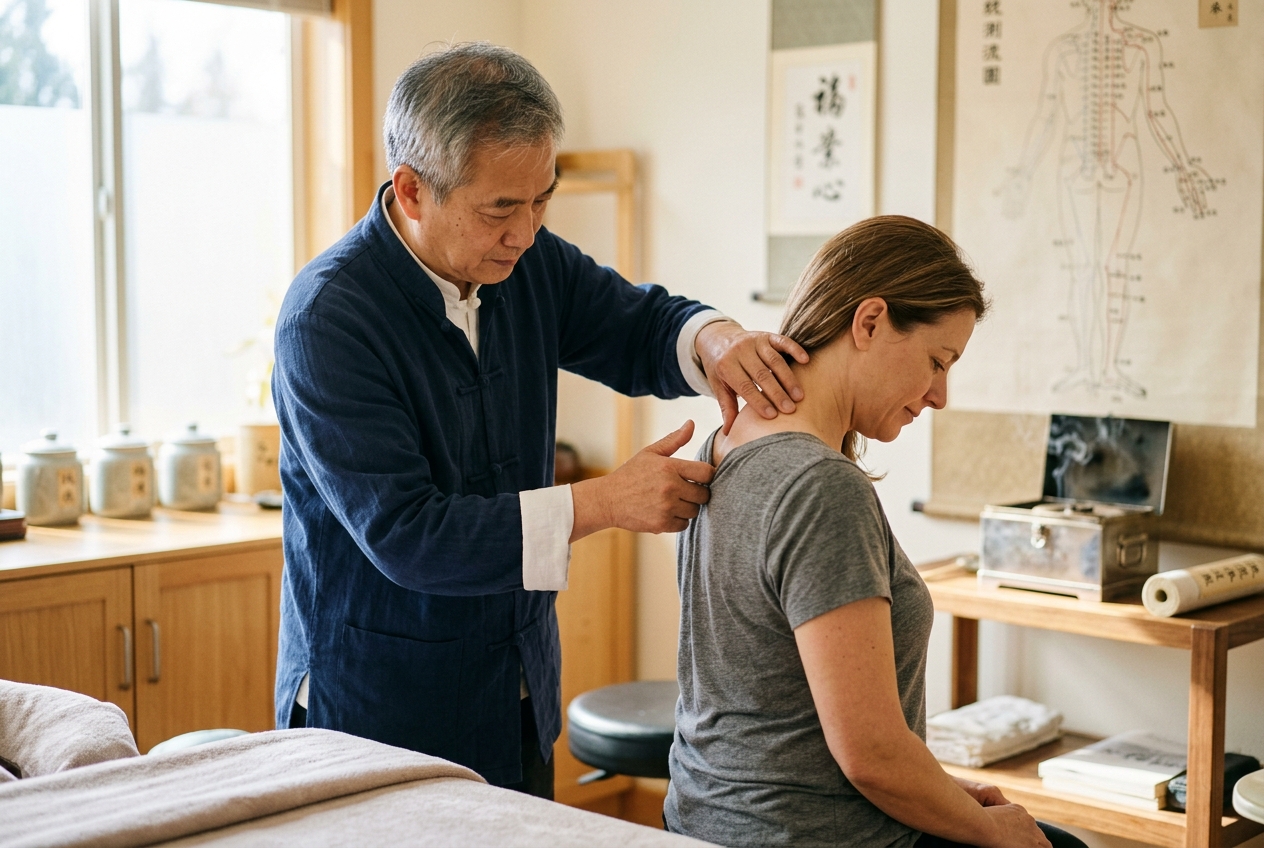
1. Opening Scene — A Moment You'll Recognise
You are sitting at your desk late on a Thursday afternoon when a sudden, blinding tension begins to constrict the base of your skull. Within minutes, the ache radiates into a band across your temples, your eyes throb behind your brow, and a subtle nausea settles into the pit of your stomach. Instinctively, without a single thought of formal anatomy or ancient medical philosophy, your hands lift. Your fingertips drift to the soft, tender depressions situated just lateral to your outer eyebrows, or your thumb presses firmly into the midpoint between your eyebrows. You rub in slow, circular motions, applying deep, targeted pressure. Almost instantaneously, a wave of decompression washes over your frontal cortex; your breath deepens, your ocular strain softens, and the oppressive vice around your cranium begins to yield.
What your hands located in that instinctive moment was not an accident, nor was it merely a localized muscle spasm. You pressed directly into Taiyang (EX-HN5) and Yintang (EX-HN3)—two of the most famous Jing Wai Qi Xue (经外奇穴), or Extraordinary Acupoints.
In the conceptual architecture of Traditional Chinese Medicine (TCM), these loci exist outside the classic fourteen primary channel pathways, yet they possess some of the most potent, reproducible clinical actions in the entire medical canon. For millennia, before modern imaging revealed neurovascular bundles, peripheral nerve branches, or myofascial trigger networks, empirical clinicians discovered that certain distinct points on the living human body acted as high-potency switches for somatic relief, visceral regulation, and neurological restoration. Today, modern biomedical research is finally unlocking why these extraordinary points exert such profound regulatory control over our nervous, endocrine, and musculoskeletal systems.
2. What This Organ System and Channel Network Does
To understand the extraordinary points, one must first understand the fundamental plumbing and communicative matrix of the human body as articulated in Chinese medicine: the Jing-Luo (经络) or Meridian System, and its symbiotic relationship with the internal Zang-Fu (藏府) organ networks.
+===================================================================================+
|                     THE EPISTEMOLOGICAL CONTINUUM OF ACUPOINTS                    |
+===================================================================================+
|                                                                                   |
|  [ Ashi Points ] --------> [ Extraordinary Points ] --------> [ Channel Points ]  |
|  (Dynamic Tenderness)      (Jing Wai Qi Xue)                 (14 Main Meridians)  |
|  • Ephemeral               • Fixed Anatomical Loci           • Fixed Topography   |
|  • Site of Injury/Spasm    • Highly Specific Function        • Channel Dynamics   |
|  • Diagnostic/Local        • Empirical Validation            • Systemic Organ Ties|
|                                                                                   |
+===================================================================================+
In classical physiological theory, the fourteen primary channels (comprising the twelve bilateral organ meridians plus the midline Du Mai / Governing Vessel and Ren Mai / Conception Vessel) serve as the primary conduits through which Qi (vital bioelectrical and metabolic energy) and Xue (nutrient-rich blood and interstitial perfusion) circulate. These meridians tie superficial somatic tissues to deep visceral organs, ensuring continuous systemic homeostasis.
However, clinical reality has always presented phenomena that overflowed neat systemic models: * The Epistemological Evolution: During the Han Dynasty (206 BCE – 220 CE), foundational treatises such as the Huangdi Neijing (黄帝内经, The Yellow Emperor's Inner Classic) and later the Zhenjiu Jiayi Jing (针灸甲乙经) systematized channel pathways. Yet, rural healers, military surgeons, and Daoist physicians continually observed that specific anatomical loci outside the mapped meridians yielded immediate, dramatic therapeutic responses for acute crises. * The Empirical Revolution in the Tang and Ming Dynasties: By the 7th century, the legendary Tang Dynasty polymath Sun Simiao (孙思邈) formalized the concept of Ashi points (阿是穴, tender reactive sites) in his monumental Beiji Qianjin Yaofang (备急千金要方, Essential Prescriptions Worth a Thousand Pieces of Gold) and recorded dozens of unclassified empirical loci. Subsequent dynasties refined these observations, culminating in Ming Dynasty master Yang Jizhou’s (杨继洲) Zhenjiu Dacheng (针灸大成, The Great Compendium of Acupuncture and Moxibustion), which documented specialized non-channel points for epilepsy, pediatric convulsion, and refractory pain. * Modern Standardization: In the late 20th century, international consensus led by the World Health Organization (WHO) systematically codified these empirical loci, validating standard locations, depths of insertion, and nomenclature under the official classification of Jing Wai Qi Xue.
Unlike primary channel points, which operate largely through broad systemic resonance and channel-to-organ relationships, Extraordinary Points are characterized by their empirical specificity and targeted neurovascular architecture. They do not require complex meridian differentiation to exert their effects; rather, they serve as high-density bio-reflex nodes situated precisely at critical nerve bifurcations, fascial clefts, and vascular networks.
3. How You Can Feel It — Signs of Balance and Imbalance
Because Extraordinary Points correlate directly with the somatic and autonomic nervous systems, your body communicates its state of balance or distress through tangible physical markers at these precise locations. When an individual experiences systemic harmony, these loci are soft, resilient, pain-free upon palpation, and thermally balanced with surrounding tissue.
When pathology, structural misalignment, or visceral dysfunction develops, these points transform into active somatic alarm zones.
+-----------------------------------------------------------------------------------+
|               SOMATIC AND AUTONOMIC MANIFESTATIONS AT EXTRAORDINARY LOCI          |
+-----------------------------------------------------------------------------------+
| REGION             | PHYSICAL MANIFESTATION           | CLINICAL CORRELATE        |
+--------------------+----------------------------------+---------------------------+
| Craniofacial       | Sharp tenderness at Taiyang,     | Autonomic stress, vagal   |
| (Head & Neck)      | heavy brow pressure at Yintang   | withdrawal, tension state |
+--------------------+----------------------------------+---------------------------+
| Paravertebral      | Rigid nodular cords at Huatuo    | Segmental facilitation,   |
| (Spine & Torso)    | Jiaji; hypersensitivity at Yishu | visceral-somatic reflex   |
+--------------------+----------------------------------+---------------------------+
| Appendicular       | Coldness/paresthesia at Shixuan; | Peripheral vasoconstrict, |
| (Extremities)      | acute sharp pain at Lanweixue    | inflammatory cascade      |
+--------------------+----------------------------------+---------------------------+
The Rapid Self-Assessment Protocol
You can conduct an immediate physical audit of your body’s neuro-energetic status by evaluating three core zones:
- The Craniofacial Stress Axis: Gently press the pad of your index finger into Yintang (between the eyebrows) and slide both thumbs to Taiyang (the temples). If these areas feel exquisitely tender, bruised, or unyielding, your sympathetic nervous system is locked in hyper-arousal, accompanied by microvascular constriction of the cerebral circulation.
- The Paravertebral Reflex Chain: Reach behind your back and palpate the muscular troughs running 0.5 to 1 finger-width lateral to the spinous processes of your thoracic spine (the Huatuojiaji zone). The presence of taut bands, fibrous nodules, or sharp focal sensitivity indicates chronic segmental facilitation—where spinal segments corresponding to your stomach, heart, or liver are under sustained neurogenic stress.
- The Peripheral Microvascular Terminals: Examine your fingertips (Shixuan) and toe web spaces (Bafeng). Persistent chilliness, sluggish capillary refill (longer than two seconds after pinching a nail bed), or unexplained dull aches in these regions signal stagnation of microcirculatory perfusion and peripheral autonomic dysregulation.
4. Qigong & Movement Practice: The Five Directions Mobilisation
To harmonize the somatic tissues housing these extraordinary points, the following daily medical Qigong sequence—"Opening the Axis and Terminals"—specifically mobilizes the spinal cord, paravertebral fascia, craniofacial nerves, and peripheral extremity loci.
+===================================================================================+
|               "OPENING THE AXIS AND TERMINALS" — QIGONG PROTOCOL                 |
+===================================================================================+
|                                                                                   |
|     (1) Neutral Wuji Stance  --->  (2) Spinal Undulation (Jiaji Activation)       |
|                                                     |                             |
|                                                     v                             |
|     (4) Shixuan/Bafeng Dispersion <--- (3) Cranial Unwinding (Yintang / Taiyang)  |
|                                                                                   |
+===================================================================================+
Step-by-Step Exercise Instructions
- Starting Position & Setup: Stand barefoot on a level surface with your feet shoulder-width apart, parallel to one another. Unlock your knees slightly. Allow your pelvis to settle into a neutral tilt, lengthening your lumbar spine. Rest the tip of your tongue lightly against the hard palate behind your upper incisors. Let your arms hang loosely at your sides, fingers softly naturally curved.
- Phase 1: Spinal Undulation for Huatuojiaji Activation (Minutes 0:00 – 2:00):
- Inhale (4 seconds): Slowly draw breath through your nose into your lower abdomen (the Dantian). Gently tuck your chin, round your shoulders forward, and softly curl the thoracic and lumbar spine, feeling a gentle stretch across the paravertebral muscles along the spine.
- Exhale (6 seconds): Reverse the motion smoothly. Beginning at the tailbone, unroll your spine upward, expanding your chest, gently drawing your shoulder blades together, and lifting your crown toward the ceiling while maintaining a relaxed neck.
- Reps: Perform 12 slow, continuous cycles.
- Phase 2: Cranial Unwinding for Yintang and Taiyang (Minutes 2:00 – 3:30):
- Bring your palms together at your chest until warm. Separate your hands and position your index finger pads at Yintang and thumb pads at Taiyang.
- Inhale: Gently draw your fingertips upward across your forehead toward the hairline.
- Exhale: Smoothly sweep outward across your temples, applying moderate, gliding pressure down the lateral neck to the base of the collarbone.
- Reps: Perform 8 smooth cycles.
- Phase 3: Terminal Flicking for Shixuan and Bafeng (Minutes 3:30 – 5:00):
- Inhale deeply, raising both arms to chest height with elbows softly bent.
- Exhale forcefully through your nose while rapidly extending and flicking your fingers outward from the palm, as though flicking water from your fingertips (Shixuan), while simultaneously shifting your weight from heels to the balls of your feet to engage the digital web points of the toes (Bafeng).
- Reps: 24 rhythmic pulses.
Sensory Shift to Anticipate: Within 3 to 5 minutes, you will observe a distinct warming sensation in your palms and feet, a softening of facial tension, and a slight tingling or electromagnetic "buzzing" along your spinal column. In clinical neurophysiology, this corresponds to increased peripheral nitric oxide release, parasympathetic reactivation, and reduced myofascial tone across the paraspinal musculature.
5. Acupressure Points You Can Try Today: Deep Academic Taxonomy & Prescriptions
The table below classifies the primary Extraordinary Points by anatomical region, noting their standard designations, anatomical localizations, underlying neurovascular structures, and clinical indications based on consensus literature indexed in the National Center for Biotechnology Information (NCBI PubMed).
+===========================================================================================================================================+
|                                    MASTER TAXONOMY OF CORE EXTRAORDINARY ACUPOINTS (JING WAI QI XUE)                                      |
+==================+===========+=========================================+=======================================+==========================+
| REGION           | POINT     | ANATOMICAL LOCATION                     | NEUROVASCULAR SUBSTRATE               | PRIMARY CLINICAL ACTIONS |
+==================+===========+=========================================+=======================================+==========================+
| Head & Neck      | Yintang   | Midpoint between the medial ends of     | Supratrochlear/supraorbital nerves;   | Frontal headache, rhinitis|
| (EX-HN)          | (EX-HN3)  | the two eyebrows (glabella)             | frontal branch of ophthalmic artery   | insomnia, anxiety, spasm |
+------------------+-----------+-----------------------------------------+---------------------------------------+--------------------------+
| Head & Neck      | Taiyang   | In depression 1 cun posterior to the    | Auriculotemporal & zygomaticofacial   | Migraine, trigeminal     |
| (EX-HN)          | (EX-HN5)  | midpoint between outer canthus & brow   | nerves; superficial temporal artery   | neuralgia, ocular strain |
+------------------+-----------+-----------------------------------------+---------------------------------------+--------------------------+
| Head & Neck      | Sishencong| 4 points, each 1 cun anterior, posterior| Greater occipital & supraorbital n.;  | Cognitive decline,       |
| (EX-HN)          | (EX-HN1)  | & lateral to Baihui (GV-20) on vertex   | epicranial aponeurosis anastomosis   | vertigo, severe insomnia |
+------------------+-----------+-----------------------------------------+---------------------------------------+--------------------------+
| Head & Neck      | Anmian    | Midpoint between Yifeng (TE-17) &       | Great auricular & lesser occipital n.;| Intractable insomnia,    |
| (EX-HN)          | (EX-HN22) | Wangu (GB-12), behind mastoid process   | posterior auricular artery/vein       | palpitations, agitation  |
+------------------+-----------+-----------------------------------------+---------------------------------------+--------------------------+
| Head & Neck      | Bailao    | 2 cun superior to Dazhui (GV-14),       | Greater occipital & accessory nerves; | Cervical spondylosis,    |
| (EX-HN)          | (EX-HN15) | 1 cun lateral to posterior midline      | deep cervical artery & vein           | chronic cough, dyspnea   |
+==================+===========+=========================================+=======================================+==========================+
| Back & Spine     | Huatuojiaji| 34 points: 0.5 cun lateral to lower     | Dorsal rami of spinal nerves &        | Segmental neuropathy,    |
| (EX-B)           | (EX-B2)   | borders of T1–L5 spinous processes      | posterior branches of intercostal art.| visceral somatoreflexes  |
+------------------+-----------+-----------------------------------------+---------------------------------------+--------------------------+
| Back & Spine     | Dingchuan | 0.5 cun lateral to the lower border of  | Posterior ramus of 8th cervical nerve;| Acute asthma, bronchial  |
| (EX-B)           | (EX-B1)   | the spinous process of C7               | transverse cervical artery            | spasm, neck stiffness    |
+------------------+-----------+-----------------------------------------+---------------------------------------+--------------------------+
| Back & Spine     | Yishu /   | 1.5 cun lateral to the lower border of  | Posterior rami of T8 spinal nerve;    | Diabetes mellitus,       |
| (EX-B)           | Weiguanxia| the spinous process of T8               | 8th intercostal artery and vein       | pancreatic dysfunction   |
+==================+===========+=========================================+=======================================+==========================+
| Chest & Abdomen  | Zigong    | 3 cun lateral to Zhongji (CV-3),        | Iliohypogastric nerve; inferior       | Infertility, uterine     |
| (EX-CA)          | (EX-CA1)  | 4 cun inferior to the umbilicus         | epigastric artery & vein              | prolapse, dysmenorrhea   |
+------------------+-----------+-----------------------------------------+---------------------------------------+--------------------------+
| Chest & Abdomen  | Sanjiaojiu| Form equilateral triangle on lower      | Medial cutaneous br. of intercostal   | Chronic enteritis, hernia|
| (EX-CA)          | (EX-CA2)  | abdomen using patient's smile width     | n.; inferior epigastric vessels       | abdominal cold-pain      |
+==================+===========+=========================================+=======================================+==========================+
| Upper Extremity  | Shixuan   | On tips of all 10 fingers, 0.1 cun      | Palmar digital proper nerves and      | High fever, coma, stroke |
| (EX-UE)          | (EX-UE11) | distal to the free edge of nails        | palmar digital proper arteries        | acute syncope, numbness  |
+------------------+-----------+-----------------------------------------+---------------------------------------+--------------------------+
| Upper Extremity  | Baxie     | On dorsum of hand, in web margins       | Dorsal digital branches of ulnar &    | Hand arthritis, tremor,  |
| (EX-UE)          | (EX-UE9)  | between the five fingers (8 points total| radial nerves; dorsal metacarpal art. | localized inflammation   |
+------------------+-----------+-----------------------------------------+---------------------------------------+--------------------------+
| Upper Extremity  | Erbai     | 4 cun above wrist crease, on both sides | Medial antebrachial cutaneous nerve & | Hemorrhoids, rectal      |
| (EX-UE)          | (EX-UE2)  | of tendon of flexor carpi radialis (2pt)| median n.; anterior interosseous art. | prolapse, forearm pain   |
+------------------+-----------+-----------------------------------------+---------------------------------------+--------------------------+
| Upper Extremity  | Luozhen   | Dorsum of hand, between 2nd & 3rd meta- | Dorsal digital nerve of radial nerve; | Acute torticollis (wry   |
| (EX-UE)          | (EX-UE8)  | carpal bones, 0.5 cun proximal to joint | dorsal metacarpal venous rete         | neck), shoulder spasm    |
+==================+===========+=========================================+=======================================+==========================+
| Lower Extremity  | Heding    | In depression at midpoint of the        | Anterior femoral cutaneous nerve &    | Knee osteoarthritis,     |
| (EX-LE)          | (EX-LE2)  | superior border of the patella          | superior patellar arterial rete       | quadriceps weakness      |
+------------------+-----------+-----------------------------------------+---------------------------------------+--------------------------+
| Lower Extremity  | Xiyan     | In depressions medial and lateral to    | Infrapatellar br. of saphenous nerve; | Gonarthrosis, cruciate   |
| (EX-LE)          | (EX-LE5)  | the patellar ligament (Neixiyan/Waixiyan| articular vascular network of knee    | ligament sprain, edema   |
+------------------+-----------+-----------------------------------------+---------------------------------------+--------------------------+
| Lower Extremity  | Lanweixue | 2 cun directly inferior to Zusanli      | Deep & superficial peroneal nerves;   | Acute/chronic appendic-  |
| (EX-LE)          | (EX-LE7)  | (ST-36) on the anterior tibialis muscle | anterior tibial artery and vein       | itis, dyspepsia, pain    |
+------------------+-----------+-----------------------------------------+---------------------------------------+--------------------------+
| Lower Extremity  | Dannangxue| 1 to 2 cun directly inferior to         | Common peroneal nerve br.; lateral    | Cholecystitis, biliary   |
| (EX-LE)          | (EX-LE6)  | Yanglingquan (GB-34) on lateral leg     | inferior genicular artery             | colic, hypochondriac pain|
+------------------+-----------+-----------------------------------------+---------------------------------------+--------------------------+
| Lower Extremity  | Bafeng    | On dorsum of foot, in web margins       | Dorsal digital nerves from superficial| Gout, peripheral sensory |
| (EX-LE)          | (EX-LE10) | proximal to margin of web (8 points)    | & deep peroneal; dorsal digital vein  | neuropathy, toe ischemia |
+==================+===========+=========================================+=======================================+==========================+
Neuroanatomical, Myofascial, and Segmental Reflex Mechanisms
How do these non-channel points exert such distinct actions? Scientific investigations into the neurobiology of Acupuncture Points have established three primary physiological models:
+===================================================================================+
|               NEUROANATOMICAL MECHANISMS OF EXTRAORDINARY ACUPOINTS               |
+===================================================================================+
|                                                                                   |
|  1. Somatovisceral Reflex Arc                                                     |
|     Somatic Input (e.g. Dannangxue) ---> Dorsal Horn (T7-T9) ---> Splanchnic Plexus|
|                                                                  (Gallbladder)    |
|                                                                                   |
|  2. Trigeminal-Vagal Parasympathetic Tuning                                       |
|     Glabellar/Temporal Afferents (Yintang/Taiyang) ---> Spinal Trigeminal Nucleus  |
|                                                    ---> Nucleus Tractus Solitarius|
|                                                    ---> Autonomic Calming         |
|                                                                                   |
|  3. Glomus Body Microvascular Shunting                                            |
|     Digital Terminals (Shixuan/Bafeng) ---> A-Delta/C-Fiber Decompression         |
|                                         ---> Microvascular Capillary Flush        |
|                                                                                   |
+===================================================================================+
- Viscerosomatic and Somatovisceral Convergence: Points like Lanweixue (EX-LE7) and Dannangxue (EX-LE6) are direct manifestations of visceral-somatic convergence in the dorsal horn of the spinal cord, as elucidated in research published in PubMed Central on Neuroanatomical Basis of Acupuncture. Afferent nociceptive fibers from the inflamed gallbladder (traveling via the greater splanchnic nerve, segments T7–T9) synapse on the exact same second-order dorsal horn neurons as somatic sensory fibers originating from the upper lateral lower leg. When the gallbladder becomes pathologically distended, these dorsal horn neurons develop central sensitization, creating focal hyperalgesia at Dannangxue. Stimulating this somatic locus sends retrograde inhibitory signals through the sympathetic chain, dampening biliary spasm and hypermotility.
- Trigeminal-Vagal and Suboccipital Calming: Points located on the cranium—such as Yintang (EX-HN3) and Taiyang (EX-HN5)—are innervated by the ophthalmic and maxillary divisions of the trigeminal nerve (Cranial Nerve V). Mechanical stimulation of these afferent fibers projects directly to the spinal trigeminal nucleus, which communicates with the nucleus tractus solitarius (NTS) and the dorsal motor nucleus of the vagus nerve. This triggers rapid parasympathetic activation, reduction in systemic blood pressure, and downregulation of central sympathetic outflow.
- Fascial Mechanotransduction and Trigger Point Overlap: As mapped in orthopedic research, a vast majority of the extraordinary points on the back and torso (most notably Huatuojiaji and Dingchuan) directly overlap with the motor entry points and myofascial trigger zones documented by Janet Travell and David Simons. Mechanical pressure or needle insertion deforms local interstitial fibroblasts, triggering ATP release, intracellular calcium waves, and local vasodilation via calcitonin gene-related peptide (CGRP) and substance P release.
Three Core Extraordinary Points You Can Self-Administer Today
1. Yintang (EX-HN3) — "Hall of Impression"
- Landmark: Exactly midway between the inner borders of the eyebrows, directly above the bridge of the nose.
- Palpation & Technique: Place the soft pad of your right middle finger or thumb on the glabella. Apply steady, perpendicular pressure directed slightly upward toward the crown of your head. Maintain a firm, soothing pressure (about 4–6 lbs of force) while closing your eyes and taking deep, diaphragmatic breaths.
- Duration: 2 to 3 minutes.
- Clinical Purpose: Immediate relief from frontal sinus congestion, tension headaches, acute mental agitation, cognitive fatigue, and sleep-onset insomnia.
2. Taiyang (EX-HN5) — "Supreme Yang"
- Landmark: In the tender depression located approximately one thumb-width posterior to the midpoint between the outer corner of the eye and the lateral tip of the eyebrow.
- Palpation & Technique: Use the pads of both thumbs to locate the soft temporal indentation. Apply moderate, circular pressure, rotating inward for 60 seconds, then outward for 60 seconds.
- Duration: 2 to 3 minutes.
- Clinical Purpose: Temporal migraines, computer vision syndrome, ocular redness, photophobia, and acute neck tension radiating into the jaw.
3. Luozhen (EX-UE8) — "Stiff Neck Point"
- Landmark: On the back of the hand, between the second and third metacarpal bones (the bones behind the index and middle knuckles), about half a thumb-width back from the knuckle joint.
- Palpation & Technique: Use your opposite thumb to dig firmly into this tender groove. While maintaining firm, continuous, slightly painful pressure, slowly and gently rotate your neck from side to side through its available range of motion.
- Duration: 1 to 2 minutes per hand.
- Clinical Purpose: Acute torticollis (waking up with a stiff, locked neck), trapezius spasms, and postural upper back strain.
Concrete Synergistic Clinical Protocols: Merging Extraordinary, Yuan-Source, and Back-Shu Points
In advanced clinical acupuncture, Extraordinary Points are rarely used in isolation; rather, they are paired with Yuan-Source (原穴, points accessing the primordial organ energy) and Back-Shu (背俞穴, segmental paraspinal points corresponding to specific organs) to build powerful therapeutic combinations.
+===================================================================================================================+
|                                    ADVANCED MULTI-TIER CLINICAL PROTOCOLS                                         |
+=========================+=============================+===========================+===============================+
| CLINICAL CONDITION      | EXTRAORDINARY LOCI          | YUAN-SOURCE INTEGRATION   | BACK-SHU INTEGRATION          |
+=========================+=============================+===========================+===============================+
| Intractable Chronic     | Huatuojiaji (C4-C7, EX-B2)  | Hegu (LI-4) &             | Dazhu (BL-11, Bone Influential)|
| Cervical Radiculopathy  | Bailao (EX-HN15)            | Taichong (LV-3)           | Feishu (BL-13)                |
| & Migraines             | Taiyang (EX-HN5)            | [Four Gates Protocol]     |                               |
+-------------------------+-----------------------------+---------------------------+-------------------------------+
| Post-Stroke Hemiplegia  | Shixuan (EX-UE11, digital)  | Taixi (KI-3) &            | Ganshu (BL-18, Liver / Motor) |
| & Neurological Rehab    | Baxie (EX-UE9, webbing)     | Taichong (LV-3)           | Shenshu (BL-23, Kidney/Brain) |
|                         | Sishencong (EX-HN1, cranium)|                           |                               |
+-------------------------+-----------------------------+---------------------------+-------------------------------+
| Metabolic Syndrome /    | Yishu / Weiguanxiashu       | Taibai (SP-3) &           | Pishu (BL-20, Spleen/Pancreas)|
| Diabetes Mellitus       | (EX-B3, T8 Pancreas Locus)  | Taixi (KI-3)              | Weishu (BL-21, Stomach)       |
| (Xiao Ke Dysregulation) | Zigong (EX-CA1, pelvic)     |                           |                               |
+=========================+=============================+===========================+===============================+
+-----------------------------------------------------------------------------------+
|                        CASE STUDY & PHYSIOLOGICAL COUPLING                        |
|                                                                                   |
| Protocol Example: Managing Chronic Cervicogenic Cephalea                          |
| 1. Extraordinary Focus: Bailao (EX-HN15) and Taiyang (EX-HN5) release deep       |
|    suboccipital compression and downregulate trigeminocervical irritation.        |
| 2. Yuan-Source Dynamic: Hegu (LI-4) activates descending analgesia via central     |
|    endorphin and dynorphin release in the periaqueductal gray (PAG).              |
| 3. Back-Shu Anchor: Feishu (BL-13) modulates upper thoracic sympathetic tone,      |
|    restoring normal arterial perfusion through the vertebral-basilar system.      |
+-----------------------------------------------------------------------------------+
6. Food & Lifestyle — Small Changes for Today
The biological substrates supporting the Extraordinary Points—specifically the myofascial sheets, capillary beds, and peripheral nerve sheaths—require consistent biochemical and lifestyle nourishment. Chronic dehydration, systemic low-grade inflammation, and postural immobility turn these reactive points into rigid, hyperalgesic nodules.
+===================================================================================+
|                    NUTRITIONAL AND LIFESTYLE ALIGNMENT MATRIX                     |
+===================================================================================+
|                                                                                   |
|  [ Microcirculatory Perfusion ]       [ Connective Tissue / Fascial Hydration ]   |
|  • Gingerol & Curcuminoids            • Bone Broth / Marine Collagen              |
|  • Dark Leafy Greens (Nitrates)       • Trace Minerals (Magnesium & Zinc)         |
|  • Hawthorn Berry Infusions           • Structured Hydration (Electrolytes)       |
|                                                                                   |
|                                    v                                              |
|                                                                                   |
|  [ Inflammatory & Microvascular Downregulators to Eliminate ]                     |
|  • Refined Industrial Seed Oils       • Excess Refined Fructose / Glycation Agents|
|                                                                                   |
+===================================================================================+
1. Dietary Strategies for Microvascular and Fascial Health
- Add Bioactive Microcirculatory Accelerators:
- Fresh Ginger (Sheng Jiang): Contains gingerols that inhibit inflammatory prostaglandins and enhance peripheral capillary perfusion to digital points like Shixuan and Bafeng.
- Steamed Hawthorn Berries or Tart Cherries: Rich in anthocyanins and proanthocyanidins, which protect vascular endothelium and enhance microvascular elastic recoil.
- Warm Bone Broths or Rich Vegetable Stocks: Provide proline, glycine, and bioavailable minerals necessary for maintaining pliable, hydrated fascial planes around the Huatuojiaji paravertebral grooves.
- Reduce Fascial and Vascular Constrictors:
- Cold, Iced Beverages: In Chinese medical physiology, cold temperatures induce acute vasoconstriction in the stomach and musculoskeletal channels, locking tension into abdominal points like Zigong and Sanjiaojiu.
- Refined High-Fructose Syrups and Trans Fats: Promote systemic advanced glycation end-products (AGEs), creating stiff, brittle, and inflamed myofascial matrices that perpetuate trigger point chronicity.
2. Ergonomic and Neurological Daily Hygiene
- The 45-Minute Postural Reset: Every 45 minutes of seated desk work, stand up and perform three cycles of the Spinal Undulation detailed in Section 4. Sustained flexion of the spine compresses the dorsal spinal rami at the Huatuojiaji nodes, cutting off localized venous return and fostering chronic paraspinal tension.
- Hydration with Trace Electrolytes: Fascia is a liquid crystal matrix. Plain demineralized water often passes rapidly through the renal system without adequately penetrating dense connective tissue. Add a pinch of unrefined sea salt or a squeeze of fresh lemon to room-temperature water to ensure optimal cellular hydration and electrical conductivity across acupoint zones.
7. Today's Takeaway
If you do only one thing today for your neurological and somatic well-being, step away from your digital screens, close your eyes, and spend precisely three minutes applying slow, rhythmic, circular acupressure to the midpoint between your eyebrows at Yintang while synchronizing your breath to a four-second inhale and six-second exhale; this single, equipment-free recalibration will instantly deactivate your sympathetic stress reflex, release cranial vascular constriction, and restore clarity across your entire neuro-energetic system.
Further reading and clinical evidence on non-channel acupoint taxonomy can be reviewed via the Cochrane Database of Systematic Reviews and standard nomenclatures maintained by the World Health Organization.