Emei Shi Er Zhuang Twelve Postures Qigong: Helical Fascial Spiraling, Cranio-Sacral Alignment, and Visceral Regulation in Classical Medical Daoyin
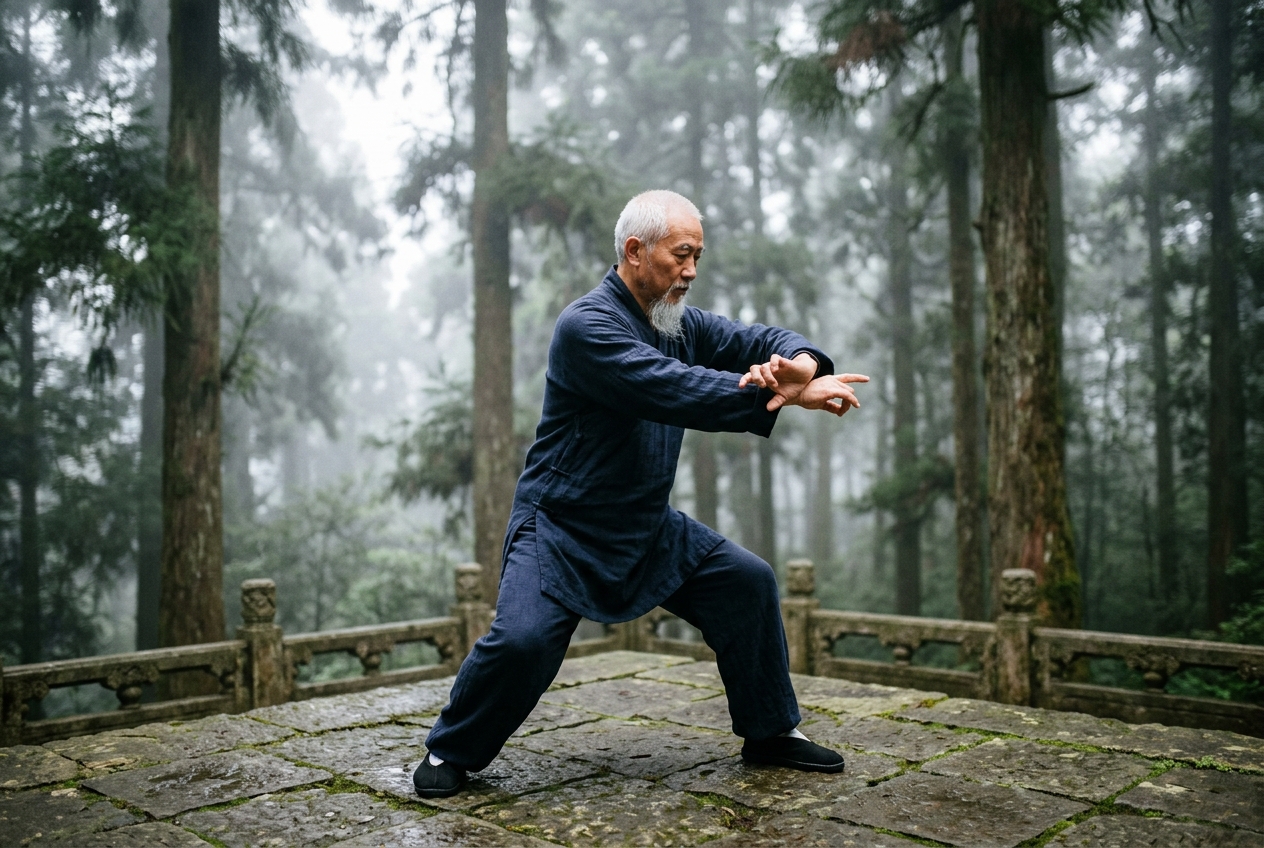
       [Baihui / Crown Suspended Upward]
                     |
           (Cervicothoracic Axis)
                     |
       [Thoracic Diaphragmatic Expansion]
                    / \
       [Chan Si: Helical Arm Spiral Outward]
                    \ /
       [Pelvic Diaphragm & Dantian Core]
                     |
             (Hip Kua Infolding)
                    / \
       [Chan Si: Helical Leg Vector Downward]
                    /   \
       [Yongquan / Bubbling Well Grounded]
1. Tian Zhuang (Heavenly Posture / 天庄): Axial Decompression and Thoracolumbar Opening
Tian Zhuang cultivates lightness, axial spinal elongation, and the expansion of the upper torso, establishing an upward vector that counteracts gravity's compressive forces on the intervertebral discs.
- Foundational Stance: Stand upright with feet parallel and hip-width apart. Shift your weight evenly across the tripod of each foot—the base of the big toe, the base of the little toe, and the calcaneus (heel).
- Ascending Vector: On a slow nasal inhalation of four counts, float both arms upward along the midline of the chest. As the hands pass the heart level, rotate the forearms externally so the palms face skyward above your head, fingers pointing toward one another across an open four-inch gap.
- The Micro-Spiral: Do not lock the elbows. Keep them softly bent and rotated slightly outward. Feel a subtle spiral unwinding from the pinky fingers down through the ulna, through the triceps, and anchoring into the lateral borders of the scapulae.
- Breath Coordination: Hold this suspended geometry for two calm breath cycles. Inhale into the lateral ribs and lower belly without elevating your clavicles. On each exhalation, actively relax the upper trapezius while maintaining the upward spatial reach of the crown point (Baihui, GV-20).
- Release: Slowly invert the palms on an exhalation, descending the hands along the central axis of the body back to your hips over six seconds. - Beginner Error & Correction: Elevating the shoulders toward the ears. Correct this by actively depressing and retracting the lower trapezius, imagining heavy weights drawing your shoulder blades downward toward your back pockets even as your palms reach upward. - Somatic Signpost: A sensation of cool length along the thoracic spine, followed by a warm flush cascading down the arms as the hands return to the resting position.
2. Di Zhuang (Earthly Posture / 地庄): Pelvic Grounding and Lower Abdominal Consolidation
Di Zhuang grounds the physiological center of mass, opens the inguinal creases (Kua), and strengthens the structural root through the soles of the feet.
- Foundational Stance: Step out to one-and-a-half shoulder widths. Subtly rotate the toes outward by no more than ten degrees.
- Sinking the Kua: On an exhalation, flex the hips and knees simultaneously, descending into a comfortable, moderate horse stance (Ma Bu). Ensure your knees track strictly in the direction of the second toes and never collapse inward past the arches.
- Embracing the Sphere: Bring both arms into a rounded embrace in front of the lower abdomen, as if holding a large, buoyant sphere between your palms and your navel. The elbows remain lower than the wrists, and the armpits remain hollowed, spacious enough to hold a small bird's egg without crushing it.
- The Rooting Vector: Direct your cognitive focus into the Yongquan acupoints (KI-1 / Bubbling Well), located in the depression formed when the foot is plantarflexed, just behind the balls of the feet. Grip the ground lightly with your toes, drawing arches upward while the sacrum drops vertically.
- Breath Dynamics: Practice slow, six-count lower belly breathing. Feel the lower abdomen expand anteriorly, laterally, and posterior-medially into the lumbar fascia on inhalation, and gently contract toward the spine on exhalation. - Beginner Error & Correction: Tucking the pelvis excessively or overarching the lower back. Correct by finding neutral pelvic tilt: imagine your pelvis is a basin of water that must not spill out from either the front rim or the rear rim. - Somatic Signpost: A distinct sensation of heaviness and magnetic anchoring in the legs, accompanied by a blooming warmth in the lower abdominal cavity.
3. Zhi Zhuang (Fingers Posture / 指庄): Terminal Fascial Vectoring and Jing-Well Activation
Zhi Zhuang focuses dynamic tension and micro-torsion into the distal extremities, engaging the fine intrinsic musculature and neurovascular bundles of the hands.
- Foundational Stance: Return to shoulder-width parallel stance with relaxed knees.
- Arm Projection: Inhale, bringing the elbows to the ribs and extending the hands forward at solar-plexus height, palms facing forward with fingers pointing straight up.
- Progressive Digit Articulation: Sequentially engage each digit from the little finger to the thumb. Spread the webbings between the fingers widely. Gently pull the thumb back toward the wrist while extending the index and middle fingers upward and slightly forward.
- Torsional Lineage: Without moving the wrists externally, project an energetic line through the center of the palms (Laogong, PC-8) while creating a counter-torsion along the radial and ulnar borders of the forearms. Maintain this active isometric extension for three full abdominal breaths.
- Relaxation: On an exhalation, soften the fingers sequentially from the thumb back to the pinky, allowing the hands to drape loosely and return to the sides. - Beginner Error & Correction: Hyper-extending the wrists and compressing the carpal tunnel. Correct by ensuring the wrist crease remains open and elongated, directing extension through the metacarpophalangeal joints rather than collapsing the wrist joint. - Somatic Signpost: Intense tingling, a buzzing, electric sensation, or a feeling of expansive fullness across the fingertips and periungual beds.
4. You Shen Zhuang (Swimming Body Posture / 游身庄): Helical Axial Rotation and Visceral Wringing
You Shen Zhuang articulates the entire spinal column through a three-dimensional serpentine wave, decompressing the intervertebral joints and massaging the internal organs.
- Foundational Stance: Stand with feet slightly wider than shoulder-width, knees buoyant.
- Helical Weight Shift: Shift 70% of your body weight onto the right leg, spiraling the right hip downward and inward into the right heel. As you do, allow the torso to rotate 45 degrees to the right.
- The Fluid Wave: Extend the left palm forward across the midline in an upward helical arc, turning the left palm upward while the right palm spirals downward and backward past the right hip.
- Transition: In a seamless, continuous motion, inhale as you transfer weight across the center to the left foot. Rotate the pelvis to the left, drawing the left hand back in a scooping curve while the right palm glides forward along the transverse plane.
- Rhythm: Move like an eel gliding through water—slow, unhurried, with the movement originating entirely from the pelvic girdle and lumbar-thoracic junction rather than the arms. Perform 12 continuous alternating cycles. - Beginner Error & Correction: Rotating the knees independently of the hips, causing torque on the meniscus. Correct by ensuring that the knee of the weighted leg remains aligned over the foot while the entire pelvis, spine, and shoulders turn as a unified kinetic unit. - Somatic Signpost: A deep, pleasant sense of releasing tension around the flank, lower ribs, and lumbar-sacral junction, accompanied by spontaneous salivation and digestive gurgling.
The Somatic Science: Fascia, Diaphragms, and Autonomic Regulation
Contemporary biomedical research validates the therapeutic mechanisms of Emei Shi Er Zhuang, translating classical paradigms into measurable physiological adaptations documented across databases indexed by the National Center for Biotechnology Information.
========================================================================================
             PHYSIOLOGICAL AND NEURO-VISCERAL ACTION MECHANISMS
========================================================================================
Practice Element       Biomedical Substrate             Clinical / Somatic Outcome
----------------------------------------------------------------------------------------
Helical Micro-Spirals  Myofascial Kinetic Chains        Enhanced interstitial fluid flow,
(Chan Si Jin)          (Tom Myers' Spiral Lines)        lysis of fascial densification.

Dual Diaphragmatic     Thoracic Diaphragm &             Optimized intra-abdominal pressure,
Pumping                Pelvic Floor Piston              mesenteric venous return.

Suboccipital / Axial   Vagus Nerve (CN X) &             Elevated Heart Rate Variability (HRV),
Suspension (Baihui)    Parasympathetic Nuclei           reduction in systemic cortisol.

Distal Digital         Jing-Well Microvascular Beds     Endothelial Nitric Oxide (eNOS) release,
Torsion (Zhi Zhuang)   & Cutaneous Mechanoreceptors     enhanced peripheral microcirculation.
========================================================================================
1. Helical Biomechanics and Fascial Tensegrity (Chan Si)
Classical Emei theory emphasizes Chan Si Jin (缠丝劲), or Silk-Reeling Force—a continuous, multi-planar helical torque generated through the limbs and spine. In anatomical terms, the human body does not operate as isolated linear lever systems, but as an integrated tensegrity matrix connected by myofascial lines, as detailed in contemporary connective tissue studies.
When an Emei practitioner executes a micro-spiral in Tian Zhuang or You Shen Zhuang, torsional stress travels along the Spiral Line, Superficial Front Line, and Deep Front Line. This rotational shearing mobilizes hyaluronic acid between fascial sheets, transitioning the extracellular matrix from a rigid, dehydrated gel state into a fluid, lubricated sol state. This process, known as fascial thixotropy, releases chronic contractures, reduces pain signaling from entrapped nociceptors, and enhances proprioception.
2. The Dual Diaphragmatic Pump and Visceral Hemodynamics
Normal shallow chest breathing utilizes only the superior rib cage, leaving the lower lobes of the lungs under-ventilated and the abdominal viscera stagnant. Emei Shi Er Zhuang utilizes a synchronized double-piston mechanic between the thoracic diaphragm and the pelvic diaphragm (levator ani and coccygeus).
During synchronized abdominal inhalation, the thoracic diaphragm descends while the pelvic floor gently relaxes and expands downward, creating a controlled increase in intra-abdominal pressure (IAP). During exhalation, the upward recoil of both diaphragmatic planes creates a rhythmic siphon effect. This hydraulic pumping action decompresses the inferior vena cava and portal vein, accelerates venous and lymphatic return from the lower extremities, and applies an internal visceral massage to the liver, spleen, and gastrointestinal tract—embodying the traditional concept of harmonizing the Zang-Fu organ systems.
3. Autonomic Regulation and Vagal Tone
By maintaining a sustained tongue-to-palate contact, lengthening the suboccipital region, and slowing the respiration rate to roughly four to six breaths per minute, Emei Qigong stimulates the parasympathetic nervous system. Slow, resonant breathing stimulates the pulmonary stretch receptors and carotid sinus baroreceptors, increasing afferent signaling along the vagus nerve (Cranial Nerve X).
As recognized in research highlighted by the World Health Organization Traditional Medicine Strategy, mind-body practices with controlled respiration downregulate the hypothalamic-pituitary-adrenal (HPA) axis, lower resting serum cortisol, increase Heart Rate Variability (HRV), and foster a homeostatic state conducive to cellular repair.
4. Jing-Well Acupoints and Microvascular Perfusion
In Zhi Zhuang, the extreme distal articulation of the fingers engages the Jing-Well (井穴) points situated at the corners of the nail beds—the anatomical origins and terminations of the Twelve Primary Meridians. These regions are rich in specialized capillary loops, glomus bodies, and high-density free nerve endings. Torsional stretch at the nail beds stimulates local endothelial nitric oxide synthase (eNOS), releasing nitric oxide to dilate microvascular beds. This explains why practitioners universally report intense thermal sensation and cutaneous tingling during and immediately after the finger postures.
The 800-Year Heritage: Mount Emei’s Daoist-Buddhist Alchemy
The origins of Emei Shi Er Zhuang trace back over eight centuries to the mist-shrouded summits of Mount Emei in Sichuan Province, one of China's Four Sacred Buddhist Mountains and a historic sanctuary for Daoist hermits.
+-----------------------------------------------------------------------------+
|              THE 800-YEAR LINEAGE OF EMEI SHI ER ZHUANG                      |
|                                                                             |
|   12th Century (Southern Song) : Master Bai Yun (白云禅师) creates system  |
|                                  at Mount Emei, fusing Daoist Neidan        |
|                                  with Chan Buddhist somatic mindfulness.    |
|                                                     |                       |
|   13th–19th Century            : Transmitted as an esoteric monastic health |
|                                  and longevity secret across monasteries.   |
|                                                     |                       |
|   20th Century (Modern Era)    : Lineage Holder Master Ju Shan (巨善)       |
|                                  transmits the complete curriculum to       |
|                                  Dr. Zhou Qianchuan (周潜川), transitioning |
|                                  monastic practice to clinical medicine.    |
+-----------------------------------------------------------------------------+
During the Southern Song Dynasty (1127–1279 CE), a revered master named Bai Yun (白云禅师 / Master White Cloud) synthesized Daoist internal alchemical practices (Neidan) with Chan (Zen) Buddhist somatic introspection. Daoist practitioners had spent centuries mapping the energetic anatomy of the human body, seeking longevity through the preservation of Jing (vital essence), the transformation of Qi (vital breath), and the refinement of Shen (spirit). Chan monks, meanwhile, brought rigorous methods of silent body awareness (Kayanupassana), observing physiological sensations without conceptual attachment.
Master Bai Yun recognized that cloistered monks frequently suffered from somatic stagnation, joint degeneration, and digestive decline due to prolonged periods of seated meditation. To remedy this, he engineered twelve dynamic and stationary somatic forms—the Twelve Postures—designed to be practiced within the footprint of a single meditation mat. Unlike externally aggressive martial systems, Emei Shi Er Zhuang was designed primarily as a curative, self-healing medical discipline.
For centuries, the practice remained an esoteric monastic treasure, handed down through a strict lineage of single-disciple transmissions within the temples of Mount Emei. In the mid-20th century, Grandmaster Ju Shan (巨善), a Buddhist monk and lineage guardian, passed the complete curriculum to Dr. Zhou Qianchuan (周潜川, 1907–1971), an accomplished medical doctor trained in both Western medicine and Traditional Chinese Medicine. Dr. Zhou recognized the urgent clinical value of this knowledge, systematizing the postures, documenting their physiological contraindications, and introducing Emei Shi Er Zhuang to the modern public and hospital wards across China. Today, the system is recognized by organizations such as the National Qigong Association and practitioners worldwide as a cornerstone of therapeutic medical Qigong.
Evidence-Based Clinical Medical Applications
Modern integrative clinics employ Emei Shi Er Zhuang as a low-impact, high-efficacy rehabilitation modality across a range of chronic disorders:
- Spinal Health and Chronic Lumbopelvic Pain: The combination of neutral pelvic tilting in Di Zhuang and rotational decompression in You Shen Zhuang strengthens the deep spinal stabilizers (multifidus, transversus abdominis) and decompresses the L4-S1 nerve roots, reducing non-specific chronic low back pain.
- Autonomic Dysregulation and Insomnia: Clinical protocols utilizing thirty minutes of evening practice emphasize the parasympathetic reset generated through slow Dantian respiration, significantly improving subjective sleep quality and objective polysomnographic metrics.
- Postural Kyphosis and Upper Crossed Syndrome: Tian Zhuang systematically reverses thoracic kyphosis and forward head posture by releasing hypertonic pectoralis minor muscles and activating the serratus anterior and rhomboids through appendicular spiraling.
- Peripheral Neuropathy and Circulatory Stagnation: Zhi Zhuang acts as a potent physical therapy exercise for microvascular circulation, reducing symptoms of Raynaud's phenomenon, diabetic peripheral numbness, and occupational repetitive strain injuries of the wrists and forearms.
Today’s Practice Commitment: The 10-Minute Morning Reset
To experience the physiological transformation of Emei Shi Er Zhuang firsthand, commit to this accessible, ten-minute routine tomorrow morning before consuming breakfast or caffeine.
- Minutes 0–2: Grounding and Diaphragmatic Priming - Stand with feet parallel, shoulder-width apart. Rest your hands over your lower belly. Inhale for four seconds, feeling the abdomen expand into your palms; exhale for six seconds, feeling your body sink softly into your heels.
- Minutes 2–5: Tian-Di Alignment (Heaven & Earth Integration) - Perform six slow cycles of Tian Zhuang, reaching upward with the palms on inhalation and sinking down into Di Zhuang on exhalation, holding each phase for two complete, calm breaths.
- Minutes 5–8: Zhi Zhuang Distal Spiral Activation - Extend the arms at chest level. Actively spread and articulate the fingers, holding the isometric micro-spiral for three minutes while maintaining smooth, quiet nasal breathing. Focus entirely on the tingling warmth building in your palms.
- Minutes 8–10: You Shen Zhuang Fluid Harmonization - Conclude with two minutes of slow, unbroken You Shen Zhuang swimming rotations, allowing the spine to loosen like a supple bamboo shoot in the wind.
After completing the final cycle, bring your hands together over your lower belly, step your feet together, close your eyes, and stand in absolute stillness for sixty seconds. Observe the sensation of warmth throughout your skin, the open clarity in your mind, and the grounded ease in your spine. This is the living legacy of Mount Emei: an ancient technology of the body, refined through centuries of contemplative observation, awakening your innate capacity for balance, vitality, and effortless physiological flow.