Dun Qiang Gong Wall Squatting Qigong: Lumbosacral Decompression, Mingmen Opening, and Cerebrospinal Fluid Hydrodynamics in Classical Neigong
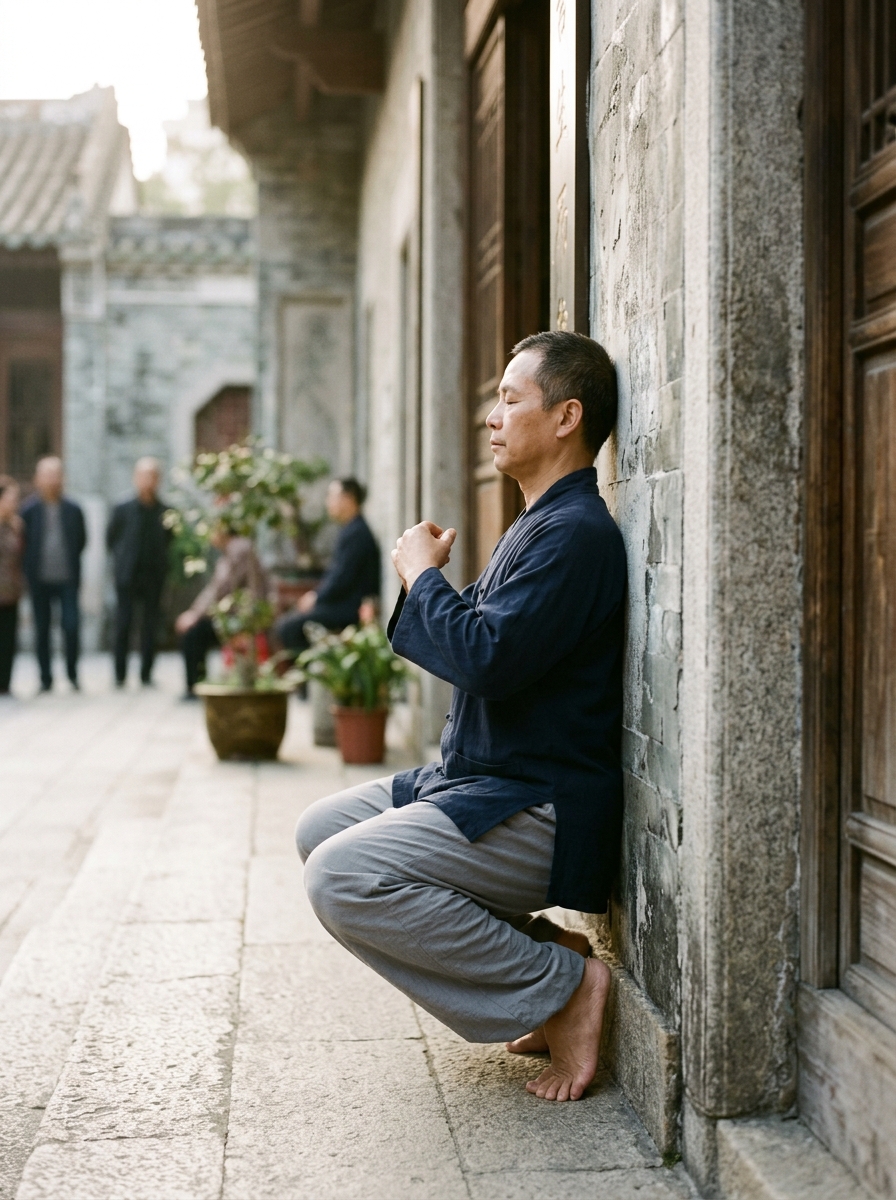
       WALL (Unyielding Plane)
         |
         |   (Head suspended via Baihui / Crown)
         |       O  <-- Chin tucked slightly; cervical spine lengthened
         |      /|\
         |     / | \
         |    (  |  ) <-- Torso forms uniform C-curve; Mingmen opens back
         |      ) (
         |     / | \
         |    /  |  \
         |   (   |   ) <-- Pelvis tucks under (posterior tilt); Kua folds
         |    \ / \ /
         |     |   |  <-- Knees track parallel over 2nd toe; no wall touch
         |    /     \
         |   |       | <-- Talocrural joint deep dorsiflexion; heels grounded
         |  [_]     [_]<-- Yongquan (bubbling spring) rooted to floor
         |
  [Baseboard]
Phase 1: Environmental Setup and Structural Alignment
- Surface Selection: Choose a clean, flat wall or smooth door completely free of baseboard obstructions, door handles, or abrasive textures. Perform the exercise barefoot or in thin, flat-soled minimalist shoes to maintain maximum tactile sensory feedback from the soles of your feet.
- Initial Stance Width: If you are a beginner or possess limited hip and ankle mobility, stand with your feet slightly wider than shoulder-width apart, with your toes placed approximately 15 to 20 centimeters (6 to 8 inches) away from the wall. As your mobility matures over weeks of practice, gradually narrow your feet and move your toes progressively closer. The ultimate, classical benchmark is standing with big toes and heels pressed flush together, with the tips of your toes directly touching the base of the wall.
- Plummeting the Center of Gravity: Distribute your body weight evenly across the "foot tripod"—the base of the big toe, the base of the little toe, and the center of the calcaneus (heel). Pay special attention to rooting through Yongquan (涌泉, Kidney 1), the energy point situated in the depression of the anterior third of the sole.
Phase 2: The Kinematic Descent (Sinking the Yao)
- Suspension of the Crown: Gently draw the chin inward to lengthen the back of the neck, imagining the vertex of your skull—Baihui (百会, Governor Vessel 20)—is suspended from above by a fine silk cord. This creates immediate axial elongation through the cervical vertebrae.
- Initiation at the Kua: Do not begin the movement by pushing the knees forward. Instead, initiate the descent by folding deeply at the Kua (the inguinal creases of the hips) and drawing the lower abdomen subtly inward.
- Posterior Pelvic Tuck: As you begin to sink, tuck your tailbone downward and forward as if curling a heavy tail between your legs. This induces a posterior pelvic tilt that flattens and broadens the lumbar spine, pushing the Mingmen (命门, "Gate of Life," located between the second and third lumbar vertebrae) outward into a gentle convex curve.
- Breath Coordination on Descent: Inhale slowly, softly, and deeply through your nose, guiding the breath down past the chest into the lower Dantian (the bio-energetic center located roughly two inches below your navel and three inches inward). Allow the intra-abdominal pressure to gently expand the lower back 360 degrees.
- Tracking the Wall: Descend smoothly along the vertical plane. Keep your knees traveling strictly parallel, tracking directly over your second and third toes. Ensure your nose, forehead, and knees remain a fraction of an inch away from the surface without actually grazing the wall. Descend until your thighs compress fully against your calves in a complete, resting deep squat.
Phase 3: The Ascending Return (Uncoiling the Central Axis)
- Rooted Drive: From the bottom of the squat, do not bounce. Anchor your awareness down into the soles of your feet. Press firmly through the floor as if pushing the earth away.
- Perineal Engagement: Subtly engage and lift Huiyin (会阴, Conception Vessel 1 / the perineum) upward toward the navel. This light pelvic floor activation stabilizes the sacrum and prevents compensatory pelvic flare.
- Vertebral Unrolling: Rise smoothly upward, leading the ascent with the crown of your head (Baihui). Imagine your spine unrolling vertebra by vertebra from the coccyx through the sacrum, lumbar, thoracic, and cervical segments.
- Exhalation on Ascent: Exhale smoothly and continuously through your nose or slightly parted lips, maintaining a relaxed jaw, soft throat, and relaxed shoulders throughout the entire upward drive.
- Top Reset: Return to the full standing position, fully extending the hips and knees without hyperextending them. Pause for one complete resting breath cycle before initiating the next repetition.
| Biomechanical Fault | Somatic Manifestation | Underlying Pathology | Somatic Cue & Correction |
|---|---|---|---|
| Knee Shear & Wall Banging | Knees push forward into the wall within first 20% of descent. | Quadriceps dominance; failure to fold at the inguinal creases (Kua). | "Hinge back at the hip creases first; imagine sitting back into water." |
| Cervical Hyperextension | Head tilts backward, gaze looks up, forehead slams into wall. | Tight thoracic spine; fear response; loss of deep neck flexor control. | "Tuck the chin softly; stretch the crown of the head up like a rising lantern." |
| Lumbar Lordotic Collapse | Lower back arches inward; tailbone flares outward behind. | Overactive hip flexors; dormant abdominal wall; tight thoracolumbar fascia. | "Tuck the tailbone under; breathe into the small of the back to push Mingmen out." |
| Heel Lift (Ankle Shear) | Heels peel off the floor; weight shifts exclusively to toes. | Severely restricted talocrural dorsiflexion; tight Achilles complex. | "Regress stance distance 2 inches; drive through the three points of the foot." |
| Valsalva Breath Straining | Holding breath on descent; bearing down with elevated blood pressure. | Autonomic threat response; lack of core-diaphragmatic integration. | "Maintain a smooth, whispered nasal breath; let the belly expand like a soft sponge." |
Sensory Milestones: What You Will Feel
During your initial sessions, you will likely encounter intense muscular burning in the tibialis anterior, gluteus medius, and deep spinal erectors. Within two to three weeks of consistent practice, however, these gross muscular sensations give way to deeper neuro-fascial and energetic responses. Practitioners routinely report a distinctive sensation of radiant heat pooling in the lumbar spine around the Mingmen area, accompanied by a fine, tingling warmth cascading up the spine toward the crown of the head.
As the lumbosacral junction opens, a profound sense of mechanical decompression occurs, often described as a feeling of "floating weightlessness" in the upper torso anchored by a dense, grounded heaviness in the legs and pelvic basin.
Why It Works: The Neuro-Fascial, Axial, and Fluid Science
While classical texts describe Dun Qiang Gong through the poetry of internal energy cultivation, modern sports science, biomechanics, and clinical neurobiology offer an equally compelling validation of its transformative efficacy.
       [ Cranium / Suboccipital Subarachnoid Space ]
                            | ^
                            | |  Cerebrospinal Fluid (CSF) Pulse
                            v |  Hydrodynamic Oscillation
      [ Cervical & Thoracic Dural Tube Elongation ]
                            | ^
                            | |  Intervertebral Foramen Opening
                            v |  Negative Intradiscal Pressure
        [ Lumbar C-Curve & Mingmen Outward Expansion ]
                            | ^
                            | |  Thoracolumbar Fascial Stretch
                            v |  Mesenteric-Vagal Nerve Activation
      [ Sacral Nutation / Counter-Nutation Hydraulic Pump ]
1. Intervertebral Foramen Decompression and Disc Imbibition
In standard human standing posture, the lumbar spine maintains a lordotic (inward) curvature that places continuous compressive loads on the posterior elements of the intervertebral discs and narrows the intervertebral foramina—the anatomical exit canals for spinal nerve roots. During Dun Qiang Gong, the mandatory verticality imposed by the wall forces the lumbar spine into a uniform, gentle C-curve flexion.
According to biomechanical research documented in PubMed Central and index publications on NCBI PubMed, controlled non-loaded flexion of the lumbar spine significantly increases the cross-sectional area of the intervertebral foramina and central spinal canal. This transient decompression relieves mechanical impingement on exiting lumbar and sacral spinal nerves, enhances microvascular perfusion to compressed nerve roots, and stimulates the process of disc imbibition—the drawing of nutrient-rich fluid into the avascular cartilaginous matrix of the intervertebral discs via cyclical changes in hydrostatic pressure.
2. The Sacral Hydraulic Pump and Craniosacral Fluid Hydrodynamics
The central nervous system is bathed in a continuous tidal rhythm of cerebrospinal fluid (CSF), an extracellular fluid produced within the cerebral ventricles that circulates through the subarachnoid space surrounding the brain and spinal cord. The movement of CSF is driven not only by arterial pulsations and respiratory excursions, but also by the micro-motion of the sacrum relative to the iliac bones—a physiological mechanism known in osteopathic medicine as the craniosacral mechanism or the "sacral pump."
During the deep descent of the wall squat, the sacrum undergoes pronounced nutation and counter-nutation against the unyielding axial column. This rhythmic articulation acts as a powerful mechanical bellows. Coupled with the synchronous elevation of the pelvic diaphragm (Huiyin) on ascent, Dun Qiang Gong generates rhythmic hydrostatic pressure waves that facilitate CSF clearance and circulation along the entire dural sheath. This augmented fluid exchange optimizes metabolic waste clearance from the spinal cord parenchymal tissue via the newly discovered spinal glymphatic pathway.
+-----------------------------------------------------------------------------------+
|                        SOMATIC CLINICAL PROOF: AXIAL DYNAMICS                     |
|                                                                                   |
|  Kinematic Parameter        Standard Squat           Dun Qiang Gong (Wall Squat)  |
|  -------------------------------------------------------------------------------  |
|  Trunk Forward Lean         35° - 55° (Hip Shear)    0° - 3° (True Vertical)      |
|  Lumbar Curvature           Lordotic / Hyperextended Uniform Convex C-Curve       |
|  Intervertebral Foramina    Compressed Posteriorly   Decompressed & Expanded      |
|  Talocrural Dorsiflexion    20° - 30°                40° - 55° (Deep Closed-Chain)|
|  Dural Sheath Tension       Segmental Shear Strain   Uniform Longitudinal Glide   |
+-----------------------------------------------------------------------------------+
3. Myofascial Continuity and Longitudinal Dural Glide
In the structural anatomy paradigm popularized by Thomas Myers' Anatomy Trains, the human body operates through integrated lines of tension rather than isolated muscles. The wall squat applies an uncompromising, head-to-toe tensile stretch across the entire Superficial Back Line (SBL)—a continuous myofascial chain running from the plantar fascia and gastrocnemius, up through the hamstrings, sacrotuberous ligament, thoracolumbar fascia, erector spinae, and epicranial aponeurosis to the brow ridge.
Simultaneously, the inward folding of the Kua and engagement of the pelvic floor stimulates the Deep Front Line (DFL)—the body's core stabilizing myofascial axis encompassing the deep flexor digitorum longus, posterior tibial compartment, adductor group, psoas major, iliacus, respiratory diaphragm, and deep cervical flexors. By elongating the hypertonic posterior line while engaging the deep anterior core, wall squatting normalizes fascial tensegrity across the pelvis and spine.
Furthermore, because the dura mater is firmly anchored to the foramen magnum, C2–C3, and the second sacral segment (S2), the continuous lengthening of the axial skeleton provides a therapeutic mechanical flossing (neural mobilization) of the spinal cord within the vertebral canal.
4. Vagal Autonomic Entrainment and Baroreflex Modulation
Chronic lumbopelvic stiffness is frequently linked with heightened sympathetic nervous system arousal. When the lower spine is locked in hyper-lordosis, the abdominal viscera are chronically compressed and the diaphragm is mechanically restricted.
Dun Qiang Gong counters this dysregulation through deep diaphragmatic respiration combined with cyclical intra-abdominal pressure modulation. As the abdomen softly compresses against the thighs at the bottom of the squat, the mesenteric vascular bed is gently pressurized, stimulating mechanoreceptors and mesenteric-vagal sensory afferents.
Upon ascending, this pressure releases, generating a rebound vasodilatory response that activates the parasympathetic division of the autonomic nervous system via the vagus nerve. Clinical trials registered with the World Health Organization Traditional Medicine portal and the National Qigong Association consistently demonstrate that sustained mind-body practices emphasizing low-frequency rhythmic breathing and pelvic stability produce substantial improvements in Heart Rate Variability (HRV), reduce systemic serum cortisol, and restore balanced autonomic tone.
Classical Lineage and Internal Energetics: Unlocking the Gate of Life
To fully appreciate Dun Qiang Gong, one must understand its historical origins as one of the most closely guarded internal training secrets in Chinese martial traditions.
       [ Baihui (GV20) - Crown of Head / Suspended Upward ]
                               ^
                               |
               DU MAI (Governing Vessel Channel)
               Yang Qi Ascent Along Posterior Spine
                               |
       [ Mingmen (GV4) - Gate of Life / Pushed Outward ]
                               |
       [ Lower Dantian - Bio-Energetic Reservoir ]
                               |
               REN MAI (Conception Vessel Channel)
               Yin Cooling Descending Anterior Midline
                               |
       [ Huiyin (CV1) - Perineum / Lifted & Sealed Upward ]
The Secret of the Martial Neigong Lineages
For centuries across northern China, masters of internal martial arts—such as Taijiquan (太极拳), Baguazhang (八卦掌), and Xingyiquan (形意拳)—faced a universal pedagogical challenge: how to rapidly transform the stiff, fragmented structural frame of a student into a unified, fluid conduit for internal power (Jin, 劲).
The primary physical obstacle was always the Yao (腰)—the lumbar-pelvic girdle. In classical Chinese somatic theory, the Yao is considered the commander of all bodily movement. If the Yao is rigid, disconnected, or lordotic, internal power cannot transfer from the ground through the legs into the upper limbs.
To solve this, masters subjected disciples to secret wall squatting drills (Zhan Zhuang and Dun Qiang). Because the wall instantly exposes any forward tilt or torque, students were forced to release the habitual grip of the lumbar erectors and surrender the pelvis downward. It was said that once a disciple could perform 100 consecutive wall squats with their toes touching the baseboard without touching the wall, their Yao was "loosened" (Song Yao, 松腰), transforming their entire spine into an elastic energetic whip.
Dr. Pang Ming and the Zhineng Qigong Revolution
During the late 1970s and 1980s, Dr. Pang Ming—a grandmaster of both Western allopathic medicine and Traditional Chinese Medicine—synthesized classical Daoist, Buddhist, and martial Neigong traditions into Zhineng Qigong (Intelligent Qigong). Dr. Pang demystified the secretive practices of ancient lineages, making high-level somatic technologies accessible to the broader public for health restoration and self-regulation.
At the renowned Huaxia Zhineng Qigong Center (often referred to globally as the "medicineless hospital" in Hebei Province), Dun Qiang Gong was instituted as a foundational therapeutic prescription. Thousands of individuals struggling with degenerative spinal diseases, chronic disc herniations, hypertension, and metabolic stagnation gathered in large training halls to practice wall squatting daily.
Dr. Pang taught that Dun Qiang Gong is the single fastest and most effective vehicle for "opening the Mingmen." In Chinese medical philosophy, Mingmen (命门, Governor Vessel 4) is the biological furnace and storehouse of Congenital Essence (Yuan Qi). In typical adults, the Mingmen point is energetically constricted by chronic lumbar lordosis. By tucking the tailbone and rounding the lower back against the wall, the Mingmen space physically widens and blossoms outward, allowing the body's foundational vitality to circulate unhindered.
Energetic Circuitry: Huiyin, Mingmen, and the Du Mai
When performed with mental presence and breath integration, Dun Qiang Gong activates the classic Microcosmic Orbit (Xiao Zhou Tian, 小周天) energetic circuit:
- The Root Seal (Huiyin): Lifting the perineum seals the bottom of the central energy reservoir, preventing the downward leakage of vital force.
- The Ignition (Mingmen): Flattening the lumbar spine creates an energetic pump at GV4, transforming stored lower-abdominal essence into active Yang Qi.
- The Ascent (Du Mai): As the practitioner rises from the squat, the mobilized Yang Qi travels upward along the Governing Vessel (Du Mai), ascending through the dorsal spine, passing through the cranial base (Yuzhen, Jade Pillow), and nourishing the brain (Sea of Marrow).
- The Descent (Ren Mai): Upon reaching the upper palate, the subtle energy cascades down the anterior centerline along the Conception Vessel (Ren Mai), returning to settle into the warm, tranquil reservoir of the Lower Dantian.
Progressive Pedagogical Strategies: From Beginner to Advanced
Attempting to perform Dun Qiang Gong with toes touching the wall on day one is a recipe for frustration and compensatory strain. Progress through these four pedagogical stages systematically. Spend at least one to two weeks at each tier before advancing.
LEVEL 1: Assisted Pole / Doorframe Squat (Building Pelvic Tuck & Hip Hinge)
   |
   v
LEVEL 2: Wide Stance Wall Squat (Feet Shoulder-Width, Toes 15-20cm Away)
   |
   v
LEVEL 3: Narrow Stance Close Wall Squat (Feet Hip-Width, Toes 3-5cm Away)
   |
   v
LEVEL 4: Classical Closed-Stance Dun Qiang Gong (Feet Together, Toes Flush at Baseboard)
Level 1: The Doorframe-Assisted Squat (Neutralizing Fear and Building Mobility)
- Position: Stand in an open doorway, holding lightly onto the doorframe at chest height with both hands. Feet are shoulder-width apart, parallel.
- Action: Use the doorframe to support your body weight while you practice the posterior pelvic tuck and deep hip fold (Kua), descending into a full deep squat with a completely vertical torso.
- Focus: Eliminating the fear of falling backward and re-educating the ankles to achieve maximum closed-chain dorsiflexion without lifting the heels.
- Target: 3 sets of 15 smooth, unhurried repetitions.
Level 2: The Shoulder-Width Wall Squat (Establishing the Wall Relationship)
- Position: Stand facing a flat wall. Feet shoulder-width apart, toes pointing straight ahead, positioned 15 to 20 cm (6 to 8 inches) away from the wall surface.
- Action: Place your hands behind your back, resting the back of your palms against your lumbar spine (Mingmen). Descend slowly, focusing on feeling the lower back broaden against your hands as you sink downward.
- Focus: Keeping the knees traveling strictly forward without letting them flare outward or touch the drywall.
- Target: 3 sets of 20 repetitions with relaxed, continuous nasal breathing.
Level 3: The Narrow-Stance Close Wall Squat (Integrating the Central Axis)
- Position: Stand facing the wall with feet hip-width apart. Position toes 3 to 5 cm (1 to 2 inches) from the wall.
- Action: Allow arms to hang loosely at your sides. Inhale as you descend, tucking the coccyx downward; exhale as you press through the earth and unroll your spine to stand.
- Focus: Uniting the movement of the crown (Baihui) with the lift of the pelvic floor (Huiyin).
- Target: 50 continuous repetitions without pause.
Level 4: Classical Flush Dun Qiang Gong (Complete Master-Level Somatic Integration)
- Position: Stand facing the wall with big toes, medial malleoli (inner ankle bones), and knees pressed completely flush together. The tips of your toes are placed directly in contact with the base of the wall.
- Action: Descend into the full squat and rise smoothly. The nose, forehead, and knees skim within millimeters of the wall surface throughout the entire arc of motion, neither touching the wall nor falling backward.
- Focus: Complete internal stillness, effortless structural tensegrity, and uninterrupted fluid circulation up the Du Mai channel.
- Target: 100 continuous, meditative repetitions performed in a single, unbroken session.
Therapeutic Applications: Restoring the Modern Somatosensory Frame
In a modern society dominated by prolonged sedentary behavior, screen-induced forward-head posture, and chronic sympathetic stress, Dun Qiang Gong serves as an exceptional corrective protocol.
+-----------------------------------------------------------------------------------+
|                        THERAPEUTIC CORRECTION MATRIX                              |
|                                                                                   |
|  Modern Dysfunctional Pattern       Dun Qiang Gong Corrective Mechanism           |
|  -------------------------------------------------------------------------------  |
|  Sedentary Lower-Back Compression   Non-loaded cyclic intervertebral decompression|
|  Gluteal Amnesia / Hip Stiffness    Deep Kua folding and eccentric glute activation|
|  Upper-Crossed Syndrome / Tech Neck Suspended Baihui lengthening deep neck flexors|
|  Restricted Shallow Chest Breathing Forced 360° intra-abdominal Dantian respiration|
|  Autonomic Sympathetic Dominance    Vagally-mediated baroreflex entrainment via    |
|                                     rhythmic intra-abdominal pressure cycles      |
+-----------------------------------------------------------------------------------+
- Reversing Sedentary Gluteal Amnesia and Pelvic Tilt: Prolonged sitting locks the iliopsoas in a shortened state, leading to anterior pelvic tilt and inactive gluteal musculature. Dun Qiang Gong restores eccentric control and functional length to the deep hip rotators and psoas complex while reactivating the gluteus maximus through full-range closed-chain extension.
- Decompressing the Thoracolumbar Junction: Sitting in front of workstations collapses the thoracic cage into the lumbar basin. The upward suspension of the crown (Baihui) coupled with the downward sink of the tailbone creates opposing directional tensile forces that decompress the thoracolumbar junction (T12–L1), alleviating a primary source of chronic back pain.
- Restoring Intrinsic Ankle and Foot Mobility: Shoes with elevated heels and rigid soles impair natural talocrural mechanics. The severe dorsiflexion demanded by the wall squat stretches the gastrocnemius, soleus, and Achilles tendon while strengthening the intrinsic arches of the feet and mobilizing the subtalar joint.
Today’s Practice Commitment: The 14-Day Morning Protocol
To transition from intellectual understanding to authentic somatic transformation, commit to the following structured 14-day introductory protocol.
+-----------------------------------------------------------------------------------+
|                   14-DAY DUN QIANG GONG INTRODUCTORY PROTOCOL                     |
|                                                                                   |
|  Days 1 – 3:    15 Repetitions at Level 1 (Doorframe-Assisted Squat)             |
|  Days 4 – 7:    20 Repetitions at Level 2 (Wall Squat, Toes 15 cm Away)           |
|  Days 8 – 10:   30 Repetitions at Level 2 (Wall Squat, Toes 10 cm Away)           |
|  Days 11 – 14:  40 Repetitions at Level 3 (Wall Squat, Toes 5 cm Away)            |
+-----------------------------------------------------------------------------------+
Protocol Instructions:
- Timing: Perform your practice first thing each morning, prior to consuming caffeine or breakfast, immediately after drinking a glass of warm water.
- Environment: Stand before a clear, uncluttered wall in a quiet, well-ventilated room.
- Execution: Perform your designated daily repetitions smoothly and continuously. Do not rush. Each full repetition (descent and ascent) should take approximately 4 to 6 seconds.
- Post-Practice Integration: Upon finishing your final repetition, step 1 foot away from the wall, stand with feet shoulder-width apart, place both palms softly over your lower navel (Lower Dantian—men with left hand over right, women with right hand over left), close your eyes, and remain in quiet stillness for two minutes. Feel the warmth circulating through your lower back and legs.
By yielding your body’s compensatory habits to the strict, objective honesty of the wall, you systematically release deep-seated tension, open your spine to its natural structural integrity, and awaken a resilient, grounded vitality that endures throughout your day.