Shi Er Jing Bie Twelve Divergent Meridians: Deep Visceral Ingress, Cranio-Cervical Confluence, and Latent Pathogen Clearance in Classical Daoyin
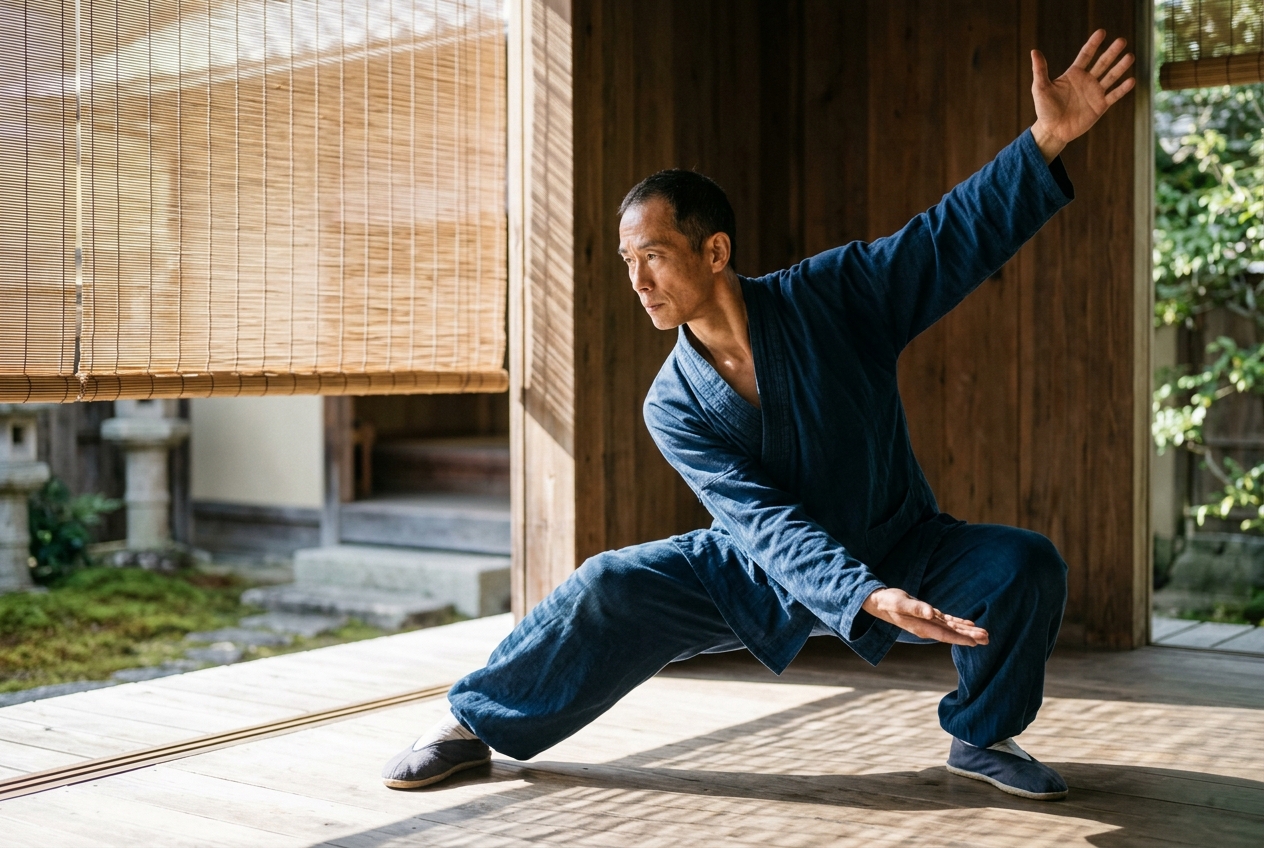
1. Foundation: The Wuji Stance and Lower Visceral Ingress
- Starting Position: Stand with feet parallel, hip-width apart. Drop your tailbone slightly as if sitting on the edge of a tall stool, allowing the lumbar curve to gently flatten. Rest your palms over your lower abdomen—the Lower Dantian, located approximately two inches beneath your navel and two inches inward.
- Movement Sequence: Inhale smoothly through the nose over a four-second count, expanding the pelvic floor, the lower abdominal wall, and the lower back simultaneously. Feel the intra-abdominal pressure build like a soft, expanding sphere. Exhale over a six-second count, drawing the lower abdomen gently toward the spine while visualizing warmth sinking deep into the pelvic bowl.
- Key Mechanics: Maintain an upright spine without rigid military posture. The crown of the head should feel suspended from above by a fine silk thread, creating decompression across all twenty-four articulating vertebrae.
2. The Coxofemoral Spiral (Opening the Lower Divergent Channels)
- Target Pathways: The Divergent channels of the Bladder/Kidney (First Confluence), Gallbladder/Liver (Second Confluence), and Stomach/Spleen (Third Confluence).
- Movement Sequence: Shift eighty percent of your body weight onto your left leg. Keeping your pelvis level, initiate a slow, continuous figure-eight spiral through the right hip joint (Kua). Rotate the femur inward, glide it backward along the arc of the acetabular cup, open it laterally, and sweep it forward. Synchronize this rotation with the breath: inhale as the hip rotates out and opens; exhale as it wraps inward and descends. Perform eight continuous, fluid loops, then switch weight to the right leg and repeat on the left hip.
- Sensations to Monitor: You should feel a deep, spreading warmth within the inguinal crease, a sensation of hydraulic suction within the pelvic basin, and an easing of tension across the sacroiliac joint.
3. Scapulothoracic and Glenohumeral Articular Pumping (Opening the Upper Divergent Channels)
- Target Pathways: The Divergent channels of the Small Intestine/Heart (Fourth Confluence), Large Intestine/Lung (Fifth Confluence), and Triple Burner/Pericardium (Sixth Confluence).
- Movement Sequence: Extend both arms laterally at shoulder height with palms facing the floor. Begin a corkscrew spiral starting from the tips of the fingers: internally rotate your thumbs downward and backward, causing the forearms to pronate, the humerus to twist inward, the clavicles to depress, and the shoulder blades to widen broadly across the ribcage as you exhale. On the inhalation, reverse the dynamic: turn the thumbs upward and backward, supinating the forearms, externally rotating the shoulder heads, lifting the sternum gently, and drawing the inferior angles of the scapulae down toward the spine. Perform twelve continuous, unbroken cycles.
- Sensations to Monitor: Look for tingling in the fingertips, a distinct release of pressure behind the sternum, and an opening sensation through the thoracic outlet and armpits.
4. The Cranio-Cervical Uncoiling (Emergence and Convergence at the Occiput)
- Target Pathways: The Emergence (Chu) and Convergence (He) zones at the sub-occipital margin (Tianzhu BL-10, Fengchi GB-20) and vertex (Baihui GV-20).
- Movement Sequence: Rest your hands at your sides. Drop the chin slightly toward the sternum to lengthen the back of the neck. Begin an infinitesimal, micro-elliptical rotation at the atlanto-occipital joint (the precise junction where the skull rests on the first cervical vertebra, C1/Atlas). Imagine tracing a horizontal coin with the crown of your head. Do not roll the entire neck loosely; isolate the rotation to the top one inch of the spine. Inhale as the crown arcs forward and across; exhale as it rounds the rear half of the ellipse. Complete nine cycles clockwise and nine counterclockwise.
- Sensations to Monitor: A profound feeling of lightness in the cranium, involuntary micro-swallowing, increased salivation, and a spontaneous clearing or sharpening of peripheral vision.
| Movement Phase | Anatomical Target | Meridian Confluence | Physiological Action |
|---|---|---|---|
| Pelvic & Hip Spiral | Acetabulofemoral & Sacroiliac Joints | 1st, 2nd, & 3rd Confluences (Leg Channels) | Hydraulic pumping of deep pelvic fascia & lymph nodes |
| Glenohumeral Wringing | Scapulothoracic & Thoracic Inlet | 4th, 5th, & 6th Confluences (Arm Channels) | Decompression of brachial plexus & endothoracic fascia |
| Atlanto-Occipital Glide | C0–C1 Craniovertebral Junction | Convergence Zones (He) on Head & Face | Stimulation of sub-occipital venous plexus & vagus nerve |
Common Practitioner Errors and Corrections
- Error: Forcing articular range of motion by jamming the joints into end-range lock.
- Correction: Work within sixty to seventy percent of your maximum joint range. The Divergent channels respond to gentle, cyclical shearing and oscillatory pumping, not aggressive stretching.
- Error: Chest-dominant, shallow thoracic breathing.
- Correction: Re-anchor attention into the pelvic floor. Ensure the ribcage expands circumferentially (three-dimensionally) rather than elevating toward the ears.
- Error: Hyperextending the knees during hip spirals.
- Correction: Maintain a continuous micro-bend in both knees throughout the sequence to keep the myofascial lines along the legs loaded and receptive to torsion.
Why It Works: The Modern Biomechanical and Neurovascular Science
While ancient scholars articulated these phenomena through the lens of elemental energetics and channel networks, contemporary anatomical science illuminates the precise physical architecture underlying the Divergent Meridians. The primary pathways of traditional acupuncture correspond closely to the superficial fascial planes described in modern myofascial continuity models. In contrast, the Twelve Divergent Meridians map with extraordinary fidelity to the deep continuous fascial network—specifically the prevertebral, endothoracic, and transversalis fascia—and their intimate interfaces with deep articular capsules and neurovascular bundles.
Fascial Biotensegrity and Visceral Organ Suspension
In contemporary biomechanics, the body is understood not as a stack of compression-bearing bones, but as a continuous tension network governed by fascial tensegrity. Within this tensegrity matrix, every internal organ is tethered to the musculoskeletal framework by connective tissue ligaments: the pericardium is anchored to the sternum and diaphragm via the sternopericardial and phrenopericardial ligaments; the liver is suspended by the falciform and coronary ligaments; the kidneys glide within the fibro-adipose renal fascia.
When you execute three-dimensional corkscrew rotations of the limbs and spine, you generate microvacuolar shearing forces throughout the interstitial connective tissue. This mechanical shearing triggers a process known as mechanotransduction, wherein physical deformation of the extracellular matrix causes cellular fibroblasts to remodel collagen, alter ground substance viscosity from a stagnant "gel" to a fluid "sol" state, and stimulate the release of anti-inflammatory cytokines. This modern mechanism mirrors the classical description of Divergent channels entering the deep interior (Ru) to regulate the internal organs.
Joint Capsule Sequestration and Lymphatic Clearance
One of the most profound physiological parallels to the Divergent Meridian theory is the mechanism of pathogen latency. When the body encounters chronic low-grade inflammation, metabolic byproducts, or sustained psychological distress that the systemic immune system cannot immediately neutralize, it sequesters inflammatory mediators (such as C-reactive protein, Interleukin-6, and substance P) within avascular and low-circulation tissues—primarily the deep articular joint capsules, fibrocartilage, and adjacent deep fascial planes.
Because synovial joint capsules and deep interfascial spaces lack direct arterial capillaries, they rely almost entirely on physical movement and fluctuating intra-articular pressure to circulate fluid. The oscillatory compressions of Daoyin act as an articular pump. By rhythmically altering synovial fluid pressure, these exercises flush stagnant interstitial fluids into the deep lymphatic vessels located near the neurovascular bundles at the joints, facilitating metabolic waste clearance and tissue renewal.
Autonomic Regulation and the Vagal Nerve Axis
The classical trajectory of the Divergent channels culminates in an emergence at the sub-occipital margin and a convergence at the head and sensory apertures. Anatomically, this sub-occipital and cervicothoracic gateway represents the densest concentration of proprioceptors and autonomic nerve junctions in the human body.
The atlanto-occipital and upper cervical articulations house the sub-occipital triangle, through which the vertebral artery and the suboccipital nerve pass, positioned immediately adjacent to the exit of the glossopharyngeal (CN IX), vagus (CN X), and accessory (CN XI) cranial nerves at the jugular foramen. Precise micro-movements at the atlanto-occipital junction relieve mechanical compression on the vagus nerve sheath. This action stimulates parasympathetic tone, regulates heart rate variability, modulates the celiac and hypogastric neural plexuses across the deep viscera, and promotes restorative autonomic balance, as documented in biomedical research published by the National Center for Biotechnology Information (NCBI PubMed).
Classical Lineage: The Ling Shu and the Architecture of Latency
The canonical theoretical foundation for the Twelve Divergent Meridians is recorded in Chapter 11 of the Huangdi Neijing Lingshu (The Yellow Emperor’s Inner Classic: Spiritual Pivot), compiled during the Han Dynasty (206 BCE – 220 CE). This seminal medical treatise introduced the Divergent channels as an advanced physiological network responsible for safeguarding the core visceral organs (Zang-Fu) from deep constitutional injury.
+===========================================================================+
|                     THE SIX DIVERGENT CONFLUENCES (LIU HE)                |
+===========================================================================+
| 1st Confluence: Bladder (Taiyang) & Kidney (Shaoyin)                      |
|    - Articular Divergence: Popliteal Fossa & Inguinal Base                |
|    - Deep Interior Ingress: Kidneys, Bladder, Lumbar Spine, Heart         |
|    - Cranial Convergence: Sub-occipital Margin (*Tianzhu* BL-10)          |
+---------------------------------------------------------------------------+
| 2nd Confluence: Gallbladder (Shaoyang) & Liver (Jueyin)                   |
|    - Articular Divergence: Coxofemoral Hip Capsule & Pelvic Brim          |
|    - Deep Interior Ingress: Liver, Gallbladder, Diaphragm, Heart Core     |
|    - Cranial Convergence: Lateral Canthus (*Tongziliao* GB-1)             |
+---------------------------------------------------------------------------+
| 3rd Confluence: Stomach (Yangming) & Spleen (Taiyin)                      |
|    - Articular Divergence: Anterior Hip Crease & Femoral Triangle         |
|    - Deep Interior Ingress: Spleen, Stomach, Cardiopulmonary Basin        |
|    - Cranial Convergence: Intra-orbital Margin (*Chengqi* ST-1)           |
+---------------------------------------------------------------------------+
| 4th Confluence: Small Intestine (Taiyang) & Heart (Shaoyin)               |
|    - Articular Divergence: Axillary Fossa & Scapular Border               |
|    - Deep Interior Ingress: Heart Organ, Small Intestine, Chest Core      |
|    - Cranial Convergence: Inner Canthus (*Jingming* BL-1)                 |
+---------------------------------------------------------------------------+
| 5th Confluence: Large Intestine (Yangming) & Lung (Taiyin)                |
|    - Articular Divergence: Glenohumeral Joint & Clavicular Space          |
|    - Deep Interior Ingress: Lungs, Large Intestine, Thoracic Viscera      |
|    - Cranial Convergence: Supraclavicular Fossa & Lateral Ala Nasi        |
+---------------------------------------------------------------------------+
| 6th Confluence: Sanjiao (Shaoyang) & Pericardium (Jueyin)                 |
|    - Articular Divergence: Acromioclavicular Joint & Axilla               |
|    - Deep Interior Ingress: Triple Burner Cavities & Pericardium Core     |
|    - Cranial Convergence: Retro-auricular Region (*Yifeng* SJ-17)         |
+===========================================================================+
The Four Classical Trajectory Phases: Li, Ru, Chu, He
In the taxonomy of the Lingshu, every Divergent channel follows a rigorous four-stage journey: 1. Divergence (Li 離): The channel separates from its primary meridian at the major articulating joints of the extremities—specifically the hips, knees, shoulders, and pelvic basin. 2. Ingress (Ru 入): The pathway plunges directly into the deep cavities of the body (peritoneal, pleural, and mediastinal spaces), communicating directly with its associated internal organ and always connecting with the anatomical Heart (Xin), the seat of constitutional consciousness. 3. Emergence (Chu 出): The internal channel ascends along the prevertebral fascial column to emerge at the neck, specifically the sub-occipital and cervicothoracic junctions. 4. Convergence (He 合): The Yin divergent channel merges directly into its paired Yang divergent channel, and together they ascend to fuse with the primary Yang meridian on the head, face, and sensory openings.
Through this four-phase mechanism, the Divergent channels unite the twelve organ systems into the Six Confluences (Liu He 六合). Crucially, they provide the internal pathways through which Yin organ systems—which normally do not ascend to the head in primary channel theory—can directly nourish, clear, and equilibrate the cranial sensory apertures (eyes, ears, nose, and mouth).
The Pathomechanism of Latency (Fu Xie)
A cornerstone of Divergent Meridian theory is the management of Fu Xie (Latent Pathogens). Classical masters understood that when an individual’s constitutional energy (Zheng Qi) or defensive energy (Wei Qi) is insufficient to fully expel an external pathogen or emotional trauma, the body adopts an intelligent survival strategy: rather than permitting the pathogen to overwhelm the delicate internal organs, the Divergent channels transport the pathogen into the deep connective tissues and joint capsules, putting it into a state of metabolic latency.
While this protects vital organ function in the acute phase, over time the sequestered latency produces chronic joint degeneration, stiffness, deep-seated fatigue, and autonomic dysregulation. Classical Daoyin practices were systematically designed to access these deep storage zones. By deliberately moving the joints through continuous, spiral arcs and drawing deep breath into the viscera, the practitioner mobilizes Wei Qi into the interior, unbinds the Six Confluences, and safely expels latent pathogenic factors out of the joint spaces and fascial planes back to the surface for elimination.
Scholarly institutions and traditional medicine initiatives globally, including the World Health Organization Traditional, Complementary and Integrative Medicine Program, the National Qigong Association (NQA), and academic resources detailing Traditional Chinese Meridian Systems, emphasize that understanding this deep structural and functional framework is essential for both clinical acupuncture and traditional therapeutic movement arts.
Today’s Practice Commitment: A 10-Minute Morning Ritual
To experience the restorative effects of the Twelve Divergent Meridians firsthand, integrate this targeted, ten-minute sequence into your daily morning routine:
- Minutes 0–2: Settle into the Wuji Stance. Rest your hands over the lower belly, close your eyes, and complete fifteen deep, three-dimensional diaphragmatic breaths to center intra-abdominal pressure and awaken the lower visceral root.
- Minutes 2–5: Perform eight continuous Coxofemoral Spirals on each leg, focusing on the deep release of the hip capsule and pelvic basin to clear the lower three Confluences.
- Minutes 5–8: Transition smoothly into twelve cycles of the Scapulothoracic and Glenohumeral Articular Pumping, corkscrewing the arms and shoulder blades to liberate the thoracic core and chest Confluences.
- Minutes 8–10: Finish with nine cycles of Atlanto-Occipital Micro-Rotations in each direction, feeling the sub-occipital margin decompress, followed by one minute of complete stillness in the standing posture.
Commit to this precise ten-minute sequence every morning for the next seven consecutive days before your first cup of coffee or tea. As you move through your day, observe whether your joint fluidity improves, your postural fatigue decreases, and a sustained, clear vitality settles into your body and mind.