Ba Bu Jin Gang Gong Eight-Step Diamond Qigong: Myofascial Kinetic Loading, Triple Burner Mobilization, and Dynamic Yang Cultivation in Classical Daoist Daoyin
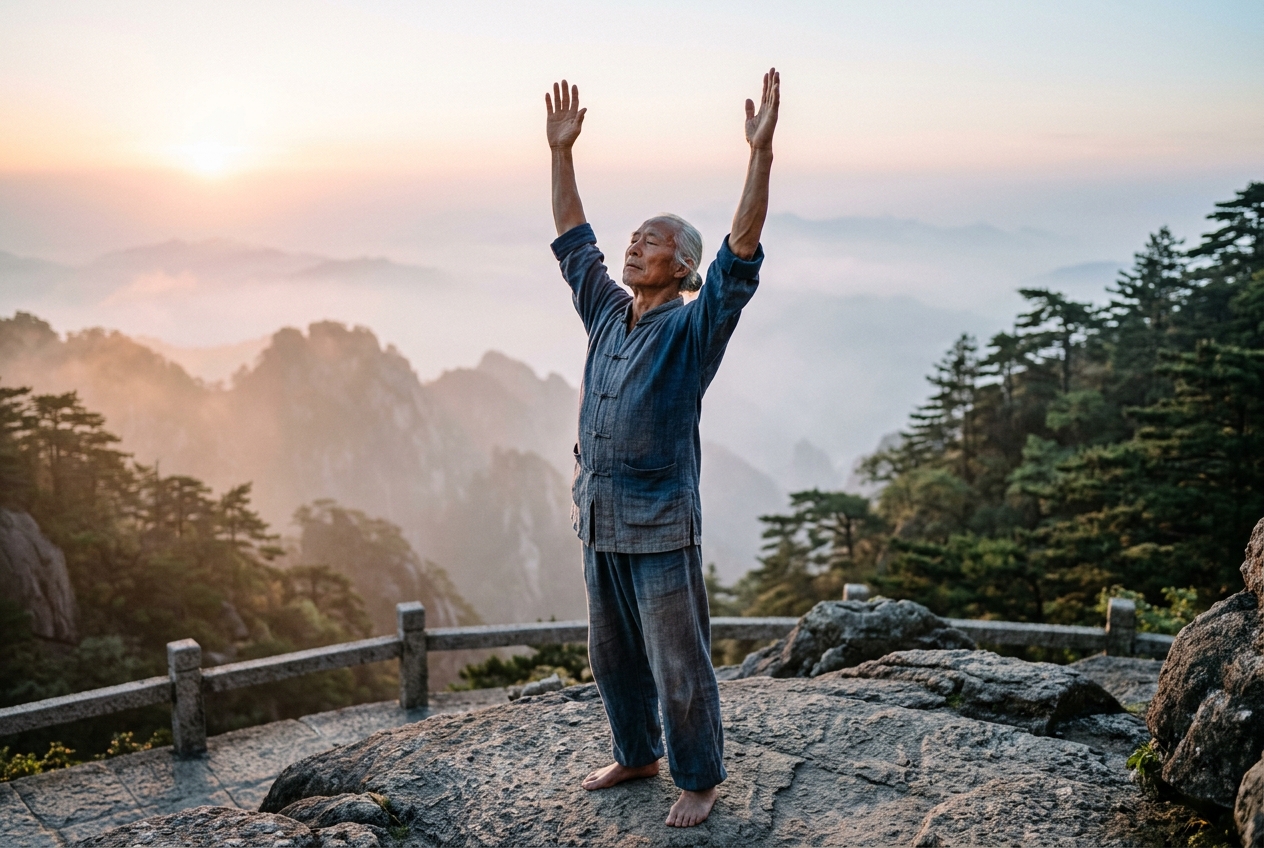
Translated into contemporary physiology, this practice is a masterclass in whole-body fascial tensegrity, neuro-vascular decompression, and diaphragmatic breathing. By pairing deep, rhythmic respiration into the lower abdomen (situated two inches below the navel, known classically as the Dantian) with isometric joint expansion, it stimulates the vagus nerve, drives oxygenated blood into microvascular capillary beds, and clears the cellular stagnation brought on by modern sedentary living. Recognized across traditional disciplines and documented by the World Health Organization Traditional Medicine Strategy, dynamic Daoyin arts like this represent a functional union of biomechanical engineering and self-directed preventative health.
       [ UPPER BURNER (Shang Jiao) ]   -> Cardiopulmonary Expansion (Thorax)
                     |
       [ MIDDLE BURNER (Zhong Jiao) ]  -> Gastrointestinal Shearing (Epigastrium)
                     |
       [ LOWER BURNER (Xia Jiao) ]    -> Urogenital / Pelvic Drainage (Lower Dantian)
                     |
       [ TENSEGRITY SPIRAL AXIS ]     -> Axial Elongation & Microvascular Flow
Step-by-Step Practice Guide: The Eight Dynamic Pillars
To experience the physiological and energetic benefits of Ba Bu Jin Gang Gong, perform each movement with relaxed, unbroken intent. The joints must never lock into hyper-extension; instead, imagine every limb extending against the gentle resistance of deep water.
0. The Preparatory Posture: Cultivating the Neutral Baseline (Wuji)
Stand upright with feet parallel, shoulder-width apart. Allow the tailbone to sink slightly as if resting against a tall stool, flattening the lumbar lordosis. The crown of your head (Baihui, located at the vertex) suspends upward as though pulled by an invisible celestial thread, gently tucking the chin to decompress the suboccipital triangle. Let your palms rest beside your hips, fingers softly parted. Breathe naturally through the nose, anchoring your awareness in the lower abdomen.
1. Dual Palms Inserting Skyward to Regulate the Triple Burner (Shuang Shou Cha Ding Shu Tian Li)
- The Movement: Cross your wrists in front of your lower abdomen, right hand over left. Inhale deeply as your hands glide vertically upward along the midline of the torso, palms facing inward. As they reach the throat, rotate the palms outward and press vertically upward above your head. Simultaneously, rise onto the balls of your feet, pressing the heels away from the earth while maintaining your balance. Extend through the palms with the fingers flared back toward the shoulders. Hold for two seconds of full isometric extension, gazing upward between your hands. Exhale slowly as you lower your heels back to the floor, turning the palms downward and pressing them in a sweeping lateral arc back to the hips.
- Biomechanical Checkpoint: Ensure the shoulders do not elevate into the ears; depress the scapulae even as the arms extend skyward to maximize the longitudinal stretch across the latissimus dorsi and the anterior longitudinal ligament of the spine.
- Beginner Pitfall: Arching the lower back into lumbar hyperextension. Correction: Keep the lower abdominal wall gently braced (transversus abdominis activation) to isolate the elongation within the thoracic spine.
- Somatic Sensations: A distinct sensation of warmth radiating down the mid-axillary line into the epigastrium, followed by a light flush across the neck as venous drainage from the thoracic outlet clears.
2. Stepping Forward and Backward to Balance Yin and Yang (Shou Zu Qian Hou Shun Yin Yang)
- The Movement: Step your left foot forward into a bow stance (weight distribution 60% front, 40% back). As you shift your mass forward, thrust the left palm forward at chest height with the fingers pointing upward, while simultaneously driving the right palm directly backward past the hip with the wrist flexed, fingers pointing down. Inhale as you extend the arms in opposing anterior-posterior vectors. Exhale as you draw both hands back to the flanks, shifting weight to the rear leg, then step forward with the right foot to repeat the contralateral vector. Perform 5 to 7 repetitions per side.
- Biomechanical Checkpoint: Maintain spinal verticality. Do not lean past the vertical plane of the front knee. The opposing push creates a dynamic shearing force across the myofascial front and back arm lines.
- Beginner Pitfall: Letting the rear heel lift off the ground. Correction: Anchor the outer edge of the rear foot firmly into the floor to preserve reciprocal hamstring-calf tension.
- Somatic Sensations: Tingling sensations extending from the fingertips through the inner arm (Lung and Pericardium meridians) coupled with a grounding heaviness in the pelvic floor.
3. Regulating the Spleen and Stomach via Single-Arm Vertical Elevation (Tiao Li Pi Wei Xu Dan Ju)
- The Movement: Bring both palms to chest level, fingertips facing each other. Inhale as your left palm rotates skyward, pressing firmly toward the ceiling with the fingers pointed toward the right shoulder, while your right palm rotates earthward, pressing downward beside the right hip with fingers pointing forward. Both elbows softly unlock at full extension. Hold this opposing vertical stretch for two seconds, gently drawing the abdominal wall inward. Exhale as both arms return to the center chest position, then switch sides: right palm presses heaven, left palm presses earth.
- Biomechanical Checkpoint: Feel the diagonal stretch across the abdomen, creating an internal sliding massage between the diaphragm, liver, and spleen.
- Beginner Pitfall: Flaring the ribs laterally and losing pelvic engagement. Correction: Maintain a neutral pelvis and focus on elongating the space between the lower ribcage and the iliac crest.
- Somatic Sensations: A visceral release in the epigastric zone, often accompanied by audible gastrointestinal peristalsis and localized heat along the digestive tract.
4. Drawing the Bow Left and Right to Clear the Liver and Lungs (Zuo Gan You Fei Ru She Diao)
- The Movement: Drop your center of gravity into a wide horse stance (Ma Bu), knees tracking over the second toes. Cross your arms in front of your chest. Inhale as you extend your left arm horizontally to the left side, forming an "L-shape" with your thumb and index finger (the "sword finger" vector) while your right hand forms a loose fist and draws back toward the right axilla, as if drawing a heavy composite recurve bow. Turn your head to gaze with focused intent over your left index finger. Feel the horizontal expanse across the pectoralis major and anterior chest. Exhale, release the bow, cross arms, and transition smoothly to the right side.
- Biomechanical Checkpoint: Ensure the drawing elbow remains level with the shoulder, maintaining horizontal scapular retraction and opening the Zhongfu (LU-1) neurovascular junction below the clavicle.
- Beginner Pitfall: Collapsing the knees inward during the horse stance. Correction: Actively externally rotate the femurs from the gluteal complex, maintaining stable arches in both feet.
- Somatic Sensations: Expansive coolness across the upper chest, followed by a surge of warmth along the radial border of the forearm down to the thumbs.
5. Spiraling Gaze Toward the Heels to Dispel Heart Afflictions (Hui Tou Wang Zu Qu Xin Ji)
- The Movement: From an upright stance, step the left foot slightly outward. Inhale as you begin a smooth spiral rotation of your entire spine to the left. Allow your neck to rotate fully, directing your visual focus down past your left hip to catch sight of your right heel. Concurrently, let your arms rotate inward, wrists crossing behind your back near the sacrum. Exhale as you slowly unwind the spiral back to center, pausing for a microsecond before initiating the identical rotation to the right side, looking down at your left heel.
- Biomechanical Checkpoint: Distribute the rotational torque evenly along the lumbar, thoracic, and cervical segments; do not pivot solely from the vulnerable atlantoaxial joint.
- Beginner Pitfall: Holding the breath during rotational end-range. Correction: Maintain continuous, frictionless nasal breathing to prevent intra-thoracic pressure spikes.
- Somatic Sensations: Deep decompression of the spinal paraspinal muscles (multifidus and rotatores), accompanied by a profound sensation of mental settling and nervous system down-regulation.
6. Looking Backward to Dissolve the Five Fatigues and Seven Overstrains (Wu Lao Qi Shang Xiang Hou Qiao)
- The Movement: Stand with feet shoulder-width apart, arms hanging naturally. Inhale as you externally rotate your shoulders, opening the palms forward and outward until they face behind you, drawing the scapulae together. Concurrently, turn your head slowly to look over your left shoulder as far as comfortably possible, opening the throat and anterior cervical triangle. Exhale as your head returns to center and your arms rotate back to their resting posture. Alternate smoothly to the right side.
- Biomechanical Checkpoint: The movement originates from the glenohumeral and scapulothoracic joints; avoid thrusting the chin forward.
- Beginner Pitfall: Shrugging the trapezius muscles upward. Correction: Actively anchor the shoulder blades downward toward the back pockets of your trousers.
- Somatic Sensations: Immediate relief from ocular and suboccipital strain, with a pulsing warmth spreading across the upper back and base of the cranium.
7. Phoenix Spreading Its Wings to Energize the Global Kinetic Web (Feng Huang Zhan Chi Zhou Shen Li)
- The Movement: Inhale as you sweep both arms outward and upward in expansive wing-like arcs, tilting the head back slightly to expand the ribcage. As you exhale, hinge from the hips with a flat back, folding forward toward the floor. Sweep both hands down the lateral lines of the legs, brushing past the ankles and across the dorsum of the feet. Inhale as you bend your knees, scoop the hands forward like lifting a vessel of water, and unroll the spine vertebra-by-vertebra back to vertical standing, concluding with another expansive lateral arm sweep.
- Biomechanical Checkpoint: Maintain spinal neutral during the initial hip hinge; bend the knees generously if the hamstrings are tight to protect the lumbar discs.
- Beginner Pitfall: Rounding the spine immediately upon descent. Correction: Drive the hips backward while maintaining an active core to load the posterior myofascial chain properly.
- Somatic Sensations: A rush of warmth coursing along the spinal erectors and back of the legs (Bladder meridian line), culminating in full-body vibrational vitality.
8. Rhythmic Heel Pulsing to Clear Pathogenic Stagnation (Liang Zu Dun Dun Xiao Bai Bing)
- The Movement: Stand tall with arms resting loosely. Rise onto the metatarsals (balls of the feet), lifting the heels approximately one to two inches off the floor. Inhale gently. On a sharp, relaxed exhale through the nose, allow the heels to drop suddenly against the floor, allowing the mechanical shockwave to ripple uninhibited through your ankles, knees, hips, and entire spinal column up to the crown. Let your shoulders, jaw, and viscera bounce naturally in resonance. Repeat for 7 to 14 rhythmic pulses.
- Biomechanical Checkpoint: Keep the knees slightly unlocked (micro-flexed) to prevent joint jamming, allowing the axial skeleton to absorb the kinetic impulse elastically.
- Beginner Pitfall: Tensing the neck or clenching the teeth during impact. Correction: Keep the mouth softly closed with the tongue resting on the upper palate, maintaining complete myofascial relaxation.
- Somatic Sensations: A fine, electric vibrational hum diffusing through the bone matrix and cutaneous tissues, leaving the body feeling grounded, porous, and refreshed.
9. The Closing Integration (Shou Shi)
Conclude by gathering the hands outward and upward, drawing them down the central axis of the body to rest over the lower abdomen—left hand over right for men, right hand over left for women. Stand quietly for two to three minutes, breathing into the belly, allowing all kinetic and thermal energy to settle into the core.
Key Somatic Benchmarks During Practice: * Warmth in the Extremities: Indicates peripheral vasodilation and down-regulation of sympathetic tone. * Micro-vibrations & Tingling: Represents microvascular recruitment and neurological re-innervation of dormant fascial planes. * Spontaneous Salivation (Jade Fluid): A definitive physiological marker of parasympathetic nervous system activation. * Postural Heaviness with Internal Buoyancy: Reflects the functional integration of tensegral musculoskeletal alignment.
Why It Works: The Biomechanical and Physiological Science
The efficacy of Ba Bu Jin Gang Gong is grounded in well-documented physiological, mechanical, and neuro-autonomic mechanisms. Modern research into somatic movement, such as studies compiled in the NCBI PubMed Database, corroborates the holistic health benefits observed in traditional Chinese movement therapies.
1. Fascial Tensegrity and Reciprocal Inhibition
The human body operates not as a stack of compression bricks, but as a continuous tension-compression network, a concept known in biomechanics as tensegrity (detailed extensively on Wikipedia's guide to Tensegrity). Fascia is a densely innervated, collagenous, liquid-crystal matrix that envelops every muscle fiber, organ, and nerve bundle. When you perform the multi-planar reaches of Jin Gang Gong—such as the simultaneous heaven-and-earth pressing of Movement 3—you apply a global stretch across continuous myofascial lines (the Spiral Line, Superficial Back Line, and Deep Front Line).
This tension creates reciprocal inhibition: as agonist muscle chains lengthen under low-load isometric contraction, hypertonic antagonist muscle groups are neurologically signaled to release. Adhered fascial sheaths are sheared against one another, hydrating the ground substance (hyaluronic acid) and restoring elastic recoil capacity to the musculoskeletal framework.
2. Endothelial Shear Stress and Nitric Oxide Release
The deliberate, sustained end-range expansions in the eight movements create rhythmic cycles of localized vascular compression followed by rapid reperfusion. When the arms are held in high-tension vectors and subsequently released, the sudden rush of blood generates laminar shear stress against the endothelial lining of blood vessels.
This mechanical stimulus activates endothelial nitric oxide synthase (eNOS), catalyzing the synthesis of nitric oxide (NO). Nitric oxide diffuses into surrounding smooth muscle cells, triggering potent vasodilation, reducing systemic vascular resistance, and dramatically improving microvascular tissue perfusion. In traditional paradigms, this physiological cascade is recognized as the rapid mobilization of Defensive Qi (Wei Qi), fortifying the body against external pathogen entry.
3. The Triple Burner as the Interstitial Fluid and Lymphatic Network
Classical Chinese medicine defines the San Jiao (detailed in the San Jiao anatomical overview) not as a single solid organ, but as the "official in charge of irrigation"—the master coordinator of metabolic fluids and thermoregulation across the upper (thoracic), middle (epigastric), and lower (pelvic) cavities.
Modern anatomical science identifies this exact architecture as the interstitium: the fluid-filled, pre-lymphatic structural spaces throughout the body's connective tissues. The twisting, compressing, and elongating movements of Ba Bu Jin Gang Gong act as a mechanical siphon, pumping stagnant interstitial fluid through lymphatic channels and venous drainage networks, expelling metabolic waste and down-regulating inflammatory cytokines.
4. Neuro-Vagal Tone and Diaphragmatic Pressure Dynamics
Every movement in Jin Gang Gong is synchronized with slow, diaphragmatic respiration. The descent of the diaphragm during deep inhalation expands the base of the lungs while generating intra-abdominal pressure that gently massages the abdominal viscera. As the diaphragm moves through its full excursion, it mechanically stimulates the vagus nerve (Cranial Nerve X) as it passes through the esophageal hiatus. This upregulates parasympathetic nervous system activity, elevating Heart Rate Variability (HRV), lowering resting blood pressure, and neutralizing the systemic cortisol surges caused by chronic psychological stress.
Classical Lineage and Context: From Daoist Hermits to Modern Somatics
Ba Bu Jin Gang Gong does not originate from contemporary sports science laboratories; it is the preserved distillation of over eight centuries of Quanzhen Daoist longevity science. The practice belongs directly to the Longmen (Dragon Gate) Sect of Quanzhen Daoism, a lineage established by Qiu Chuji (Master Changchun), one of the celebrated Seven Immortals of the North during the Jin-Yuan dynasties.
For centuries, these dynamic Daoyin methods (see Wikipedia's history of Daoyin) were strictly guarded internal monastic treasures, transmitted exclusively from master to disciple behind temple walls in the sacred Wudang and Huashan mountain ranges. They served a vital pragmatic function: Daoist hermits engaging in long periods of seated meditation (Neidan or internal alchemy) frequently suffered from physical ailments—deep vein stagnation, muscular atrophy, spinal stiffness, and digestive paralysis.
To counteract the morbid physical consequences of sedentary meditation, masters developed Jin Gang Gong (Diamond Skill) as a dynamic, Yang-strengthening counterweight. The term Jin Gang (Diamond / Vajra) denotes indestructible strength, structural clarity, and the capacity to shatter physical disease.
The preservation and global dissemination of this pristine form is credited to the legendary Daoist Abbot Zhang Zhi Shun (张至顺, 1912–2015, known by his monastic title Chunyangzi). Having practiced these arts daily for nearly a century on secluded peaks, Abbot Zhang made the historic decision in the late 20th century to break the historical vow of secrecy. Recognizing the mounting physical fragility and chronic stress of the modern world, he codified and openly taught both the dynamic Ba Bu Jin Gang Gong (practiced at sunrise to cultivate dynamic Yang energy) and its companion system, the soft and quiescent Ba Bu Chang Shou Gong (Eight-Step Longevity Skill, practiced at sunset to nourish Yin).
Today, this lineage stands alongside resources from the National Qigong Association and the wider global history of Qigong as a living, unbroken bridge connecting classical hermit arts with contemporary preventative medicine.
Today's Practice Commitment: A 15-Minute Daily Somatic Blueprint
Theoretical understanding yields zero physiological adaptation without physical execution. Tomorrow morning, before checking your phone, drinking your first coffee, or sitting down at your desk, commit to a single 15-minute cultivation session:
- Step into the Morning Air (0:00–2:00): Stand facing east or toward a window with natural light. Assume the Wuji stance. Take 10 deep diaphragmatic breaths, scanning your entire kinetic chain from scalp to soles.
- Execute the Eight Movements (2:00–12:00): Perform Movements 1 through 8 sequentially, completing 5 deliberate repetitions of each exercise. Keep your attention anchored inside your physical tissues—do not allow the mind to wander to daily logistics.
- Closing Stillness (12:00–15:00): Rest both hands over your lower belly. Close your eyes, soften your breathing to a quiet, natural rhythm, and observe the internal thermodynamic shift: the localized heat, the tingling skin, the light buoyancy along the spine, and the settled quietude of the mind.
Repeat this protocol every morning for seven consecutive days. You will not simply be practicing ancient gymnastics; you will be systematically tuning the living tensegrity matrix of your body, cultivating resilient physical vitality, and mastering the internal art of structural longevity.