Dayan Wild Goose Qigong: Scapular Kinetic Chains, Acupoint Flutter Modulation, and Microvascular Meridian Stimulation in Classical Medical Qigong
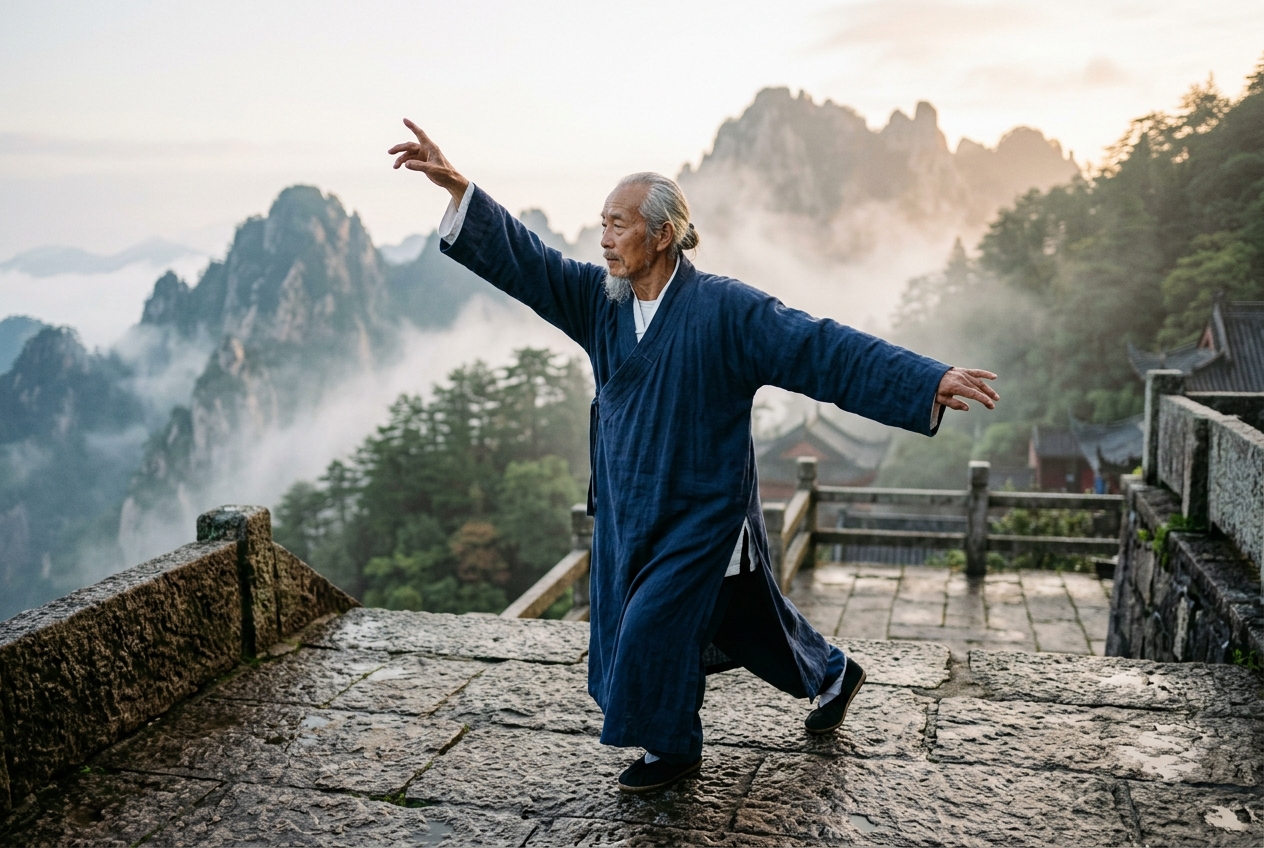
In traditional Chinese medicine (TCM), the body’s health depends on the unobstructed flow of life force through interconnected energetic pathways known as meridians, anchored by deep energetic reservoirs called Dantian (energy centers). The primary focus of Dayan Gong is to nourish the Lower Dantian—the physiological and energetic center of gravity located approximately two inches below the navel and three inches deep—while stimulating the Kidney meridian water element to preserve Jing (our foundational constitutional essence and hormonal reserves). Modern movement science reveals that these poetic concepts directly correspond to parasympathetic nervous system upregulation, diaphragmatic excursion, fascial hydrations, and microvascular vasodilation.
Step-by-Step Practice Guide
The foundational opening sequence of Dayan Wild Goose Qigong establishes structural integrity, awakens distal acupuncture points, and synchronizes respiration with full-body kinetic wave propagation. Perform this sequence in a quiet, well-ventilated space with loose clothing.
       [Baihui (GV-20) Suspended Upward]
                     |
               (Soft Gaze)
                     |
            [Cervical Spine Wave]
                     |
    <-- [Scapular Retraction/Protraction] -->
   /                 |                      \
[Elbows Soft]  [Thoracic Open]         [Elbows Soft]
  |                  |                       |
[Wrists Fluid] [Lumbar Elongation]     [Wrists Fluid]
  |                  |                       |
[LU-11 / PC-9  [Pelvic Neutral /       [LU-11 / PC-9
 Fingertip]     Huiyin (CV-1)]          Fingertip]
 Flutter             |                   Flutter
               [Knees Supple]
                     |
           [Yongquan (KID-1) Root]
1. Wuji Starting Stance (Foundational Grounding & Alignment)
- Kinetic Setup: Stand with your feet parallel and hip-to-shoulder-width apart. Distribute your body weight evenly across the tripod of each foot: the base of the first metatarsal, the base of the fifth metatarsal, and the calcaneus (heel). Connect mentally with Yongquan (KID-1, "Bubbling Spring"), the depression situated on the anterior third of the sole.
- Axial Alignment: Gently draw the chin inward to lengthen the suboccipital region, imagining the vertex of the skull—Baihui (GV-20, "Hundred Convergences")—is suspended by an invisible silk cord from the heavens. Allow the coccyx to sink toward the floor, eliminating excess lumbar hyperlordosis. The tongue rests lightly against the hard palate behind the upper incisors, bridging the Ren (Conception) and Du (Governing) extraordinary vessels.
- Interoceptive Breath: Inhale smoothly through the nose for four counts, feeling the lower abdomen expand circum-ferentially across the lower back and pelvic floor without engaging the secondary accessory muscles of respiration in the neck. Exhale for six counts, sensing a downward gravitational grounding.
2. Spreading the Wings (Scapulothoracic Elevation & Wave)
- Kinetic Sequencing: As you initiate a slow inhalation, drive a subtle kinetic impulse from the feet through soft knees into the pelvis. Let this ripple up the spine, coaxing the scapulae into a gentle retraction and downward glide that causes both arms to float laterally and upward like the broad wings of a goose.
- Joint Kinematics: The movement is led by the wrists with the elbows remaining soft, bent at approximately 135 degrees. The shoulders must remain depressed (away from the ears) through active engagement of the lower trapezius and serratus anterior. Elevate the arms until they reach shoulder height at an angle of roughly 45 degrees anterior to the coronal plane (the scapular plane).
- Thoracic Expansion: As the wings reach their apex, allow the sternum to lift gently, producing a thoracic extension that expands the rib cage and increases the longitudinal traction of the deep front fascial line.
3. The Fluttering Wing & Trembling Finger Dynamic (Distal Acupoint Activation)
- Kinetic Sequencing: At the apex of the wing spread, pause the macroscopic movement of the arms. Transition immediately into a high-frequency, low-amplitude micro-flutter (10–12 Hz) initiated at the wrists and propagating through the metacarpophalangeal and interphalangeal joints.
- Focal Points: Focus mental intent (Yi) on the terminal Jing-Well and Source acupoints located on the palmar and dorsal aspects of the hand:
- Shaoshang (LU-11): Radial aspect of the thumb interphalangeal terminal margin.
- Zhongchong (PC-9): Tip of the central digit, opening the pericardium and calming the spirit (Shen).
- Hegu (LI-4): The dorsal webbing between the first and second metacarpal bones.
- Sensation: Maintain this rapid trembling for 5 to 10 seconds while maintaining continuous, uninterrupted diaphragmatic respiration.
4. Descending Flight and Gathering Qi to Lower Dantian
- Kinetic Sequencing: Begin a slow, continuous exhalation. Flex the wrists softly so the fingertips trail upward, then allow the elbows to sink downward first, guiding the forearms and palms inward in an arc toward the torso.
- Condensation: As the hands descend past the heart and solar plexus, face the palms inward toward the lower abdomen. Hover the palms 2 to 3 inches away from Guanyuan (CV-4) and Qihai (CV-6), feeling a field of warmth and gentle compression between the palms and the abdominal wall.
- Grounding: Allow your weight to settle two percent more into your heels as your knees soften further. Rest here for two full breathing cycles, feeling your vitality consolidate in the pelvic basin.
Somatic Cueing and Biomechanical Corrections
Practitioners must cultivate interoceptive awareness to prevent compensatory patterns that disrupt energy flow and neuromuscular integration.
| Movement Phase | Anatomical Focus | Somatic Sensory Cue | Energetic & Physiological Objective |
|---|---|---|---|
| Wuji Stance | Plantar fascia, axial spine, pelvic bowl | "Feel roots growing deep into the earth from the balls of your feet; head floats upward like a cloud." | Stabilizes base of support, unloads spinal facet joints, activates Yongquan (KID-1). |
| Wing Elevation | Serratus anterior, lower trapezius, latissimus dorsi | "Float the wrists on warm water; keep the armpits hollow as if holding a soft bird's egg." | Prevents subacromial impingement; expands thoracic cage without apical breathing. |
| Trembling Flutter | Extensor digitorum, flexor digitorum superficialis | "Fingers vibrate like humming bird wings; drops of water flicking off the fingertips." | Mechanoreceptor excitation, piezoelectric fascial charging, Jing-Well stimulation. |
| Descending Sinking | Diaphragm, pelvic floor, rectus abdominis release | "Warm honey pouring down from the throat through the chest, collecting in the pelvic bowl." | Facilitates venous return, downregulates sympathetic tone, roots Qi into Lower Dantian. |
Common Somatic Deviations and Biomechanical Adjustments
+---------------------------------------------------------------------------------------------------+
| CLINICAL CORRECTION PROTOCOL: COMMON BIOMECHANICAL DEVIATIONS                                    |
+---------------------------------------------------------------------------------------------------+
| 1. SHOULDER ELEVATION & TRAPEZIUS HYPERTONICITY                                                  |
|    - Fault: Elevation of the shoulder girdle via upper trapezius and levator scapulae during wing |
|      ascent, pinching cervical neurovascular bundles.                                             |
|    - Correction: Actively cue lower trapezius engagement: "Slide the shoulder blades downward    |
|      toward the back pockets of your trousers before the arms move."                              |
+---------------------------------------------------------------------------------------------------+
| 2. LUMBAR HYPERLORDOSIS & PELVIC ANTERIOR TILT                                                   |
|    - Fault: Tilting the pelvis forward and overarching the lower back to compensate for poor      |
|      thoracic mobility, closing Mingmen (GV-4, "Gate of Vitality").                               |
|    - Correction: Gently tuck the tailbone by contracting the transversus abdominis: "Imagine a   |
|      plumb line dropping straight down from your coccyx between your heels."                      |
+---------------------------------------------------------------------------------------------------+
| 3. INSPIRATORY VALSALVA OR BREATH FIXATION                                                        |
|    - Fault: Holding the breath or tensing the glottis during the trembling finger phase, inducing |
|      transient blood pressure spikes.                                                             |
|    - Correction: Keep the lips slightly parted with a micro-smile; articulate a soft, inaudible   |
|      sigh during the flutter to ensure continuous airway patency.                                 |
+---------------------------------------------------------------------------------------------------+
| 4. GENU RECURVATUM (HYPEREXTENDED KNEES)                                                          |
|    - Fault: Locking the knee joints backward, arresting kinetic chain transmission and vascular   |
|      flow through the popliteal fossa.                                                            |
|    - Correction: Maintain a constant 5-degree micro-bend in the knees; align the center of the    |
|      patella directly with the second toe.                                                        |
+---------------------------------------------------------------------------------------------------+
Why It Works — The Body Science
The health benefits of Dayan Wild Goose Qigong arise from the precise intersection of classical Daoist kinesiology and modern human physiology. Rigorous studies indexed in the National Center for Biotechnology Information (NCBI) demonstrate that mind-body exercises modulate autonomic tone, lymphatic clearance, and musculoskeletal biomechanics.
1. Scapulothoracic Waves and Respiratory Pump Mechanics
During the "Spreading Wings" motion, the synchronized upward rotation and retraction of the scapulae trigger an expansion of the anteroposterior and transverse diameters of the rib cage. In accordance with Boyle's Law, this anatomical expansion decreases intrathoracic and intrapleural pressures below atmospheric pressure, creating a physiological suction gradient.
This dynamic shift does not merely optimize alveolar recruitment across the well-perfused pulmonary bases; it dramatically enhances venous return via the inferior and superior vena cava into the right atrium. As documented in biomedical literature available on PubMed Central, the cyclical alteration between negative intrathoracic pressure during elevation and positive intra-abdominal compression during descent functions as an internal cardiopulmonary pump, boosting cardiac stroke volume while lowering resting arterial resistance.
2. Mechanotransduction, Piezoelectricity, and Distal Acupoint Flutter
The rapid (10–12 Hz) trembling finger flutter is a hallmark innovation of Dayan Gong. From a biophysical perspective, living fascia is a continuous liquid-crystalline collagen matrix that exhibits piezoelectric and streaming potential properties. High-frequency micro-movements generate oscillatory mechanical shear stresses on fibroblasts and microvascular endothelial cells. Through mechanotransduction, this physical vibration triggers: * Microvascular Nitric Oxide (NO) Synthesis: Shearing forces stimulate endothelial nitric oxide synthase (eNOS), releasing local bursts of NO that dilate terminal capillary beds in the digits, explaining the rapid onset of warmth and tingling (erythema and paresthesia) reported by practitioners. * Perineural and Mechanoreceptor Excitation: Rapid micro-oscillations stimulate low-threshold Pacinian and Meissner corpuscles, saturating the dorsal horn of the spinal cord with non-noxious somatosensory input and downregulating central pain sensitization. * Acupuncture Meridian Conductivity: Distal extremities house the highest concentration of free nerve endings, arteriovenous anastomoses, and low-impedance electrical pathways. Stimulating Shaoshang (LU-11), Zhongchong (PC-9), and Hegu (LI-4) amplifies bio-electromagnetic signals along the fascial planes, supporting energy flow concepts systematized in traditional Asian medical frameworks recognized by the World Health Organization.
3. Spinal Undulation, Craniosacral Dynamics, and Vagal Tone
Dayan Gong avoids rigid, linear movements in favor of continuous sinusoidal waves moving from the coccyx through the cervical vertebrae. This movement promotes: * Intervertebral Decompression and Hydration: Sinusoidal spinal waves create alternating compression and imbibition across the intervertebral discs, enhancing the diffusion of nutrient-rich interstitial fluids into avascular disc structures. * Cerebrospinal Fluid (CSF) Circulation: Undulation of the sacral base in concert with the suboccipital hinge optimizes the physiological pressure pulsations of the craniosacral mechanism, aiding in neuro-lymphatic and glymphatic clearance of metabolic waste products from the central nervous system. * Vagal Autonomic Modulation: Spinal fluidity unloads chronic tension in the suboccipital and cervicothoracic junction, directly decompressing the vagus nerve (Cranial Nerve X) as it exits the jugular foramen. This increases Heart Rate Variability (HRV), a clinical biomarker of autonomic resilience, emotional regulation, and physiological recovery.
4. Neuro-Lymphatic Drainage and Chronic Fatigue Rehabilitation
Unlike the cardiovascular system, the lymphatic system lacks a central muscular pump, relying entirely on skeletal muscle contractions, deep diaphragmatic excursions, and fascial shear. The thoracic duct—which empties up to 75% of the body's lymph into the left subclavian vein—runs directly along the anterior surface of the thoracic spine, piercing the respiratory diaphragm at the aortic hiatus.
Dayan Gong’s integrated diaphragmatic breathing and scapular waves dynamically compress and decompress the Cisterna Chyli and the thoracic duct. This dynamic pumping accelerates the clearance of cellular debris and inflammatory cytokines. In patients suffering from Chronic Fatigue Syndrome (ME/CFS), fibromyalgia, and post-viral sequelae, regular practice gently restores neuro-immune homeostasis without triggering post-exertional symptom exacerbation.
Classical Lineage & Historical Context
The heritage of Dayan Wild Goose Qigong is steeped in the esoteric Daoist hermit traditions of the sacred Kunlun Mountains (Kunlun Shan) in western China. According to traditional records documented across the history of Qigong, the foundational movements were formulated during the Jin Dynasty (266–420 CE) by Daoist master Dao An and his monastic disciples.
Observing the wild geese that rested in the Kunlun foothills during their trans-Himalayan migrations, the monks marveled at these avian creatures: their ability to fly at altitudes exceeding 25,000 feet in sub-zero, oxygen-depleted atmospheres, their graceful ease in navigating high-altitude turbulence, and their remarkable lifespan and vitality.
For nearly seventeen centuries, the Dayan Gong system was preserved as a secret monastic treasure, passed down unbroken through twenty-seven generations of Daoist lineage holders. The tradition mandated that each grandmaster select and train only a single worthy disciple in each generation to safeguard the purity of the kinetic and alchemical knowledge.
This centuries-long secrecy ended with the 28th-generation lineage grandmaster, Grandmaster Yang Meijun (1896–2002). Having inherited the complete 64-movement primary and advanced forms from her grandfather, Grandmaster Yang survived the immense social upheavals of twentieth-century China. In 1978, at the age of 82, motivated by deep compassion for a public reeling from civil turmoil and widespread illness, she broke historical precedent and began teaching Wild Goose Qigong openly in Beijing’s public parks.
Grandmaster Yang lived vigorously to the age of 106, serving as a living testament to the longevity and constitutional benefits of the practice. Today, certified lineages under organizations like the National Qigong Association preserve her original forms while collaborating with academic somatic researchers to bring this ancient art into integrative medicine clinics worldwide.
Somatic Sensations and Interoceptive Milestones
As you establish a regular practice of Dayan Wild Goose Qigong, your nervous system will progress through identifiable sensory milestones. Understanding these signals helps you track structural alignment and bio-energetic flow.
+---------------------------------------------------------------------------------------------------+
| INTEROCEPTIVE ROADMAP: PROGRESSION OF SOMATIC SENSATIONS                                         |
+---------------------------------------------------------------------------------------------------+
| STAGE 1: NEUROMUSCULAR REALIGNMENT (Weeks 1 to 3)                                                 |
| - Sensations: Heaviness in the feet, gentle aching in postural muscles as postural compensations  |
|   release, transient yawning or deep spontaneous sighs.                                           |
| - Meaning: Downregulation of sympathetic tone; physical re-stacking of the skeletal frame.        |
+---------------------------------------------------------------------------------------------------+
| STAGE 2: MICROVASCULAR & FASCIAL AWAKENING (Weeks 4 to 8)                                         |
| - Sensations: Pronounced heat in the palm centers (Laogong PC-8), tingling/pulsing in the         |
|   fingertips during and after the trembling flutter, sensation of magnetic resistance or soft     |
|   density between the hands.                                                                      |
| - Meaning: Nitric oxide-mediated peripheral vasodilation; heightened mechanoreceptor sensitivity;  |
|   activation of the Jing-Well pathways.                                                           |
+---------------------------------------------------------------------------------------------------+
| STAGE 3: KINETIC FLUIDITY & VISCERAL RESONANCE (Months 3+)                                        |
| - Sensations: Effortless, buoyant floating of the limbs; warmth radiating from the Lower Dantian  |
|   into the lumbar spine (Mingmen); wave-like propagation through the entire spine during breath.  |
| - Meaning: Integration of deep front line myofascial continuity; enhanced craniosacral fluid      |
|   dynamics; tonification of Kidney Jing.                                                          |
+---------------------------------------------------------------------------------------------------+
Today’s Practice Commitment
To experience the transformative physiological and energetic benefits of Dayan Wild Goose Qigong, commit to this accessible morning protocol for the next seven consecutive days:
Take mental note of your energy reserves, postural comfort, and emotional equilibrium as you navigate your day. Through this simple commitment, the timeless wisdom of the Kunlun Daoist masters becomes your personal foundation for lifelong vitality.