Cun Si Daoist Concentrative Visualization: Microscopic Somatosensory Mapping, Visceral Shen Illumination, and Neuro-Visual Energy Guiding in Classical Neidan
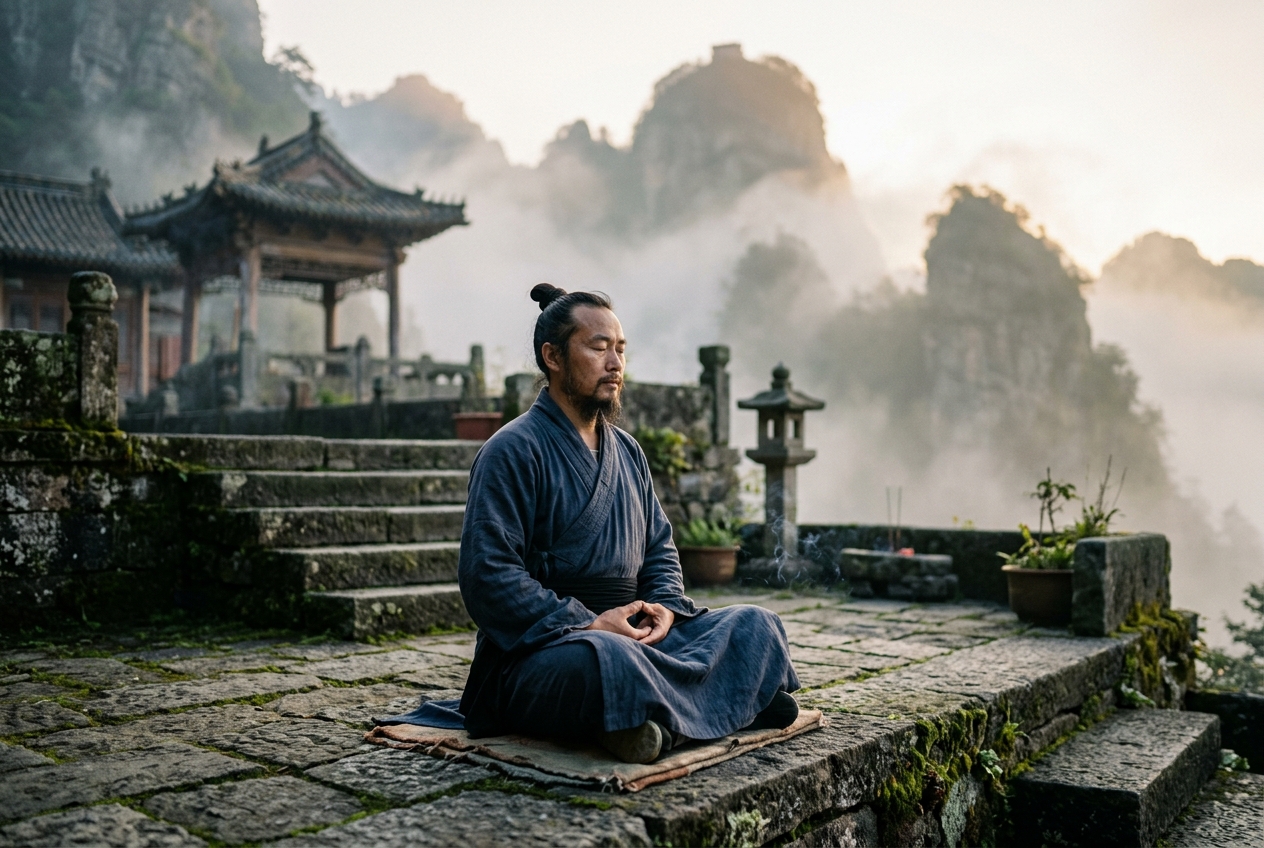
- Cun Si (存思 — Concentrative Visualization / Actualization): This is a kataphatic (generative, form-based) method rooted in the active projection of archetypal forms, cosmic lights, and chromatic frequencies into the biological terrain. The character Cun (存) implies "to preserve, to maintain, to bring into tangible existence," while Si (思) denotes "contemplation, intentional thought, or focalized cognition." In Cun Si, the mind operates as an alchemical chisel, deliberately populating the bodily interior with specific luminous qualities to tonify depleted organ networks and alter autonomic patterning.
- Nei Guan (内观 — Inner Observation / Somatic Interoception): In contrast, Nei Guan is an interoceptive, receptive methodology. The practitioner adopts the stance of a detached, non-interfering witness, tracking visceral pulsations, peristaltic motility, thermal shifts, and somatic currents without imposing preconceived forms or colors upon them. It parallels modern mindfulness-based interoceptive training, cultivating refined insular sensitivity to afferent bodily signals.
- Zuo Wang (坐忘 — Sitting in Oblivion / Void Meditation): Derived from the philosophical treatises of the Zhuangzi, Zuo Wang is a radically apophatic (content-free) praxis. Here, both active visualization and passive tracking of somatic forms are surrendered. The practitioner sits and "forgets" the limbs, dispels sensory distinctions, and dissolves the conceptual boundary between subject and object, resting in primordial emptiness (Wuji, 无极).
While Nei Guan diagnoses the internal landscape and Zuo Wang returns consciousness to its unconditioned source, Cun Si is the therapeutic engine of transformation. It reconstructs somatic architecture from within, harnessing deliberate visual-sensory feedback loops to alter physical pathology.
Historical and Lineage Epistemology: The Shangqing Revelation
The systematic elaboration of Cun Si reached its historical zenith during the fourth century CE under the auspices of the Shangqing (上清, Supreme Purity) school of Daoism, established on the sacred slopes of Mount Maoshan (茅山) in Jiangsu province. Guided by the visionary transmissions recorded by the mystic and calligrapher Yang Xi (330–c. 386 CE) and attributed to the female adept Lady Wei Huacun (252–334 CE), Shangqing Daoism revolutionized Chinese meditative liturgy. Later cataloged and refined by the imperial polymath Tao Hongjing (456–536 CE), this tradition shifted the paradigm of internal transformation from external laboratory alchemy (Waidan, 外丹) to the psychosomatic laboratory of the living human vessel (Neidan, 内丹).
Central to this canonical revolution was the Shangqing Huangting Jing (上清黄庭经, Scripture of the Yellow Court), an extraordinary physiological and alchemical text that mapped the human body as an enchanted microcosm. Within the Huangting Jing, the internal viscera (Zang-Fu, 脏腑) were not viewed merely as biochemical pump-and-filter mechanisms, but as sacred palaces inhabited by radiant cosmological forces and visceral deities (Shen, 神).
The scripture taught that illness, psychological fracture, and premature aging occur when an individual's conscious intention scatters outward into sensory distraction, causing the spiritual life-forces (Zhen Shen) to abandon their physiological thrones.
Through the focused application of Cun Si, the adept visualized these visceral domains illuminated by the specific spectral hues of the five cosmological directions and astronomical constellations. By summoning and "preserving" these radiant lights within the heart, liver, lungs, kidneys, and spleen, the practitioner drew external macrocosmic energies into the microvascular matrix of the physical body. As noted in contemporary scholarship on Daoist traditions through the Stanford Encyclopedia of Philosophy and historical records documented across canonical texts on the Shangqing School and the Huangting Jing, this practice merged liturgical mysticism with an acutely rigorous empirical anatomy of healing.
Biophysical and Neurological Mechanisms: How Focused Intention Alters Flesh
How does an ancient practice of visualizing colored light inside an organ translate into measurable biological transformation? The intersection of contemporary neurobiology, vascular medicine, and biophysics offers clear insights into the efficacy of Cun Si.
1. The Ideomotor Principle and Neurovascular Coupling
When a practitioner engages in high-resolution, emotionally grounded somatic visualization, the brain does not distinguish purely between external sensory perception and internally generated imagery. Functional neuroimaging demonstrates that visualizing internal anatomical regions activates the primary visual cortices (V1, V2), the primary and secondary somatosensory cortices (S1, S2), and the anterior insular cortex—the primary neuroanatomical clearinghouse for interoception.
This focused cortical activation triggers descending autonomic projections to peripheral microvasculature. Under the influence of sustained mental focus (Yi), targeted tissues experience local endothelial activation. This process stimulates endothelial nitric oxide synthase (eNOS), yielding the rapid release of nitric oxide (NO)—a potent gaseous vasodilator. Capillary beds within the visualized visceral compartments expand, significantly accelerating local perfusion, oxygenation, and nutrient exchange while flushing accumulated ischemic metabolites. Research archived by the National Center for Biotechnology Information (NCBI / PubMed) corroborates that sustained mental focus and diaphragmatic modulation produce rapid shifts in peripheral microvascular perfusion and autonomic balance.
2. Autonomic Tone, Vagal Modulation, and Cortical Noise Suppression
Chronic psychological distress and somatic stress lock the human organism into sympathetic hyper-arousal, characterized by elevated baseline cortisol, inflammatory cytokine release (such as IL-6 and TNF-$\alpha$), and constricted visceral blood flow. Cun Si alters this state through several distinct biological vectors:
- Parasympathetic Down-Regulation: The pairing of rhythmic diaphragmatic breathing with visceral visualization stimulates afferent fibers of the vagus nerve (Cranial Nerve X). This elevates heart rate variability (HRV), optimizes baroreceptor sensitivity, and down-regulates sympathetic adrenergic outflow.
- Default Mode Network (DMN) Attenuation: The hyperactive narrative loop of the Default Mode Network—responsible for depressive rumination, anxiety, and catastrophic self-referential thinking—is rapidly quieted during the rigorous mental discipline of Cun Si. The cognitive load required to construct and sustain multi-sensory visceral imagery recruits task-positive frontoparietal networks, drastically lowering "cortical noise" and central nervous system hypersensitivity. Detailed research on this functional balance is widely documented in peer-reviewed journals such as Frontiers in Neuroscience.
3. Fascial Bioelectricity and Liquid Crystalline Matrix Conduction
The human fascial network is not an inert wrapping material; it is a contiguous, fluid-filled, liquid-crystalline collagen matrix endowed with distinct piezoelectric and streaming-potential properties. Mechanical deformation caused by deep diaphragmatic displacement, combined with the subtle thermal and ionic changes induced by microvascular dilation, generates minute bioelectric fields along fascial planes. In Daoist energetics, these bioelectric currents are recognized as the movement of Qi. By systematically shifting the focus of Cun Si through the body, the practitioner effectively directs these endogenous bioelectric currents along myofascial meridians, accelerating tissue repair and intercellular communication.
Visceral Color Resonance and the Five Phases (Wu Xing)
The operational heart of classical Cun Si is visceral color resonance: the deliberate projection of specific spectral frequencies into the five Zang organ networks. In Five Phase (Wu Xing, 五行) cosmology and TCM diagnostic theory, each core organ vibrates in sympathetic resonance with a specific elemental phase, direction, season, emotional virtue, and optical wavelength.
The clinical rationale behind chromatic assignment is grounded in sensory-somatic resonance:
1. Kidneys (Shen, 肾) — The Water Phase (Shui)
- Direction & Season: North / Deep Winter
- Spectral Frequency: Deep Midnight Blue / Indigo / Obsidian Black (Xuan, 玄)
- Psycho-Spiritual Anchor: Houses the Zhi (志, Willpower and Primal Drive); stores congenital Jing (精, Primordial Essence).
- Alchemical Action: Visualizing deep, cool, indigo-black light saturating the renal beds and adrenal glands calms autonomic hyper-reactivity, counteracts adrenal exhaustion, dissolves systemic fear, and restores deep cellular fluids.
2. Liver (Gan, 肝) — The Wood Phase (Mu)
- Direction & Season: East / Spring
- Spectral Frequency: Vibrant Emerald / Cyan-Green (Qing, 青)
- Psycho-Spiritual Anchor: Houses the Hun (魂, Ethereal Soul); regulates the smooth, unobstructed spreading of Qi and emotions.
- Alchemical Action: Saturating the right hypochondriac region with rich, nourishing green light dissolves smooth-muscle constriction, alleviates hepatic portal congestion, calms irritability and rage, and promotes the restorative virtue of benevolence (Ren, 仁).
3. Heart (Xin, 心) — The Fire Phase (Huo)
- Direction & Season: South / Peak Summer
- Spectral Frequency: Pure Vermilion / Ruby Red (Chi, 赤 / Zhu, 朱)
- Psycho-Spiritual Anchor: Houses the Shen (神, Conscious Spirit and Shen-Luminosity); serves as the Sovereign Emperor of the somatic realm.
- Alchemical Action: Visualizing a warm, bright crimson flame or ruby-red light within the chest center dilates coronary vessels, balances cardiac rhythm, relieves insomnia and existential anxiety, and awakens spiritual discernment, joy, and unconditional love.
4. Spleen (Pi, 脾) — The Earth Phase (Tu)
- Direction & Season: Center / Late Summer (Solstitial Transition)
- Spectral Frequency: Rich Imperial Gold / Amber Ochre (Huang, 黄)
- Psycho-Spiritual Anchor: Houses the Yi (意, Intellect, Coherent Intention, and Digestion of Experience).
- Alchemical Action: Directing warm, dense golden light into the epigastrium and pancreas improves digestive motility, resolves chronic systemic dampness, terminates repetitive rumination and worry, and roots the nervous system in unwavering trust and equanimity.
5. Lungs (Fei, 肺) — The Metal Phase (Jin)
- Direction & Season: West / Autumn
- Spectral Frequency: Luminescent Crystalline White (Bai, 白)
- Psycho-Spiritual Anchor: Houses the Po (魄, Corporeal/Somatic Soul); governs defensive immunity (Wei Qi) and boundary regulation.
- Alchemical Action: Flooding the thoracic cavity with brilliant white light clears bronchial constriction, enhances alveolar oxygen perfusion, processes unexpressed grief and loss, and instills righteous courage and clear boundary discernment.
The Classical Step-by-Step Cun Si Practice Guide
This protocol represents a complete, classical cycle of the Five-Phase Visceral Illumination sequence, organized according to the Mutual Generation (Xiangsheng, 相生) cycle of Neidan alchemy. It is designed to be performed safely at home without complex apparatus.
Stage 1: Structural Posture and Lower Dantian Grounding
- The Seat: Sit erect on a firm cushion or the edge of a chair with the pelvis tilted slightly forward. The feet rest flat on the floor, parallel and hip-width apart. If sitting cross-legged, ensure the knees rest below the level of the hip joints.
- The Alignment: Gently lift the crown of the head (Baihui, 百会, DU-20) toward the sky as if suspended by an invisible silk thread. Tuck the chin slightly. Let the tailbone (Weilu, 尾闾) drop straight down, smoothing the lumbar lordosis and gently opening the "Door of Life" (Mingmen, 命门, DU-4) in the lower back.
- The Bridge: Place the tip of the tongue gently against the upper palate, just behind the front teeth, connecting the Conception Vessel (Ren Mai) and Governing Vessel (Du Mai) to form the classical "Magpie Bridge" (Que Qiao). Rest your hands over your lower abdomen, right hand over left for men, left hand over right for women, centered over the Lower Dantian (Xia Dantian, 下丹田).
Stage 2: Abdominal Respiration (Tu Na)
- Inhale deeply through the nose, feeling the entire lower abdomen, flank, and lower back expand radially three-dimensionally.
- Exhale smoothly through the nose, drawing the navel gently toward the spine. Maintain a smooth, silent cadence: four seconds in, six seconds out.
- Perform nine complete breath cycles, imagining your breath condensing into a warm, dense, glowing charcoal ember situated inside the pelvis—the seed of Jing waiting to be activated.
Stage 3: The Visceral Illumination Sequence (The Generative Sheng Cycle)
Step 1: Awakening the Kidneys (The North / Water Phase)
- Direct your mental intention (Yi) into the lower back, beneath the bottom ribs on either side of the spine.
- Inhale, and visualize pure, cool, midnight-blue mist streaming from the northern cosmos into both kidneys.
- Exhale, and see both kidneys glowing like polished obsidian spheres, bathed in a deep, oceanic blue-black luminescence. Feel the lower back become cool yet deeply nourished, dissolving fear and fatigue. Repeat for 6 conscious breaths.
Step 2: Igniting the Liver (The East / Wood Phase)
- Trace the blue light from the kidneys forward and upward across the right side of the ribcage into the liver.
- As the water nourishes the wood, see the indigo light blossom into a vibrant, emerald-green radiance within the liver and gallbladder.
- Inhale, expanding the green light until it clears all stagnation from the right hypochondriac region.
- Exhale, feeling the tendons, eyes, and diaphragm soften, bathing your internal space in kindness and generosity. Repeat for 6 conscious breaths.
Step 3: Illuminating the Heart (The South / Fire Phase)
- Guide a brilliant tendril of green light from the liver upward, piercing into the center of the chest and resting within the heart.
- As wood fuels fire, witness the green light ignite into a glorious, warm ruby-red and vermilion illumination that fills the entire pericardial chamber.
- Inhale, feeling the chest expand with buoyant, soothing warmth.
- Exhale, allowing all tension, hurriedness, and anxiety to dissolve into clear spiritual light (Shen Ming). Feel a profound sense of inner joy and unshakeable peace. Repeat for 6 conscious breaths.
Step 4: Centering the Spleen (The Center / Earth Phase)
- Allow the rich red warmth of the heart to descend gently to the left side of the upper abdomen, settling directly into the spleen, pancreas, and stomach.
- As fire leaves behind fertile ash, visualize the crimson light transforming into a dense, golden-amber ochre illumination.
- Inhale, feeling the stomach and left ribcage fill with radiant, golden sunlight.
- Exhale, feeling your digestive center become grounded, stable, and completely anchored, eliminating worry and scattered thoughts. Repeat for 6 conscious breaths.
Step 5: Purifying the Lungs (The West / Metal Phase)
- Direct the golden earth-light upward into both sides of the thoracic cavity, saturating the lobes of the lungs.
- As earth condenses precious minerals, visualize the golden light crystallizing into a brilliant, immaculate, diamond-white radiance.
- Inhale, feeling the lungs expand with cool, clean, pristine white air, revitalizing the body's immune perimeter (Wei Qi).
- Exhale, releasing all sorrow, grief, and unexpressed tears, leaving the mind sharp, discerning, and courageous. Repeat for 6 conscious breaths.
Stage 4: Transmutation into the Radiant Unified Qi (Taihe Qi)
- Now, behold all five organs glowing simultaneously in their true colors: obsidian blue in the kidneys, emerald green in the liver, ruby red in the heart, amber gold in the spleen, and crystalline white in the lungs.
- On a slow, deep inhalation, draw all five chromatic streams into the central axis of the torso (Zhong Mai), merging them together.
- Watch them coalesce into a single, unified column of shimmering, pearlescent white-gold light—the Breath of Great Harmony (Taihe Qi, 太和气). This light circulates up and down the spine, bathing every cell, nerve ending, and fascial plane in radiant coherence.
Stage 5: Sealing the Energetic Circuit in the Yellow Court
- Bring your hands back over your navel, resting them gently upon the lower abdomen.
- Inhale, and visualize this vast column of pearlescent light gently condensing inward, drawing down from the head and chest into the Middle Dantian—the Yellow Court (Huang Ting, 黄庭), situated in the region behind the solar plexus and stomach.
- Exhale, and compress that light further downward into the Lower Dantian, two inches beneath the navel. Imagine spiraling the light clockwise 36 times into a tiny, dense, golden pearl the size of a single mustard seed, locking its restorative energy safely within the body's deep reservoirs.
- Take three slow, grounding breaths. Rub your palms together until they are hot, place them over your closed eyes to absorb the residual warmth, gently wipe your face, and open your eyes.
Diagnostic Guidance: Somatosensory Signs and Troubleshooting
When practicing Cun Si, the nervous system provides tangible physical feedback that confirms whether you are effectively engaging neurovascular pathways or merely straining mentally.
Common Errors and Direct Corrections
[!WARNING] Error 2: Somatic Floating and Upper-Body Heat (Qi Shang Ni) * Symptom: Feeling dizzy, lightheaded, or experiencing flushed cheeks and racing thoughts after practice. * Correction: You have gathered energy into the upper centers (Heart or Upper Dantian) without properly sealing it downward. Immediately place your full attention on the bubbling spring points (Yongquan, 涌泉, KD-1) on the soles of your feet for two minutes, and spend an extra three minutes compressing the visualized light down into the Lower Dantian.
[!TIP] Error 3: Discouragement Over "Fuzzy" Imagery * Symptom: Frustration that the colors appear murky, unstable, or disappear rapidly. * Correction: Mental imagery improves with neuroplastic conditioning over time. If a color fails to appear visually, focus entirely on its emotional and thermal counterpart: for the Heart, focus on warmth and affection; for the Kidneys, focus on cool stillness; for the Liver, focus on supple flexibility. The vascular response follows somatic intent even when visual fidelity is developing.
Restorative and Clinical Benefits: Somatic Medicine Perspectives
From the standpoint of integrative healthcare, Cun Si serves as a low-cost, self-administered intervention with broad-spectrum clinical applications. Global health institutions, including the World Health Organization (WHO) Traditional Medicine Programme, actively recognize the value of integrating traditional contemplative and somatic practices into modern public health frameworks.
- Alleviation of Functional Gastrointestinal Disorders (FGIDs): Irritable Bowel Syndrome (IBS) and functional dyspepsia are classic manifestations of dysregulated gut-brain axis communication. By illuminating the Spleen/Stomach network with amber earth-light, patients quiet sympathetic vasoconstriction across the splanchnic circulation, promoting healthy peristaltic motility and mucosal healing.
- Management of Hypertensive and Cardiac Stress: The Heart illumination sequence acts directly upon cardiovascular autonomic control, lowering systemic vascular resistance through nitric-oxide-mediated vasodilation and enhancing baroreceptor sensitivity.
- Restoration from Chronic Burnout and HPA-Axis Fatigue: The Kidney-Water visualization serves as an effective counter-measure to the neuroendocrine depletion caused by chronic sympathetic overdrive, replenishing the felt sense of core vitality and mitigating adrenal exhaustion.
- Resolution of Somatized Trauma: Psychological trauma frequently encysts within fascial restrictions and chronic visceral brace-patterns. By reintroducing luminous, virtuous qualities (such as benevolence into the liver and courage into the lungs), Cun Si gently uncouples trapped visceral nociceptive feedback from the amygdala, providing a somatic pathway for emotional release without cognitive retraumatization. Organizations like the National Qigong Association (NQA) provide ongoing clinical resources and educational initiatives regarding these therapeutic mechanisms.
Today's Practice Commitment: The Five-Minute Alchemical Reset
You do not need an isolated mountain cave or an hour of uninterrupted silence to experience the benefits of Daoist concentrative visualization. Tomorrow morning, before checking your phone or taking your first sip of coffee, commit to this exact five-minute protocol:
- Minute 1: Grounding & Breath: Sit on the edge of your bed, align your spine, place both hands over your lower belly, and take six slow, resonant breaths into the Lower Dantian (4 seconds in, 6 seconds out).
- Minute 2: Kidneys & Liver: Spend 30 seconds breathing cool, deep indigo-blue light into your lower back, then 30 seconds guiding it into an emerald-green glow across your right ribcage.
- Minute 3: Heart & Spleen: Spend 30 seconds blooming warm, ruby-red light in the center of your chest, then 30 seconds settling it into a golden, sunlit warmth beneath your left ribs.
- Minute 4: Lungs & Unified Field: Spend 30 seconds filling both lungs with crystalline, diamond-white clarity. For the remaining 30 seconds, merge all five lights into a column of pearlescent harmony cascading through your central spine.
- Minute 5: Sealing: Rest your palms over your navel, draw the entire luminous field down into the Lower Dantian, condense it into a single, vibrant golden pearl behind your navel, take one deep breath, and open your eyes.
Notice the clarity in your eyes, the warmth in your extremities, and the deep stillness at the base of your thoughts over the hours that follow. You have not simply engaged in an exercise of imagination; you have aligned your conscious intent with your biology, illuminating the palaces of the living body.