Channel Differentiation (Jing Luo Bian Zheng) Meridian Dynamics: Governing Pathway Trajectories, Somatosensory Radiation, and Meridian Syndrome Identification in Traditional Chinese Medicine
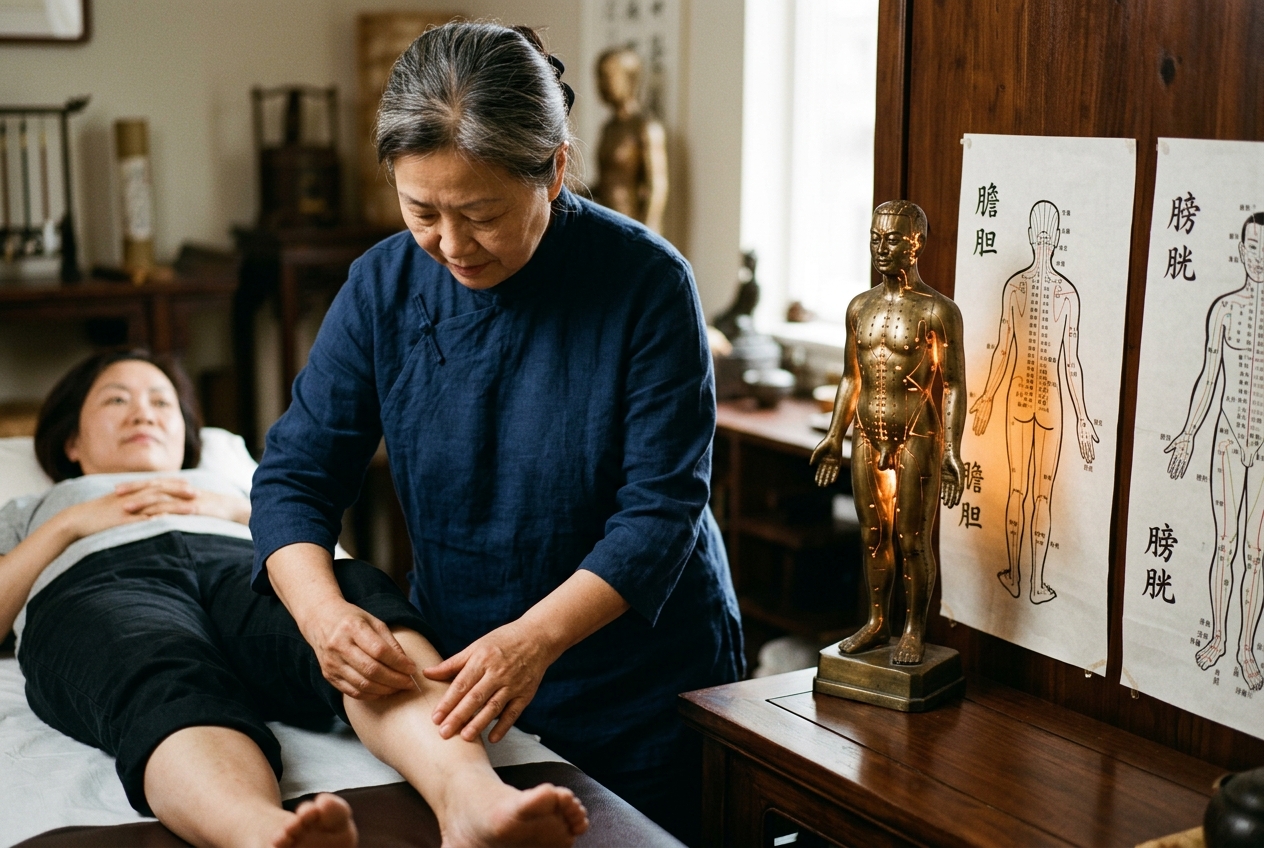
1. Opening Scene — A Moment You'll Recognise
You wake up, turn your head toward the morning light, and are instantly arrested by a sharp, pulling ache that tracks precisely from the base of your skull, over the apex of your shoulder, and down along the outer seam of your forearm to your index finger. There is no fever, no gastrointestinal distress, and no laboratory marker out of range; yet your neck feels like an overstretched bowstring, and your forearm muscles are taut and tender to the lightest touch. Later in the afternoon, after hours of tense focus at a desk, that ache mutates: a throbbing band tightens across your temples, an uncomfortable fullness lodges under your right ribcage, and a sharp pinch shoots down the lateral line of your hip and thigh whenever you bear weight.
In biomedicine, such complaints are often fragmented into disparate diagnostic buckets—cervical strain, tension-type headache, myofascial pain syndrome, or mild trochanteric bursitis. In the sophisticated clinical epistemology of Traditional Chinese Medicine (TCM), however, these somatic events are recognized not as isolated musculoskeletal anomalies, but as coherent, mapped manifestations of Channel Pathology (Jīng Bìng, 经病).
Long before an imbalance penetrates the deep, nutritive interior of an organ, the body’s vast, communicating web of connective tissue, interstitial fluid pathways, and bioelectrical channels speaks in the language of localized resistance, tender nodules, and radiating trajectories. Understanding this intricate landscape through Channel Differentiation (Jīng Luò Biàn Zhèng, 经络辨证) transforms vague physical discomfort into a precise anatomical and energetic roadmap for systemic restoration.
2. What This System Does: The Jing Luo Matrix, Fascia, and Visceral Interconnectivity
To appreciate channel differentiation, one must first grasp the core distinction between Channel-Proper Disorders (Jīng Bìng, 经病) and Visceral-Organ Disorders (Zàng Fǔ Bìng, 脏腑病).
The Chinese term Jīng Luò (经络) is commonly translated as "meridians" or "channels," but its literal etymology evokes a dynamic loom: Jīng denotes the longitudinal, unyielding warp threads that run vertically through the trunk and limbs, while Luò refers to the branching, horizontal weft networks that cross-stitch the tissues, skin, muscles, and viscera into an unbroken whole.
                                +-------------------------------------------+
                                |          PRIMARY CHANNEL (*JĪNG*)         |
                                |  (Longitudinal Deep Trunks / Axis Flow)  |
                                +---------------------+---------------------+
                                                      |
                                                      v
                                +-------------------------------------------+
                                |         COLLATERAL NETWORK (*LUÒ*)        |
                                |  (Superficial, Transverse, Interstitial)  |
                                +---------------------+---------------------+
                                                      |
                         +----------------------------+----------------------------+
                         |                                                         |
                         v                                                         v
    +-----------------------------------------+               +-----------------------------------------+
    |         CHANNEL PATHOLOGY (*JĪNG BÌNG*) |               |       VISCERAL PATHOLOGY (*ZÀNG FǓ BÌNG*)|
    | - Radiating somatic ache & numbness     |               | - Endocrine, metabolic, & biochemical   |
    | - Palpable fascial nodules / cords      |               | - Digestion, core thermoregulation      |
    | - Motor limitation along channel path   |               | - Constitutional organ failure / vacuity|
    +-----------------------------------------+               +-----------------------------------------+
Channel Pathology (Jīng Bìng) versus Visceral Pathology (Zàng Fǔ Bìng)
- Visceral Pathology (Zàng Fǔ Bìng): Concerns the physiological, metabolic, and biochemical functions of the internal parenchymal (Zàng) and hollow (Fǔ) organs—such as the Liver’s role in lipid metabolism and autonomic tone, the Spleen’s role in enzymatic digestive extraction, or the Kidney’s governance of fluid-electrolyte balance and endocrine vitality.
- Channel Pathology (Jīng Bìng): Pertains directly to the structural, myofascial, and bioelectrical conductivity along the anatomical pathway of the channel itself. When pathogenic factors (such as physical trauma, repetitive strain, postural distortion, or external climatic Wind, Cold, and Dampness) invade the meridian, the Qì (vital metabolic energy) and Xuè (nourishing blood) stagnate. This results in pain, paresthesias, restricted range of motion, and palpable tissue indurations along specific somatic pathways—often occurring while the internal visceral organ itself remains entirely unimpaired.
Modern biomedical research has increasingly corroborated this channel architecture. Seminal studies by Langevin and Yandow on the relationship between acupuncture meridians and connective tissue planes demonstrated an over 80% anatomical correspondence between traditional acupuncture points/channels and intermuscular or intramuscular connective tissue cleavage planes. When Qì stagnates in a channel, mechanical strain and altered interstitial fluid flow manifest as myofascial trigger points, altered collagen density, and neurogenic inflammation. The World Health Organization Traditional Medicine Strategy highlights the integration of these classical diagnostic frameworks with modern somatic mapping, providing a rigorous structural basis for classical Jingluo meridian theories.
3. How You Can Feel It: Diagnostic Differentiation Across the Six Conformations, Twelve Channels & Extraordinary Vessels
Channel differentiation relies on precise topological anatomy. A patient does not merely present with a "headache" or "back pain"; the clinician identifies the specific meridian conformation involved by mapping the exact somatic trajectory, aggravating positions, and palpatory signs.
                      THE SIX CHANNEL CONFORMATIONS & SOMATIC PAIN AXES
                      =================================================

+-------------------------------------------------------------------+
          |                      YANG CHANNELS (EXTERIOR)                     |
          +---------------------------------+---------------------------------+
                                            |
           +--------------------------------+--------------------------------+
           |                                |                                |
           v                                v                                v
    [ TÀIYÁNG (Greater Yang) ]     [ SHÀOYÁNG (Lesser Yang) ]      [ YÁNGMÍNG (Yang Brightness) ]
    * Occipital / Suboccipital     * Temporal & Parietal Head       * Frontal & Supraorbital Head
    * Trapezius / Rhomboid Spasm   * Sternocleidomastoid Tension    * Temporomandibular & Jaw Ache
    * Paraspinal / Sacral Line     * Intercostal / Hypochondriac    * Anterior Shoulder & Forearm
    * Posterior Hamstring / Heel   * Lateral Gluteal & Iliotibial   * Anterior Tibial / Dorsal Foot
                                            |
          +---------------------------------+---------------------------------+
          |                      YIN CHANNELS (INTERIOR)                      |
          +---------------------------------+---------------------------------+
                                            |
           +--------------------------------+--------------------------------+
           |                                |                                |
           v                                v                                v
    [ TÀIYĪN (Greater Yin) ]       [ SHÀOYĪN (Lesser Yin) ]        [ JUÉYĪN (Terminal Yin) ]
    * Anterolateral Arm Pain       * Deep Inner Foot / Achilles     * Vertex (Crown of Head) Pain
    * Medial Scapular Pulling      * Medial Knee & Deep Lumbar      * Subcostal / Diaphragm Spasm
    * Thenar Eminence Tightness    * Posterior-Medial Thigh Ache    * Inguinal & Inner Thigh Strain
The Six Conformations & The Twelve Primary Meridians
1. The Tàiyáng (Greater Yang) Axis: Bladder (Zú Tàiyáng) & Small Intestine (Shǒu Tàiyáng)
- Anatomical Trajectory: Begins at the inner canthus of the eye, ascends over the cranium, blankets the suboccipital ridge, descends down the paraspinal muscles (sacrospinalis group), courses over the gluteus maximus, down the posterior midline of the hamstrings and calf, terminating at the lateral pinky toe. In the upper limb, it runs from the ulnar digit up the posterior-medial arm to the scapula and neck.
- Somatic Symptom Complex: Acute stiffness at the occipital-cervical junction; unyielding upper back and trapezius tension; acute lumbar spasm aggravated by forward flexion; sciatica radiating strictly down the posterior thigh and calf to the lateral malleolus; ulnar neuritis.
- Classic Clinical Presentation: The "draft-in-the-neck" phenomenon where exposure to air conditioning induces severe suboccipital contraction, or posterior chain myofascial tightness from prolonged sedentary compression.
2. The Shàoyáng (Lesser Yang) Axis: Gallbladder (Zú Shàoyáng) & San Jiao (Shǒu Shàoyáng)
- Anatomical Trajectory: Traverses the lateral aspect of the human form. Begins at the outer canthus, zig-zags across the temporoparietal skull, crosses the superior trapezius, descends down the mid-axillary and lateral costal margins, navigates the lateral hip (tensor fasciae latae, trochanteric zone), down the iliotibial (IT) band and lateral fibula, ending at the fourth toe. Upper channel tracks the dorsal midline of the forearm through the triceps to the lateral eyebrow.
- Somatic Symptom Complex: Unilateral or throbbing temporal headaches; sternocleidomastoid and upper trapezius rigidity; intercostal neuralgia and hypochondriac distension; sharp, snapping pain at the greater trochanter; tight IT band syndrome; pain radiating to the lateral ankle.
- Classic Clinical Presentation: Chronic stress-induced lateral neck and temple tension accompanied by sighing, ribcage tightness, and clicking hip pain.
3. The Yángmíng (Yang Brightness) Axis: Stomach (Zú Yángmíng) & Large Intestine (Shǒu Yángmíng)
- Anatomical Trajectory: Dominates the anterior surface of the body. Originates infraorbitally and at the lateral nose, courses through the masseter and anterior neck, descends through the mamillary line, rectus abdominis, quadriceps (rectus femoris), anterior tibialis, to the second and third toes. Upper limb spans the radial aspect of the index finger, extensor carpi radialis, and anterior deltoid.
- Somatic Symptom Complex: Frontal and supraorbital headaches; sinus pressure; masseter clenching and temporomandibular joint (TMJ) dysfunction; anterior shoulder impingement; epicondylitis (tennis elbow); anterior shin splints and dorsal foot cramping.
- Classic Clinical Presentation: Clenched-jaw bruxism with radiating throbbing across the forehead, often paired with anterior shoulder stiffness following repetitive upper-body strain.
4. The Tàiyīn (Greater Yin) Axis: Lung (Shǒu Tàiyīn) & Spleen (Zú Tàiyīn)
- Anatomical Trajectory: Upper channel tracks from the subclavicular pectoral region down the anterolateral bicep and radial forearm to the thumb. Lower channel begins at the medial big toe, ascends along the anterior-medial border of the tibia, over the vastus medialis, entering the anteromedial groin and lateral abdomen.
- Somatic Symptom Complex: Subpectoral fascial contracture causing rounded-shoulder posture; radial wrist ache (de Quervain's tenosynovitis); medial tibial stress syndrome; heavy, aching, water-logged sensation in the inner lower limbs with focal tenderness along the medial tibial crest.
5. The Shàoyīn (Lesser Yin) Axis: Heart (Shǒu Shàoyīn) & Kidney (Zú Shàoyīn)
- Anatomical Trajectory: Upper limb runs along the deep medial axilla down the anterior-ulnar forearm to the little finger. Lower limb originates at the plantar surface of the foot (the bubbling spring), loops behind the medial malleolus, ascends the deep posterior-medial calf, medial popliteal space, and inner thigh to the pubic bone and paraspinal deep core.
- Somatic Symptom Complex: Plantar fasciitis, calcaneal spurs, and Achilles tendinopathy; deep, cold, aching soreness in the medial knee joint and deep lumbar spine; ulnar-sided palm tingling and medial elbow stiffness.
6. The Juéyīn (Terminal Yin) Axis: Pericardium (Shǒu Juéyīn) & Liver (Zú Juéyīn)
- Anatomical Trajectory: Upper channel runs down the central axis of the anterior forearm between the flexor carpi radialis and palmaris longus tendons into the palm. Lower channel starts at the lateral nail of the big toe, crosses the dorsum of the foot, ascends anterior to the medial malleolus, traverses the medial thigh adductors, encircles the external genitalia, and terminates internally at the vertex of the head via deep internal collaterals.
- Somatic Symptom Complex: Severe, deep, pulling vertex (crown of head) headaches; carpal tunnel syndrome and flexor tendonitis; tight groin and adductor strains; subdiaphragmatic tension and intercostal cramping.
The Extraordinary Vessels (Qí Jīng Bā Mài) in Channel Pathology
When channel pathologies transcend single-meridian pathways and involve broad postural or developmental axes, the Eight Extraordinary Vessels provide the organizing structural matrix:
| Extraordinary Vessel | Somatic Trajectory | Diagnostic Symptom Complex | Master / Coupled Point |
|---|---|---|---|
| Dū Mài (Governing Vessel) | Posterior spinal midline from coccyx over the cranium to upper lip | Rigid spine, inability to flex/extend trunk, severe axial back pain, suboccipital stiffness | SI 3 (Hòuxī) / BL 62 (Shēnmài) |
| Rèn Mài (Conception Vessel) | Anterior midline from perineum to chin | Central sternal constriction, linea alba myofascial tightness, pelvic floor floor tension | LU 7 (Lièquē) / KI 6 (Zhàohǎi) |
| Chōng Mài (Penetrating Vessel) | Deep pelvic core ascending through abdomen to throat | Spasmodic abdominal cramping, sensation of Qì rushing upward to chest, tight psoas | SP 4 (Gōngsūn) / PC 6 (Nèiguān) |
| Dài Mài (Girdling Vessel) | Horizontal band encircling the waist like a belt | Sensation of sitting in cold water, waist feeling as if broken, loose hip stability, flank weakness | GB 41 (Zúlínqì) / TE 5 (Wàiguān) |
| Qīao & Wéi Vessels | Bilateral lateral/medial vertical balance and superficial structural netting | Inversion/eversion ankle instability, intractable alternating chills/aches, lateral body collapse | BL 62 / KI 6 / TE 5 / PC 6 |
Palpatory Diagnostics: Reading the Fascial and Thermographic Landscape
A hallmark of channel differentiation is palpation (Qiè Zhěn, 切诊). The skilled practitioner does not merely rely on subjective patient reporting; they run their fingertips along the channel pathways to identify objective, localized tissue transformations:
[ Normal Tissue: Supple, Springy, Isothermal, Free Gliding ]
                            |
           Pathogenic Influx / Biomechanical Strain
                            |
                            v
+-------------------------------------------------------------------------+
|                  PALPATABLE PATHOLOGICAL SIGNATURES                     |
+-------------------------------------------------------------------------+
|  1. CORD-LIKE INDURATIONS (Suǒ Zhuàng Wù) : Chronic muscle/fascial     |
|     contractures (e.g., tight bands along GB 20, BL 23, GB 34).         |
|  2. NODULAR ACCUMULATIONS (Jié Jié)       : Round, pearl-like fibrotic  |
|     granules at Xi-Cleft or Yuan-Source sites indicating focal stasis.  |
|  3. THERMOGRAPHIC SHIFTS (Wēn Rè / Hán Liáng): Focal heat (acute        |
|     inflammation) vs. localized icy coolness (vacuity / cold stasis).  |
|  4. TENDER ĀSHÌ FOVEA (Yā Tòng Diǎn)     : Sharp, flinching pain on     |
|     direct perpendicular compression, signaling localized channel lock. |
+-------------------------------------------------------------------------+
- Cutaneous & Subcutaneous Nodules (Jié Jié, 结节): Small, mobile, or fixed pearl-like fibrotic granules found in the fascial clefts. When discovered near Xi-Cleft or Yuan-Source points, they confirm chronic, localized Blood stasis and Qì stagnation in that specific meridian.
- Cord-Like Indurations (Suǒ Zhuàng Wù, 索状物): Taut, violin-string fascial bands tracking longitudinally across muscle bellies (e.g., along the Gallbladder channel at the upper trapezius or the Bladder channel along the erector spinae).
- Thermographic Shifts: Running the dorsal aspect of the fingers along the channel reveals micro-climatic fluctuations. A cold, clammy zone denotes Qì and Yang deficiency with fluid stagnation; localized radiant heat denotes acute channel heat or constrained Wind-Fire.
- Pitting Flaccidity vs. Elastic Resistance: Depressions that fail to rebound indicate structural emptiness (Xū), whereas unyielding resistance under light pressure confirms channel repletion (Shí).
4. Qigong & Movement Practice: The Dragon Stretching the Six Lines (Lóng Shēn Liù Jīng)
This specialized, non-strenuous neuro-fascial unwinding practice is engineered to open the primary Yang channels (Tàiyáng, Shàoyáng, Yángmíng) and clear stagnant interstitial pressure across the cervical-thoracic-lumbar axis.
                    BIOMECHANICAL AXIS OF THE PRACTICE
                    ==================================

[Inhale] Expand Chest / Retract Scapulae  ---> Opens Tàiyīn & Yángmíng
        [Hold]   Spiral Neck & Peer Over Heel     ---> Twists & Wrings Shàoyáng Axis
        [Exhale] Soften Knees & Release Downward  ---> Decompresses Tàiyáng Paraspinals
Setup and Starting Alignment
- Stand with your feet parallel, hip-width apart, knees unlocked (micro-bent).
- Allow your pelvis to rest in a neutral, relaxed position so your lower back lengthens naturally.
- Suspend the crown of your head from above (the Bǎihuì point, DU 20), allowing your chin to tuck slightly while your shoulders melt away from your ears.
- Rest your hands comfortably over your lower abdomen (Dāntián), breathing naturally into your belly through your nose.
Step-by-Step Movement Sequence
Step 1: Opening the Anterior Axis (Yángmíng & Tàiyīn)
- Inhale slowly through your nose over a count of 4.
- Sweep both arms outward and upward in a broad circle until your hands reach shoulder height, turning your palms upward toward the sky.
- Gently expand your chest, draw your shoulder blades slightly toward your spine, and allow your gaze to elevate 15 degrees.
- Feel a gentle, lengthening stretch traversing from the tips of your thumbs (Lung channel), along your anterior biceps, across the pectoral girdle, and down your abdomen.
Step 2: The Spiral Wring for the Lateral Line (Shàoyáng)
- Retain the breath comfortably for 2 seconds.
- Begin a gentle, continuous spiral of your upper body to the left: rotate your torso, shoulders, and neck smoothly toward the left side.
- Drop your left arm behind your back to rest against your sacrum; simultaneously extend your right arm across your chest, pressing the heel of the right palm softly toward the left diagonal.
- Turn your head smoothly to look over your left shoulder down toward your left heel.
- Sensory checkpoint: Feel the spiral line wringing out the lateral neck, the space beneath your ribs, and the outer seam of your left hip.
Step 3: Descending Release Along the Posterior Chain (Tàiyáng)
- Exhale smoothly through your nose over a count of 6.
- Slowly unwind your torso back to center, soften your knees deeper, and allow your arms to drape forward like heavy silk ropes.
- Let your chin drop toward your chest, curling down one vertebra at a time through your cervical and upper thoracic spine.
- Only fold as far as is effortlessly comfortable (do not force a deep hamstring stretch); let the weight of your head gently traction the entire paraspinal muscle chain.
Step 4: Reset and Reverse
- Inhale as you gently push down through your feet, rolling up smoothly through your spine to stand tall once more.
- Repeat the entire sequence to the right side.
Prescription
- Reps & Duration: Perform 6 full cycles (3 to each side), lasting approximately 5 to 7 minutes in total.
- Sensory Milestones: Look for a warm, tingling sensation (the arrival of Qì, Dé Qì) traveling down your fingertips and across the lateral ribcage, followed by an immediate sense of spaciousness at the base of your skull and neck.
5. Acupressure Points & Clinical Point Prescription Algorithms
When channel blockages cause pain and stiffness, classical acupuncture utilizes sophisticated multi-point formulas based on dynamic point categories. Below are three primary self-care acupressure points, followed by advanced clinical prescription algorithms for practitioners.
Daily Acupressure Points You Can Use Today
        LOCATION: LI 4 (HÉGǓ)                    LOCATION: GB 34 (YÁNGLÍNGQUÁN)
   [ Dorsal Web Space: 1st & 2nd Metacarpals ]      [ Antero-Inferior to Fibular Head ]
                 |                                                 |
                 v                                                 v
         (•) Firm Pincer Grip                              (•) Deep Circular Pressure
         Resolves Frontal/Jaw Pain                         Softens Sinews & Lateral Tension
1. Large Intestine 4 (Hégǔ, 合谷) — "Joining Valleys"
- Anatomical Landmark: Located on the dorsum of the hand, between the first and second metacarpal bones, in the middle of the muscle belly of the first dorsal interosseous. Squeeze your thumb against your index finger; the point lies at the highest mound of the bulging muscle.
- Application Method: Use the opposite thumb and index finger to form a firm pincer clamp. Apply deep, continuous perpendicular pressure toward the bone, rotating in tiny micro-circles for 2 to 3 minutes per side while taking slow, deep breaths.
- Primary Clinical Action: Clears stagnation throughout the entire Yángmíng channel. Instantly relieves frontal headaches, sinus congestion, jaw clenching (TMJ pain), toothaches, and anterior shoulder tension. (Contraindicated during pregnancy).
2. Gallbladder 34 (Yánglíngquán, 阳陵泉) — "Yang Mound Spring"
- Anatomical Landmark: Located on the lateral aspect of the lower leg, in the soft depression situated approximately one finger-breadth anterior and inferior to the head of the fibula.
- Application Method: Place your thumb directly into the tender notch below the bony prominence on the outside of your knee. Apply firm, sustained pressure, angled slightly upward and inward, for 2 minutes on each leg.
- Primary Clinical Action: The Influential Point of the Sinews (Huì Xué). It relaxes hypertonic connective tissue, eases tight IT bands, resolves intercostal ribcage tension, and alleviates temporal headaches along the Shàoyáng axis.
3. Bladder 60 (Kūnlún, 昆仑) — "Kunlun Mountains"
- Anatomical Landmark: Located on the lateral ankle, in the deep, soft hollow situated midway between the prominence of the external malleolus (outer ankle bone) and the lateral border of the Achilles tendon.
- Application Method: Grasp your outer ankle with your thumb, pressing firmly into the hollow toward the center of the ankle joint. Maintain steady, rhythmic pressure for 90 seconds per side.
- Primary Clinical Action: The River point of the Tàiyáng meridian. Acts as a master release for the posterior chain: alleviates occipital headaches, acute cervical neck stiffness, upper trapezius spasms, and radiating lower back/sciatic pain.
Advanced Clinical Point Prescription Algorithms
For clinical practitioners, resolving channel blockages requires combining structural and functional point categories based on classical channel theory:
+---------------------------------------------------------------------------------------------------+
|                           CLASSICAL POINT COMBINATION STRATEGIES                                  |
+---------------------------------------------------------------------------------------------------+
|  1. HOST-GUEST (*YUÁN-LUÒ*) PAIRING : Combine the Yuan-Source point of the affected channel with |
|     the Luo-Connecting point of its internally-externally paired Yin/Yang meridian.                |
|     Example: GB 40 (Source) + LR 5 (Luo) to drain Gallbladder Fire and resolve lateral stasis.   |
|                                                                                                   |
|  2. XI-CLEFT (*XĪ-XUÉ*) INTERVENTION: Deploy Xi-Cleft points for acute, severe channel pain and    |
|     intractable localized blood stasis.                                                           |
|     Example: BL 63 (Jīnmén) for acute lumbar spasm; LU 6 (Kǒngzuì) for sharp respiratory/arm pain.|
|                                                                                                   |
|  3. FIVE SHU-TRANSPORT (*WǓ SHŪ XUÉ*): Select points based on Nan Jing dynamics:                  |
|     - Jǐng-Well (Distal clearance of acute fullness & heat)                                       |
|     - Yíng-Spring (Clears febrile inflammation along the meridian)                                |
|     - Shū-Stream (Treats heaviness, joint pain, and biomechanical stagnation)                    |
|     - Jīng-River (Treats cough, voice changes, and sinew/bone sensations)                         |
|     - Hé-Sea (Treats rebellious Qi and connects channel to viscera)                               |
|                                                                                                   |
|  4. DISTAL-LOCAL ANCHORING           : Pair distal trajectory-clearing points with localized      |
|     palpated tender points (*Āshì Xué*) to unbind the local myofascial compartment.               |
+---------------------------------------------------------------------------------------------------+
Neurophysiological investigations of these classical point combinations, such as the analysis of acupoint specificity and somatosensory pathways in NCBI PubMed, demonstrate that combining distal and local points activates descending inhibitory pain pathways and modulates sympathetic vasomotor tone, accelerating tissue repair along the meridian tract.
6. Food, Lifestyle & Clinical Ergonomics: Restoring Meridian Patency
Channel health requires maintaining optimal hydration, tissue elasticity, and unhindered blood flow through the microvasculature of the connective tissue. When tissues become chronically dehydrated, cold, or mechanically compressed, Qì and Blood congeal, locking channels into persistent dysfunction.
                           THE MERIDIAN HEALTH TRIAD
                           =========================

[ BIOMECHANICAL ALIGNMENT & ERGONOMICS ]
                  * Neutral Pelvis & Uncompressed Spine
                  * Eliminates Physical Trapping of Channels
                                    / \
                                   /   \
                                  /     \
                                 /       \
  [ THERMAL REGULATION ] <---------------+---------------> [ NUTRITIONAL HYDRATION ]
  * Protect Vulnerable Gates                               * Warm Broths, Ginger, Citrus Peel
  * Avoid Cold/Draft Stasis                                * Avoid Damp, Cold-Congealing Foods
1. Thermal Regulation: Protecting the Gates
- Wind-Cold Vulnerability: The posterior neck and upper back host the primary "Wind Gates" (Fēng Mén, BL 12; Fēng Chí, GB 20). Exposure to cold drafts causes rapid reflex contraction of the trapezius and suboccipitals, constricting the Tàiyáng and Shàoyáng channels. Always protect your cervical spine with a light scarf in air-conditioned environments.
- Targeted Heat Therapy: Apply a warm compress or moxibustion over chronically cold, cord-like indurations for 10–15 minutes daily. Heat dilates the local capillary bed, replenishes blood flow, and disperses cold-induced stagnation.
2. Dietary Therapy: Circulating the Channels
- Incorporate Meridian-Moving Aromatics: Add mild, pungent, and warming kitchen ingredients that gently move Qì and invigorate Blood without depleting Yin:
- Fresh Ginger (Shēng Jiāng): Warms and opens the Tàiyáng and Yángmíng channels, expelling exterior cold.
- Turmeric (Jiāng Huáng): Renowned in traditional pharmacopeias for breaking blood stasis and clearing shoulder and upper-limb channel obstruction.
- Tangerine Peel (Chén Pí): Regulates Qì, transforms dampness, and relieves distension along the ribcage and abdomen.
- Warm Bone or Vegetable Broths: Infuse connective tissues with bioavailable gelatin and hydration, preserving the slide and glide of fascial planes.
- Foods to Minimize: Heavily iced drinks, excess raw cold foods, and refined sugars. In TCM theory, excessive cold and damp foods impair the Spleen’s transformative capacity, leading to systemic "Dampness" that settles into the joints and channels as chronic heaviness and dull, achy pain.
3. Ergonomic Micro-Resets
- Prolonged sitting mechanically compresses the Bladder and Gallbladder channels along the gluteal and hamstring pathways. Set an hourly timer to stand, perform 3 gentle pelvic tucks, and roll your shoulders backward to prevent postural stagnation from solidifying into chronic fascial nodules.
7. Today's Takeaway
+-------------------------------------------------------------------------+
|                    YOUR 5-MINUTE DAILY CHANNEL RESET                    |
+-------------------------------------------------------------------------+
|  1. Apply firm pincer pressure to LI 4 (Hégǔ) on each hand (1 min).     |
|  2. Perform 4 cycles of the "Dragon Stretching the Six Lines" (3 min).  |
|  3. Sip a warm cup of hot water with a slice of fresh ginger (1 min).   |
|                                                                         |
|  RESULT: Decompresses the cervical-cranial axis, disperses stagnant     |
|  Qi, and restores effortless, fluid movement throughout your day.        |
+-------------------------------------------------------------------------+
The single most effective action you can take today for your meridian system requires no equipment and takes less than five minutes: perform four unhurried cycles of the Dragon Stretching the Six Lines, followed by sixty seconds of focused acupressure on LI 4 (Hégǔ). By gently lengthening the long fascial chains of your body and engaging your breath, you immediately decompress trapped neurovascular pathways, flush your interstitial connective tissue with fresh circulation, and restore the free, unhindered flow of Qì and Blood from your head to your toes.
Authoritative References & Further Reading
- World Health Organization: Traditional, Complementary and Integrative Medicine
- Langevin HM, Yandow JA. Relationship of acupuncture points and meridians to connective tissue planes. Anat Rec. 2002;269(6):257-265. (PubMed)
- Acupoint Specificity and Neuroimaging Somatosensory Networks (PubMed)
- Jingluo: The Channel Network in Classical Chinese Medicine (Wikipedia)
- Principles of Meridian Differentiation and Channel Theory (Wikipedia)
- The Neurophysiology of Xi-Cleft and Yuan-Source Acupoints (PubMed)