Biao and Ben Points: Navigating Ling Shu Branch-Root Dynamics, Distal-Core Energetics, and Reflexive Acupressure Protocols
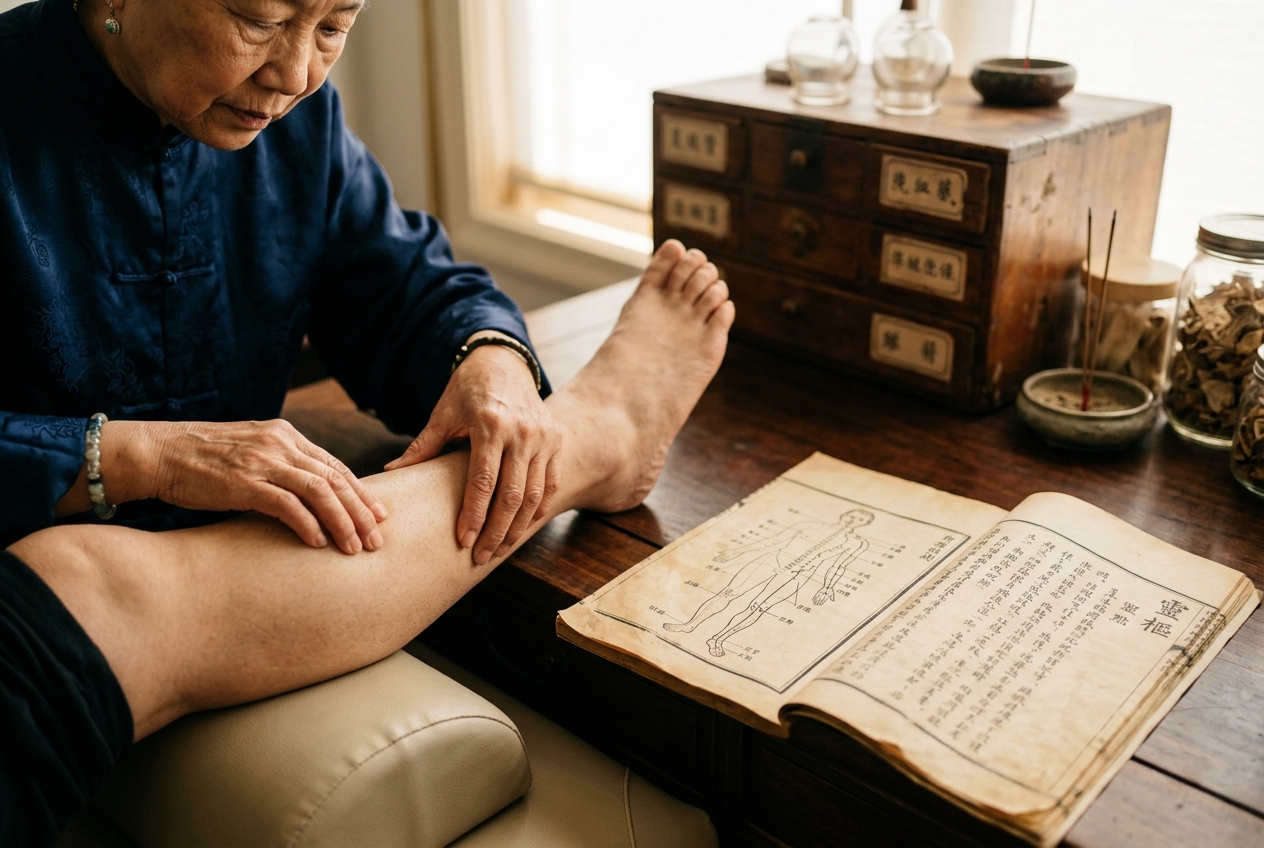
If you have ever spent a ten-hour day staring into the relentless blue glow of a workstation, only to find yourself gripped by a vise-like band of pressure across your temples, an aching heaviness at the base of your skull, and a dry, burning fatigue behind your eyeballs, you have experienced the unmistakable distress of an overloaded cranial circuit. The intuitive modern impulse is almost always local: we press our knuckles into our furrowed brows, dig our thumbs into the tight ridges of our occiput, or massage our throbbing temples. Yet within minutes of letting go, the throbbing reasserts itself. The pain returns because our therapeutic intuition addresses only the smoke, entirely missing the furnace.
Traditional Chinese Medicine (TCM) offers an alternative biomechanical and energetic paradigm for this exact frustration. In the foundational classical canons of East Asian medicine, the site where a symptom screams the loudest is rarely the place where the pathology originates. The human body is governed by a long-range communication network known as the Biao-Ben (Branch and Root) dynamic. Formulated over two millennia ago in the pivotal medical treatise the Huangdi Neijing (The Yellow Emperor’s Inner Classic), this doctrine asserts that the deep, potent energetic roots (Ben) of our internal organ networks reside far down on the distal extremities—the feet, ankles, hands, and wrists—while their broad clinical manifestations and symptomatic branches (Biao) unfurl across the head, chest, sensory orifices, and back.
Understanding this architecture transforms how we treat everyday pain, visceral stagnation, and stress. By mastering the bidirectional signaling between peripheral Ben roots and somatic Biao branches, one discovers that the most rapid and enduring way to clear a migraine, ease diaphragmatic constriction, or settle a turbulent digestive tract is not to attack the site of distress directly, but to manipulate the distant switches wired along the body's connective tissues and neurovascular pathways.
1. Classical Foundation: The Canonical Genesis of Biao and Ben in the Ling Shu
The theoretical bedrock of Biao-Ben dynamics is articulated in Chapter 6 (Wei Qi / "Defensive Qi") of the Ling Shu (The Divine Pivot), the acupuncture-focused half of the imperial medical canon compiled between the second century BCE and the second century CE. Here, the classical physician-philosophers asked a fundamental physiological question: How does life-sustaining Qi distribute itself between the somatic core and the periphery?
The canon reveals that every primary channel (Jingmai) possesses a functional polarization. The Ben (本, meaning "root," "stem," or "origin") represents the concentrated, stable energetic reservoir situated distally along the limbs—predominantly at or distal to the knee and elbow joints. Conversely, the Biao (標, meaning "branch," "treetop," or "outer manifestation") designates the proximal territory where that channel's energetic influence spreads outward into the viscera, sensory organs, face, and cranium.
The Ling Shu asserts:
"The foot channels have their Ben at the lower limbs and their Biao at the head, neck, and torso; the hand channels have their Ben at the wrists and forearms and their Biao at the chest, throat, and sensory portals."
This is not a static anatomical diagram; it describes a dynamic bidirectional highway. In health, Qi generated by the internal organs circulates outward to anchor in the Ben roots, while kinetic movements and sensory stimuli from the distal extremities transmit vital regulatory feedback inward and upward to the Biao manifestations.
When pathology strikes, this axis becomes distorted. A blockage in the lower extremities can cause Qi to rebel upward (Qi Ni), resulting in intracranial hypertension, ocular pain, or thoracic fullness. Conversely, chronic mental rumination or emotional trauma can congest the Biao canopy of the head and chest, depriving the peripheral Ben roots of circulation and leaving the feet and hands ice-cold. Restoring systemic equilibrium requires the clinician to treat the distal root to drain the proximal branch, or calm the proximal branch to nourish the distal root.
2. Comparative Diagnostics: Differentiating Biao-Ben, Gen-Jie, and Five Shu Systems
To comprehend Biao-Ben theory with true academic precision, one must distinguish it from two other classical topographical systems with which it is frequently conflated: Gen-Jie (Root and Knot) and the Wu Shu Xue (Five Shu Transport Points).
The Five Shu System: The Longitudinal Hydraulic Model
The Five Shu system models channel Qi as a linear river flowing from the tips of the digits toward the elbows and knees: 1. Jing-Well (Jing): Where Qi bubbles forth at the nail beds. 2. Ying-Spring (Ying): Where Qi trickles through the metatarsal/metacarpal valleys. 3. Shu-Stream (Shu): Where Qi pours and cascades across the wrists and ankles. 4. Jing-River (Jing): Where Qi flows heavily along the forearms and lower legs. 5. He-Sea (He): Where Qi plunges deeply into the visceral core at the elbows and knees.
This system is inherently unidirectional and elementally graded according to Five Phase (Wu Xing) mechanics.
The Gen-Jie System: The Quadrant Convergence Model
Detailed in Ling Shu Chapter 5, the Gen-Jie ("Root and Knot") doctrine is an axial teleology. The Gen (roots) reside exclusively at the extreme distal Jing-Well points of the toes and fingers, while the Jie (knots) represent massive convergence centers situated in the three anatomical cavities: the cranium (Niwan), the thorax (Tanzhong), and the lower abdomen (Guanyuan). Gen-Jie is primarily used to explain how systemic Yang and Yin forces gather into functional anatomical centers.
The Biao-Ben System: The Bidirectional Resonance Model
Biao-Ben does not restrict its roots exclusively to terminal nail beds, nor are its branches confined to broad abdominal zones. Instead, Biao-Ben establishes precise point-to-point and region-to-region functional alignments across all twelve primary channels. It serves as both a diagnostic polarity and a therapeutic lever.
Where the Five Shu points describe how deep the Qi is running, and Gen-Jie describes where Qi gathers, Biao-Ben dictates how distal actions trigger specific proximal reactions. It explains why stimulating a point on the lateral fifth toe directly decompresses the inner canthus of the eye and the occipital suboccipital triangle.
3. Topographical Mapping of the Twelve Primary Channels
The Ling Shu outlines a rigorous anatomical atlas mapping the Ben and Biao zones for each of the twelve primary channels. Standardized in modern clinical practice alongside the World Health Organization (WHO) Standard Acupuncture Point Locations, this matrix forms the architectural blueprint of meridian resonance:
The Foot Channels: Grounding the Cranium and Torso
- Foot Taiyang (Bladder): The Ben originates at the lateral aspect of the fifth metatarsophalangeal joint at point BL65 (Shugu) and throughout the distal Achilles tendon. Its Biao blooms at the inner ocular canthus at BL1 (Jingming) and ascends into the suboccipital musculature at BL10 (Tianzhu). This creates a continuous posterior kinetic chain running the entire length of the dorsal human frame.
- Foot Yangming (Stomach): The Ben anchors at the lateral tip of the second digit at ST45 (Lidui) and travels up the anterior compartment of the shin. Its Biao manifests at the carotid bifurcation at ST9 (Renying), branching upward into the maxillary sinuses and the frontalis muscle of the forehead.
- Foot Shaoyang (Gallbladder): The Ben is anchored at the lateral fourth toe at GB44 (Zuqiaoyin) and the lateral malleolus. Its Biao covers the lateral cranium, specifically GB1 (Tongziliao) at the outer eye and GB2 (Tinghui) at the temporomandibular joint.
- Foot Taiyin (Spleen): The Ben sits at the junction of the medial malleolus and tibial shaft around SP6 (Sanyinjiao). Its Biao projects into the mid-axillary lymphatic line at SP21 (Dabao) and deep into the epigastrium at CV12 (Zhongwan).
- Foot Shaoyin (Kidney): The Ben roots in the plantar depression of the foot at KD1 (Yongquan) and the medial calcaneal basin at KD7 (Fuliu). Its Biao surfaces at the suprahyoid lingual root at CV23 (Lianquan) and the bilateral lumbar paraspinal zone at BL23 (Shenshu).
- Foot Jueyin (Liver): The Ben gathers along the medial tibia at LR5 (Ligou) and the web space between the first and second toes at LR3 (Taichong). Its Biao terminates at the hypochondriac costal margin at LR14 (Qimen) and ascends internally to the cranial vertex at GV20 (Baihui).
The Hand Channels: Regulating the Senses and Thorax
- Hand Taiyin (Lung): The Ben anchors at the radial wrist crease at LU9 (Taiyuan). Its Biao manifests over the pectoral apex at LU1 (Zhongfu) and the supraclavicular fossa at ST12 (Quepen).
- Hand Yangming (Large Intestine): The Ben resides in the first dorsal interosseous muscle at LI4 (Hegu) and the lateral elbow crease at LI11 (Quchi). Its Biao terminates at the contralateral alar base of the nose at LI20 (Yingxiang).
- Hand Shaoyang (San Jiao / Triple Burner): The Ben anchors between the fourth and fifth metacarpals at TE3 (Zhongzhu). Its Biao dominates the lateral tail of the eyebrow at TE23 (Sizhukong) and the periauricular fascial envelope.
- Hand Taiyang (Small Intestine): The Ben roots along the ulnar border of the hand at SI3 (Houxi) and the olecranon groove at SI8 (Xiaohai). Its Biao manifests at the tragus of the ear at SI19 (Tinggong) and the zygomatic cheek bone.
- Hand Shaoyin (Heart): The Ben is secured at the ulnar wrist crease at HT7 (Shenmen). Its Biao projects into the precordial center at CV14 (Juque) and the sensory apparatus of the tongue.
- Hand Jueyin (Pericardium): The Ben rests between the tendons of flexor carpi radialis and palmaris longus at PC6 (Neiguan). Its Biao expands across the sternal midline at CV17 (Danzhong) and the subaxillary region at PC1 (Tianchi).
4. Physiological and Neurological Mechanisms
Modern biomedical and biomechanical research has begun to demystify why stimulating these distal extremities produces profound physiological changes in distant somatic and visceral zones. The efficacy of the Biao-Ben axis is driven by three interconnected physiological systems: myofascial tensegrity, autonomic reflex pathways, and neurovascular signaling.
1. Myofascial Tensegrity and Cytoskeletal Transduction
Research pioneered by Dr. Helene Langevin and published in the Journal of Cellular Physiology demonstrates that acupuncture and manual acupressure exert mechanical shear strain upon interstitial connective tissue. When a distal Ben point such as BL65 (foot) or LI4 (hand) is palpated, fibroblasts within the surrounding extracellular matrix undergo cellular deformation.
Through integrin-mediated cytoskeletal mechanotransduction, this localized mechanical signal ripples along continuous sheets of deep investing fascia. As described in Thomas Myers’ Anatomy Trains model, the Foot Taiyang channel corresponds precisely to the Superficial Back Line—a continuous myofascial sheet running from the plantar fascia, through the Achilles tendon, gastrocnemius, hamstrings, sacrotuberous ligament, and spinal erectors, over the galea aponeurotica of the skull, and terminating at the supraorbital ridge (BL1). Mechanical decompression initiated at the distal calcaneal root physically alters resting resting tension across the cranial canopy.
2. Somatovisceral Reflexes and Dorsal Horn Convergence
The neuroanatomical basis of Biao-Ben organ regulation relies heavily on the somatovisceral reflex. Neuroanatomical mapping conducted at Harvard Medical School by Dr. Qiufu Ma and colleagues, detailed in Nature, has identified specific somatic sensory neurons that drive systemic autonomic anti-inflammatory and visceral regulatory axes.
When a distal Ben point like ST36 (Zusanli) is stimulated, primary somatic afferent fibers (specifically A-delta and C fibers) transmit action potentials into the dorsal horn of the spinal cord. Because somatic afferent pathways from the limbs converge on the same secondary spinal interneurons and ascending spinothalamic tracts that receive visceral autonomic signals from the digestive and cardiopulmonary viscera, peripheral stimulation can modulate visceral motility, suppress sympathetic hyperarousal, and dampen the perception of central visceral pain.
3. Axonal Reflexes, Purinergic Signaling, and Microvascular Tone
Localized mechanical pressure on peripheral Ben points triggers the immediate release of adenosine triphosphate (ATP), which rapidly degrades into extracellular adenosine—a potent biochemical mediator of analgesia and vasodilation.
This triggers an antidromic axonal reflex, releasing calcitonin gene-related peptide (CGRP) and substance P. These neuropeptides promote localized microvascular dilation, while simultaneously sending signals through ascending pathways to the periaqueductal gray (PAG) and nucleus raphe magnus in the brainstem. The brainstem responds by releasing endogenous endorphins, systemically downregulating nociceptive signaling across the corresponding Biao zones in the head, neck, and chest.
5. Key Points You Can Palpate and Press Right Now
To bridge classical theory and daily practice, we can focus on three primary Biao-Ben anchor points. These points provide clear therapeutic access to the body's major kinetic and neurological pathways.
1. Zu San Li (ST36 - "Leg Three Miles") | The Yangming Gastrointestinal Root
- Location: Sit comfortably with your knees bent at a right angle. Place the palm of your right hand over your right kneecap. Your fingers will naturally drape down the front of your shinbone. Locate the soft muscular depression approximately four finger-widths below the lower edge of the kneecap, and one finger-width to the outside of the sharp anterior crest of the tibia.
- Somatic Landmark: The muscular belly of the tibialis anterior. When you flex your foot upward toward your shin, this muscle will bulge directly under your fingertip.
- The Deqi Sensation: A distinct, dull, spreading ache that often radiates down the outer shin into the ankle or upward toward the knee joint.
- Palpation Dynamics: Apply firm pressure using the tip of your thumb, angled slightly inward toward the center of the shinbone. Maintain steady, rhythmic pressure for 2 to 3 minutes while breathing deeply into your lower abdomen.
- Daily Relief: Rapidly eases postprandial bloating, counters midday lethargy, stabilizes blood sugar spikes, and soothes anticipatory gut anxiety.
2. Tian Zhu (BL10 - "Celestial Pillar") | The Taiyang Occipital Branch
- Location: Rest your fingertips on the back of your head and let your thumbs slide into the base of your skull. Locate the broad, firm bands of the trapezius muscle running vertically up the back of your neck. BL10 lies in the soft, ropey depression immediately along the outer border of these large muscle bands, about half an inch above your hairline and half an inch lateral to the spine.
- Somatic Landmark: The lateral suboccipital insertion of the trapezius on the occipital bone.
- The Deqi Sensation: A deep, satisfying tenderness that often produces a warming, releasing sensation spreading over the crown of the head toward the eyes.
- Palpation Dynamics: Interlace your fingers behind your cranium and use both thumbs to apply firm, upward-angled pressure into the base of the skull. Hold for 90 to 120 seconds while gently tilting your chin downward to stretch the back of your neck.
- Daily Relief: Releases stubborn tension headaches, relieves chronic screen-induced eye strain, alleviates cervicogenic stiffness, and calms a racing nervous system.
3. Nei Guan (PC6 - "Inner Gate") | The Jueyin Thoracic and Enteric Conductor
- Location: Extend your left arm with your palm facing upward. Place the three middle fingers of your right hand across your left inner wrist, with your ring finger resting on the proximal wrist crease. The point lies directly beneath the index finger, precisely in the center of the forearm between the two prominent, ropey tendons.
- Somatic Landmark: The soft valley between the flexor carpi radialis and palmaris longus tendons. (If you make a tight fist and flex your wrist upward, these two tendons will stand out prominently).
- The Deqi Sensation: A characteristic heavy, numbing, or slightly electric sensation that travels down into the palm or up the forearm toward the inner elbow.
- Palpation Dynamics: Press your right thumb perpendicularly into the groove between the tendons. Apply sustained, moderate pressure while slowly rotating your left wrist in gentle circles. Hold for 2 minutes on each arm.
- Daily Relief: Relieves acute motion sickness and nausea, releases tight diaphragmatic constriction, slows a racing heart during panic episodes, and softens sleep-disrupting anxiety.
6. Clinical Point Combinations for Common Somatic Issues
By pairing a distal Ben point with its corresponding proximal Biao manifestation, you engage both ends of the meridian circuit simultaneously. This creates a balanced, lasting therapeutic effect.
Protocol 1: Acute Occipital Tension, Screen Fatigue, and Temple Pressure
Channel Systems: Hand Yangming (Large Intestine) and Foot Taiyang (Bladder)
[ Step 1: Drain the Root ]                [ Step 2: Clear the Branch ]
LI4 (Hegu) / BL65 (Shugu)                  BL10 (Tianzhu) / Suboccipital Ridge
Firm thumb pressure (120s)                 Upward traction (90s)
Drains excess Qi downward                  Decompresses myofascial tension
- Target Presentation: Severe tension headache at the base of the skull, radiating temple throbbing, stiff upper trapezius, and dry, strained eyes after extended computer use.
- Positioning: Sit upright in a supportive chair with your feet flat on the floor, your shoulders dropped, and your jaw relaxed.
Step-by-Step Procedure:
- Engage the Distal Root (Ben) at LI4 (Hegu): Locate the web space between the thumb and index finger of your left hand, on the highest point of the muscle when the thumb and finger are brought close together. Grasp this muscular ridge with your right thumb and index finger. Apply firm, deep pressure angled toward the bone of the index finger. Hold for 120 seconds while taking slow, measured breaths. Repeat on the right hand.
- Clear the Distal Hydraulic Root (Ben) at BL65 (Shugu): Move down to your foot. On the outer border of the foot, locate the depression just behind (proximal to) the flare of the little toe’s fifth metatarsophalangeal joint. Press firmly inward toward the center of the foot with your thumb for 60 seconds on each side. This drains tension downward from the head along the dorsal fascia.
- Decompress the Proximal Manifestation (Biao) at BL10 (Tianzhu): Reach both hands behind your neck and place your thumbs on the suboccipital base at BL10 (just outside the vertical neck muscles). Lean your head slightly back into your thumbs, applying firm, upward-angled pressure. Close your eyes, inhale deeply for a count of 4, and exhale for a count of 6. Continue for 90 seconds.
Protocol 2: Diaphragmatic Constriction, Shallow Breathing, and Grief-Induced Chest Tightness
Channel System: Hand Taiyin (Lung)
[ Step 1: Open the Distal Wrist ]          [ Step 2: Expand the Pectoral Canopy ]
LU9 (Taiyuan)                              LU1 (Zhongfu)
Gentle pulsating pressure (90s)            Broad circular friction (120s)
Soothes the radial arterial pulse          Releases subclavicular tightness
- Target Presentation: Sensation of a tight band around the ribs, inability to take a satisfying deep breath, postural chest collapse, or a heavy emotional lump in the throat.
- Positioning: Recline comfortably against pillows at a 45-degree angle, or lie flat on your back with a small bolster under your knees.
Step-by-Step Procedure:
- Anchor the Distal Pulse Root (Ben) at LU9 (Taiyuan): On the palmar crease of your left wrist, locate the soft depression at the extreme radial edge, immediately on the outer side of the radial artery (where you feel your wrist pulse). Using your right index fingertip, apply gentle, sustained pressure directly into this depression without occluding the arterial pulse. Hold for 90 seconds, focusing your awareness on the slow, steady rhythm under your finger.
- Release the Thoracic Manifestation (Biao) at LU1 (Zhongfu): Locate the prominent hollow just below the outer end of your collarbone (the infraclavicular fossa). Slide your fingers down about one inch below this hollow onto the upper outer chest wall, just medial to the shoulder joint. Place the flat pads of your fingers over LU1 and apply firm, broad circular friction. Breathe deeply into the apex of your lungs, imagining the chest expanding horizontally. Continue for 120 seconds on each side.
Protocol 3: Epigastric Bloating, Sluggish Digestion, and Enteric Anxiety
Channel Systems: Foot Yangming (Stomach) and Hand Jueyin (Pericardium)
[ Step 1: Activate the Extremities ]       [ Step 2: Unbind the Epigastric Core ]
ST36 (Zusanli) + PC6 (Neiguan)             CV12 (Zhongwan) / Epigastrium
Firm, rhythmic compression (180s)          Clockwise palmar massage (120s)
Stimulates vagal parasympathetic drive     Softens the enteric nervous system
- Target Presentation: Abdominal distension following meals, reflux, nervous nausea, intestinal cramping, or a persistent sensation of gut tension.
- Positioning: Lie comfortably on your back with your knees bent and the soles of your feet resting flat on the mattress or floor to soften your abdominal wall.
Step-by-Step Procedure:
- Engage the Distal Digestive Engines (Ben) at ST36 and PC6: Begin by pressing PC6 (Neiguan) on your left inner wrist for 90 seconds to relax your diaphragm and soothe the vagus nerve. Next, move down to your legs and locate ST36 (Zusanli) on your shin. Use your thumb or the knuckle of your index finger to apply firm, rhythmic, downward-kneading pressure into the tibialis anterior muscle for 180 seconds on each leg.
- Unbind the Central Somatic Canopy (Biao) at CV12 (Zhongwan): Locate the midline of your abdomen, halfway between the lower edge of your breastbone (xiphoid process) and your belly button. Rest the warm palm of your right hand flat over this center. Inhale slowly, letting your belly rise gently into your hand; as you exhale, apply gentle, melting palmar pressure, moving in slow, clockwise circles around your upper abdomen for 2 full minutes.
7. Safety, Clinical Cautions, and Sensible Practice
Acupressure along the Biao-Ben meridian circuits is an exceptionally safe, non-invasive therapeutic modality. However, working with powerful neurovascular and fascial trigger zones requires appropriate clinical care and clear contraindications.
Pregnancy Precautions
Certain distal Ben points exert a powerful descending energetic vector (Jiang Qi) and stimulate uterine myometrial tone via spinal reflex arcs.
Pressure Guidelines and Tissue Sensitivity
Acupressure should evoke the classical Deqi sensation—a dull, heavy, spreading ache, a mild localized tingling, or a pleasant sensation of myofascial release. It should never cause sharp, piercing, or excruciating pain.
Avoid pressing directly over visible, inflamed varicose veins, acute bruises, fractures, skin infections, or deep vein thromboses. Furthermore, extreme caution must be exercised around anterior cervical points like ST9 (Renying): never apply bilateral or heavy pressure over the carotid triangle, as this can stimulate the carotid sinus baroreceptors and trigger sudden bradycardia or hypotension.
When to Seek Medical Evaluation
Acupressure is a restorative and complementary modality; it is not an alternative to emergency medical care. Seek prompt medical attention if you experience: - Sudden, unprecedented "thunderclap" headaches accompanied by neck stiffness or fever. - Acute neurological deficits (sudden vision loss, facial drooping, slurred speech, or unilateral limb weakness). - Crushing substernal chest pressure radiating to the left arm, jaw, or shoulder blade. - Severe, localized abdominal pain with guarding, rebound tenderness, and high fever.
8. Today's Takeaway: A Two-Minute Somatosensory Reset
Before you close this guide and return to your daily routine, take two minutes to experience the power of the Biao-Ben circuit directly on your own nervous system.
- Locate: Drop your hands into your lap. Bring your right thumb into the muscular webbing of your left hand, finding the highest point of the muscle between your thumb and index finger (LI4 - Hegu).
- Press: Angle your right thumb inward toward the index finger bone until you feel that familiar, dull, spreading ache.
- Breathe: Close your eyes. Inhale slowly through your nose for a count of 4, feeling your lower ribs expand. Exhale slowly through your nose for a count of 6.
- Observe: As you sustain this deep pressure for 60 seconds, notice how the tension in your jaw, the tight bands across your temples, and the heaviness behind your eyes begin to soften and drain downward.
- Switch: Move your left thumb over to your right hand’s LI4 point and repeat for another 60 seconds with the same slow, extended exhalations.
In just two minutes, you have engaged the ancient Biao-Ben axis—using a distal switch on the hand to clear the cranial canopy, grounding your mind and centering your body for the day ahead.