Balance Method Meridian Systems: Navigating Six Channel Balance Matrices, Holographic Mirroring, and Distal Acupressure Protocols
1. OPENING — A PROBLEM THIS SOLVES TODAY
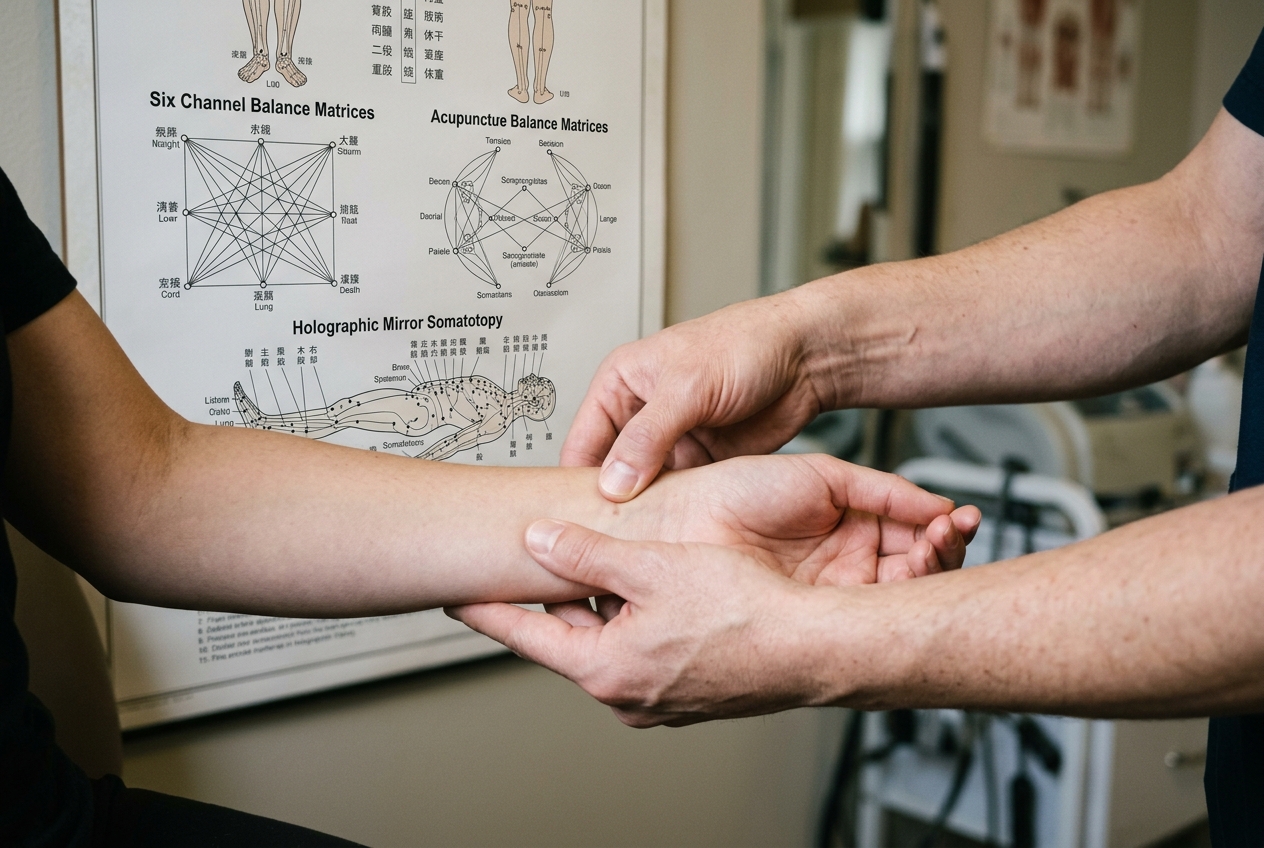
If you have ever spent hours locked in a desk chair only to rise with a searing ache tracing the lateral seam of your hip down into your calf, or if you awaken with a vice-like throb gripping your temples and an uneasy tightness knotting your stomach before a high-stakes presentation, you have experienced the distributed nature of somatic distress. Conventional intuition urges us to press, rub, or manipulate the exact site of suffering—kneading the painful lower back, digging into the irritated subacromial tendon, or pressing the throbbing temple. Yet, in clinical practice, direct local manipulation frequently exacerbates acute inflammation, triggers protective myofascial guarding, and fails to alter the underlying functional dysregulation.
Traditional Chinese Medicine (TCM) offers a radically counter-intuitive and mathematically precise alternative: the treatment of somatic and visceral pathology through distal energetic counterpoints. When an individual suffers from acute lateral hip impingement or sciatic neural tension along the posterior leg, relief is often achieved not by touching the lumbar spine or the gluteus, but by palpating a tender nodule along the contralateral forearm or the web between the metacarpal bones of the hand.
+-------------------------------------------------------------------------------+
| CLINICAL PARADOX IN SOMATIC PAIN MANAGEMENT                                   |
| Local tissue irritation -> Direct local pressure triggers myofascial spasm    |
| Distal balancing stimulation -> Stimulates mechanoreceptors along reciprocal   |
| channels, initiating instantaneous descending pain inhibition and myofascial  |
| remodeling without tissue trauma at the primary lesion site.                  |
+-------------------------------------------------------------------------------+
This phenomenon is neither arbitrary nor mystical; it represents the clinical application of the Balance Method, a classical therapeutic framework formalized in the late twentieth century by the late Dr. Richard Teh-Fu Tan. Rooted in the binary mathematical structures of the I Ching (Book of Changes) and codified through the Six Channel (Liu Jing) physiological pathways articulated in the Huangdi Neijing (Inner Canon of the Yellow Emperor), the Balance Method transforms the human meridian system into a dynamic matrix of energetic and mechanical reciprocity.
By understanding how channels reflect, invert, and harmonize one another across anatomical planes, clinicians and patients can achieve rapid, non-invasive analgesic and visceral regulation. Today, biomedical research into mechanotransduction and connective tissue continuity confirms that remote mechanical deformation along tension lines modulates dorsal horn gating and autonomic tone, validating classical channel balance as an integrated neuro-fascial science.
2. THE MERIDIAN PATH — A JOURNEY THROUGH CLASSICAL FOUNDATIONS AND THE LIVING BODY
To understand how distal points command distant bodily regions, one must conceptualize the twelve primary meridians (Jing Luo) not as isolated conduit pipes, but as interconnected bio-cybernetic loops spanning the extremities, trunk, and cranium.
                  +-------------------------------+
                  |      THE SIX CHANNEL AXES     |
                  +---------------+---------------+
                                  |
         +------------------------+------------------------+
         |                                                 |
         v                                                 v
  [ THREE YANG CHANNELS ]                          [ THREE YIN CHANNELS ]
  * Taiyang: Supreme Defensive Exterior           * Taiyin: Structural Nourishment
    (SI: Hand -> BL: Foot)                          (LU: Hand -> SP: Foot)
  * Yangming: Abundant Qi & Blood Matrix          * Jueyin: Terminal Hinge / Reversal
    (LI: Hand -> ST: Foot)                          (PC: Hand -> LR: Foot)
  * Shaoyang: Dynamic Metabolic Pivot             * Shaoyin: Deep Core Essence
    (SJ: Hand -> GB: Foot)                          (HT: Hand -> KI: Foot)
In classical Chinese medical physiology, the twelve channels are organized into Six Channel pairings (Liu Jing), each divided into a Hand (Shou) and a Foot (Zu) division:
- Taiyang (Greater Yang): Hand Small Intestine (Shou Taiyang) and Foot Bladder (Zu Taiyang). Representing the most superficial, defensive layer of the body, Taiyang runs along the ulnar border of the hand, ascends the dorsal shoulder, crosses the occiput, traverses the entire paraspinal musculature down the posterior thigh and calf, terminating at the lateral fifth digit of the foot.
- Yangming (Yang Brightness): Hand Large Intestine (Shou Yangming) and Foot Stomach (Zu Yangming). Characterized as "abundant in Qi and Blood," Yangming originates at the radial aspect of the index finger, ascends the anterolateral arm and shoulder to the cheek and jaw, before descending down the anterior neck, chest, rectus abdominis, quadriceps, and anterior tibialis, culminating at the second toe.
- Shaoyang (Lesser Yang): Hand Sanjiao / Triple Burner (Shou Shaoyang) and Foot Gallbladder (Zu Shaoyang). Serving as the physiological "pivot" (Shu) between interior and exterior, Shaoyang ascends the dorsal aspect of the ring finger, weaves through the lateral forearm, traverses the supraspinatus, wraps around the auricular region, descends the lateral ribs, flank, iliotibial band, and lateral fibula to the fourth toe.
- Taiyin (Greater Yin): Hand Lung (Shou Taiyin) and Foot Spleen (Zu Taiyin). The primary metabolic interface for post-heaven Qi and fluid transformation, Taiyin originates in the middle abdomen, surfaces near the infraclavicular fossa, runs along the anteromedial aspect of the arm to the thumb, and pairs with the pathway ascending from the medial great toe, along the inner shinbone and anteromedial thigh, to the lateral costal margin.
- Jueyin (Absolute / Terminal Yin): Hand Pericardium (Shou Jueyin) and Foot Liver (Zu Jueyin). The energetic pivot of the Yin realm regulating blood storage and vascular smooth muscle tone, Jueyin traverses the central anterior forearm, passes between the flexor carpi radialis and palmaris longus tendons, enters the center of the palm, and connects to the medial ascending pathway tracing the instep, inner knee, and inguinal ring up to the ribcage.
- Shaoyin (Lesser Yin): Hand Heart (Shou Shaoyin) and Foot Kidney (Zu Shaoyin). The deepest constitutional axis uniting the imperial fire of the Heart and the primordial water of the Kidney, Shaoyin traces the axillary space down the posteromedial arm to the little finger, interfacing with the deep ascending channel that emerges from the plantar sole (Yongquan, KI 1), circles the medial malleolus, ascends the posteromedial calf, and hugs the anterior midline of the trunk.
The Hexagram Polarity Architecture
Dr. Richard Tan’s core theoretical breakthrough lay in recognizing that the Six Channels are macroscopic physiological expressions of the sixty-four hexagrams of the I Ching. Each meridian is assigned a core trigram (Ba Gua) based on its Yin/Yang polarity, depth, and anatomical orientation.
                                 [ QIAN: Pure Yang === ]
                                           |
                                   (Hexagram Inversion)
                                           |
                                 [ KUN: Pure Yin - - - ]
When pathology manifests as pain, stagnation, or functional deficiency, the local channel's electromagnetic and bio-informational field is distorted. To re-establish equilibrium without aggravating the affected region, one applies a complementary trigram via a distal meridian whose binary structure offsets and stabilizes the diseased channel. The interaction between paired channels operates through six distinct mathematical balancing systems.
3. THE SIX SYSTEMS OF MERIDIAN BALANCING & HOLOGRAPHIC PROJECTION
+==================================================================================================+
|                       DR. RICHARD TAN'S SIX BALANCING SYSTEMS                                    |
+========+=============================+==================================+========================+
| System | Name / Theoretical Basis     | Channel Relationship             | Archetypal Example     |
+--------+-----------------------------+----------------------------------+------------------------+
| 1      | Same Name / Hand-Foot Axis  | Hand Channel <-> Foot Channel    | Hand Taiyang (SI)      |
|        | (Same Liu Jing Name)        | (Same Yin/Yang Identity)         | balances Foot Taiyang  |
|        |                             |                                  | (BL)                   |
+--------+-----------------------------+----------------------------------+------------------------+
| 2      | Interior-Exterior Coupling  | Yin Channel <-> Yang Channel     | Hand Taiyang (SI)      |
|        | (Biao-Li Relationship)      | (Same Limb Segment)              | balances Hand Shaoyin  |
|        |                             |                                  | (HT)                   |
+--------+-----------------------------+----------------------------------+------------------------+
| 3      | Midnight-Noon Polarity      | Opposite Limb Segment            | Hand Taiyang (SI)      |
|        | (Clock Opposite / Ziwu)     | (Opposite Yin/Yang on Chrono-Map)| balances Foot Taiyin   |
|        |                             |                                  | (SP)                   |
+--------+-----------------------------+----------------------------------+------------------------+
| 4      | Clock Neighbor Flow         | Sequential Circulation Partner   | Hand Taiyang (SI)      |
|        | (Continuous Qi Generation)  | (Preceding or Succeeding Channel)| balances Foot Shaoyang |
|        |                             |                                  | (GB) or Hand Yangming  |
+--------+-----------------------------+----------------------------------+------------------------+
| 5      | Same Name Alternate Axis    | Hand Yin/Yang <-> Foot Alternate | Hand Taiyang (SI)      |
|        | (Crossed Liu Jing Axis)     | (Hexagram Line Transformation)   | balances Foot Shaoyin  |
|        |                             |                                  | (KI)                   |
+--------+-----------------------------+----------------------------------+------------------------+
| 6      | Interior-Exterior Cross-Pair| Yin/Yang Paired Channel          | Hand Taiyang (SI)      |
|        | (Crossed Biao-Li Coupling)  | (Located on Opposite Extremity)  | balances Foot Shaoyin  |
|        |                             |                                  | (KI) / Hand Shaoyin-BL |
+========+=============================+==================================+========================+
Deconstructing the Six Systems
System 1: Same Name (Hand-Foot Axis / Tong Ming)
System 1 pairs channels that share the exact same Six-Channel (Liu Jing) classification across the upper and lower extremities. Because Hand Taiyang (Small Intestine) and Foot Taiyang (Bladder) share the identical structural frequency of Greater Yang, mechanical stimulation along the distal Hand Taiyang channel (e.g., SI 3, SI 4) instantly balances and relieves acute stagnation along the Foot Taiyang channel in the lumbar spine, gluteal crease, or popliteal fossa.
System 2: Interior-Exterior Coupling (Biao-Li Anatomical Pairs)
Based on direct organ-viscus couplings within the same extremity segment, System 2 pairs Yin and Yang meridians that share an interior-exterior functional bridge. For instance, the Hand Taiyang (Small Intestine, Yang) channel directly balances the Hand Shaoyin (Heart, Yin) channel. Pain manifesting along the anterior arm or axillary crest (Heart meridian) can be resolved by selecting points along the lateral border of the hand and scapula (Small Intestine meridian).
System 3: Clock Opposite (Midnight-Noon / Ziwu Liuzhu Polarity)
In the 24-hour chronobiological circulation of Qi through the twelve channels, each meridian sits directly opposite another channel separated by twelve hours on the Chinese Horary Clock. For example, Hand Taiyang (Small Intestine, maximal activity 1:00 PM – 3:00 PM) stands in direct polarity with Foot Taiyin (Spleen, maximal activity 9:00 AM – 11:00 AM). Consequently, chronic or acute digestive distress and medial leg edema along the Spleen pathway can be treated by manipulating Small Intestine points on the hand and wrist.
                    12:00 PM (Heart - Hand Shaoyin)
                                  ^
                                  |
   9:00 AM (Spleen) <-------------+-------------> 3:00 PM (Bladder)
                                  |
                                  v
                   12:00 AM (Gallbladder - Foot Shaoyang)
System 4: Clock Neighbor (Sequential Flow)
Channels that share a direct entry-exit transition in the circadian energetic sequence possess strong communicative resonance. Hand Taiyang (Small Intestine) transitions directly into Foot Taiyang (Bladder), which then transitions into Foot Shaoyin (Kidney). Furthermore, preceding channels balance their successors. System 4 allows a clinician to utilize the adjacent functional channel to redirect stagnant pressure along the kinetic chain.
System 5: Same Name Alternate Limb Axis (Trigram Inversion)
System 5 pairs channels possessing the same energetic name across an inverted Yin/Yang polarity and alternate limb axis. By converting the hexagram lines of Hand Taiyang into its structural opposite, one derives Foot Shaoyin (Kidney). This enables profound cross-limb balancing: deep lower-back pain (Bladder/Kidney territory) can be relieved via point arrays on the contralateral upper limb (Hand Taiyang/Hand Shaoyin).
System 6: Interior-Exterior Cross-Pairing
System 6 combines the principles of Biao-Li coupling (System 2) and Cross-Limb dynamics (System 1/5). Hand Taiyang (Small Intestine) pairs with Foot Shaoyin (Kidney), while Hand Shaoyin (Heart) balances Foot Taiyang (Bladder). This allows complete diagonal body balancing—ideal for complex, multidimensional pain syndromes where local palpation is contraindicated.
Anatomical Mirroring and Imaging Formats
Once the balancing meridian is selected using the Six Systems, the specific point prescription is determined through Holographic Projection Matrices. The human organism exhibits self-similar fractal geometry; any single anatomical segment contains a complete holographic representation of the whole body.
+-----------------------------------------------------------------------------------+
|                        ANATOMICAL MIRRORING (LIMB-TO-LIMB)                        |
+-----------------------------------------+-----------------------------------------+
| DIRECT MIRROR                           | REVERSE MIRROR                          |
| * Hand / Wrist    <---> Foot / Ankle    | * Hand / Wrist    <---> Hip / Pelvis    |
| * Forearm         <---> Lower Leg       | * Forearm         <---> Thigh           |
| * Elbow           <---> Knee            | * Elbow           <---> Knee            |
| * Upper Arm       <---> Thigh           | * Upper Arm       <---> Lower Leg       |
| * Shoulder        <---> Hip / Groin     | * Shoulder        <---> Foot / Ankle    |
+-----------------------------------------+-----------------------------------------+
|                        ANATOMICAL IMAGING (LIMB-TO-TRUNK/HEAD)                    |
+-----------------------------------------+-----------------------------------------+
| DIRECT IMAGE                            | REVERSE IMAGE                           |
| * Fingers / Hand  <---> Head / Vertex   | * Fingers / Hand  <---> Perineum / Pelvis|
| * Wrist / Forearm <---> Throat / Chest  | * Wrist / Forearm <---> Lower Abdomen   |
| * Elbow           <---> Epigastrium/M.T.| * Elbow           <---> Epigastrium/M.T.|
| * Upper Arm       <---> Lower Abdomen   | * Upper Arm       <---> Chest / Thorax  |
| * Shoulder        <---> Pelvis / Groin  | * Shoulder        <---> Head / Occiput  |
+-----------------------------------------+-----------------------------------------+
- Direct Mirroring (Limb-to-Limb Iso-Localization): Joints correspond directly across upper and lower limbs. The wrist corresponds to the ankle; the forearm corresponds to the calf/shin; the elbow corresponds to the knee; the shoulder corresponds to the hip.
- Reverse Mirroring (Limb-to-Limb Inverted Localization): The limb is inverted over its reciprocal partner. The hand/wrist mirrors the hip/gluteus; the elbow mirrors the knee; the shoulder mirrors the foot/ankle. This explains why stimulating the metacarpal space of the hand resolves deep gluteal and piriformis spasms.
- Direct Imaging (Limb-to-Trunk Projection): The entire human torso and cranium are mapped along a single extremity from proximal to distal. In the direct image, the top of the hand or foot represents the cranium; the wrist/ankle corresponds to the neck and cervical spine; the forearm/lower leg corresponds to the chest and epigastrium; the shoulder/hip corresponds to the hypogastrium and reproductive organs.
- Reverse Imaging (Inverted Limb-to-Trunk Projection): The projection is flipped. The hand/foot corresponds to the pelvic basin, sacrum, and genital floor; the elbow/knee corresponds to the solar plexus; the shoulder/hip corresponds to the head, atlas, and occipital ridge.
4. KEY CLINICAL POINTS FOR NON-INVASIVE ACUPRESSURE
To achieve clinical efficacy via acupressure, the practitioner must not merely push on skin, but engage the deeper fascia to elicit Deqi—a distinct sensation of localized dullness, distension, warmth, or radiating bio-electric tingling. Mechanical deformation of the interstitial matrix activates Piezoelectric currents in collagen fibrils and stimulates low-threshold A-beta mechanoreceptors, instigating rapid gate-control inhibition in the spinal cord.
+===================================================================================================================+
|                                    TARGET ACUPRESSURE MATRIX FOR BALANCE METHOD                                   |
+==============+=========================+=============================+============================================+
| Point Name   | Anatomical Landmark     | Somatosensory Feedback      | Clinical Target Indications                |
+--------------+-------------------------+-----------------------------+--------------------------------------------+
| Linggu       | Dorsal hand webspace,   | Distinct deep radiating     | Acute lower lumbar spine pain, sciatic     |
| (Tung/System)| junction of 1st & 2nd   | ache, localized heaviness,  | distribution, epigastric hypomotility,     |
|              | metacarpal bases        | electric descending impulse | constitutional Yang deficiency             |
+--------------+-------------------------+-----------------------------+--------------------------------------------+
| Zhongbai     | Dorsal hand, depression | Dull aching tension,        | Acute lateral neck spasm, temporal         |
| (SJ 3 / A01) | proximal to 4th & 5th   | spreading numbness toward   | cephalalgia, subacromial impingement,      |
|              | metacarpophalangeal jct | the mid-forearm             | outer canthus / retroauricular pain        |
+--------------+-------------------------+-----------------------------+--------------------------------------------+
| Tiaokou      | Anterior leg, 8 cun     | Intense radiating sensation | Severe frozen shoulder, subacromial        |
| (ST 38)      | inferior to tibial tub.,| down into foot and upward   | impingement, anterior hip flexor contract, |
|              | 1 finger-breadth lat.   | to knee                     | Yangming frontal sinus congestion          |
+--------------+-------------------------+-----------------------------+--------------------------------------------+
| Neiguan      | Volar forearm, 2 cun    | Spreading warmth, mild      | Thoracic outlet constriction, cardiac      |
| (PC 6)       | proximal to wrist crease| electric pulse, diaphragmatic| arrhythmia sensations, epigastric nausea,  |
|              | between flexor tendons  | relaxation                  | stress-induced globus hystericus           |
+==============+=========================+=============================+============================================+
1. Linggu (Master Tung / Balance System Point)
- Precise Anatomical Location: Situated on the dorsum of the hand, in the deep osseous junction between the first and second metacarpal bones, proximal to the standard location of Large Intestine 4 (Hegu).
- Palpatory Verification & Somatosensation: When palpated correctly with deep, angled pressure toward the radial aspect of the second metacarpal bone, the recipient experiences a pronounced, deep muscular ache, accompanied by an instantaneous sense of warmth radiating up the forearm or descending the spine.
- Biomechanical Application Technique: Apply firm, constant compressive force using the thumb tip angled at 45 degrees into the bone edge. Hold for 90 to 180 seconds while directing the patient to actively mobilize their affected joint (e.g., rotating the painful lumbar spine or mobilizing a restricted shoulder).
- Clinical Utility: Unsurpassed for resolving contralateral acute lumbar paraspinal spasms, sciatic nerve impingement (Foot Taiyang/Foot Shaoyang territory), and chronic upper pelvic stagnation via Reverse Mirroring.
       [Thumb: 1st Metacarpal]
                 \
                  \   (Linggu - Deep at the junction)
                   \  *
                    \ |
       [Index Finger: 2nd Metacarpal]
2. Zhongbai / Zhongzhu (Hand Shaoyang SJ 3 / Tung 22.06)
- Precise Anatomical Location: Located on the dorsal surface of the hand, in the groove between the fourth and fifth metacarpal bones, roughly 0.5 cun proximal to the metacarpophalangeal joint.
- Palpatory Verification & Somatosensation: Palpation elicits an immediate, sharp yet satisfying ache that disperses proximally between the ulna and radius.
- Biomechanical Application Technique: Anchor the patient's hand with your fingers supporting the palm. Apply sustained rotary kneading with your thumb for 2 minutes. Simultaneously, ask the patient to perform slow, deep cervical rotations.
- Clinical Utility: Rapidly eliminates temporal cephalalgia, unilateral migraine episodes, supraspinatus tendonitis, and acute lateral neck restriction via System 1 (balancing Foot Shaoyang Gallbladder) and System 4.
3. Tiaokou (Foot Yangming ST 38)
- Precise Anatomical Location: On the anterolateral aspect of the lower leg, exactly midway between the inferior border of the patella and the lateral malleolus (8 cun distal to the tibial plateau), one finger-breadth lateral to the anterior crest of the tibia.
- Palpatory Verification & Somatosensation: Deep perpendicular pressure triggers an unmistakable, profound neuro-fascial response (Deqi) that travels downward into the ankle and dorsal foot.
- Biomechanical Application Technique: Apply vigorous, circular friction with the reinforced thumb or knuckle, driving the force into the interosseous membrane between the tibia and fibula for 2 to 3 minutes.
- Clinical Utility: Serves as the quintessential distal balancing locus for severe acute subacromial shoulder impingement and frozen shoulder along the Large Intestine, Sanjiao, and Small Intestine channels via System 1 (Yangming balances Yangming) and System 2 (Yangming balances Taiyin).
4. Neiguan (Hand Jueyin PC 6)
- Precise Anatomical Location: On the anterior forearm, 2 cun (approximately the width of two interphalangeal thumb segments) proximal to the distal wrist flexion crease, situated strictly between the tendons of the flexor carpi radialis and the palmaris longus.
- Palpatory Verification & Somatosensation: Gentle but focused perpendicular pressure generates a localized dull ache with spreading sensations toward the central palm and the medial epicondyle of the elbow.
- Biomechanical Application Technique: Use the tip of the thumb to press perpendicularly into the fascial interspace between the tendons. Maintain steady compression for 120 seconds while guiding the patient through diaphragmatic breathing.
- Clinical Utility: Balances Foot Shaoyang (System 2, Jueyin-Shaoyang pairing) and Foot Yangming (System 3, Horary polarity), delivering immediate relief for epigastric distension, gastroesophageal reflux, temporal tension, and stress-induced cardiac palpitations.
5. DISTAL ACUPRESSURE PROTOCOLS FOR FOUR MAJOR CLINICAL PATTERNS
+==================================================================================================+
|                         SYSTEMIC BALANCE METHOD CLINICAL PROTOCOLS                               |
+=========================+==========================+=============================================+
| Clinical Syndrome       | Affected Meridians       | Distal Balancing Prescription               |
+=========================+==========================+=============================================+
| 1. Acute Sciatic Pain   | Foot Taiyang (BL) and/or | Contralateral Linggu + Dabai (Hand Yangming)|
|    (Posterior / Lateral)| Foot Shaoyang (GB)       | + Zhongbai (SJ 3) + Houxi (SI 3)            |
+-------------------------+--------------------------+---------------------------------------------+
| 2. Subacromial Shoulder | Hand Yangming (LI) and/or| Contralateral Tiaokou (ST 38)               |
|    Impingement          | Hand Shaoyang (SJ)       | + Yanglingquan (GB 34) + Zusanli (ST 36)    |
+-------------------------+--------------------------+---------------------------------------------+
| 3. Temporal Cephalalgia | Foot Shaoyang (GB) and/or| Contralateral Zhongbai (SJ 3) + Neiguan     |
|    (Lateral Head Pain)  | Hand Shaoyang (SJ)       | (PC 6) + Taichong (LR 3)                    |
+-------------------------+--------------------------+---------------------------------------------+
| 4. Epigastric Qi        | Foot Yangming (ST) and/or| Bilateral Neiguan (PC 6) + Gongsun (SP 4)   |
|    Stagnation & Reflux  | Foot Taiyin (SP)         | + Lieque (LU 7)                             |
+=========================+==========================+=============================================+
Protocol 1: Acute Sciatic Distribution Pain (Posterior/Lateral Axis)
        Contralateral Hand/Wrist             Contralateral Foot/Ankle
       [Linggu / SI 3 / SJ 3]                      [BL 60 / GB 40]
                 \                                     /
                  \                                   /
                   =======> [ LUMBAR / SCIATIC ] <======
                            [ LESION SITE (Pain) ]
- Pathophysiological Landscape: Severe radiating pain originating in the lumbosacral junction (L4-S1) traversing the piriformis, posterior ischial notch (Foot Taiyang / Bladder), and iliotibial band (Foot Shaoyang / Gallbladder).
- Balancing Strategy: 1. Foot Taiyang (Bladder) is balanced by Hand Taiyang (Small Intestine) via System 1 (Same Name) and Hand Shaoyin (Heart) via System 5. 2. Foot Shaoyang (Gallbladder) is balanced by Hand Shaoyang (Sanjiao) via System 1 and Hand Jueyin (Pericardium) via System 2. 3. Mirroring Principle: Reverse Mirror (Hand/Metacarpus projects onto Hip/Pelvic Basin).
- Step-by-Step Acupressure Sequence: 1. Positioning: Have the patient sit comfortably with the lumbar spine supported, avoiding direct compression on the sciatic notch. 2. Contralateral Stimulation: Identify the hand opposite the symptomatic leg. 3. Point 1 (Linggu): Sink your thumb firmly into the osseous junction of the first and second metacarpals. Apply deep, oscillating force for 90 seconds. While maintaining pressure, instruct the patient to gently flex, extend, and rotate the lumbar spine or mobilize the seated hip. 4. Point 2 (Houxi, SI 3): Locate the ulnar border of the hand, proximal to the fifth metacarpophalangeal joint. Press directly into the bone edge, holding for 60 seconds to balance the posterior Bladder pathway. 5. Point 3 (Zhongbai, SJ 3): Press into the intermetacarpal depression between the fourth and fifth digits for 60 seconds to clear the lateral Gallbladder pathway. 6. Duration & Frequency: Repeat the complete distal cycle twice for a total intervention time of 6 to 8 minutes. Significant reduction in tension and pain should be noted immediately.
Protocol 2: Subacromial Shoulder Impingement & Rotator Cuff Tendonitis
- Pathophysiological Landscape: Pain localized to the anterior and lateral shoulder capsular complex during abduction and internal rotation, affecting the supraspinatus and biceps long head tendons (Hand Yangming / Large Intestine and Hand Shaoyang / Sanjiao territories).
- Balancing Strategy: 1. Hand Yangming (Large Intestine) is balanced by Foot Yangming (Stomach) via System 1 and Foot Jueyin (Liver) via System 5. 2. Hand Shaoyang (Sanjiao) is balanced by Foot Shaoyang (Gallbladder) via System 1 and Foot Jueyin (Pericardium/Liver) via System 2 & 6. 3. Mirroring Principle: Direct Mirror (Knee / Lower Leg projects onto Elbow / Shoulder) and Reverse Mirror (Ankle / Foot projects onto Shoulder).
- Step-by-Step Acupressure Sequence: 1. Positioning: Patient remains seated with the injured shoulder resting passively in a neutral, supported posture. 2. Contralateral Leg Selection: Use the lower extremity on the opposite side of the affected shoulder. 3. Point 1 (Tiaokou, ST 38): Palpate 8 cun distal to the patella, 1 finger-breadth lateral to the tibia. Apply deep, vigorous kneading using your knuckle. Maintain firm pressure while instructing the patient to slowly elevate and abduct the restricted arm through its full, previously painful arc of motion (Dong Qi dynamic mobilization). Continue for 120 seconds. 4. Point 2 (Yanglingquan, GB 34): Locate the tender depression situated anterior and inferior to the head of the fibula. Apply sustained compressive pressure for 90 seconds to release the lateral deltoid and supraspinatus fibers. 5. Point 3 (Zusanli, ST 36): Locate 3 cun distal to the lateral patellar eye. Press firmly for 60 seconds to flood the Yangming axis with descending neuro-inhibitory signals. 6. Duration: 5 minutes total. Re-evaluate passive and active range of motion; patients typically report an immediate 40–70% reduction in impingement pain.
Protocol 3: Temporal Cephalalgia & Unilateral Migraine (Shaoyang Pivot)
- Pathophysiological Landscape: Throbbing unilateral pain concentrated over the temporal bone, parietal ridge, and supraorbital margin, corresponding to hyperactive Liver/Gallbladder Yang or microvascular spasticity along the Foot and Hand Shaoyang channels.
- Balancing Strategy: 1. Foot Shaoyang (Gallbladder) is balanced by Hand Shaoyang (Sanjiao) via System 1, Hand Jueyin (Pericardium) via System 2, and Foot Jueyin (Liver) via System 5. 2. Mirroring Principle: Direct Imaging (Metacarpals and distal joints project to Cranium/Vertex).
- Step-by-Step Acupressure Sequence: 1. Positioning: Patient lies supine in a quiet, dimly lit environment, taking slow diaphragmatic breaths. 2. Point 1 (Contralateral Zhongbai, SJ 3): Apply moderate, pulsing pressure into the 4th-5th intermetacarpal space for 2 minutes to drain acute heat from the cranial Shaoyang loop. 3. Point 2 (Bilateral Neiguan, PC 6): Shift to the anterior forearms. Press both PC 6 points simultaneously with your thumbs for 90 seconds, harmonizing the Jueyin terminal axis to regulate cranial vascular resistance. 4. Point 3 (Contralateral Taichong, LR 3): Palpate the dorsal foot depression between the first and second metatarsal bones. Press deeply toward the heel for 90 seconds to anchor surging Liver Qi and mitigate neurogenic vasodilation. 5. Duration: 6 minutes total.
Protocol 4: Epigastric Qi Stagnation, Gastroesophageal Reflux & Functional Dyspepsia
- Pathophysiological Landscape: Postprandial bloating, epigastric fullness, acid regurgitation, and functional gastroparesis spanning the Foot Yangming (Stomach) and Foot Taiyin (Spleen) pathways.
- Balancing Strategy: 1. Foot Yangming (Stomach) is balanced by Hand Taiyin (Lung) via System 3 (Midnight-Noon) and Hand Jueyin (Pericardium) via System 6. 2. Foot Taiyin (Spleen) is balanced by Hand Taiyang (Small Intestine) via System 3 and Hand Shaoyin (Heart) via System 1. 3. Mirroring Principle: Direct Image (Forearm flexor region projects directly to Epigastrium and Solar Plexus).
- Step-by-Step Acupressure Sequence: 1. Positioning: Patient in a comfortable reclining or semi-Fowler position with legs uncrossed. 2. Point 1 (Neiguan, PC 6): Press into the central forearm 2 cun above the wrist crease for 2 minutes. This stimulates vagal efferent pathways to downregulate gastric hyperacidity and restore normal antral motility. 3. Point 2 (Gongsun, SP 4): Locate the depression at the basomedial aspect of the first metatarsal bone on the inner foot. Press firmly for 90 seconds to open the Chong Mai (Penetrating Vessel) and disperse middle jiao distension. 4. Point 3 (Lieque, LU 7): Located 1.5 cun proximal to the radial styloid process on the lateral forearm. Apply gentle linear friction for 60 seconds to mobilize descending Lung and Stomach Qi. 5. Duration: 5 to 7 minutes. Follow with slow sips of warm water.
6. SAFETY, PHYSIOLOGICAL LIMITS & CLINICAL GOVERNANCE
While distal Balance Method acupressure is an extraordinarily safe and non-invasive modality, rigorous clinical governance demands strict adherence to physiological thresholds and contraindications.
+==================================================================================================+
|                            SAFETY CRITERIA & CONTRAINDICATION MATRIX                             |
+=========================+=======================================+================================+
| Risk Category           | High-Risk Zones / Points              | Clinical Rationale / Red Flags |
+=========================+=======================================+================================+
| Pregnancy (Absolute     | Hegu (LI 4), Sanyinjiao (SP 6),       | Potent oxytocic stimulation,   |
| Contraindications)      | Jianjing (GB 21), Zhiyin (BL 67),     | downward-bearing Qi induction, |
|                         | Linggu (Deep 1st/2nd Metacarpal Web)  | uterine contractility risk     |
+-------------------------+---------------------------------------+--------------------------------+
| Vascular & Tissue       | Carotid sinus bifurcation, popliteal  | Risk of embolus mobilization,  |
| Compromise              | fossa aneurysms, severe varicose      | tissue dissection, bruising in |
|                         | veins, open dermatological lesions    | coagulopathic patients         |
+-------------------------+---------------------------------------+--------------------------------+
| Red-Flag Pathology      | Unexplained "thunderclap" cephalalgia,| Immediate referral required;   |
| (Non-Acupressure        | progressive sensory-motor deficit,    | indicates structural, ischemic,|
| Indications)            | suspected cauda equina, visceral shock| or neoplastic emergencies      |
+=========================+=======================================+================================+
> [!CAUTION]
> **Pregnancy Precautions**: Points exhibiting downward-bearing Qi dynamics—specifically **Linggu**, **LI 4 (*Hegu*)**, **SP 6 (*Sanyinjiao*)**, and **GB 21 (*Jianjing*)**—must be completely avoided throughout pregnancy due to their ability to stimulate myometrial contractility and induce labor.
Biomechanical Pressure Thresholds
Acupressure must never inflict sharp, tearing, or bruising trauma. Pressure should always fall within a subjective rating of 4 to 7 out of 10 on the patient's discomfort scale—the state known clinically as "pleasant soreness" (Suan Tong). If a patient tenses their protective musculature, the mechanosensory reflex is aborted, inducing sympathetic fight-or-flight dominance rather than parasympathetic neuromodulation.
Red-Flag Clinical Triaging
Distal balancing methods are designed for functional dysregulation, neuro-muscular entrapment, and myofascial tension. They do not replace emergency medical intervention. Immediate clinical referral is mandatory whenever a patient presents with: * Sudden, catastrophic "thunderclap" headache or progressive unilateral neurological deficits (ruling out stroke or intracranial hemorrhage). * Saddle anesthesia, loss of bowel/bladder sphincter control, or bilateral lower extremity foot drop (ruling out acute Cauda Equina Syndrome). * Unremitting nocturnal bone pain, unexplained systemic weight loss, or high-grade unresolving fever (ruling out malignancy or osteomyelitis). * Acute rigid abdomen with rebound tenderness (ruling out hollow organ perforation or peritonitis).
7. TODAY'S TAKEAWAY: A TWO-MINUTE IMMEDIATE SOMATIC RESET
+-------------------------------------------------------------------------------+
|                       THE 2-MINUTE OPPOSITE-HAND PROTOCOL                     |
|                                                                               |
| Step 1: Identify Side & Channel -> Pinpoint exact location of pain/tension    |
| Step 2: Locate Mirror Point     -> Measure 2-3 cm into opposite hand/forearm   |
| Step 3: Deep Rotary Pressure   -> Apply firm 45-degree angle pressure          |
| Step 4: Active Mobilization    -> Gently move restricted area for 120 seconds |
+-------------------------------------------------------------------------------+
For immediate relief of acute desk-bound shoulder tension, lateral neck stiffness, or stress-induced tension headaches right now, execute this self-balancing micro-practice:
- Locate: Find your non-dominant hand. Using your other thumb, find the tender depression between the fourth and fifth metacarpal bones on the back of your hand (Zhongbai / SJ 3), about 1.5 cm behind the knuckle of your ring finger.
- Engage: Press firmly inward at a slight angle toward your ring finger bone until you detect a distinct, deep ache (a 5/10 on the sensitivity scale).
- Mobilize: While holding this steady, rhythmic pressure for exactly two minutes, slowly perform gentle shoulder rolls and slow side-to-side neck stretches while inhaling and exhaling deeply through the nose.
By stimulating the Hand Shaoyang pivot distally, you immediately trigger mechanotransductive signaling and descending pain inhibition across your upper trapezius and temporal chain.
REFERENCES AND AUTHORITATIVE CITATIONS
- World Health Organization (WHO) Standard Acupuncture Point Locations in the Western Pacific Region — Official international anatomical standards for meridian pathways and point topography.
- Langevin, H. M., et al. (NCBI PubMed) — Relationship of Acupuncture Points and Meridians to Connective Tissue Planes — Groundbreaking cellular and histological evidence validating the mechanotransductive nature of acupuncture points and myofascial interstitial sheets.
- Vickers, A. J., et al. (NCBI PubMed) — Acupuncture for Chronic Pain: Individual Patient Data Meta-Analysis — Rigorous clinical meta-analysis demonstrating significant, robust pain reduction across musculoskeletal domains compared to sham controls.
- National Center for Biotechnology Information (NCBI PubMed) — Neurobiological Mechanisms of Acupuncture and Acupressure — Detailed exposition of descending inhibitory pathways, beta-endorphin release, and spinal gate control mechanisms activated by distal somatic stimulation.
- Wikipedia: I Ching and Binary Systems — Classical mathematical lineage and trigram polarity structures underlying Dr. Richard Tan’s Balance Method matrix.
- Wikipedia: Traditional Chinese Medicine Meridian Theory — Comprehensive encyclopedic overview of the Twelve Primary Channels and Six Channel (Liu Jing) physiological classifications.