Bagua Circle Walking Qigong: Tangential Centrifugal Torque, Mud-Stepping Biomechanics, and Helical Spinal Vectoring in Daoist Martial Daoyin
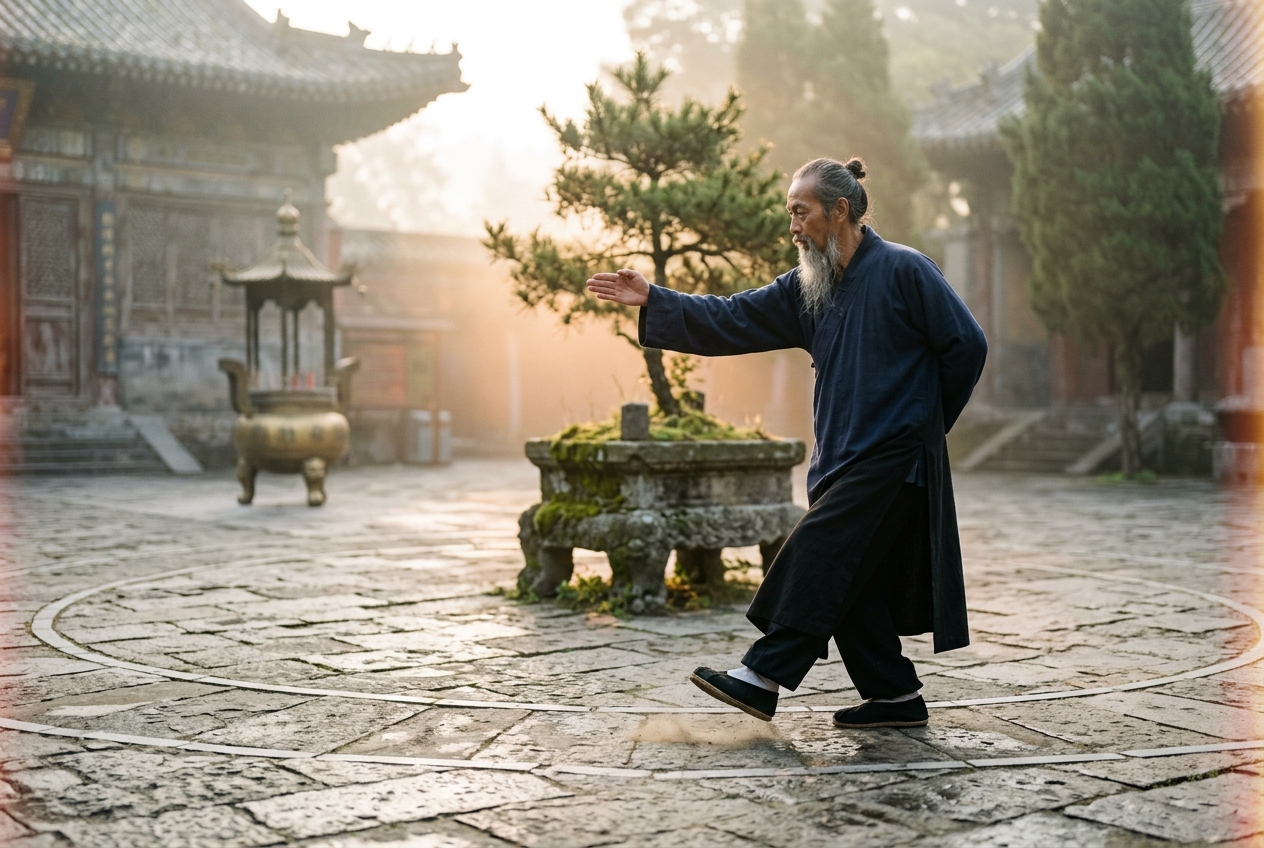
       DIRECTION OF MOVEMENT: CLOCKWISE OR COUNTER-CLOCKWISE

                     [ Step 2: Bai Bu (Out-Hook) ]
                                 \  ^
                                  \ | (45°-90° Turn Outward)
                                   \|
       [ Step 1: Kou Bu (In-Hook) ] ---> [ Center Axis ]
              (45° Turn Inward)    /
                                  /
                                 v
1. Setting the Perimeter and Spatial Geometry
Clear a circular floor space approximately eight to twelve natural paces in circumference (a diameter of roughly 2.5 to 3.5 meters). Place a small, non-distracting visual marker—such as a candle, a stone, or a potted plant—at the exact geometric center to serve as your central axis. This focal anchor stabilizes your vestibular orientation and provides a reference point for your upper-body spiral.
2. The Static Structural Posture (Ding Shu)
Stand on the perimeter of the circle with your right shoulder facing inward toward the center marker (for clockwise walking): * The Vertical Plumb Line: Suspend the crown of your head (Baihui, GV-20) upward as if gently lifted by a silk thread, allowing the cervical spine to lengthen naturally. Simultaneously sink the tailbone down toward the perineum (Huiyin, CV-1), flattening the excessive lumbar curve and engaging the deep core stabilizers. * The Palm Structure (Dan Huan Zhang alignment): Raise your inside (right) arm until the palm is level with your heart or throat, pushing the heel of the palm slightly toward the center marker with fingers spread and curved like a tiger’s paw. The thumb is drawn back, and the index finger stands erect. Drop the right shoulder blade down the ribcage. Bring your outside (left) hand near your right elbow, palm pressing downward and inward to shield the lower ribs, creating a closed, circular loop of upper-limb kinetic tension. * The Torsional Split: Keep your hips oriented tangentially along the circumference of the circle, but rotate your thoracic spine and shoulders inward thirty to forty-five degrees so your heart and gaze project directly toward the central marker.
3. Executing the Mud-Stepping Locomotion (Tang Ni Bu)
Begin walking along the circular path using the classical mud-glide technique: * The Gliding Stride: Lift the foot barely a quarter-inch off the floor. Slide it forward parallel to the ground as though skimming across thin ice or gliding through slick, shallow mud. Avoid the conventional heel-to-toe heel strike. * Plantar Contact and Weight Shift: Land the foot completely flat (Ping Qi Ping Luo—level rise, level fall), making primary contact through the "Bubbling Spring" point located in the depression behind the ball of the foot (Kidney-1 / Yongquan). Root your weight fully into the supporting leg before initiating the next step. * Elimination of Vertical Oscillation: Maintain a constant, level knee flexion throughout the gait cycle. Your head and hips must travel on a perfectly horizontal plane without rising during the swing phase or dropping during the stance phase. * Gait Mechanics: The inner foot travels straight along the circumference of the circle, while the outer foot steps with a deliberate, slight inward angle to continuously carve the curve without letting the knees collapse.
4. The Directional Transitions: Kou Bu and Bai Bu
To reverse your orbital direction and balance bilateral development, execute the classical footwork transitions: * The In-Hook Step (Kou Bu): As the outside foot steps forward, rotate the hip and ankle inward at a sharp forty-five to sixty-degree angle across the midline of the body, placing the foot with the toes pointing toward the center axis. This closes the hip, halts linear momentum, and winds the pelvic fascial spring. * The Out-Hook Step (Bai Bu): Shift your weight onto the in-hooked foot, open the opposite hip, and swing the inside foot outward at an angle of forty-five to ninety degrees, tracing a wide outward arc that establishes the new circular trajectory in the opposite direction.
5. The Single Palm Change Transition (Dan Huan Zhang)
Synchronize the footwork transition with the upper-body helical reversal: 1. Inhale (Loading the Core): As the outer foot executes the Kou Bu (in-hook), compress the lower abdomen, draw the trailing palm underneath the lead elbow, and coil the torso deeper toward the center. 2. Exhale (The Uncoiling Wave): As the second foot executes the Bai Bu (out-hook), untwist the spine, extend the new lead palm outward along the new circular path, and sweep the trailing hand downward and across the pelvis to guard the lower flank. 3. Resume (Smooth Continuity): Flow immediately back into the level, silent glide of Tang Ni Bu in the counter-clockwise direction without breaking the continuous stream of movement.
+---------------------------------------------------------------------------------------------------+
|                                 SOMATIC BIOFEEDBACK INDICATORS                                    |
+------------------------------------+--------------------------------------------------------------+
| Sensory Feedback                   | Underlying Neuro-Energetic Mechanism                         |
+------------------------------------+--------------------------------------------------------------+
| Microvascular Warmth & Fullness     | Peripheral vasodilation triggered by parasympathetic tone    |
| (Hands, Forearms, Face)            | and nitric oxide release along fascial sheaths.              |
+------------------------------------+--------------------------------------------------------------+
| Tingling / "Electric" Paresthesia  | Gentle nerve gliding and interstitial fluid stimulation      |
| along Distal Extremities           | within continuous myofascial tension channels.               |
+------------------------------------+--------------------------------------------------------------+
| Sensation of Visceral Heaviness    | Descent of the anatomical center of mass into the lower       |
| in Lower Abdomen (*Dantian*)       | pelvic basin with deep diaphragmatic stabilization.          |
+------------------------------------+--------------------------------------------------------------+
| Panoramic Visual Softness &        | Attenuation of focal sympathetic saccades via optic flow,    |
| Mental Stillness                   | stimulating alpha-band brainwave synchronization.            |
+------------------------------------+--------------------------------------------------------------+
Why It Works: The Biomechanical and Physiological Science
The transformative effects of Bagua Circle Walking stem from the integration of three foundational systems: myofascial tensegrity, neuro-vestibular integration, and dynamic hemodynamics. Contemporary research documented through the National Center for Biotechnology Information (NCBI) increasingly demonstrates that low-impact, complex rotational movements exert profound therapeutic effects on neuroplasticity, autonomic regulation, and musculoskeletal resilience.
1. Myofascial Tensegrity and the Spiral Line
In the anatomical framework articulated by Thomas Myers in Anatomy Trains, the human body relies on continuous meridian sheets of connective tissue to distribute mechanical stress. Circle walking specifically recruits and strengthens the Spiral Line (SPL), a double-helix fascial loop that wraps around the torso, crosses over the spine, travels along the lateral thighs, loops under the arches of the feet, and ascends the posterior leg.
       MYOFASCIAL SPIRAL LINE ENGAGEMENT (Myers SPL)

       Splenius Capitis (Cervical Spine)
               \
                 \   (Crosses Midline via Rhomboids & Serratus Anterior)
                   \
                     ===> External / Internal Obliques (Torso Coil)
                            \
                              \   (TFL & Iliotibial Tract)
                                \
                                  ===> Tibialis Anterior & Peroneus Longus
                                         \
                                           ===> Plantar Arch Loop (Yongquan)
By continuously walking forward while rotating the upper trunk inward, the practitioner creates a state of continuous torsional pre-tension. This dynamic "wringing of the wet towel" across the thoracolumbar fascia and the abdominal wall compresses and releases the deep fascial matrix, stimulating interstitial fluid flow, reducing localized adhesions, and transforming the spine from a rigid weight-bearing pillar into a resilient, shock-absorbing spring.
                      HYDRAULIC INTERSTITIAL PUMPING

    [ Inward Torso Twist ]  --->  [ Fascial Ground Substance Compressed ]
             |                                    |
             v                                    v
    [ Interstitial Outflow ]              [ Waste Products Expelled ]
             |                                    |
             v                                    v
    [ Untwisting / Step ]   --->  [ Fresh Capillary Fluid Absorbed ]
2. The Girdling Vessel (Dai Mai) and the Mingmen Pump
In traditional somatic bioenergetics, the Dai Mai (Girdling Vessel) is the only meridian that traverses the body horizontally, encircling the waist like an elastic belt to bind all vertical energetic pathways (World Health Organization Traditional Medicine Benchmarks). Biomechanically, this corresponds directly to the transverse abdominis, the internal and external obliques, and the quadratus lumborum.
The sustained circular torque of Tang Ni Bu generates alternating hydraulic pressure gradients across the renal beds and the lumbar plexus, centered at the anatomical region known as Mingmen (the "Gate of Life," situated between the second and third lumbar vertebrae). This continuous wringing action acts as a mechanical visceral pump, enhancing perfusion to the kidneys, stimulating adrenal drainage, and decompressing the intervertebral discs without axial shock loading.
3. Vestibular Calibration, Optic Flow, and Proprioceptive Integration
Locomotion along a continuous curve forces the brain to resolve complex, asymmetric sensory inputs. The vestibular apparatus within the inner ear—specifically the horizontal semicircular canals and the otolith organs—detects continuous angular acceleration. Concurrently, the visual cortex processes steady optic flow across the peripheral field while the foveal gaze remains anchored on the central marker.
+----------------------------------------------------------------------------------------------------+
|                             NEURO-SENSORY TRIAD OF CIRCLE WALKING                                  |
+--------------------------+-------------------------------------+-----------------------------------+
| Sensory System           | Mechanical Input                    | Neurological Adaptation           |
+--------------------------+-------------------------------------+-----------------------------------+
| Vestibular Apparatus     | Continuous angular acceleration in  | Enhances vestibulospinal reflexes |
| (Inner Ear Canals)       | horizontal semicircular canals.     | and balance recalibration.        |
+--------------------------+-------------------------------------+-----------------------------------+
| Visual System &          | Central gaze fixation paired with   | Inhibits tunnel-vision stress;    |
| Optic Flow               | continuous peripheral stream.       | upregulates parasympathetic tone. |
+--------------------------+-------------------------------------+-----------------------------------+
| Somatosensory System     | Asymmetric plantar pressure with    | Heightens cerebral hemispheric    |
| ([Proprioception](https://en.wikipedia.org/wiki/Proprioception))| rotational kinetic chain loading.   | cross-talk and motor mapping.     |
+--------------------------+-------------------------------------+-----------------------------------+
This cross-modal sensory coordination demands elevated neuroplastic engagement from the cerebellum and the prefrontal cortex. Scientific inquiries into mind-body locomotion published via the National Library of Medicine emphasize that multi-directional, rotational mind-body exercises significantly improve postural stability, executive functioning, and spatial cognition in adults compared to simple linear walking.
4. Autonomic and Hemodynamic Harmony
The absence of vertical bobbing in Tang Ni Bu eliminates the abrupt impact spikes associated with heel strikes, protecting the articular cartilage of the knees and hips. Meanwhile, deep, unforced diaphragmatic breathing synchronized with the rotational cadence modulates intra-abdominal pressure. This dynamic pressure fluctuation optimizes venous return to the right atrium of the heart, stimulating aortic baroreceptors and promoting a profound shift toward parasympathetic dominance—marked clinically by increased Heart Rate Variability (HRV) and reduced systemic cortisol levels.
Classical Lineage & Historical Evolution
The origins of Bagua Circle Walking represent a historic synthesis of ancient Daoist monastic longevity methods and northern Chinese internal martial arts. For centuries, Daoist adepts belonging to the Quanzhen Longmen (Complete Reality Dragon Gate) tradition practiced a form of moving meditation known as Zhuan Quan (Circle Turning). Practitioners would walk in continuous orbits around sacred altars, natural boulders, or trees on China’s sacred mountains—such as Mount Wudang and Mount Jiuhua—chanting mantras, cultivating the internal elixir (Neidan), and mirroring the celestial revolutions of the Big Dipper and the solar ecliptic.
       HISTORICAL GENEALOGY OF CIRCLE WALKING

       [ Ancient Daoist Circle Turning (*Zhuan Quan*) ]
       (Quanzhen Longmen Monastic Longevity Arts)
                           |
                           v
       [ Grandmaster Dong Haichuan (1797–1882) ]
       (Synthesizes Circular Meditation & Martial Striking)
                           |
            +--------------+--------------+
            |                             |
            v                             v
   [ Yin Fu (1840–1909) ]       [ Cheng Tinghua (1848–1900) ]
   (Yin Style: Quick, Snake)    (Cheng Style: Swimming Dragon, Wide)
            |                             |
            +--------------+--------------+
                           |
                           v
       [ Modern Global Practice: Health & Yangsheng ]
       (Preserved via International Qigong & Somatic Lineages)
In the mid-nineteenth century, during the twilight of the Qing Dynasty, a martial arts master named Dong Haichuan (董海川, 1797–1882) unified these esoteric Daoist stepping rituals with the kinetic principles of indigenous Chinese striking arts, founding the formal art of Baguazhang (Eight Trigram Palm). Serving as an imperial security official within the Prince Su Palace in Beijing, Dong gained renown for his fluid evasion, multidirectional agility, and indomitable structural rooting.
Unlike martial systems that relied on rigid, linear power generation, Dong taught that constant circular change was the ultimate martial and therapeutic strategy. Grounded in the cosmological principles of the Yijing (I Ching or Book of Changes), Bagua Circle Walking embodies the dynamic balance of Yin and Yang: the external physical body maintains relentless, uninterrupted motion (Yang), while the internal consciousness, breath, and core maintain tranquil stillness (Yin).
Dong passed this legacy to prominent disciples who cultivated distinctive stylistic expressions: * Yin Fu (1840–1909): Characterized by explosive footwork, cold snapping power, and linear changes reminiscent of the "Yin Style" leopard and snake archetypes. * Cheng Tinghua (1848–1900): Known as "Swimming Body" Baguazhang, famous for continuous, serpentine dragon movements, wide rounded postures, and deep helical throwing mechanics.
Throughout the twentieth century, as the therapeutic dimensions of internal arts gained worldwide recognition through organizations like the National Qigong Association, Circle Walking evolved beyond its combative roots. Today, it stands globally as a premiere dynamic Yangsheng (life-nourishment) discipline, practiced worldwide for chronic pain alleviation, cognitive enhancement, and profound spiritual grounding.
Today’s Practice Commitment
To translate the bioenergetic and biomechanical theory of Bagua Circle Walking into measurable physical adaptations, commit to the following structured ten-minute protocol every morning before turning on your digital screens or drinking your morning coffee:
+----------------------------------------------------------------------------------------------------+
|                                DAILY 10-MINUTE FOUNDATIONAL SEQUENCE                               |
+-------------------+---------------------------------------+----------------------------------------+
| Duration          | Focus & Practice Element              | Key Somatic Anchor                     |
+-------------------+---------------------------------------+----------------------------------------+
| Minutes 0:00–1:00 | Static Alignment (*Ding Shu*)         | Plumb line suspension; deep nasal      |
|                   | Postural centering at the perimeter   | breathing into lower *Dantian*.        |
+-------------------+---------------------------------------+----------------------------------------+
| Minutes 1:00–5:00 | Clockwise Circle Walking              | Smooth mud-stepping (*Tang Ni Bu*);    |
|                   | (Right palm facing center)            | zero vertical bobbing; soft gaze.      |
+-------------------+---------------------------------------+----------------------------------------+
| Minute 5:00–5:30  | Directional Reversal Transition       | Inhale on *Kou Bu*; exhale and unwind  |
|                   | (Single Palm Change / *Dan Huan Zhang*) | spine smoothly on *Bai Bu*.          |
+-------------------+---------------------------------------+----------------------------------------+
| Minutes 5:30–9:30 | Counter-Clockwise Circle Walking      | Maintain inward thoracic spiral; even  |
|                   | (Left palm facing center)             | weight distribution on *Yongquan*.     |
+-------------------+---------------------------------------+----------------------------------------+
| Minute 9:30–10:00 | Closing Stillness (*Zhan Zhuang*)     | Step to center; hands over navel;      |
|                   | Neutral integration stance            | absorb and settle the cultivated Qi.   |
+-------------------+---------------------------------------+----------------------------------------+
After completing the sequence, stand in silence with both hands resting over your lower abdomen for thirty seconds. Observe the residual microvascular warmth radiating in your hands, the open decompression along your lower spine, and the calm, focused clarity settling across your mind. Practiced consistently, this circular walking meditation ceases to be a mere physical exercise—it becomes an enduring inner sanctuary of fluid strength, rooted stability, and vibrant physical vitality.