Auricular Meridian Microsystem: Navigating Vagal Cranial Topography, Inverted Somatotopic Mapping, and Auricular Acupressure Protocols
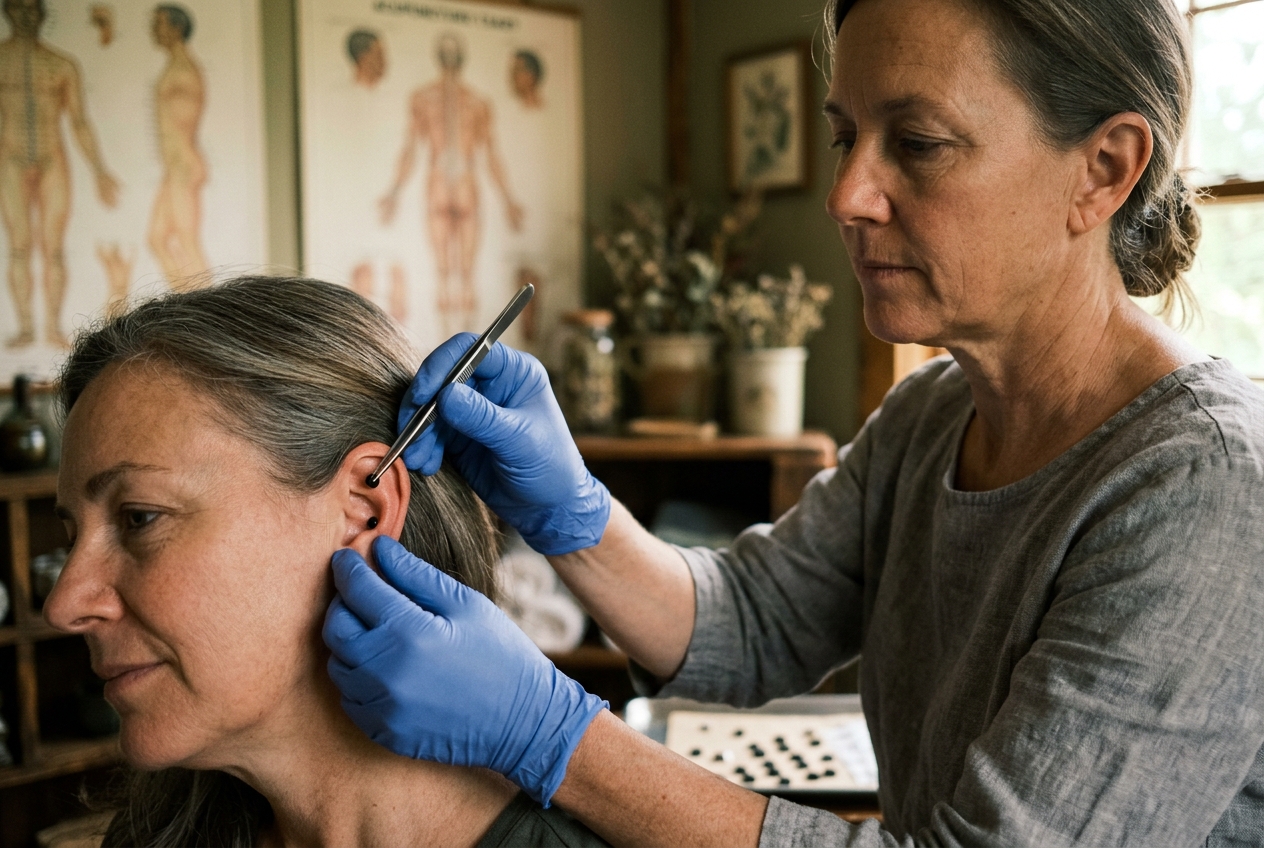
If you find yourself sitting at your desk in the late afternoon with tight, burning shoulders, shallow breath trapped high in your chest, and a persistent hum of sensory overload vibrating behind your eyes, you are experiencing the quintessential signature of 21st-century autonomic distress. Our typical response is systemic: we ingest another double espresso, swallow an over-the-counter analgesic, or resolve to collapse into bed early—only to find our racing thoughts prevent restorative sleep. Yet, nestled on both sides of the cranium lies a remarkably accessible, densely innervated reflexogenic control console that Traditional Chinese Medicine (TCM) and contemporary neurobiology have both identified as a primary interface for systemic equilibrium: the human auricle.
The external ear is far more than a passive funnel for acoustic vibrations. In classical East Asian medical epistemology and cutting-edge neurocardiology alike, the pinna functions as an exquisite somatic microsystem—a self-contained topographical projection where the entire physiological, visceral, and musculoskeletal organism is mapped in miniature. By engaging specific reflex nodes upon this cartilaginous framework using nothing more complicated than the pads of your index finger and thumb, you can directly interface with the central autonomic network, downregulating sympathetic fight-or-flight reactivity and instigating a cascade of restorative parasympathetic tone within minutes.
                                  [ HELIX ]
                             . - ~ ~ ~ ~ ~ - .
                         . '   . - ~ ~ ~ - .   ' .
                       /   . '  (TRIANGULAR) ' .   \
                      /   /     (  FOSSA  )     \   \
                     /   /   [Auricular Shen Men]\   \
                    /   /      \  /       \  /    \   \
                   |   |        \/         \/      |   |
                   |   |  [SUPERIOR CRUS]          |   |
                   |   |  [INFERIOR CRUS]          |   |
                   |   |   \                      /|   |
                   |   |    \--[Sympathetic]-----/ |   |
                   |   |      \                 /  |   |
                   |    \      |  CYMBA CONCHAE | /    |
                   |     \     | (Abdominal Org)|/     |
                   |      \    |  [Kidney/Liver]|      |
                   |    [CRUS HELICIS]          |      |
                   |      /----[Point Zero]-----\      |
                   |     /     | CAVUM CONCHAE  |\     |
                   |    /      | (Thoracic Org) | \    |
                   |   |       |  [Heart/Lung]  |  |   |
                   |   | [TRAGUS]               |  |   |
                   |   |   |   |   [ANTITRAGUS] |  |   |
                    \   \   \ /                 /  /
                     \   ' . _ _ _ _ _ _ _ _ . '  /
                      \                          /
                       \        [ LOBULE ]      /
                         \    (Craniofacial)  /
                           ' - . _ _ _ _ . - '
1. Classical Roots and Contemporary Neuroanatomy: The Convergence of Twelve Meridians
The conceptual origin of the ear as a total-body diagnostic and therapeutic portal was codified over two millennia ago in the foundational canon of Chinese medicine, the Huangdi Neijing (The Yellow Emperor’s Inner Classic). In the Ling Shu (Miraculous Pivot, Chapter 28, "Oral Transmission"), the classical text articulates a profound physiological axiom: "Er zhe, zong mai zhi suo ju ye"—"The ear is the confluence where all blood vessels and meridian pathways gather."
The classical channel architecture posits that the auricle possesses a unique energetic status unlike any other anatomical region. All six primary Yang meridians—the Gallbladder (Foot Shaoyang), Small Intestine (Hand Taiyang), Triple Energizer/Sanjiao (Hand Shaoyang), Stomach (Foot Yangming), Large Intestine (Hand Yangming), and Bladder (Foot Taiyang)—either directly enter the periauricular and intra-auricular topography or dispatch primary branches to the ear. Concurrently, the six primary Yin meridians (Lung, Spleen, Heart, Kidney, Pericardium, Liver), though running deeper along the ventral and medial planes of the body, communicate intimately with the auricle through their Jing Bie (divergent longitudinal collateral vessels). The ear thereby functions as a systemic clearinghouse where internal organ pathologies manifest on the superficial cartilage, and where cutaneous tactile stimulation can broadcast regulatory impulses deep into the core zang-fu visceral matrix.
+-----------------------------------------------------------------------------+
|               CLASSICAL DIVERGENT MERIDIAN NETWORK (JING BIE)               |
|                                                                             |
|   SIX YANG CHANNELS                                     SIX YIN CHANNELS    |
|   (Direct Auricular Ingress)                            (Divergent Vessels) |
|   - Hand/Foot Shaoyang   =======\                 /====== Hand/Foot Taiyin  |
|   - Hand/Foot Yangming   ======== [ AURICULAR  ] ======== Hand/Foot Shaoyin |
|   - Hand/Foot Taiyang    =======/ [ MICROSYSTEM] \====== Hand/Foot Jueyin   |
|                                         ||                                  |
|                                         \/                                  |
|                       CENTRAL HOMEOSTATIC EQUILIBRIUM                       |
+-----------------------------------------------------------------------------+
This classical construct remained empirical and largely non-somatotopic until 1957, when a French physician and neurosurgeon from Lyon, Dr. Paul Nogier, revolutionized the discipline. Nogier observed that patients presenting with refractory lumbosacral sciatica exhibited localized cauterization scars on the superior antihelical crus of the external ear, administered by a folk practitioner named Madame Barrin. Intrigued by this precise somatic correlation, Nogier undertook decades of rigorous clinical investigations, culminating in his groundbreaking discovery: the external ear bears a direct, predictable, somatotopically organized projection of the human body configured as an inverted fetus in utero (homunculus auricularis).
Under Nogier’s model, standardized by the World Health Organization Auricular Nomenclature Committee, the earlobe represents the cephalic and craniofacial structures; the prominent curved cartilaginous ridge of the antihelix mirrors the undulating curvatures of the spinal column; the superior bifurcated crura represent the lower extremities and pelvic girdle; the lateral trough of the scapha reflects the upper limbs; and the deep, excavated conchal bowl houses the visceral organs of the thorax and abdomen.
+-----------------------------------------------------------------------------+
|              SOMATOTOPIC HOMUNCULUS MAPPING (NOGIER / WHO)                  |
|                                                                             |
|   AURICULAR STRUCTURE          ANATOMICAL / SOMATIC CORRELATE               |
|   ===================          ==============================               |
|   Lobule (Earlobe)             Craniofacial, Eyes, Jaw, Frontal Cortex      |
|   Antihelix (Ridge)            Spinal Column (Cervical -> Thoracic -> Lumbar|
|   Triangular Fossa             Pelvis, Sacrum, Uterus / Genitourinary Axis  |
|   Scapha (Outer Valley)        Upper Extremity (Shoulder, Arm, Wrist, Hand) |
|   Cymba Conchae (Upper Bowl)   Abdominal Viscera (Digestive Organs, Kidneys)|
|   Cavum Conchae (Lower Bowl)   Thoracic Viscera (Heart, Lungs, Mediastinum) |
|   Tragus / Intertragic Notch   Endocrine Axis, Brainstem, Neurohypophysis   |
+-----------------------------------------------------------------------------+
Modern neurohistology has substantiated this ancient-modern synthesis by uncovering the tri-neural sensory innervation of the human auricle. The ear is one of the most neuro-vascularly privileged tissues in the human body, wired simultaneously by cranial nerves and the somatic cervical plexus:
+-----------------------------------------------------------------------------+
|                 TRI-NEURAL INNERVATION OF THE EXTERNAL EAR                  |
|                                                                             |
|  1. AURICULAR BRANCH OF VAGUS (CN X) -> Cavum & Cymba Conchae (Viscera)     |
|     Direct afferent gateway to Nucleus Tractus Solitarii (NTS)              |
|                                                                             |
|  2. AURICULOTEMPORAL NERVE (CN V3)   -> Tragus, Crus Helicis (Homeostasis)  |
|     Trigeminal-paragigantocellular axis modulating sensory-motor gates      |
|                                                                             |
|  3. GREAT AURICULAR / C2-C3 PLEXUS   -> Antihelix, Scapha, Lobule (Soma)    |
|     Spinal-dorsal horn gateway modulating musculoskeletal pain pathways     |
+-----------------------------------------------------------------------------+
- The Auricular Branch of the Vagus Nerve (Cranial Nerve X / Arnold's Nerve): Innervates the entirety of the inner conchal bowl (cymba and cavum conchae). As documented in neurophysiological research on transcutaneous auricular vagus nerve stimulation (taVNS), mechanical or electrical stimulation of this cutaneous field conveys direct sensory afferents through the jugular ganglion into the Nucleus Tractus Solitarii (NTS) in the medulla oblongata. The NTS subsequently projects to the locus coeruleus, dorsal raphe nuclei, and parabrachial area, downregulating peripheral sympathetic outflow, dampening pro-inflammatory cytokine production (TNF-alpha, IL-1beta) via the cholinergic anti-inflammatory pathway, and enhancing heart rate variability (HRV).
- The Auriculotemporal Nerve (Mandibular Division of Trigeminal Nerve / CN V3): Supplies the anterior-superior quadrants, including the tragus, ascending border of the helix, and the crus helicis. This provides a direct pathway into the main sensory and spinal trigeminal nuclei, influencing central sensorimotor gating, trigemino-cardiac reflexes, and cranial vascular tone.
- The Great Auricular Nerve & Lesser Occipital Nerve (Cervical Plexus C2–C3): Supplies the structural perimeter, encompassing the antihelix, scapha, antitragus, and lobule. These spinal somatic afferents enter the dorsal horns of the cervical spinal cord, interacting directly with spinothalamic tracts to mediate descending pain modulation and release local substance P antagonists across corresponding somatic myofascial zones.
2. The Meridian Path: A Physical Journey Across the Landscape of the Ear
To navigate the ear effectively, one does not require complex instruments or arcane terminology. Instead, we can understand the auricle as an elegant, natural landscape featuring ridges, valleys, caves, and terraces. Learning to read this terrain allows you to trace your own anatomy effortlessly:
[Outer Rim: Helix] ---> [Outer Valley: Scapha] ---> [Inner Ridge: Antihelix]
                                                          |
                                                          v
[Central Cave: Concha] <--- [Central Terrace: Crus] <--- [Upper Cave: Cymba]
Begin your tactile journey at the bottom of the structure: the soft, fleshy earlobe (lobule). This is your anatomical head and face. When you gently roll the earlobe between your thumb and forefinger, you are palpating the reflex projections of the eyes, jaw, frontal sinuses, and cerebral cortex.
Gliding upward along the inner border of the ear, your finger encounters a prominent, firm cartilaginous ridge: the antihelix. This sweeping crescent is your spinal column. The lowest portion, directly above the lobe and antitragus, corresponds to your cervical spine and neck—the exact location where screen-time strain accumulates. As your finger travels up this curved ridge, you traverse the thoracic spine (mid-back) before reaching the upper crest, which represents the lumbar spine, sacrum, and coccyx.
At its superior terminus, this spinal ridge splits into an inverted "Y" shape, creating a smooth, shallow triangular depression between its upper and lower branches: the triangular fossa. This sheltered depression represents the pelvic basin and genitourinary core, serving as one of the most neurologically potent, tranquilizing zones on the human body.
Running parallel to the spinal ridge, along the outer border just inside the ear’s curved rim (the helix), lies a narrow, elongated trough: the scapha. This valley corresponds to the upper limbs. The lowest section of the trough corresponds to the shoulder and rotator cuff; travelling upward leads through the elbow, forearm, and wrist, terminating at the very top of the ear where the fingers and toes are mapped.
Finally, slip your fingertip inward, dropping off the spinal ridge into the central hollows of the ear—the concha. This deep bowl is bisected horizontally by a shelf of cartilage called the crus of the helix (the root of the ear): - The upper bowl (cymba conchae) represents the abdominal visceral cavity, containing the reflex points for the kidneys, liver, gallbladder, stomach, and intestines. - The lower bowl (cavum conchae), directly encircling the opening of the ear canal, represents the thoracic cavity, housing the direct vagal projections for the heart, lungs, bronchi, and mediastinum.
3. Core Therapeutic Points for Immediate Autonomic & Somatic Regulation
Mastering just three fundamental auricular nodes equips you with an extraordinary capacity to stabilize the autonomic nervous system, extinguish stress-induced pain loops, and reset physiological homeostasis.
+=============================================================================+
|                       CORE AURICULAR THERAPEUTIC TRIAD                      |
+=============================================================================+
| 1. AURICULAR SHEN MEN (TF-4)  | Location: Triangular Fossa (Upper Outer)    |
|    "The Divine Gate"          | Function: Psycho-Emotional Calming, Anxiety |
| ----------------------------- + ------------------------------------------- |
| 2. POINT ZERO (HX-1)          | Location: Crus of Helix (Central Notch)     |
|    "Homeostatic Center"       | Function: Autonomic Reset, Visceral Balance |
| ----------------------------- + ------------------------------------------- |
| 3. SYMPATHETIC POINT (AH-6a)  | Location: Inferior Crus / Helix Junction    |
|    "Autonomic Balancer"       | Function: Smooth Muscle Spasm, Vasodilation |
+=============================================================================+
Point 1: Auricular Shen Men (TF-4, Spirit Gate)
- Everyday Location: Nestled in the upper third of the ear, directly within the small triangular valley (triangular fossa) formed where the upper cartilage ridge splits. Position your index finger in the shallow hollow at the top-outer corner of this depression.
- Palpatory Sensation: When properly engaged, you will detect a distinct, sweet, dull ache accompanied by a gentle sensation of spreading warmth across the upper hemisphere of the ear.
- Biomedical & TCM Mechanism: Shen Men is universally recognized as the master psycho-emotional regulator of the auricular microsystem. Classical texts credit it with anchoring the Shen (the conscious spirit and emotional mind) and clearing internal heat from the Heart meridian. Neurophysiologically, stimulation of this zone activates overlapping trigeminal-vagal sensory fibers, promoting the release of endogenous beta-endorphins and gamma-aminobutyric acid (GABA), while significantly dampening hyperactive amygdala signaling within the limbic system.
- How to Press: Place the pad of your index finger securely into the triangular fossa on the front of the ear, with your thumb braced flat against the posterior aspect of the ear directly behind it. Apply steady, moderate compression while executing slow, micro-circular revolutions (approx. 1 revolution per second) for 90 to 120 seconds. Breathe slowly and deeply through your nose.
- Primary Clinical Indications: Acute situational anxiety, panic attacks, insomnia, high mental tension, global inflammatory pain, and systemic hypersensitivity.
Point 2: Point Zero (HX-1, The Master Homeostatic Pacemaker)
- Everyday Location: Located at the geometric center of the auricle. Trace your index finger along the firm horizontal ridge of cartilage that divides the upper and lower conchal bowls (the crus of the helix). Follow this ridge inward toward the face until your finger drops into a distinct, tiny notch right where the ridge rises out of the ear’s central floor.
- Palpatory Sensation: A sharply localized, exquisitely tender, pinpoint sensation. Even light pressure here often produces an immediate sigh reflex or involuntary swallow.
- Biomedical & TCM Mechanism: Point Zero serves as the anatomical and energetic axis of the entire Nogier somatotopic matrix. In French neuro-acupuncture, it is classified as the universal homeostatic reset button, acting directly on the hypothalamic-pituitary-adrenal (HPA) axis and the solar plexus. It acts as an autonomic buffer, restoring dynamic balance regardless of whether an organ system is hyperactive (e.g., tachycardia, hypertension) or hypoactive (e.g., hypotension, digestive fatigue).
- How to Press: Use the clean, blunt tip of a fingernail or the rounded tip of an index finger. Press directly inward against the cartilaginous floor with sustained, perpendicular, firm pressure for 60 seconds. Maintain a steady, unwavering hold without circular grinding.
- Primary Clinical Indications: Autonomic exhaustion, visceral shock, digestive arrhythmias, chronic fatigue, and post-stress physical disorientation.
Point 3: Sympathetic Point (AH-6a, Autonomic Balance Point)
- Everyday Location: Position your index finger on the horizontal lower branch of the cartilage ridge (the inferior crus of the antihelix) inside the upper bowl. Slide your finger forward toward the face until it slips slightly beneath the overhanging inner lip of the outer ear rim.
- Palpatory Sensation: A warm, spreading tenderness that frequently radiates down into the jawline or toward the temporal bone.
- Biomedical & TCM Mechanism: This point directly modulates vascular smooth muscle tone and autonomic equilibrium. Stimulating this node activates descending inhibitory pathways that reduce sympathetic vasoconstriction, promoting peripheral vasodilation, easing coronary artery spasms, and relaxing spastic visceral smooth musculature across the gastrointestinal and urogenital tracts.
- How to Press: Pinch the cartilaginous edge between your index finger (tucked under the rim) and your thumb (clamping the outer edge). Apply firm, rhythmic pulsing pressure—press firmly for 3 seconds, release slightly for 1 second—for a total duration of 1 to 2 minutes.
- Primary Clinical Indications: Stress-induced gastrointestinal cramps, tension headaches, cold hands and feet due to vasoconstriction, arterial hypertension, and chronic physical tightness in the neck and shoulders.
4. Conchal Visceral Topography and the Standardized NADA Protocol
For systemic disorders involving chronic metabolic dysregulation, emotional trauma, or chemical dependency, individual point stimulation is elevated by accessing the deep conchal visceral fields.
+-----------------------------------------------------------------------------+
|               THE NADA FIVE-POINT PROTOCOL ARCHITECTURE                     |
|                                                                             |
|   1. SYMPATHETIC (AH-6a)  ====> Autonomic tone, vascular dilation           |
|   2. SHEN MEN (TF-4)      ====> Psycho-emotional settling, GABA tone        |
|   3. KIDNEY ZONE (CO-10)  ====> Adrenals, water metabolism, fear mitigation |
|   4. LIVER ZONE (CO-12)   ====> Neuroendocrine smoothing, tension release   |
|   5. LUNG ZONE (CO-14)    ====> Respiratory grounding, vagal parasympathetic|
+-----------------------------------------------------------------------------+
As recognized in empirical studies published across NCBI PubMed Central on the NADA Protocol, the National Acupuncture Detoxification Association (NADA) protocol utilizes a standardized five-point auricular prescription: 1. Sympathetic: Restores autonomic sympathovagal balance. 2. Shen Men: Alleviates psycho-emotional stress and anxiety. 3. Kidney: Situated in the superior-posterior aspect of the cymba conchae; reinforces ancestral Jing (essence), supports adrenal function, and dispels deep-seated psychological fear. 4. Liver: Located in the posterior-inferior quadrant of the cymba conchae; regulates smooth flow of Qi, softens emotional irritability, and enhances hepatic microcirculation. 5. Lung: Located directly in the center of the deep cavum conchae (surrounding the Heart reflex); regulates respiration, boosts Wei Qi (immune defense), and facilitates grief resolution.
5. Targeted Protocol: The Nocturnal Decompression and Vagal Reset Sequence
For individuals burdened by evening mental hyper-arousal, screen-induced visual fatigue, and an inability to transition into deep restorative sleep, execute the following four-stage protocol 30 minutes before sleep.
+=============================================================================+
|            STEP-BY-STEP NOCTURNAL VAGAL RESET SEQUENCE (6 MINUTES)          |
+=============================================================================+
| STAGE 1: GLOBAL AURICULAR ROLLING & UNSTRETCHING               (60 Seconds) |
| Position: Seated upright or supine.                                         |
| Technique: Pinch upper helix between index and thumb. Unroll cartilage      |
| outward and downward in slow, sweeping motions until lobules flush warm.    |
| --------------------------------------------------------------------------- |
| STAGE 2: BILATERAL ACTIVATION OF POINT ZERO                    (60 Seconds) |
| Position: Supine with neck supported.                                       |
| Technique: Anchor both index fingernails into the central crus notches.     |
| Apply steady inward pressure synchronized with slow 4-count nasal inhales.  |
| --------------------------------------------------------------------------- |
| STAGE 3: SYNCHRONIZED BILATERAL SHEN MEN CIRCLES              (120 Seconds) |
| Position: Supine, eyes closed.                                              |
| Technique: Compress both Triangular Fossae. Execute deliberate, rhythmic    |
| circular kneading (1 rev/sec) while exhaling slowly through pursed lips.    |
| --------------------------------------------------------------------------- |
| STAGE 4: CONCHAL VAGAL SPIRAL MASSAGE                          (90 Seconds) |
| Position: Deep relaxation.                                                  |
| Technique: Place index finger pads inside both Cavum Conchae. Perform slow, |
| soothing circular spirals along the ear canal floor to stimulate CN X.      |
+=============================================================================+
6. Applied Methodology: Tools, Diagnostic Cues, and Clinical Safety
To translate auricular meridian theory into safe and effective daily practice, proper mechanical dosage, hygiene, and somatic diagnostic awareness are essential.
+-----------------------------------------------------------------------------+
|                      NON-INVASIVE APPLICATION METHODS                       |
|                                                                             |
|   1. MANUAL PALPATION       -> Thumb & index finger pincer compression.     |
|   2. VACCARIA SEEDS         -> Natural, non-piercing botanical pressure.    |
|   3. MAGNETIC PELLETS       -> Micro-magnetic flux stimulation (100–800 G). |
|   4. BLUNT SPRING PROBE     -> Diagnostic identification of low-capacitance |
|                                reactive points.                             |
+-----------------------------------------------------------------------------+
Application Modalities
- Manual Finger Compression: The most immediate, accessible tool. Utilize the soft pulps of the thumbs and index fingers, ensuring fingernails are trimmed to prevent micro-abrasions to the delicate perichondrium.
- Vaccaria Seeds (Wang Bu Liu Xing): The dried, smooth seeds of Vaccaria segetalis mounted on hypo-allergenic adhesive tape provide consistent, mild acupressure. Once placed on precise auricular coordinates, seeds can remain in situ for 3 to 5 days. The user gently presses the seeds for 30 seconds, 3 to 4 times daily, to deliver continuous therapeutic stimulation.
- Magnetic Pellets: Gold- or silver-plated micro-magnetic pellets (typically delivering 100 to 800 Gauss) provide continuous mild electrical and magnetic polarization across reactive tissue zones, especially beneficial for musculoskeletal pain conditions.
+-----------------------------------------------------------------------------+
|                       PALPATORY DIAGNOSTIC MARKERS                          |
|                                                                             |
|  Look for these visible and tactile cues on the ear's surface:              |
|                                                                             |
|  - Focal Erythema (Redness)     ===> Acute inflammation, localized heat     |
|  - Desquamation (Flakiness)     ===> Chronic deficiency or stagnant flow    |
|  - Telangiectasia (Veins)       ===> Blood stasis, long-standing pathology  |
|  - Exquisite Focal Tenderness   ===> Active somatotopic reflex node         |
+-----------------------------------------------------------------------------+
Palpatory Diagnostics
When exploring the auricle, observe subtle physical cues. An active auricular point often presents with: - Focal tenderness: A marked increase in sensitivity compared to surrounding tissue. - Morphological changes: Tiny nodules, cords, or depressions in the cartilage. - Dermatological signs: Localized redness (erythema), paleness, dry skin flaking (desquamation), or tiny visible spider veins (telangiectasia), which indicate energetic stagnation or chronic visceral stress in the corresponding anatomical region.
[!WARNING]
Safety, Precautions & Contraindications
- Pregnancy Considerations: While auricular acupressure is exceptionally safe, deep or vigorous stimulation of specific points—notably the Uterus point, the Endocrine/Internal Secretion point, the Abdomen zone, and strong autonomic clearing points—is strictly contraindicated during pregnancy, as it can stimulate uterine smooth muscle activity.
- Perichondritis and Cartilage Integrity: The cartilage of the ear has a limited blood supply. Never apply excessive, sharp, or bruising pressure that leaves the cartilage aching for hours. If using seeds or pellets, replace them every 3–5 days and clean the skin thoroughly with alcohol to prevent local moisture accumulation, skin breakdown, or cartilage infection (perichondritis).
- Hygiene and Skin Health: Do not apply seeds, pellets, or manual pressure over broken skin, open abrasions, cuts, or active eczema/psoriasis lesions.
- Scope of Practice: Auricular acupressure is a powerful adjunctive method for autonomic regulation and functional comfort. It is not a replacement for emergency medical care, structural surgical intervention, or professional medical diagnosis.
7. Today's Takeaway: The Two-Minute Vagal Brake
You don't need to memorize the entire somatotopic map to experience the benefits of auricular therapy today. Before closing this article, take two minutes to give your nervous system a direct, grounding reset:
+=============================================================================+
|                      THE 120-SECOND VAGAL BRAKE PRACTICE                    |
+=============================================================================+
| 1. REST YOUR ELBOWS on a stable surface and soften your gaze or close eyes. |
| 2. SLIDE YOUR INDEX FINGERS into the top triangular valleys of both ears    |
|    (Auricular Shen Men), clamping your thumbs flat behind them.             |
| 3. INHALE DEEPLY through your nose for a count of 4.                        |
| 4. EXHALE SLOWLY through gently parted lips for a count of 6.               |
| 5. MAINTAIN FIRM, CIRCULAR PRESSURE on both Shen Men points throughout.     |
| 6. REPEAT FOR 10 BREATH CYCLES (approx. 2 minutes).                         |
+=============================================================================+
Notice the immediate physical shift: the gentle drop of your shoulders, the softening of your jaw muscles, the moistening of your mouth as parasympathetic salivation resumes, and the steady return of mental clarity. The ear is not merely an organ of hearing; it is your built-in, direct gateway to inner physical harmony and neurological calm.
Authoritative References & Academic Resources
- World Health Organization: WHO Guidelines on Traditional Medicine and Auricular Nomenclature
- National Center for Biotechnology Information (NCBI): Mechanisms of Transcutaneous Auricular Vagus Nerve Stimulation (taVNS)
- PubMed Central: Clinical Utility of the NADA 5-Point Auricular Acupuncture Protocol
- Neuroanatomy Compendium: The Solitary Nucleus (Nucleus Tractus Solitarii) and Autonomic Control
- Anatomical Foundations: Auricular Branch of the Vagus Nerve (Arnold's Nerve)
- Classical Literature: Huangdi Neijing (The Yellow Emperor's Classic of Internal Medicine)