Aromatic Dampness-Transforming Herbs (Fang Xiang Hua Shi Yao) Pharmacodynamics: Governing Turbid Dampness Resolution, Spleen Awakening, Middle Burner Qi Regulation, and Epigastric Distension Relief in Traditional Chinese Medicine
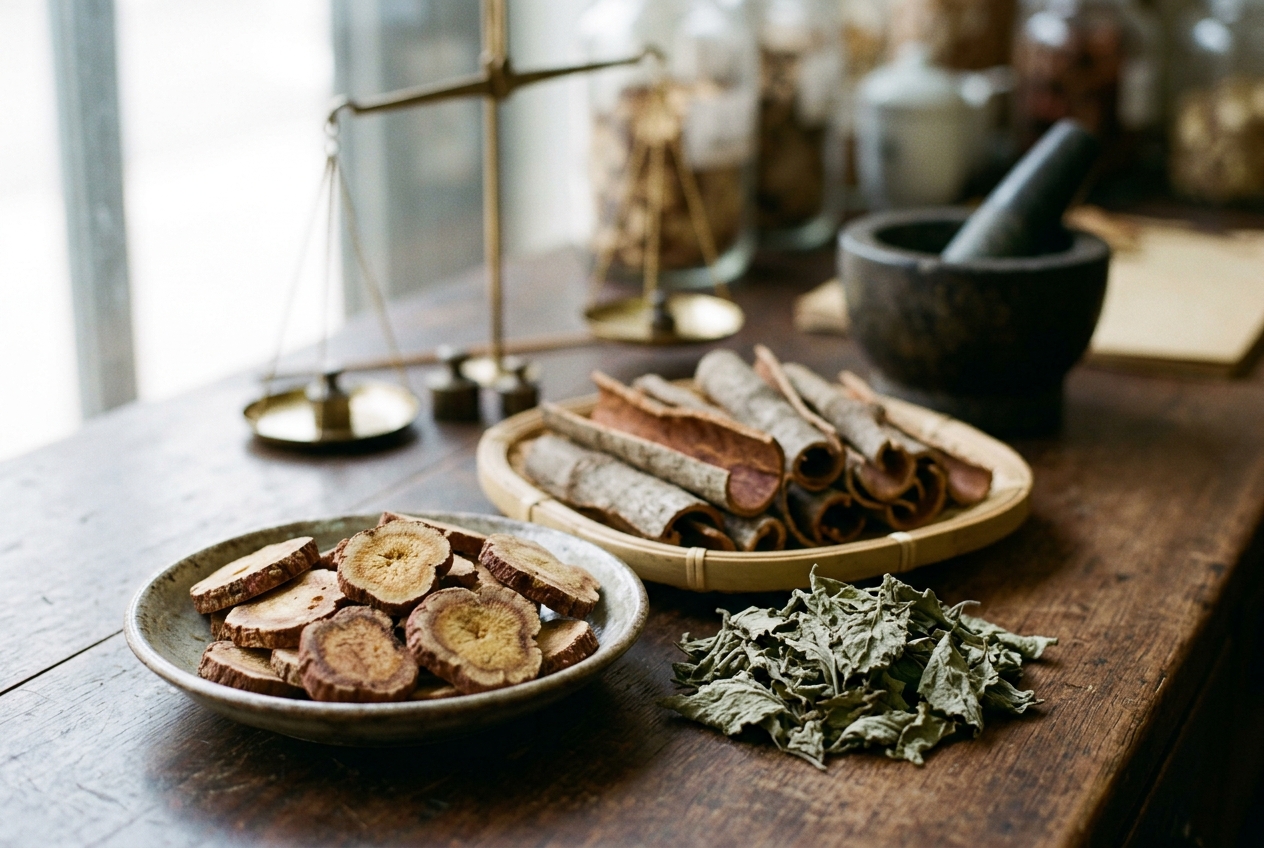
1. Opening Scene — A Moment You'll Recognise
It is 2:30 in the afternoon. You finished a standard midday meal an hour ago—perhaps a sandwich, a cold salad, or a grain bowl eaten while scanning emails at your desk—and now an inescapable, leaden heaviness settles across your entire body. Your limbs feel weighted, as though wading through shallow water; your eyelids droop with an intractable mental fog that caffeine fails to dispel. When you press gently beneath your ribcage, you encounter a taut, waterlogged fullness, accompanied by mild bloating, a sticky sensation along the palate, and a total absence of genuine digestive warmth.
In contemporary clinical terms, you might dismiss this as postprandial somnolence, low blood sugar volatility, or early-stage functional dyspepsia. However, in the foundational framework of Traditional Chinese Medicine (TCM), you are experiencing a classic crisis of the Middle Burner (Zhōng Jiāo): your Spleen (Pí) has become encumbered by internal dampness (Shī Kùn Pí).
Dampness in the body behaves precisely as it does in nature: it is heavy, turbid, adhesive, and prone to settling into the lowest and most stagnant spaces. When the metabolic engine of the central burner is overwhelmed by cold, heavy nourishment or chronic mental strain, its ability to transform food into vital fuel stalls. The ancient physician-scholars observed that the most effective way to dissipate this viscous stagnation was not merely to drain or purge it, but to awaken the system using the diffusive, volatile, and penetrating energy of aromatic botanicals—a mechanism now validated by modern gastrointestinal pharmacodynamics.
2. What This Organ System Does: The Central Metabolic Crucible
In classical Chinese physiology, the Spleen (Pí) does not correspond strictly to the anatomical lymphatic organ identified in Western medicine. Instead, it represents an entire functional organ network responsible for digestion, nutrient distribution, fluid partitioning, and structural integrity.
The core responsibilities of this central system encompass several interrelated physiological imperatives:
Transformation and Transportation (Yùn Huà)
The Spleen is designated as the Foundational Minister of Digestion and Assimilation. It receives food and fluid digested by the Stomach (Wèi), separates the refined nutrients (the "Clear Yang", Qīng Yáng) from waste products (the "Turbid Yin", Zhuó Yīn), and distributes these essences upward to the Heart and Lungs to synthesize Post-Heaven Qi (Hòu Tiān Zhī Qì) and blood.
When the transformation and transportation dynamic is robust, metabolic processes operate smoothly: cellular energy is abundant, the gut mucosal barrier remains resilient, and tissue hydration remains balanced without water retention.
Ascending Clear Yang and the Digestive Pivot
Digestion relies on a coordinated vertical axis between two paired organs: * The Spleen: Governs the upward ascent of clear energy (Sheng Qing). It lifts nutrient-dense fluids to the thoracic cavity and maintains the structural suspension of visceral organs. * The Stomach: Governs the downward descent of turbid waste (Jiang Zhuo). It propels digestive chyme through the duodenum, jejunum, and colon.
Together, the Spleen and Stomach constitute the "Central Pivot" (Zhōng Zhōu). If the Spleen fails to ascend, fatigue and diarrhea manifest; if the Stomach fails to descend, rebellious Stomach Qi triggers nausea, reflux, belching, and epigastric fullness.
The Aversion to Dampness and the Awakening Vector of Aromatics
Classical medical canons, notably the Huangdi Neijing (The Yellow Emperor's Inner Classic), state that "the Spleen delights in dryness and loathes dampness" (Pí Xǐ Zào Ér Wù Shī). Moisture, when properly transformed, produces healthy bodily fluids (Jīn Yè). However, when transformation stalls due to dietary excess, constitutional weakness, or environmental humidity, fluids congeal into pathological dampness (Shī) and turbid phlegm (Tán).
To resolve this state, classical pharmacology developed a specialized therapeutic category: Aromatic Dampness-Transforming Herbs (Fāng Xiāng Huà Shī Yào). Characterized by acrid (Xīn), warm (Wēn), and aromatic (Fāng Xiāng) qualities, these botanicals do not simply dry the body; their volatile, vaporizing phytochemicals disperse stagnation, stimulate the enteric nervous system, and awaken dormant Spleen metabolic function (Xǐng Pí).
3. How You Can Feel It: Signs of Balance and Imbalance
The operational integrity of the Spleen and Middle Burner is readily apparent across daily physical, cognitive, and somatic markers. Use the self-assessment framework below to evaluate your current metabolic equilibrium.
| Physiological Domain | Balanced Spleen & Middle Burner (Pí Wèi Hé) | Encumbered Spleen / Damp Stagnation (Pí Xū Shī Kùn) |
|---|---|---|
| Postprandial Energy | Sustained clarity, steady stamina, absence of heavy abdominal pressure after eating. | Profound post-meal lethargy, brain fog, heavy sensation in the limbs and torso. |
| Digestion & Abdomen | Flat abdomen, efficient transit, clear appetite, silent and comfortable peristalsis. | Distension, bloating after minor meals, epigastric fullness, loose stools with sticky residue. |
| Fluid Metabolism | Normal hydration, absence of peripheral edema, comfortable joint flexibility. | Puffiness around eyes upon waking, fluid retention in ankles, heavy and stiff joints. |
| Oral & Sensory Markers | Clean taste, vibrant appreciation of flavors, moist lips with healthy vascular pinkness. | Sticky or sweet taste in the mouth, lack of thirst despite dry lips, thick tongue coating. |
| Mental & Emotional State | Analytical lucidity, capacity to concentrate, ease of letting go of repetitive thoughts. | Rumination, obsessive overthinking, circular worry, difficulty initiating cognitive tasks. |
Self-Assessment: Evaluating Your Tongue and Pulse
- The Mirror Test: Look at your tongue upon waking. A balanced Spleen presents a supple, pale-red tongue body with a thin, translucent white coat. If your tongue displays tooth marks (scalloping) along the lateral edges, an enlarged and swollen body, or a thick, greasy white-or-yellow coating over the middle third, pathological dampness is actively encumbering the Middle Burner.
- The Visceral Palpation Test: Lie flat on your back and place your fingertips four inches above the umbilicus (at the level of Zhongwan CV-12). Press gently inward. If the tissue feels congested, doughy, or uncomfortably resistant, your digestive pivot requires aromatic mobilization.
4. Qigong & Movement Practice: "Separating Heaven and Earth"
To restore the bidirectional flow of the Middle Burner—facilitating the ascent of Spleen Yang and the descent of Stomach Yin—the traditional medical qigong exercise known as Separating Heaven and Earth (Liáo Lǐ Pí Wèi Xū Dān Jǔ) from the classic Baduanjin (Eight Brocades) provides an effective physical intervention.
Setup and Posture
- Stand with your feet parallel, hip-width apart.
- Soften your knees slightly and allow your tailbone to sink, releasing tension in the lumbar spine.
- Rest your hands in front of your lower abdomen (Lower Dantian), palms facing upward as if cradling a sphere of light, with elbows gently rounded.
- Relax your shoulders and align the crown of your head (Baihui GV-20) toward the ceiling.
Movement Protocol
- Inhale (Preparation): Draw the breath deep into your abdomen through the nose. Bring both hands upward along the midline of the chest to the level of the solar plexus.
- Exhale (Separation): Rotate your left palm upward and push it straight up toward the sky, pressing the heel of the palm flat against the ceiling with fingers pointing inward toward the right. Simultaneously, turn your right palm downward and press the heel of the right hand firmly toward the ground by your right hip, fingers pointing forward.
- The Micro-Pause (Tension & Extension): At the end of the exhalation, hold the stretch for two seconds. Feel the physical elongation through the left hypochondriac region and spleen meridian, creating an antagonistic vertical stretch across the abdominal cavity.
- Inhale (Return): Soften the hands and bring both palms back to the center of the chest, fingers relaxing as the palms face one another.
- Exhale (Alternation): Reverse the sides. Press your right palm skyward while pressing the left palm toward the earth, stretching the right hypochondriac and epigastric zone.
- Reps and Timing: Perform 8 to 12 cycles (4 to 6 repetitions per side) slowly, completing each breath cycle over 8 to 10 seconds.
Somatosensory Feedback
During the separation phase, look for a gentle warming sensation in the solar plexus, accompanied by subtle borborygmi (audible digestive rumbling) or spontaneous deep exhalation. This indicates the mechanical release of diaphragmatic tension and the reactivation of gastrointestinal peristalsis.
5. Acupressure Points for Middle Burner Stagnation
Acupressure offers a non-invasive, targeted modality to mobilize stagnant digestive fluids and regulate enteric neural circuits. Apply firm, steady pressure using your thumb or middle finger, maintaining deep rhythmic breathing for 90 to 180 seconds per point.
1. Zhongwan (CV-12) — "Middle Cavity"
- Anatomical Landmark: Located on the anterior midline of the abdomen, exactly midway between the xiphoid process (the bottom of the sternum) and the center of the umbilicus (approximately 4 cun / four thumb-widths above the navel).
- Technique: Place the pads of your middle and index fingers over the point. Apply gentle, gradual perpendicular pressure inward while breathing out. Maintain a circular, clockwise kneading motion with moderate, non-painful depth for 2 minutes.
- Clinical Efficacy: As the Front-Mu point of the Stomach and the confluence point for the Middle Burner, CV-12 harmonizes the gastric environment, eases gastric fullness, stops acid regurgitation, and relieves abdominal distension.
2. Zusanli (ST-36) — "Leg Three Miles"
- Anatomical Landmark: Located on the anterior lateral aspect of the lower leg, four finger-breadths below the lower border of the patella (kneecap), and one finger-breadth lateral to the anterior crest of the tibia.
- Technique: Apply firm, deep pressure with your thumb tip angled slightly toward the bone until a dull, radiating distending sensation (De Qi) travels down the shin. Maintain pressure for 2 to 3 minutes on both legs.
- Clinical Efficacy: Documented across countless clinical studies indexed on NCBI PubMed, ST-36 modulates autonomic nervous output, increases gastric motor complexes via vagal pathways, and acts as the preeminent tonification point for gastrointestinal debility and systemic fatigue.
3. Yinlingquan (SP-9) — "Yin Mound Spring"
- Anatomical Landmark: Located on the inner aspect of the lower leg, in the depression directly below and posterior to the medial condyle of the tibia (run your thumb up the inside of your shinbone until it falls into a distinct notch just below the knee joint).
- Technique: Press deeply into the tender recess using the tip of your thumb. Hold firm pressure while performing slow micro-rotations for 90 seconds per side.
- Clinical Efficacy: SP-9 is the He-Sea point of the Spleen meridian, serving as the primary classical point for transforming pathological fluid encumbrance, draining water retention, relieving heavy limb sensations, and clearing sticky stool dynamics.
6. Phytochemical Mechanisms, Classical Pharmacopoeia, and Modern Clinical Practice
To move beyond general lifestyle adaptations into the pharmacodynamics of herbal therapeutics, we examine the classical class of Aromatic Herbs that Transform Dampness (Fang Xiang Hua Shi Yao). These botanical agents leverage potent volatile secondary metabolites that resolve fluid turbidity, restore gastric motility, and modulate the gut-brain axis.
Biochemical Mechanisms: Monoterpenes, Sesquiterpenes, and Phenylpropanoids
Modern pharmacological investigations have established precise molecular targets for the volatile fractions extracted from these herbs:
- Gastrointestinal Motility and Interstitial Cells of Cajal (ICC): Volatile oils, such as patchouli alcohol and eudesmol, act upon gastrointestinal pacemaker cells (Interstitial Cells of Cajal) to regularize the slow-wave electrical rhythms of the digestive tract. Furthermore, compounds like magnolol and honokiol exhibit dual-action prokinetic capabilities: they stimulate serotonin-4 ($5\text{-HT}_4$) receptors to accelerate delayed gastric emptying while modulating cholinergic neurotransmission to resolve spasms, as detailed in research via the National Center for Biotechnology Information (NCBI).
- Gastric Mucosal Cytoprotection and Secretory Balance: Aromatic constituents stimulate sub-epithelial sensory nerves, promoting localized microcirculation via calcitonin gene-related peptide (CGRP) and nitric oxide (NO) release. This upregulates the synthesis of protective gastric mucus and bicarbonate secretion without provoking hyperchlorhydria.
- Visceral Sensitivity and Transient Receptor Potential Channels: Phenylpropanoids and monoterpenoids interact directly with TRP channels (TRPV1 and TRPA1) distributed along enteric sensory afferents. By attenuating peripheral nociceptive signaling, these compounds directly reduce the visceral hypersensitivity responsible for postprandial distress, cramping, and functional bloating.
Comparative Pharmacological Profiles of Core Representative Botanicals
Understanding the precise clinical vector, temperature profile, and organ tropism of each herb allows for precise therapeutic differentiation:
1. Cang Zhu (Atractylodes lancea)
- Properties & Channels: Acrid, Bitter, Warm. Enters Spleen, Stomach, and Liver channels.
- Key Constituents: Atractylodin, $\beta$-eudesmol, hinesol.
- Pharmacodynamics & Clinical Utility: Cang Zhu is exceptionally drying and robust. It excels at scouring internal dampness from the gut lumen while clearing exterior wind-damp pathogens from the joints and muscles. Modern pharmacology highlights atractylodin’s capacity to upregulate ghrelin receptor binding, directly stimulating gastric emptying in states of hypomotility.
2. Hou Po (Magnolia officinalis)
- Properties & Channels: Bitter, Acrid, Warm. Enters Spleen, Stomach, and Large Intestine channels. Consult botanical classifications via Magnolia officinalis on Wikipedia.
- Key Constituents: Magnolol, honokiol, $\beta$-eudesmol.
- Pharmacodynamics & Clinical Utility: Regarded as the premier agent for descending rebellious Qi and eliminating physical distension (Pǐ Mǎn). Magnolol acts as a potent $5\text{-HT}_4$ receptor partial agonist and smooth-muscle relaxant, alleviating both functional constipation and painful abdominal gas accumulation.
3. Huo Xiang (Pogostemon cablin / Agastache)
- Properties & Channels: Acrid, Slightly Warm, Aromatic. Enters Spleen, Stomach, and Lung channels. Learn more via Pogostemon cablin on Wikipedia.
- Key Constituents: Patchouli alcohol, pogostone, $\alpha$-bulnesene.
- Pharmacodynamics & Clinical Utility: Highly volatile and diffusive, Huo Xiang works on both the exterior and interior. It releases the exterior to relieve summer-heat or sudden gastrointestinal chills (gastroenteritis) while awakening the Spleen to arrest nausea, vomiting, and acute diarrhea.
4. Pei Lan (Eupatorium fortunei)
- Properties & Channels: Acrid, Neutral, Aromatic. Enters Spleen and Stomach channels.
- Key Constituents: Eupatorine, coumarin, thymol methyl ether.
- Pharmacodynamics & Clinical Utility: Neutral in temperature, Pei Lan is uniquely suited for clearing dampness without generating excess heat or drying fluids. It is the gold-standard classical herb for treating a sweet, sticky taste in the mouth (Kǒu Tián), excessive saliva production, and halitosis stemming from Middle Burner fermentation.
5. Sha Ren (Amomum villosum)
- Properties & Channels: Acrid, Warm, Intensely Aromatic. Enters Spleen, Stomach, and Kidney channels.
- Key Constituents: Bornyl acetate, camphor, limonene, borneol.
- Pharmacodynamics & Clinical Utility: Penetrates the middle and lower burners to warm Spleen Yang, promote gastric fluid circulation, and calm restless fetal movement (An Tai) in morning sickness. It is commonly added to rich tonifying formulas to prevent heavy tonics from causing indigestion.
6. Bai Dou Kou (Amomum kravanh / White Cardamom)
- Properties & Channels: Acrid, Warm, Aromatic. Enters Lung, Spleen, and Stomach channels.
- Key Constituents: 1,8-cineole (eucalyptol), terpinyl acetate, $\alpha$-terpineol.
- Pharmacodynamics & Clinical Utility: Possesses an ascending and diffusing quality that opens the chest, dissolves upper-burner phlegm stagnation, and descends rebellious Stomach Qi to arrest intractable belching and dry heaves.
7. Cao Dou Kou (Alpinia katsumadai)
- Properties & Channels: Acrid, Warm, Aromatic. Enters Spleen and Stomach channels.
- Key Constituents: Alpinetin, cardamonin.
- Pharmacodynamics & Clinical Utility: Considerably hotter and more drying than Sha Ren, this herb is reserved for severe cold-damp accumulations in the Middle Burner presenting with intense cold abdominal pain, vomiting of clear water, and intractable diarrhea.
8. Cao Guo (Amomum tsaoko)
- Properties & Channels: Acrid, Warm, Strongly Aromatic. Enters Spleen and Stomach channels.
- Key Constituents: 1,8-cineole, geranial, trans-2-dodecenal.
- Pharmacodynamics & Clinical Utility: The most robust, pungent agent in the category. Cao Guo pierces deep, dense layers of cold-dampness, foul turbidity, and malarial-type disorders (Nüè Jí) characterized by alternating chills and fevers with heavy abdominal distension.
Core Classical Formula Architectures
To harness these herbs safely and effectively, classical physicians combined them into synergistic formula architectures designed to simultaneously drain dampness, descend rebelliousness, and tonify underlying metabolic weakness.
1. Ping Wei San (Calm the Stomach Powder)
First recorded in the Formularies of the Bureau of Taiping People's Welfare Pharmacy (Taiping Huimin Heji Jufang, 1151 AD).
- Formula Composition:
- Cang Zhu (Rhizoma Atractylodis) — Sovereign (Jūn): Strongly dries dampness and awakens the Spleen.
- Hou Po (Cortex Magnoliae Officinalis) — Minister (Chén): Relieves fullness, breaks up gas, and directs Qi downward.
- Chen Pi (Pericarpium Citri Reticulatae) — Assistant (Zuǒ): Harmonizes Stomach Qi and dissolves phlegm.
- Zhi Gan Cao (Radix Glycyrrhizae Preparata) — Envoy (Shǐ): Harmonizes the formula and protects the mucosal lining from excessive dryness.
- Synergistic Dynamic: Rather than merely supplementing a weak digestive tract, Ping Wei San cuts through the thick, turbid dampness that paralyzes Spleen motility. Once this stagnant fluid layer is dispersed, the Middle Burner automatically resumes its native metabolic operations.
2. Huo Xiang Zheng Qi San (Agastache Powder to Rectify the Qi)
- Clinical Target: Acute external wind-cold invasion combined with internal damp stagnation (e.g., modern "stomach flu", acute travel diarrhea, or food poisoning accompanied by chills and fever).
- Architecture Highlights: Combines Huo Xiang, Zi Su Ye (Perilla Leaf), and Bai Zhi (Angelica dahurica) to release the exterior, while incorporating Hou Po, Cang Zhu, Ban Xia, and Fu Ling to drain water-dampness and stabilize fluid loss in the intestines.
Chronopharmacology: Volatile Oil Preservation Protocols
The volatile mono- and sesquiterpenes responsible for the therapeutic actions of these botanicals are thermally sensitive and possess low boiling points. In clinical decoction preparation, improper heating destroys their clinical potency.
Contraindications and Differential Diagnosis
Due to their acrid, warm, and drying characteristics, aromatic dampness-transforming herbs must be used with careful clinical discretion:
- Yin Deficiency and Fluid Depletion (Yīn Xū Jīn Kuī): In patients presenting with a dry red tongue without coating, chronic night sweats, deep thirst with dry throat, or emaciation, standard use of these herbs is strictly contraindicated. Their drying nature risks further evaporating delicate bodily fluids (Jin Ye).
- True Heat / Stomach Fire (Wèi Huǒ Chì Shèng): For patients experiencing severe burning epigastric pain, acid reflux with bitter tastes, and deep red mucosal inflammation, these warming botanicals must be combined with cold, damp-clearing agents (such as Huang Lian or Zhi Mu) to neutralize thermal aggression.
Translational Medicine: SIBO, Functional Dyspepsia, and Metabolic Endotoxemia
Modern functional medicine increasingly recognizes that the classical pathology of "Middle Burner Damp-Turbidity" shares close clinical and pathophysiological parallels with contemporary gastrointestinal disorders, as detailed by the WHO Global Centre for Traditional Medicine:
- Small Intestinal Bacterial Overgrowth (SIBO): The volatile components in Cang Zhu, Hou Po, and Huo Xiang exhibit broad-spectrum antimicrobial and anti-biofilm properties against hydrogen- and methane-producing microbial colonies residing aberrantly in the small intestine. Learn more about clinical management via Functional Dyspepsia on NCBI Books.
- Migrating Motor Complex (MMC) Optimization: By stimulating Phase III interdigestive migrating motor complexes, these herbs clear fermenting luminal debris between meals, preventing bacterial backflow and chronic postprandial bloating.
- Endotoxemia and Intestinal Permeability: Lipopolysaccharide (LPS) leakage across a compromised epithelial barrier mirrors the classical concept of "Turbid Toxins entering the Blood" (Zhuo Du Ru Xue). Terpenes from Magnolia officinalis and Pogostemon cablin upregulate tight-junction proteins (Claudin-1 and ZO-1), preserving mucosal barrier integrity and reducing low-grade systemic inflammation.
Food & Everyday Lifestyle Strategies
You can apply the principles of aromatic dampness resolution directly at home using common culinary spices and simple mealtime habits:
- Incorporate Everyday Culinary Aromatics: Cardamom pods (crushed lightly and steeped in hot water), fresh ginger root (Sheng Jiang), grated orange peel (tangerine peel/Chen Pi), fennel seeds, and fresh basil provide gentle, accessible aromatic stimulation that prevents damp accumulation.
- Limit Cold and Heavy Foods: Dampness is aggravated by cold, raw, and high-fat items that overwhelm digestive capacity. Reduce iced drinks, excessive dairy, unfermented soy, refined sugars, and raw salads—especially during colder months or periods of fatigue.
- Warm and Light Cooking Methods: Choose quick stir-frying, steaming with aromatic spices, or slow-simmered broths. Cooking foods thoroughly performs the initial "thermal breakdown," saving the Spleen from expending its own metabolic Yang to warm incoming nourishment.
- Mealtime Mindset: Sit upright, chew each bite thoroughly, and avoid working on laptops or engaging in stressful discussions while eating. Chronic mental tension pulls blood flow toward skeletal muscles and brain tissue, depriving the splanchnic circulation of the energy needed for transformation and transportation.
7. Today's Takeaway
To immediately clear postprandial heaviness and awaken the digestive pivot, try this simple 5-minute ritual: Crush two whole green cardamom pods and two thin slices of fresh ginger into a mug, pour 250 ml of freshly boiled water over them, cover tightly with a saucer to trap the volatile oils, and let it steep for five minutes. Sip the warm infusion slowly while taking deep diaphragmatic breaths and gently massaging point CV-12 (four finger-widths above your navel) in slow, clockwise circles. This combination delivers instant aromatic carminative stimulation, resets gastric descent, and restores clear energy to your body and mind.