Shuai Shou Gong Arm Swinging Qigong: Rhythmic Pendular Biomechanics, Peripheral Capillary Perfusion, and Autonomic Reset in Medical Daoyin
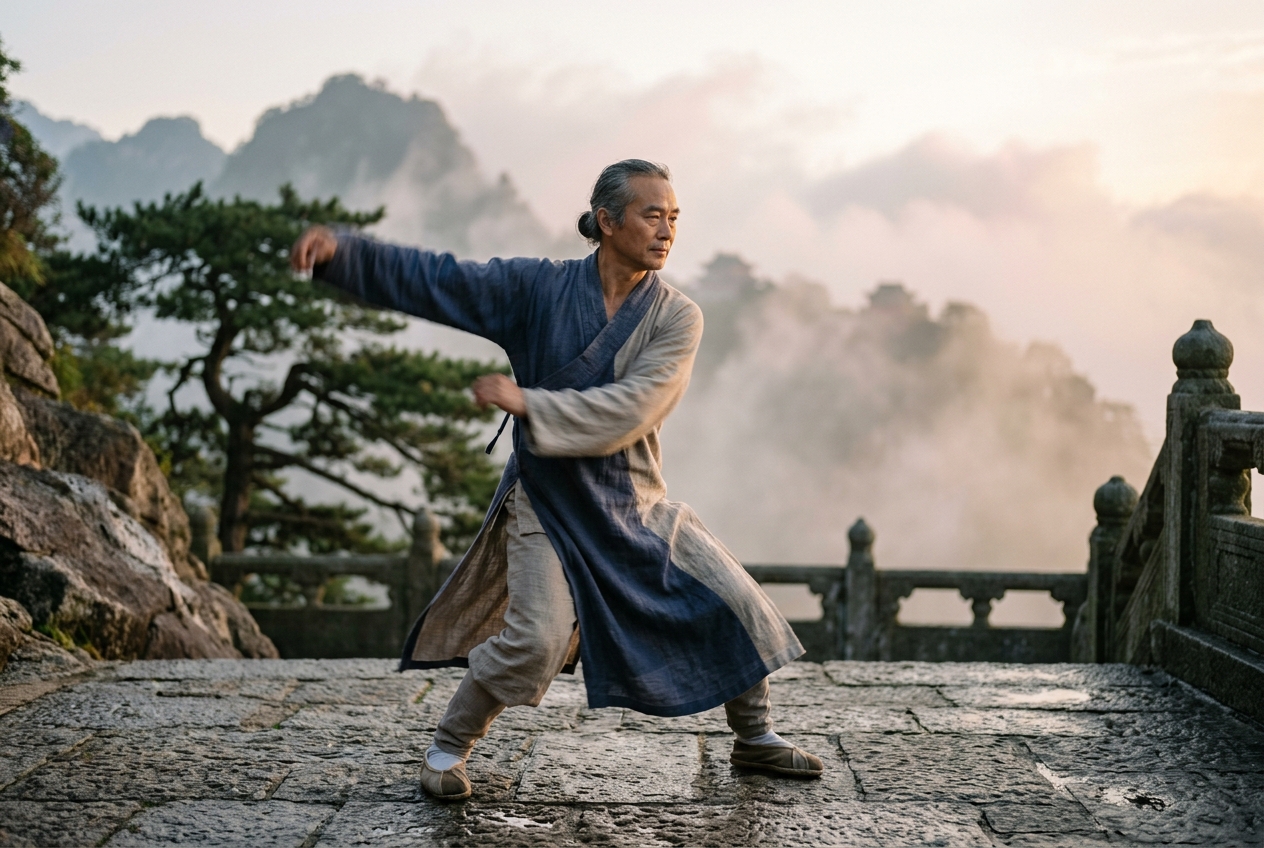
To the untrained eye, the movement appears deceptively simple—almost childlike in its repetitive ease. Yet beneath this gentle oscillatory kinetic loop lies a sophisticated therapeutic engine that marries the classical energetic architecture of Traditional Chinese Medicine (TCM) with modern principles of vascular hemodynamics, myofascial kinetic recoil, and neurovisceral regulation. In traditional somatic terminology, this practice descends rebellious Qi (pathologically rising internal heat and tension) downward from a congested head and chest into the grounding root of the feet, flushes stagnant energy through the primary channels of the upper limbs, and tonifies the Xia Dantian—the body’s constitutional reservoir located roughly two inches below the navel. In the vocabulary of Western biophysics, it transforms the entire musculoskeletal architecture into a low-frequency biological pump, optimizing venous return, driving lymphatic drainage, inducing widespread peripheral vasodilation, and coaxing a hyperaroused nervous system back into parasympathetic equilibrium.
The Step-by-Step Practice Guide
The profound clinical efficacy of Shuai Shou Gong depends entirely upon structural precision, kinetic relaxation (Song, 鬆), and the absolute surrender of active muscular force in favor of momentum and elastic recoil. Follow this comprehensive, six-stage instructional protocol to establish a safe and therapeutic daily home practice.
       [ Baihui (GV-20) Elevated ]
                  |
             ( Neutral )  <--- Gaze forward at eye level
             (  Head   )
                  |
           [ Open Chest ] <--- Arms swing passively forward to 70°
           /             \     and drop backward via gravity
   (Left Arm)         (Right Arm)
         \                 /
          \   [ Dantian ] /   <--- Center of mass anchored
           \   (Pelvis)  /
              |       |
            (Soft Knees)      <--- Gentle dual-spring dip on 5th swing
              |       |
         [ Yongquan (KD-1) ]  <--- Feet parallel & rooted flat
1. Structural Alignment and Grounding Setup
Begin by standing with your feet parallel, precisely hip- to shoulder-width apart. Ensure your toes point directly forward rather than flaring outward, which stabilizes the sacroiliac joints and keeps the hip sockets neutral. Distribute your body weight evenly across the tripod of each foot: the base of the big toe, the base of the little toe, and the center of the calcaneus (heel). Gently grip the floor with your toes to engage the plantar fascia without clenching, opening the hollow depression at the sole of the foot known as Yongquan (Kidney-1 / Bubbling Spring).
Tuck the tailbone slightly downward as though sitting on the edge of a tall barstool, which flattens excessive lumbar lordosis and unlocks the Mingmen (Life Gate) acupuncture point on the lower back. Soften the knees by maintaining a subtle micro-bend. Suspend the vertex of your skull as if lifted by an invisible silk thread attached to Baihui (Governing Vessel-20) at the crown of your head, which naturally draws the chin in, elongates the cervical spine, and relieves compressive load across the suboccipital triangle. Rest the tip of your tongue lightly against the hard palate just behind the upper incisors to bridge the Conception and Governing energetic vessels.
2. The Fundamental Pendular Swing
With your torso erect and stable, raise both arms forward simultaneously until they reach approximately chest or shoulder height (roughly a 60- to 70-degree angle from the vertical torso). Keep the wrists relaxed, fingers naturally extended without rigidity, and elbows soft. This forward lift represents the only phase of the cycle that uses active kinetic initiation.
Once the arms reach their peak height, release all muscular contraction across the anterior deltoids, pectorals, and biceps. Allow both arms to drop freely and swing backward past your hips purely under the acceleration of gravity and their own pendular inertia. As the arms pass the frontal plane of the thighs and swing behind the torso, do not forcefully pull or hyperextend the shoulder joint; let the passive elastic tension of the anterior myofascial chain catch the momentum and naturally rebound the arms forward again. The entire oscillatory movement should feel effortless, resembling the heavy, frictionless sway of two pendulums suspended from a stable crossbeam.
3. The Five-Swing Knee-Dip Cadence
The classical rhythm of Shuai Shou Gong operates on a continuous five-count cycle. Maintain an unhurried, metronomic tempo of approximately one full swing cycle every 1.2 to 1.5 seconds:
- Swing One: Swing arms forward to chest height; let them drop and rebound backward naturally. Torso remains upright, knees softly buoyant.
- Swing Two: Repeat the identical forward-and-backward pendular swing.
- Swing Three: Repeat the identical pendular swing.
- Swing Four: Repeat the identical pendular swing.
- Swing Five (The Dual Spring): As the arms drop backward on the fifth repetition, gently bend both knees into a soft, shallow squat (sinking approximately 2 to 3 inches). As the arms rebound past the hips toward the front, execute a second, rhythmic micro-bounce of the knees before straightening back up into the neutral resting stance as the arms rise.
This rhythmic "dip-bounce" on every fifth repetition activates the powerful musculovenous pump of the calves, compresses and releases the pelvic diaphragm, and creates a kinetic wave that travels up the spine, reinforcing whole-body structural integration.
4. Respiration, Gaze, and Attentional Anchoring
Respiration throughout the practice must remain entirely unforced, silent, and natural (Ziran, 自然). Do not attempt to rigidly coordinate inhalations and exhalations with individual arm movements, as doing so induces thoracic hyperventilation and hypercapnia. Instead, allow the lungs to establish their own slow, automatic diaphragmatic rhythm through the nose. As the practice deepens, the descending diaphragm will naturally synchronize with the rhythmic oscillations of intra-abdominal pressure.
Cast your visual gaze softly forward at eye level, neither focusing intently on a single point nor allowing the eyes to wander. Anchor your interoceptive attention in the physical sensations unfolding in the lower abdomen (Xia Dantian) and the soles of the feet (Yongquan). If intrusive cognitive chatter arises, simply note the thoughts without judgment and redirect your awareness to the heavy, swinging sensation in your hands.
5. Common Beginner Errors and Corrective Adjustments
- Error 1: Muscular Muscling and Shoulder Elevation. Beginners frequently hike the trapezius muscles toward the ears or actively push and pull the arms with muscular force.
Correction: Consciously widen the clavicles, broaden the armpits as if holding a small bird’s egg under each axilla, and ensure the shoulder blades remain depressed throughout the arc. - Error 2: Lumbar Swaying and Torso Rocking. Allowing the pelvis to tip anteriorly and the torso to rock back and forth disrupts the body's vertical plumb line.
Correction: Anchor the pelvic bowl; the spine must remain a stable, immovable pillar around which the pendular limbs oscillate. - Error 3: Knee Valgus Collapse. During the fifth-count double dip, the knees may collapse inward toward the midline, stressing the medial collateral ligaments.
Correction: Track the patellae directly over the second and third toes of each foot, maintaining constant engagement of the gluteus medius. - Error 4: Excessive Forward Elevation. Swinging the arms higher than shoulder level creates impingement across the subacromial space.
Correction: Cap the forward arc at roughly 70 degrees, keeping the arms below eye level.
6. Somatosensory Milestones (De Qi Sensations)
As you progress past five to ten minutes of continuous swinging, specific neurovascular sensations will reliably emerge. Recognizing these milestones confirms proper energetic and physiological alignment:
- Distal Paresthesia and Tingling: A distinct "pins-and-needles" or effervescent tingling sensation across the palms and fingertips indicates peripheral capillary vasodilation and the activation of unmyelinated cutaneous C-fibers.
- Gravitational Heaviness and Fullness: The hands begin to feel swollen, heavy, and full, like dense iron weights swinging on ropes. This sensation—termed Zhang (脹) in medical Daoyin—reflects enhanced distal blood volume and microvascular engorgement.
- Radiating Thermogenesis: A profound, soothing warmth begins in the center of the palms (Laogong, PC-8) and gradually ascends the forearm while radiating into the lower abdomen and soles of the feet.
- Spontaneous Autonomic Sighing: Spontaneous deep yawning, abdominal gurgling (borborygmi), and natural sighs indicate an active shift from sympathetic arousal to parasympathetic rest-and-digest dominance.
Why It Works — The Biomechanical & Physiological Body Science
The clinical power of Shuai Shou Gong lies in the elegant convergence of classical meridian mechanics with contemporary biomechanics, vascular physiology, and neurobiology.
Biomechanical Principles: Pendular Inertia and Myofascial Recoil
Unlike conventional resistance training, which relies on concentric and eccentric muscular contractions that consume metabolic energy and produce lactic acid, Shuai Shou Gong leverages pendular kinetics and the elastic properties of the human fascial network. When the arms fall from their peak forward arc, they accelerate under gravity. As they swing behind the coronal plane, kinetic energy is transferred into the anterior superficial and deep myofascial chains—specifically stretching the pectoral fascia, the biceps brachii tendon, and the anterior thoracolumbar fascial sheet.
These connective tissue structures store potential energy like stretched rubber bands. When the backward swing reaches its terminal excursion, this stored elastic strain energy is released, automatically snapping the arms forward without requiring heavy active contraction from the anterior deltoid muscles. This zero-torque kinetic rebound dramatically minimizes metabolic expenditure while promoting frictionless joint mobility, decompressing the glenohumeral joint and freeing the neurovascular bundle at the thoracic outlet.
Microvascular Perfusion and Endothelial Nitric Oxide Release
The continuous, cyclical swinging of the upper limbs creates centrifugal and gravitational fluid shifts that dramatically impact the peripheral vascular bed. As blood is propelled toward the fingertips during each downward swing, the luminal endothelial cells lining the digital arterioles and capillary beds experience rhythmic pulses of fluid shear stress.
In response to this mechanical deformation, endothelial cells activate the enzyme endothelial nitric oxide synthase (eNOS), synthesizing and releasing nitric oxide (NO) into the vascular smooth muscle cells. Nitric oxide stimulates cyclic guanosine monophosphate (cGMP) production, resulting in immediate smooth-muscle relaxation and robust peripheral vasodilation. This biochemical pathway explains the rapid onset of distal erythema, profound skin temperature increases, and relief of Raynaud-type peripheral vasoconstriction observed in clinical studies published across NCBI PubMed.
Venous Hemodynamics and Lymphatic Drainage
The human venous system within the lower extremities relies on the musculovenous pump to overcome gravitational hydrostatic pressure and propel deoxygenated blood back toward the right atrium of the heart. The five-swing knee-dip cadence of Shuai Shou Gong systematically compresses the soleus and gastrocnemius muscles, acting directly upon deep intramuscular veins. The one-way tricuspid valves inside these vessels prevent retrograde pooling, driving venous return upward through the popliteal and femoral veins.
Concurrently, the rhythmic oscillation of the upper limbs and thorax modulates intra-thoracic and intra-abdominal pressures. The thoracic duct—the primary trunk of the human lymphatic system—ascends through the posterior mediastinum and drains into the left subclavian vein. The alternating mechanical compression and decompression of the axillary nodes and subclavicular junctions act as a non-invasive mechanical suction pump, accelerating the clearance of interstitial metabolic waste, cellular debris, and systemic inflammatory mediators.
Autonomic Regulation and Cardiorespiratory Entrainment
Prolonged psychological stress and sedentary lifestyle habits frequently trap modern individuals in a state of chronic sympathetic nervous system overactivation, characterized by elevated baseline cortisol, systemic vasoconstriction, impaired digestion, and suppressed Heart Rate Variability (HRV).
The metronomic, oscillatory rhythm of Shuai Shou Gong stimulates low-threshold mechanoreceptors throughout the joint capsules and myofascia, sending a steady stream of inhibitory afferent signals via the dorsal column-medial lemniscal pathway to the brainstem. This sensory input dampens sympathetic outflow from the rostral ventrolateral medulla and upregulates efferent vagal nerve activity. The resultant elevation in vagal tone enhances high-frequency HRV, resets central arterial baroreflex sensitivity, and produces clinically verified reductions in resting systolic and diastolic blood pressure among hypertensive cohorts.
Energetic Pathways: Descending Rebellious Qi and Dantian Tonification
Within the theoretical taxonomy of medical Daoyin and acupuncture meridians, excessive mental rumination, chronic stress, and screen fatigue cause Qi and Blood to stagnate in the upper burner (Shang Jiao), generating pathological heat that manifests as insomnia, migraines, anxiety, and hypertension—a pattern termed Rebellious Qi.
Shuai Shou Gong functions as a powerful somatic grounding mechanism:
- Clearing Upper Extremity Channels: The continuous swinging motion opens the three Yin channels of the arm—the Lung, Heart, and Pericardium meridians—clearing emotional constriction and toxic heat from the chest cavity and the central pericardial point Laogong (PC-8).
- Descending Fire to Water: By maintaining mindful awareness on the soles of the feet, internal energy is drawn downward along the Kidney meridian to Yongquan (KD-1), anchoring the rising fire of the Heart back into the cooling water essence of the Kidneys.
- Pelvic Diaphragm Entrainment (Huiyin Pulsing): The fifth-count knee dip induces a rhythmic contraction and relaxation of the perineal floor (Huiyin, CV-1), which compresses and revitalizes the Xia Dantian, nourishing primordial Jing (essence) and building a resilient constitutional reserve.
Summary of Clinical Evidence & Biomarkers
| Physiological Domain | Biological Mechanism | Clinical Biomarkers & Measurable Outcomes | Primary Therapeutic Indications |
|---|---|---|---|
| Microvascular Circulation | Shear-stress-induced endothelial nitric oxide (eNOS) upregulation; peripheral capillary recruitment. | $\uparrow$ Distal skin temperature (+1.5–3.0°C); $\uparrow$ Microvascular blood flux; $\downarrow$ Peripheral vascular resistance. | Hypertension, Raynaud's phenomenon, diabetic peripheral neuropathy, chronic cold extremities. |
| Autonomic Nervous System | Mechanoreceptor afferent signaling; central vagal nerve stimulation; baroreceptor resetting. | $\uparrow$ RMSSD and HF-HRV power; $\downarrow$ Serum salivary cortisol; $\downarrow$ Resting heart rate (5–8 bpm). | Chronic sympathetic overload, generalized anxiety, insomnia, burnout syndrome. |
| Venous & Lymphatic Fluid Dynamics | Soleus/gastrocnemius musculovenous pump activation; axillary/thoracic duct pressure gradients. | $\uparrow$ Venous return velocity; $\downarrow$ Lower limb interstitial edema; accelerated clearance of systemic inflammatory cytokines (IL-6, TNF-$\alpha$). | Venous insufficiency, lymphedema management, metabolic sluggishness, post-viral fatigue. |
| Connective Tissue & Posture | Kinetic energy storage and release across thoracolumbar fascia and anterior arm lines. | $\downarrow$ Passive tissue stiffness; $\uparrow$ Glenohumeral range of motion; reduction of thoracic kyphosis angles. | Upper cross syndrome, myofascial shoulder pain, postural fatigue, spinal rigidity. |
Classical Lineage & Historical Evolution
The lineage of arm-swinging Daoyin represents one of the most resilient streams of Chinese movement medicine, bridging ancient Chan Buddhist monastic disciplines with 21st-century integrative oncology and hospital rehabilitation.
Bodhidharma and the Monastic Daoyin Heritage
According to traditional martial and medical historiography, the foundational origins of rhythmic tendon-changing exercises trace back to the arrival of the Indian sage Bodhidharma (Damo, 達摩) at the Shaolin Monastery in Henan Province during the early 6th century CE. Finding the resident monks emaciated, physically stagnant, and collapsing from the rigors of prolonged seated meditation, Bodhidharma synthesized two seminal physical cultivation systems: the Yi Jin Jing (易筋經, Muscle-Tendon Changing Classic) and the Xi Sui Jing (洗髓經, Marrow Washing Classic), documented in comprehensive scholarly records such as the Wikipedia Overview of Yijin Jing.
The primary philosophical premise of the Yi Jin Jing was revolutionary: spiritual enlightenment requires an open, structurally aligned, and physically resilient biological vessel. The earliest prototypes of Shuai Shou Gong emerged from these tendon-changing exercises, where monks utilized simple, repetitive pendular movements to systematically flush the body's fascial sheaths, eliminate joint stasis, and maintain vigorous cardiovascular and immune vitality without depleting their meditative stillness.
Dynastic Refinements in Classical Chinese Medicine
During the Tang (618–907 CE) and Song (960–1279 CE) Dynasties, these monastic exercises were incorporated into secular medical encyclopedias, such as the Zhubing Yuanhou Lun (Treatise on the Pathogenesis and Manifestations of All Diseases) compiled by the imperial physician Chao Yuanfang. Classical physicians recognized that physical diseases predominantly arose from stagnation—stagnation of Blood, stagnation of Qi, and stagnation of internal fluids (Tan Yin, phlegm-fluid retention).
By the Qing Dynasty (1644–1912 CE), simplified variants of arm swinging were compiled under the specific title Shuai Shou Gong within traditional martial and health treatises, celebrated as a democratic, universally accessible medicine that required zero financial investment, zero specialized equipment, and zero esoteric theoretical knowledge to achieve health and longevity.
Modern Clinical Rebirth: Master Li Feng-shan and Ping Shuai Gong
In the late 20th century, the traditional form underwent a major clinical refinement under the renowned Taiwanese martial artist and humanitarian Master Li Feng-shan (founder of the Meimen Qigong Center). Master Li standardized the ancient disparate methods into the contemporary protocol known globally as Ping Shuai Gong (平甩功, Level Arm Swinging), introducing the signature rhythmic five-swing cadence with the double knee bounce.
Recognizing that modern populations suffer from intense sensory overload and sedentary workplace postures, Master Li distilled the practice into an uncompromised, highly reproducible somatic prescription. Over the past three decades, modern healthcare systems, supported by global wellness frameworks established by the World Health Organization Traditional Medicine Programme, have integrated this standardized form into mainstream hospital environments across Asia and North America.
Clinical research overseen by organizations such as the National Qigong Association and the National Center for Complementary and Integrative Health has explored the application of Ping Shuai Gong as a powerful adjunctive therapy in: * Integrative Oncology: Alleviating chemotherapy-induced fatigue, improving white blood cell recovery rates, and reducing cancer-related oxidative stress. * Metabolic Syndrome & Type 2 Diabetes: Enhancing cellular insulin sensitivity through low-intensity muscular glucose uptake and reducing chronic low-grade systemic inflammation. * Cardiopulmonary Rehabilitation: Safely improving functional exercise capacity and lowering systemic vascular resistance in fragile, elderly, or post-cardiac surgery patients who cannot endure high-impact aerobic training.
Today’s Practice Commitment
True somatic transformation does not demand grueling hours of high-intensity exhaustion; it requires unbroken consistency and mindful presence. Commit today to initiating this restorative practice with the following clear, actionable prescription:
The 10-Minute Daily Protocol * When: Tomorrow morning, immediately upon waking and before your first cup of coffee or tea. * Where: Next to an open window or in a quiet room with fresh, circulating air. * Duration: Set a gentle timer for precisely 10 minutes (which yields approximately 400 to 500 total swings at a steady cadence). * The Sequence: 1. Stand in the rooted posture: feet parallel and shoulder-width apart, knees soft, tailbone sunk, spine suspended. 2. Execute the five-count swing: four relaxed pendular swings forward to chest level and back, followed by the fifth swing with the soft double knee bounce. 3. Maintain natural, quiet diaphragmatic breathing through your nose. 4. When the timer sounds, bring your arms to a gentle rest at your sides. Close your eyes and stand completely still for 60 seconds. Observe the sparkling warmth in your hands, the downward gravitational pull in your feet, and the quiet stillness of your mind.
As you step into the remainder of your day, notice the subtle changes in your baseline energy, the natural depth of your breathing, and the calm resilience of your nervous system. You have not just performed an exercise—you have engaged in a living, centuries-old lineage of biological renewal.