ZX-Calculus: Simplifying Quantum Circuits and Verifying Fault-Tolerant Compilations Via Diagrammatic Rewriting
Every digital transaction that underpins modern civilization—from international wire transfers to encrypted diplomatic cables—rests on mathematical assumptions that a fault-tolerant quantum computer will inevitably dismantle. The cryptographic shields we take for granted, notably RSA and elliptic-curve cryptography, rely on the sheer classical impossibility of factoring gigantic integers or calculating discrete logarithms. A quantum machine operating at scale could unravel these problems in a matter of hours.
Yet, beneath this staggering promise lies an engineering and mathematical bottleneck that the quantum computing industry rarely discusses in its promotional literature: the catastrophic overhead of quantum circuit compilation and error correction. Translating an abstract quantum algorithm into instructions that physical hardware can execute without succumbing to environmental noise requires millions of physical operations. For over three decades, physicists and computer scientists have attempted to tame this beast using standard quantum circuit notation—a framework that treats quantum logic as a sequence of discrete musical notes played across horizontal wire staves.
This traditional framework is failing. Standard circuit diagrams conceal the rich, topological symmetries of quantum entanglement behind an arbitrary, time-ordered sequence of matrices. When quantum circuits grow to thousands of interacting operations, verifying that an optimized program performs the exact same mathematical transformation as its unoptimized predecessor becomes virtually impossible via brute-force linear algebra. Calculating the product of $2^N \times 2^N$ matrices for a mere 100 qubits would require more memory than all the atoms in the observable universe could store.
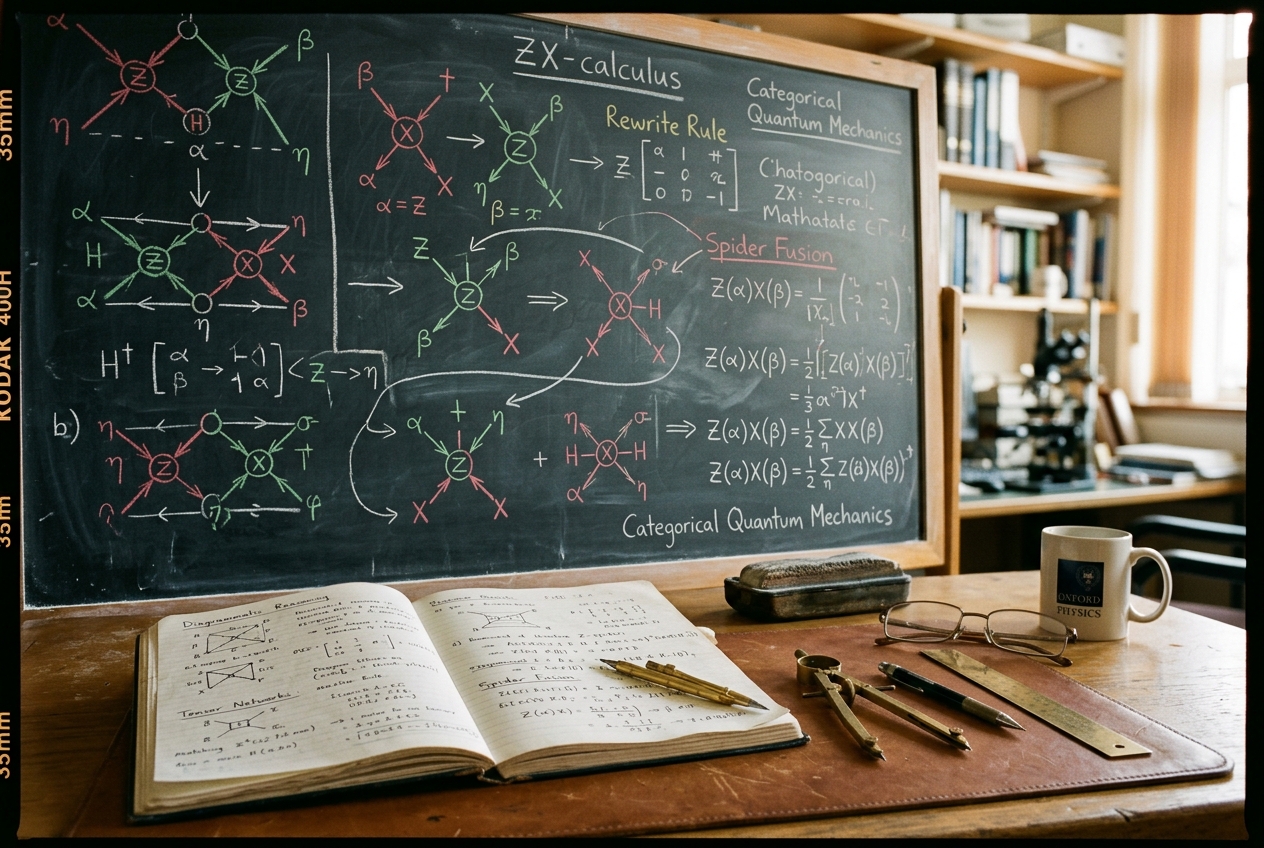
Enter ZX-calculus. Pioneered by mathematical physicists Bob Coecke and Ross Duncan at Oxford University, this revolutionary diagrammatic language discards the rigid horizontal timeline of traditional quantum circuits. Instead, it translates quantum transformations into interactive, color-coded graphs. By manipulating interconnected red and green nodes known as "spiders," quantum engineers can fuse, morph, and untangle complex algorithms with the intuitive elegance of knot theory. ZX-calculus does not merely make quantum mechanics visual; it provides a rigorous, complete algebraic system that allows automated compilers to strip away redundant operations, slash fault-tolerant overheads, and formally verify the architecture of tomorrow’s quantum supercomputers.
1. THE IDEA IN PLAIN ENGLISH: FROM RIGID TRACKS TO FLUID PLUMBING
To understand why traditional quantum circuit diagrams are holding the field back, one must first appreciate the artificial constraints of classical computer notation. Since the days of Alan Turing and John von Neumann, we have conceptualized computation as a sequential assembly line: information enters from the left, undergoes a series of discrete clock-cycle operations, and emerges on the right as a definitive output.
When physicists developed the standard quantum circuit model in the 1980s, they instinctively copied this assembly line metaphor. They drew horizontal wires representing qubits and dropped geometric boxes onto them to represent quantum logic gates. But quantum reality does not behave like a classical assembly line. Quantum mechanics is fundamentally non-local, bidirectional, and symmetrical in space and time. A measurement performed on one entangled qubit instantly constrains the state of its distant partner, collapsing the notion of a strictly forward-marching chronological trajectory.
Imagine trying to describe a complex, three-dimensional plumbing network using only flat, one-way conveyor belts. If two pipes merge, twist around each other, and split into three separate outlets, forcing that system into a series of rigid, left-to-right conveyor segments obscures the underlying geometry of the water pressure. You would have to invent complex rules to explain how a valve on conveyor track five retroactively changes the speed of a package on conveyor track one.
ZX-calculus replaces the conveyor belts with the actual plumbing pipes. In this visual language: - Quantum states, gates, and measurements are transformed into interconnected junctions called spiders. - Spiders act as multi-port plumbing fixtures that distribute, phase-shift, and entangle quantum information across any number of incoming and outgoing wires. - The direction of the wires, their physical arrangement on the page, and the exact spatial ordering of the junctions become irrelevant. All that matters is the topology—which spiders are connected to which.
If two junctions of the same type touch, they seamlessly melt into a single larger junction, naturally combining their properties. If junctions of opposite types interact, they exchange information through elegant graph-rewriting rules. A computation that would require multiplying billions of complex matrix entries in traditional linear algebra is reduced to a visual game of merging bubbles and sliding connections along topological networks.
2. HOW IT ACTUALLY WORKS: THE MECHANICS OF SPIDERS AND TOPOLOGY
At the bedrock of the ZX-calculus formalism lies the mathematics of symmetric monoidal categories (specifically, dagger-compact categories of finite-dimensional Hilbert spaces). Rather than tracking abstract state vectors across high-dimensional coordinate planes, ZX-calculus encodes quantum linear maps directly through diagrammatic generators and equational rewrite rules.
The Fundamental Generators: Z-Spiders, X-Spiders, and the Hadamard Wire
The language is built upon two complementary families of non-linear nodes—distinguished diagrammatically by color—and a foundational bridge wire:
- Z-Spiders (Green Nodes): A green spider possesses $n$ input wires and $m$ output wires and is parametrized by a continuous real phase angle $\alpha \in [0, 2\pi)$. Formally, a Z-spider represents a linear map expressed in the standard computational basis ${|0\rangle, |1\rangle}$. When fed quantum information, it acts as a generalized copier and phase-rotator:
$$\mathcal{Z}_n^m(\alpha) = |0\rangle^{\otimes m} \langle 0|^{\otimes n} + e^{i\alpha} |1\rangle^{\otimes m} \langle 1|^{\otimes n}$$
In plain words: this formula states that the green spider preserves the all-zero state while attaching a rotational phase shift $\alpha$ to the all-one state, discarding any amplitude where the inputs disagree. When $\alpha = 0$, the Z-spider behaves as a pure coherent branching point or state-equality tester.
- X-Spiders (Red Nodes): A red spider similarly features $n$ inputs, $m$ outputs, and a phase angle $\beta \in [0, 2\pi)$, but it operates entirely within the transverse or Fourier basis ${|+\rangle, |-\rangle}$, where $|+\rangle = \frac{1}{\sqrt{2}}(|0\rangle + |1\rangle)$ and $|-\rangle = \frac{1}{\sqrt{2}}(|0\rangle - |1\rangle)$. It is mathematically defined as:
$$\mathcal{X}_n^m(\beta) = |+\rangle^{\otimes m} \langle +|^{\otimes n} + e^{i\beta} |-\rangle^{\otimes m} \langle -|^{\otimes n}$$
In plain words: the red spider acts as the exact dual of the green spider. It copies states in the plus/minus basis and introduces relative phase shifts between symmetric and antisymmetric quantum superpositions.
- The Hadamard Bridge (Yellow Box or Blue Dashed Edge): The Hadamard transition represents the foundational discrete transformation that maps the computational basis directly to the transverse basis: $|0\rangle \leftrightarrow |+\rangle$ and $|1\rangle \leftrightarrow |-\rangle$. Graphically, passing a wire through a Hadamard box converts a Z-spider into an X-spider, and vice versa. In graph-like ZX representations, Hadamard boxes are simplified into dashed or colored edges between spiders.
The Core Graphical Rewrite Rules
The power of ZX-calculus stems from its completeness: any identity that holds true in the linear algebra of quantum mechanics can be proven entirely through diagrammatic rewrites without ever writing down a matrix. The foundational transformation rules include:
I. Spider Fusion
When two spiders of the identical color are linked by one or more wires, they immediately fuse into a single composite spider. The inputs and outputs of both nodes are combined, and their internal phase angles simply add together modulo $2\pi$:
$$\mathcal{Z}_k^m(\alpha) \circ \mathcal{Z}_n^k(\beta) = \mathcal{Z}_n^m(\alpha + \beta)$$
II. The Bialgebra Rule
When a green spider and a red spider with zero phase are connected, they interact according to the categorical bialgebra law. Wires that branch through one color can be pushed through the other color, transforming a parallel pair of copy operations into a fully connected bipartite mesh. This captures the fundamental algebraic interaction between the quantum bit-flip ($X$) and phase-flip ($Z$) operations.
III. Color Change via Euler Decomposition
A spider of one color with a non-trivial phase can be converted into a chain of three spiders of the opposite color surrounded by Hadamard transitions, echoing the classic Euler angle decomposition of single-qubit rotations: $R_z(\theta) = H R_x(\theta) H$.
IV. Local Complementation and Pivoting
In the modern, graph-theoretic formulation of ZX-calculus, circuits are transformed into "graph-like" ZX-diagrams where all spiders are green and all connections are Hadamard edges. Within this structure, Clifford-phase spiders (spiders whose angles are integer multiples of $\pi/2$) can be systematically removed using two topological graph operations: - Local Complementation: Eliminates a spider with phase $\pm \pi/2$ by taking all of its graph neighbors and inverting their mutual connections (toggling the existence of edges between every pair of adjacent nodes), while applying a local phase adjustment to those neighbors. - Pivoting: Eliminates a pair of connected interior spiders with phases $0$ or $\pi$ by swapping connections across their tripartite neighborhood partitions.
GRAPH REWRITE: LOCAL COMPLEMENTATION
Before: Spider V has phase π/2, connected to neighbors A, B, C.
Rewrite: Remove V. For every pair in {A, B, C}, toggle the edge between them.
Result:  A, B, C update their internal phases by -π/2; the graph shrinks.
Completeness, Clifford+T Universal Logic, and T-Count Reduction
In quantum computation, not all operations carry the same physical cost. Gates belonging to the Clifford group (such as CNOT, Hadamard, and Phase gate $S$) can be simulated efficiently on a classical computer, as established by the celebrated Gottesman-Knill theorem. However, to achieve universal quantum computation capable of executing any algorithm, one must introduce a non-Clifford operation—most commonly the T-gate, which corresponds to a phase angle of $\pi/4$.
In fault-tolerant quantum computing architectures based on quantum error-correcting codes, Clifford gates are "transversal" (naturally protected and simple to execute). T-gates, by contrast, cannot be implemented transversally without destroying the code's protection. They must be manufactured through an extraordinarily expensive process known as magic state distillation, consuming up to 90% of the physical quantum computer's time and physical qubit resources.
Minimizing the number of T-gates (the T-count) is the single most important objective in quantum software compilation. Traditional circuit optimizers struggle with this because T-gates often hide inside complex subroutines spread across distant qubits.
Because ZX-calculus was proven complete for Clifford+T quantum mechanics by researchers Emmanuel Jeandel, Simon Perdrix, and Renaud Vilmart in 2018, any two equivalent quantum circuits can be transformed into one another using purely diagrammatic ZX rules. Automated compilers like the open-source library PyZX convert entire quantum programs into graph-like ZX diagrams, apply local complementation and pivoting to melt away Clifford spiders, and merge non-Clifford T-phases across the graph topology. The result is an unprecedented, automated reduction in T-count that frequently surpasses human-designed circuit optimizations by 30% to 50%.
Step-by-Step Graphical Reduction: Multi-Qubit CNOT and State Preparation
To see the graphical machinery in action, consider a standard quantum subroutine: preparing an entangled state using a Hadamard gate, feeding it into a two-qubit CNOT gate, and applying a phase rotation before measuring.
In just three diagrammatic steps, the sequential gate-based circuit has been transformed into its minimal, canonical graph state representation: two green phase spiders linked by an entangled edge, ready to be mapped directly onto topological hardware without redundant gate executions.
3. REAL-WORLD APPLICATIONS TODAY (2024–2026)
ZX-calculus is no longer an esoteric branch of mathematical logic confined to academic journals. Over the past three years, it has become a structural pillar of industrial quantum engineering, adopted by leading hardware manufacturers, quantum software unicorns, and national laboratories.
1. Quantinuum: Supercharging Quantum Compilers with TKET
The Institution: Quantinuum (formed by the merger of Cambridge Quantum Computing and Honeywell Quantum Solutions), developer of high-fidelity trapped-ion quantum processors.
The Objective: Quantum algorithms written in high-level programming frameworks cannot run directly on trapped-ion hardware; they must first be compiled down to the native laser pulses and physical ion shuttling operations of the machine. Quantinuum integrates ZX-calculus deeply into its open-source compiler, TKET.
The Quantum Advantage: By converting complex subroutines (such as molecular chemistry simulations) into ZX-diagrams, TKET automatically identifies and cancels redundant entangling operations that standard gate-level compilers cannot detect. This optimization drastically shortens circuit depth, allowing researchers to run deep quantum algorithms before the fragile trapped ions lose coherence.
2. Riverlane: Verifying Lattice Surgery in Topological Surface Codes
The Institution: Riverlane, a leading quantum error correction company based in the UK.
The Objective: Building commercial fault-tolerant quantum computers requires implementing topological surface codes. In these 2D grids of physical qubits, logical quantum gates are not executed by pulsing single qubits, but by performing lattice surgery—slicing, merging, and reconnecting macroscopic patches of the surface code across time.
The Quantum Advantage: Proving that a complex sequence of physical lattice merges and splits correctly performs a target logical algorithm without introducing fatal uncorrectable errors is mathematically intractable using matrix mechanics. Riverlane leverages ZX-calculus because the rules of lattice surgery map one-to-one onto the topological operations of Z- and X-spiders. ZX-calculus acts as an automated formal verification engine, guaranteeing that error-correction protocols are mathematically sound before they are burned into microchip control silicon.
3. IBM Quantum: Next-Generation Transpilation in Qiskit
The Institution: IBM Quantum, operator of the world's largest fleet of superconducting quantum processors.
The Objective: Superconducting qubits on IBM's Eagle and Heron processors have fixed physical connectivity; each qubit can only interact with its immediate nearest neighbors on a heavy-hexagonal lattice. When a user submits an arbitrary algorithm via IBM Qiskit, the transpiler must insert dozens of SWAP gates to move quantum states across the chip.
The Quantum Advantage: IBM research teams have incorporated ZX-calculus-based routing and simplification passes into the Qiskit compilation pipeline. By representing multi-qubit Clifford subroutines as graph states, the transpiler can re-route entanglement across the chip without physically swapping qubits step-by-step, eliminating up to 40% of the noisy two-qubit gates traditionally required for physical execution.
4. PsiQuantum: Routing Fault-Tolerant Photonic Fusion Networks
The Institution: PsiQuantum, a Silicon Valley hardware company building a utility-scale, million-qubit quantum computer using silicon photonics.
The Objective: Unlike stationary superconducting or trapped-ion qubits, photonic qubits travel continuously at the speed of light through optical waveguides on silicon microchips. Computation in PsiQuantum's architecture is performed by "fusing" single photons in spatial and temporal measurement devices, generating a three-dimensional cluster state known as a spacetime fusion network.
The Quantum Advantage: Standard circuit diagrams cannot represent continuous photonic computation because there are no static qubits stored in resting registers. Because ZX-calculus natively models measurement-based quantum computing (MBQC) and topological cluster states, PsiQuantum relies on diagrammatic graphical calculus to design, optimize, and route photonic fusion graphs directly through silicon optical delay lines.
4. WHAT THIS MEANS FOR YOU: THE RACE FOR FAULT-TOLERANT SECURITY AND MEDICINE
It is easy to dismiss diagrammatic rewriting and categorical quantum mechanics as academic abstractions far removed from daily life. In reality, the efficiency gains delivered by ZX-calculus are directly accelerating the timeline for when quantum computers will impact personal privacy, healthcare, and economic security.
Consider the global transition to post-quantum cryptography. Financial institutions, healthcare systems, and national intelligence agencies are currently spending billions of dollars upgrading their cybersecurity infrastructure to resist quantum decryption. The urgency of this migration depends entirely on how quickly quantum hardware manufacturers can build a machine with enough error-corrected logical qubits to run Shor’s factoring algorithm.
Before the widespread adoption of ZX-calculus optimization, compiling Shor's algorithm to crack standard 2048-bit RSA encryption was estimated to require billions of physical operations and an astronomical physical qubit count, placing the threat safely decades into the future. By slashing the T-count and streamlining lattice surgery operations, ZX-calculus has compressed those resource estimates by orders of magnitude, moving the horizon of practical quantum advantage noticeably closer.
The same efficiency explosion applies directly to peaceful computational chemistry: - Clean Industrial Chemistry: Simulating the active chemical site of the nitrogenase enzyme—the biological key to producing ammonia for agriculture at ambient temperature and pressure—requires computing the quantum interactions of complex iron-sulfur molecular clusters. Classical supercomputers cannot accurately model these electron correlations. By drastically shrinking the required quantum circuit depth, ZX-calculus brings the computational design of energy-efficient synthetic fertilizers within reach of early fault-tolerant quantum hardware. - Precision Pharmaceuticals: Designing complex small-molecule oncology drugs without years of physical trial-and-error laboratory synthesis requires precise quantum simulation of molecular binding affinities. Optimization via graphical calculus makes simulating these biomolecular interactions computationally viable on near-term fault-tolerant processors.
5. TODAY’S TAKEAWAY
The revolution of ZX-calculus proves that progress in quantum computing is not merely an engineering race to manufacture cleaner physical qubits; it is equally a mathematical crusade to liberate our thinking from the rigid, sequential prejudices of classical computing. By abandoning the assembly-line conveyor belts of traditional circuit notation in favor of the fluid, topological symmetries of green and red spiders, ZX-calculus provides the universal language needed to optimize, verify, and ultimately realize the promise of fault-tolerant quantum computation.
AUTHORITATIVE REFERENCES & FURTHER STUDY
- ZX-Calculus Official Academic Repository & Documentation
- Bob Coecke & Ross Duncan (2011), Interacting Quantum Observables: Categorical Quantum Mechanics with ZX-calculus, New Journal of Physics
- Nature Physics: Quantum Information & Categorical Foundations
- MIT OpenCourseWare: Quantum Physics and Quantum Computation Foundations
- PyZX: Graph-Theoretic Quantum Circuit Optimization Library
- IBM Quantum Documentation: Qiskit Transpiler Architecture