Wigner Function: Characterizing Phase-Space Quasiprobability Distributions and Non-Classical State Negativity
1. THE STAKES OF PHASE SPACE: BEYOND THE DISCRETE QUBIT
The global race to construct fault-tolerant quantum computers is frequently narrated through the discrete lens of the two-level "qubit"—the quantum analogue of the classical binary transistor. Yet, across major research laboratories from Toronto to Tokyo, a fundamentally different, exceptionally potent paradigm is quietly maturing: continuous-variable (CV) quantum information. Rather than encoding quantum data into isolated electronic or nuclear spins, continuous-variable systems manipulate the continuous physical degrees of freedom of electromagnetic wave fields, such as their continuous amplitudes and phases.
The immediate real-world consequence of this paradigm is transformative. A continuous-variable quantum optical processor can generate millions of entangled quantum modes (qumodes) simultaneously on a single microphotonic chip, bypassing the catastrophic physical scaling bottlenecks that plague superconducting circuits and trapped-ion vacuum chambers. However, moving from discrete values to infinite-dimensional continuous systems forces quantum physicists to confront an ancient mathematical paradox: how does one describe a particle or an optical field in classical phase space—simultaneously tracking position $x$ and momentum $p$—when the Heisenberg uncertainty principle explicitly forbids them from possessing simultaneous, well-defined deterministic values?
The answer lies in the Wigner quasiprobability distribution, a mathematical construct formulated by Nobel laureate Eugene Wigner in 1932. The Wigner function maps quantum states onto classical phase space, producing a continuous terrain of probabilities. But it comes with an astonishing feature: under specific quantum conditions, the Wigner function dips below zero, yielding regions of negative probability. Far from being a mathematical artifact, this phase-space negativity is the unambiguous signature of quantum contextuality and the indispensable resource powering computational quantum advantage. Without negative Wigner volume, any continuous-variable quantum device—no matter how many billions of entangled optical modes it manipulates—can be simulated on an ordinary classical laptop in polynomial time.
2. THE INTUITION OF QUASIPROBABILITY: MAPPING THE UNCERTAIN REALM
To build an intuitive grasp of the Wigner function, consider a classical lighthouse sweeping its beam across the sea. If you wish to map both where the beam is hitting the coastline ($x$) and the direction of its sweeping velocity ($p$), a standard joint classical probability distribution $P(x, p)$ suffices. This classical distribution is strictly non-negative; at every point, the probability is either zero or positive, and integrating over the entire map yields exactly 1 (100% certainty that the beam is somewhere).
In quantum mechanics, measuring position disturbs momentum, governed by the canonical commutation relation $[\hat{x}, \hat{p}] = i\hbar$. A naive joint probability distribution $P(x, p)$ cannot exist under standard Kolmogorov probability axioms because measuring both variables simultaneously with arbitrary precision violates quantum law.
The Wigner distribution resolves this dilemma by acting as a quasiprobability distribution. It retains the intuitive property of classical distributions: if you integrate out momentum entirely, you obtain the exact, physically observable probability of finding the particle at position $x$. If you integrate out position entirely, you obtain the exact probability of measuring momentum $p$.
Yet, when both coordinates are examined together, quantum wave interference creates localized interference ripples in phase space. Where peaks and troughs of the quantum wavefunction overlap destructively, the value of the distribution dips below zero. A "negative probability" does not mean an event occurs minus-five percent of the time; rather, it signifies that the underlying quantum state cannot be explained by any local classical statistical model. It serves as a mathematical certificate that the physical system is behaving in an exclusively non-classical manner.
3. THE MATHEMATICAL FOUNDATIONS: THE WEYL-WIGNER TRANSFORM AND MARGINALS
The rigorous formulation of the Wigner distribution begins with the correspondence between quantum operators acting on an infinite-dimensional Hilbert space $\mathcal{H}$ and classical functions on phase space $\mathbb{R}^2$, known as the Weyl-Wigner transform.
Let $\hat{\rho}$ be the density operator describing an arbitrary quantum state (satisfying $\hat{\rho} = \hat{\rho}^\dagger$, $\text{Tr}(\hat{\rho}) = 1$, and $\hat{\rho} \ge 0$). In the position representation, the matrix elements of $\hat{\rho}$ are given by $\langle x' | \hat{\rho} | x'' \rangle$. The Wigner distribution $W(x, p)$ is formally defined as the Fourier transform of the off-diagonal density matrix elements parameterized by the spatial displacement $y$:
$$W(x, p) = \frac{1}{2\pi\hbar} \int_{-\infty}^{\infty} \left\langle x - \frac{y}{2} \right| \hat{\rho} \left| x + \frac{y}{2} \right\rangle e^{\frac{i p y}{\hbar}} \, dy$$
For a pure quantum state $|\psi\rangle$, where $\hat{\rho} = |\psi\rangle\langle\psi|$, this simplifies to:
$$W(x, p) = \frac{1}{2\pi\hbar} \int_{-\infty}^{\infty} \psi^*\left(x + \frac{y}{2}\right) \psi\left(x - \frac{y}{2}\right) e^{\frac{i p y}{\hbar}} \, dy$$
Proof of the Marginal Distributions
The foundational validity of $W(x, p)$ rests upon its ability to yield true, measurable marginal probability densities when integrated along any phase-space slice.
1. Position Marginal
Integrating $W(x, p)$ over all momenta $p \in (-\infty, \infty)$:
$$\int_{-\infty}^{\infty} W(x, p) \, dp = \frac{1}{2\pi\hbar} \int_{-\infty}^{\infty} \int_{-\infty}^{\infty} \left\langle x - \frac{y}{2} \right| \hat{\rho} \left| x + \frac{y}{2} \right\rangle e^{\frac{i p y}{\hbar}} \, dy \, dp$$
Recognizing the integral representation of the Dirac delta function $\int_{-\infty}^{\infty} e^{i p y / \hbar} \, dp = 2\pi\hbar \, \delta(y)$, we evaluate:
$$\int_{-\infty}^{\infty} W(x, p) \, dp = \int_{-\infty}^{\infty} \left\langle x - \frac{y}{2} \right| \hat{\rho} \left| x + \frac{y}{2} \right\rangle \delta(y) \, dy = \langle x | \hat{\rho} | x \rangle = |\psi(x)|^2$$
2. Momentum Marginal
Integrating $W(x, p)$ over all positions $x \in (-\infty, \infty)$ requires shifting variables $u = x - y/2$ and $v = x + y/2$, yielding Jacobian determinant $|J| = 1$. Expressing the position states in terms of momentum eigenstates via $\langle p | x \rangle = \frac{1}{\sqrt{2\pi\hbar}} e^{-i p x / \hbar}$:
$$\int_{-\infty}^{\infty} W(x, p) \, dx = \langle p | \hat{\rho} | p \rangle = |\psi(p)|^2$$
Moyal's Bracket and the Deformation of Classical Mechanics
In classical statistical mechanics, the time evolution of a phase-space distribution is governed by the Poisson bracket: $\partial_t \rho = {\mathcal{H}, \rho}_{\text{PB}}$. In the quantum domain, operator non-commutativity alters this dynamics. Under the Weyl-Wigner framework, operator multiplication is mapped to the non-local Moyal star-product ($\star$):
$$A(x, p) \star B(x, p) = A(x, p) \exp\left[ \frac{i\hbar}{2} \left( \frac{\overleftarrow{\partial}}{\partial x}\frac{\overrightarrow{\partial}}{\partial p} - \frac{\overleftarrow{\partial}}{\partial p}\frac{\overrightarrow{\partial}}{\partial x} \right) \right] B(x, p)$$
The quantum time evolution of the Wigner function is governed by the Moyal bracket:
$$\frac{\partial W(x, p)}{\partial t} = {{ H, W }}{\text{MB}} = \frac{1}{i\hbar} (H \star W - W \star H) = {H, W}{\text{PB}} + \mathcal{O}(\hbar^2)$$
The higher-order spatial and momentum derivatives $\mathcal{O}(\hbar^2)$ introduce non-local phase-space dispersion. This mathematical deformation prevents $W(x, p)$ from acting as an ordinary positive-definite Kolmogorov measure, inevitably carving out regions of phase-space negativity whenever non-linear or non-quadratic potentials interact with quantum states.
4. HUDSON’S THEOREM AND THE GAUSSIAN BOUNDARY
A pivotal question in continuous-variable quantum information is: Which pure quantum states exhibit strictly non-negative Wigner distributions everywhere in phase space?
The answer is formalized by Hudson’s Theorem (1974), one of the most celebrated structural theorems in quantum physics.
Let $|\psi\rangle \in L^2(\mathbb{R})$ be a pure quantum state. Its associated Wigner function $W(x, p)$ is non-negative everywhere on phase space, $W(x, p) \ge 0 \quad \forall (x, p) \in \mathbb{R}^2$, if and only if $|\psi\rangle$ is a Gaussian pure state.
A Gaussian pure state is defined as any state whose position-space wave function $\psi(x)$ takes the generalized Gaussian exponential form:
$$\psi(x) = \exp\left( -\frac{1}{2} a x^2 + b x + c \right), \quad \text{Re}(a) > 0, \quad a, b, c \in \mathbb{C}$$
This family encompasses the three foundational building blocks of quantum optics: 1. The Vacuum State $|0\rangle$: The ground state of the quantum harmonic oscillator, possessing symmetric quantum fluctuations $\Delta x \Delta p = \hbar/2$ centered at $(0, 0)$. 2. Coherent States $|\alpha\rangle$: Displaced vacuum states produced by classical single-mode laser radiation, which minimize the uncertainty product with isotropic circular symmetry. 3. Squeezed States $|\xi\rangle$: States where the quantum noise in one quadrature (e.g., position $\Delta x$) is reduced below the vacuum level at the expense of increased noise in the conjugate quadrature ($\Delta p$), producing an elliptical Gaussian contour in phase space.
For all Gaussian pure states, the Wigner function takes the multivariate Gaussian form:
$$W(\mathbf{r}) = \frac{1}{\pi \sqrt{\det(\mathbf{V})}} \exp\left[ -(\mathbf{r} - \mathbf{d})^T \mathbf{V}^{-1} (\mathbf{r} - \mathbf{d}) \right]$$
where $\mathbf{r} = (x, p)^T$, $\mathbf{d} = \langle \hat{\mathbf{r}} \rangle$ is the classical displacement vector, and $\mathbf{V}$ is the real, symmetric, positive-definite $2 \times 2$ covariance matrix. Because the exponential of a real quadratic form is strictly positive, $W(\mathbf{r}) > 0$ across the entire phase plane.
5. NON-GAUSSIANITY, CONTEXTUALITY, AND COMPUTATIONAL ADVANTAGE
Hudson’s Theorem establishes a strict operational boundary. In continuous-variable quantum computing, Gaussian states manipulated exclusively by Gaussian operations (such as beam splitters, phase shifters, optical parametric amplifiers, and homodyne detection) are subject to the continuous-variable analogue of the Gottesman-Knill Theorem. As proven by Mari and Eisert in 2012, any quantum circuit operating entirely on positive Wigner distributions can be efficiently simulated by a classical Monte Carlo algorithm in polynomial time.
Consequently, Wigner negativity is the non-negotiable fuel for computational quantum supremacy in continuous variables. To achieve an exponential quantum computational speedup, an architecture must inject non-Gaussianity.
Exemplary Non-Gaussian Quantum States
1. The Single-Photon Fock State $|1\rangle$
The single-photon state represents the fundamental energy excitation of an electromagnetic mode. Its spatial wavefunction is given by $\psi_1(x) = \left(\frac{m\omega}{\pi\hbar}\right)^{1/4} \sqrt{\frac{2m\omega}{\hbar}} \, x \, e^{-\frac{m\omega}{2\hbar}x^2}$. Evaluating the Wigner integral yields:
$$W_{|1\rangle}(x, p) = \frac{1}{\pi\hbar} \left( \frac{2}{\hbar} \left( \frac{p^2}{2m\omega} + \frac{1}{2}m\omega x^2 \right) - 1 \right) \exp\left[ -\frac{1}{\hbar} \left( \frac{p^2}{m\omega} + m\omega x^2 \right) \right]$$
In dimensionless quadrature units ($q, p$), this simplifies to:
$$W_{|1\rangle}(q, p) = \frac{1}{\pi} (2q^2 + 2p^2 - 1) e^{-(q^2 + p^2)}$$
At the phase-space origin $(q=0, p=0)$, the Wigner function reaches its minimum value:
$$W_{|1\rangle}(0, 0) = -\frac{1}{\pi} < 0$$
This deep negative dip at the origin provides an incontrovertible certificate of quantum non-classicality and particle-like graininess.
2. Optical Schrödinger Cat States
A Schrödinger cat state is a macroscopic quantum superposition of two diametrically opposed coherent states: $|\text{cat}_\pm\rangle = \mathcal{N} (|\alpha\rangle \pm |-\alpha\rangle)$.
Its Wigner distribution contains two positive Gaussian hills located at $(+\alpha, 0)$ and $(-\alpha, 0)$ representing the classical macroscopic components, separated by a central quantum interference term centered at the origin:
$$W_{\text{cat}}(x, p) \propto e^{-(x - \alpha)^2 - p^2} + e^{-(x + \alpha)^2 - p^2} \pm 2 e^{-x^2 - p^2} \cos(2 p \alpha)$$
The rapid cosine oscillation along the momentum axis produces alternating bands of deep positive and negative quasiprobability. These oscillations demonstrate that the electromagnetic field is not simply in a statistical mixture of two states, but in a coherent quantum superposition that simultaneously explores both macroscopic phases.
3. Gottesman-Kitaev-Preskill (GKP) States
To build fault-tolerant quantum computers out of continuous harmonic oscillators, Gottesman, Kitaev, and Preskill conceived GKP grid states. A GKP state encodes a discrete logical qubit inside an infinite-dimensional continuous mode by creating a periodic 2D Dirac comb in phase space. The Wigner function of an ideal GKP state consists of a regular square or hexagonal grid of alternating positive and negative delta-like spikes. The sharp negative features stabilize the state against continuous phase-space drift errors, forming the cornerstone of modern optical error correction.
6. EXPERIMENTAL RECONSTRUCTION: BALANCED OPTICAL HOMODYNE TOMOGRAPHY
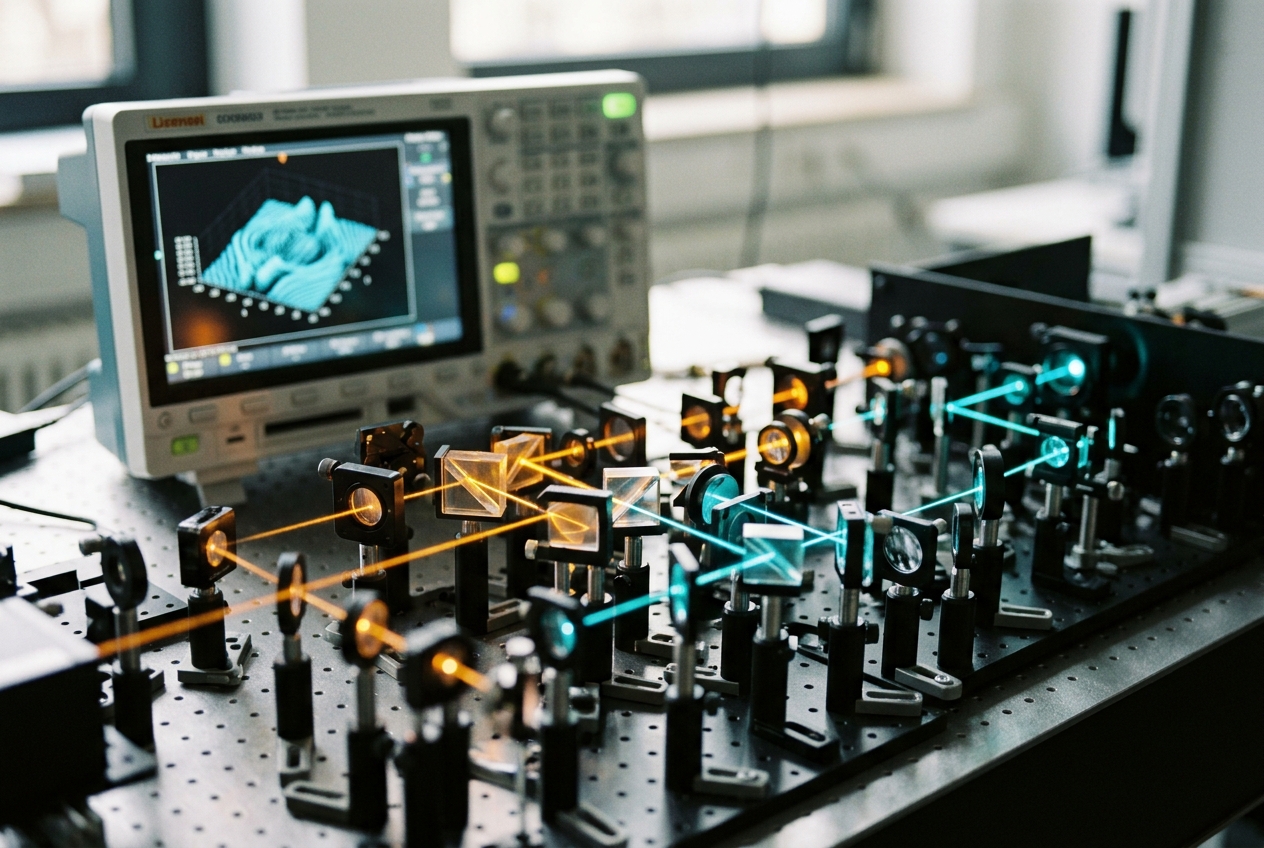
Because the Heisenberg uncertainty principle prohibits the simultaneous direct measurement of conjugate quadratures $\hat{x}$ and $\hat{p}$, the Wigner function cannot be measured directly with a single detector. Instead, experimental physicists reconstruct $W(x, p)$ from the ground up using Balanced Optical Homodyne Tomography—a continuous-variable technique analogous to medical X-ray Computed Tomography (CT).
The Measurement Mechanism
- Interference with a Local Oscillator: The unknown quantum light state $\hat{\rho}$ is mixed at a balanced (50:50) beam splitter with an intense, classical reference laser beam known as the Local Oscillator (LO), described by $|\alpha_{\text{LO}} e^{i\theta}\rangle$.
- Phase Control: By precisely varying the optical phase $\theta \in [0, \pi]$ of the local oscillator with a piezo-actuated mirror, the experimentalist selects which specific generalized quadrature operator $\hat{x}_\theta = \hat{x}\cos\theta + \hat{p}\sin\theta$ is amplified.
- Differential Detection: The two output ports of the beam splitter feed into twin high-speed photodiodes ($D_1, D_2$). Subtracting their photocurrents cancels the intense classical noise of the local oscillator, generating a difference current $i_{\text{diff}}$ that is directly proportional to the instantaneous value of the field quadrature $\hat{x}_\theta$.
- Radon Transform Mapping: Repeating this measurement millions of times generates marginal probability distributions $P_\theta(x_\theta) = \langle x_\theta | \hat{\rho} | x_\theta \rangle$ for each phase angle $\theta$. Mathematically, this dataset is the Radon Transform $\mathcal{R}[W]$ of the Wigner function:
$$P_\theta(x_\theta) = \int_{-\infty}^{\infty} W(x_\theta\cos\theta - p_\theta\sin\theta, \, x_\theta\sin\theta + p_\theta\cos\theta) \, dp_\theta$$
- Inverse Reconstruction: By applying the Inverse Radon Transform (via Filtered Back-Projection) or Maximum Likelihood Estimation (MaxLik), the full two-dimensional continuous function $W(x, p)$ is reconstructed. When researchers witness the reconstructed terrain dip below zero, they have experimentally verified the generation of a non-classical, non-Gaussian quantum state.
7. REAL-WORLD CONTINUOUS-VARIABLE APPLICATIONS TODAY (2024–2026)
Continuous-variable quantum mechanics and Wigner phase-space engineering have moved beyond fundamental physics laboratories into multi-billion-dollar computing and sensing industries.
1. Photonic Quantum Computing: Xanadu (Toronto, Canada)
- Objective: Building fault-tolerant, room-temperature photonic quantum computers using integrated nanophotonic silicon nitride chips.
- Mechanism & Advantage: Unlike discrete-qubit companies that struggle to scale past hundreds of qubits, Xanadu's quantum architecture leverages continuous-variable squeezed states multiplexed across spatial and temporal modes. By developing non-Gaussian photon-number-resolving detectors and GKP state generation modules, Xanadu harnesses negative Wigner volumes to achieve universal quantum computation with millions of entangled qumodes.
2. Quantum Metrology & Gravitational Wave Astronomy: NIST & JILA (Boulder, USA)
- Objective: Measuring physical displacements, gravitational waves, and electromagnetic fields beyond the Standard Quantum Limit (SQL).
- Mechanism & Advantage: Researchers at NIST and JILA engineer continuous-variable squeezed vacuum states where phase-space uncertainty in one quadrature is suppressed by over 15 dB. Injecting these states into the dark ports of gravitational wave observatories (like LIGO and Virgo) and optical atomic clocks eliminates vacuum fluctuation noise, boosting sensing sensitivity by orders of magnitude.
3. Long-Distance Quantum Networking: AWS Center for Quantum Networking & Harvard University
- Objective: Deploying unhackable, high-bandwidth Continuous-Variable Quantum Key Distribution (CV-QKD) and quantum repeaters over standard commercial fiber infrastructure.
- Mechanism & Advantage: CV-QKD encodes cryptographic keys directly into the continuous amplitude and phase quadratures of coherent laser pulses. By characterizing channel attenuation through Wigner function state evolution and using non-Gaussian state distillation, researchers on the arXiv and at AWS achieve high secret-key rates that integrate directly with existing classical telecommunication hardware without requiring exotic cryogenic single-photon detectors.
4. Cavity Quantum Electrodynamics: Max Planck Institute of Quantum Optics (Garching, Germany)
- Objective: Deterministic engineering of macroscopic Schrödinger cat and GKP states in microwave cavities coupled to superconducting transmon ancillas.
- Mechanism & Advantage: Theoretical and experimental teams published in Nature Physics utilize non-linear dispersive coupling to map discrete qubit non-linearities onto harmonic oscillator modes. This creates massive macroscopic quantum superpositions whose negative Wigner volumes are monitored in real time, validating quantum error correction codes designed to protect quantum memories against photon loss.
8. WHAT THIS MEANS FOR THE FUTURE: A PARADIGM SHIFT IN INFORMATION
For decades, the popular narrative of quantum computing has been tied to the concept of the discrete two-level qubit. Yet nature, at its most fundamental electromagnetic level, is governed by continuous harmonic fields.
Understanding the Wigner quasiprobability distribution alters our perspective on how quantum mechanics functions. It demonstrates that quantum superiority is not achieved merely by adding more variables or creating large classical-like statistical mixtures. A quantum computer gains its power by penetrating into non-classical phase space—carving out regions of negative quasiprobability that have no classical mathematical analogue.
For the modern citizen, continuous-variable quantum mechanics is not an abstract academic exercise: * In Cybersecurity: The mathematical security proofs of next-generation continuous-variable quantum encryption guarantee that no eavesdropper can intercept communications without distorting the Wigner distribution of the optical channel. * In Medicine & Materials: Molecular docking simulations and enzyme catalyst modeling require calculating complex multi-mode molecular vibrations. Continuous-variable photonic processors naturally map vibrational modes onto optical qumodes, promising breakthroughs in pharmaceutical drug discovery decades ahead of classical supercomputers. * In Infrastructure: The ultra-precise atomic clocks and navigational sensors calibrated via squeezed phase-space distributions will soon enable GPS-free navigation systems resilient against satellite jamming and spoofing.
9. THE FOUNDATIONAL TAKEAWAY
The Wigner distribution provides the definitive bridge between the classical phase-space trajectories of Newton and Hamilton and the operator mechanics of Schrödinger and Heisenberg. By mapping quantum states onto continuous coordinates of position and momentum, it preserves the true physical marginals while revealing the profound non-classicality of quantum interference through negative values.
Hudson’s Theorem precisely demarcates this boundary: classical-like, non-negative distributions belong exclusively to Gaussian states, which can be simulated by everyday computers. True quantum computational advantage, contextuality, and fault tolerance exist strictly where the Wigner function dips below zero—proving that the computational supremacy of the quantum universe is written in the geometry of negative probability.
Authoritative References & Academic Resources
- Explore interactive continuous-variable quantum circuits via IBM Quantum Learning.
- Access foundational lectures on phase-space quantum mechanics at MIT OpenCourseWare Quantum Physics.
- Study the mathematical proofs of quasiprobability distributions on the Wigner Quasiprobability Distribution Wikipedia Reference.
- Read breakthroughs in continuous-variable quantum state tomography in Nature Physics Quantum Information.
- Review foundational papers on continuous-variable quantum computing and negativity on the Quantum Physics arXiv Archive.