Transmon Qubits: Engineering Josephson Nonlinearity and Charge-Noise Immunity in Superconducting Processors
1. Opening Hook — Why You Should Care
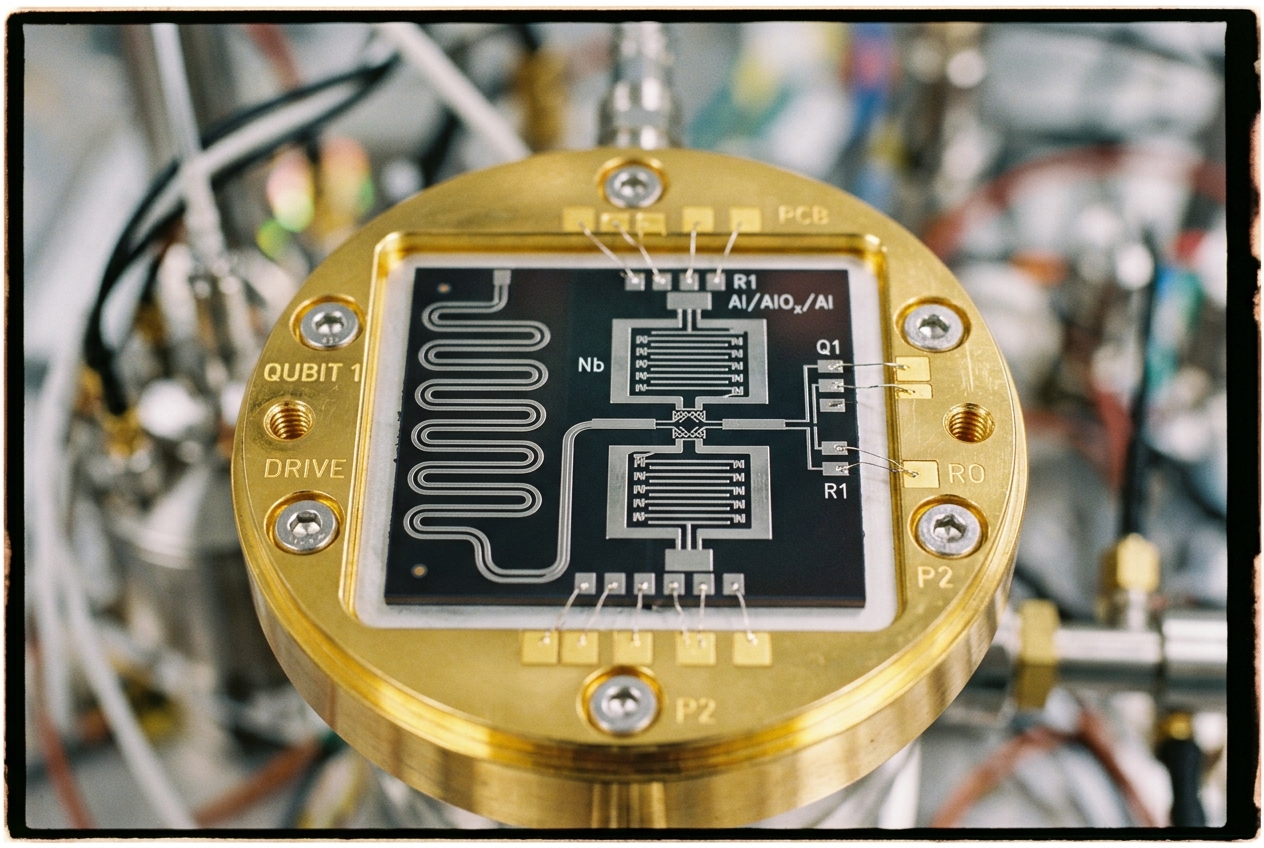
Inside a multi-million-dollar dilution refrigerator chilled to fifteen thousandths of a degree above absolute zero—colder than the vacuum of deep interstellar space—sits a fingernail-sized piece of silicon patterned with thin films of superconducting aluminum. Within this silent chamber, billions of Cooper pairs of electrons flow in perpetual, frictionless synchronization. This microchip does not merely process classical bits of ones and zeros; it suspends human engineering inside the counterintuitive laws of quantum mechanics.
The modern quest to build a fault-tolerant quantum computer is often framed as an abstract race of pure mathematics and geopolitical power. The real-world stakes, however, could not be more tangible. The Haber-Bosch chemical process, which synthesizes the nitrogen fertilizer responsible for sustaining nearly half of the global human population, currently consumes roughly two percent of all energy generated on Earth because classical supercomputers cannot simulate the quantum mechanical catalyst—the iron-molybdenum cofactor inside the natural nitrogenase enzyme—that biological bacteria use to break chemical bonds at room temperature. Simultaneously, the RSA public-key cryptographic infrastructure that secures trillions of dollars in daily international banking, sovereign communications, and planetary supply chains rests upon the mathematical difficulty of factoring large composite integers—a computational barrier that a sufficiently large, coherent quantum processor could dismantle in a matter of hours.
Yet for decades, the physical realization of a reliable, controllable quantum bit (qubit) remained stalled by a seemingly insurmountable physical barrier: the devastating fragility of quantum states when exposed to ambient electromagnetic noise. The breakthrough that transformed quantum computing from a delicate laboratory curiosity into an industrial engineering reality is an artificial atom known as the transmon qubit. By cleverly rewriting the electrodynamic equations of superconducting circuits, the transmon resolved the greatest vulnerability of solid-state quantum hardware, providing the foundational engine that powers today's leading quantum processors across the world.
2. The Idea in Plain English: From Rigid Ladders to Anharmonic Pendulums
To understand how a transmon works, one must first confront the fundamental physics problem of turning an electrical circuit into an artificial atom.
In classical electronics, an inductor paired with a capacitor forms an LC circuit—the electrical equivalent of a child on a playground swing or a frictionless mechanical pendulum. When energy is injected into a standard LC circuit, the electric and magnetic fields oscillate at a precise resonance frequency. If you cool this circuit down to cryogenic temperatures so that quantum mechanics takes over, its energy levels become quantized, resembling the rungs of a ladder.
Harmonic Oscillator (Standard LC Circuit)        Anharmonic Oscillator (Transmon Qubit)
Equidistant Rungs (Photon Leakage Hazard)       Unequal Rungs (Isolated Qubit Transition)

--- Level |3> (3 * hbar * omega)                 --- Level |3>
           |                                                |   delta_23 (Compressed)
     --- Level |2> (2 * hbar * omega)                 --- Level |2>
           |                                                |   delta_12 = omega_01 - E_C
     --- Level |1> (1 * hbar * omega)                 --- Level |1>
           |                                                |   omega_01 (Addressable Qubit)
     --- Level |0> (Ground State)                     --- Level |0>
Herein lies the fatal flaw of a standard harmonic oscillator: every rung on the ladder is separated by the exact same energy spacing ($\hbar\omega$). If you broadcast a microwave pulse tuned to this frequency in an attempt to kick the circuit from the ground state ($|0\rangle$) to the first excited state ($|1\rangle$), the exact same pulse will immediately kick the circuit from state $|1\rangle$ into state $|2\rangle$, then $|3\rangle$, and so on up the ladder. The system behaves like a runaway elevator with no brakes, making it impossible to isolate and control a clean, two-level quantum bit.
To build a genuine quantum bit, physicists must engineer an anharmonic oscillator—a circuit where the distance between the rungs changes as you climb. If the gap between rung 0 and rung 1 is distinct from the gap between rung 1 and rung 2, a microwave tone calibrated specifically to the $0 \rightarrow 1$ transition frequency will leave state $|2\rangle$ completely untouched.
In superconducting circuits, this ladder-bending nonlinearity is introduced via a nanoscale marvel known as a Josephson junction. A Josephson junction consists of two superconducting metal leads separated by an ultra-thin insulating barrier—typically an aluminum oxide layer merely one to two nanometers thick. Rather than behaving as an ordinary linear inductor whose energy grows quadratically with current, the junction acts as a non-linear inductor whose inductive energy varies as the cosine of the quantum phase difference across the barrier. This cosine potential acts like a heavy pendulum swinging through large angles: the higher it swings, the more its period stretches, compressing the upper energy levels together.
Before the invention of the transmon, the earliest circuit of this type was known as the Cooper Pair Box (CPB). While the Cooper Pair Box possessed immense anharmonicity, it suffered from a catastrophic weakness: its energy levels were wildly sensitive to microscopic static electricity. Stray background charges—such as a single electron shifting position in the substrate microchip—would radically change the qubit's transition frequency from microsecond to microsecond. This phenomenon, known as charge noise, constantly detuned the circuit from its control signals, causing the fragile quantum state to dephase and collapse in mere nanoseconds.
In 2007, a theoretical and experimental team at Yale University—led by Jens Koch, Michel Devoret, Steven Girvin, and Robert Schoelkopf—unveiled a revolutionary architectural insight published in Physical Review A. They discovered that by shunting the Josephson junction with a massive, engineered auxiliary capacitor, they could flood the circuit with capacitive energy, fundamentally shifting the balance between electrostatic charging energy and magnetic tunneling energy. This new operating regime was dubbed the transmission-line shunted plasma oscillation qubit, universally abbreviated as the transmon.
The transmon achieved an astonishing mathematical miracle: it suppressed charge noise sensitivity exponentially while reducing the vital ladder-distorting anharmonicity only algebraically (as a weak power law). In doing so, the transmon preserved just enough level spacing difference to allow pristine two-state control, while rendering the qubit virtually deaf to the chaotic electrostatic static of its environment.
3. How It Actually Works — The Mechanics of Circuit Quantization and Noise Immunity
To understand the operational mechanics of the transmon, we must trace the formal Hamiltonian mechanics of superconducting circuit quantization, explore its asymptotic mathematical solutions via Mathieu functions, and examine the microwave control techniques and electromagnetic environments that govern multi-qubit architectures.
The Cooper Pair Box Hamiltonian and Circuit Quantization
A superconducting circuit is quantized by identifying the generalized coordinates of node flux $\Phi(t) = \int_{-\infty}^t V(t') dt'$ and its conjugate momentum, the node charge $Q(t) = C_\Sigma \dot{\Phi}(t)$. The superconducting order parameter phase difference $\hat{\phi} = 2\pi \hat{\Phi} / \Phi_0 = 2e \hat{\Phi} / \hbar$ across the junction forms a conjugate quantum pair with the number operator of transferred Cooper pairs, $\hat{n} = \hat{Q} / (2e)$, satisfying the canonical commutation relation:
$$[\hat{\phi}, \hat{n}] = i$$
The electrodynamics of the Cooper Pair Box circuit are governed by the interplay of two characteristic energy scales: 1. The Charging Energy ($E_C$): The electrostatic energy cost required to add a single Cooper pair (charge $2e$) to the total capacitance $C_\Sigma = C_J + C_B + C_g$ (where $C_J$ is junction capacitance, $C_B$ is shunt capacitance, and $C_g$ is gate coupling capacitance): $$E_C = \frac{e^2}{2 C_\Sigma}$$ 2. The Josephson Energy ($E_J$): The maximum phase-coherent tunneling energy of Cooper pairs across the insulating barrier, determined by the critical current $I_c$ of the junction and the magnetic flux quantum $\Phi_0 = h / (2e)$: $$E_J = \frac{I_c \Phi_0}{2\pi} = \frac{\hbar I_c}{2e}$$
When an external DC gate voltage $V_g$ is applied through the gate capacitance $C_g$, it induces a continuous dimensionless offset polarization charge $n_g = C_g V_g / (2e)$. The full circuit Hamiltonian in the charge basis is written as:
$$\hat{H} = 4 E_C (\hat{n} - n_g)^2 - E_J \cos \hat{\phi}$$
In this differential formulation, the number operator operates as $\hat{n} = -i \frac{\partial}{\partial \phi}$. The state of the circuit lives on a circle $\phi \in [0, 2\pi)$, subject to periodic boundary conditions on the superconducting phase wavefunction $\psi(\phi + 2\pi) = \psi(\phi)$.
   +-----------------------------------------------------------+
   |                     THE TRANSMON REGIME                   |
   |                                                           |
   |   Cooper Pair Box (CPB):      E_J / E_C ~ 1               |
   |   * Anharmonicity:            Very High (~ -E_C)          |
   |   * Charge Noise Sensitivity: Severe (Linear/Quadratic)   |
   |   * Coherence Time (T2*):     ~ 10 - 100 nanoseconds      |
   |                                                           |
   |   Transmon Qubit:             E_J / E_C >> 1 (50 - 100)   |
   |   * Anharmonicity:            Moderate (~ -E_C)           |
   |   * Charge Noise Sensitivity: Exponentially Vanishing     |
   |   * Coherence Time (T2*):     ~ 50 - 300 microseconds     |
   +-----------------------------------------------------------+
The Mathieu Equation and Asymptotic Flatness of Energy Bands
When solving the stationary Schrödinger equation $\hat{H} \psi_m(\phi) = E_m(n_g) \psi_m(\phi)$, a mathematical transformation $\phi = 2\theta - \pi$ maps the Hamiltonian directly onto the canonical Mathieu Differential Equation. The exact eigenenergies $E_m(n_g)$ are given analytically by Mathieu characteristic values:
$$E_m(n_g) = E_C \cdot \mathcal{M}_A\left(2(n_g + k), -\frac{E_J}{2E_C}\right)$$
In the historical Cooper Pair Box regime where $E_J \approx E_C$, the eigenenergies $E_m(n_g)$ vary strongly as a function of the offset charge $n_g$. Low-frequency $1/f$ fluctuations in stray electrostatic charge cause $n_g$ to wander chaotically, inducing severe spectral broadening and rapid dephasing.
The foundational theoretical triumph of the transmon design is operating in the deep asymptotic regime where $E_J / E_C \gg 1$ (typically tuned via massive lithographic shunt capacitors to ratios between 50 and 100). In this limit, quantum phase fluctuations become tightly localized near the minimum of the cosine potential well ($\phi \approx 0$). Expanding the energy bands using asymptotic Mathieu function expansions reveals the exact functional dependence of the charge dispersion $\epsilon_m = E_m(n_g = 1/2) - E_m(n_g = 0)$—the peak-to-peak frequency variation caused by environmental charge drift:
$$\epsilon_m \approx (-1)^m E_C \frac{2^{4m+5}}{m!} \sqrt{\frac{2}{\pi}} \left(\frac{E_J}{2E_C}\right)^{\frac{m}{2} + \frac{3}{4}} \exp\left(-\sqrt{\frac{8E_J}{E_C}}\right)$$
The significance of this analytical result cannot be overstated: the charge noise dispersion decays exponentially with the square root of the ratio $\sqrt{8E_J/E_C}$. For $E_J/E_C = 80$, the charge dispersion $\epsilon_{01}$ of the fundamental transition drops below $1\text{ kHz}$—a negligible fluctuation compared to the typical $5\text{ GHz}$ operating frequency of the qubit.
Crucially, while charge noise is suppressed exponentially, the circuit's absolute anharmonicity $\alpha = \omega_{12} - \omega_{01} = (E_2 - E_1)/\hbar - (E_1 - E_0)/\hbar$ decreases only as a weak algebraic power law. Performing a Taylor expansion on the cosine potential around the origin, $\cos\hat{\phi} \approx 1 - \frac{\hat{\phi}^2}{2!} + \frac{\hat{\phi}^4}{4!} - \dots$, maps the Hamiltonian to a Duffing oscillator. Utilizing first-order perturbation theory, the zero-point phase fluctuations $\phi_{\text{zpf}} = (2E_C / E_J)^{1/4}$ yield an anharmonicity of:
$$\alpha \approx -E_C$$
For typical transmon parameters with $E_C / h \approx 200\text{ to }350\text{ MHz}$, the transition frequency between the computational states is $\omega_{01} \approx (\sqrt{8E_J E_C} - E_C)/\hbar \approx 4\text{ to }6\text{ GHz}$. An anharmonicity of $-250\text{ MHz}$ provides an enormous spectral window, allowing microwave control pulses with durations of 10 to 30 nanoseconds to address the $|0\rangle \rightarrow |1\rangle$ transition without unintentionally driving the system into higher-energy states.
Microwave Control Challenges and DRAG Pulse Engineering
Because the anharmonicity $\alpha \approx -E_C$ is negative and finite (rather than infinite), driving fast single-qubit quantum logic gates introduces a critical control hazard: leakage into non-computational states (specifically state $|2\rangle$), along with phase error accumulation in the $|1\rangle$ state.
Frequency Spectrum of Transmon Driving and Leakage:

Energy
  ^
  |        |2>
  |         |
  |         |  <--- omega_12 = omega_01 + alpha  (e.g., 4.75 GHz)
  |        |1>
  |         |
  |         |  <--- omega_01  (Target Gate Drive, e.g., 5.00 GHz)
  |        |0>
  +-------------------------------------------------------------> Frequency
                      |<-- Anharmonicity alpha (~ -250 MHz) -->|
When a standard Gaussian microwave pulse $\Omega_x(t)$ with envelope duration $\tau \approx 10\text{ ns}$ is applied along the in-phase ($x$) control channel, its Fourier spectrum contains non-zero spectral power at the neighboring frequency $\omega_{12} = \omega_{01} + \alpha$. This spectral overlap drives the unwanted transition $|1\rangle \rightarrow |2\rangle$ and causes dynamic Stark shifts that rotate the qubit around the Z-axis of the Bloch sphere.
To completely neutralize this leakage, quantum engineers implement the DRAG (Derivative Removal by Adiabatic Gate) technique, originally developed by Motzoi, Gambetta, Rebentrost, and Wilhelm. DRAG applies a simultaneous, phase-shifted correction pulse along the orthogonal quadrature ($y$) channel proportional to the time derivative of the primary in-phase envelope:
$$\Omega_y(t) = -\frac{\dot{\Omega}_x(t)}{\alpha}$$
The fundamental operating principle of DRAG is destructive quantum interference: the derivative pulse in the quadrature channel induces a transition amplitude into state $|2\rangle$ that is exactly equal in magnitude but $180^\circ$ out of phase with the transition amplitude driven by the primary Gaussian pulse. Consequently, population leakage into non-computational states is mathematically canceled to first order, allowing gate fidelities to routinely surpass $99.9\%$ at speeds approaching ten nanoseconds.
       DRAG Pulse Waveform Synthesis:

In-Phase Drive:      \Omega_x(t)  = Gaussian(t)
       Quadrature Drive:    \Omega_y(t)  = - [d/dt \Omega_x(t)] / \alpha

Amplitude
          ^
       +1 |         .-''''-.  <--- In-phase envelope \Omega_x(t)
          |       .'        '.
        0 |------/------------\------------------> Time (ns)
          |     /   .-''-.     \
       -1 |    '---'      '-----' <--- Quadrature derivative \Omega_y(t)
Frequency Tunability via DC-SQUIDs and Dispersive Circuit QED
To construct multi-qubit quantum processors, transmons must be selectively coupled, tuned, and measured without introducing physical wires that conduct thermal noise into the quantum core.
Dispersive Circuit QED Readout Architecture:

Flux Bias Line               Readout Transmission Line (Microwave In/Out)
       |                                          |
       v                                          v
   +-------+   Capacitive Coupling (g)     +-------------+
   | SQUID | <===========================> | CPW Cavity  | (omega_r)
   | Loop  |                               | Resonator   |
   +-------+                               +-------------+
   (Transmon omega_q)                             |
                                           [Purcell Filter]
                                                  |
                                           [Cryogenic HEMT Amp]
-
Magnetic Flux Tuning via DC-SQUIDs: Rather than utilizing a single fixed Josephson junction, many modern transmons employ a split-transmon geometry, replacing the single junction with a pair of junctions in parallel forming a Superconducting Quantum Interference Device (DC-SQUID) loop. By threading an external magnetic flux $\Phi_{\text{ext}}$ through the loop via an on-chip flux bias line, the effective Josephson energy becomes continuously tunable: $$E_J(\Phi_{\text{ext}}) = (E_{J1} + E_{J2}) \cos\left(\frac{\pi \Phi_{\text{ext}}}{\Phi_0}\right) \sqrt{1 + d^2 \tan^2\left(\frac{\pi \Phi_{\text{ext}}}{\Phi_0}\right)}$$ where $d = (E_{J1} - E_{J2})/(E_{J1} + E_{J2})$ accounts for junction asymmetry. This enables engineers to rapidly sweep qubit frequencies into and out of resonance to execute ultra-fast two-qubit entangling operations, such as Cross-Resonance or Controlled-Z gates.
-
Dispersive Readout via Circuit QED: To measure the transmon without destroying its delicate quantum superposition, the qubit is capacitively coupled with strength $g$ to a high-quality coplanar waveguide (CPW) superconducting resonator with resonance frequency $\omega_r$. Operating in the dispersive regime, where the qubit-resonator detuning $|\Delta| = |\omega_{01} - \omega_r| \gg g$, the interaction is described by the dispersive Circuit Quantum Electrodynamics (cQED) Hamiltonian: $$\hat{H}{\text{disp}} \approx \hbar \left(\omega_r + \chi \hat{\sigma}_z\right) \hat{a}^\dagger \hat{a} + \frac{\hbar \tilde{\omega}{01}}{2} \hat{\sigma}_z$$ Here, $\hat{a}^\dagger$ and $\hat{a}$ are the creation and annihilation operators of the microwave cavity, and $\chi \approx \frac{g^2}{\Delta} \frac{\alpha}{\Delta + \alpha}$ is the state-dependent dispersive shift. The presence of the qubit in state $|0\rangle$ versus state $|1\rangle$ shifts the resonant frequency of the microwave cavity by $+2\chi$. By reflecting a weak probe microwave tone off the resonator and amplifying the output with quantum-limited traveling wave parametric amplifiers (TWPAs), the qubit's quantum state can be determined in hundreds of nanoseconds with over $99\%$ fidelity without inducing wave-function destruction through direct state measurement.
-
Mitigating Purcell Decay and Dielectric TLS Loss: Coupling a transmon to a readout cavity introduces an intrinsic energy relaxation pathway: the qubit's oscillating dipole can spontaneously emit photons into the transmission line through the cavity via the Purcell effect, decaying at a rate $\gamma_P \approx \kappa (g / \Delta)^2$ (where $\kappa$ is the cavity linewidth). To prevent this relaxation from limiting the qubit lifetime $T_1$, quantum engineers insert bandpass Purcell filters between the readout cavity and the measurement line, which suppress transmission at the qubit frequency $\omega_{01}$ by over $30\text{ dB}$ while preserving transmission at the readout frequency $\omega_r$. Concurrently, state-of-the-art fabrication utilizes high-purity superconducting metals like tantalum or niobium on ultra-clean sapphire or high-resistivity silicon substrates, chemically etching interfaces to eliminate two-level system (TLS) defect centers in amorphous dielectric oxides that otherwise sap quantum coherence.
4. Real-World Applications Today (2024–2026)
Transmon qubits represent the operational backbone of the global superconducting quantum computing industry. Leading academic institutions and enterprise laboratories are utilizing transmon-based quantum processors to tackle problems across physics, cryptography, and materials design:
+---------------------------------------------------------------------------------------------------+
|                           SUPERCONDUCTING TRANSMON PROCESSOR PLATFORMS                            |
+----------------------+-----------------------------+----------------------------------------------+
| Organization         | Core Platform Architecture  | Primary Computational Milestone              |
+----------------------+-----------------------------+----------------------------------------------+
| IBM Quantum          | Heron & Condor Processors   | Scalable 5,000-gate utility simulation and   |
|                      | (Heavy-Hex Transmon Array)  | quantum chemistry error mitigation.          |
|                      |                             |                                              |
| Google Quantum AI    | Willow & Sycamore Architectures| Surface-code quantum error correction below  |
|                      | (Tunable Transmons + Couplers)| the fault-tolerant threshold.               |
|                      |                             |                                              |
| IQM Quantum Computers| Co-Designed Radiance Grid   | On-premises quantum accelerators for         |
|                      | (Star & Resonant Topologies)| industrial finite-element & combinatorial math.|
|                      |                             |                                              |
| Yale & Fermilab SQMS | High-Q Cavity Transmons     | High-coherence 3D cQED architecture for      |
|                      | (3D Cavity + Transmon Qubit)| fundamental dark matter axion detection.     |
+----------------------+-----------------------------+----------------------------------------------+
-
IBM Quantum: Through platforms documented on IBM Quantum and programmed using the Qiskit Framework, IBM has deployed fixed-frequency transmon processors based on the Heron architecture. Featuring heavy-hexagonal lattice topologies that minimize cross-talk between neighboring qubits, IBM is executing quantum utility benchmarks with over 5,000 two-qubit gate operations. These systems are actively modeling complex quantum magnetism in solid-state materials and simulating non-trivial molecular orbital configurations for organometallic catalysts using advanced zero-noise extrapolation (ZNE) error mitigation techniques.
-
Google Quantum AI: Utilizing their Willow and Sycamore architectures, Google Quantum AI employs frequency-tunable split-transmons linked together with dynamic superconducting flux couplers. In landmark demonstrations published across Nature, Google researchers have demonstrated physical surface-code quantum error correction where scaling from a Distance-3 to a Distance-5 and Distance-7 logical qubit array systematically reduces logical error rates, proving that superconducting hardware has crossed the threshold where quantum error correction actively improves qubit lifetime.
-
IQM Quantum Computers: Operating out of Europe, IQM designs application-specific transmon architectures that integrate application-tailored topologies (such as star and ring resonators) directly into quantum hardware. Partnering with supercomputing centers like the Leibniz Supercomputing Centre (LRZ), IQM is coupling transmon-based quantum processing units (QPUs) directly to classical High-Performance Computing (HPC) clusters to accelerate complex industrial optimization problems, including airline fleet logistics and electrical power grid load balancing.
-
Yale University & The Fermilab SQMS Center: Pioneering the frontier of fundamental physics, researchers at Yale's Center for Quantum Information Physics (in collaboration with the Department of Energy's Superconducting Quantum Materials and Systems Center) pair transmons with ultra-high-coherence 3D superconducting radio-frequency (SRF) niobium cavities. These systems achieve single-photon storage times exceeding several seconds, utilizing transmon nonlinearities to engineer non-classical cat states designed to detect ultra-weak dark matter axion wave signatures traversing high-gradient magnetic fields.
To explore the foundational quantum physics underlying these superconducting circuits, learners can examine the MIT OpenCourseWare Quantum Physics Resources.
5. What This Means for You
While the cryogenic physics of transmon qubits might seem isolated inside pristine research laboratories, the downstream impact of this technology will fundamentally alter everyday modern life over the coming decade:
- The Transformation of Medicine and Clean Energy: The development of complex medications currently requires billions of dollars and decades of trial-and-error laboratory synthesis because classical computers cannot calculate how large pharmaceutical molecules fold or bind to target proteins at a quantum mechanical level. As transmon-based quantum computers scale toward fault tolerance, molecular simulation will shift from slow physical chemistry experiments to exact in silico quantum computation. This will accelerate the discovery of targeted oncology drugs, unlock solid-state battery chemistries with ten times the energy density of lithium-ion cells, and create carbon-capture membranes capable of scrubbing carbon dioxide directly from the atmosphere.
- The Imperative for Global Data Privacy: Every encrypted message you send, every online banking transaction you authorize, and every piece of medical data stored in cloud databases is currently protected by public-key cryptography. Because scaling transmon processors will eventually render these legacy encryption protocols vulnerable via Shor's algorithm, cybersecurity organizations worldwide are currently racing to implement post-quantum cryptographic standards. The physics of transmon circuits is directly forcing the reconstruction of global Internet security protocols.
- A New Industrial Computing Paradigm: You will not have a dilution refrigerator or a transmon chip inside your smartphone. Instead, transmon QPUs will live in central cloud data centers, functioning alongside classical graphics processing units (GPUs) and central processing units (CPUs). When a logistics provider needs to optimize global shipping routes during extreme weather, or when an aerospace manufacturer needs to model turbulence across an aircraft wing, those hard computational subroutines will be seamlessly offloaded to superconducting transmon arrays.
6. Today's Takeaway
The transmon qubit is one of the most brilliant engineering compromises in the history of modern physics. By intentionally shunting a non-linear Josephson junction with a massive capacitor, physicists discovered that they could sacrifice a small amount of ladder-bending anharmonicity to purchase an exponential immunity against environmental charge noise. This profound physical insight transformed an unruly, static-sensitive quantum circuit into a stable, highly controllable artificial atom—transforming superconducting quantum computation from an impossible scientific dream into the defining computational hardware of the twenty-first century.