Toric Code: Structuring Topological Quantum Memory and Plaquette Stabilizers on 2D Periodic Lattices
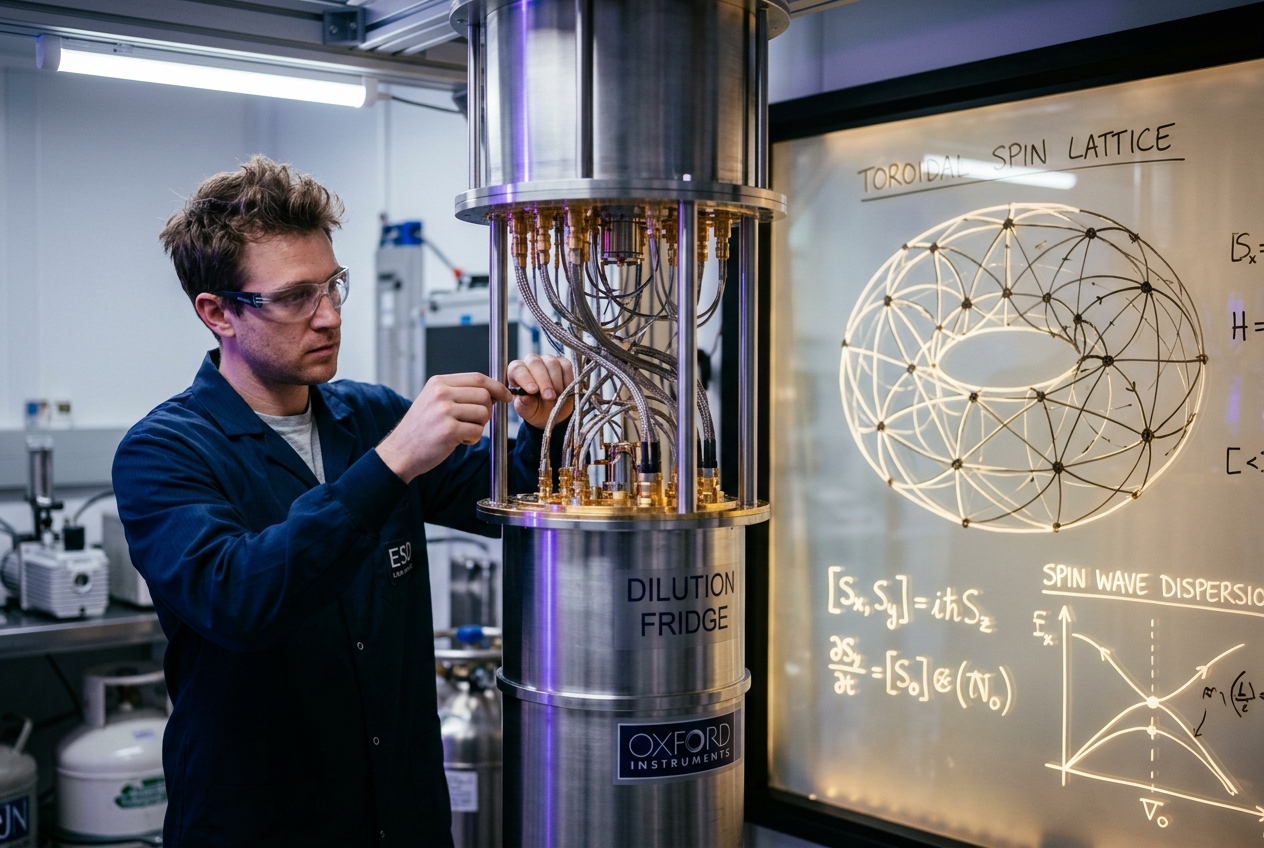
The definitive mathematical answer to this crisis arrived in 1997, when theoretical physicist Alexei Kitaev introduced an entirely new paradigm for data storage: the Toric Code. Instead of attempting to insulate an isolated, fragile physical particle from all external influence, Kitaev demonstrated that quantum information could be encoded into the global, topological properties of an entire many-body system. By distributing quantum information across a two-dimensional grid wrapped into the shape of a torus, the Toric Code ensures that no local environmental error—no matter how violent—can read, alter, or destroy the encoded logical state. This foundational model gave birth to the modern field of topological quantum error correction and serves as the theoretical ancestor to the planar surface codes running inside today's most advanced quantum laboratories.
1. Opening Hook — Why You Should Care
The global digital economy relies on mathematical assumptions that are inching closer to obsolescence. Every encrypted banking transaction, classified intelligence dossier, and secure communications channel relies on public-key cryptosystems like RSA and elliptic-curve cryptography. A fault-tolerant quantum computer running Shor’s algorithm could dismantle these cryptographic foundations in a matter of hours. Yet, the physical machines existing in laboratories today—possessing between dozens and a few thousand noisy qubits—cannot yet crack a basic encryption key. The bottleneck is not the number of physical components, but their error rate: physical quantum operations fail roughly once every thousand operations, whereas running Shor’s algorithm on cryptographic scales requires failure rates lower than one in a trillion.
Classical redundancy cannot bridge this nine-order-of-magnitude chasm. If an engineer attempts to measure a quantum bit to detect whether an error has occurred, the act of measurement itself collapses the delicate superposition, inadvertently destroying the very computation they sought to protect.
The Toric Code resolves this paradox through a stroke of geometric genius. It allows us to measure whether an error has entered the system without measuring the stored quantum data itself. By embedding quantum information into non-local topological invariants, it renders local noise mathematically blind to the data being processed. Understanding the Toric Code is not merely an exercise in abstract mathematical physics; it is the blueprint for how humanity will transition from the era of noisy, unreliable prototypes to permanent, fault-tolerant quantum computers.
2. The Idea in Plain English
To understand how topological protection works, imagine a smooth silk ribbon laying flat on a table. If an environmental disturbance comes along—such as a gust of wind or an accidental tear—the shape of the ribbon is easily altered or destroyed. This fragile ribbon represents a standard, unprotected physical qubit.
       CONVENTIONAL QUBIT                     TOPOLOGICAL QUBIT
    (Fragile, Local State)               (Non-Local Global Topology)

       +---------------+                     .------------------.
       | Local Noise   |                    /   .------------.   \
       | Collapses     |                   /   /   (Torus)    \   \
       | Stored Value  |                  |   |   O      O     |   |
       +-------+-------+                  |    \   Wilson Loop/    |
               |                           \    '------------'    /
       [Physical Qubit]                     '--------------------'
    Local perturbation = Loss            Local perturbation = Zero Data Loss
Now imagine taking that same ribbon and tying it in a closed loop through the handle of a ceramic coffee mug. If someone comes by with a pair of scissors and makes a tiny scratch or small puncture on the ceramic surface of the mug, the global loop remains completely intact. You cannot determine whether the loop is threaded through the handle by examining any single microscopic square millimeter of the porcelain; you must trace the entire path around the handle.
In topological quantum computing, our "coffee mug" is a two-dimensional lattice of physical spins whose boundaries are connected to form a torus (a geometric doughnut). The stored quantum information is not kept inside any single spin on the surface. Instead, the logical data is encoded exclusively in closed loops of quantum operators that wind completely around the doughnut’s longitudinal and latitudinal circumferences.
Because local noise from the environment acts on only one or two neighboring spins at a time, it cannot tell whether a loop winds around the entire torus. The environment can create tiny "scratches" on the surface, but unless those scratches assemble into an unbroken chain that stretches all the way around the body of the doughnut, the stored logical information remains perfectly preserved and mathematically invisible to the noise.
3. How It Actually Works — The Mechanics
To see why this geometric insulation is mathematically absolute, we must examine the exact Hamiltonian mechanics of the 2D lattice on a torus, the construction of its stabilizer operators, the emergence of anyonic excitations, and the extraction of error syndromes.
                  Lattice Geometry on a 2-Torus

                s (Vertex / Star)
                 \     | (Qubit on Edge)
                  \    |
             ------o---*---o------
                   |       |
                   |   p   |  <-- Plaquette
                   |       |
             ------o---*---o------
                       |
                       |

             A_s = X_1 * X_2 * X_3 * X_4   (Star Operator)
             B_p = Z_1 * Z_2 * Z_3 * Z_4   (Plaquette Operator)
The 2D Spin-1/2 Lattice on a Torus
Consider a two-dimensional square grid embedded on the surface of a 2-torus $\mathbb{T}^2$, defined with periodic boundary conditions along both spatial directions of lengths $L_x$ and $L_y$. The lattice contains vertices (denoted by $s$ for "star"), faces (denoted by $p$ for "plaquette"), and edges (denoted by $i$).
In Kitaev's construction, a physical two-level quantum system (a spin-1/2 qubit with a two-dimensional Hilbert space $\mathcal{H}_i \cong \mathbb{C}^2$) is placed on every edge of the lattice. For a grid with $V$ vertices, there are $F = V$ plaquettes and $E = 2V$ edges, meaning the total physical Hilbert space of the system has dimension:
$$\dim(\mathcal{H}_{\text{total}}) = 2^E = 2^{2V}$$
The Star and Plaquette Stabilizer Operators
To govern the dynamics and define the code subspace, we construct two types of multi-body Hermitian operators:
-
Star (Vertex) Operators ($A_s$): For each vertex $s$, let $\text{star}(s)$ denote the set of four edges adjacent to $s$. The star operator $A_s$ is the tensor product of the Pauli-$X$ (bit-flip) matrices acting on those four incident edges: $$A_s = \prod_{i \in \text{star}(s)} X_i$$
-
Plaquette (Face) Operators ($B_p$): For each square face $p$, let $\partial p$ denote the set of four boundary edges circumscribing $p$. The plaquette operator $B_p$ is the tensor product of the Pauli-$Z$ (phase-flip) matrices acting on those four boundary edges: $$B_p = \prod_{j \in \partial p} Z_j$$
Since Pauli matrices satisfy $X^2 = Z^2 = I$ and are Hermitian, every $A_s$ and $B_p$ is Hermitian and squares to the identity ($A_s^2 = I$, $B_p^2 = I$), possessing eigenvalues strictly equal to $+1$ or $-1$.
Proof of Mutual Commutativity
A foundational requirement of any stabilizer code is that all stabilizer generators commute with one another. It is trivial that $[A_s, A_{s'}] = 0$ (all Pauli-$X$ matrices) and $[B_p, B_{p'}] = 0$ (all Pauli-$Z$ matrices).
To prove that star operators and plaquette operators commute ($[A_s, B_p] = 0$ for all $s, p$), consider their geometric overlap: - If vertex $s$ and plaquette $p$ are spatially separated, they share zero edges, so their constituent operators act on disjoint Hilbert spaces and commute trivially. - If vertex $s$ lies on the boundary of plaquette $p$, they share exactly two adjacent edges (call them edge 1 and edge 2).
On those two shared edges, the product contains $X_1 Z_1$ and $X_2 Z_2$. Recalling that the single-qubit Pauli matrices anti-commute ($X Z = -Z X$), swapping the order of $A_s$ and $B_p$ incurs a negative sign for each shared edge:
$$A_s B_p = (-1)^2 B_p A_s = (+1) B_p A_s \implies [A_s, B_p] = 0$$
Because all $A_s$ and $B_p$ mutually commute, they can be simultaneously diagonalized across the entire Hilbert space.
       GEOMETRIC COMMUTATION PROOF

       Vertex 's' and Plaquette 'p' share exactly TWO edges (1 and 2):

             (s)-------[Edge 1]-------o
              |                       |
           [Edge 2]      (p)          |
              |                       |
              o-----------------------o

       A_s contains:  X_1 * X_2
       B_p contains:  Z_1 * Z_2

       Commutation relation:
       (X_1 Z_1)(X_2 Z_2) = (-Z_1 X_1)(-Z_2 X_2) = (-1)^2 (Z_1 Z_2)(X_1 X_2) = +1
The Exactly Solvable Hamiltonian and 4-Fold Ground State Degeneracy
Kitaev defined the Toric Code Hamiltonian as a sum of these mutually commuting projection penalties:
$$H = -J_e \sum_{s} A_s - J_m \sum_{p} B_p \quad \quad (J_e, J_m > 0)$$
Because all terms in $H$ commute with each other, every energy eigenstate can be labeled by the eigenvalues of $A_s = \pm 1$ and $B_p = \pm 1$. The ground state space $\mathcal{L}$ corresponds to the configuration that minimizes the energy of every single term simultaneously—that is, the simultaneous $+1$ eigenspace of all star and plaquette operators:
$$\mathcal{L} = { |\psi\rangle \in \mathcal{H}_{\text{total}} \;\mid\; A_s |\psi\rangle = +|\psi\rangle, \; B_p |\psi\rangle = +|\psi\rangle \; \forall s, p }$$
How many independent quantum states satisfy this condition? On a closed 2-torus: - The product of all star operators over all vertices multiplies every physical edge twice (since each edge connects exactly two vertices), yielding $\prod_s A_s = \prod_{i=1}^E X_i^2 = I$. Thus, only $V - 1$ star conditions are independent. - Similarly, the product of all plaquette operators multiplies every edge twice (since each edge borders exactly two plaquettes), yielding $\prod_p B_p = \prod_{j=1}^E Z_j^2 = I$. Thus, only $F - 1 = V - 1$ plaquette conditions are independent.
The total number of independent stabilizer constraints is $(V - 1) + (V - 1) = 2V - 2$. Subtracting these constraints from the $2V$ physical degrees of freedom gives:
$$k = 2V - (2V - 2) = 2 \text{ logical qubits}$$
The ground-state subspace is therefore $2^k = 2^2 = 4$-fold degenerate. More generally, for a two-dimensional compact surface of genus $g$ (where a torus has $g=1$), the ground-state degeneracy is topologically invariant and equal to $2^{2g}$.
Key Result: Ground-State Topological Degeneracy
The code space on a closed manifold of genus $g$ encodes exactly $2g$ logical qubits, producing a protected ground subspace of dimension $2^{2g}$ that depends strictly on the global topology of the surface, completely independent of the microscopic lattice spacing or system size.
Anyonic Quasiparticles, Emergent Fermions, and Braiding Statistics
Excitations above the ground state represent localized defects or "syndromes" created by environmental errors:
- Electric Charges ($e$-anyons): An accidental Pauli-$Z$ error on an edge anti-commutes with the two star operators at the ends of that edge, flipping their eigenvalues from $+1$ to $-1$. These point-like defects at the vertices act as localized "electric charges."
- Magnetic Fluxes ($m$-anyons): An accidental Pauli-$X$ error on an edge anti-commutes with the two plaquette operators adjacent to that edge, flipping their eigenvalues to $-1$. These defects on the faces act as localized "magnetic vortices."
                 CREATION OF ANYON PAIRS

    Pauli-Z Error creates TWO 'e' anyons at endpoints:

       ( -1 )=======[ Z Error Path ]=======( -1 )
         s_1                                 s_2

    Pauli-X Error creates TWO 'm' anyons on adjacent faces:

       +---------+---------+
       |  ( -1 ) |  ( -1 ) |
       |   p_1   |   p_2   |
       +----*----+---------+
            |
        [X Error]
These excitations are not bosons or fermions; in two dimensions, they behave as Abelian anyons. - If two identical electric charges $e$ are exchanged, the wave function acquires a trivial phase factor of $+1$ ($e$ and $m$ are individually self-bosons). - However, if an electric charge $e$ is moved in a closed loop completely encircling a magnetic flux $m$, the path of $Z$ operators acting on the boundary crosses a single edge of the plaquette containing $m$. The resulting wave function picks up a non-trivial topological phase factor:
$$e^{i \theta} = -1 \quad (\theta = \pi)$$
This mutual semionic statistics ($\theta = \pi$) is the exact quantum many-body analogue of the Aharonov-Bohm effect. Furthermore, the composite particle $\epsilon = e \times m$ formed by binding an electric charge to a magnetic vortex behaves as an emergent fermion, acquiring a self-exchange phase of $-1$.
                 BRAIDING TOPOLOGICAL PHASE

            [ e-anyon trajectory ]
                 .---------.
                /     m     \      Braiding 'e' around 'm' yields:
               |   (Flux)    |     |ψ_final> = e^(i * π) |ψ_initial>
                \           /                = - |ψ_initial>
                 '---------'
Logical Operators as Non-Contractible Homology Loops
Because all contractible closed loops of $X$ or $Z$ operators are simply products of star ($A_s$) or plaquette ($B_p$) stabilizers, they act trivially ($+1$) on the ground-state code space.
To manipulate the stored logical qubits without exciting anyons, one must apply string operators that have no endpoints (i.e., commute with all $A_s$ and $B_p$) but are non-contractible—meaning they wind around the non-trivial 1-cycles of the torus homology group $H_1(\mathbb{T}^2, \mathbb{Z}_2)$:
- Logical Pauli-Z operators ($Z_{L1}, Z_{L2}$): Closed loops of Pauli-$Z$ operators traversing the longitudinal ($\alpha_1$) and latitudinal ($\beta_1$) cycles of the primal lattice.
- Logical Pauli-X operators ($X_{L1}, X_{L2}$): Closed loops of Pauli-$X$ operators traversing the dual cycles ($\alpha_2, \beta_2$) orthogonal to the $Z$-loops.
Because the non-trivial cycles $\alpha_1$ and $\beta_2$ cross each other at an odd number of edges (exactly one edge), their logical operators anti-commute:
$${ X_{L1}, Z_{L1} } = 0, \quad { X_{L2}, Z_{L2} } = 0$$
These satisfy the canonical Pauli algebra for two independent logical qubits. To execute an undetected logical bit-flip or phase-flip, an environmental perturbation must align randomly along an entire non-contractible loop of length $d = \min(L_x, L_y)$. For large lattices, the probability of such a correlated multi-qubit error decays exponentially as $\mathcal{O}(p^d)$, where $p$ is the physical error rate.
            HOMOLOGY CYCLES ON THE TORUS

                  .--------------------.
                 /    Z_L1 (Loop α_1)   \
                /     .--------------.   \
               |     /                \   |
               |    |   X_L1 (Loop β_2)|  |
               |     \   (Crossing)   /   |
                \     '--------------'   /
                 '----------------------'
      A logical operation requires a string spanning the entire genus.
Syndrome Extraction and Minimum-Weight Perfect Matching (MWPM)
To protect quantum information during computation, the stabilizer operators are measured periodically:
- Syndrome Measurement: Measuring $A_s$ and $B_p$ produces a discrete syndrome map revealing the locations of defective endpoints (where the measurement returns $-1$). Crucially, these measurements provide the coordinates of anyon pairs without collapsing the logical superposition.
- Decoding via Minimum-Weight Perfect Matching: When errors occur, anyons appear in pairs at the chain's endpoints. A classical decoder, such as the Jack Edmonds' Blossom algorithm for Minimum-Weight Perfect Matching (MWPM), takes the graph of defective syndromes and finds the most probable set of error chains that connects every defect to a matching partner (or to a boundary) with minimum total edge weight.
- Correction: Applying the matched string of correction operators annihilates the anyon pairs. If the union of the error string and the correction string forms contractible loops (elements of the stabilizer group), the quantum memory is returned perfectly to its ground state.
       SYNDROME DECODING VIA MWPM

       Defect (-1)                         Defect (-1)
          (s_1) . . . . . . . . . . . . . . . (s_2)
            \                                   /
             \-------[ MWPM Match Path ]-------/

       Applying Pauli corrections along the shortest path
       annihilates the anyon pair and restores the stabilizer subspace.
From Torus to Planar Surface Codes
While the periodic torus is theoretically elegant, fabricating a physical torus on planar microchips poses severe 3D routing and connectivity challenges. In 1998, Sergey Bravyi and Alexei Kitaev demonstrated that by slicing open the torus and terminating the lattice with alternating rough boundaries (which condense $e$-anyons) and smooth boundaries (which condense $m$-anyons), one can construct a planar surface code.
Planar surface codes maintain topological protection on standard two-dimensional planar layouts with strictly nearest-neighbor connectivity, forming the direct architectural foundation of modern industrial quantum hardware.
4. Real-World Applications Today
The theoretical insights of the Toric Code are not locked in mathematical archives; they drive the design of current physical quantum processors across leading industry laboratories and academic institutions between 2024 and 2026.
+--------------------------+------------------------------+------------------------------------+
| Institution / Enterprise | Technology Platform          | Real-World Topological Achievement |
+--------------------------+------------------------------+------------------------------------+
| Google Quantum AI        | Superconducting Transmons    | Below-threshold planar codes       |
| IBM Quantum              | Heavy-Hex Superconducting    | Real-time syndrome & dynamic logic |
| QuEra / Harvard / MIT    | Reconfigurable Neutral Atoms | Hundreds of zoned logical qubits   |
| Quantinuum               | Trapped-Ion (QCCD)           | High-fidelity fault-tolerant gates |
+--------------------------+------------------------------+------------------------------------+
1. Google Quantum AI
- Initiative: Scaling physical transmon processors (the Sycamore and successor architectures) into fault-tolerant planar surface codes.
- Milestone: In a landmark series of papers published in Nature, Google's team demonstrated for the first time that increasing the code distance from $d=3$ (using 17 physical qubits) to $d=5$ (using 49 physical qubits) suppressed logical error rates.
- Quantum Advantage: Proving experimentally that topological protection works as predicted: physical errors scale exponentially downward as system size increases, validating Kitaev's original 1997 thesis.
2. IBM Quantum
- Initiative: Deploying scalable topological stabilizer circuits across high-density superconducting processors via the IBM Quantum Learning Platform and Qiskit.
- Milestone: IBM has implemented real-time syndrome extraction, mid-circuit measurements, and dynamic feed-forward decoding on its heavy-hexagonal lattice designs.
- Quantum Advantage: Mitigating crosstalk by embedding topological codes onto sparse bipartite graphs, allowing continuous error correction cycles that preserve logical quantum states during active algorithmic execution.
3. Harvard University, QuEra Computing, and MIT
- Initiative: Utilizing reconfigurable arrays of neutral rubidium atoms trapped in dynamic optical tweezers to execute topological surface codes.
- Milestone: In recent experimental breakthroughs, researchers demonstrated entanglement across dozens of fault-tolerant logical qubits, executing transverse Clifford logic and non-Abelian anyon braiding in reconfigurable geometric architectures.
- Quantum Advantage: Neutral atoms allow physical qubits to be shuttled dynamically in 2D space, eliminating fixed-wire routing bottlenecks and enabling real-time topological surgery across arbitrary code boundaries.
4. Quantinuum (Honeywell)
- Initiative: Trapped-ion Quantum Charge-Coupled Device (QCCD) architectures executing color codes and surface code variants.
- Milestone: Quantinuum demonstrated logical qubits with physical two-qubit gate fidelities surpassing $99.9\%$, achieving fault-tolerant logical state teleportation and universal gate synthesis via magic state distillation.
- Quantum Advantage: Unprecedentedly low base physical error rates combined with all-to-all topological connectivity through ion shuttling, drastically reducing the physical-to-logical qubit overhead.
5. What This Means for You
For the non-specialist, topological quantum memory might sound like an esoteric branch of condensed matter mathematics. In reality, it is the linchpin technology that will determine when and how quantum computation impacts daily human life.
                       HOW TOPOLOGY TOUCHES YOUR FUTURE

   +-------------------------------------------------------------------------+
   |  DATA PRIVACY        Accelerates the global transition to post-quantum  |
   |                      cryptography to protect banking and infrastructure |
   +-------------------------------------------------------------------------+
   |  LIFE SCIENCES       Enables exact quantum chemistry simulation for     |
   |                      targeted drug design and enzyme engineering        |
   +-------------------------------------------------------------------------+
   |  SUSTAINABILITY      Unlocks room-temperature catalysts, transforming   |
   |                      fertilizer synthesis and grid-scale battery chemistry|
   +-------------------------------------------------------------------------+
The Shield Behind Next-Generation Privacy
The immediate consequence of topological error correction is that large-scale, cryptanalytically relevant quantum computers will eventually become a reality. This reality has forced organizations like the US National Institute of Standards and Technology (NIST) to finalize post-quantum cryptography standards. The digital infrastructure securing your personal bank accounts, medical records, and smart-grid utilities is being rewritten today because topological codes proved that quantum scaling is physically achievable.
Accelerating Medical and Molecular Breakthroughs
Classical supercomputers must use approximations when simulating the quantum-mechanical interactions inside complex molecules. A fault-tolerant quantum computer running on topological surface codes will simulate molecular orbitals with exact precision. This will radically compress the time required to discover novel pharmaceutical compounds, design enzyme-targeted cancer therapies, and optimize the artificial nitrogen fixation process (the Haber-Bosch process), potentially slashing global energy consumption.
6. Today's Takeaway
The profound insight of Kitaev's Toric Code is that order can emerge from geometry when isolation fails. By storing quantum information not in the fragile state of an individual particle, but within the non-local topological fabric of an entire lattice, we make quantum data indestructible to local noise. The torus teaches us that while the environment can scratch, jiggle, and corrupt the microscopic components of a system, it cannot untie a topological knot it cannot see.
Further Reading and References
- Wikipedia: Toric Code — A detailed technical reference on topological code stabilizer generators and homological error correction.
- Kitaev's Original 1997 Paper: Fault-Tolerant Quantum Computation with Anyons — The foundational manuscript introducing anyonic excitations, topological quantum memory, and abelian braiding statistics.
- Nature: Surface Codes for Fault-Tolerant Quantum Computing — Landmark scientific publication reviewing the physics and architectural implementation of surface codes.
- IBM Quantum Learning: Understanding Stabilizer Codes — Interactive courses and open-source notebooks for implementing topological quantum circuits in Qiskit.
- MIT OpenCourseWare: Quantum Physics and Quantum Information — Comprehensive lecture notes covering quantum error correction, stabilizer formalisms, and many-body quantum Hamiltonian dynamics.