Swap Test: Quantifying Quantum State Overlap and Hilbert Space Inner Products Via Controlled Interference
1. Opening Hook — Why You Should Care
Imagine a vault containing two encrypted, microscopic blueprints. You are tasked with determining whether these two blueprints are completely identical, subtly different, or fundamentally opposed. In our everyday classical world, the solution is trivial: you photograph the first blueprint, photograph the second, place the images side by side, and compare them pixel by pixel.
In the quantum domain, however, that simple act of looking triggers a catastrophe.
Under the foundational laws of quantum mechanics, observing an unknown quantum state destroys the delicate superposition of possibilities that defined it in the first place, permanently collapsing it into a mundane string of classical bits. Worse still, the No-Cloning Theorem—a bedrock principle established by physicists William Wootters and Wojciech Zurek—proves that it is physically impossible to make an exact copy of an unknown quantum state. You cannot make a backup before you inspect the original. Once you read the information, the original is wiped out forever.
For decades, this created a daunting bottleneck known as the tomography trap. To extract the similarity between two unknown quantum states—a geometric measure known as their inner product or overlap—a classical computer would need to prepare, measure, and destroy millions of identical copies across thousands of distinct measurement bases. For an $n$-qubit system, this brute-force reconstruction, known as quantum state tomography, scales exponentially as $\mathcal{O}(4^n)$. Comparing two relatively modest 50-qubit molecular states would require more measurement runs than there are atoms in the observable universe.
Yet in 2001, a landmark paper published in Physical Review Letters by Harry Buhrman, Richard Cleve, John Watrous, and Ronald de Wolf introduced an ingenious quantum shortcut: the Swap Test.
The Swap Test is a compact quantum routine that computes the precise geometric overlap between two arbitrary quantum states without ever decoding what those states actually are. It performs the quantum equivalent of weighing two sealed envelopes to see if they hold the exact same letter, without opening either envelope or reading a single word. Today, this elegant circuit serves as the fundamental engine driving quantum machine learning, molecular comparison in drug discovery, and cybersecurity verification.
2. The Idea in Plain English
To understand how the Swap Test accomplishes this feat, we must first discard the misconception that quantum data is just a sequence of regular numbers.
A classical bit is like a light switch: it is either on or off, up or down, 0 or 1. A quantum bit, or qubit, is often described as a coin spinning in mid-air. While in flight, it exists in a fluid blend—a superposition—of both heads and tails simultaneously.
When you extend this concept to multiple qubits, a quantum state becomes an arrow pointing in an unimaginably vast, multi-dimensional geometric landscape known as a Hilbert space. In this space, two quantum states are "identical" if their arrows point in the exact same direction. They are "orthogonal"—meaning completely distinct and mutually exclusive—if their arrows point at exact right angles to one another. The "overlap" is simply the degree of alignment between these two arrows, expressed as a number between 0 (completely perpendicular) and 1 (perfectly parallel).
If you try to determine this angle by inspecting the arrows directly, your measurement collapses the multi-dimensional vector into a flat, one-dimensional axis. You lose all the subtle phase information, relative rotations, and quantum correlations that made the state unique.
The Swap Test avoids this collapse by introducing an impartial referee: a single extra qubit called an ancilla.
Instead of forcing the two target quantum states to reveal their coordinates, the circuit entangles both states with this ancilla referee. The ancilla is placed into a balanced superposition, effectively splitting reality into two parallel branches. In the first branch, the two target states are left untouched. In the second branch, their positions are swapped.
When the referee qubit is subsequently brought back together and measured, the two quantum pathways interfere with one another—exactly like overlapping ripples on the surface of a pond. If the two target states were completely identical, the swapped branch and the unswapped branch look identical to the universe, creating perfect constructive interference that forces the referee qubit to land on 0 every single time. If the two states were distinct, the asymmetry causes destructive interference, causing the referee qubit to fluctuate between 0 and 1.
By simply counting how often the referee lands on 0, an experimenter extracts the exact mathematical similarity between the two states without ever learning the private contents of either one.
3. How It Actually Works — The Mechanics
The elegance of the Swap Test lies in its structural simplicity. The canonical circuit requires only three elements: an ancilla qubit initialized in the standard base state $|0\rangle$, two quantum registers holding the states $|\psi\rangle$ and $|\phi\rangle$ to be compared, and a sequence of quantum logic gates that orchestrate the interference.
The Three-Step Choreography
The algorithm unfolds through a strict chronological progression across the quantum register:
-
Preparing the Referee (The First Hadamard Gate)
The ancilla qubit begins in the definite state $|0\rangle$. It is immediately passed through a Hadamard gate, transforming it into an equal 50/50 superposition of $|0\rangle$ and $|1\rangle$. The composite system of the ancilla and the two target states enters the entangled state: $$\frac{1}{\sqrt{2}}|0\rangle|\psi\rangle|\phi\rangle + \frac{1}{\sqrt{2}}|1\rangle|\psi\rangle|\phi\rangle$$ At this stage, the ancilla acts as a quantum switch, poised to dictate two alternative computational timelines. -
The Conditional Exchange (The Controlled-SWAP or Fredkin Gate)
Next, a three-qubit Controlled-SWAP gate—historically known as the Fredkin gate—is applied across the entire system. This gate reads the ancilla referee: - If the ancilla is in state $|0\rangle$, the two target registers remain unaltered: $|\psi\rangle|\phi\rangle$. - If the ancilla is in state $|1\rangle$, the two target registers are swapped: $|\phi\rangle|\psi\rangle$.
Because the ancilla is in an active superposition of both 0 and 1, the quantum computer executes both possibilities simultaneously. The state of the universe is now: $$\frac{1}{\sqrt{2}}|0\rangle|\psi\rangle|\phi\rangle + \frac{1}{\sqrt{2}}|1\rangle|\phi\rangle|\psi\rangle$$
- Interference and Readout (The Second Hadamard Gate)
Finally, the ancilla is passed through a second Hadamard gate. This recombines the two divergent quantum paths, mapping the symmetry of the target states directly back onto the ancilla's measurement probabilities. When an optical detector or superconducting readout resonator measures the ancilla in the computational basis, the probability of detecting the outcome $0$, denoted as $P(0)$, yields our central governing formula:
$$P(0) = \frac{1}{2}\left(1 + |\langle\psi|\phi\rangle|^2\right)$$
If the two quantum states are identical ($|\langle\psi|\phi\rangle|^2 = 1$), the state simplifies such that the outcome $0$ occurs with 100% certainty. If the states are completely orthogonal ($|\langle\psi|\phi\rangle|^2 = 0$), the outcome is completely random—a fair coin toss yielding 0 exactly 50% of the time. Any intermediate value of $P(0)$ between $0.5$ and $1.0$ directly reveals the exact degree of overlap.
Pure quantum states $|\psi\rangle$ exist only in pristine, theoretical vacuums. Real-world quantum processors are subjected to thermal fluctuations and magnetic noise, transforming pure vectors into mixed states described by statistical density matrices, $\rho$ and $\sigma$. The Swap Test generalises effortlessly to these noisy environments: measuring the ancilla extracts the Hilbert-Schmidt inner product, $\text{Tr}(\rho\sigma)$. If you feed the circuit two identical copies of the same noisy state $\rho$, the measurement extracts the quantum purity, $\text{Tr}(\rho^2)$, providing an instantaneous diagnostic of how much quantum coherence has survived environmental decoherence.
The Hardware Dilemma: Coherent vs. Destructive Swap Tests
While the canonical Swap Test is theoretically pristine, building a 3-qubit Fredkin gate on modern Noisy Intermediate-Scale Quantum (NISQ) hardware presents serious physical challenges. In physical architectures such as transmon superconducting circuits or trapped-ion arrays, a controlled-SWAP gate cannot be executed natively. It must be decomposed into a sequence of at least 5 to 8 two-qubit CNOT gates interleaved with single-qubit rotations.
On noisy chips, this deep circuit accumulation causes errors to compound rapidly. To circumvent this, researchers at MIT OpenCourseWare and major industry labs frequently deploy the Destructive Swap Test.
Instead of using an ancilla referee and coherent multi-qubit gates, the destructive variant applies a single transversal CNOT gate directly between matching qubits of the two target registers, followed by a Hadamard gate and immediate measurement of both qubits. By correlating the classical parity of the measurement outcomes, experimenters recover the exact inner product $\text{Tr}(\rho\sigma)$.
Although this destroys the target states instantly—preventing them from being used in downstream quantum subroutines—it slashes the circuit depth by more than 70%, making it the preferred method on contemporary hardware.
4. Real-World Applications Today
The ability to compare high-dimensional vectors with exponential speedups makes the Swap Test an indispensable building block across modern computational science:
1. Quantum Machine Learning and Support Vector Machines (IBM Quantum & MIT)
In classical machine learning, algorithms like Support Vector Machines classify complex data (such as financial transactions or patient health records) by projecting features into higher-dimensional mathematical spaces via a "kernel function." When feature spaces exceed millions of dimensions, calculating these kernel distances classical becomes computationally impossible.
Engineers at IBM Quantum utilize the Swap Test to execute Quantum Support Vector Machines (QSVMs). By encoding classical data points into quantum states $|\phi(x_1)\rangle$ and $|\phi(x_2)\rangle$, the Swap Test evaluates the quantum kernel matrix $K(x_1, x_2) = |\langle\phi(x_1)|\phi(x_2)\rangle|^2$ in constant time $\mathcal{O}(1)$, offering exponential acceleration for complex pattern classification.
2. Molecular Drug Discovery and Materials Design (Xanadu)
Designing novel pharmaceuticals requires evaluating how candidate molecules bind to disease-causing proteins. Calculating the electronic wave-function overlap between molecular orbitals requires solving complex many-body Schrödinger equations.
Photonic quantum computing company Xanadu leverages the Swap Test within variational quantum algorithms to rapidly compute transition amplitudes and ground-state overlaps between complex molecular configurations. This allows biochemists to screen candidate therapeutic molecules without running approximations on high-performance supercomputers.
3. Quantum Autoencoders and Data Compression (Google Quantum AI & Harvard)
Quantum simulations of exotic materials generate enormous amounts of quantum data that overwhelm existing qubit memory buffers.
Researchers at Google Quantum AI, in collaboration with Harvard University, have demonstrated quantum autoencoders that compress large quantum states into compact core registers. The system uses a parameterized neural circuit to train an encoder; the Swap Test continuously compares the reconstructed output against the original input, serving as the quantum loss function that guides machine-learning optimization until near-perfect fidelity is attained.
4. Entanglement Verification and Cybersecurity (Max Planck Institute)
In quantum communication networks and quantum key distribution (QKD), proving that two remote nodes share pure, un-tampered quantum entanglement is essential for mathematical security.
Physicists at the Max Planck Institute of Quantum Optics use destructive Swap Tests across photonic quantum repeaters to perform real-time purity audits ($\text{Tr}(\rho^2)$). If an eavesdropper intercepts or tampers with the quantum line, the purity of the state drops instantaneously, alerting network operators to abort the transmission before any cryptographic keys are compromised.
5. What This Means for You
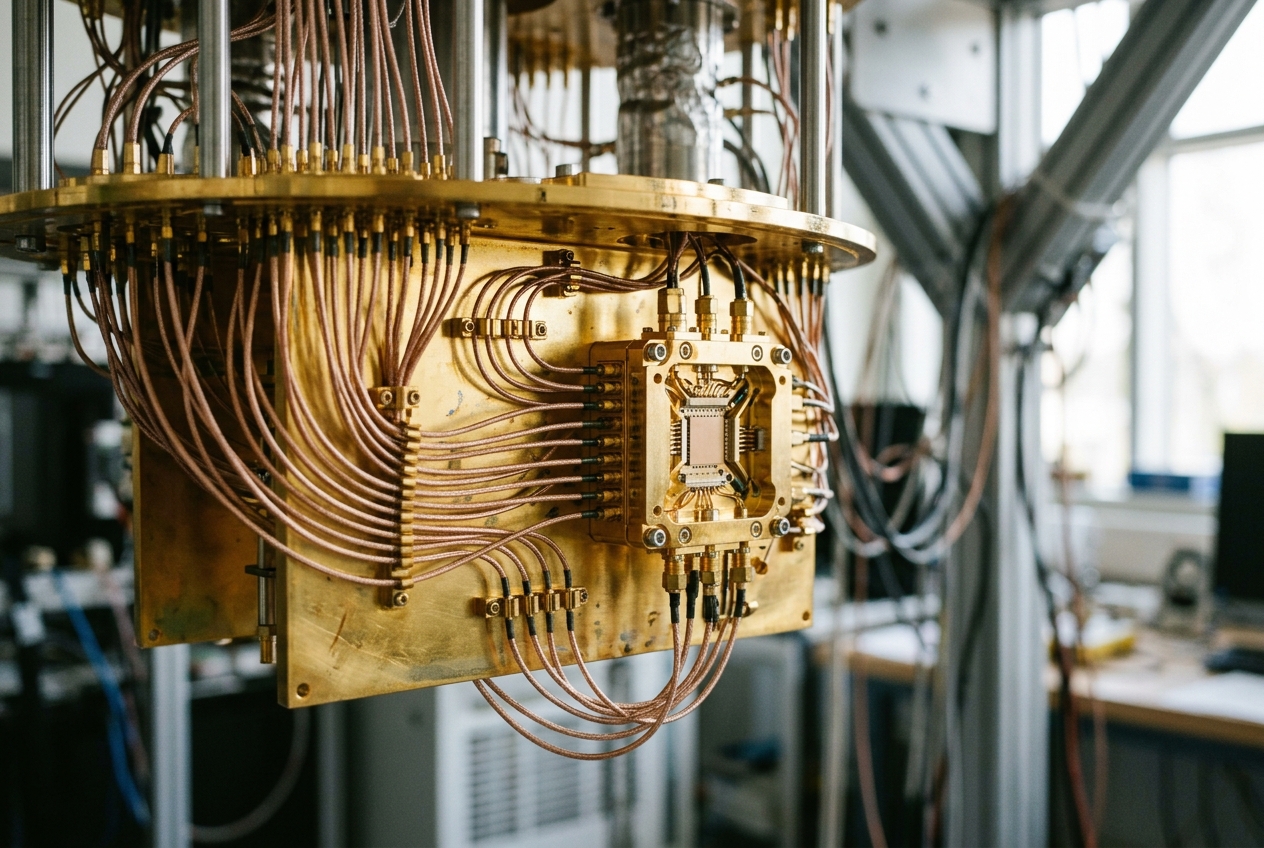
It is easy to view the Swap Test as a rarefied curiosity confined to cryogenic dilution refrigerators and academic physics departments. Yet its real-world consequences will quietly reshape the infrastructure of daily life over the coming decade.
                  CLASSICAL SEARCH             QUANTUM SWAP TEST

   Data Space     Exhaustive,                  Instantaneous geometric
   Comparison     bit-by-bit parsing           overlap evaluation

   Societal       Years of clinical            Precision medicine
   Impact         trial-and-error              matched in seconds
Consider the development of personalized cancer vaccines. Today, identifying whether an engineered synthetic mRNA sequence will match a patient's uniquely mutated tumor receptor requires months of supercomputer simulations and laboratory trial-and-error. By using the Swap Test to compare quantum representations of molecular geometry directly, quantum machine learning models will compress those screening pipelines from months to seconds.
Furthermore, the Swap Test underpins the future of privacy-preserving cloud computing. Through quantum fingerprinting, secure cloud servers will soon be able to authenticate massive biometric databases or encrypted financial registries, proving that two sensitive records match without the server ever gaining access to the raw personal information contained within them.
6. Today's Takeaway
The ultimate power of quantum computation does not come from doing classical arithmetic faster; it comes from transforming difficult mathematical problems into simple physical phenomena.
The Swap Test is the purest expression of this philosophy. Rather than spending eons measuring, copying, and calculating the similarity between two complex systems, it lets the universe compute their relationship through the natural interference of quantum waves. By turning the fundamental fragility of quantum information into an instrument of measurement, the Swap Test proves that in the quantum world, you do not need to look inside a secret to know whether two secrets are the same.