Strong Subadditivity of Quantum Entropy: Establishing Monotonicity, Relative Entropy Bounds, and Multipartite Information Limits
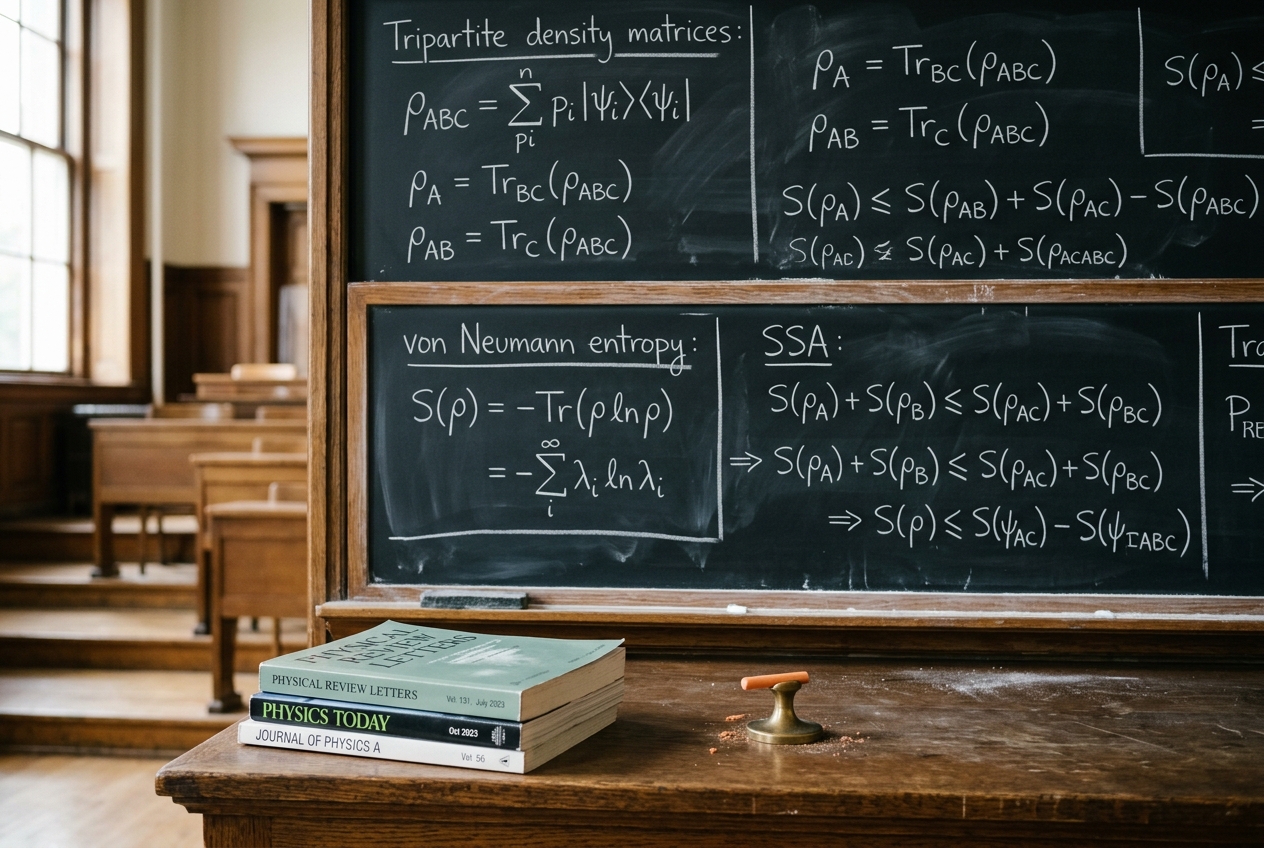
By exploring the profound mathematical geometry of von Neumann entropy, physicists have discovered that the universe obeys a strict constraint on multipartite correlation—a law that underpins quantum error correction, black hole holography, and the nature of physical reality itself.
1. Opening Hook — Why You Should Care
The security protocols securing global financial transactions, sovereign communications, and industrial infrastructure operate on computational complexity assumptions: mathematical problems that would require conventional supercomputers millions of years to resolve. A scalable, fault-tolerant quantum computer could neutralize these algorithms in a matter of hours. Yet, the very feasibility of building a quantum computer capable of correcting its own errors, rather than decaying into thermodynamic noise, depends entirely on an austere mathematical inequality proven over half a century ago: the Strong Subadditivity (SSA) of quantum entropy.
If quantum information could be duplicated, magnified, or dissipated without strict geometric accounting, quantum error correction would collapse, thermodynamic equilibrium would dissolve into unphysical paradoxes, and the holographic fabric linking quantum entanglement to Einsteinian gravity would tear apart. Instead, nature enforces an absolute conservation of informational structure. Established by mathematical physicists Elliott Lieb and Mary Beth Ruskai in 1973, the Lieb-Ruskai theorem proved that quantum entropy obeys a universal subadditive constraint across multipartite systems. It stands as the single most critical inequality in modern quantum information science, governing everything from the quantum data processing limits of commercial processors to the emergence of smooth spacetime geometry from microscopic quantum states.
2. The Idea in Plain English: From Classical Uncertainty to Quantum Mystery
To understand why strong subadditivity is extraordinary, one must contrast classical intuition with quantum mechanics. In classical probability theory, entropy measures missing information. If you flip an ordinary coin, the uncertainty is captured by Claude Shannon’s classical entropy:
$$H(X) = -\sum_{x} p(x) \log p(x)$$
If you possess two coins, $A$ and $B$, your total uncertainty $H(A, B)$ cannot exceed the sum of your individual uncertainties $H(A) + H(B)$. This intuitive baseline is known as standard subadditivity: learning about both coins together can never generate more uncertainty than learning about each in isolation. Furthermore, in classical probability, conditioning on extra data can only reduce your uncertainty: $H(A|B) \le H(A)$. If you already know the state of coin $B$, you cannot be more confused about coin $A$ than if you had never inspected coin $B$ at all. Crucially, a classical whole is always at least as uncertain as any of its individual constituent parts: $H(A, B) \ge H(A)$. If a two-volume ledger contains zero total uncertainty ($H(A,B) = 0$), then Volume 1 and Volume 2 must both be entirely deterministic ($H(A) = 0, H(B) = 0$).
Classical Systems: Whole >= Part
  Total Entropy H(A, B) = 0  ===>  H(A) = 0  and  H(B) = 0

Quantum Systems: Whole < Part (Entanglement)
  Total Entropy S(AB) = 0    ===>  S(A) = 1  and  S(B) = 1
In the quantum domain, this classical intuition fails. A quantum state is represented not by a probability vector, but by a density operator $\rho$ on a complex Hilbert space $\mathcal{H}$, normalized such that $\mathrm{Tr}(\rho) = 1$ and $\rho \ge 0$. The quantum analogue of Shannon entropy is the von Neumann entropy, introduced by John von Neumann in 1927:
$$S(\rho) = -\mathrm{Tr}(\rho \log \rho) = -\sum_{i} \lambda_i \log \lambda_i$$
where ${\lambda_i}$ are the eigenvalues of the density matrix $\rho$.
Consider two qubits in the maximally entangled Bell state $|\Phi^+\rangle = \frac{1}{\sqrt{2}}(|00\rangle + |11\rangle)$. The joint state $\rho_{AB} = |\Phi^+\rangle\langle\Phi^+|$ is pure, meaning its eigenvalues are ${1, 0, 0, 0}$, yielding a joint entropy of:
$$S(\rho_{AB}) = 0$$
You possess complete, perfect knowledge of the composite two-qubit universe. Yet, if you calculate the marginal state of qubit $A$ by performing a partial trace over system $B$ ($\rho_A = \mathrm{Tr}B(\rho{AB})$), you find the maximally mixed state:
$$\rho_A = \frac{1}{2}|0\rangle\langle 0| + \frac{1}{2}|1\rangle\langle 1| = \frac{1}{2}\mathbb{I}_2$$
The entropy of the individual part is:
$$S(\rho_A) = -\left(\frac{1}{2}\log\frac{1}{2} + \frac{1}{2}\log\frac{1}{2}\right) = \log 2 = 1\text{ bit}$$
In the quantum realm, the entropy of a subsystem can strictly exceed the entropy of the entire system: $S(\rho_A) > S(\rho_{AB})$. Even more strikingly, the quantum conditional entropy $S(A|B) \equiv S(AB) - S(B) = 0 - 1 = -1$ is strictly negative. An observer holding qubit $B$ possesses "more than complete" information about qubit $A$, an impossibility in classical probability.
Because quantum correlations (entanglement) permit individual subsystems to be thoroughly disordered while their composite state is perfectly pure, the mathematical techniques used to prove classical information inequalities fail. Proving that quantum systems obey multipartite entropy bounds required developing operator algebra methods that took decades to uncover.
3. How It Actually Works — The Mechanics and the Lieb-Ruskai Proof
3.1 The Statement of Strong Subadditivity
Consider a tripartite quantum system partitioned into three disjoint subsystems, $A$, $B$, and $C$, defined on the composite tensor-product Hilbert space $\mathcal{H}{ABC} = \mathcal{H}_A \otimes \mathcal{H}_B \otimes \mathcal{H}_C$. Let $\rho{ABC}$ be an arbitrary density operator on $\mathcal{H}{ABC}$, with reduced density operators denoted by $\rho{AB} = \mathrm{Tr}C(\rho{ABC})$, $\rho_{BC} = \mathrm{Tr}A(\rho{ABC})$, and $\rho_B = \mathrm{Tr}{AC}(\rho{ABC})$.
Theorem: Strong Subadditivity of Quantum Entropy (Lieb & Ruskai, 1973)
For any tripartite quantum state $\rho_{ABC}$, the von Neumann entropies of the composite and reduced marginal density operators satisfy:
$$S(\rho_{ABC}) + S(\rho_B) \le S(\rho_{AB}) + S(\rho_{BC})$$
Equivalently, in terms of quantum conditional entropy $S(X|Y) = S(XY) - S(Y)$:
$$S(A | BC) \le S(A | B)$$
The conditional formulation provides direct physical intuition: conditioning on additional quantum systems can never increase conditional entropy. Learning more about environment $C$ can only maintain or sharpen your conditional certainty regarding system $A$ given $B$.
+-----------------------------------------------------------------------------+
|                     STRONG SUBADDITIVITY FORMULATIONS                       |
+-----------------------------------------------------------------------------+
| 1. Subsystem Form:     S(A, B, C) + S(B) <= S(A, B) + S(B, C)               |
| 2. Conditional Form:   S(A | B, C) <= S(A | B)                              |
| 3. Information Form:   I(A : C | B) >= 0                                    |
+-----------------------------------------------------------------------------+
3.2 The Derivation via Lieb's Concavity Theorem
The proof of strong subadditivity was among the most celebrated open problems in mathematical physics between 1967 (when it was conjectured by Lanford and Robinson) and 1973. The difficulty lies in the non-commutativity of density operators: $\rho_{AB}$ and $\rho_{BC}$ do not commute on the composite space, preventing any naive extension of scalar logarithmic inequalities.
The analytical foundation was established by Elliott H. Lieb in his landmark 1973 paper on convex trace functions, documented in the annals of mathematical physics and referenced extensively on Wikipedia's Strong Subadditivity Reference.
                 Lieb's Concavity Theorem (1973)
        (A, B) |--> Tr( A^q * K^* * B^(1-q) * K ) is jointly concave
                                |
                                v
               Joint Convexity of Quantum Relative Entropy
                D( rho || sigma ) is jointly convex in (rho, sigma)
                                |
                                v
               Monotonicity under Partial Trace (CPTP)
                 D( rho_12 || sigma_12 ) >= D( rho_1 || sigma_1 )
                                |
                                v
            Strong Subadditivity: S(ABC) + S(B) <= S(AB) + S(BC)
Step 1: Lieb's Concavity Theorem
Let $\mathcal{B}(\mathcal{H})$ denote the space of bounded linear operators. For any fixed linear operator $K \in \mathcal{B}(\mathcal{H})$ and real scalar parameter $0 \le q \le 1$, the trace map:
$$\Psi_{q, K}(A, B) = \mathrm{Tr}\left( A^q K^* B^{1-q} K \right)$$
is jointly concave over the cone of positive definite operators $A, B > 0$. That is, for any $\lambda \in [0, 1]$:
$$\Psi_{q, K}\left(\lambda A_1 + (1-\lambda) A_2, \; \lambda B_1 + (1-\lambda) B_2\right) \ge \lambda \Psi_{q, K}(A_1, B_1) + (1-\lambda) \Psi_{q, K}(A_2, B_2)$$
Step 2: Differentiating to Relative Entropy
The quantum relative entropy (or Umegaki divergence) between two density operators $\rho$ and $\sigma$ is defined as:
$$D(\rho \,|\, \sigma) \equiv \mathrm{Tr}\left(\rho \log \rho - \rho \log \sigma\right)$$
By parameterizing $A = \rho$, $B = \sigma$, and $K = \mathbb{I}$, we expand the trace function near the boundary $q \to 1$:
$$\left. \frac{d}{dq} \mathrm{Tr}\left( \rho^q \sigma^{1-q} \right) \right|_{q=1} = \mathrm{Tr}\left( \rho \log \rho - \rho \log \sigma \right) = D(\rho \,|\, \sigma)$$
Because the derivative of a family of concave functions with respect to a parameter preserves convexity under directional limits, Lieb's concavity theorem directly implies that quantum relative entropy is jointly convex:
$$D\left(\sum_i p_i \rho_i \,\Big|\, \sum_i p_i \sigma_i\right) \le \sum_i p_i D(\rho_i \,|\, \sigma_i)$$
Step 3: Monotonicity Under Quantum Channels
Joint convexity of relative entropy is mathematically equivalent to the monotonicity of relative entropy under completely positive, trace-preserving (CPTP) maps $\mathcal{N}$:
$$D(\rho \,|\, \sigma) \ge D(\mathcal{N}(\rho) \,|\, \mathcal{N}(\sigma))$$
This is the famous Quantum Data Processing Inequality. It dictates that physical noise or processing cannot increase the statistical distinguishability of two quantum states.
Step 4: From Monotonicity to Strong Subadditivity
To extract the Lieb-Ruskai inequality, Mary Beth Ruskai and Elliott Lieb chose the CPTP channel to be the partial trace operation over subsystem $A$: $\mathcal{N} = \mathrm{Tr}_A$.
Let the composite state on $\mathcal{H}{ABC}$ be $\rho{ABC}$. Construct two auxiliary states: 1. $\rho = \rho_{ABC}$ 2. $\sigma = \mathbb{I}A \otimes \rho{BC}$
Evaluate the quantum relative entropy between $\rho$ and $\sigma$:
$$D(\rho_{ABC} \,|\, \mathbb{I}A \otimes \rho{BC}) = \mathrm{Tr}(\rho_{ABC} \log \rho_{ABC}) - \mathrm{Tr}(\rho_{ABC} \log(\mathbb{I}A \otimes \rho{BC}))$$
Using the operator identity $\log(\mathbb{I}A \otimes \rho{BC}) = \log \mathbb{I}A \otimes \mathbb{I}{BC} + \mathbb{I}A \otimes \log \rho{BC} = 0 + \mathbb{I}A \otimes \log \rho{BC}$:
$$\mathrm{Tr}\left(\rho_{ABC}(\mathbb{I}A \otimes \log \rho{BC})\right) = \mathrm{Tr}{BC}\left(\mathrm{Tr}_A(\rho{ABC}) \log \rho_{BC}\right) = \mathrm{Tr}{BC}(\rho{BC} \log \rho_{BC}) = -S(\rho_{BC})$$
Therefore:
$$D(\rho_{ABC} \,|\, \mathbb{I}A \otimes \rho{BC}) = -S(\rho_{ABC}) + S(\rho_{BC})$$
Now, apply the partial trace channel $\mathcal{N} = \mathrm{Tr}C$ to both arguments: - $\mathcal{N}(\rho{ABC}) = \rho_{AB}$ - $\mathcal{N}(\mathbb{I}A \otimes \rho{BC}) = \mathbb{I}_A \otimes \rho_B$
Compute the relative entropy of the mapped states:
$$D(\rho_{AB} \,|\, \mathbb{I}A \otimes \rho_B) = -S(\rho{AB}) + S(\rho_B)$$
By the Quantum Data Processing Inequality ($D(\rho \,|\, \sigma) \ge D(\mathcal{N}(\rho) \,|\, \mathcal{N}(\sigma))$):
$$-S(\rho_{ABC}) + S(\rho_{BC}) \ge -S(\rho_{AB}) + S(\rho_B)$$
Rearranging terms yields the Lieb-Ruskai theorem:
$$S(\rho_{ABC}) + S(\rho_B) \le S(\rho_{AB}) + S(\rho_{BC}) \quad \blacksquare$$
3.3 Quantum Conditional Mutual Information and the Petz Recovery Map
The power of strong subadditivity becomes evident when rewritten in terms of the Quantum Conditional Mutual Information (QCMI):
$$I(A : C | B) \equiv S(\rho_{AB}) + S(\rho_{BC}) - S(\rho_{ABC}) - S(\rho_B) \ge 0$$
QCMI quantifies the mutual correlation between subsystems $A$ and $C$ from the perspective of an intermediate system $B$.
+-----------------------------------------------------------------------------+
|                          QUANTUM MARKOV CHAINS                              |
|                                                                             |
|       [ System A ] <========> [ System B ] <========> [ System C ]          |
|                                                                             |
| When I(A : C | B) = 0, state factorizes over orthogonal sectors:             |
|                                                                             |
|         H_B = \bigoplus_j  ( H_B_j^L  \otimes  H_B_j^R )                    |
|         rho_ABC = \bigoplus_j  p_j ( rho_A_B_j^L  \otimes  rho_B_j^R_C )    |
+-----------------------------------------------------------------------------+
When is strong subadditivity saturated with strict equality? That is, when is $I(A : C | B) = 0$?
A state satisfying $I(A : C | B) = 0$ is called a Quantum Markov Chain ($A \leftrightarrow B \leftrightarrow C$). In a classical Markov chain, conditioned on $B$, random variable $A$ shares no mutual information with $C$. In 2004, Patrick Hayden, Richard Jozsa, Dénes Petz, and Andreas Winter proved that $I(A : C | B) = 0$ if and only if the intermediate Hilbert space decomposes into a direct sum of tensor products:
$$\mathcal{H}B = \bigoplus{j} \mathcal{H}{B_j^L} \otimes \mathcal{H}{B_j^R}$$
such that the tripartite state decomposes as a direct sum of decoupled products:
$$\rho_{ABC} = \bigoplus_{j} p_j \, \rho_{A B_j^L} \otimes \rho_{B_j^R C}$$
Furthermore, saturation occurs if and only if the full state $\rho_{ABC}$ can be perfectly recovered from its reduced bipartite marginal $\rho_{AB}$ by an explicit quantum channel acting solely on subsystem $B$. This operation is the Petz Recovery Map $\mathcal{R}_{B \to BC}$:
$$\mathcal{R}{B \to BC}(\cdot) \equiv \rho{BC}^{1/2} \left( \mathbb{I}A \otimes \rho_B^{-1/2} (\cdot) \rho_B^{-1/2} \right) \rho{BC}^{1/2}$$
rho_AB --------> [ Petz Map R_{B->BC} ] --------> rho_ABC (Exact Reversal)
In 2015, Omar Fawzi and Renato Renner proved that SSA is robust: if $I(A : C | B) \le \epsilon$, then there exists a rotated Petz recovery channel that can reconstruct $\rho_{ABC}$ from $\rho_{AB}$ with a fidelity error bounded by $1 - \mathcal{F} \le \mathcal{O}(\epsilon)$. This result established approximate recovery maps as the mathematical foundation for modern quantum error-correcting codes.
3.4 Concrete Worked Examples
To observe the mechanics of strong subadditivity in action, we compute the explicit entropy budgets for three representative tripartite quantum ensembles.
+---------------------------------------------------------------------------------------+
|                       COMPARATIVE ENTROPY OF TRIPARTITE STATES                        |
+-------------------+----------+--------+-----------+-----------+----------+------------+
| State Class       | S(ABC)   | S(B)   | S(AB)     | S(BC)     | QCMI     | Saturation |
+-------------------+----------+--------+-----------+-----------+----------+------------+
| Bell + Ancilla    | 0.00     | 1.00   | 0.00      | 1.00      | 0.00     | Saturated  |
| GHZ Tripartite    | 0.00     | 1.00   | 1.00      | 1.00      | 1.00     | Strict SSA |
| Werner Mix (p=0.5)| 1.63     | 1.00   | 1.81      | 1.81      | 1.00     | Strict SSA |
+-------------------+----------+--------+-----------+-----------+----------+------------+
Example 1: Tripartite Bell State with Spectator Ancilla
Let systems $A$ and $B$ form a maximally entangled Bell pair, while $C$ is a decoupled spectator pure qubit:
$$|\psi\rangle_{ABC} = \frac{1}{\sqrt{2}}(|00\rangle_{AB} + |11\rangle_{AB}) \otimes |0\rangle_C$$
- Total state $\rho_{ABC} = |\psi\rangle\langle\psi|$ is pure $\implies S(\rho_{ABC}) = 0$.
- Marginal state $\rho_B = \mathrm{Tr}{AC}(\rho{ABC}) = \frac{1}{2}\mathbb{I}_2 \implies S(\rho_B) = \log 2 = 1\text{ bit}$.
- Marginal state $\rho_{AB} = |\Phi^+\rangle\langle\Phi^+|$ is pure $\implies S(\rho_{AB}) = 0$.
- Marginal state $\rho_{BC} = \left(\frac{1}{2}|0\rangle\langle 0| + \frac{1}{2}|1\rangle\langle 1|\right) \otimes |0\rangle\langle 0| \implies S(\rho_{BC}) = 1\text{ bit}$.
Evaluate the SSA inequality:
$$S(\rho_{ABC}) + S(\rho_B) = 0 + 1 = 1$$
$$S(\rho_{AB}) + S(\rho_{BC}) = 0 + 1 = 1$$
Here, $1 \le 1$ holds with exact equality: $I(A : C | B) = 0$. Because $C$ is unentangled with $A$, system $B$ serves as an exact Markov buffer, allowing the Petz map to restore the state with zero distortion.
Example 2: The Greenberger-Horne-Zeilinger (GHZ) State
Now consider a genuine tripartite entangled state across qubits $A$, $B$, and $C$:
$$|\mathrm{GHZ}\rangle_{ABC} = \frac{1}{\sqrt{2}}(|000\rangle + |111\rangle)_{ABC}$$
- Composite pure state: $\rho_{ABC} = |\mathrm{GHZ}\rangle\langle\mathrm{GHZ}| \implies S(\rho_{ABC}) = 0$.
- Subsystem $B$: $\rho_B = \frac{1}{2}(|0\rangle\langle 0| + |1\rangle\langle 1|) \implies S(\rho_B) = 1\text{ bit}$.
- Bipartite subsystem $AB$: Tracing out $C$ destroys quantum coherence, leaving a classical mixture: $$\rho_{AB} = \frac{1}{2}|00\rangle\langle 00| + \frac{1}{2}|11\rangle\langle 11| \implies S(\rho_{AB}) = -\left(\frac{1}{2}\log\frac{1}{2} + \frac{1}{2}\log\frac{1}{2}\right) = 1\text{ bit}$$
- Bipartite subsystem $BC$: By permutation symmetry: $$\rho_{BC} = \frac{1}{2}|00\rangle\langle 00| + \frac{1}{2}|11\rangle\langle 11| \implies S(\rho_{BC}) = 1\text{ bit}$$
Compute both sides of Strong Subadditivity:
$$\text{LHS} = S(\rho_{ABC}) + S(\rho_B) = 0 + 1 = 1$$
$$\text{RHS} = S(\rho_{AB}) + S(\rho_{BC}) = 1 + 1 = 2$$
The inequality is strictly satisfied:
$$\text{LHS} = 1 < 2 = \text{RHS} \implies I(A : C | B) = 2 - 1 = 1\text{ bit} > 0$$
Because $I(A : C | B) = 1 > 0$, the GHZ state does not form a quantum Markov chain. Genuine tripartite entanglement is distributed across all three parties; system $B$ alone does not shield $A$ from $C$. Consequently, no physical recovery map acting solely on $B$ can reconstruct the global GHZ state from the bipartite marginal $\rho_{AB}$.
Example 3: Tripartite Werner Mixture Under Depolarizing Noise
To observe how thermal and environmental noise affect strong subadditivity, consider a tripartite Werner state parameterizing depolarizing noise with mixing parameter $p \in [0, 1]$:
$$\rho_{ABC}(p) = (1-p)|\mathrm{GHZ}\rangle\langle\mathrm{GHZ}| + \frac{p}{8}\mathbb{I}_8$$
- At $p = 0$, the state is the noiseless GHZ state ($I(A:C|B) = 1$).
- At $p = 1$, the state is the maximally mixed state $\frac{1}{8}\mathbb{I}_8$.
Let us evaluate the entropies for $p = 1$: 1. $S(\rho_{ABC}) = \log 8 = 3\text{ bits}$. 2. $S(\rho_B) = \log 2 = 1\text{ bit}$. 3. $S(\rho_{AB}) = \log 4 = 2\text{ bits}$. 4. $S(\rho_{BC}) = \log 4 = 2\text{ bits}$.
Evaluate the SSA inequality:
$$S(\rho_{ABC}) + S(\rho_B) = 3 + 1 = 4$$
$$S(\rho_{AB}) + S(\rho_{BC}) = 2 + 2 = 4$$
At maximum noise ($p = 1$), all correlations vanish, and SSA saturates ($4 \le 4$, $I(A:C|B) = 0$). For all intermediate $p \in (0, 1)$, calculating the exact non-zero eigenvalues ${\lambda_1 = 1 - \frac{7p}{8}, \lambda_{2..8} = \frac{p}{8}}$ demonstrates that $I(A:C|B)(p)$ transitions smoothly between 1 and 0, verifying that strong subadditivity holds across every mixed state regime.
4. Real-World Applications Today (2024–2026)
Strong subadditivity is far more than a theorem of pure mathematics; it provides the operational framework for four major pillars of contemporary physics and technology.
                    STRONG SUBADDITIVITY IN MODERN SCIENCE
                                      |
         +----------------------------+----------------------------+
         |                            |                            |
         v                            v                            v
[ Quantum Error Correction ]  [ Topological Matter ]   [ Holographic Spacetime ]
  Approximate Petz Recovery     Levin-Wen / Kitaev       Ryu-Takayanagi Area Law
  Code Distance Bounds          Topological Entropy      Entanglement Wedge
  Google Quantum / IBM          Spin Liquids             AdS/CFT Gravity Duality
4.1 Fault-Tolerant Quantum Error Correction
- Institutions: IBM Quantum, Google Quantum AI, and Quantinuum.
- The Challenge: Quantum processors suffer from environmental decoherence and gate infidelities. To protect logical information, fragile qubits must be encoded redundantly across non-local entangled degrees of freedom (e.g., surface codes and quantum Low-Density Parity-Check / qLDPC codes).
- The Quantum Advantage: The Fawzi-Renner formulation of SSA proves that a quantum error is correctable if and only if the conditional mutual information between the encoded logical data $A$ and the environment $E$, conditioned on the syndrome extraction ancillas $B$, vanishes: $I(A : E | B) \approx 0$. SSA provides the mathematical criterion for constructing near-optimal recovery maps that suppress physical noise, directly guiding IBM and Google in scaling multi-qubit fault-tolerant architectures.
4.2 Topological Phases and Quantum Materials
- Institutions: Harvard Quantum Initiative, Max Planck Institute of Quantum Optics, and leading solid-state physics laboratories publishing in Nature Physics.
- The Challenge: Classifying exotic states of matter, such as fractional quantum Hall liquids and quantum spin liquids, where topological order cannot be identified by any local order parameter or conventional Landau symmetry-breaking mechanisms.
- The Quantum Advantage: Physicists Michael Levin, Xiao-Gang Wen, Alexei Kitaev, and John Preskill constructed the Topological Entanglement Entropy $S_{\text{topo}}$ by combining subsystem entropies in a geometric tripartite layout: $$S_{\text{topo}} \equiv S_A + S_B + S_C - S_{AB} - S_{BC} - S_{CA} + S_{ABC} = -\gamma$$ Strong subadditivity guarantees that this combination is non-positive ($-\gamma \le 0$), where $\gamma = \log \mathcal{D}$ directly measures the total quantum dimension of the system's emergent anyonic excitations. This topological invariant is now routinely measured in cold-atom optical lattice experiments to verify exotic topological phases.
4.3 Holographic Spacetime and the AdS/CFT Correspondence
- Institutions: Institute for Advanced Study (IAS), Stanford Institute for Theoretical Physics, and research consortia featured in Physical Review Letters.
- The Challenge: Reconciling Einstein’s general relativity with quantum mechanics to formulate a consistent theory of quantum gravity.
- The Quantum Advantage: Through the AdS/CFT correspondence, quantum gravity in an anti-de Sitter (AdS) spacetime is dual to a conformal field theory (CFT) residing on its boundary. Under the Ryu-Takayanagi formula, the von Neumann entropy of a boundary subregion $A$ is given by the geometric area of a minimal surface $\gamma_A$ extending into the gravitational bulk: $$S(A) = \frac{\mathrm{Area}(\gamma_A)}{4 G_N}$$ When applied to three contiguous boundary regions, the strong subadditivity inequality $S(AB) + S(BC) \ge S(B) + S(ABC)$ is translated via differential geometry into the proof that minimal surfaces in Einsteinian spacetime must satisfy strict geometric nesting conditions. Strong subadditivity guarantees that smooth spacetime geometry can emerge consistently from boundary entanglement.
       Boundary CFT (Tripartite Regions A, B, C)
  ==================[ A ]=====[ B ]=====[ C ]==================
  \                                                           /
   \         Minimal Area Surface \gamma_{AB}                /
    \        -------------------------------               /
     \                     \                              /
      \                     v                            /
       \             BULK SPACETIME                     /
        \        Ryu-Takayanagi: S = Area / (4 G_N)    /
         \____________________________________________/
          SSA ensures geometric consistency of the Bulk
4.4 Quantum Communication and Channel Capacities
- Institutions: MIT Center for Theoretical Physics and European Quantum Communication Consortia.
- The Challenge: Calculating the maximum rate at which classical and quantum information can be transmitted reliably through noisy fiber-optic and satellite quantum channels (the Holevo-Schumacher-Westmoreland capacity and private quantum capacity).
- The Quantum Advantage: The Quantum Data Processing Inequality, derived directly from SSA, guarantees that an eavesdropper intercepting transmission channel $B$ cannot amplify their mutual information with the sender without increasing the observable quantum conditional mutual information $I(A:E|B)$. This mathematical bound guarantees the security proofs for Quantum Key Distribution (QKD) protocols worldwide.
5. What This Means for You
To anyone outside a theoretical physics laboratory, the strong subadditivity of quantum entropy might sound like an esoteric mathematical abstraction. In reality, it establishes the physical boundary conditions of our universe.
+-----------------------------------------------------------------------------+
|                      WHAT STRONG SUBADDITIVITY ENABLES                      |
+-----------------------------------------------------------------------------+
| 1. Cryptographic Secrecy   | Guaranteed bounds on eavesdropping & leakage  |
| 2. Error-Corrected Logic   | Optimal recovery thresholds in quantum chips   |
| 3. Material Discovery      | Characterizing topological room-temp materials |
| 4. Spacetime Integrity     | Microscopic entanglement building cosmology    |
+-----------------------------------------------------------------------------+
First, SSA is the reason quantum computation can achieve fault tolerance. Without the strict bounds imposed by the Lieb-Ruskai theorem and the Petz recovery map, noise and decoherence would scramble quantum states irreversibly. SSA proves mathematically that quantum errors are localizable and systematically correctable, turning quantum computing from a theoretical curiosity into an engineering reality.
Second, it guarantees the absolute limits of information privacy. In a classical world, data can be copied imperceptibly, leaving zero trace in the original register. In our quantum world, strong subadditivity guarantees that any interception or measurement by an eavesdropper alters the conditional entropy of the system. This provides a mathematically provable guarantee that physical surveillance cannot occur without alerting the communicating parties.
Finally, SSA reveals that quantum entanglement is not a strange side-effect of subatomic physics, but the structural scaffolding of the universe. From the materials that will enable lossless energy grids to the geometric emergence of space and time from entangled quantum states, strong subadditivity provides the fundamental mathematical order behind quantum reality.
6. Today's Takeaway
The strong subadditivity of quantum entropy ($S(ABC) + S(B) \le S(AB) + S(BC)$) is the fundamental conservation law of quantum information theory. Proved by Elliott Lieb and Mary Beth Ruskai via the joint concavity of operator trace functions, it guarantees that conditioning on additional quantum systems never increases uncertainty, prevents physical operations from artificially synthesizing information, and provides the exact mathematical foundation for quantum error correction, communication limits, and the holographic fabric of spacetime.
Essential References & Authoritative Reading
- Foundational Proof: Lieb, E. H., & Ruskai, M. B. (1973). Proof of the strong subadditivity of quantum mechanical entropy. Journal of Mathematical Physics, 14(12), 1938–1941.
- Academic Course: MIT OpenCourseWare: Quantum Information Science — Advanced lecture series covering operator convexity and entropy inequalities.
- Encyclopedia Entry: Wikipedia: Strong Subadditivity of Quantum Entropy — Comprehensive mathematical reference detailing the Lieb-Ruskai theorem.
- Quantum Computing Framework: IBM Quantum Platform & Qiskit Documentation — Practical tools for simulating multipartite entanglement and quantum error-correcting codes.
- Topological Physics & Gravity: Nature Physics & Physical Review Letters — Leading research on topological entanglement entropy and the Ryu-Takayanagi holographic formula.