Quantum Steering: Characterizing Asymmetric Non-Local Correlations and One-Sided Device-Independent Protocols
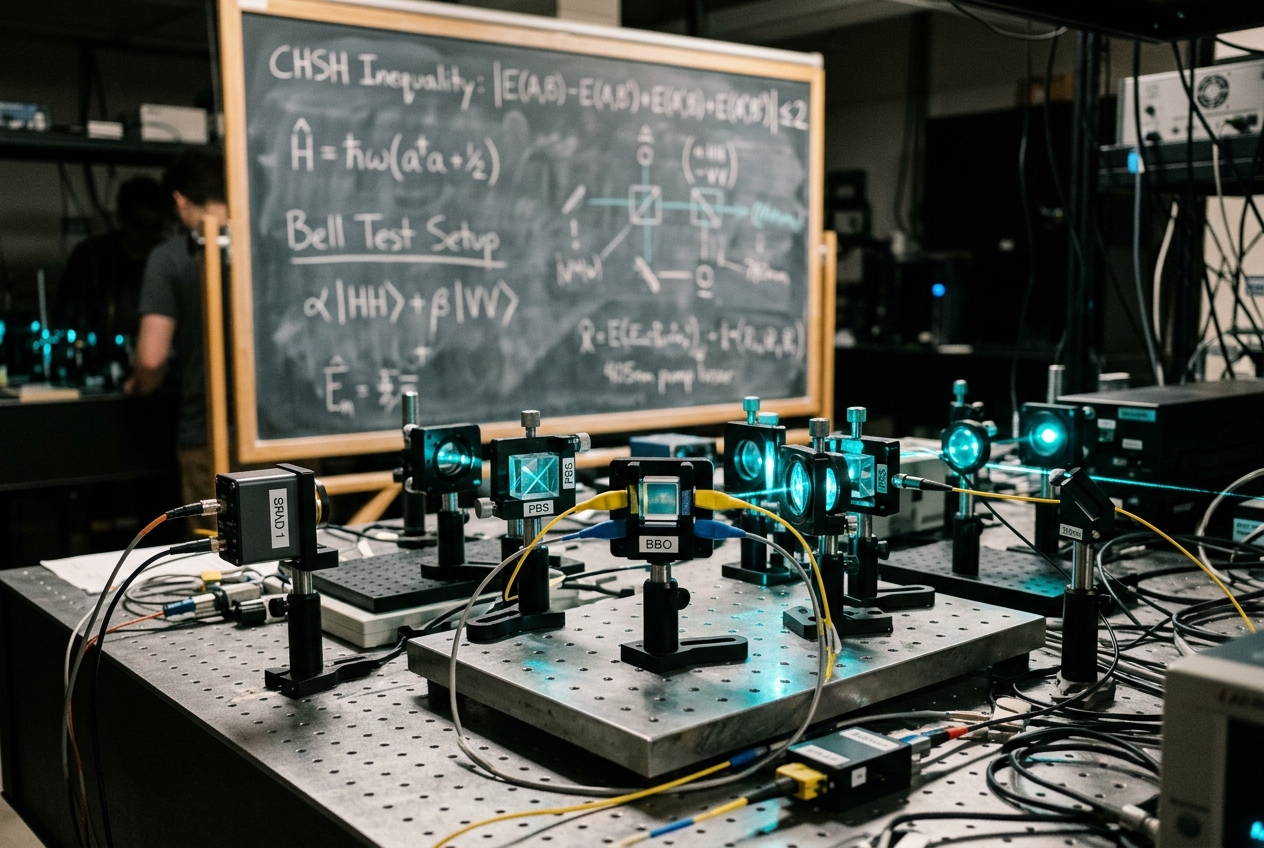
1. Opening Hook — Why You Should Care
The global race to construct a quantum-safe internet is caught in an uncomfortable dilemma of trust. Today, the cryptographic algorithms shielding electronic banking, defense communications, and critical energy grids face eventual obsolescence at the hands of fault-tolerant quantum computers. In response, physicists and engineers have developed quantum key distribution, a technique that leverages the laws of quantum mechanics rather than mathematical difficulty to guarantee communication privacy.
Yet, in practical engineering, an existential vulnerability remains: how can you guarantee the security of a quantum link if you do not fully trust the physical hardware inside the terminal? If a financial server in London communicates with an untrusted client terminal manufactured overseas, or if a ground station exchanges data with a satellite whose optical sensors have degraded in orbit, standard quantum protocols break down.
For decades, physicists believed the only path forward was an extreme binary choice: either completely trust every optical component and laser in both devices, or demand full "device-independence" via Bell tests—an ultra-fragile, low-rate approach that collapses under minor real-world fiber loss.
Quantum steering resolves this crisis. By mathematically formalizing an asymmetric scenario—where one party holds uncertified, untrusted hardware while the other commands a fully calibrated, trusted laboratory—quantum steering unlocks bulletproof cryptographic keys across noisy, imperfect channels. It provides the mathematical bridge between theoretical physics and the realities of global network security.
2. The Idea in Plain English
To understand quantum steering, one must first dismantle the common misconception that quantum non-locality is an all-or-nothing phenomenon.
Imagine two players, Alice and Bob, who receive two sealed wooden boxes containing spinning coins. Under the rules of ordinary classical physics, whatever outcome Alice discovers when opening her box has no bearing on Bob's box beyond pre-agreed correlations—like someone placing matching socks in two packages before mailing them.
In the quantum domain, things are radically different. When Alice and Bob share an entangled pair of particles, their physical states are intrinsically linked. But Einstein, Podolsky, and Rosen famously argued in 1935 that this linkage implied an unacceptable paradox: if Alice could choose whether to measure the position or the momentum of her particle, and thereby immediately predict the exact state of Bob’s particle across the universe, she appeared to be exerting "spooky action at a distance."
+-------------------------------------------------------------------------+
|                  THE TRIPARTITE HIERARCHY OF CORRELATIONS               |
|                                                                         |
|   +-----------------------------------------------------------------+   |
|   |  ENTANGLEMENT                                                   |   |
|   |  • All non-separable quantum states                             |   |
|   |  • Both Alice and Bob must be fully trusted/characterized       |   |
|   |                                                                 |   |
|   |   +---------------------------------------------------------+   |   |
|   |   |  QUANTUM STEERING (EPR Steering)                        |   |   |
|   |   |  • Asymmetric non-locality                              |   |   |
|   |   |  • Alice is untrusted (Black Box); Bob is trusted       |   |   |
|   |   |                                                         |   |   |
|   |   |   +-------------------------------------------------+   |   |   |
|   |   |   |  BELL NON-LOCALITY                              |   |   |   |
|   |   |   |  • Full device-independence                     |   |   |   |
|   |   |   |  • Neither Alice nor Bob needs to be trusted    |   |   |   |
|   |   |   +-------------------------------------------------+   |   |   |
|   |   +---------------------------------------------------------+   |   |
|   +-----------------------------------------------------------------+   |
+-------------------------------------------------------------------------+
Erwin Schrödinger recognized that Alice is not transmitting a signal faster than light; rather, her choice of measurement basis steers Bob's particle into a distinct quantum ensemble.
In plain terms, steering describes the ability of one party (Alice), through her local choice of measurement, to remotely manipulate the quantum state of a distant partner (Bob) in a manner that cannot be explained away by classical mimicry.
Crucially, Bob does not simply take Alice’s word for it. Bob tests whether Alice is a genuine quantum magician or a fraud. If Alice were an illusionist armed with classical classical computers, she could send Bob a stream of ordinary particles accompanied by pre-programmed labels ("if you measure in direction X, I say outcome was +1"). Bob's operational goal is to mathematically verify whether the collection of states he receives could have originated from a classical cheat sheet—termed a Local Hidden State (LHS) model—or if Alice has genuinely steered his quantum system across space.
3. How It Actually Works — The Mechanics & Operational Hierarchy
The modern mathematical foundation of Einstein-Podolsky-Rosen (EPR) steering was formulated in seminal work published in Physical Review Letters by Howard M. Wiseman, S. J. Jones, and A. C. Doherty in 2007. They established that quantum non-locality does not consist of a single layer, but rather a strict three-tier hierarchy:
$$\text{Entanglement} \supset \text{Quantum Steering} \supset \text{Bell Non-Locality}$$
Every quantum state that exhibits Bell non-locality is steerable, and every steerable state is entangled. However, the converses are strictly false: there exist entangled states that cannot demonstrate steering, and steerable states that cannot violate any Bell inequality.
===========================================================================
CALLOUT: THE TRIPARTITE HIERARCHY IN WERNER STATES
---------------------------------------------------------------------------
Consider a two-qubit Werner state with visibility parameter v in [0, 1]:
  rho_W = v |psi-><psi-| + ((1 - v) / 4) * I_4

• Entangled Region:       v > 1/3 ≈ 0.333
• Steerable Region:       v > 1/2 = 0.500 (under infinite projective settings)
• Bell-Nonlocal Region:   v > 1/√2 ≈ 0.707 (violates the CHSH inequality)

For v between 0.500 and 0.707, the state is proven to be steerable, yet it
can never violate any Bell inequality under local projective measurements.
===========================================================================
The Operational Setup: Asymmetric Trust
To frame steering mathematically, consider an operational game of asymmetric trust: 1. Alice is treated as a black box. She possesses an untrusted, uncharacterized measurement apparatus. She selects a measurement setting $x \in {1, \dots, m}$ and observes a discrete measurement outcome $a \in {+1, -1}$. 2. Bob operates in a fully characterized, trusted quantum mechanics laboratory. He receives physical quantum states and performs calibrated tomographic measurements to reconstruct his local density matrices.
When Alice performs measurement $x$ and obtains outcome $a$, she updates Bob's system into an unnormalized conditional quantum state $\sigma_{a|x}$. The complete collection of these conditional states for all of Alice's choices and outcomes is known as an assemblage, denoted by the set ${\sigma_{a|x}}$.
The Local Hidden State (LHS) Model
Bob wants to determine whether Alice is actually steering his system or merely sending him states according to a classical strategy. Alice could simulate correlations if she possessed a classical random variable $\lambda$ governed by a probability distribution $P(\lambda)$, such that Bob receives a genuine fixed quantum state $\rho_\lambda$ (the Local Hidden State), while Alice generates her outcome $a$ given setting $x$ according to a classical response function $P(a|x, \lambda)$.
An assemblage is declared unsteerable if and only if every element can be decomposed into an LHS model:
$$\sigma_{a|x} = \sum_{\lambda} P(\lambda) P(a|x, \lambda) \rho_{\lambda}$$
Here, $P(a|x, \lambda) \ge 0$ is a valid response probability distribution satisfying $\sum_a P(a|x, \lambda) = 1$, and each $\rho_\lambda$ is a normalized quantum state on Bob's Hilbert space.
If no such classical probability distribution and set of local hidden states exist to reproduce Bob's observed assemblage ${\sigma_{a|x}}$, then the state shared between Alice and Bob demonstrates quantum steering.
Computational Diagnosis via Semidefinite Programming (SDP)
Testing whether an observed assemblage admits a Local Hidden State decomposition is computationally formidable if attempted by brute-force search. Fortunately, because the set of unsteerable assemblages forms a closed, convex polytope within the operator space, determining steerability can be mapped directly onto a Semidefinite Program (SDP).
Semidefinite programming allows physicists and computer scientists to efficiently optimize linear objective functions over the cone of positive semidefinite matrices, guaranteeing global convergence in polynomial time. If the SDP solver fails to find a valid decomposition for a given assemblage, it returns a dual certificate: a steering inequality.
These steering inequalities, developed notably by Daniel Cavalcanti, Eric Cavalcanti, and Wiseman, establish experimental thresholds on correlation expectation values:
$$\sum_{k=1}^{m} \langle A_k \otimes B_k \rangle \le C_{\text{LHS}}$$
In this formulation, $A_k$ denotes Alice's uncharacterized dichotomic observables, $B_k$ represents Bob's calibrated quantum operators, and $C_{\text{LHS}}$ is the rigorous classical bound derived under the assumption that a Local Hidden State model holds. A violation of this inequality proves steering beyond statistical doubt.
===========================================================================
SUMMARY: COMPARISON OF QUANTUM NON-LOCALITY DOMAINS
---------------------------------------------------------------------------
Property             Entanglement        Steering            Bell Non-Locality
---------------------------------------------------------------------------
Mathematical Model   Non-separable rho   Failure of LHS      Failure of LHV
Trust in Alice       Fully Trusted       Untrusted (Black)   Untrusted (Black)
Trust in Bob         Fully Trusted       Fully Trusted       Untrusted (Black)
Mathematical Tool    PPT Criterion       SDP / Inequalities  Linear Programming
Noise Tolerance      Highest             Intermediate        Lowest (Fragile)
Primary Use-Case     Quantum Computing   1sDI-QKD / Space    Full DI-QKD / RNG
===========================================================================
Furthermore, quantum steering exhibits a striking directional asymmetry: there exist non-symmetric entangled states that are steerable from Alice to Bob ($A \to B$), but completely unsteerable from Bob to Alice ($B \to A$). This directional property reflects the fundamental physical distinction between preparation and measurement in quantum theory, as explored in MIT OpenCourseWare Quantum Physics lecture archives.
4. Real-World Applications Today
The unique operational properties of quantum steering have propelled it from a foundational debate into active development across major research institutes and quantum consortia between 2024 and 2026.
+-------------------------------------------------------------------------+
|                  APPLICATIONS OF QUANTUM STEERING                       |
|                                                                         |
|   1. 1sDI-QKD               2. Satellite Downlinks                      |
|      • Asymmetric banking      • Uncalibrated space terminals           |
|      • Untrusted mobile edge   • High atmospheric loss tolerance        |
|                                                                         |
|   3. Sub-Channel QA         4. Asymmetric QRNG                          |
|      • Quantum memory links    • Provable randomness                    |
|      • Photonic processor QC   • Black-box entropy sources              |
+-------------------------------------------------------------------------+
1. One-Sided Device-Independent Quantum Key Distribution (1sDI-QKD)
- Institutions: University of Science and Technology of China (USTC), University of Bristol, and Max Planck Institute for the Science of Light.
- The Challenge: Standard Quantum Key Distribution (QKD) requires certifying that every laser, modulator, and detector behaves according to theoretical specifications. Hackers can exploit side-channel imperfections (such as detector-blinding attacks). Conversely, fully Device-Independent QKD (DI-QKD) requires violating Bell inequalities, which demands near-zero detector loss and yields extremely low key-generation rates over long distances.
- The Quantum Advantage: 1sDI-QKD establishes cryptographic security in asymmetric commercial environments. A secure data center (Bob) maintains certified, calibrated detectors, while end-user clients, smart meters, or branch offices (Alice) use cheap, mass-manufactured, uncharacterized chips. Steering guarantees that even if Alice’s device was manufactured by a malicious third party or suffers from calibration drift, eavesdroppers cannot intercept the cryptographic key.
2. Satellite-to-Ground Asymmetric Quantum Communication
- Institutions: European Space Agency (ESA) Quantum Communications Hub and national aerospace laboratories.
- The Challenge: Deploying high-precision, cryogenically cooled, fully calibrated measurement stations on satellites is constrained by payload weight, cosmic radiation degradation, and severe launch vibrations. Ground stations, however, have access to abundant electrical power and precision laboratory equipment.
- The Quantum Advantage: Quantum steering allows ground stations to verify non-classical links without requiring the satellite to possess characterized, drift-free detection systems. Because steering is far more resilient to atmospheric turbulence and photon transmission loss than Bell non-locality, ground-to-space links remain operational in weather conditions that would disable Bell tests entirely.
3. Sub-Channel State and Quantum Memory Verification
- Institutions: Academic and industrial hardware teams, including researchers using architectures documented via IBM Quantum Documentation and photonic pioneers like Xanadu.
- The Challenge: When coupling flying photonic qubits to stationary quantum memories (such as nitrogen-vacancy centers or trapped ions), verifying that quantum entanglement has been successfully stored without destroying the memory node requires complex, error-prone readout certification.
- The Quantum Advantage: By formulating the verification protocol as a steering task, engineers treat the optical interface as an uncharacterized black box while fully measuring the read-out quantum register, proving memory-photon coherence with significantly fewer measurements and lower overhead.
4. Asymmetric Certified Quantum Random Number Generation
- Institutions: Commercial quantum security firms (such as ID Quantique) in collaboration with university laboratories.
- The Challenge: Standard random number generators can be deterministic algorithms in disguise, while physical thermal noise generators are vulnerable to environmental predictability.
- The Quantum Advantage: Steering-based randomness expansion allows a trusted host to generate provably non-deterministic random numbers using an uncharacterized quantum source. If the host observes a violation of a steering inequality, the output numbers are mathematically guaranteed by quantum mechanics to be unpredictable to any external adversary.
5. What This Means for You
For anyone outside a physics laboratory, quantum mechanics can often seem like an abstract domain of academic debate. But quantum steering has direct, tangible implications for the future of digital privacy, global finance, and hardware security.
In the near future, the devices we carry—smartphones, payment fobs, biometric ID cards, and connected vehicles—will interact directly with quantum-secured infrastructure. It is economically and physically impossible to equip a consumer smartphone with a million-dollar, temperature-stabilized optical laboratory that can be certified against every physical side-channel vulnerability.
===========================================================================
THE CONSUMER TRUST PARADOX: RESOLVED BY STEERING
---------------------------------------------------------------------------
Consumer Reality:   You purchase an inexpensive smart device manufactured
                    by an unverified third-party vendor.
Security Threat:    Is the device leaking cryptographic keys via hardware
                    trojans or uncalibrated physical noise?
Steering Solution:  The central bank verifies steering mathematically.
                    If steering inequalities are satisfied, security is
                    guaranteed regardless of internal device flaws.
===========================================================================
Quantum steering provides the exact mathematical framework that makes secure consumer-to-infrastructure quantum communication possible. It ensures that when your mobile device communicates with a central banking server or cloud infrastructure, the system does not require blind faith in the integrity of your phone's internal silicon. As long as the server remains calibrated and trusted, the physical asymmetry of quantum steering protects your transactions from eavesdropping.
Readers seeking deeper foundational treatments of these principles can explore comprehensive analyses available on Wikipedia's Quantum Steering reference and foundational quantum information literature on arXiv Quantum Physics.
6. Today's Takeaway
Quantum steering is not merely an intermediate mathematical curiosity situated between entanglement and Bell non-locality; it is the fundamental physics of asymmetric trust, proving that a calibrated observer can verify quantum reality across space even when viewing the universe through an uncalibrated, imperfect lens.