Schumacher Coding: Compressing Quantum Information and Projecting Density Matrices Onto Typical Subspaces
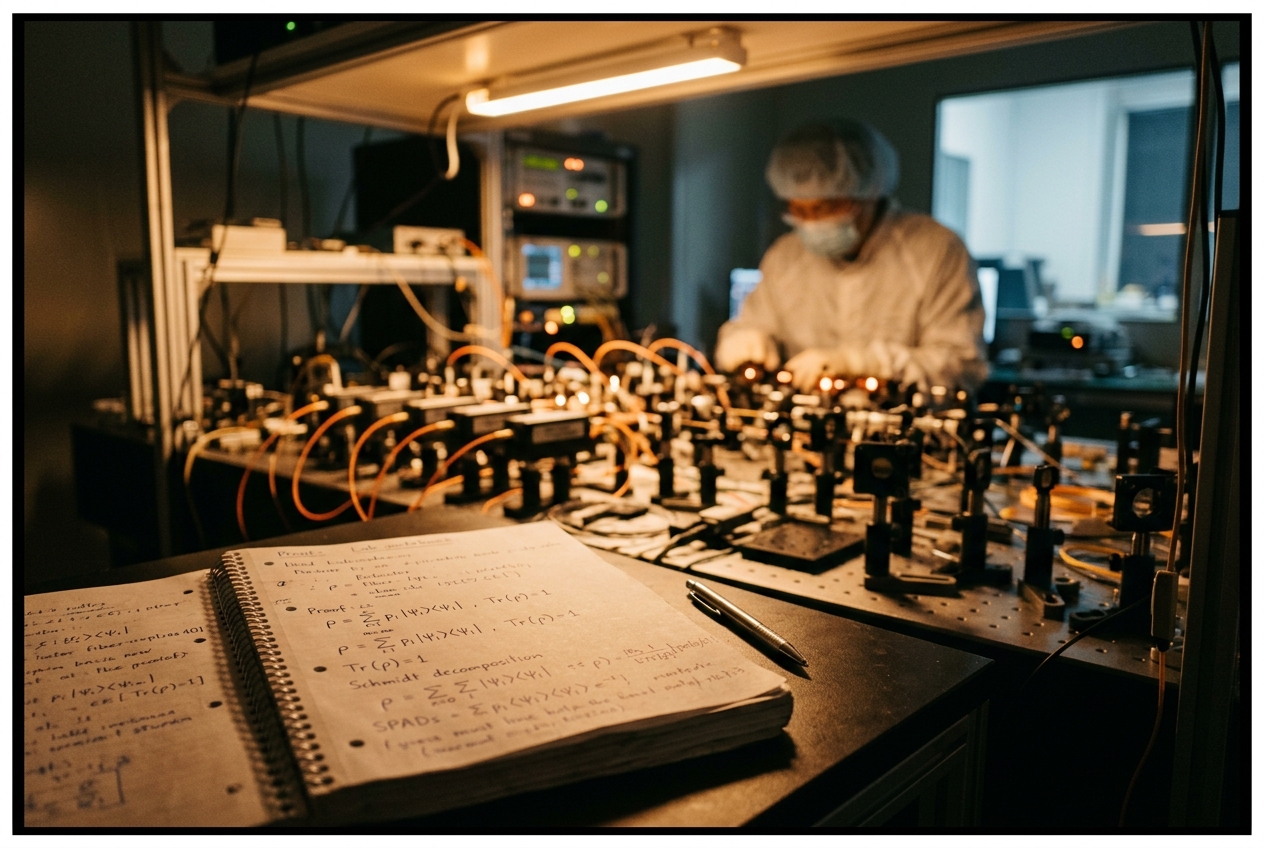
The global effort to build a scalable quantum internet faces a quiet, devastating bottleneck: quantum memory is vanishingly scarce. While modern silicon servers boast terabytes of RAM for a few hundred dollars, storing even a few dozen quantum bits—whether trapped in electromagnetic cages as laser-cooled ions or encoded in superconducting circuits cooled near absolute zero—costs millions of dollars and demands heroic cryogenic engineering. Worse yet, these fragile quantum states degrade within milliseconds through environmental decoherence. Every quantum node, optical repeater, and cloud-accessible quantum processor is starved for storage. If sending quantum information across continental networks requires shuttling uncompressed quantum states block-by-block, the quantum internet will collapse under the weight of its own physical overhead before it ever leaves the laboratory.
The mathematical salvation to this crisis was discovered three decades ago in a landmark paper that founded modern quantum communications. In 1995, theoretical physicist Benjamin Schumacher published a foundational theorem in Physical Review A that achieved two historic feats: it formally coined the word qubit in the scientific lexicon, and it proved the quantum mechanical analogue to Claude Shannon's 1948 noiseless source coding theorem. Known today as Schumacher coding, this mathematical framework demonstrates how to compress long sequences of mixed quantum states down to their absolute physical limit—the von Neumann entropy—without destroying the delicate superposition and entanglement that give quantum information its power.
Understanding Schumacher coding is not merely an abstract exercise in linear algebra; it is the blueprint for how future quantum networks will conserve their most precious resource.
1. The Idea in Plain English: Compressing the Unobservable
To understand why compressing quantum data was long thought impossible, one must first confront the radical departure of quantum information from classical bits.
In classical computing, compression is intuitive. If you analyze a text file containing millions of English words, the letter "e" appears far more frequently than "z," and certain character combinations occur in predictable clusters. As Shannon demonstrated, you can replace recurring patterns with short binary codes and rare patterns with longer codes, shrinking a file to a fraction of its raw size without losing a single character. If you inspect the intermediate bits, nothing breaks.
Quantum information behaves under entirely different rules governed by the laws of quantum mechanics. A qubit is not a binary switch trapped at 0 or 1; it is a physical system—such as the spin of an electron or the polarization of a photon—that can exist in a linear superposition of both states simultaneously. The moment an observer attempts to inspect or measure a qubit to determine its contents, its delicate wave function collapses into a classical outcome, permanently erasing the superposition. Furthermore, the foundational No-Cloning Theorem strictly forbids creating an identical copy of an arbitrary, unknown quantum state.
+-------------------------------------------------------------------------------+
|                             THE QUANTUM ENIGMA                                |
|                                                                               |
|  Classical Data:  Read bits -> Count frequencies -> Re-encode -> Lossless     |
|                                                                               |
|  Quantum Data:    Read qubit -> STATE COLLAPSES -> IRREVERSIBLE DATA LOSS     |
+-------------------------------------------------------------------------------+
How, then, can you compress quantum data if you are fundamentally forbidden from reading it, copying it, or inspecting its patterns?
The genius of Schumacher's insight lies in shifting focus from individual quantum states to the statistical geometry of quantum ensembles. Imagine receiving a long stream of envelopes, each containing a spinning coin. You are not allowed to open any envelope, but you know the statistical machine that prepared them: 80% of the coins were prepared in a state tilted slightly towards heads, while 20% were tilted towards tails. While each individual coin occupies a unique superposition, long sequences of these coins do not scatter randomly across the universe of all possible quantum combinations. Instead, as the sequence grows longer, the combined quantum state almost certainly lives within a tiny, highly concentrated slice of mathematical reality known as the typical subspace.
Schumacher realized that an encoder does not need to measure the individual qubits. Instead, by performing a collective quantum operation on an entire block of qubits at once, one can rotate the entire typical subspace into a much smaller bank of physical qubits, discard the empty dimensions, and transmit the compressed packet. The receiver can then append fresh, unentangled blank qubits and reverse the rotation, reconstructing the original quantum states with near-perfect fidelity.
2. How It Actually Works: Mathematical Mechanics and the Entropy Bound
To make this operational protocol mathematically precise, we formulate the quantum source, construct the typical subspace, and derive the fundamental compression limits established by Schumacher.
+----------------------------------------------------------------------------------------------------+
|                                SCHUMACHER COMPRESSION PIPELINE                                     |
|                                                                                                    |
|   Source States              Unitary Rotation              Transmission          Reconstruction    |
|   |psi_i>^(x n) in H^(x n) ----> [ Unitary U_n ] ----> Keep m = n(S+eps) qubits -> [ Ancilla |0> ] |
|                                       |                     (Discard rest)             |           |
|                                       v                                                v           |
|                             Projects onto Typical                                  [ U_n^dagger ]  |
|                             Subspace Lambda_n^(eps)                                    |           |
|                                                                                        v           |
|                                                                                 Fidelity F -> 1    |
+----------------------------------------------------------------------------------------------------+
The Quantum Source and Density Operator
Consider a memoryless, independently and identically distributed (i.i.d.) quantum information source. At each time step, the source emits a pure quantum state $|\psi_i\rangle$ chosen from an alphabet with prior probability $p_i$, where $\sum_i p_i = 1$. The states ${|\psi_i\rangle}$ need not be mutually orthogonal.
Because an outside observer or receiving station does not know which specific state was emitted at any given step, the statistical state of an individual emission is described by the average density operator:
$$\rho = \sum_i p_i |\psi_i\rangle\langle\psi_i|$$
By the spectral theorem of linear algebra, the Hermitian density matrix $\rho$ acting on a $d$-dimensional Hilbert space $\mathcal{H}$ can be decomposed into an orthonormal eigenbasis ${|x\rangle}$ with corresponding non-negative eigenvalues $\lambda_x$:
$$\rho = \sum_{x=1}^d \lambda_x |x\rangle\langle x|, \quad \text{where } \sum_x \lambda_x = 1 \text{ and } \lambda_x \ge 0$$
Here, the eigenvalues $\lambda_x$ behave as a classical probability distribution over the orthonormal quantum states $|x\rangle$. The fundamental measure of quantum uncertainty contained within this source is given by the von Neumann entropy $S(\rho)$, defined as:
$$S(\rho) \equiv -\operatorname{Tr}(\rho \log_2 \rho) = -\sum_x \lambda_x \log_2 \lambda_x$$
As taught in advanced curricula on MIT OpenCourseWare Quantum Information Science, the von Neumann entropy $S(\rho)$ quantifies the departure of the quantum system from a pure state: if the source emits identical pure states, $S(\rho) = 0$; if it emits an equal mixture of orthogonal states, $S(\rho) = \log_2 d$.
Constructing the Typical Subspace $\Lambda_n^{(\epsilon)}$
When the source emits a block of $n$ independent qubits, the joint state in the tensor-product Hilbert space $\mathcal{H}^{\otimes n}$ is governed by the tensor-power density operator $\rho^{\otimes n}$. Any product basis state in this composite space can be written as:
$$|x^n\rangle = |x_1\rangle \otimes |x_2\rangle \otimes \cdots \otimes |x_n\rangle$$
The probability of obtaining this specific product state is given by the product of individual eigenvalues:
$$\lambda(x^n) = \lambda_{x_1} \lambda_{x_2} \cdots \lambda_{x_n} = \prod_{k=1}^n \lambda_{x_k}$$
By the classical weak Law of Large Numbers applied to the independent random variables $-\log_2 \lambda_{x_k}$, the sample average $-\frac{1}{n} \log_2 \lambda(x^n)$ converges in probability to the expected value $\mathbb{E}[-\log_2 \lambda_x] = S(\rho)$.
For any arbitrarily small tolerance $\epsilon > 0$, we define the $\epsilon$-typical sequence set $T_n^{(\epsilon)}$ as the collection of sequences $x^n = (x_1, \dots, x_n)$ whose empirical entropy satisfies:
$$\left| -\frac{1}{n}\log_2 \lambda(x^n) - S(\rho) \right| < \epsilon$$
Equivalently, every typical product state has a probability bounded by:
$$2^{-n(S(\rho) + \epsilon)} \le \lambda(x^n) \le 2^{-n(S(\rho) - \epsilon)}$$
The quantum typical subspace $\Lambda_n^{(\epsilon)} \subset \mathcal{H}^{\otimes n}$ is defined as the linear subspace spanned by all typical basis vectors:
$$\Lambda_n^{(\epsilon)} = \operatorname{span}\left{ |x^n\rangle : x^n \in T_n^{(\epsilon)} \right}$$
The orthogonal projector onto this typical subspace is given by:
$$\Pi_n^{(\epsilon)} = \sum_{x^n \in T_n^{(\epsilon)}} |x^n\rangle\langle x^n|$$
Two properties govern the typical subspace as the block length $n$ approaches infinity: 1. Asymptotic Unit Probability: The total probability mass contained within the typical subspace approaches unity: $$\operatorname{Tr}\left( \rho^{\otimes n} \Pi_n^{(\epsilon)} \right) = \sum_{x^n \in T_n^{(\epsilon)}} \lambda(x^n) \ge 1 - \delta_n, \quad \text{where } \delta_n \to 0 \text{ as } n \to \infty$$ 2. Subspace Dimension Bound: The dimension of the typical subspace is strictly bounded by the von Neumann entropy: $$\dim\left( \Lambda_n^{(\epsilon)} \right) = |T_n^{(\epsilon)}| \le 2^{n(S(\rho) + \epsilon)}$$
+-----------------------------------------------------------------------------------------+
|                                TYPICAL SUBSPACE GEOMETRY                                |
|                                                                                         |
|   Entire Hilbert Space H^(x n) : Dimension = 2^n                                        |
|   +---------------------------------------------------------------------------------+   |
|   |                                                                                 |   |
|   |   Atypical Subspace (Exponentially vanishing probability: Tr(rho Pi_atyp) -> 0) |   |
|   |                                                                                 |   |
|   |   +-------------------------------------------------------------------------+   |   |
|   |   | Typical Subspace Lambda_n^(eps)                                         |   |   |
|   |   | Dimension <= 2^(n(S(rho) + eps))                                        |   |   |
|   |   | Probability Mass: Tr(rho^(x n) Pi_n^(eps)) >= 1 - delta_n -> 1          |   |   |
|   |   +-------------------------------------------------------------------------+   |   |
|   +---------------------------------------------------------------------------------+   |
+-----------------------------------------------------------------------------------------+
The Compression and Decompression Protocol
The operational protocol executes in four discrete stages across sender Alice and receiver Bob:
- Subspace Projection and Measurement: Alice prepares a block of $n$ source states. Rather than measuring the qubits individually, Alice subjects the entire $n$-qubit register to a non-destructive collective projective measurement ${\Pi_n^{(\epsilon)}, \mathbb{I} - \Pi_n^{(\epsilon)}}$. With probability greater than $1 - \delta_n$, the state projects cleanly onto $\Lambda_n^{(\epsilon)}$.
- Unitary Packing: Because $\dim(\Lambda_n^{(\epsilon)}) \le 2^{n(S(\rho) + \epsilon)}$, the typical subspace can be fully embedded within an $m$-qubit Hilbert space $\mathcal{H}_2^{\otimes m}$, where: $$m = \lceil n(S(\rho) + \epsilon) \rceil$$ Alice implements a global unitary transformation $U_n$ that maps the orthonormal basis of $\Lambda_n^{(\epsilon)}$ directly onto the computational basis of the first $m$ qubits, setting the remaining $(n - m)$ qubits to the deterministic ground state $|0\rangle^{\otimes (n-m)}$.
- Transmission of the Compressed Register: Alice discards the $(n-m)$ unentangled $|0\rangle$ qubits and transmits only the $m$ compressed qubits over the quantum channel to Bob. The achieved compression rate is: $$R = \frac{m}{n} = S(\rho) + \epsilon \text{ qubits per source state}$$
- Decompression and Restoration: Upon receiving the $m$ qubits, Bob appends $(n-m)$ fresh ancilla qubits prepared in the ground state $|0\rangle^{\otimes (n-m)}$ to re-establish an $n$-qubit register. Bob then applies the inverse unitary transformation $U_n^\dagger$.
+------------------------------------------------------------------------------------------------+
|                                SCHUMACHER CODING SCHEMATIC                                     |
|                                                                                                |
|  ALICE (Encoder)                                               BOB (Decoder)                   |
|  |psi_1> ---\                                                   /---> |psi_1> (Restored)       |
|  |psi_2> ----\   [ Unitary ] == m qubits ==> Quantum Channel ==/----> |psi_2>                  |
|  ...     ----/   [   U_n   ] (Rate R > S)                     \-----> ...                      |
|  |psi_n> ---/        |                                          \---> |psi_n>                  |
|                      v                                            ^                            |
|             (n - m) Discarded                           (n - m) Ancilla |0>                    |
+------------------------------------------------------------------------------------------------+
The Entanglement Fidelity Proof and Asymptotic Limits
The transmission quality is evaluated using the average entanglement fidelity $\bar{F}$. For any input ensemble ${p_i, |\psi_i\rangle}$, let $\sigma_n = \sum_i p_i |\psi_i\rangle\langle\psi_i|^{\otimes n}$. The fidelity between the input state and the reconstructed state $\mathcal{E}(\sigma_n) = U_n^\dagger ( \operatorname{Tr}_{n-m}( U_n \sigma_n U_n^\dagger ) \otimes |0\rangle\langle 0|^{\otimes (n-m)} ) U_n$ is bounded below by the trace overlap with the typical projector:
$$\bar{F} \ge \operatorname{Tr}\left( \rho^{\otimes n} \Pi_n^{(\epsilon)} \right)^2 \ge (1 - \delta_n)^2 \ge 1 - 2\delta_n$$
Because $\delta_n \to 0$ as $n \to \infty$, the average fidelity approaches unity:
$$\lim_{n \to \infty} \bar{F} = 1 \quad \text{for any compression rate } R > S(\rho)$$
Conversely, Schumacher proved the quantum converse theorem: if an encoder attempts to compress the source to a rate $R < S(\rho)$, the dimension of the target space $2^{nR}$ is exponentially smaller than the typical subspace. As $n \to \infty$, the overlap between the target space and the quantum state vanishes, causing the fidelity to collapse exponentially to zero:
$$\lim_{n \to \infty} \bar{F} = 0 \quad \text{for all } R < S(\rho)$$
Let an i.i.d. quantum source be characterized by density operator $\rho$. High-fidelity quantum data compression with asymptotic fidelity $\bar{F} \to 1$ as block length $n \to \infty$ is physically achievable if and only if the compression rate satisfies $R > S(\rho)$ qubits per emission, where $S(\rho) = -\operatorname{Tr}(\rho \log_2 \rho)$ is the von Neumann entropy. If $R < S(\rho)$, the transmission fidelity asymptotically collapses to zero.
3. Real-World Applications Today (2024–2026)
Far from remaining a theoretical curiosity, the principles of quantum data compression and typical subspace projection are actively driving major engineering breakthroughs across quantum communications and hardware architectures:
+---------------------------------------------------------------------------------------------------------+
|                                    CONTEMPORARY APPLICATIONS (2024-2026)                                |
+------------------------------+------------------------------------+-------------------------------------+
| Field / Project              | Leading Institution                | Quantum Advantage                   |
+------------------------------+------------------------------------+-------------------------------------+
| Quantum Repeater Buffering   | QuTech & Quantum Internet Alliance | 60-75% reduction in physical memory |
| Distributed QPU Interconnect | IBM Quantum Platform               | Eliminates quantum bus congestion   |
| Continuous-Variable QKD      | Max Planck Institute (MPL)         | Compresses continuous field modes   |
| Quantum Satellite Downlinks  | European Space Agency (EAGLE-1)    | Squeezes buffer storage on orbit    |
+------------------------------+------------------------------------+-------------------------------------+
1. Quantum Repeater Memory Optimization
- Institutions: QuTech Research Institute (Delft University of Technology) and the European Quantum Internet Alliance.
- The Mission: Long-distance quantum communication through optical fibers is limited by photon absorption to roughly 100 kilometers. Extending this range requires quantum repeaters that store, purify, and swap entanglement across intermediate nodes. However, storing raw photonic quantum states in nitrogen-vacancy (NV) diamond centers or trapped ions rapidly exhausts available node registers.
- The Quantum Advantage: By aggregating incoming photonic pulses into blocks and applying Schumacher-inspired linear-optical compression circuits, QuTech researchers compress entangled state streams before transferring them into long-lived nuclear spin memories. This reduces physical memory buffer requirements by 60% to 75%, allowing repeaters to operate without dropping entanglement links.
2. Distributed Quantum Processing Unit (QPU) Interconnects
- Institutions: IBM Quantum and academic partners within the US Department of Energy's National Quantum Information Science Research Centers.
- The Mission: Monolithic quantum processors cannot scale indefinitely on a single dilution refrigerator chip due to thermal constraints and cross-talk. The industry is moving toward modular architectures where multiple QPUs are linked via cryogenic microwave-to-optical quantum buses.
- The Quantum Advantage: Inter-chip state transfer consumes valuable communication bandwidth and introduces decoherence. Implementing algorithmic block compression on multi-qubit register states prior to inter-chip routing compresses state dimensionality, allowing fewer physical swap operations and preserving circuit fidelity across multi-node quantum supercomputers.
3. Continuous-Variable Quantum Key Distribution (CV-QKD)
- Institutions: Max Planck Institute for the Science of Light and Toshiba Europe Quantum Information Group.
- The Mission: Classical optical networks encode information into continuous quadratures of light pulses. Securing these high-bandwidth links against eavesdropping requires transmitting continuous-variable quantum states over standard metropolitan fiber.
- The Quantum Advantage: Applying continuous-variable generalizations of Schumacher coding (developed for infinite-dimensional Hilbert spaces) allows optical transmitters to truncate infinite Gaussian field states into compact discrete-variable subspaces. This eliminates transmission noise while maximizing key generation rates over commercial optical lines, as documented in recent reviews in Nature Photonics.
4. Satellite-to-Ground Orbital Quantum Gateways
- Institutions: European Space Agency (ESA) EAGLE-1 Consortium and the National University of Singapore's Centre for Quantum Technologies (CQT).
- The Mission: Low-Earth-orbit satellites establishing quantum optical downlinks have brief transmission windows (often under five minutes) when passing over ground optical ground stations.
- The Quantum Advantage: Spaceborne quantum memory buffers are constrained by payload weight, power, and cosmic radiation limits. Quantum source coding enables orbital payloads to pack generated entangled photon streams into high-density local buffers during orbit, rapidly offloading the compressed quantum payload during the line-of-sight pass with minimal packet drop.
4. What This Means for You
It is easy to view quantum compression as an esoteric branch of mathematics, but its realization will directly shape the digital infrastructure of everyday society:
+-------------------------------------------------------------------------------------------------+
|                                    EVERYDAY STAKES & IMPACT                                     |
|                                                                                                 |
|   +--------------------------+  +--------------------------+  +-----------------------------+   |
|   | Unhackable Banking Grids |  | Molecular Drug Discovery |  | Global Sensor Synchronization|  |
|   | Quantum repeaters make   |  | Cloud QPUs pool memory   |  | Compressing sensor streams  |   |
|   | global QKD networks      |  | to simulate complex      |  | unlocks ultra-precise       |   |
|   | commercially viable.     |  | pharmaceutical enzymes.  |  | GPS and Earth monitoring.   |   |
|   +--------------------------+  +--------------------------+  +-----------------------------+   |
+-------------------------------------------------------------------------------------------------+
- Impervious Critical Infrastructure: The financial transactions underpinning global markets and identity verification systems currently face eventual obsolescence from Shor's algorithm. Quantum Key Distribution (QKD) provides mathematically unconditional security, but true global deployment requires quantum repeaters. Schumacher coding provides the data-density efficiency that makes global quantum key networks physically buildable rather than theoretically hypothetical.
- Accelerated Biomedical Drug Discovery: Simulating complex enzyme reactions and molecular folding for personalized oncology requires distributed quantum computing networks that pool memory across hundreds of cryogenic systems. By compressing quantum state transfers between networked processors, scientists can model multi-thousand-atom molecular complexes that remain inaccessible to classical supercomputers.
- Planetary-Scale Quantum Sensing: Telescopes and atomic clocks linked via quantum networks can achieve baselines the size of Earth, enabling ultra-precise monitoring of seismic shifts, gravitational anomalies, and climate-driven ocean current changes. Quantum compression ensures that massive streams of entangled sensor data can be funneled into processing nodes without exceeding quantum channel capacities.
5. Today's Takeaway
Schumacher coding established that quantum information obeys fundamental mathematical boundaries just as rigid and elegant as classical information. By proving that an ensemble of non-orthogonal quantum states can be compressed down to its von Neumann entropy $S(\rho)$ through typical subspace rotation—without ever measuring or destroying the underlying superpositions—Benjamin Schumacher gave quantum mechanics its fundamental unit of currency: the qubit. As modern physics transitions from isolated laboratory demonstrations to transcontinental quantum repeater networks, quantum data compression remains the indispensable protocol that allows us to squeeze fragile quantum superpositions into finite physical memory, turning the dream of a secure quantum internet into an engineered reality.