Greenberger-Horne-Zeilinger Theorem: Refuting Local Realism Without Probabilistic Inequalities Via Tripartite Entanglement
1. Opening Hook — Why You Should Care
Every digital interaction that defines modern existence—from the authorization of a trillion-dollar interbank wire transfer to the encrypted medical record transmitted across a hospital intranet—relies on a fragile mathematical armistice. Contemporary cryptographic protocols work because classical computers cannot factor monstrous integers into prime components in reasonable timeframes. Yet the ultimate guarantee of future digital security will not rest on mathematical difficulty at all. It will rest on the physical laws of nature itself, specifically on the realization that our universe is fundamentally, incontrovertibly non-local.
For decades, the standard scientific response to quantum weirdness was one of statistical compromise. Albert Einstein famously rejected the notion that physical reality depended on the act of measurement, deriding quantum entanglement as "spooky action at a distance" (spukhafte Fernwirkung). To Einstein, Boris Podolsky, and Nathan Rosen, the theory was simply incomplete: particles had to possess predetermined, objective properties before anyone looked at them, governed by local hidden variables that obeyed the cosmic speed limit of light.
When physicist John Stewart Bell formulated his celebrated theorem in 1964, he demonstrated that no local hidden-variable theory could reproduce all statistical predictions of quantum mechanics. However, Bell’s proof carried an experimental burden: it relied on statistical averages, correlation inequalities, and thousands of accumulated particle measurements. Skeptics could—and did—argue for decades about detector inefficiencies, sampling loopholes, and statistical flukes.
Then, in 1989, Daniel Greenberger, Michael Horne, and Anton Zeilinger—later expanded with physicist David Mermin—delivered the coup de grâce. Known as the Greenberger–Horne–Zeilinger (GHZ) theorem, this revelation did not rely on statistical correlations, probabilities, or mathematical inequalities. It presented an exact, deterministic "all-versus-nothing" contradiction.
In a single simultaneous measurement across three entangled particles, local realism predicts a result of positive one with absolute certainty, while quantum mechanics predicts negative one with equal certainty. Nature cannot be both. The GHZ theorem demonstrated that classical local realism is not merely statistically improbable; it is mathematically and physically impossible. Today, this insight forms the architectural foundation for multi-party quantum cryptography, unhackable distributed voting, and fault-tolerant quantum computing.
2. The Idea in Plain English
To understand why the GHZ theorem is so devastating to classical intuition, consider how human beings have conceptualized physical reality for millennia.
Imagine you purchase a pair of handcrafted leather shoes, placed in two identical sealed cardboard boxes. You keep one box in London and mail the other to a colleague in Tokyo. The moment you slice open your box in London and discover a left shoe, you know instantaneously, without a shadow of a doubt, that your colleague’s box contains the right shoe.
+-------------------------------------------------------------------------+
|                  THE CLASSICAL "SHOE" INTUITION                         |
|                                                                         |
|   [ London Box: Left Shoe ] <-----------------> [ Tokyo Box: Right Shoe] |
|                                                                         |
|   Common Sense: The shoe was ALWAYS left-handed from the factory floor.  |
|   Measurement merely reveals a preexisting, independent physical fact.  |
+-------------------------------------------------------------------------+
There is nothing mystical about this. The shoe did not magically transform into a left shoe because you peeled back the cardboard; it was manufactured as a left shoe in the workshop, retained its shape during transit across the Eurasian continent, and possessed an objective, physical reality independent of your observation. This is the bedrock philosophy of local realism: 1. Realism: Physical objects possess definite, preexisting properties prior to measurement. 2. Locality: An action performed at point A cannot instantaneously alter physical reality at point B faster than the speed of light.
For decades, physicists attempted to explain quantum entanglement using this exact shoe analogy. They posited that entangled particles carried hidden instructions—programmed at their common origin like DNA—dictating how they would behave when measured.
Bell's theorem challenged this by showing that if you measure two entangled particles along varying, mismatched angles, the statistical correlation between them exceeds the maximum mathematical threshold allowed by any pre-programmed instruction sheet. But testing Bell’s inequality required thousands of trials, leaving open the philosophical escape hatch that experimental errors or biased detectors were skewing the averages.
The GHZ theorem eliminates the need for averages entirely. Instead of two shoes, imagine three interconnected mechanical vaults situated in London, Tokyo, and New York. Each vault features a console with two switches: an $X$-switch and a $Y$-switch. When an investigator flips a switch, the vault immediately dispenses a token stamped with either $+1$ or $-1$.
Under the classical assumption of local realism, each vault must contain a predetermined answer for both the $X$-switch and the $Y$-switch before the investigators arrive. If three investigators test the combinations across the world, simple classical arithmetic dictates that certain combined products must always be positive.
Yet when quantum mechanics runs this experiment using three entangled particles, the final joint test produces an outcome that is unequivocally negative. There is no statistical wiggle room, no margin for error, and no need to aggregate data over millions of runs. A single execution of the experiment reveals that the universe defies classical arithmetic.
3. How It Actually Works — The Mechanics
To see the mathematical machinery behind this profound paradox, we step into the formal framework of quantum information theory, as chronicled on Wikipedia: Greenberger–Horne–Zeilinger state and taught in advanced curricula at MIT OpenCourseWare.
The Tripartite Quantum State
The scenario involves three spatially separated observers—traditionally named Alice, Bob, and Charlie—who share a tripartite entangled state of three two-level quantum systems (qubits). In the standard computational basis, where $|0\rangle$ and $|1\rangle$ denote the orthogonal states of a qubit (such as the horizontal and vertical polarization of a photon, or the ground and excited states of a superconducting artificial atom), the tripartite GHZ state is formally defined as:
$$|\text{GHZ}\rangle = \frac{1}{\sqrt{2}} \left( |000\rangle + |111\rangle \right)$$
This expression represents an equal quantum superposition of all three particles being simultaneously in state $|0\rangle$ and all three particles being simultaneously in state $|1\rangle$. Crucially, no individual particle possesses a definite state of its own; the physical reality is entirely distributed across the tripartite entangled system.
+-------------------------------------------------------------------------+
|                  THE GHZ ENTANGLED CONFIGURATION                        |
|                                                                         |
|                           |GHZ⟩ State Source                            |
|                               /    |    \                               |
|                              /     |     \                              |
|                             v      v      v                             |
|                        Alice      Bob    Charlie                        |
|                       (London)  (Tokyo)  (New York)                     |
|                                                                         |
|   Each observer chooses independently to measure Observable X or Y.     |
+-------------------------------------------------------------------------+
The Pauli Measurement Operators
Each observer is equipped with apparatus capable of measuring two complementary, non-commuting physical observables: the Pauli operator $\sigma_x$ (measuring spin along the x-axis) and the Pauli operator $\sigma_y$ (measuring spin along the y-axis). These operators act on single-qubit states according to standard quantum mechanics: - $\sigma_x$ flips the state: $\sigma_x |0\rangle = |1\rangle$ and $\sigma_x |1\rangle = |0\rangle$. - $\sigma_y$ flips the state with a phase: $\sigma_y |0\rangle = i|1\rangle$ and $\sigma_y |1\rangle = -i|0\rangle$.
Both operators have eigenvalues of $+1$ and $-1$, representing the two possible numerical readouts on the detector.
Now consider joint measurements across all three particles. We construct four joint composite observables by computing tensor products of these single-particle operators: 1. $A_1 = \sigma_x \otimes \sigma_y \otimes \sigma_y$ (Alice measures $X$, Bob measures $Y$, Charlie measures $Y$) 2. $A_2 = \sigma_y \otimes \sigma_x \otimes \sigma_y$ (Alice measures $Y$, Bob measures $X$, Charlie measures $Y$) 3. $A_3 = \sigma_y \otimes \sigma_y \otimes \sigma_x$ (Alice measures $Y$, Bob measures $Y$, Charlie measures $X$) 4. $A_4 = \sigma_x \otimes \sigma_x \otimes \sigma_x$ (Alice measures $X$, Bob measures $X$, Charlie measures $X$)
When we apply the operator $A_1$ to our state $|\text{GHZ}\rangle$, the action transforms $|000\rangle$ into $(\sigma_x |0\rangle) \otimes (\sigma_y |0\rangle) \otimes (\sigma_y |0\rangle) = |1\rangle \otimes (i|1\rangle) \otimes (i|1\rangle) = -|111\rangle$. Similarly, it transforms $|111\rangle$ into $(\sigma_x |1\rangle) \otimes (\sigma_y |1\rangle) \otimes (\sigma_y |1\rangle) = |0\rangle \otimes (-i|0\rangle) \otimes (-i|0\rangle) = -|000\rangle$. Factoring out the global negative sign demonstrates that $|\text{GHZ}\rangle$ is an eigenstate of $A_1$ with an exact eigenvalue of $+1$.
By complete circular symmetry, the exact same algebraic result holds for operators $A_2$ and $A_3$. Therefore, quantum mechanics predicts with absolute $100\%$ certainty: - Measuring $(X, Y, Y)$ yields a joint product of $+1$. - Measuring $(Y, X, Y)$ yields a joint product of $+1$. - Measuring $(Y, Y, X)$ yields a joint product of $+1$.
The Classical Local-Realist Hypothesis
Now, let us examine how classical local realism—the philosophical worldview championed by Einstein—analyzes this setup.
According to local realism, the three particles cannot communicate instantaneously across light-years. Therefore, each particle $k$ (where $k \in {1, 2, 3}$ for Alice, Bob, and Charlie) must possess predetermined, objective values for both possible measurements before the experiment takes place. Let these objective values be denoted as: - $m_x^{(k)} \in {+1, -1}$ (the predetermined outcome if observer $k$ measures $X$) - $m_y^{(k)} \in {+1, -1}$ (the predetermined outcome if observer $k$ measures $Y$)
To match the undeniable, deterministic quantum predictions for the first three experiments, these classical values must satisfy the following system of algebraic equations: 1. $m_x^{(1)} \cdot m_y^{(2)} \cdot m_y^{(3)} = +1$ 2. $m_y^{(1)} \cdot m_x^{(2)} \cdot m_y^{(3)} = +1$ 3. $m_y^{(1)} \cdot m_y^{(2)} \cdot m_x^{(3)} = +1$
Let us determine what this local-realist model must predict if all three observers decide to measure along the $X$-axis simultaneously, corresponding to the joint observable $A_4 = \sigma_x \otimes \sigma_x \otimes \sigma_x$. In classical physics, the outcome must simply be the product of the individual preexisting values: $m_x^{(1)} \cdot m_x^{(2)} \cdot m_x^{(3)}$.
We can calculate this product by multiplying the three established equations together:
$$\left(m_x^{(1)} m_y^{(2)} m_y^{(3)}\right) \left(m_y^{(1)} m_x^{(2)} m_y^{(3)}\right) \left(m_y^{(1)} m_y^{(2)} m_x^{(3)}\right) = (+1)(+1)(+1) = +1$$
Regrouping the terms by observer yields:
$$\left(m_x^{(1)} m_x^{(2)} m_x^{(3)}\right) \cdot \left(m_y^{(1)}\right)^2 \cdot \left(m_y^{(2)}\right)^2 \cdot \left(m_y^{(3)}\right)^2 = +1$$
Because every predetermined value $m_y^{(k)}$ is either $+1$ or $-1$, its square is strictly positive one: $(m_y^{(k)})^2 = 1$. The terms vanish from the multiplication, leaving an unavoidable classical prediction:
$$m_x^{(1)} \cdot m_x^{(2)} \cdot m_x^{(3)} = +1$$
The Inescapable Contradiction
Classical local realism has backed itself into an unyielding corner: if the first three measurements always yield $+1$, the fourth measurement must yield $+1$.
Now, let us evaluate the quantum mechanical prediction for the exact same fourth measurement, $A_4 = \sigma_x \otimes \sigma_x \otimes \sigma_x$. Using standard Pauli matrix multiplication, we note that $\sigma_x \sigma_y = i \sigma_z$ and $\sigma_y \sigma_x = -i \sigma_z$. When we compute the operator product of our first three stabilizer observables, the non-commuting algebra of quantum operators produces:
$$A_1 A_2 A_3 = (\sigma_x \sigma_y \sigma_y) \otimes (\sigma_y \sigma_x \sigma_y) \otimes (\sigma_y \sigma_y \sigma_x) = -\sigma_x \otimes \sigma_x \otimes \sigma_x = -A_4$$
Because the GHZ state is an eigenstate of $A_1$, $A_2$, and $A_3$ with eigenvalue $+1$, it follows immediately that:
$$A_4 |\text{GHZ}\rangle = - (A_1 A_2 A_3) |\text{GHZ}\rangle = - (+1)(+1)(+1) |\text{GHZ}\rangle = -1 |\text{GHZ}\rangle$$
Quantum mechanics dictates that measuring all three particles along the $X$-axis will yield a joint product of $-1$ with absolute certainty.
+-------------------------------------------------------------------------+
|                THE ALL-VERSUS-NOTHING CONTRADICTION                     |
|                                                                         |
|   Classical Local Realism Demands:    Product(X1, X2, X3) = +1          |
|   Quantum Mechanics Predicts:         Product(X1, X2, X3) = -1          |
|                                                                         |
|                          +1  ≠  -1                                      |
|                                                                         |
|   Conclusion: Physical reality cannot be both local and predetermined.  |
+-------------------------------------------------------------------------+
Here lies the monumental power of the GHZ theorem. There are no statistical curves to fit, no bell-shaped distributions to integrate, and no confidence intervals to debate. Local realism demands $+1$; quantum mechanics yields $-1$.
This mathematical structure is closely related to the famous Mermin-Peres magic square, an algebraic proof of quantum contextuality where nine observables arranged in a $3 \times 3$ grid demonstrate that quantum measurements cannot be assigned state-independent, non-contextual values without arriving at the mathematical absurdity of $+1 = -1$.
4. Real-World Applications Today
The refutation of local realism is far more than a triumph of abstract philosophy. In labs across the globe, the unique properties of GHZ states are driving breakthrough technologies between 2024 and 2026.
+---------------------------------------------------------------------------+
|               MAJOR CONTEMPORARY APPLICATIONS OF GHZ STATES              |
|                                                                           |
|   1. Quantum Secret Sharing (QSS)   --> Unbreakable multi-party crypto    |
|   2. Distributed Consensus Protocols --> Fault-tolerant quantum networks  |
|   3. Quantum Error Correction       --> Stabilizer codes & surface codes  |
|   4. Sub-Shot-Noise Metrology       --> Ultra-precise atomic clocks       |
+---------------------------------------------------------------------------+
1. Quantum Secret Sharing (QSS) in Financial Infrastructure
- Institutions Involved: Leading financial consortia, national research labs, and academic centers published in Nature and Physical Review Letters.
- The Objective: To distribute a cryptographic decryption key among multiple executive parties (e.g., three central banking nodes) such that no single party or rogue pair can decrypt sensitive transactions alone. Decryption is only physically possible when all three nodes collaborate simultaneously.
- The Quantum Advantage: Classical secret sharing relies on mathematical algorithms that an adversary with sufficient computing power or backdoors could intercept. Quantum Secret Sharing protocols leverage tripartite GHZ states: Alice, Bob, and Charlie perform joint Pauli measurements. Because the correlation is deterministic and non-local, any eavesdropper attempting to tap the quantum fiber channel will instantly collapse the delicate tripartite superposition, introducing detectable errors and terminating the transaction before data is compromised.
2. Distributed Consensus and Byzantine Fault Tolerance
- Institutions Involved: Quantum network research groups across Europe and the United States, including experimental testbeds documented on IBM Quantum.
- The Objective: In distributed networks, nodes must agree on a single state of truth (e.g., a blockchain transaction ledger or aerospace flight control decision) even if some participating nodes are malicious or faulty (the classic "Byzantine Generals Problem").
- The Quantum Advantage: Classical Byzantine consensus requires extensive rounds of communication and cannot withstand scenarios where more than one-third of the nodes are traitorous. GHZ-based quantum consensus protocols allow nodes to share multipartite entangled states. Because the measurement correlations are mathematically bound by the $-1$ quantum eigenvalue, traitorous nodes cannot lie about their measurement results without creating an impossible mathematical contradiction that the honest nodes detect immediately.
3. Fault-Tolerant Quantum Error Correction
- Institutions Involved: Commercial quantum leaders including Quantinuum, Google Quantum AI, and IBM.
- The Objective: To protect fragile quantum processors from environmental thermal noise and decoherence, which destroy delicate quantum states in fractions of a millisecond.
- The Quantum Advantage: Modern quantum error-correcting codes, such as surface codes and color codes, utilize the stabilizer formalism directly descended from GHZ algebra. By entangling computational data qubits with helper "ancilla" qubits in GHZ-like configurations, quantum computers can measure multi-qubit parity operators (like $\sigma_z \otimes \sigma_z$ or $\sigma_x \otimes \sigma_x \otimes \sigma_x$) without disturbing the underlying data. This enables the machine to diagnose and correct bit-flip and phase-flip errors in real time.
4. Heisenberg-Limited Quantum Metrology
- Institutions Involved: National metrology institutes (such as NIST in the US and NPL in the UK).
- The Objective: To construct next-generation atomic clocks, gravitational wave detectors, and magnetic field sensors with unprecedented sensitivity.
- The Quantum Advantage: Standard measurement techniques using unentangled particles are bound by the Standard Quantum Limit (or shot-noise limit), where measurement precision scales as $1/\sqrt{N}$ for $N$ particles. By preparing an ensemble of $N$ trapped ions or cold atoms in a collective $N$-partite GHZ state $(|00\dots0\rangle + |11\dots1\rangle)/\sqrt{2}$, the quantum phase sensitivity scales at the fundamental Heisenberg limit of $1/N$. This quadratic enhancement allows atomic clocks to achieve temporal precision that will not lose a single second over the lifetime of the universe.
5. What This Means for You
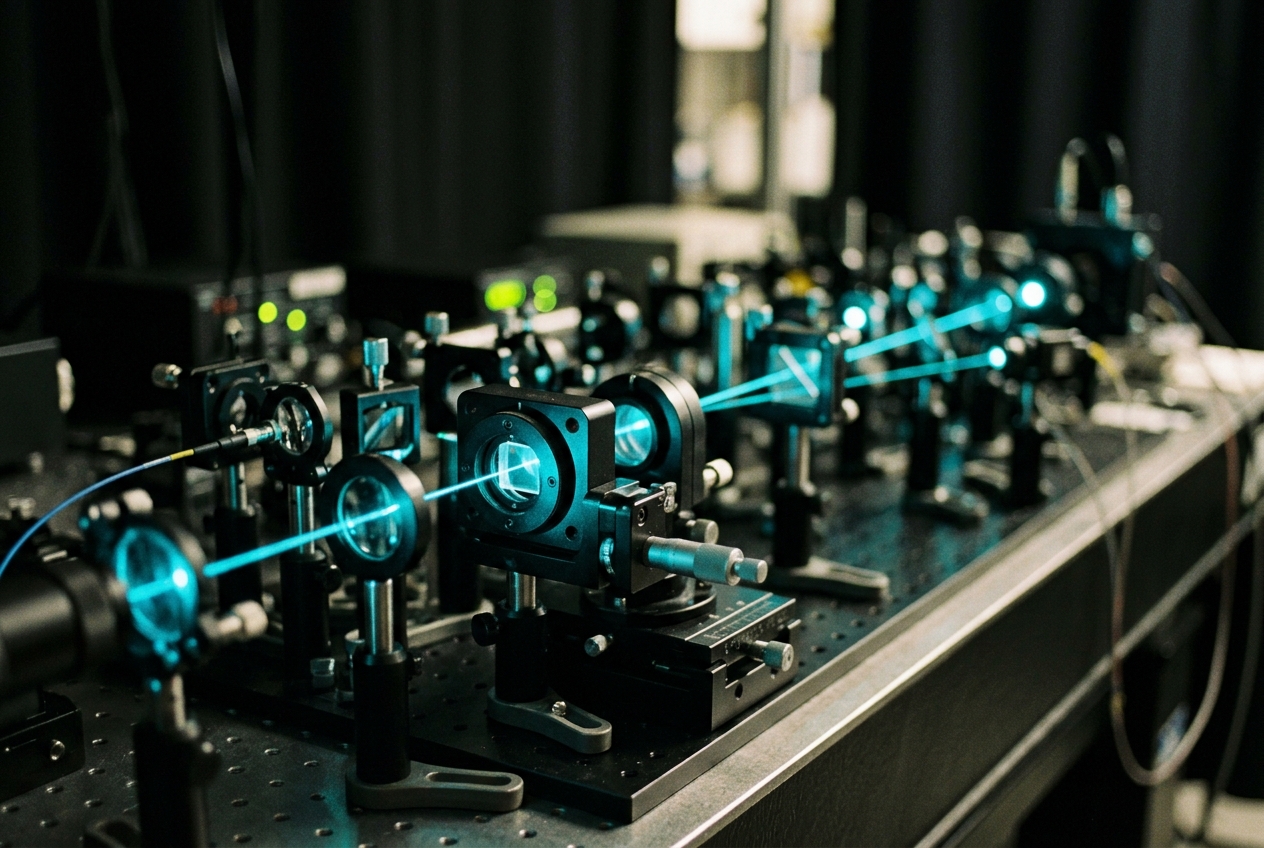
For the non-physicist, the implications of the GHZ theorem reach far beyond laboratory optics benches and cryogenic refrigerators. It fundamentally alters our understanding of our place in the cosmos and secures the infrastructure of everyday modern life.
First, it establishes that the universe is participatory rather than passive. We do not live in a clockwork Newtonian cosmos where every event was mechanically pre-written at the Big Bang. Physical reality at its deepest layer is an interconnected web of probabilities and non-local correlations that solidify only when interactions occur.
Second, on a practical level, this non-local reality provides the only known mechanism for provable, absolute digital privacy. When you use classical encryption today, your data is secure only until someone invents a faster algorithm, constructs a larger supercomputer, or discovers an unpatched mathematical vulnerability. Quantum protocols rooted in GHZ entanglement bypass this computational arms race entirely.
Because GHZ states cannot be cloned, intercepted, or simulated by any classical local mechanism, a communication network protected by multipartite entanglement provides security guaranteed by the geometry of Hilbert space itself. If a hostile intelligence agency or criminal syndicate attempts to intercept your future quantum-encrypted financial transactions, they are not fighting against human software engineering; they are fighting against the fundamental laws of nature—and losing.
6. Today's Takeaway
The Greenberger–Horne–Zeilinger theorem forever dismantled Einstein’s dream of a local, deterministic universe, not through statistical accumulation or mathematical approximations, but through a single, devastatingly elegant contradiction: where classical realism demands positive one, quantum reality delivers negative one. In proving that physical properties do not exist independently of their measurement, the GHZ state transformed our deepest philosophical dilemma into the most powerful computational and cryptographic architecture of the twenty-first century.