Gate Teleportation: Implementing Fault-Tolerant Non-Clifford Logic Via Ancillary Magic States and Adaptive Pauli Corrections
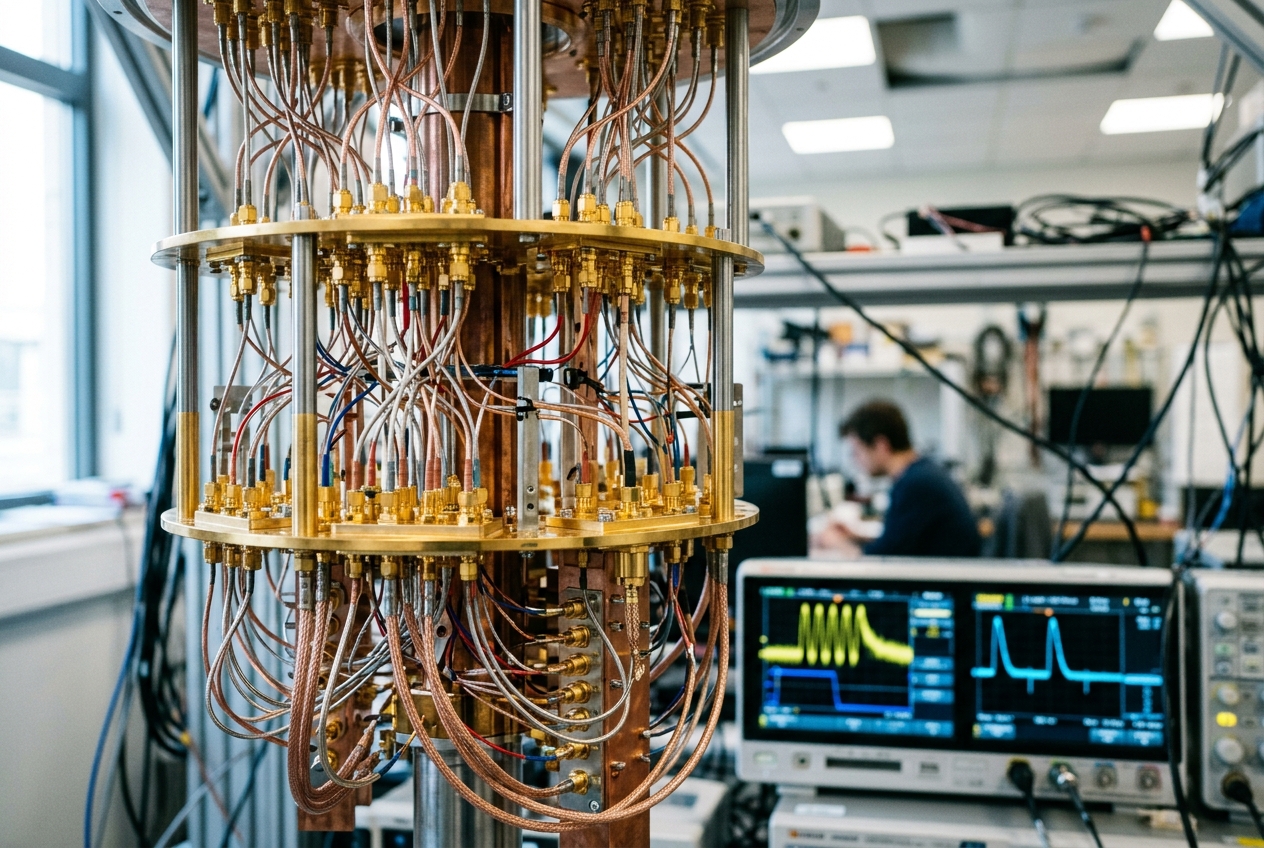
To prevent quantum data from vanishing into static, physicists encapsulate fragile quantum bits inside protective, multi-qubit error-correcting codes. But this introduces a maddening paradox proven by mathematical physics: the more securely you protect quantum information against errors, the harder it becomes to perform the essential calculations that give quantum computing its power.
The breakthrough that circumvents this fundamental roadblock is an elegant technique known as gate teleportation. Rather than applying blunt physical forces directly to delicate data, quantum processors manufacture sacrificial "magic" states offline, entangle them with the protected data, and exploit quantum teleportation to inject complex mathematical operations without breaking the protective shield. Understanding how gate teleportation works is understanding how humankind will ultimately build universal, fault-tolerant quantum machines.
1. Opening Hook — Why You Should Care
We are currently living through the foundational era of quantum technology. Across government labs and industrial research facilities, quantum processors are demonstrating tasks that skirt the edge of classical tractability. Yet every quantum computation executed today faces an existential threat: environmental noise. A stray thermal fluctuation, a microscopic magnetic tremor, or an errant electromagnetic pulse can flip a quantum state, introducing computational errors that compound exponentially with every step of a calculation.
If quantum computers are ever to design carbon-neutral fertilizers, simulate complex proteins to cure chronic diseases, or crack current public-key cryptography via Shor’s algorithm, they must operate with error rates below one mistake per billion operations. Because individual physical components cannot achieve this extreme purity on their own, the field relies on quantum error correction. By entangling dozens or hundreds of physical qubits into a single cohesive "logical qubit," errors can be continuously identified and fixed in real time without disturbing the underlying calculation.
Here lies the catch. A foundational law of quantum computing dictates that no quantum error-correcting code can simultaneously protect data and natively execute the full suite of operations required for universal computation. Without a workaround, quantum computers would be like pocket calculators missing the multiplication button—capable of basic bookkeeping, but structurally barred from solving humanity’s hardest problems. Gate teleportation is that necessary workaround.
2. The Idea in Plain English
To understand why quantum operations are so difficult to execute safely, consider how quantum information differs from classical data. A classical bit is like a standard light switch: it is definitively either OFF (0) or ON (1). A quantum bit, or qubit, behaves more like a coin spinning in mid-air. While in motion, it exists in a superposition—a continuous blend of both heads and tails simultaneously, governed by complex probabilities. When multiple qubits interact, they can become entangled, linking their fates such that measuring one instantly reveals properties of the other, regardless of distance.
To protect this delicate spinning coin from being knocked over by ambient noise, quantum engineers do not store it on a single microscopic atom or superconducting loop. Instead, they distribute the coin's state across an entire array of physical qubits, forming a logical qubit. Think of it as a secret message divided across nine safety deposit boxes. If an intruder tampers with any single box, the overall message remains uncorrupted because the error-detection circuitry continuously checks the relations between boxes and repairs the damage.
The simplest way to manipulate this protected data is through transversal gates. A transversal operation applies an identical, isolated pulse to each individual safety deposit box independently. Because the boxes do not interact directly during this process, an error occurring in one box cannot spread to its neighbors. Transversal gates are the holy grail of fault tolerance: they are naturally immune to catastrophic error cascades.
However, in 2009, physicists Bryan Eastin and Emanuel Knill proved a sobering theorem. The Eastin-Knill theorem states that no quantum error-correcting code can implement a complete, universal set of logical gates using transversal operations alone.
Transversal operations can only execute a restricted sub-library of logic known as the Clifford group. Clifford operations—which include bit flips, phase flips, and swapping states—are vital, but they are not computationally powerful on their own. In fact, the Gottesman-Knill theorem proves that any quantum circuit composed exclusively of Clifford gates can be simulated efficiently on a common laptop.
To achieve true quantum supremacy, a processor must execute at least one non-Clifford operation, such as the non-Clifford phase rotation known as the $T$ gate or the three-qubit Toffoli gate. But applying a non-Clifford gate directly to a logical qubit breaks the code’s symmetry, allowing errors to cascade uncontrollably across the entire array and destroying the error protection.
This is where gate teleportation provides a brilliant solution. Instead of forcing a non-Clifford gate directly onto the delicate logical qubit, we build a separate, sacrificial quantum state offline in a quarantined area of the chip. We clean and purify this auxiliary state until it reaches near-perfect fidelity, turning it into what physicists call a magic state. We then entangle this sacrificial magic state with our data qubit and measure the combined system.
Through the mechanics of quantum teleportation, the desired non-Clifford mathematical operation is transferred onto our data qubit automatically. The direct physical interaction is replaced by entanglement, measurement, and simple cleanup steps, preserving the integrity of the error-correcting vault.
3. How It Actually Works — The Mechanics
The theoretical framework for gate teleportation was formulated in 1999 by quantum theorists Daniel Gottesman and Isaac Chuang. Their protocol demonstrated that any arbitrary quantum operation can be applied to a target data qubit by consuming a specialized entangled resource state through standard Clifford interactions, Bell-basis measurements, and classically controlled corrections.
The Anatomy of a Single-Qubit $T$ Gate Teleportation
To see the algebra in action, consider the execution of the non-Clifford $T$ gate on an unknown arbitrary data state, $|\psi\rangle = \alpha|0\rangle + \beta|1\rangle$, where $\alpha$ and $\beta$ are complex probability amplitudes satisfying $|\alpha|^2 + |\beta|^2 = 1$. The ideal target state we wish to construct is:
$$T|\psi\rangle = \alpha|0\rangle + e^{i\pi/4}\beta|1\rangle$$
Direct transversal execution of this operation on a logical surface code qubit is prohibited by the Eastin-Knill theorem. Instead, an auxiliary qubit is prepared offline in the specialized magic state $|\mathcal{T}\rangle$, defined as the result of applying the $T$ gate to the equal superposition state $|+\rangle = \frac{1}{\sqrt{2}}(|0\rangle + |1\rangle)$:
$$|\mathcal{T}\rangle = T|+\rangle = \frac{1}{\sqrt{2}}\left(|0\rangle + e^{i\pi/4}|1\rangle\right)$$
The protocol proceeds through four distinct, mathematically precise stages:
- State Initialization: The system begins as a composite two-qubit state comprising the valuable data qubit and the auxiliary magic state:
$$|\Psi_0\rangle = |\psi\rangle \otimes |\mathcal{T}\rangle = (\alpha|0\rangle + \beta|1\rangle) \otimes \frac{1}{\sqrt{2}}\left(|0\rangle + e^{i\pi/4}|1\rangle\right)$$
- Entangling Interaction: A transversal controlled-NOT ($\text{CNOT}$) gate is applied, with the data qubit acting as the control and the magic state serving as the target. The $\text{CNOT}$ gate maps $|00\rangle \to |00\rangle$, $|01\rangle \to |01\rangle$, $|10\rangle \to |11\rangle$, and $|11\rangle \to |10\rangle$. Expanding the algebraic product yields the entangled state:
$$|\Psi_1\rangle = \frac{1}{\sqrt{2}}\left[ \alpha|0\rangle\left(|0\rangle + e^{i\pi/4}|1\rangle\right) + \beta|1\rangle\left(|1\rangle + e^{i\pi/4}|0\rangle\right) \right]$$
- Projective Measurement: We measure the original data qubit in the standard computational basis ($Z$-basis). This measurement projects the first qubit onto either classical outcome $m = 0$ or $m = 1$ with equal 50% probability:
-
If the measurement yields $m = 0$, the remaining auxiliary qubit collapses into:
$$|\phi_{m=0}\rangle = \alpha|0\rangle + e^{i\pi/4}\beta|1\rangle = T|\psi\rangle$$
-
If the measurement yields $m = 1$, the remaining auxiliary qubit collapses into:
$$|\phi_{m=1}\rangle = \alpha e^{i\pi/4}|0\rangle + \beta|1\rangle = e^{i\pi/4}\left(\alpha|0\rangle + e^{-i\pi/4}\beta|1\rangle\right) = e^{i\pi/4} S^\dagger T|\psi\rangle$$
- Adaptive Feed-Forward Correction: If the measurement registers $m = 0$, the teleportation succeeded perfectly; the auxiliary qubit now holds the exact state $T|\psi\rangle$, and no further action is required. If the measurement registers $m = 1$, the state contains an unwanted Clifford phase artifact ($S^\dagger$). Because $S = \text{diag}(1, i)$ belongs to the transversal Clifford group, we simply apply a conditional Clifford phase gate $S$ to the output qubit conditioned on the classical measurement outcome $m = 1$:
$$\text{Output} = S^m |\phi_m\rangle = T|\psi\rangle$$
Through this mechanism, the non-Clifford operation has been completed deterministically. The non-transversal component was encapsulated entirely inside the offline preparation of $|\mathcal{T}\rangle$, while the online interaction utilized only fault-tolerant transversal $\text{CNOT}$ operations, projective measurement, and an adaptive Clifford correction.
Multi-Qubit Non-Clifford Operations: The Toffoli and CCZ States
The Gottesman-Chuang paradigm extends naturally to multi-qubit non-Clifford gates, such as the Controlled-Controlled-$Z$ ($\text{CCZ}$) and Toffoli (Controlled-Controlled-NOT) gates, which are indispensable for arithmetic routines and quantum phase estimation.
Instead of a single-qubit rotation, the processor prepares an entangled three-qubit resource state, $|\text{CCZ}\rangle = \text{CCZ}|+\rangle^{\otimes 3}$, which can be written in full algebraic expansion as:
$$|\text{CCZ}\rangle = \frac{1}{\sqrt{8}}\sum_{x,y,z \in {0,1}} (-1)^{xyz}|x,y,z\rangle$$
When three logical data qubits interact with this three-qubit resource state via transversal $\text{CNOT}$ gates and subsequent measurements, the classical outcomes dictate adaptive two-qubit Controlled-$Z$ ($\text{CZ}$) and single-qubit $S$ corrections.
By consuming this tri-partite magic state, the processor executes a full three-qubit non-linear logic operation without ever forcing physical non-Clifford interactions across the three operational data lines.
       =================================================================
       SUMMARY: THE GOTTESMAN-CHUANG GATE TELEPORTATION PROTOCOL
       =================================================================
       1. Offline Phase   : Distill pure magic state |T⟩ = T|+⟩
       2. Interaction     : Apply transversal CNOT (Data = Control, Magic = Target)
       3. Measurement     : Measure Data Qubit in Z-basis -> Outcome m ∈ {0, 1}
       4. Feed-Forward    : If m = 1, apply transversal Clifford Phase Gate S
       5. Result          : Target qubit is transformed into exact state T|ψ⟩
       =================================================================
The Architectural Cost: Magic State Distillation and Lattice Surgery
While gate teleportation provides a clean theoretical solution to the Eastin-Knill theorem, its physical implementation requires significant hardware overhead. Preparing the raw magic states $|\mathcal{T}\rangle$ with physical lasers or microwave pulses is inherently noisy. If a raw magic state has an error rate of $10^{-3}$, injecting it into a logical circuit would corrupt the entire calculation.
To overcome this, quantum architectures use Magic State Distillation, a technique pioneered by Sergey Bravyi and Alexei Kitaev. In a specialized region of the quantum processor known as a "distillation factory," multiple noisy magic states are processed through an error-detecting circuit.
For instance, the standard 15-to-1 distillation routine consumes 15 noisy copies of a magic state to yield a single, purified magic state with an error rate reduced by orders of magnitude. If higher purity is required, these routines can be nested hierarchically.
In planar surface codes—the most widely pursued architecture by industrial labs—logical qubits are laid out as two-dimensional grids of physical qubits. Computations between these patches are performed using lattice surgery, where adjacent qubit patches are merged and split along their boundaries to measure joint Pauli operators.
Because magic state distillation factories require continuous cycles of lattice surgery and state routing, they dominate the physical footprint of the chip. Contemporary architectural models from Nature and leading institutions indicate that over 90% of the physical qubits and space-time volume in a fault-tolerant quantum computer will be devoted entirely to distilling magic states and routing them via gate teleportation.
Furthermore, gate teleportation imposes strict latency constraints. The classical feed-forward step—measuring the data qubit, decoding the error syndromes, transmitting the single-bit result $m$, and switching the microwave control lines to apply the conditional $S$ gate—must occur well within the coherence time of the qubits. This requires ultra-fast, cryogenic classical control hardware operating alongside the quantum processor.
4. Real-World Applications Today
The theoretical principles of fault-tolerant gate teleportation are no longer confined to academic chalkboards. Between 2024 and 2026, leading industrial and academic consortia have achieved crucial milestones, transitioning from noisy prototypes to early fault-tolerant operations:
1. Quantum Chemistry & Catalyst Synthesis (Microsoft Quantum & Quantinuum)
- The Goal: To simulate the electronic structure of the active iron-molybdenum cofactor (FeMoco) inside the nitrogenase enzyme. Nitrogenase allows bacteria to fix atmospheric nitrogen at room temperature, a process humanity replicates industrially only through the energy-intensive Haber-Bosch process, which consumes roughly 1–2% of all global energy.
- The Quantum Advantage: Classical computers cannot simulate the complex, strongly correlated electron orbitals of FeMoco due to exponential scaling in memory requirements. Using fault-tolerant phase estimation powered by millions of teleported non-Clifford $T$ gates, a fault-tolerant quantum computer can map the energy surfaces of nitrogenase, potentially enabling the design of synthetic room-temperature catalysts that dramatically reduce global carbon emissions.
2. Post-Quantum Cryptanalysis & Security Benchmarking (IBM Quantum & MIT)
- The Goal: Rigorously determining the exact physical resource requirements needed to factor 2048-bit RSA integers using Shor’s algorithm, while developing post-quantum cryptography standards through resources like IBM Quantum Learning.
- The Quantum Advantage: Shor's algorithm requires billions of modular arithmetic operations, which map directly to millions of teleported $\text{CCZ}$ and Toffoli gates. By benchmarking modular lattice surgery and feed-forward latencies on their latest superconducting architectures, researchers are defining the exact operational threshold where classical encryption ceases to be secure, guiding global infrastructure upgrades.
3. Solid-State Battery Electrolyte Modeling (Google Quantum AI)
- The Goal: Modeling the degradation mechanisms and lithium dendrite formation at the atomic interface of solid-state lithium-sulfur batteries.
- The Quantum Advantage: Transition-metal chemistry involves open-shell electron configurations that classical density functional theory cannot resolve accurately. Fault-tolerant algorithms utilizing teleported non-Clifford operations allow researchers to simulate multi-reference electron wavefunctions, accelerating the synthesis of stable, high-density energy storage materials for electric vehicles and renewable power grids.
4. High-Energy Physics & Topological Quantum Matter (Harvard University, QuEra, and MIT)
- The Goal: Simulating non-Abelian anyons, lattice gauge theories, and string-net condensed phases using dynamically reconfigurable neutral-atom arrays.
- The Quantum Advantage: In landmark experiments published in Nature Physics and the Physical Review Letters, researchers moved laser-trapped rubidium atoms across optical tweezers to perform fault-tolerant transversal Clifford gates combined with teleported non-Clifford phase rotations. This enables the direct simulation of topological matter and gauge field dynamics that are completely intractable on classical supercomputers.
5. What This Means for You
It is easy to view quantum computing as an abstract discipline of cryostats, lasers, and linear algebra. But the engineering solutions developed to solve gate teleportation will directly impact your everyday life:
- Your Digital Privacy: The timeline for breaking modern encryption is dictated by how quickly engineers can build high-speed magic state distillation factories. The transition to post-quantum cryptography—protecting your personal finances, passport data, and medical histories—is actively timed against the hardware latency of classical feed-forward circuits.
- Cleaner, Cheaper Energy: The optimization of non-Clifford gate teleportation brings us closer to simulating chemical catalysts that could eliminate billions of tons of industrial emissions from fertilizer production and chemical manufacturing.
- Next-Generation Medicine: Today, drug discovery relies on costly trial-and-error laboratory synthesis. A universal quantum computer executing fault-tolerant gate sequences can model drug-protein binding affinities with quantum precision, cutting the timeline for discovering life-saving therapeutics from decades to months.
- Materials on Demand: From room-temperature superconductors to more efficient solar cells, direct quantum simulation of crystalline and molecular lattices will unlock materials with properties tailored to specific technological needs.
6. Today's Takeaway
The Eastin-Knill theorem presented quantum computing with a fundamental dilemma: you can have perfect error protection, or you can have a complete set of simple logic operations, but you cannot have both at the same time. Gate teleportation resolves this conflict by separating the source of quantum complexity from the data itself.
By preparing fragile "magic" states offline, purifying them through distillation, and consuming them through entanglement and adaptive measurement, quantum computers execute universal logic without puncturing their error-correcting armor. What once stood as an insurmountable mathematical barrier has become a concrete engineering roadmap toward universal, fault-tolerant quantum computing.
Further Reading & Academic References
- Gottesman, D., & Chuang, I. L. (1999). Demonstrating the viability of universal quantum computation using teleportation and single-qubit operations. arXiv:quant-ph/9908010.
- Eastin, B., & Knill, E. (2009). Restrictions on Transversal Encoded Quantum Gate Sets. Physical Review Letters.
- Bravyi, S., & Kitaev, A. (2005). Universal quantum computation with ideal Clifford gates and noisy ancillas. Physical Review A.
- Fowler, A. G., et al. (2012). Surface codes: Towards practical large-scale quantum computation. Physical Review A.
- MIT OpenCourseWare. Quantum Physics and Quantum Information Processing. MIT OCW Course Materials.
- IBM Quantum Research & Development Hub. IBM Quantum Learning.