Entanglement Swapping: Distributing Non-Local Quantum Correlations Between Independent Nodes Without Direct Physical Interaction
Yet, building a planetary-scale quantum network confronts a formidable physical obstacle. In classical telecommunications, light pulses traversing fiber-optic glass can be amplified, cloned, and retransmitted across thousands of kilometers through classical repeaters. In the quantum realm, the No-Cloning Theorem strictly forbids the amplification or copying of an arbitrary, unknown quantum state. Furthermore, standard silica optical fibers attenuate photon transmission exponentially: over a standard distance of 1,000 kilometers, barely one photon out of $10^{50}$ survives the transit.
To connect quantum processors separated by oceans and continents without physically transmitting fragile photons across vast, attenuating abysses, physicists rely on an astonishing quantum protocol: entanglement swapping. First proposed theoretically by Marek Żukowski, Anton Zeilinger, Michael A. Horne, and Artur K. Ekert in their seminal 1993 paper in Physical Review Letters, entanglement swapping enables two quantum systems that have never shared a common physical origin, interacted, or existed within each other's past light cones to become maximally entangled.
By performing an entangling measurement on two intermediary particles that are subsequently discarded, spatial entanglement is teleported across disconnected domains. This phenomenon serves as the indispensable mathematical engine behind quantum repeaters, non-local quantum computation, and the architecture of the future quantum internet.
1. The Core Intuition: The Relayed Coin Toss
Before formalizing the Hilbert space transformations, the physical intuition can be understood through a classical-to-quantum analogy.
Imagine two independent pairs of synchronized coins produced by two distinct fabrication facilities: Factory A produces Pair $(1, 2)$, and Factory B produces Pair $(3, 4)$. Whenever a coin from a given factory pair is flipped, it yields a completely random result—heads ($0$) or tails ($1$) with exactly 50% probability. However, because each pair was entangled at its respective factory, Coin 1 and Coin 2 are guaranteed to yield perfectly identical outcomes when flipped, as are Coin 3 and Coin 4.
Now, distribute these coins across great distances: * Alice in London holds Coin 1. * Bob in Frankfurt holds intermediate Coin 2 and intermediate Coin 3. * Charlie in Tokyo holds Coin 4.
   [ Alice: Qubit 1 ] <==== Entangled Pair A ====> [ Bob: Qubit 2 ]
                                                            |
                                                   Joint Measurement (BSM)
                                                            |
   [ Charlie: Qubit 4 ] <==== Entangled Pair B ====> [ Bob: Qubit 3 ]
Alice and Charlie are separated by thousands of kilometers and share zero physical correlation. If Alice flips Coin 1 and Charlie flips Coin 4, their results will be entirely uncorrelated noise.
Bob, sitting at the central hub in Frankfurt, does not inspect Coins 2 and 3 individually to see whether they are heads or tails. Instead, Bob subjects Coins 2 and 3 to a joint collective interrogation—a Bell-State Measurement. This collective measurement asks only a relational question: "Do Coin 2 and Coin 3 have identical or opposite orientations, and what is their relative quantum phase?"
The instant Bob performs this joint interrogation, he destroys the individual identities of Coins 2 and 3, merging them into an entangled composite. Because Coin 2 was intrinsically tied to Coin 1 in London, and Coin 3 was intrinsically tied to Coin 4 in Tokyo, Bob’s relational measurement instantaneously forces Coin 1 and Coin 4 into a state of shared entanglement. Once Bob broadcasts his two-bit measurement outcome over a classical radio link to Charlie, Charlie performs a local rotation on Coin 4.
Remarkably, Alice’s coin in London and Charlie’s coin in Tokyo are now directly, maximally entangled, despite having never traversed the distance between them nor interacted in any shared physical medium.
2. Mathematical Formulation & Bell-State Projection
To understand the deterministic elegance of this protocol, we examine the evolution of the state vector within the composite four-qubit Hilbert space $\mathcal{H}_1 \otimes \mathcal{H}_2 \otimes \mathcal{H}_3 \otimes \mathcal{H}_4 \cong \mathbb{C}^{16}$, as cataloged in foundational references such as MIT OpenCourseWare Quantum Physics and Wikipedia's Entanglement Swapping Guide.
Let the canonical computational basis of a single qubit be ${|0\rangle, |1\rangle}$. The four maximally entangled two-qubit Bell states (or Einstein-Podolsky-Rosen pairs) are defined as:
$$\begin{aligned} |\Phi^+\rangle &= \frac{1}{\sqrt{2}} (|00\rangle + |11\rangle), \quad &|\Phi^-\rangle &= \frac{1}{\sqrt{2}} (|00\rangle - |11\rangle) \ |\Psi^+\rangle &= \frac{1}{\sqrt{2}} (|01\rangle + |10\rangle), \quad &|\Psi^-\rangle &= \frac{1}{\sqrt{2}} (|01\rangle - |10\rangle) \end{aligned}$$
The Initial Uncorrelated Composite State
Two independent EPR sources emit two distinct Bell pairs, arbitrarily prepared in the canonical state $|\Phi^+\rangle$: * Source A generates qubits 1 and 2 in state $|\Phi^+\rangle_{12} = \frac{1}{\sqrt{2}} (|00\rangle_{12} + |11\rangle_{12})$. * Source B generates qubits 3 and 4 in state $|\Phi^+\rangle_{34} = \frac{1}{\sqrt{2}} (|00\rangle_{34} + |11\rangle_{34})$.
Because these sources operate independently, the global four-qubit wave function $|\psi\rangle_{1234}$ is the tensor product of the two isolated pairs:
$$|\psi\rangle_{1234} = |\Phi^+\rangle_{12} \otimes |\Phi^+\rangle_{34} = \frac{1}{2} \Big( |0000\rangle_{1234} + |0011\rangle_{1234} + |1100\rangle_{1234} + |1111\rangle_{1234} \Big)$$
In this initial configuration, the bipartite subsystem consisting of qubits $(1,4)$ is described by a completely unpolarized, maximally mixed density matrix $\rho_{14} = \operatorname{Tr}{23}(|\psi\rangle\langle\psi|{1234}) = \frac{1}{4} \mathbb{I}_4$. There exists zero entanglement, zero quantum discord, and zero classical mutual information between Alice (qubit 1) and Charlie (qubit 4).
Basis Transformation to the Intermediate Relational Basis
To perform an entangling Bell-State Measurement (BSM) on the intermediate qubits $(2,3)$, we expand the computational basis elements of qubits $(2,3)$ into the complete, orthonormal Bell basis ${|\Phi^+\rangle_{23}, |\Phi^-\rangle_{23}, |\Psi^+\rangle_{23}, |\Psi^-\rangle_{23}}$:
$$\begin{aligned} |00\rangle_{23} &= \frac{1}{\sqrt{2}} \left( |\Phi^+\rangle_{23} + |\Phi^-\rangle_{23} \right) \ |11\rangle_{23} &= \frac{1}{\sqrt{2}} \left( |\Phi^+\rangle_{23} - |\Phi^-\rangle_{23} \right) \ |01\rangle_{23} &= \frac{1}{\sqrt{2}} \left( |\Psi^+\rangle_{23} + |\Psi^-\rangle_{23} \right) \ |10\rangle_{23} &= \frac{1}{\sqrt{2}} \left( |\Psi^+\rangle_{23} - |\Psi^-\rangle_{23} \right) \end{aligned}$$
Substituting these expansions into the full four-qubit state $|\psi\rangle_{1234}$ and grouping terms by the joint states of qubits $(2,3)$ and the distant outer qubits $(1,4)$, we obtain an exact algebraic identity:
$$|\psi\rangle_{1234} = \frac{1}{2} \left[ |\Phi^+\rangle_{23} \otimes |\Phi^+\rangle_{14} + |\Phi^-\rangle_{23} \otimes |\Phi^-\rangle_{14} + |\Psi^+\rangle_{23} \otimes |\Psi^+\rangle_{14} + |\Psi^-\rangle_{23} \otimes |\Psi^-\rangle_{14} \right]$$
This mathematical reformulation reveals the underlying symmetry of quantum mechanics: the product of two independent entangled pairs can be identically represented as a superposition of entangled pairs between the cross-matched subsystems $(2,3)$ and $(1,4)$.
3. Projection Dynamics, Classical Feedforward, and Pauli Corrections
The execution of a Bell-State Measurement on the intermediate subsystem $(2,3)$ is formally represented by the projection operators:
$$\hat{\Pi}{23}^k = |k\rangle\langle k|{23} \otimes \mathbb{I}_{14}, \quad \text{where } k \in {\Phi^+, \Phi^-, \Psi^+, \Psi^-}$$
When Bob measures qubits 2 and 3, the Born rule dictates that each of the four possible relational Bell states occurs with equal, deterministic probability:
$$P(k) = \operatorname{Tr}\left( \hat{\Pi}{23}^k |\psi\rangle\langle\psi|{1234} \right) = \left| \frac{1}{2} |k\rangle_{14} \right|^2 = \frac{1}{4} = 25\%$$
The projection collapses the non-local wave function instantaneously into a pure, maximally entangled state for the outer qubits $(1,4)$:
Bob's BSM Outcome (Qubits 2 & 3)    Post-Measurement State of Qubits (1 & 4)
---------------------------------    ----------------------------------------
|Φ⁺⟩₂₃                              |Φ⁺⟩₁₄ = (1/√2)(|00⟩ + |11⟩)
|Φ⁻⟩₂₃                              |Φ⁻⟩₁₄ = (1/√2)(|00⟩ - |11⟩)
|Ψ⁺⟩₂₃                              |Ψ⁺⟩₁₄ = (1/√2)(|01⟩ + |10⟩)
|Ψ⁻⟩₂₃                              |Ψ⁻⟩₁₄ = (1/√2)(|01⟩ - |10⟩)
Deterministic State Recovery via Local Pauli Gates
While the outer pair $(1,4)$ is now maximally entangled, its exact Bell state depends upon Bob's random measurement outcome. To render this protocol deterministic rather than probabilistic, Bob sends his two-bit measurement result $c \in {00, 01, 10, 11}$ over a classical communication channel to Charlie (who holds qubit 4).
Upon receipt of the classical bits, Charlie applies a single-qubit local unitary transformation chosen from the Pauli group ${\mathbb{I}, \sigma_x, \sigma_y, \sigma_z}$ to rotate his qubit into the target fiducial state $|\Phi^+\rangle_{14}$:
$$\begin{aligned} \text{If Bob observes } |\Phi^+\rangle_{23} &: \quad \hat{U}4 = \mathbb{I} = \begin{pmatrix} 1 & 0 \ 0 & 1 \end{pmatrix} \implies (\mathbb{I}_1 \otimes \mathbb{I}_4) |\Phi^+\rangle{14} = |\Phi^+\rangle_{14} \ \text{If Bob observes } |\Phi^-\rangle_{23} &: \quad \hat{U}4 = \sigma_z = \begin{pmatrix} 1 & 0 \ 0 & -1 \end{pmatrix} \implies (\mathbb{I}_1 \otimes \sigma_z) |\Phi^-\rangle{14} = |\Phi^+\rangle_{14} \ \text{If Bob observes } |\Psi^+\rangle_{23} &: \quad \hat{U}4 = \sigma_x = \begin{pmatrix} 0 & 1 \ 1 & 0 \end{pmatrix} \implies (\mathbb{I}_1 \otimes \sigma_x) |\Psi^+\rangle{14} = |\Phi^+\rangle_{14} \ \text{If Bob observes } |\Psi^-\rangle_{23} &: \quad \hat{U}4 = i\sigma_y = \sigma_x \sigma_z = \begin{pmatrix} 0 & 1 \ -1 & 0 \end{pmatrix} \implies (\mathbb{I}_1 \otimes i\sigma_y) |\Psi^-\rangle{14} = |\Phi^+\rangle_{14} \end{aligned}$$
Key Theoretical Result: At no point in this sequence did qubit 1 and qubit 4 share a causal connection or local interaction. Yet, through intermediate projection and classical feedforward, qubits 1 and 4 now share verifiable non-local correlations capable of violating Bell's Inequality (Clauser-Horne-Shimony-Holt parameter $S = 2\sqrt{2} > 2$). Crucially, because Charlie cannot interpret or use his entangled qubit until Bob's classical message arrives at the speed of light $c$, the protocol strictly preserves relativistic causality and the No-Signaling Theorem.
4. Quantum Repeaters: Overcoming Exponential Photon Loss
The primary application of entanglement swapping is the construction of quantum repeaters, initially formulated by Hans-Jürgen Briegel, Wolfgang Dür, Juan Ignacio Cirac, and Peter Zoller (BDCZ) in 1998.
The Physics of Optical Attenuation
In classical glass fibers, optical power decays according to the Beer-Lambert law:
$$P(L) = P(0) \cdot 10^{-\frac{\alpha L}{10}}$$
where $\alpha \approx 0.2\text{ dB/km}$ at telecommunication wavelengths ($\lambda \approx 1550\text{ nm}$). Over a distance of $L = 1000\text{ km}$, transmission efficiency drops to $\eta = 10^{-20}$. In classical systems, Erbium-doped fiber amplifiers (EDFAs) boost optical pulses along the route. In quantum systems, unknown qubits cannot be cloned.
Direct transmission of a single photon over 1,000 km at a 10 GHz source rate yields an expected arrival rate of roughly one photon every three centuries.
Direct Transmission:     [ Alice ] ----------------- Exponential Loss e^(-αL) -----------------> [ Charlie ]
                                                          (Impractical for L > 100 km)

Quantum Repeater Chain:  [ Alice ] <--- L₀ ---> [ Node 1 ] <--- L₀ ---> [ Node 2 ] <--- L₀ ---> [ Charlie ]
                              |                     |                     |                     |
                          Memory A              Memory B₁             Memory B₂             Memory C
                              \_____________________/ \___________________/ \___________________/
                                     Swap #1                 Swap #2                 Final State
Cascading Swaps and Polynomial Scaling
Quantum repeaters circumvent exponential loss by dividing a long channel of total length $L$ into $N = 2^n$ shorter elementary segments of length $L_0 = L/N$, where transmission loss is minimal ($L_0 \approx 20\text{--}50\text{ km}$).
- Parallel Entanglement Generation: Entanglement is generated simultaneously across each elementary segment $(k, k+1)$ and stored in local quantum memories (e.g., trapped ions, atomic ensembles, or solid-state color centers).
- Heralded Verification: Each node confirms that a Bell pair has been successfully stored without measuring the quantum state itself.
- Nested Swapping: Intermediate nodes perform concurrent Bell-state measurements, effectively doubling the entanglement distance at each hierarchical nesting level: * Level 1: Entanglement extends across distance $2L_0$. * Level 2: Entanglement extends across distance $4L_0$. * Level $n$: Entanglement spans the entire distance $L = 2^n L_0$.
- Entanglement Purification (Distillation): Because real-world optical operations and memory storage introduce decoherence, intermediate noisy Bell pairs are purified. By consuming multiple lower-fidelity pairs via local operations and classical communication (LOCC), nodes distill a smaller set of high-fidelity Bell pairs ($F > 0.99$).
This hierarchical architecture transforms the resource scaling of quantum communication from exponential $\mathcal{O}(e^{\alpha L})$ to polynomial $\mathcal{O}(\operatorname{poly}(L))$, making global quantum communications physically feasible.
5. Experimental Implementations and Physical Realities
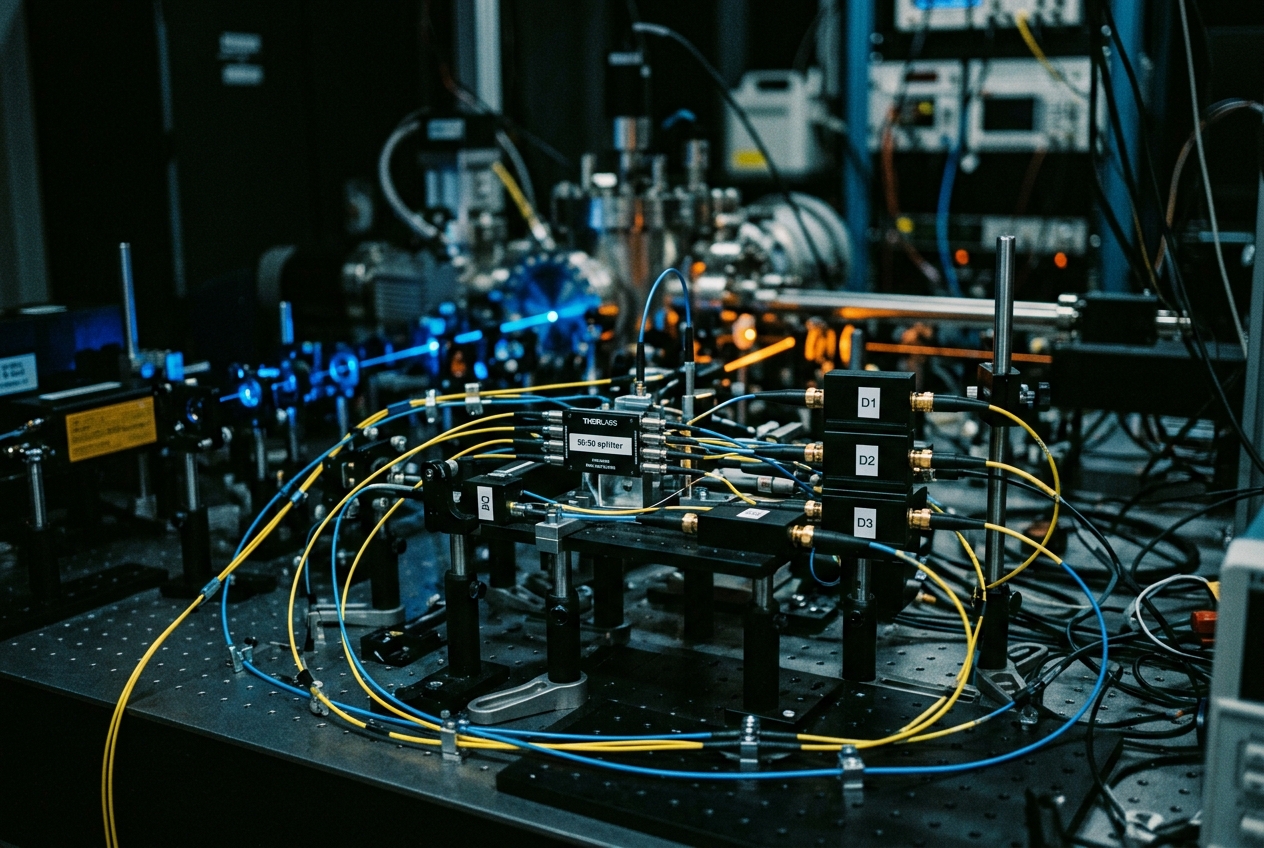
Translating the mathematics of entanglement swapping into practical laboratory hardware represents one of the most demanding frontiers in experimental physics.
                     [ Spontaneous Parametric Down-Conversion Source A ]
                                      /              \
                                     / (Photon 1)     \ (Photon 2)
                                    v                  v
                             [ Alice's Detector ]     [ 50:50 Beam Splitter ] <--- Hong-Ou-Mandel Interference
                                                       ^ (Photon 3)     \
                                                      /                  \
                                                     / (Photon 4)         v
                     [ Spontaneous Parametric Down-Conversion Source B ]  [ Charlie's Detector ]
Key Historical Milestones
- Pan et al. (1998): The first experimental demonstration of entanglement swapping was achieved at the University of Vienna by Jian-Wei Pan, Dik Bouwmeester, Harald Weinfurter, and Anton Zeilinger, published in Nature. Using spontaneous parametric down-conversion (SPDC) in non-linear BBO crystals, they demonstrated that two independent photons emitted by different laser pulses exhibited polarization entanglement after their twin counterparts underwent a joint projection.
- Hensen et al. (2015): A landmark experiment at TU Delft led by Ronald Hanson achieved the world's first loophole-free Bell test, published in Nature. The team used entanglement swapping between nitrogen-vacancy (NV) diamond spin qubits separated by 1.3 kilometers across the Delft campus, simultaneously closing both the locality and detection loopholes.
Experimental Roadblocks & Engineering Constraints
Executing a high-fidelity Bell-state measurement on independent photons requires overcoming several subtle physical noise mechanisms:
1. Hong-Ou-Mandel (HOM) Interference and Indistinguishability
To project two incoming photons (qubits 2 and 3) into an antisymmetric Bell state $|\Psi^-\rangle$, the photons must interfere at a balanced 50:50 beam splitter. Quantum interference occurs only if the two photons are fundamentally indistinguishable across every physical degree of freedom: * Spatial Mode: Spatial overlap on the beam-splitter interface must approach unity. * Temporal Overlap: The photons must arrive within a time window smaller than their coherence time ($\Delta t \ll \tau_c$). * Spectral Purity: The emission spectra must be identical ($\Delta \omega_2 = \Delta \omega_3$). * Polarization Alignment: Polarization modes must be precisely matched.
The degree of indistinguishability is quantified by the Hong-Ou-Mandel visibility $V = (R_{\text{max}} - R_{\text{min}})/R_{\text{max}}$. To violate Bell's inequality after a swap, the interference visibility must exceed $V > 1/\sqrt{2} \approx 70.7\%$, with commercial-grade repeaters requiring $V > 95\%$.
2. Timing Jitter and Dark Counts
Single-photon avalanche diodes (SPADs) and superconducting nanowire single-photon detectors (SNSPDs) exhibit intrinsic timing jitter (typically 15–50 picoseconds). If timing jitter exceeds the photon wavepacket duration, the Bell-state measurement loses distinguishability, polluting the swapped state with classical Poissonian noise. Furthermore, detector dark counts—false positive detection events triggered by thermal fluctuations—lead to false heralds, reducing the final entanglement fidelity $F = \langle \Phi^+ | \rho_{\text{real}} | \Phi^+ \rangle$.
3. Quantum Memory Coherence
To synchronize probabilistic swapping events across multiple nodes, photons must be mapped into quantum memories and stored without phase drift. Current platforms—ranging from rare-earth-doped crystals ($\text{Pr}^{3+}{:!}\text{Y}_2\text{SiO}_5$) to optical cavities containing rubidium ($^{87}\text{Rb}$) atoms—must maintain coherence times $T_2$ exceeding the round-trip classical communication latency ($T_2 \gg 2L/c$).
6. Real-World Applications Across Science and Industry
Entanglement swapping is transitioning from fundamental university physics laboratories to commercial and government testbeds:
+------------------------------------+-------------------------------------------+----------------------------------------------+
| Organization / Consortium          | Core Technological Objective              | Quantum Advantage via Swapping               |
+------------------------------------+-------------------------------------------+----------------------------------------------+
| QuTech & EuroQCI                   | Pan-European Quantum Internet Backbone    | Multinodal repeater chains enabling QKD      |
| (Delft, Netherlands / EU)          | using solid-state NV diamond centers.     | over continental scales without trusted hubs.|
+------------------------------------+-------------------------------------------+----------------------------------------------+
| Amazon Web Services (AWS)          | Scalable nanophotonic diamond repeaters   | Direct modular interconnects for distributed |
| Center for Quantum Networking      | integrated with fiber networks.           | quantum compute clusters in cloud centers.   |
+------------------------------------+-------------------------------------------+----------------------------------------------+
| Event Horizon Telescope (EHT)      | Quantum-assisted Long Baseline            | Teleporting optical phase data via swapped   |
| Quantum Astronomy Collaboration    | Interferometry (VLBI) for telescopes.     | pairs to synthesize Earth-diameter apertures.|
+------------------------------------+-------------------------------------------+----------------------------------------------+
| IBM Quantum &                      | Blind quantum cloud computation using     | Zero-knowledge quantum execution: quantum    |
| Qiskit Ecosystem Projects          | distributed multi-core QPUs.              | algorithms executed without leaking states.  |
+------------------------------------+-------------------------------------------+----------------------------------------------+
- Sovereign Quantum Key Distribution (QKD): Existing commercial QKD networks rely on "trusted nodes," where classical keys are decrypted and re-encrypted at intermediate physical routing stations, introducing security vulnerabilities. Entanglement swapping eliminates trusted nodes entirely: intermediate repeater stations never hold or measure the cryptographic key, guaranteeing end-to-end security verified directly by Bell's theorem.
- Distributed Quantum Cloud Computing: Just as modern supercomputers network thousands of classical CPU cores via high-speed fiber links, large-scale quantum computers will require modular quantum processing units (QPUs) linked by quantum channels. Companies like IBM Quantum and AWS are developing entanglement-swapped photonic interconnects to weave isolated 1,000-qubit chips into coherent, millions-of-qubits distributed architectures.
- Quantum-Enhanced Astronomical Interferometry: Optical telescope resolution is fundamentally limited by physical aperture diameter. By distributing swapped entangled pairs between telescopes situated on different continents, astronomers can perform non-local phase comparisons, effectively creating a telescope with a virtual aperture the size of the Earth, capable of resolving details on exoplanetary surfaces.
7. What This Means for Global Security and Computing
To the non-physicist, quantum mechanics often feels like a collection of abstract mathematical paradoxes. However, entanglement swapping directly reshapes our physical infrastructure:
- Unhackable Communications: Future financial transactions, military commands, and personal identities can be shielded by device-independent quantum key distribution. Even if an adversary intercepts every signal or physically compromises the intermediate repeater hardware, the laws of quantum measurement ensure that any eavesdropping immediately destroys the entanglement fidelity, alerting both endpoints instantly.
- The Blind Quantum Cloud: When running proprietary algorithms—such as molecular simulations for drug discovery or proprietary financial models—on a third-party quantum server, entanglement swapping enables blind quantum computing. The user interacts with the remote quantum computer via entangled states, leaving the server operators with zero physical means of discerning what calculations are being executed.
8. Today's Takeaway
Entanglement swapping proves that quantum non-locality does not depend on a shared physical history or direct local interaction. By performing a collective measurement on two intermediate particles, we stitch together independent quantum systems across vast spatial domains, converting local interactions into distributed, non-local networks. In doing so, entanglement swapping transforms one of the deepest paradoxes of quantum theory into the foundational routing protocol of the global quantum internet.