Dynamical Decoupling: Suppressing Environmental Dephasing and Extending Qubit Coherence Via Periodic Pulse Sequences
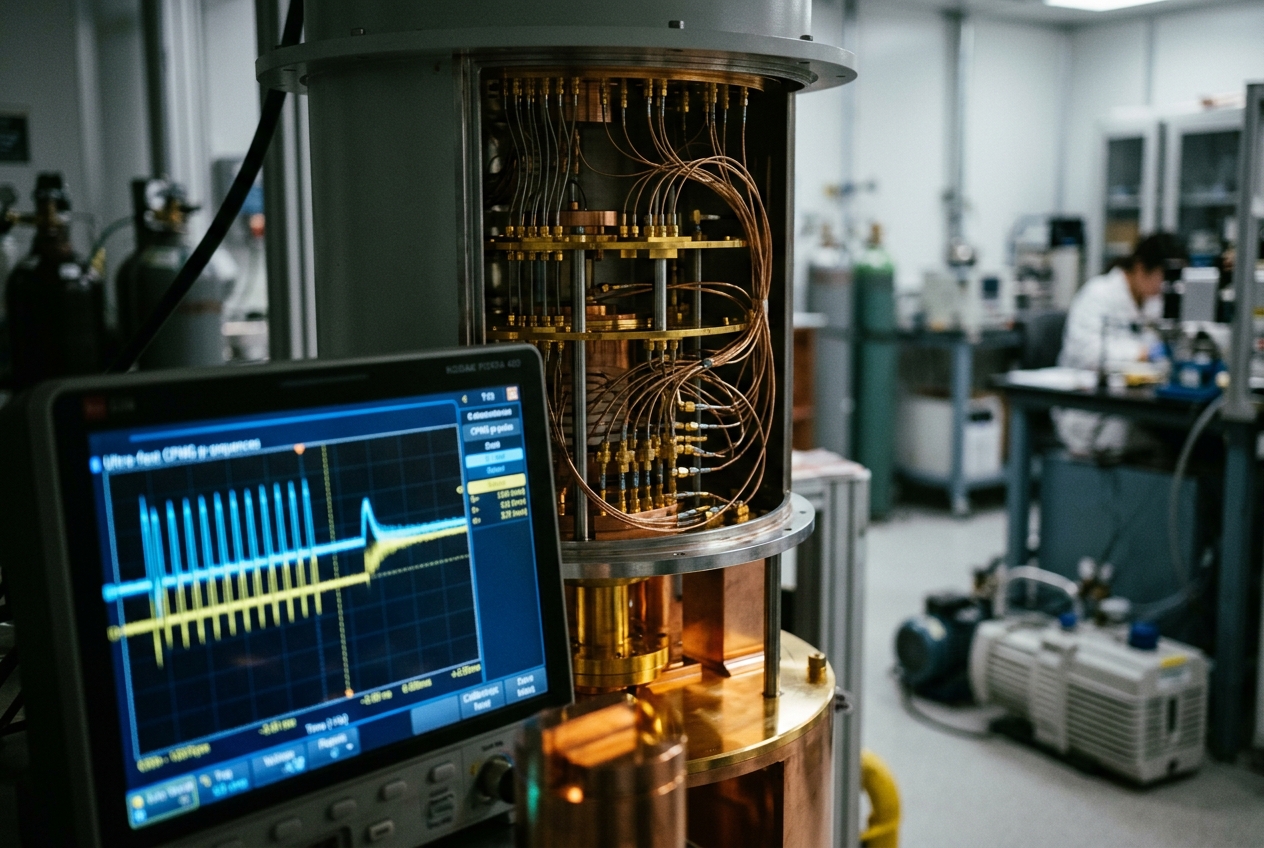
Left entirely to itself, a quantum bit (or qubit) does not merely execute algorithms; it eavesdrops on the universe. Stray magnetic fields from nearby power lines, high-frequency voltage ripples across control wires, thermal vibrations within microscopic silicon lattices, and the faint nuclear spin murmurs of surrounding materials continuously batter the qubit's delicate quantum state. Within microseconds, this relentless environmental bombardment randomizes the phase of the quantum superposition, destroying the computed data in a catastrophic process known as decoherence.
If quantum computers required an active, massive-scale fault-tolerant architecture—with thousands of auxiliary physical qubits dedicated to correcting every single stray interaction—for every step of every calculation, the field would remain indefinitely confined to academic laboratories. Fortunately, physicists have developed an extraordinarily elegant, zero-overhead physical mechanism to shield qubits from their environments using nothing more than precisely timed electromagnetic pulses: Dynamical Decoupling.
1. The Idea in Plain English: Noise-Cancelling Headphones for Quantum States
To understand dynamical decoupling, one must first dismantle the misconception that a qubit is simply an abstract binary switch capable of being "0 and 1 at the same time." A far more accurate physical picture is to imagine a qubit as a microscopic spinning top or gyroscope suspended in space.
When you initialize a qubit into an equal superposition, you are effectively tipping this spinning top sideways so that its axis of rotation sweeps horizontally along the equator of a sphere (known to physicists as the Bloch Sphere). The precise angle of that horizontal sweep at any given moment represents the quantum phase. If two tops spin at identical, perfectly stable speeds, their relative phases stay in complete synchrony. Quantum computation works by choreographing intricate interference patterns between these synchronized phases.
However, in the real world, the local environment acts like turbulent, unpredictable gusts of wind blowing past the spinning tops. A slight magnetic fluctuation will cause one top to speed up momentarily; an electric field fluctuation will cause another to slow down. After a short interval, a collection of qubits initialized in perfect lockstep will have drifted into random, chaotic orientations. This phase dispersion is termed pure dephasing.
Crucially, dephasing is distinct from energy decay. In quantum physics, a qubit possesses two primary relaxation timescales: * $T_1$ (Longitudinal Relaxation Time): The time it takes for an excited qubit ($|1\rangle$) to physically lose its energy to the cold bath and collapse to its ground state ($|0\rangle$). This is analogous to a pendulum losing kinetic energy due to friction until it stops moving altogether. * $T_2^*$ (Ensemble Dephasing Time): The timescale over which phase information is scrambled by static spatial inhomogeneities and low-frequency environmental noise across repeated measurements. * $T_2$ (Intrinsic Transverse Coherence Time): The true homogeneous limit of phase coherence when static, repeatable drifts are neutralized.
In almost all modern quantum architectures, dephasing occurs orders of magnitude faster than energy loss ($T_2^* \ll T_1$). The information vanishes not because the qubit ran out of energy, but because its internal clock was desynchronized by environmental chatter.
Dynamical decoupling functions precisely like a pair of high-end active noise-cancelling headphones. Noise-cancelling headphones listen to incoming ambient acoustic waves, invert their phase by 180 degrees, and broadcast the inverted signal into your ear canal so that the physical wave and its anti-wave destructively interfere, yielding silence. Dynamical decoupling does something mathematically analogous to the qubit: by flipping the qubit's quantum state upside-down at surgically calculated moments, it forces the noise accumulated during the first interval to subtract itself out during the second interval. The qubit effectively cancels its own environmental disturbance.
2. How It Actually Works: From Hahn Echoes to Multi-Pulse Sequences
Erwin Hahn's 1950 Breakthrough: The Spin Echo
The intellectual lineage of dynamical decoupling began not in quantum information science, but in early nuclear magnetic resonance (NMR) spectroscopy. In 1950, physicist Erwin Hahn published a groundbreaking discovery in the Physical Review: the Spin Echo.
Hahn devised a classic footrace analogy to explain the phenomenon. Imagine a group of runners lined up at a starting line. Some runners are naturally fast, while others are slow. When the starter pistol fires (representing an initial radiofrequency pulse that places the spins into the transverse plane), the runners sprint down the track. Because their velocities differ, the runners rapidly spread out across the field; the neat cluster dissolves into spatial disorder. This dispersion represents inhomogeneous dephasing ($T_2^*$).
Now, at time $t = \tau$, the referee fires a second pistol and commands every runner to instantly turn around 180 degrees and run back toward the starting line at their exact individual speeds. The fastest runner, who was furthest ahead, now has the longest distance to travel back. The slowest runner, who lagged closest to the start, has the shortest distance. At precisely time $t = 2\tau$, every runner crosses the starting line at the exact same instant.
In quantum mechanics, this instantaneous turnaround is achieved via a $\pi$-pulse (a 180-degree rotation around an axis in the transverse plane, such as the Pauli-$X$ operator). If the background magnetic field gradients are static over the duration $2\tau$, the phase accumulated before the pulse, $\Delta \phi_1 = \int_0^\tau \delta \omega \, dt = \delta \omega \cdot \tau$, is precisely cancelled by the phase accumulated after the inversion, $\Delta \phi_2 = \int_\tau^{2\tau} (-\delta \omega) \, dt = -\delta \omega \cdot \tau$. The net phase accumulation is $\Delta \phi_{\text{total}} = 0$.
The Hahn echo successfully extended the observable coherence lifetime from the inhomogeneous limit $T_2^*$ up to the intrinsic limit $T_2$.
Multi-Pulse Sequences: CPMG and Robust Phase Cycles
While a single Hahn echo eliminates static (time-invariant) background inhomogeneities, real quantum processors operate in environments filled with stochastic (time-varying) fluctuations. A single pulse cannot reverse a fluctuating bath whose value at time $t > \tau$ bears little resemblance to its value at $t < \tau$.
To tame fluctuating noise baths, physicists Herman Carr and Edward Purcell expanded Hahn’s concept into a periodic train of pulses, later refined by Saul Meiboom and David Gill into the legendary CPMG (Carr-Purcell-Meiboom-Gill) sequence. By sandwiching the qubit between a rapid series of equidistant $\pi$-pulses separated by intervals of $2\tau$, the system inverts the sign of the noise coupling so rapidly that the environmental fluctuations cannot integrate over time.
However, real-world control hardware is imperfect. An electromagnetic pulse designed to rotate a qubit by precisely $180.0^\circ$ might actually rotate it by $180.2^\circ$ due to power amplifier drifts or slight detuning. In a sequence of 1,000 pulses, these systematic angle errors accumulate coherently, rapidly driving the qubit out of its computational subspace and destroying the very state one sought to preserve.
To eliminate pulse errors, researchers developed symmetrized phase-alternating sequences, most notably XY-4, XY-8, and XY-16, as documented in foundational literature on arXiv and Physical Review A. Instead of pulsing repeatedly along the same axis (e.g., $X-X-X-X$), an XY-8 sequence permutes the phase of the rotation pulses across orthogonal axes:
$$\text{XY-8 Unit Cell} = X - Y - X - Y - Y - X - Y - X$$
By cycling through orthogonal rotation axes ($X$ and $Y$), the over-rotation introduced by an $X$-pulse is geometrically cancelled by the subsequent $Y$ and inverted pulses. The sequence exhibits self-correcting geometric symmetry: pulse errors cancel out to second and higher orders regardless of the initial quantum state.
3. The Mathematical Formalism: Filter Functions and Magnus Expansions
To establish how dynamical decoupling eliminates noise from a rigorous physical standpoint, two complementary mathematical frameworks are employed: Average Hamiltonian Theory in the time domain, and Spectral Filter Function Theory in the frequency domain.
Average Hamiltonian Theory via the Magnus Expansion
Consider an open quantum system comprising a single qubit coupled to a fluctuating environmental bath. The total Hamiltonian governing the combined universe is:
$$H(t) = H_S(t) + H_B + H_{SB}$$
where $H_S(t)$ represents the time-dependent external control pulses applied to the qubit, $H_B$ is the internal Hamiltonian of the bath, and $H_{SB} = \sigma_z \otimes B(t)$ is the longitudinal dephasing interaction coupling the qubit Pauli operator $\sigma_z$ to a bath operator $B(t)$.
When we apply a sequence of control pulses, it is convenient to transform the system into the toggling frame (the interaction picture defined with respect to the control Hamiltonian $H_S(t)$). In this frame, the explicit pulse operations disappear, and their effect is mapped entirely onto a time-dependent modulation of the system-bath interaction operator:
$$\tilde{H}_{SB}(t) = y(t) \sigma_z \otimes B(t)$$
Here, $y(t) \in {+1, -1}$ is the control modulation function (or toggling frame function). Every time a $\pi$-pulse is applied, $y(t)$ flips its sign.
According to the Magnus Expansion, the cumulative unitary time-evolution operator over a total cycle time $\tau_c$ can be expressed as the exponential of an effective, time-averaged Hamiltonian:
$$U(\tau_c) = \exp\left( -i \sum_{k=0}^{\infty} \bar{H}^{(k)} \tau_c \right)$$
The leading-order (zeroth-order) average Hamiltonian $\bar{H}^{(0)}$ is simply the direct time-integral of the interaction Hamiltonian across the cycle:
$$\bar{H}^{(0)} = \frac{1}{\tau_c} \int_0^{\tau_c} \tilde{H}_{SB}(t) \, dt = \frac{\sigma_z}{\tau_c} \int_0^{\tau_c} y(t) B(t) \, dt$$
If the noise bath fluctuates slowly relative to the pulse spacing, $B(t)$ can be treated as approximately constant over the cycle ($B(t) \approx B_0$). The integral then reduces to:
$$\bar{H}^{(0)} \approx \frac{\sigma_z B_0}{\tau_c} \int_0^{\tau_c} y(t) \, dt$$
By designing symmetric pulse sequences such that the control function spends exactly equal amounts of time in the $+1$ and $-1$ states ($\int_0^{\tau_c} y(t) \, dt = 0$), the zeroth-order average interaction Hamiltonian vanishes completely:
$$\bar{H}^{(0)} = 0$$
Through surgical timing, the physical interaction between the qubit and the environmental bath has been mathematically averaged to zero. Higher-order pulse sequences (such as XY-16 or nested concatenated dynamical decoupling) systematically force the higher-order Magnus terms ($\bar{H}^{(1)}, \bar{H}^{(2)}, \dots$) to vanish as well, decoupling the system from increasingly rapid and non-Markovian environmental fluctuations.
The Frequency-Domain Filter Function
A profoundly insightful way to analyze dynamical decoupling is in the frequency domain. Environmental noise is characterized by its Power Spectral Density $S(\omega)$, which measures the noise power present in the bath as a function of angular frequency $\omega$. For instance, solid-state electronics are typically plagued by $1/f$ "pink" noise, where the noise power diverges at low frequencies.
Under Gaussian noise approximations, the loss of qubit coherence (the decay of the off-diagonal density matrix elements $\rho_{01}(t) = \rho_{01}(0) e^{-\chi(t)}$) is dictated by the decay parameter $\chi(t)$:
$$\chi(t) = \frac{1}{\pi} \int_0^{\infty} S(\omega) \frac{F(\omega t)}{\omega^2} \, d\omega$$
In this formulation, $F(\omega t) = |\omega \tilde{y}(\omega)|^2$ is the dimensionless Filter Function, defined as the Fourier transform of the time-domain control modulation function $y(t)$.
The filter function acts as a spectral bandpass filter. For a free-precessing qubit without pulses (a Ramsey experiment), the filter function is centered directly at zero frequency ($\omega = 0$), exposing the qubit to the full brunt of destructive $1/f$ low-frequency noise.
When a periodic CPMG sequence with inter-pulse spacing $\tau$ is applied, the filter function shifts its fundamental transmission peak away from zero to a high passband frequency:
$$\omega_{\text{peak}} = \frac{\pi}{\tau}$$
Below this frequency, $F(\omega t)$ scales as $\omega^4$ or higher, carving out an aggressive spectral suppression zone around zero frequency. Because the dominant noise power in solid-state devices resides at low frequencies, shifting the qubit's sensitivity window into the quiet, high-frequency regime suppresses the integral $\chi(t)$, thereby extending the qubit's operational lifetime by several orders of magnitude.
4. Uhrig Dynamical Decoupling (UDD): Breaking the Equidistant Mold
For decades, the consensus in magnetic resonance was that pulse sequences should be strictly equidistant—meaning the time intervals between pulses should all be identical. In 2007, German theoretical physicist Götz Uhrig shattered this assumption in a landmark paper published in Physical Review Letters.
Uhrig asked a fundamental mathematical question: If an open quantum system is coupled to a bath with a sharp high-frequency spectral cutoff $\omega_c$ (such as ohmic baths common in solid-state physics), what is the absolute mathematically optimal arrangement of $n$ pulses to eliminate the maximum number of time-derivatives of the decoherence function?
Using analytical techniques, Uhrig proved that the pulses should not be spaced equally. Instead, the optimal time coordinate $t_j$ for the $j$-th pulse within a total duration $T$ follows an elegant trigonometric distribution:
$$t_j = T \sin^2\left( \frac{j \pi}{2(n + 1)} \right) \quad \text{for } j = 1, 2, \dots, n$$
Notice the striking geometric structure: the pulses are tightly packed near the beginning ($t = 0$) and the end ($t = T$) of the evolution window, while spreading out in the central region.
5. Real-World Applications Today: Noise Spectroscopy and Quantum Hardware
Dynamical decoupling is not merely a theoretical curiosity; it is a ubiquitous, mission-critical operational layer embedded across every major quantum computing and quantum sensing platform operating today.
1. Superconducting Transmon Processors (IBM Quantum & Google Quantum AI)
In modern superconducting quantum processors (such as IBM's Eagle and Heron chips, documented in IBM Qiskit Documentation), multi-qubit quantum circuits inevitably involve "idle spectator qubits." While a two-qubit gate (like a CZ or CNOT) is being executed on two active qubits, adjacent bystander qubits sit idle, awaiting their turn.
During these idle periods, spectator qubits suffer from parasitic static couplings (such as unwanted stray $ZZ$-crosstalk) and low-frequency charge and flux noise. IBM Quantum automatically compiles dynamical decoupling sequences (such as XY-4 or CPMG sequences) into the idle windows of their quantum circuits. By constantly flipping the idle qubits during computation, the hardware cancels unwanted crosstalk and background dephasing, significantly boosting circuit execution depths without altering the core algorithm.
2. Quantum Noise Spectroscopy with Diamond NV Centers
A Nitrogen-Vacancy (NV) Center in diamond consists of a point defect in the diamond carbon crystal lattice where a nitrogen atom replaces a carbon atom adjacent to a vacant site. Its electron spin can be initialized and read out optically, serving as an atomic-scale quantum sensor.
Researchers at institutions such as Harvard University and the Max Planck Institute use dynamical decoupling not just to protect the NV center, but as a tunable spectrometer. By systematically sweeping the inter-pulse spacing $\tau$ in a multi-pulse sequence, the filter function $F(\omega)$ scans across different frequency bands like a radio tuner. When the filter function's center frequency $\omega = \pi/\tau$ coincides with the Larmor precession frequency of nearby external nuclear spins (such as individual carbon-13 atoms or hydrogen atoms in a single protein molecule resting on the diamond surface), the NV center absorbs the signal and exhibits a sharp drop in coherence. This technique allows researchers to perform single-molecule nanoscale MRI and NMR spectroscopy, mapping the structure of proteins that cannot be crystallized for conventional X-ray crystallography.
3. Trapped-Ion Processors and Shuttling Registers (Quantinuum)
In trapped-ion quantum architectures (such as Quantinuum's H-Series quantum computers), atomic ions (e.g., ytterbium or barium ions) are suspended in ultra-high vacuum by oscillating electromagnetic fields. To execute gates across large registers, ions must be physically shuttled across micro-fabricated trap zones.
During physical transport, ions pass through spatial magnetic field gradients and voltage fluctuations on the trap electrodes, which induce severe dephasing. By interleaving continuous dynamical decoupling microwave pulses during the shuttling routines, trapped-ion systems protect the internal hyperfine qubit states throughout transport, maintaining memory coherence across seconds-long execution cycles.
4. AI-Driven Quantum Control and Firmware Optimization (Q-CTRL)
Commercial quantum infrastructure companies, such as Q-CTRL, utilize advanced open-loop control theory combined with machine learning to design custom dynamical decoupling pulse shapes (e.g., GRAPE and DRAG pulse engineering). By replacing naive square pulses with smooth, analytically shaped microwave envelopes, these control layers eliminate pulse distortions caused by room-temperature cabling and cryogenic impedance mismatches, achieving near-theoretical decoupling fidelities across diverse cloud quantum backends.
6. What This Means for You: Bridging the Chasm to Fault Tolerance
To understand why dynamical decoupling is essential for the future of society, one must appreciate the enormous engineering barrier facing practical quantum computation: the Fault-Tolerance Threshold.
Quantum algorithms capable of simulating room-temperature superconductors, breaking global public-key cryptography, or optimizing global supply chains require billions of sequential quantum operations. Because physical qubits will never be 100% immune to noise, these algorithms must run on Logical Qubits encoded via Quantum Error Correction (QEC) codes, such as the Surface Code.
In a surface code, dozens or hundreds of noisy physical qubits are entangled together to form a single, highly stable virtual logical qubit. However, QEC only works if the physical error rate of the individual hardware components is below a strict mathematical boundary known as the fault-tolerance threshold (typically around $0.1\% \text{ to } 1\%$ error per gate). If your physical error rate is $2\%$, adding more physical error-correcting qubits actually makes the calculation worse, rapidly accelerating the destruction of data.
Dynamical decoupling provides the critical, zero-cost boost needed to push physical qubits below this threshold. Because it is an open-loop control technique—meaning it applies pre-calculated electromagnetic pulses without requiring active measurements, feedback circuits, or auxiliary syndrome-measurement qubits—it introduces zero computational overhead.
By suppressing background environmental dephasing and crosstalk during idle times and gate operations, dynamical decoupling lowers the raw physical error rate from the unworkable regime down into the compliant regime. It directly reduces the number of physical qubits needed to build a single fault-tolerant logical qubit from thousands down to hundreds. For the public, this engineering shift represents the difference between waiting forty years for a functional, life-saving quantum computer and deploying one within the coming decade.
7. Today's Takeaway
Authoritative References and Further Reading
- Erwin Hahn's 1950 Spin Echo: Explore the original historical paper on nuclear spin echoes in Physical Review.
- Uhrig Dynamical Decoupling: Read Götz Uhrig's mathematical derivation of non-equidistant pulse sequences in Physical Review Letters.
- Quantum Noise Spectroscopy & Nanoscale NMR: Review real-world experimental implementations of dynamical decoupling in diamond NV centers in Nature.
- Quantum Open Systems & Coherence: Study foundational lecture notes on quantum coherence and density matrix formalism on MIT OpenCourseWare Quantum Physics.
- Practical Pulse Implementation in Superconducting Circuits: Learn how to implement CPMG and XY-4 sequences directly on cloud quantum hardware via the IBM Qiskit Documentation.