Quantum Discord: Revealing Non-Classical Correlations and Measurement Disturbance in Separable Mixed States
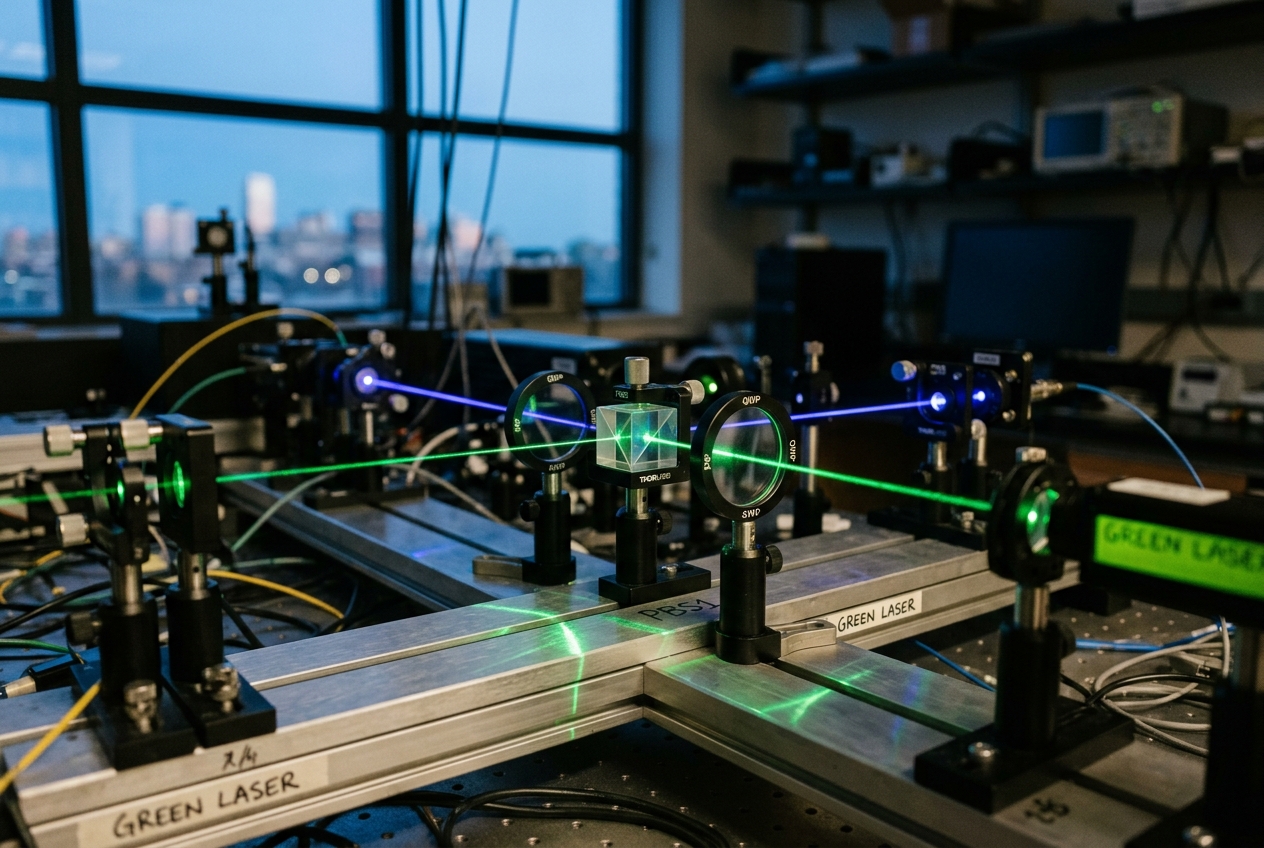
Yet, inside laboratories at IBM Quantum, Oxford, and the Max Planck Institute, a quieter and far more subversive revolution is taking place. Physicists have discovered that physical systems completely devoid of entanglement can nonetheless perform computational feats that leave classical supercomputers behind, extract thermodynamic energy through purely quantum pathways, and transmit information with anomalous efficiency.
The hidden catalyst behind these phenomena is quantum discord. First formulated independently by Harold Ollivier and Wojciech Zurek, and by Leah Henderson and Vlatko Vedral at the turn of the millennium, quantum discord measures the fundamental quantumness of correlations between interacting systems. It reveals that entanglement is not the monolithic boundary of the quantum realm, but merely a subset of a vastly richer, more resilient landscape of non-classical correlations. Understanding quantum discord is not merely an academic exercise; it is reshaping how we build noise-resilient quantum hardware, understand thermodynamic arrows of time, and conceptualize the very act of observation.
1. The Idea in Plain English: The Observer's Indelible Footprint
To grasp why classical and quantum information part ways, consider a literary analogy. Imagine two identical, synchronized copies of an encyclopaedia locked in separate rooms—one held by an investigator named Alice in London, the other by Bob in New York.
In a purely classical universe, information is passive. If Alice enters her room, opens Volume 4, and reads page 120, she instantly acquires knowledge about what is written in Bob’s identical volume. Crucially, Alice’s act of reading does not alter the physical ink on the pages in London, nor does it disturb the book in New York. Because classical information can be copied, read, and cross-referenced without changing the underlying physical state, classical information theory treats the act of measurement as an invisible, non-invasive observation.
In the quantum domain, this peaceful passivity vanishes. A quantum system is not a static book printed with permanent ink; it is more akin to an intricate, spinning kinetic sculpture. The moment Alice attempts to inspect any property of her sculpture—by bouncing a photon off it or applying a magnetic pulse—she exerts a physical back-action. She forces the quantum state to collapse into one of several distinct configurations.
If Alice’s and Bob’s systems share classical correlations alone, Alice can choose a clever way of measuring her system that extracts all available shared data without disturbing the composite state of the entire system. But if their joint system possesses quantum discord, no such harmless measurement exists. Any attempt by Alice to interrogate her local subsystem irrevocably scrambles the global correlations, destroying information that previously existed across the composite whole. Quantum discord is, at its conceptual core, the exact mathematical toll charged by quantum mechanics for the invasiveness of local measurement.
2. The Foundational Discrepancy: When Classical Equations Split
To see where discord emerges mathematically, one must examine the bedrock of classical information theory established by Claude Shannon in 1948. In classical probability theory, the information shared between two random variables, $A$ and $B$, is quantified by the mutual information. Shannon offered two formulations that are mathematically equivalent:
-
Total Entropy Reduction: $$I(A:B) = H(A) + H(B) - H(A,B)$$ Here, $H(A)$ and $H(B)$ represent the marginal Shannon entropies (the individual uncertainties of $A$ and $B$), while $H(A,B)$ represents the joint entropy of the combined system.
-
Conditional Uncertainty Reduction: $$J(A:B) = H(A) - H(A|B)$$ Here, $H(A|B)$ denotes the conditional entropy—the average uncertainty remaining in $A$ once the exact state of $B$ is known.
According to Bayes’ theorem, $P(A, B) = P(B) P(A|B)$. As a direct algebraic consequence, $H(A,B) = H(B) + H(A|B)$. Substituting this into the first equation yields $I(A:B) \equiv J(A:B)$. In classical physics, these two expressions describe the exact same quantity from two different perspectives: the total correlation between two systems is identical to the amount of uncertainty removed from one system by learning the state of the other.
The Quantum Bifurcation
When this framework is mapped into quantum mechanics, this classical equivalence breaks down completely. The classical probability distribution is replaced by a bipartite density operator, $\rho_{AB}$, acting on a tensor product Hilbert space $\mathcal{H}_A \otimes \mathcal{H}_B$, and Shannon entropy is replaced by the von Neumann entropy:
$$S(\rho) = -\mathrm{Tr}(\rho \log_2 \rho)$$
The first definition of mutual information translates seamlessly into the quantum regime:
$$I(A:B) = S(\rho_A) + S(\rho_B) - S(\rho_{AB})$$
where $\rho_A = \mathrm{Tr}B(\rho{AB})$ and $\rho_B = \mathrm{Tr}A(\rho{AB})$ are the reduced density operators obtained by tracing out the respective subsystems. The quantity $I(A:B)$ represents the total correlations (both classical and quantum) present within the bipartite system $\rho_{AB}$.
The second definition, $J(A:B)$, cannot be translated directly because quantum mechanics lacks an unambiguous, state-independent definition of "conditional state." To determine the state of subsystem $A$ conditioned on subsystem $B$, an observer must perform an explicit physical measurement on $B$.
Let this measurement be defined by a set of Positive Operator-Valued Measures (POVMs) or orthogonal projection operators ${\Pi_i^B}$ acting on $\mathcal{H}_B$, satisfying $\sum_i \Pi_i^B = \mathbb{I}_B$ and $\Pi_i^B \ge 0$. If the measurement on $B$ yields outcome $i$, which occurs with probability:
$$p_i = \mathrm{Tr}{AB}\big((\mathbb{I}_A \otimes \Pi_i^B)\rho{AB}\big)$$
the state of subsystem $A$ conditionally collapses to:
$$\rho_{A|i} = \frac{1}{p_i} \mathrm{Tr}B\big((\mathbb{I}_A \otimes \Pi_i^B)\rho{AB}(\mathbb{I}_A \otimes \Pi_i^B)\big)$$
The quantum conditional entropy of $A$ relative to the measurement basis ${\Pi_i^B}$ is the probability-weighted sum of the von Neumann entropies of the resulting conditional states:
$$S(A|{\Pi_i^B}) = \sum_i p_i S(\rho_{A|i})$$
Subtracting this conditional entropy from the initial marginal entropy $S(\rho_A)$ gives the one-way classical correlation accessible through the local measurement basis ${\Pi_i^B}$:
$$J(A|B)_{{\Pi_i^B}} = S(\rho_A) - S(A|{\Pi_i^B})$$
To capture the maximum possible classical information that Bob can extract about Alice, one must maximize this quantity over all conceivable valid measurement strategies ${\Pi_i^B}$:
$$J(A|B) = \sup_{{\Pi_i^B}} J(A|B)_{{\Pi_i^B}}$$
3. Formal Definition and Mathematical Properties
Because local quantum measurements necessarily destroy superpositions and alter non-commuting observables, $J(A|B)$ generally fails to match the total mutual information $I(A:B)$. The resulting difference is quantum discord, denoted as $\mathcal{D}(A|B)$:
$$\mathcal{D}(A|B) = I(A:B) - J(A|B) = S(\rho_B) - S(\rho_{AB}) + \inf_{{\Pi_i^B}} \sum_i p_i S(\rho_{A|i})$$
+-------------------------------------------------------------------+
|                   TOTAL CORRELATIONS: I(A:B)                     |
|  [ Classical Correlation: J(A|B) ]  |  [ Quantum Discord: D(A|B) ] |
+-------------------------------------------------------------------+
Essential Mathematical Theorems
Quantum discord satisfies several fundamental mathematical properties that distinguish it from classical correlation metrics and conventional entanglement measures:
-
Strict Non-Negativity: For any physical bipartite state $\rho_{AB}$, $\mathcal{D}(A|B) \ge 0$. This inequality stems directly from the strong subadditivity of von Neumann entropy, first proven by Elliott Lieb and Mary Beth Ruskai. The total correlation $I(A:B)$ is an absolute upper bound on the classical correlation $J(A|B)$ extractable via local measurement.
-
Inherent Directional Asymmetry: Unlike entanglement measures (such as Entanglement of Formation or Negativity) and unlike mutual information $I(A:B)$, quantum discord is inherently directional: $$\mathcal{D}(A|B) \neq \mathcal{D}(B|A) \quad \text{(in general)}$$ This asymmetry reflects the physical reality that measuring subsystem $B$ to learn about $A$ can perturb the global state to a completely different degree than measuring subsystem $A$ to learn about $B$.
-
Characterization of Zero-Discord States: A bipartite state $\rho_{AB}$ possesses zero discord with respect to measurements on $B$ ($\mathcal{D}(A|B) = 0$) if and only if it is a classical-quantum (CQ) state. Such states admit an explicit block-diagonal decomposition: $$\rho_{CQ} = \sum_k p_k \rho_k^A \otimes |k\rangle\langle k|^B$$ where ${|k\rangle}$ forms an orthonormal basis for subsystem $B$, $p_k \ge 0$ with $\sum_k p_k = 1$, and each $\rho_k^A$ is an arbitrary valid density operator on subsystem $A$. For these states, measuring subsystem $B$ in the ${|k\rangle\langle k|}$ basis extracts all shared correlation without inducing any state collapse or back-action on the global ensemble.
-
Pure State Equivalence: When the bipartite state is globally pure ($\rho_{AB} = |\psi\rangle\langle\psi|_{AB}$), quantum discord simplifies and coincides with the standard Entanglement of Formation: $$\mathcal{D}(A|B) = \mathcal{D}(B|A) = S(\rho_A) = S(\rho_B)$$ For pure states, all non-classical correlation is entanglement. The divergence between discord and entanglement manifests exclusively in mixed states—which represent all realistic, finite-temperature quantum systems subjected to environmental noise.
4. Discord vs. Entanglement: Unmasking the Boundary
The central revelation of quantum discord is that separability does not imply classicality.
In standard quantum information theory, a bipartite state is defined as separable (unentangled) if its density matrix can be written as a convex combination of product states:
$$\rho_{sep} = \sum_j q_j \rho_j^A \otimes \rho_j^B, \quad q_j \ge 0, \quad \sum_j q_j = 1$$
According to the famous Peres-Horodecki Positive Partial Transpose (PPT) criterion, separable states cannot violate Bell inequalities, cannot be used for standard quantum teleportation protocols, and possess strictly zero entanglement.
THE HIERARCHY OF QUANTUM CORRELATIONS:
+---------------------------------------------------------------------+
| TOTAL CORRELATIONS (Mutual Information)                             |
|  +---------------------------------------------------------------+  |
|  | QUANTUM DISCORD > 0                                           |  |
|  |   +---------------------------------------------------------+ |  |
|  |   | ENTANGLEMENT > 0 (Inseparable States)                   | |  |
|  |   |   +---------------------------------------------------+ | |  |
|  |   |   | Bell Non-Local States (Violate Bell Inequalities) | | |  |
|  |   |   +---------------------------------------------------+ | |  |
|  |   +---------------------------------------------------------+ |  |
|  |   | Separable Mixed States with Discord (Non-Classical!)   | |  |
|  |   +---------------------------------------------------------+ |  |
|  +---------------------------------------------------------------+  |
|  | ZERO DISCORD (Purely Classical States: sum p_k |k><k| x |j><j|) |
+---------------------------------------------------------------------+
However, a separable state possesses zero quantum discord if and only if the local states ${\rho_j^B}$ are mutually orthogonal (forming a commutative algebra). Whenever a separable state is constructed from non-orthogonal, overlapping quantum states, the state exhibits strictly positive quantum discord ($\mathcal{D}(A|B) > 0$). Because no local measurement can distinguish non-orthogonal states without error, observing such a system unavoidably introduces disturbance.
The Canonical Example: Werner States
To observe this divergence clearly, consider the family of two-qubit Werner states, which model a maximally entangled singlet state $|\psi^-\rangle = \frac{1}{\sqrt{2}}(|01\rangle - |10\rangle)$ contaminated by isotropic, unpolarized white noise:
$$\rho_W(p) = p |\psi^-\rangle\langle\psi^-| + \frac{1-p}{4}\mathbb{I}_4, \quad p \in [0, 1]$$
where $\mathbb{I}_4$ is the $4 \times 4$ identity matrix and $p$ represents the purity parameter.
WERNER STATE BEHAVIOUR AS PURITY (p) VARIES:
p = 0.0                      p = 1/3                      p = 1.0
+-----------------------------+-----------------------------+
|    ENTANGLEMENT = 0         |     ENTANGLEMENT > 0        |
+-----------------------------+-----------------------------+
| DISCORD = 0 |      DISCORD > 0 (Separable Quantumness)    |
+-------------+---------------------------------------------+
p=0           p>0                                          p=1
- For $p > \frac{1}{3}$, the Werner state is non-separable and possesses positive entanglement.
- For $p \le \frac{1}{3}$, the entanglement collapses strictly to zero (the state becomes entirely separable).
- Yet, as shown in analytical calculations published in Physical Review Letters, the quantum discord $\mathcal{D}(A|B)$ remains strictly positive for all $p > 0$.
Only at the solitary point $p = 0$ (the completely depolarized state $\frac{1}{4}\mathbb{I}_4$) does discord vanish. Across the entire parameter window $p \in (0, 1/3]$, the state contains zero entanglement, yet it retains active, non-classical correlations that distinguish it from any classical probability distribution.
Resistance to Environmental Decoherence
This distinction becomes critical when quantum systems interact with dissipative environments. In open quantum systems subject to phase damping or thermal relaxation, entanglement often suffers from Entanglement Sudden Death (ESD)—a phenomenon where entanglement drops to absolute zero in a finite, measurable time.
In sharp contrast, research across Nature Physics and arXiv Quantum Physics has proven that quantum discord decays asymptotically, remaining finite over extended time scales. Discord exhibits extraordinary resilience against environmental noise, preserving non-classical informational resources long after all entanglement has been extinguished.
5. Operational Interpretations & Real-World Applications (2024–2026)
For years after its discovery, critics labeled quantum discord an interesting mathematical curiosity lacking physical utility. That skepticism was shattered as theorists and experimentalists uncovered deep operational roles for discord across computation, thermodynamics, and quantum metrology.
1. Quantum Computing Without Entanglement: The DQC1 Model
The most striking demonstration of discord's computational power is the Deterministic Quantum Computation with 1 Qubit (DQC1) model, introduced by Emanuel Knill and Raymond Laflamme.
In the DQC1 architecture, an algorithm processes a single pure control qubit initialized in $|+\rangle = \frac{1}{\sqrt{2}}(|0\rangle + |1\rangle)$ alongside a register of $n$ target qubits in a completely mixed, thermal state $\frac{1}{2^n}\mathbb{I}_{2^n}$:
The circuit evaluates the normalized trace of an arbitrary $2^n \times 2^n$ unitary matrix $U$—a task that is classically intractable (believed to require exponential time), yet solved by DQC1 in polynomial time.
Remarkably, Animesh Datta, Anil Shaji, and Carlton Caves demonstrated that the entanglement across the split between the control qubit and the target register is vanishingly small or provably zero throughout the computation. Instead, the computational speedup correlates directly with the generation of quantum discord. Discord, rather than entanglement, serves as the non-classical resource powering this algorithm.
2. Quantum Thermodynamics and Maxwell’s Demons
In quantum thermodynamics, discord quantifies the difference between the global work extractable from a correlated system and the work extractable by isolated, local observers restricted to Local Operations and Classical Communication (LOCC).
Under the quantum state merging protocol established by Michał Horodecki, Jonathan Oppenheim, and Andreas Winter, discord represents the exact quantum information deficit incurred when two observers attempt to combine their local quantum information without a shared quantum channel. A non-zero discord state acts as a thermodynamic engine: local measurements destroy correlations, converting the discord into heat dissipation or unlocking extractable work that cannot be harvested classically.
3. Modern Frontiers and Active Research Programs
+-------------------------------------------------------------------------------------------------+
|                                 FRONTIERS OF QUANTUM DISCORD                                   |
+===========================+================================+====================================+
| Domain                    | Institutions & Companies       | Quantum Advantage                  |
+---------------------------+--------------------------------+------------------------------------+
| Room-Temperature Sensing  | Max Planck Institute / Oxford  | Uses NV centers in diamond where   |
| & Magnetometry            | Quantum Information Network    | discord persists despite noise.    |
+---------------------------+--------------------------------+------------------------------------+
| Algorithmic Benchmarking  | IBM Quantum / Qiskit Research  | Evaluates NISQ circuit performance |
| on Noisy Hardware         | & MIT OpenCourseWare           | using geometric discord metrics.   |
+---------------------------+--------------------------------+------------------------------------+
| Quantum State Estimation  | National Institute of          | Maximizes Fisher information in    |
| and Metrology             | Standards and Technology (NIST)| optical interferometers with       |
|                           |                                | mixed states.                      |
+---------------------------+--------------------------------+------------------------------------+
- Room-Temperature Quantum Sensing: Institutions such as the Max Planck Institute and Oxford are deploying nitrogen-vacancy (NV) centers in diamond for ultra-sensitive biological magnetometry. Operating at ambient room temperature, these solid-state spins experience severe thermal noise that destroys entanglement. By exploiting quantum discord, these sensors achieve sub-nanotesla precision, mapping electrical activity in living neurons.
- Noise-Resilient Computing on NISQ Processors: Research groups using the MIT OpenCourseWare Quantum Information curriculum and IBM Quantum hardware are investigating discord-based algorithms on noisy intermediate-scale quantum (NISQ) processors. Because discord does not suffer from sudden death, algorithms designed around discord remain stable under hardware noise levels that cause entanglement-based gate sequences to fail.
- Quantum Metrology: The National Institute of Standards and Technology (NIST) utilizes discord-assisted quantum metrology to enhance phase sensitivity in optical interferometers, allowing precision measurement beyond the standard quantum limit using mixed, partially coherent light sources.
6. The Computational Challenge: Geometric Quantum Discord
Evaluating standard quantum discord $\mathcal{D}(A|B)$ requires solving a complex optimization problem: finding the supremum of $J(A|B)_{{\Pi_i}}$ over all possible generalized measurement bases on subsystem $B$.
In 2014, computer scientist Dacheng Huang proved that computing quantum discord for arbitrary high-dimensional bipartite density matrices is NP-complete. For large quantum systems, calculating exact discord is computationally intractable.
To bypass this barrier, Borivoje Dakic, Vlatko Vedral, and Caslav Brukner introduced Geometric Quantum Discord ($D_G$). Rather than optimizing conditional entropies, geometric discord measures the shortest geometric distance between the state $\rho$ and the nearest zero-discord classical-quantum state $\chi \in \Omega_0$ in Hilbert-Schmidt space:
$$D_G(\rho) = \min_{\chi \in \Omega_0} |\rho - \chi|{HS}^2 = \min{\chi \in \Omega_0} \mathrm{Tr}\big((\rho - \chi)^2\big)$$
Geometric discord admits closed-form analytical solutions for arbitrary two-qubit states, providing an indispensable tool for experimentalists seeking to measure non-classicality directly in the laboratory without performing full, computationally prohibitive quantum state tomography.
7. What This Means for the Future of Technology
For decades, the public has been told that practical quantum technology requires cooling massive machines down to millikelvin temperatures inside dilution refrigerators colder than deep space, simply to protect fragile entanglement from environmental noise.
Quantum discord fundamentally reframes this challenge. It reveals that the quantum realm is far sturdier and more ubiquitous than previously recognized. Non-classical behavior does not vanish the moment entanglement dissolves; it lingers in the subtle, non-commutative geometry of mixed states.
This insight opens new engineering pathways: - Resilient Medical Sensors: Instead of fighting noise to preserve entanglement, biomedical engineers can build room-temperature diagnostic tools that harness quantum discord to detect cardiac micro-currents and cancerous cellular anomalies in living tissue. - Ambient Quantum Networks: Discord-based protocols could enable quantum repeaters and communication channels that operate through turbulent atmospheres and room-temperature optical fibers without requiring cryogenic repeaters. - Accessible Quantum Accelerators: Compact quantum co-processors operating at room temperature or modest refrigeration could execute specialized algorithms—like the trace evaluations of DQC1—accelerating chemical simulations, logistics optimization, and machine learning models.
Today's Takeaway
Quantum entanglement was never the whole story. By defining non-classicality through the unavoidable physical disturbance caused by local measurement, quantum discord proves that quantum mechanics leaves an indelible mark on information even in warm, noisy, and unentangled systems. As quantum science moves beyond the fragile confines of absolute zero, discord provides the mathematical and operational roadmap for a robust, noise-resilient quantum era.