Device-Independent Quantum Key Distribution: Guaranteeing Cryptographic Security Via Bell Non-Locality and Self-Testing Protocols
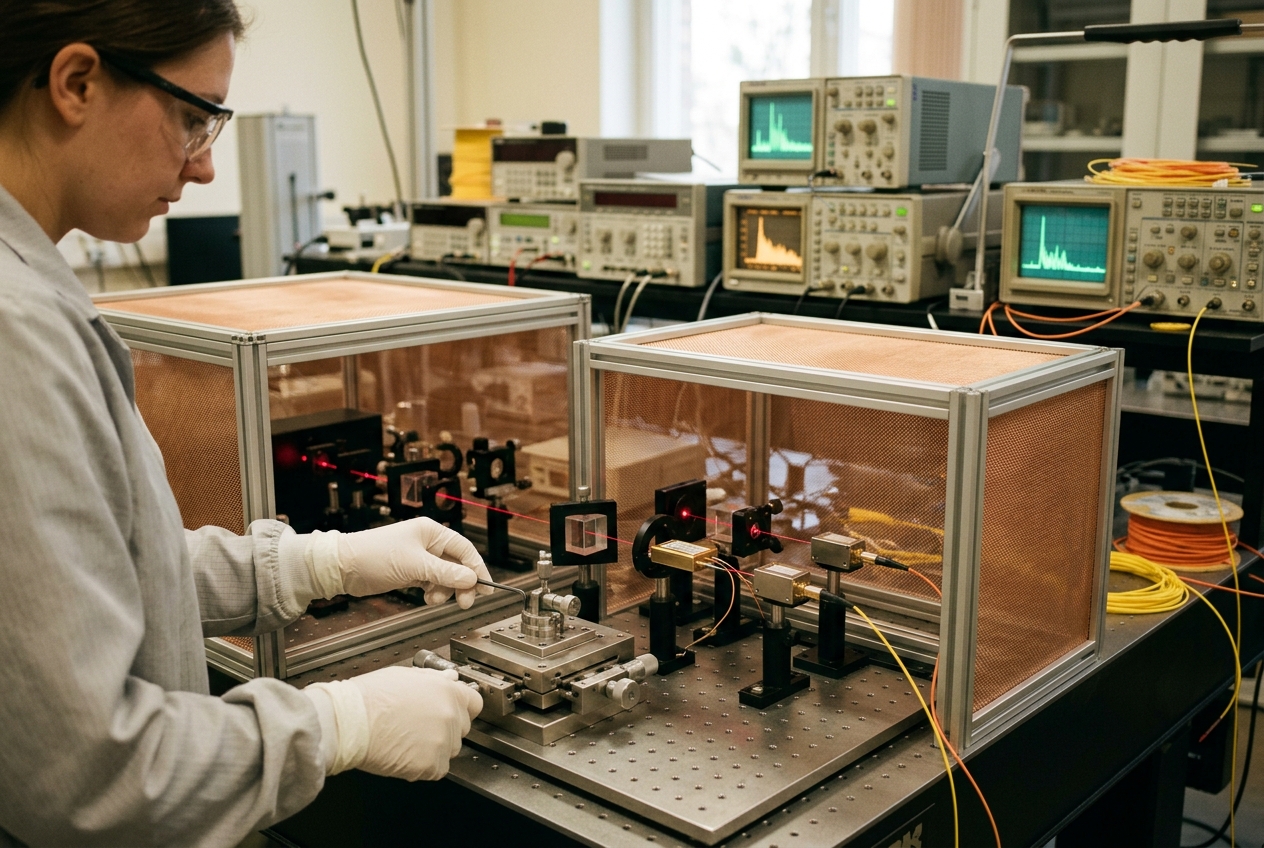
1. Opening Hook — Why You Should Care
The encryption protecting your bank account, medical records, and national defense communications rests on a fragile mathematical wager. Every time you submit a credit card number or send a confidential message, your device executes an algorithm that relies on the computational difficulty of specific mathematical problems, such as factoring large composite integers or computing discrete logarithms on elliptic curves. A conventional supercomputer would take billions of years to crack these problems through brute force. A cryptographically relevant quantum computer, leveraging Shor's algorithm, could dismantle that same mathematical shield in a matter of minutes.
In response, governments and corporations are rushing to implement post-quantum cryptography (PQC) and first-generation quantum key distribution (QKD). Yet both approaches harbor an insidious, hidden vulnerability: the problem of hardware trust. When you purchase cryptographic equipment, how can you be certain that the microchips inside do not contain a subtle backdoor engineered by a foreign intelligence agency or a rogue vendor? Even if the vendor is entirely honest, how do you verify that an adversary has not subtly altered the physical behavior of your optical detectors or laser emitters using imperceptible side-channel intrusions?
In classical computing and early quantum networks, this trust dilemma is insoluble. If your hardware is compromised, your security is dead on arrival.
Device-Independent Quantum Key Distribution (DI-QKD) represents a paradigm shift that fundamentally breaks this reliance on vendor honesty. It is a cryptographic framework wherein two communicating parties—conventionally named Alice and Bob—can establish mathematically unbreakable encryption keys using uncharacterized, uncalibrated, and potentially malicious hardware purchased directly from an adversary. By treating physical hardware as an opaque "black box" and subjecting its input-output statistics to the unyielding laws of quantum non-locality, DI-QKD achieves what was once considered scientifically impossible: absolute privacy certified purely by the laws of nature.
2. The Idea in Plain English
To understand how you can extract unbreakable secrecy from devices you do not trust, imagine a physical analogy.
Suppose a suspicious locksmith hands you two sealed wooden boxes. Each box has a dial on top with two settings (Option 0 or Option 1) and an indicator light that flashes either Red (+1) or Green (−1) every time you flip an internal lever. The locksmith claims that inside each box is a pair of synchronized dice. However, because you do not trust the locksmith, you suspect the boxes might contain hidden micro-transmitters broadcasting your choices to an eavesdropper, or a pre-programmed memory bank designed to fool you into generating predictable codes.
       +-------------------+                     +-------------------+
Input: |  x in {0, 1}      |                     |  y in {0, 1}      |
       v                   |                     v                   |
  +----------+             |                +----------+             |
  |  ALICE   |             |                |   BOB    |             |
  |  DEVICE  |             |                |  DEVICE  |             |
  +----------+             |                +----------+             |
       |                   |                     |                   |
Output:|  a in {+1, -1}    |                     |  b in {+1, -1}    |
       +-------------------+                     +-------------------+
                 \                                 /
                  \_______ Entangled Pair ________/
                           (Quantum Source)
In the classical world, the locksmith can easily rig this game. Any correlation between the lights can be explained by pre-programmed classical instructions (shared random numbers stored on a chip) or hidden radio signals passing between the boxes.
In the quantum world, particles can exist in a state of quantum entanglement—an intimate physical connection where two separated particles behave as a unified system, regardless of the spatial distance separating them. Before you measure an entangled particle, its physical properties do not have predetermined values; it exists in a superposition, much like a coin spinning rapidly in mid-air that is neither heads nor tails until it lands.
In 1964, the Northern Irish physicist John Stewart Bell discovered a profound mathematical benchmark, now known as Bell's Theorem. Bell proved that if the physical world obeyed "local realism"—the intuitive classical assumption that objects possess definite properties prior to observation and that signals cannot travel faster than light—there is a strict mathematical limit to how correlated two separated systems can be.
If Alice and Bob take their two sealed boxes into separate, shielded rooms and find that the statistical correlations between their dials and flashing lights consistently violate Bell’s classical ceiling, only one conclusion is physically possible: the boxes are generating genuine quantum entanglement in real time. Because the correlation violates local realism, the outputs could not have been predetermined by the locksmith, stored on a pre-programmed hard drive, or leaked through a classical channel. The randomness is certified by physics itself.
3. How It Actually Works — The Mechanics
The Failure of Conventional QKD: The Side-Channel Vulnerability
To appreciate why DI-QKD is necessary, one must examine why standard prepare-and-measure protocols (such as BB84, formulated by Charles Bennett and Gilles Brassard in 1984) and early entanglement schemes (such as Artur Ekert's E91 protocol) fall short in high-security environments.
Standard QKD protocols prove unconditional security under the strict mathematical assumption that the physical apparatus behaves identically to its idealized theoretical model: 1. The single-photon sources must emit exactly one photon per pulse with pure polarization states. 2. The phase and polarization modulators must rotate the quantum states by exact angles without phase drift. 3. The avalanche photodiodes (APDs) or single-photon detectors must possess uniform detection efficiency across all measurement bases.
In practice, physical devices never match their mathematical abstractions. Malicious eavesdroppers (traditionally named Eve) exploit these discrepancies using side-channel attacks: * Detector Blinding Attacks: Eve shines bright, continuous-wave laser light into Bob's avalanche photodiodes, forcing them out of single-photon Geiger mode into linear photodiode mode. Bob's detectors cease to be sensitive to single quantum states and fire only when Eve delivers an engineered classical laser pulse, allowing Eve to intercept and resend the key without introducing detectable errors. * Trojan-Horse Attacks: Eve fires bright probe pulses into Alice’s optical setup and analyzes the back-reflected photons to read out the internal settings of Alice's state modulators before the quantum state leaves the laboratory. * Spatial and Calibration Modes: Variations in beam paths, thermal shifts, or timing jitters create side channels where the detector efficiency depends on the measurement basis, completely invalidating the security proof.
The Black-Box Paradigm and the CHSH Bell Inequality
Device-Independent QKD resolves these vulnerabilities by discarding all assumptions regarding the internal workings of the equipment. Alice and Bob treat their measurement devices as untrusted black boxes characterized strictly by their inputs and outputs.
During each round $i$ of the protocol: 1. Alice chooses an input $x \in {0, 1}$ (corresponding to a measurement setting) and obtains a binary output $a \in {+1, -1}$. 2. Bob chooses an input $y \in {0, 1, 2}$ and obtains a binary output $b \in {+1, -1}$. 3. Alice and Bob record their choices over $N$ consecutive rounds without exchanging information about their outputs.
After completing $N$ rounds, Alice and Bob publicly announce their inputs $x, y$ and a small, randomly chosen subset of their outputs to estimate the joint conditional probability distribution $P(a, b | x, y)$.
To certify non-locality, they calculate the Clauser-Horne-Shimony-Holt (CHSH) correlation parameter, denoted as $S$:
$$\langle A_x B_y \rangle = \sum_{a, b \in {+1, -1}} a \cdot b \cdot P(a, b | x, y)$$
$$S = \langle A_0 B_0 \rangle + \langle A_0 B_1 \rangle + \langle A_1 B_0 \rangle - \langle A_1 B_1 \rangle$$
For any classical system governed by local hidden variables (LHV), local realism imposes the strict upper bound:
$$S_{\text{classical}} \le 2$$
In quantum mechanics, entangled states can violate this inequality. The absolute upper limit achievable by quantum physical systems—derived by Boris Tsirelson in 1980—is:
$$S_{\text{quantum}} \le 2\sqrt{2} \approx 2.8284$$
The Self-Testing Property
The mathematical engine powering DI-QKD is the principle of self-testing, first introduced by Dominic Mayers and Andrew Yao. Self-testing is a rigidity theorem: it proves that if an unknown quantum state $|\psi\rangle_{AB}$ across an uncharacterized Hilbert space $\mathcal{H}_A \otimes \mathcal{H}_B$ and uncharacterized measurement operators ${A_x}, {B_y}$ produce the maximal CHSH violation $S = 2\sqrt{2}$, then there must exist a local isometry $\Phi = \Phi_A \otimes \Phi_B$ that maps the physical state and operators directly to the ideal singlet Bell state $|\Phi^+\rangle$ and ideal Pauli spin measurements:
$$\Phi(|\psi\rangle_{AB}) = |\Phi^+\rangle \otimes |\text{junk}\rangle, \quad \text{where } |\Phi^+\rangle = \frac{|00\rangle + |11\rangle}{\sqrt{2}}$$
$$\Phi_A A_0 \Phi_A^\dagger = \sigma_z \otimes \mathbb{I}, \quad \Phi_A A_1 \Phi_A^\dagger = \sigma_x \otimes \mathbb{I}$$
$$\Phi_B B_0 \Phi_B^\dagger = \frac{\sigma_z + \sigma_x}{\sqrt{2}} \otimes \mathbb{I}, \quad \Phi_B B_1 \Phi_B^\dagger = \frac{\sigma_z - \sigma_x}{\sqrt{2}} \otimes \mathbb{I}$$
Because the ideal Pauli matrices anticommute (${\sigma_x, \sigma_z} = \sigma_x \sigma_z + \sigma_z \sigma_x = 0$), observing $S = 2\sqrt{2}$ mathematically forces the measurements inside the untrusted boxes to be mutually complementary and non-commuting. This eliminates all possible classical deterministic strategies and guarantees that Eve's quantum system $E$ is completely decoupled in a tensor product state:
$$\rho_{ABE} = |\Phi^+\rangle\langle\Phi^+|_{AB} \otimes \rho_E$$
Eve's mutual information with Alice's raw key is identically zero.
Asymptotic Key Rates and the Devetak-Winter Bound
In a realistic physical deployment, experimental imperfections (channel loss, detector inefficiencies, environmental decoherence) prevent Alice and Bob from reaching $2\sqrt{2}$. Instead, they observe an intermediate violation $2 < S < 2\sqrt{2}$ alongside a non-zero Quantum Bit Error Rate (QBER), denoted as $Q$, on the key-generation round $(x=0, y=2)$.
To compute the fraction of secure key bits extractable per round in the asymptotic limit ($N \to \infty$), we invoke the Devetak-Winter bound:
$$r \ge I(A : B) - \chi(A : E)$$
Here, $I(A : B) = 1 - h(Q)$ represents the classical mutual information between Alice and Bob (where $h(p) = -p\log_2 p - (1-p)\log_2(1-p)$ is the binary Shannon entropy function), and $\chi(A : E)$ is the Holevo quantity bounding the maximum information accessible to a quantum-enabled eavesdropper Eve.
In DI-QKD, Eve's conditional von Neumann entropy $H(A | E)$ is bounded as a direct mathematical function of the observed Bell violation $S$. Antonio Acín and colleagues derived the fundamental asymptotic DI-QKD secret key rate formula:
$$r \ge 1 - h(Q) - h\left(\frac{1 + \sqrt{(S/2)^2 - 1}}{2}\right)$$
 Secret Key Rate r
   ^
1.0|                                      * (S = 2.828, Q = 0%, r = 1.0)
   |                                    *
0.8|                                  *
   |                                *
0.6|                              *
   |                            *
0.4|                          *
   |                       *
0.2|                    *
   |                 *
0.0+---------------+----------------------+------>
   2.0            2.2                    2.828   CHSH Violation S
 (Classical)                          (Tsirelson Bound)
If $S \le 2$, the right-hand term evaluates to $1$, yielding a key rate of $r \le 0$ (no key can be established). As $S \to 2\sqrt{2}$, the argument of the binary entropy becomes $1/2$, yielding $h(1/2) = 1$, which reduces Eve's knowledge to zero and allows $r \to 1 - h(Q)$.
Finite-Key Security and the Entropy Accumulation Theorem (EAT)
While the asymptotic Devetak-Winter formula proves security for an infinite sequence of identical, independent rounds, real-world cryptographic exchanges operate over finite blocks ($N \sim 10^6 - 10^9$ rounds). In a finite implementation, an adversary can execute coherent attacks: Eve entangles a single high-dimensional quantum probe across all physical rounds, introducing complex time-dependent memory effects between the boxes.
For over a decade, proving the security of DI-QKD against general coherent attacks with finite keys remained an open challenge. The breakthrough came with the formulation of the Entropy Accumulation Theorem (EAT) by Frédéric Dupuis, Serge Fehr, Renato Renner, and colleagues.
The EAT establishes that the total smooth min-entropy $H_{\min}^\epsilon(A^N | E)$ accumulated across $N$ sequential, non-independent rounds can be lower-bounded by the sum of the conditional von Neumann entropies of the individual rounds, minus a statistical penalty term proportional to $\sqrt{N}$:
$$H_{\min}^\epsilon(A^N | E) \ge N \cdot \eta(S - \Delta) - c \sqrt{N \ln(1/\epsilon)}$$
Where: * $\eta(S)$ is the single-round entropy bounding function derived from the CHSH parameter, * $\Delta$ is the statistical confidence interval associated with estimating $S$ over a finite sample, * $\epsilon$ is the security parameter (the maximum tolerable failure probability, typically set to $\epsilon \le 10^{-10}$), * $c$ is a system-dependent constant reflecting the dimension and variance of the state space.
The Entropy Accumulation Theorem guarantees that finite-round DI-QKD remains composably secure against arbitrary coherent attacks without requiring the boxes to be memoryless.
The Two Experimental Loopholes
To guarantee that a Bell violation $S > 2$ is genuine and not an artifact of experimental imperfections, an implementation must close two critical experimental vulnerabilities simultaneously:
+-----------------------------------------------------------------------------+
|                     LOOPHOLES IN BELL TESTS FOR DI-QKD                      |
+-----------------------------------------------------+-----------------------+
| 1. Locality Loophole                                | 2. Detection Loophole |
| Space-like separation between Alice and Bob prevents| Detectors must catch  |
| sub-luminal communication between the boxes during  | enough photons so Eve |
| input choices and output generation.                | cannot hide in losses.|
+-----------------------------------------------------+-----------------------+
- The Locality Loophole: Alice and Bob must choose their random inputs $x$ and $y$ and record their outputs $a$ and $b$ at space-like separated intervals. The relativistic spacetime separation ensures that no signal traveling at or below the speed of light ($c$) could convey Alice's choice of $x$ to Bob's device before Bob's measurement is finalized. If the locality loophole is open, malicious chips could exchange classical radio pulses to artificially simulate $S = 2\sqrt{2}$ without entanglement.
- The Detection (Fair-Sampling) Loophole: If the physical detectors fail to register every emitted particle due to optical transmission loss or sub-unity quantum efficiency, an eavesdropper can exploit the missing events. Eve could design the devices to deliver outputs only when the measurements yield an artificially high CHSH violation and report a "no-detection" outcome otherwise. To close the detection loophole in a standard CHSH test without additional assumptions, the overall system collection-and-detection efficiency $\eta_{\text{det}}$ must strictly satisfy:
$$\eta_{\text{det}} > \frac{2}{1 + \sqrt{2}} \approx 82.84\%$$
4. Real-World Applications Today
Between 2022 and 2026, experimental physics crossed a historic threshold: the realization of the world's first fully functional, loophole-free DI-QKD links. Research teams across premier academic institutions and corporate quantum laboratories are currently driving the physical deployment of this technology.
+---------------------------------------------------------------------------------------+
|                           ACTIVE DI-QKD RESEARCH FRONTIERS                            |
+----------------------+---------------------------+------------------------------------+
| Institution / Group  | Physical Architecture     | Key Milestone                      |
+----------------------+---------------------------+------------------------------------+
| Oxford & Sorbonne    | Trapped Strontium Ions    | First loophole-free DI-QKD link    |
| LMU Munich & MPQ     | Neutral Rubidium Atoms    | Entanglement over 400m urban fiber |
| MIT, Harvard & NIST  | Photonic SNSPD Networks   | High-rate certified randomness     |
+----------------------+---------------------------+------------------------------------+
1. Oxford University & Sorbonne University: Trapped-Ion DI-QKD
In landmark experiments published in Nature, a research consortium led by the University of Oxford demonstrated the world’s first complete, loophole-free DI-QKD key exchange. The experimental apparatus employed two trapped Strontium-88 ions ($^{88}\text{Sr}^+$) situated in independent vacuum chambers separated across a physical building.
The ions were entangled via photonic interconnects: each ion emitted a single photon entangled with its internal atomic spin state, and the two photons were routed to an intermediate optical Bell-state measurement station. Because trapped-ion readout achieves detection efficiencies surpassing $99\%$, the Oxford system permanently closed the detection loophole, generating certified secret keys over thousands of consecutive experimental rounds without relying on model assumptions.
2. Ludwig Maximilian University of Munich (LMU) & Max Planck Institute: Neutral Atom Links
Concurrently, experimental physicists at LMU Munich achieved loophole-free DI-QKD using single neutral Rubidium-87 ($^{87}\text{Rb}$) atoms trapped in optical dipole traps separated by 400 meters of urban optical fiber.
By coupling the trapped atoms to high-finesse optical micro-cavities, the Munich team achieved high-fidelity atom-photon state mapping and rapid atomic spin-state readouts. Their setup demonstrated that matter-matter entanglement can be distributed across metropolitan distances, providing the foundational architecture for long-distance device-independent quantum repeaters.
3. MIT, Harvard & QuTech: High-Efficiency Photonic Networks
While atomic systems provide near-perfect detection efficiency, their key generation rates are constrained by the mechanical repetition rates of atomic traps. To scale transmission speeds, consortia involving MIT, Harvard University, and QuTech are developing all-photonic DI-QKD links.
These architectures deploy high-purity spontaneous parametric down-conversion (SPDC) photon-pair sources coupled to ultra-low-loss Superconducting Nanowire Single-Photon Detectors (SNSPDs) operating at cryogenic temperatures near absolute zero ($0.8\text{ K}$). By achieving total system detection efficiencies in excess of $84\%$, these photonic platforms are unlocking high-speed device-independent key rates over optical fiber testbeds.
4. NIST: Certified Quantum Randomness Generation
At the National Institute of Standards and Technology (NIST), researchers are utilizing the mathematics of DI-QKD to solve a critical foundational problem: the generation of certified, private randomness.
Standard hardware random number generators (TRNGs) can be compromised by thermal drift, manufacturing defects, or hidden algorithmic seeds. Using loophole-free Bell violations, NIST’s device-independent randomness beacons continuously output numerical strings whose unpredictability is certified by non-locality. These beacons supply untampered entropy to financial market settlement architectures, national lottery infrastructure, and cryptographic key generation facilities worldwide.
5. Sovereign Defense & Central Banking Infrastructure
National laboratories and defense agencies are actively evaluating DI-QKD for zero-trust critical infrastructure. In conventional high-security settings, supply chain auditing requires painstaking microscopic analysis of integrated circuits to detect hardware trojans.
DI-QKD eliminates the need for physical hardware inspection. A sovereign nation or financial consortium can deploy cryptographic nodes manufactured by foreign competitors, knowing that if the nodes pass the real-time CHSH Bell test, the generated communication keys are mathematically insulated from eavesdropping.
5. What This Means for You
For the non-physicist navigating an increasingly precarious digital world, Device-Independent Quantum Key Distribution represents a philosophical and practical revolution in how we define digital privacy.
Every digital transaction you execute today relies on a long chain of implicit trust: * You trust that the microprocessor inside your laptop does not contain hidden firmware backdoors. * You trust that the commercial encryption software securing your banking application has no undocumented design flaws. * You trust that foreign state intelligence agencies will not invent an unforeseen mathematical shortcut that instantly renders post-quantum cryptographic algorithms obsolete.
DI-QKD breaks this cycle of continuous vulnerability. It is the only cryptographic framework in human history where security does not depend on the assumed mathematical limitations of an attacker, nor on the physical integrity of the manufacturing supply chain.
+-----------------------------------------------------------------------------+
|                      CLASSICAL VS. DEVICE-INDEPENDENT TRUST                 |
+------------------------------------+----------------------------------------+
| Classical / Conventional QKD       | Device-Independent QKD (DI-QKD)        |
+------------------------------------+----------------------------------------+
| * Relies on unproven math problems | * Relies purely on laws of quantum     |
| * Vulnerable to hardware backdoors |   non-locality and self-testing        |
| * Requires trusted manufacturers   | * Untrusted, "black box" hardware      |
| * Susceptible to side-channel taps | * Mathematically immune to side channels|
+------------------------------------+----------------------------------------+
When DI-QKD networks are integrated into global telecommunications backbones, the data securing your medical records, personal identity, and sovereign civic systems will achieve information-theoretic security. This guarantees that even if a future adversary possesses a fault-tolerant quantum supercomputer with millions of physical qubits, your past encrypted data can never be decrypted. Secrecy transitions from a temporary technical advantage into a permanent physical law.