Density Matrix Formalism: Resolving Mixed Quantum States, Statistical Ensembles, and Partial Traces
This catastrophic unraveling is known as decoherence. For decades, physicists struggled to describe this process using standard textbook quantum mechanics, which assumed that systems are perfectly isolated, immaculate, and completely knowable. In the real world, no system is an island. The revolutionary mathematical tool that allowed physicists to step out of the sterile vacuum of idealized theory and master the unruly reality of open, leaking, and entangled physical systems is the density matrix. By providing a rigorous mathematical language for both quantum indeterminacy and plain human ignorance, the density matrix formalism has become the cornerstone of modern quantum information science.
THE IDEA IN PLAIN ENGLISH: FROM SPINNING COINS TO CLOUDED ENVELOPES
To grasp why the density matrix was necessary, one must first confront the difference between quantum uncertainty and ordinary statistical ignorance.
Imagine a fair coin tossed into the air. While it spins through the atmosphere, classical physics dictates that its trajectory, velocity, and angular momentum are fully determined by deterministic equations; you merely lack the computational speed to track them. In elementary quantum mechanics, a single isolated quantum bit, or qubit, behaves in an analogous yet fundamentally stranger manner. Represented as a state vector, or "wavefunction," an isolated qubit does not possess a definite value of heads (the binary zero state) or tails (the binary one state) before measurement. Instead, it exists as a genuine physical superposition of both possibilities at once, capable of interfering with itself. This is what physicists call a pure quantum state—a condition of maximum possible knowledge about a closed quantum system.
Now consider a different experiment. A dealer in a locked room prepares thousands of coins. Half of them are carefully placed flat on heads; the other half are placed flat on tails. The dealer seals each coin inside an opaque black envelope, shuffles them thoroughly, and hands one envelope to you.
What is the state of the coin in your hands?
It is not spinning in mid-air. It is not in a quantum superposition. It is unequivocally either heads or tails, but you do not know which because of classical, macroscopic ignorance.
What happens when an engineer builds a complex quantum processor where both phenomena occur simultaneously? A physical qubit might be partly in a quantum superposition, while also being subject to classical thermal jitter, laser calibration fluctuations, and unmonitored entanglement with the ambient room. Standard wavefunctions, which describe only pure states with absolute certainty, fail completely in this regime.
The density matrix bridges this divide. It provides a unified geometric framework that can simultaneously track the wave-like quantum phases that enable quantum computation, and the classical probabilities that arise when information bleeds away into the environment. When a quantum system is pure, its state sits proudly on the outer skin of an abstract geometrical sphere. When it interacts with the messy universe, the density matrix tracks its slow, tragic migration into the sphere's murky, uncertain interior.
HOW IT ACTUALLY WORKS: THE MECHANICS OF THE DENSITY OPERATOR
The density matrix—often called the density operator—was introduced independently by Lev Landau and John von Neumann in 1927. Rather than tracking a single state vector, it represents an ensemble: a statistical collection of different possible quantum states, each weighted by a classical probability representing our level of knowledge.
The Mathematical Foundation
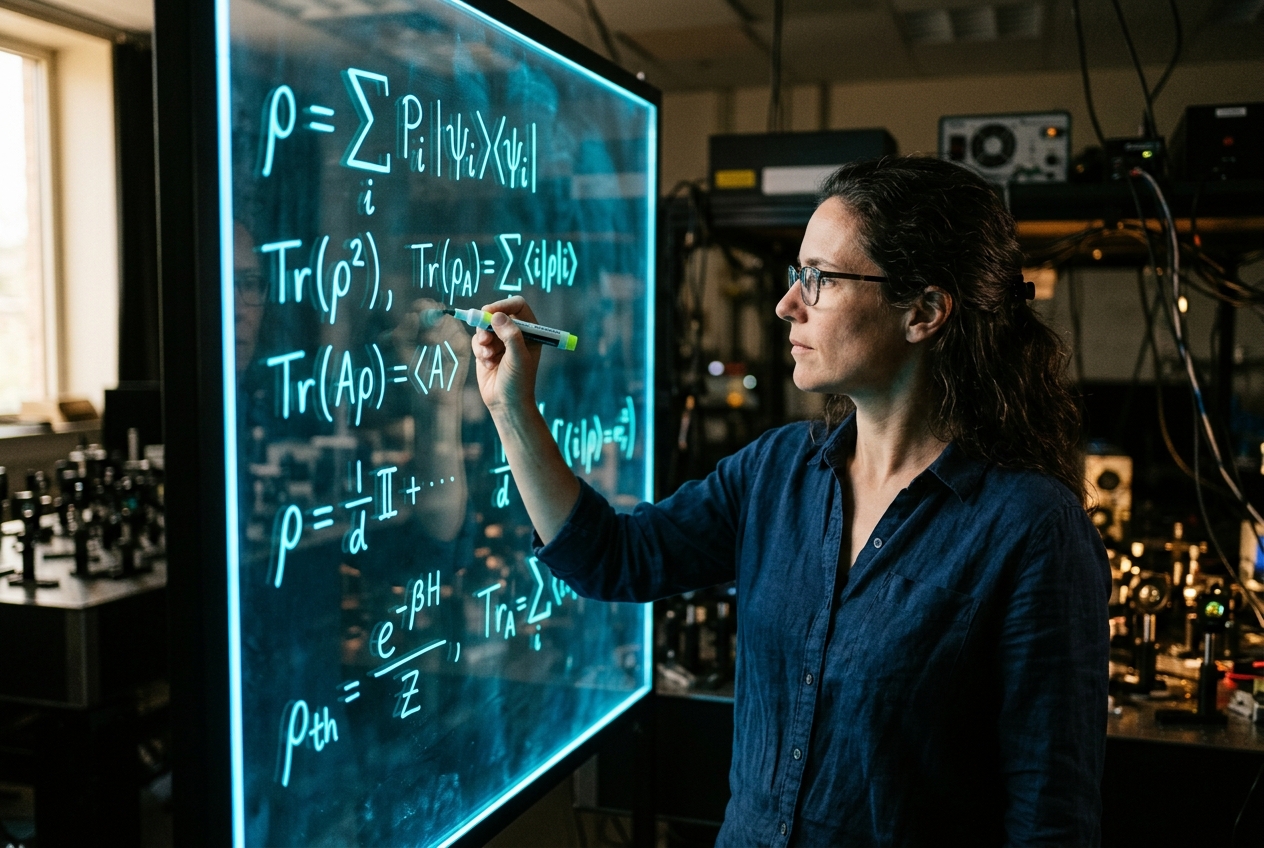
Formally, if a quantum system has a classical probability $p_i$ of being in a particular normalized quantum state $|\psi_i\rangle$, the density operator $\rho$ is constructed as the weighted sum of the projection operators for each state:
$$\rho = \sum_i p_i |\psi_i\rangle\langle\psi_i|$$
Here, each probability $p_i$ is a non-negative real number, and their sum equals one. While this definition appears straightforward, the mathematical structure of $\rho$ must satisfy three non-negotiable physical axioms to represent a valid quantum reality:
- Hermiticity: The operator is self-adjoint, meaning it is equal to its own conjugate transpose. In practical physical terms, Hermiticity guarantees that whenever we calculate the expectation value of any measurable physical observable—such as energy, spin, or position—the resulting mathematical prediction is always a strictly real number, never an unphysical complex quantity.
- Unit Trace: The sum of the diagonal elements of the density matrix, known as its trace, must equal exactly one. Because the diagonal elements of $\rho$ represent the probabilities of finding the system in each base physical configuration, the unit trace condition enforces the fundamental rule of probability conservation: the universe mandates that the total likelihood of all possible experimental outcomes must sum to one hundred percent.
- Positive Semi-Definiteness: For any arbitrary physical state vector, the expectation value of $\rho$ must never be negative. This prevents the mathematical formalism from generating absurdities such as negative probabilities for physical measurement outcomes. Equivalently, it ensures that all eigenvalues of the matrix are real numbers greater than or equal to zero.
Pure versus Mixed States: The Purity Metric
The density matrix establishes an unambiguous criterion to distinguish an immaculate quantum state from one contaminated by classical uncertainty. If a system is in a pure state, there is no classical ignorance; the summation collapses to a single projection operator. When you square a pure density matrix, you recover the exact same matrix. Consequently, the trace of the squared density matrix equals exactly one.
If the system is in a mixed state, classical randomness has infiltrated the ensemble. Squaring the matrix yields smaller diagonal weights, causing the trace of the squared density matrix to drop strictly below one. For a two-level qubit system, this value reaches its absolute minimum at one-half, which corresponds to the maximally mixed state—a state of total physical entropy where every measurement outcome is completely unpredictable coin-tossing noise.
Mapping Uncertainty: The Bloch Ball
For a single qubit, this mathematical distinction manifests as a profound geometric picture. Any single-qubit density matrix can be decomposed into the identity operator and the three fundamental quantum rotation operators known as the Pauli spin matrices:
$$\rho = \frac{1}{2}\left(I + \vec{r}\cdot\vec{\sigma}\right)$$
In this parameterization, the vector $\vec{r} = (r_x, r_y, r_z)$ is known as the Bloch vector. The magnitude of this vector serves as a direct spatial gauge of quantum coherence:
- The Surface ($|\vec{r}| = 1$): When the length of the vector is exactly unity, the density matrix describes a pure state. These states populate the pristine outer surface of the celebrated Bloch Sphere. Here, quantum superpositions retain full phase coherence.
- The Interior ($|\vec{r}| < 1$): When the qubit interacts with an uncontrolled environment, phase information leaks outward. The length of the vector shrinks below one, pulling the quantum state inward into the solid bulk of the Bloch Ball.
- The Center ($\vec{r} = \vec{0}$): At the dead center of the sphere, the Bloch vector has zero length. The density matrix becomes exactly equal to half the identity matrix. All quantum phase information has been extinguished; the qubit has degraded into a purely classical, fifty-fifty statistical toss.
Subsystems and the Magic of the Partial Trace
The true power of the density operator emerges when analyzing composite systems—such as two entangled particles, or a qubit interacting with an entire room of air molecules. In the formalism of quantum mechanics, composite systems inhabit a combined tensor product Hilbert space $\mathcal{H}_A \otimes \mathcal{H}_B$.
Suppose we possess an entangled pair of particles, $A$ and $B$, described by a global density operator $\rho_{AB}$, but an experimenter only has physical access to particle $A$. How do we mathematically isolate the local physics of particle $A$ while discarding particle $B$?
We perform the partial trace, an operation that averages over all possible states of the inaccessible subsystem $B$:
$$\rho_A = \mathrm{Tr}B(\rho{AB}) = \sum_k \langle k|B \, \rho{AB} \, |k\rangle_B$$
The partial trace reveals one of the most astonishing paradoxes in all of physics. Consider the canonical two-qubit Bell State, where two particles are maximally entangled: their spins are locked in a shared superposition such that measuring one instantly dictates the state of the other. Globally, this two-qubit pair exists in an immaculate, one-hundred-percent pure state. Its total entropy is zero, and its global density matrix satisfies the pure state condition with absolute mathematical perfection.
Yet, if you apply the partial trace operator to trace out particle $B$, the resulting local density matrix $\rho_A$ for particle $A$ collapses into the maximally mixed state—half the identity matrix.
Locally, particle $A$ exhibits zero quantum coherence and maximum statistical randomness. The information has not been destroyed; rather, it has been woven entirely into the non-local correlation between the two particles. This mathematical mechanism explains environmental decoherence: when a single qubit in a laboratory processor becomes unintentionally entangled with the trillions of uncontrolled quantum particles in its surrounding environment, tracing out that inaccessible environment instantly converts the qubit's local pure state into a degraded, mixed density matrix.
REAL-WORLD APPLICATIONS TODAY: THE DENSITY MATRIX AT WORK (2024–2026)
Far from being a sterile mathematical abstraction, the density matrix is the daily workhorse of 21st-century quantum engineering. Across leading research laboratories and industrial tech giants, the density operator is actively deployed to tame the frontier of open quantum systems.
1. Fault-Tolerant Quantum Computing and Error Correction
At commercial quantum computing installations such as IBM Quantum and Google Quantum AI, engineers are racing to build fault-tolerant processors using the surface code. Real-world physical qubits do not experience clean, idealized bit-flips; they suffer continuous amplitude damping and phase dephasing caused by thermal fluctuations and electromagnetic crosstalk. By modeling the physical processors via the Lindblad master equation—a differential equation governing the time evolution of density matrices—engineers calculate real-time error syndromes. This allows automated control software to diagnose when a logical qubit's density matrix has drifted into the interior of the Bloch ball and apply precise microwave pulses to restore its purity before quantum information is permanently lost.
2. Quantum State Tomography and Hardware Characterization
Before a quantum computing chip can be certified for scientific calculations, researchers at institutions like the National Institute of Standards and Technology (NIST) and startup ecosystems like Rigetti Computing must verify the fidelity of their quantum logic gates. Because a single quantum measurement collapses the state, one cannot inspect a quantum state directly. Instead, physicists run identical experiments thousands of times across multiple measurement bases (measuring along the X, Y, and Z axes) to perform Quantum State Tomography (QST). Using statistical algorithms such as Maximum Likelihood Estimation, researchers reconstruct the full empirical density matrix of the fabricated qubits, as documented across foundational lecture series on MIT OpenCourseWare. Comparing this reconstructed matrix to the ideal pure state reveals subtle manufacturing imperfections and phase drifts down to fractional percentages.
3. Quantum Biology and Photosynthetic Energy Transfer
In biophysics, researchers at Oxford University and MIT are utilizing the density matrix formalism to solve a long-standing evolutionary mystery: how photosynthetic bacterial complexes, such as the Fenna-Matthews-Olson (FMO) protein complex, achieve near-100% quantum efficiency in transferring solar energy. As highlighted in research published across Nature Physics, the energy absorbed from incoming sunlight travels through a network of chlorophyll molecules as a quantum excitation called an exciton. The surrounding biological cell is a warm, vibrating, wet environment that acts as an aggressive thermal bath. By applying density matrices and partial traces over the vibrational protein environment, biophysicists proved that nature utilizes an optimal balance between quantum coherence and environmental noise—a phenomenon known as Environment-Assisted Quantum Transport—to funnel energy to the chemical reaction center before it can dissipate as waste heat.
4. Ultra-Sensitive Quantum Sensing and Biomedical Imaging
In medical diagnostics, researchers at Harvard University and the Max Planck Institute are using the density matrices of Nitrogen-Vacancy (NV) centers in synthetic diamonds to develop next-generation magnetic resonance sensors. As detailed in landmark papers across Physical Review Letters, an NV-center consists of a single trapped electron spin inside a diamond crystal lattice. When exposed to external magnetic fields from nearby biological molecules—such as single cancer biomarker proteins or firing neurons—the density matrix of the electron spin undergoes subtle, predictable phase shifts. By measuring how the off-diagonal terms of the spin's density matrix decay over microseconds, these quantum sensors detect magnetic variations billions of times weaker than the Earth's magnetic field, paving the way for non-invasive, single-cell magnetic resonance imaging inside living tissue.
WHAT THIS MEANS FOR YOU: THE STAKES BEYOND THE LABORATORY
To the person on the street, matrix mechanics and partial traces might sound like the esoteric preoccupations of blackboard physicists. Yet, the physics captured by the density matrix will dictate the parameters of twenty-first-century life.
Consider the security of your private data. Today, every credit card transaction, medical record transfer, and encrypted text message relies on classical cryptographic protocols that will become obsolete when scalable quantum computers emerge. The timeline for that quantum transition is not constrained by our ability to write quantum code; it is constrained entirely by our ability to prevent quantum density matrices from shrinking into the center of the Bloch ball. Every year that physicists buy in the fight against environmental decoherence is a year closer to fault-tolerant quantum computation—and a year closer to the complete cryptographic obsolescence of our current internet infrastructure.
Furthermore, the materials that will define the next century—such as room-temperature superconductors that could transmit electricity across continents with zero resistance, or catalysts capable of capturing atmospheric carbon at industrial scales—are governed by complex, highly entangled many-body quantum interactions. Classical supercomputers cannot simulate these materials because tracking the pure state vectors of hundreds of interacting electrons requires more memory bits than there are atoms in the observable universe.
By using density matrices to discard irrelevant environmental variables and focus exclusively on active molecular subsystems, quantum engineers are learning how to model real-world materials accurately. The medicines designed to target your specific genomic variations, the batteries powering your electric transport, and the encryption safeguarding your sovereign identity are all direct dividends of our growing mastery over the density operator.
TODAY'S TAKEAWAY
The ultimate lesson of the density matrix is that in our universe, isolation is an illusion. Standard quantum mechanics taught us that nature is fundamentally probabilistic; the density matrix revealed something far deeper: that pure quantum coherence is a fragile, fleeting treasure constantly bleeding into an interconnected cosmos. By providing the mathematical machinery to track this leakage—quantifying exactly how pure superpositions decay into mixed statistical classicality—the density matrix transformed decoherence from an insurmountable mystery into an engineered frontier, giving humanity the indispensable roadmap it needs to finally harness the quantum world.