Decoherence-Free Subspaces: Protecting Quantum Information From Collective Environmental Noise Via Symmetry-Protected Invariant States
1. Opening Hook — Why You Should Care
The global digital economy rests upon an unspoken agreement with mathematics: certain calculations are simply too difficult for any machine to solve in a human lifetime. The cryptographic protocols safeguarding sovereign communications, interbank financial transfers, and medical databases depend entirely on the sheer impossibility of factoring multi-hundred-digit prime products on classical silicon microprocessors. A fully realized, fault-tolerant quantum computer could unpick those mathematical locks in mere hours. Beyond cryptography, such machines promise to simulate molecular chemistry at atomic resolution, unlocking room-temperature superconductors, hyper-efficient battery chemistries, and targeted pharmaceuticals designed directly inside a silicon chip.
Yet, between this computational revolution and our present reality stands an unforgiving barrier: the catastrophic fragility of quantum states. The basic units of quantum computation—qubits—are so acutely sensitive to their surroundings that a stray thermal photon, a microscopic fluctuation in a magnetic field, or the acoustic vibration of a refrigerator compressor can instantly scramble their calculations. In the race to prevent this decay, known as decoherence, conventional wisdom dictates an aggressive regime: build legions of auxiliary qubits, measure them continuously thousands of times per second, and actively repair errors as they occur.
+-------------------------------------------------------------------------------+
| THE CORE DILEMMA OF QUANTUM COMPUTING                                         |
| Active Error Correction: Demands thousands of physical qubits per logical     |
| qubit, generating immense hardware overhead and decoding latency.             |
| Passive Symmetry Shielding: Hides information within physical blind spots      |
| where environmental noise cancels itself out entirely by symmetry.            |
+-------------------------------------------------------------------------------+
What if there is a fundamentally more elegant path? Rather than running an exhausting cycle of active error detection and correction, physicists have discovered that we can structure quantum information so that the environment’s own noise cancels itself out automatically. This strategy—known as the Decoherence-Free Subspace (DFS)—transforms noise from an existential threat into an irrelevant background hum. By encoding quantum information into geometric symmetries of multi-qubit systems, we can construct logical quantum memories that are entirely impervious to collective environmental damage, without ever measuring an error or applying a corrective pulse.
2. The Idea in Plain English
To understand how a decoherence-free subspace operates, we must first abandon the misconception that quantum noise is purely random chaos. While noise is unpredictable in time, it often possesses profound geometric and spatial order.
Imagine two identical rowboats tethered closely alongside each other on a choppy ocean. If a long, rolling ocean swell approaches, it does not toss the two boats in opposite directions. Because the boats are right next to each other, the wave lifts both hulls upward at the exact same instant, by the exact same height, and lowers them together as the crest passes. If an observer on the distant shore measures the absolute height of either boat relative to the sea floor, the signal fluctuates wildly. But if you measure the relative difference in height between the two boats, that difference remains exactly zero. The rolling wave cannot alter their relative separation.
       Incoming Long-Wavelength Noise Wave ===>
            _.~"~._.~"~._.~"~._.~"~._
                   / \     / \
                  | O |   | O |   <-- Two Qubits in Close Proximity
                   \_/     \_/
           [ Both Experience Identical Up-and-Down Phase Shifts ]
           ------------------------------------------------------
           Absolute Phase: Scrambled by the wave.
           Relative Phase: PERFECTLY PRESERVED (Difference = 0).
In quantum physics, a single qubit behaves like a solitary boat. It can exist in a state of 0, a state of 1, or any delicate simultaneous blend of both—a state called a superposition. When stray electromagnetic fields sweep through a quantum processor, they impart uncontrolled phase shifts, scrambling the qubit’s fragile balance within microseconds. This loss of quantum phase coherence is termed dephasing.
However, if we place two physical qubits immediately adjacent to each other—so close that the wavelength of the ambient environmental disturbance is far larger than the physical gap between them—both qubits experience the exact same wave of noise simultaneously. This condition is called collective noise.
If we choose to store a single bit of quantum data not across the absolute state of one qubit, but rather in the difference or relative alignment between two qubits, the environmental wave becomes powerless. When the noise shifts the first qubit, it shifts the second qubit by the exact same amount in the exact same direction. The relative encoded information remains untouched.
A Decoherence-Free Subspace is simply the formal, mathematical name for this collective blind spot: a carefully insulated pocket within a larger quantum system where environmental disturbances cancel out completely due to symmetry.
3. How It Actually Works — The Mechanics
To see how passive shielding emerges from the laws of quantum mechanics, we must examine the mathematical bridge connecting an open quantum system to its surrounding thermal environment.
The Physical Emergence of Collective Coupling
In realistic quantum architectures, a processor is never entirely isolated; it couples to an uncontrolled environment known as a bath (consisting of stray electromagnetic modes, crystal lattice phonons, or fluctuating background nuclear spins). The total Hamiltonian governing the processor and bath is written as:
$$H_{\text{total}} = H_{\text{system}} \otimes I_{\text{bath}} + I_{\text{system}} \otimes H_{\text{bath}} + H_{\text{interaction}}$$
The interaction term can be decomposed into a sum over distinct spatial noise operators acting across the qubits:
$$H_{\text{interaction}} = \sum_{k} S_k \otimes B_k$$
where $S_k$ represents an operator acting on the system's qubits, and $B_k$ represents fluctuating bath operators.
+-------------------------------------------------------------------------------+
| THE SPATIAL CORRELATION CRITERION FOR COLLECTIVE COUPLING                     |
|                                                                               |
| Let 'd' be the inter-qubit separation distance.                               |
| Let '\lambda_c' be the correlation length (or wavelength) of the bath noise.  |
|                                                                               |
| When d << \lambda_c:                                                          |
| Individual noise operators S_k merge into a single global collective operator:|
|                       S_collective = \sum_{i=1}^N \sigma^{(i)}                |
+-------------------------------------------------------------------------------+
When the inter-qubit separation distance $d$ is negligible compared to the characteristic spatial correlation length or wavelength $\lambda_c$ of the bath modes, the bath cannot resolve the individual identities of the qubits. The bath couples to all qubits through an identical spatial profile. Consequently, the individual interaction operators $S_k$ condense into a single collective operator:
$$S_{\text{collective}} = \sum_{i=1}^N \sigma^{(i)}$$
where $\sigma^{(i)}$ represents a Pauli operator acting on the $i$-th qubit. This spatial uniformity creates a powerful dynamical symmetry.
The Algebraic Condition: Invariance under the Lindblad Master Equation
The standard tool for modeling open quantum systems is the Lindblad master equation, which tracks the evolution of the system's density matrix $\rho(t)$ over time in the presence of Markovian environmental noise:
$$\frac{d\rho}{dt} = -\frac{i}{\hbar}[H_{\text{system}}, \rho] + \sum_k \left( L_k \rho L_k^\dagger - \frac{1}{2} \left{ L_k^\dagger L_k, \rho \right} \right)$$
Here, the operators $L_k$ are the Lindblad jump operators representing environmental noise channels, and the curly braces denote the anti-commutator.
For a specific subspace $\mathcal{H}_{\text{DFS}}$ of the total Hilbert space to be completely free of decoherence, every state vector $|\psi\rangle$ within that subspace must be an eigenstate of every Lindblad jump operator with identical eigenvalues:
$$L_k |\psi\rangle = c_k |\psi\rangle \quad \forall |\psi\rangle \in \mathcal{H}_{\text{DFS}}$$
When all basis states of $\mathcal{H}{\text{DFS}}$ share the exact same complex scalar eigenvalue $c_k$ (or when $c_k = 0$, meaning the jump operators annihilate the subspace), we can substitute any density matrix $\rho$ constructed exclusively from states in $\mathcal{H}{\text{DFS}}$ into the dissipative part of the Lindblad equation.
The dissipative terms collapse:
$$\sum_k \left( (c_k |\psi\rangle)(c_k^* \langle\psi|) - \frac{1}{2} { |c_k|^2 I, |\psi\rangle\langle\psi| } \right) = \sum_k \left( |c_k|^2 \rho - |c_k|^2 \rho \right) = 0$$
The non-unitary noise dissipator vanishes entirely. Within this designated algebraic subspace, the quantum system evolves purely according to standard, reversible Schrödinger mechanics, completely unperturbed by the open environment.
                        TOTAL HILBERT SPACE
         +------------------------------------------------+
         | Unprotected States                             |
         | (|00>, |11>)                                   |
         |    Subject to dissipative decay and dephasing   |
         |                                                |
         |         +----------------------------+         |
         |         | DECOHERENCE-FREE SUBSPACE  |         |
         |         | {|01>, |10>}               |         |
         |         | Jump operator L_k acts as  |         |
         |         | a scalar multiple (c_k=0). |         |
         |         | Dissipation = 0.           |         |
         |         +----------------------------+         |
         +------------------------------------------------+
The Canonical Two-Qubit DFS Against Collective Dephasing
The clearest working example of this principle protects against collective dephasing (stray magnetic field fluctuations along the $Z$-axis). Consider two physical qubits exposed to a uniform, fluctuating magnetic field. The collective error operator is the sum of their individual Pauli-$Z$ operators:
$$J_z = \sigma_z^{(1)} + \sigma_z^{(2)}$$
Let us analyze how this collective error acts upon the standard two-qubit basis states: - For $|00\rangle$: $J_z |00\rangle = (+1 + 1)|00\rangle = +2|00\rangle$ - For $|11\rangle$: $J_z |11\rangle = (-1 - 1)|11\rangle = -2|11\rangle$ - For $|01\rangle$: $J_z |01\rangle = (+1 - 1)|01\rangle = 0$ - For $|10\rangle$: $J_z |10\rangle = (-1 + 1)|10\rangle = 0$
The states $|01\rangle$ and $|10\rangle$ both reside in the kernel (zero-eigenvalue eigenspace) of the error operator $J_z$. We can therefore define an entirely protected single logical qubit using these two physical states:
$$|0_L\rangle = |01\rangle, \quad |1_L\rangle = |10\rangle$$
Any arbitrary superposition of this logical qubit, $|\psi_L\rangle = \alpha |01\rangle + \beta |10\rangle$, has a net collective magnetic moment of zero. When a collective magnetic fluctuation occurs, the global phase transformation operator $U_{\text{noise}} = \exp(-i \phi J_z)$ acts on the state as:
$$U_{\text{noise}} |\psi_L\rangle = \alpha e^{-i \phi (0)} |01\rangle + \beta e^{-i \phi (0)} |10\rangle = \alpha |01\rangle + \beta |10\rangle = |\psi_L\rangle$$
The logical state does not accumulate any phase error whatsoever. The noise passes through the system without leaving any trace on the encoded information.
The Four-Qubit Singlet DFS Against Arbitrary Collective Rotations
If the environment subjects qubits to arbitrary, isotropic spatial fluctuations—such that noise can rotate qubits simultaneously around the $X$, $Y$, and $Z$ axes—a two-qubit encoding is no longer sufficient. Protection against the full group of collective three-dimensional rotations, known mathematically as the Lie group SU(2), requires finding states that are invariant under all three collective angular momentum operators:
$$J_x = \frac{1}{2}\sum_{i=1}^N \sigma_x^{(i)}, \quad J_y = \frac{1}{2}\sum_{i=1}^N \sigma_y^{(i)}, \quad J_z = \frac{1}{2}\sum_{i=1}^N \sigma_z^{(i)}$$
According to the quantum mechanical rules for the addition of angular momentum, coupling four spin-1/2 physical qubits yields an overall 16-dimensional Hilbert space that decomposes into representations of total spin $J$:
$$\frac{1}{2} \otimes \frac{1}{2} \otimes \frac{1}{2} \otimes \frac{1}{2} = (J=2) \oplus 3(J=1) \oplus 2(J=0)$$
The two singlet sectors with total angular momentum $J=0$ form a two-dimensional invariant subspace. Because their total spin is zero, every collective rotation operator satisfies $\vec{J} |\psi_{\text{singlet}}\rangle = 0$.
We can define a fully protected logical qubit using two mutually orthogonal four-qubit singlet states:
$$\begin{aligned} |0_L\rangle &= \frac{1}{2} (|01\rangle - |10\rangle) \otimes (|01\rangle - |10\rangle) = \frac{1}{2} (|0101\rangle - |0110\rangle - |1001\rangle + |1010\rangle) \ |1_L\rangle &= \frac{1}{\sqrt{12}} \Big( 2|0011\rangle + 2|1100\rangle - (|01\rangle + |10\rangle)(|01\rangle + |10\rangle) \Big) \end{aligned}$$
Because both basis states have total angular momentum $J=0$, any arbitrary collective rotation—regardless of direction or angle—acts as an identity operator on this subspace. Information stored within these four physical qubits is completely shielded from isotropic background electromagnetic noise.
+-------------------------------------------------------------------------------+
| SUMMARY OF COMMON DECOHERENCE-FREE ENCODINGS                                  |
+-------------------+--------------------+-------------------+------------------+
| Physical Qubits   | Noise Symmetry     | Invariant Sector  | Encoded Capacity |
+-------------------+--------------------+-------------------+------------------+
| 2 Qubits          | Collective Z       | Odd-parity states | 1 Logical Qubit  |
|                   | (Phase noise)      | {|01>, |10>}      |                  |
+-------------------+--------------------+-------------------+------------------+
| 4 Qubits          | Full Collective    | Total Spin J = 0  | 1 Logical Qubit  |
|                   | SU(2) Rotations    | (Singlet subspace)|                  |
+-------------------+--------------------+-------------------+------------------+
Performing Universal Logic Without Leakage
Preserving stored quantum memory is only half the battle; a quantum computer must also manipulate the encoded data. Computing within a decoherence-free subspace requires executing a universal set of quantum logic gates without ever driving states outside the protected sector—an error process known as leakage.
To prevent leakage, every physical control Hamiltonian $H_{\text{control}}(t)$ used to drive logic gates must commute with the collective error generators, or must strictly act within the subspace:
$$[H_{\text{control}}(t), S_{\text{collective}}] = 0$$
For our two-qubit dephasing-protected subspace (${|01\rangle, |10\rangle}$), logical operations are achieved using exchange-type interactions:
- Logical Pauli-$Z$ Gate ($Z_L$): A logical phase flip is implemented by applying differential energy shifts between the physical qubits, governed by the Hamiltonian $H_{Z_L} = \frac{\hbar \Delta}{2} (\sigma_z^{(1)} - \sigma_z^{(2)})$. This shifts the relative energy between $|01\rangle$ and $|10\rangle$ while preserving the total parity.
- Logical Pauli-$X$ Gate ($X_L$): A logical bit flip (swapping $|01\rangle \leftrightarrow |10\rangle$) is driven by an isotropic Heisenberg exchange interaction or planar XY-coupling: $H_{X_L} = \frac{J}{2} (\sigma_x^{(1)}\sigma_x^{(2)} + \sigma_y^{(1)}\sigma_y^{(2)})$. This swaps the states of the physical qubits without ever populating the unprotected $|00\rangle$ or $|11\rangle$ states.
- Entangling Two Logical Qubits: By coupling physical qubits from two separate DFS pairs via pairwise exchange interactions (such as Heisenberg exchange $H_{12} = \vec{\sigma}^{(1)} \cdot \vec{\sigma}^{(2)}$), one can execute a logical Controlled-NOT (CNOT) or Controlled-Phase gate across logical qubits entirely within the protected subspace.
LOGICAL GATE IMPLEMENTATION IN 2-QUBIT DFS
|0_L> = |01>  ---[ XY Exchange Coupling: J(X1 X2 + Y1 Y2) ]--->  |1_L> = |10>
                     (Transitions strictly between |01> and |10>)
                     (Zero population leaks to |00> or |11>)
The Triad of Quantum Protection: Passive DFS vs. Active QEC vs. Dynamical Decoupling
Decoherence-free subspaces occupy a distinct, foundational position in the broader framework of quantum protection strategies. Understanding when to deploy a DFS requires contrasting it with its two primary alternatives:
+-------------------------------------------------------------------------------+
| THE THREE PILLARS OF QUANTUM ERROR MITIGATION                                 |
+------------------------------------+------------------------------------------+
| METHOD                             | MECHANISM & TRADE-OFFS                   |
+------------------------------------+------------------------------------------+
| 1. Decoherence-Free Subspaces      | • Passive algebraic shielding via spatial|
|    (Passive Protection)            |   symmetry.                              |
|                                    | • Zero measurement overhead or latency.  |
|                                    | • Only protects against correlated noise.|
+------------------------------------+------------------------------------------+
| 2. Dynamical Decoupling (DD)       | • Active open-loop coherent averaging via|
|    (Temporal Refocusing)           |   rapid stroboscopic pulse trains.       |
|                                    | • No auxiliary qubits required.          |
|                                    | • Limited by control pulse fidelity.     |
+------------------------------------+------------------------------------------+
| 3. Stabilizer Error Correction     | • Active closed-loop feedback via ancilla|
|    (Active Fault-Tolerance)        |   syndrome measurement and recovery.     |
|                                    | • Protects against arbitrary errors.     |
|                                    | • Immense physical qubit overhead.       |
+------------------------------------+------------------------------------------+
- Decoherence-Free Subspaces (Passive Symmetry Protection): DFS relies purely on the spatial correlations of noise. It consumes zero energy during idle storage, requires no measurement circuitry, and generates no algorithmic latency. However, its protection is conditional: it shields solely against noise matching its specific spatial symmetry, leaving uncorrelated, local qubit errors unaddressed.
- Dynamical Decoupling (Temporal Averaging): As detailed in literature on open quantum systems, dynamical decoupling applies high-frequency sequences of inversion pulses (such as CPMG or XY-4 sequences) to average out time-dependent phase drift. Unlike DFS, dynamical decoupling operates in the time domain rather than the spatial domain.
- Active Quantum Error Correction (Stabilizer Codes): Exemplified by the surface code and modern quantum low-density parity-check (qLDPC) codes, active QEC encodes logical qubits across topological lattices, continuously measuring multi-qubit parity operators (syndromes) to detect and correct arbitrary local errors. While active QEC offers universal protection, it incurs massive hardware overhead—often requiring hundreds or thousands of physical qubits per logical qubit.
Modern quantum processor engineering increasingly combines these three paradigms into a unified defense: utilizing Decoherence-Free Subspaces at the base physical layer to neutralize dominant environmental field fluctuations, applying Dynamical Decoupling to suppress temporal drift, and layering Active Stabilizer Codes over the resulting high-fidelity logical building blocks.
4. Real-World Applications Today
The practical implementation of decoherence-free subspaces has graduated from theoretical physics papers to daily operation across leading quantum hardware laboratories worldwide.
+-------------------------------------------------------------------------------+
| REAL-WORLD DFS IMPLEMENTATIONS IN ADVANCED QUANTUM HARDWARE                   |
+---------------------+-------------------------+-------------------------------+
| Hardware Platform   | Leading Institutions    | Target Noise Protected        |
+---------------------+-------------------------+-------------------------------+
| Trapped-Ion Chains  | Quantinuum, Innsbruck   | Laser phase noise & ambient   |
|                     |                         | magnetic field fluctuations   |
+---------------------+-------------------------+-------------------------------+
| Superconducting     | IBM Quantum, Yale       | Common-mode flux noise and    |
| Circuits            | Quantum Institute       | control-line crosstalk        |
+---------------------+-------------------------+-------------------------------+
| Silicon Spin Qubits | QuTech, Harvard, UNSW   | Overhauser nuclear spin bath  |
|                     |                         | dephasing                     |
+---------------------+-------------------------+-------------------------------+
Trapped-Ion Crystals: Quantinuum and the University of Innsbruck
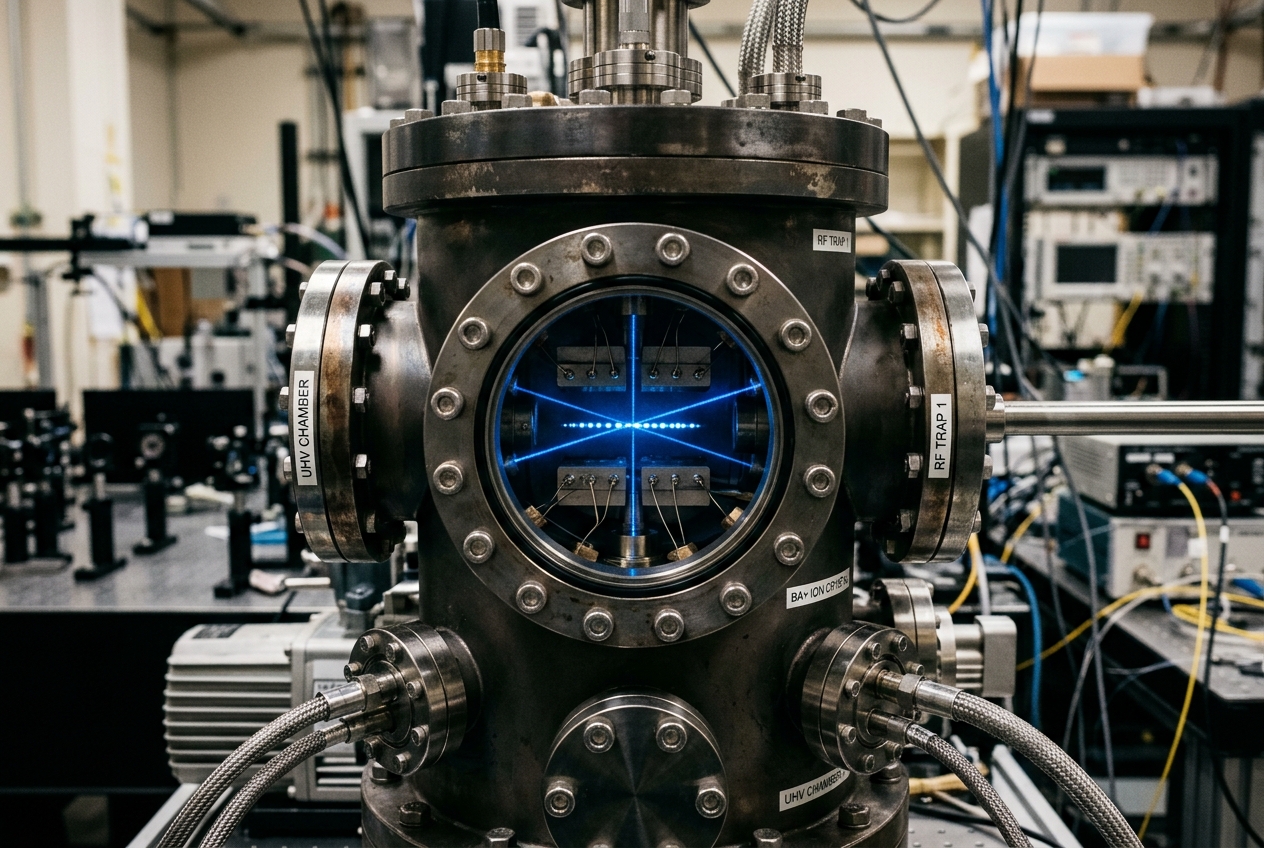
In trapped-ion quantum computers, such as those engineered by Quantinuum and academic groups at the University of Innsbruck, atomic ions (such as $^{171}\text{Yb}^+$ or $^{40}\text{Ca}^+$) are suspended in ultra-high vacuum using oscillating radiofrequency electric fields. The primary sources of decoherence are ambient magnetic field fluctuations and phase jitter in the driving laser beams.
Because the trapped ions sit in a linear crystal separated by only a few micrometers, the wavelength of ambient magnetic field noise is thousands of times larger than the entire ion chain. By pairing adjacent ions into two-qubit DFS configurations ($|01\rangle$ and $|10\rangle$), researchers regularly achieve quantum memory coherence times extending beyond tens of minutes. The collective magnetic fluctuations shift both ions in lockstep, preserving the encoded superposition without active intervention.
Superconducting Architectures: IBM Quantum and the Yale Quantum Institute
In superconducting quantum circuits, such as transmon and fluxonium processors developed by IBM Quantum and researchers at the Yale Quantum Institute, qubits are microfabricated aluminum and niobium circuits patterned onto silicon chips. These circuits are subject to low-frequency magnetic flux noise and parasitic electrical cross-talk emanating from control lines.
By organizing transmon pairs into differential dipole configurations—often termed superconducting "noiseless subsystems"—engineers ensure that common-mode electrical noise affects both junction loops identically. Recent work published across journals of the American Physical Society demonstrates that encoding logical states in the differential subspace suppresses low-frequency $1/f$ flux dephasing by multiple orders of magnitude, providing a cleaner physical baseline for higher-level error-correcting codes.
Semiconductor Spin Qubits: QuTech, Harvard University, and UNSW
Spin qubits hosted in silicon and gallium-arsenide quantum dots—championed by QuTech in the Netherlands, Harvard University, and the University of New South Wales—represent an exceptionally compact quantum computing platform. However, electron spins confined in semiconductor dots suffer relentless dephasing from the "Overhauser field"—a fluctuating bath of thousands of surrounding host nuclear spins.
To solve this, researchers utilize Singlet-Triplet ($S-T_0$) qubits and Exchange-Only three-spin qubits. By defining the logical qubit strictly within the zero-magnetic-quantum-number ($m_s = 0$) subspace of two or three neighboring electrons, the system becomes completely immune to uniform background magnetic field fluctuations. Universal quantum operations can then be executed purely by pulsing electrical voltages on electrostatic gates to tune the exchange interaction, completely eliminating the need for noisy, oscillating magnetic control fields.
5. What This Means for You
While the mathematical formalism of decoherence-free subspaces operates in the realm of group theory and quantum electrodynamics, its consequences will directly shape the trajectory of consumer technology, medical science, and global digital infrastructure over the coming decade.
The greatest bottleneck to delivering a practical, commercially viable quantum computer is the sheer engineering overhead of error correction. Under standard brute-force architectures, running a useful quantum algorithm might require a warehouse-sized facility containing one million physical qubits simply to sustain a few hundred reliable, error-corrected logical channels.
By integrating decoherence-free subspaces into the physical hardware layer, quantum engineers dramatically slash this overhead. Passive symmetry-based shielding neutralizes the most pervasive environmental noise channels before active error correction even needs to run.
This hardware efficiency accelerates the timeline toward transformative real-world milestones:
- Pharmaceutical Discovery: Simulating the complex catalytic centers of enzymes (such as nitrogenase for fertilizer production, or viral proteases for rapid antiviral design) requires modeling quantum entanglements beyond the reach of any classical supercomputer. DFS-stabilized processors bring the computational requirements for these chemistry simulations within reach years ahead of earlier projections.
- Next-Generation Materials and Energy: Designing solid-state battery electrolytes that do not degrade or developing lightweight alloys for aerospace demands exact quantum simulations of electron correlations in crystalline lattices.
- Information Security Timelines: Understanding how efficiently quantum processors can scale gives cybersecurity agencies and financial institutions a precise roadmap for rolling out post-quantum cryptography standards, ensuring that private health records and financial ledgers remain secure against future decryption capabilities.
6. Today's Takeaway
+-------------------------------------------------------------------------------+
| THE FUNDAMENTAL PRINCIPLE OF DECOHERENCE-FREE SUBSPACES                       |
| You do not need to fight environmental noise if you store your information in |
| a shape the noise is physically incapable of seeing. By encoding quantum      |
| data into relative geometric symmetries across coupled qubits, noise is       |
| transformed from a destructive hazard into an imperceptible uniform shift,   |
| achieving perfect passive immunity without the cost of active error repair.   |
+-------------------------------------------------------------------------------+
Authoritative References & Further Reading
- Foundational Open Quantum Systems Theory: Explore master equations and quantum noise models through MIT OpenCourseWare Quantum Physics Resources.
- Algebraic Formulations of Noiseless Subsystems: Read the definitive technical overview on Wikipedia: Decoherence-Free Subspaces.
- Experimental Implementations in Superconducting Circuits: Explore technical benchmarks and processor architectures at IBM Quantum Platform.
- Primary Research in Physical Review Letters: Study seminal experimental demonstrations of symmetry-protected quantum memory via the American Physical Society / Physical Review Letters.
- State-of-the-Art Quantum Information Science: Track breakthroughs in trapped-ion and semiconductor qubit preservation in Nature.