Data Processing Inequality: Enforcing Information Monotonicity and Relative Entropy Contraction Across Quantum Channels
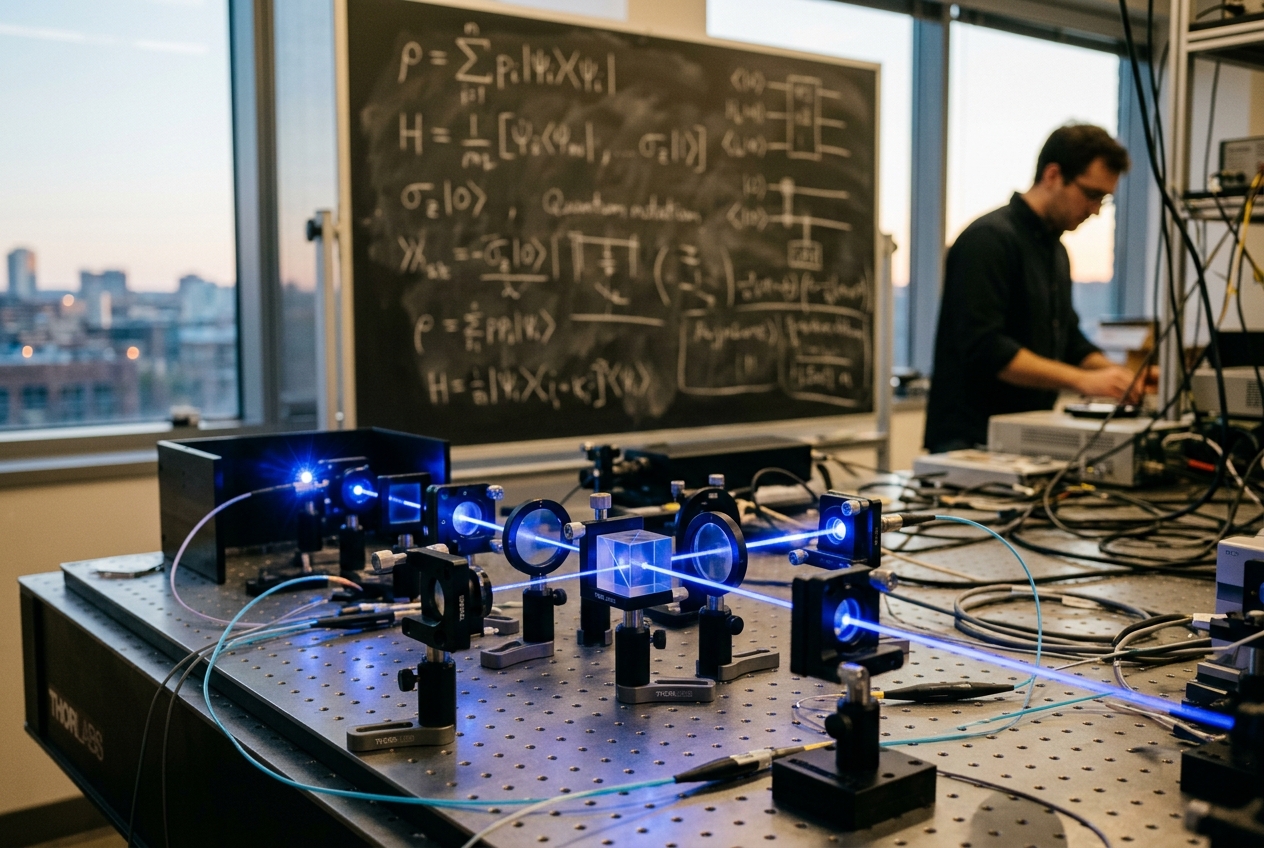
Every piece of information in our universe, from the encrypted handshake securing your personal bank account to the genetic blueprint inside a strand of DNA, is fundamentally bound by a merciless physical rule: no amount of clever computation can create distinctness out of confusion. If an eavesdropper intercepts an encrypted transaction, or if cosmic radiation corrupts a calculation mid-execution, running that corrupted data through filters, supercomputers, or neural networks will never magically restore the lost clarity beyond what the physical interaction left behind. Processing data can rearrange it, compress it, or discard its irrelevant clutter, but it can never generate true statistical distinction from nothing.
In the classical computing realm, this principle feels intuitive: make a photocopy of a photocopy, and the text degrades; blur a photograph in an image editor, and no sharpening algorithm can genuinely resurrect the lost micro-details without guessing. Yet in the quantum domain—where the world’s leading research laboratories are racing to build quantum computers capable of simulating life-saving molecular reactions and breaking world-standard cryptosystems—this intuitive restriction transforms into a profound, universal law of nature known as the Quantum Data Processing Inequality.
This mathematical iron law dictates the absolute limits of quantum memory, bounds our ability to shield delicate qubits from environmental noise, and governs the very fabric of space-time thermodynamics. It represents the information-theoretic equivalent of the Second Law of Thermodynamics: entropy grows, correlations dilute, and quantum states subjected to physical noise become monotonically less distinguishable. Understanding this inequality is not merely an academic exercise in abstract algebra; it is the definitive blueprint that reveals whether fault-tolerant quantum computers can ever survive the noisy reality of our physical universe.
2. The Idea in Plain English
To understand the Data Processing Inequality, one must first understand what "information" fundamentally measures: distinguishability. Imagine two distinct physical messages. Message A is a coin that landed strictly on heads; Message B is a coin that landed strictly on tails. To an observer, distinguishing between these two states is trivial—their statistical distance is maximal because the two distributions do not overlap at all.
Now imagine someone takes both coins, places them inside a tumbler, and shakes them vigorously before handing them back to you. Even if you do not know which coin was originally heads and which was tails, the physical operation—the tumbling—has scrambled their orientations. If the tumbling was completely random, both coins now have a 50% probability of showing heads and a 50% probability of showing tails. The two messages have become physically identical, their distinguishing features erased forever.
In quantum mechanics, physical states are not merely binary coins lying flat on a table. A quantum state is represented by a mathematical object called a density matrix—often denoted by the Greek letter $\rho$ (rho)—which describes a quantum system that may be in a pure superposition or an entangled, statistical mixture with its surrounding environment. When we speak of two possible states of a quantum computer, say $\rho$ and $\sigma$ (sigma), the fundamental question is: How easily can a physical measurement tell them apart?
The Data Processing Inequality asserts that whenever these quantum states undergo any physical operation—whether that operation is a deliberate gate applied by a programmer, an environmental interaction such as thermal vibration, or the irreversible loss of a photon—the distinguishability between $\rho$ and $\sigma$ can only decrease or remain constant. It can never increase.
Any physical manipulation acts as a noisy channel, mathematically termed a completely positive trace-preserving (CPTP) map. In plain English, a CPTP map represents any physically permissible transformation that respects the fundamental laws of probability: probabilities must remain positive, and the total sum of all possible outcomes must always equal exactly one. The Data Processing Inequality is the rigorous statement that under any such valid physical evolution, nature smooths over differences. Distinguishability is a non-renewable currency; once spent or corrupted by the environment, no subsequent physical processing can ever replenish it.
3. How It Actually Works — The Mechanics
To chart how this principle operates mathematically, we must trace its lineage from classical probability theory into the non-commutative landscape of modern quantum mechanics.
The Classical Foundation: Kullback-Leibler Divergence
The historical origin of data processing begins with the measurement of relative entropy in classical statistics. Suppose we have two probability distributions, $P(x)$ and $Q(x)$, defined over the same alphabet of possible outcomes. To quantify how distinct distribution $P$ is from distribution $Q$, classical information theory employs the Kullback-Leibler divergence, frequently referred to as classical relative entropy:
$$D_{\mathrm{KL}}(P \parallel Q) = \sum_{x} P(x) \log \left( \frac{P(x)}{Q(x)} \right)$$
This quantity is strictly non-negative; it equals zero if and only if the distributions $P$ and $Q$ are identical almost everywhere, and it grows toward infinity as the distributions become mutually exclusive.
When a classical distribution undergoes processing through a transition matrix—representing a stochastic Markov channel where inputs are mapped probabilistically to outputs—the divergence between the transformed distributions is always less than or equal to the divergence between the original inputs. This is the Classical Data Processing Inequality. It demonstrates that randomized processing only muddies the statistical contrast between distinct initial hypotheses.
The Quantum Generalization: Umegaki Relative Entropy
In quantum systems, probability vectors are replaced by density operators acting on a complex Hilbert space. Density operators do not generally commute ($\rho \sigma \neq \sigma \rho$), which prevents one from simply taking a quotient of probabilities as in the classical formulation. In 1962, the Japanese mathematician Hisaharu Umegaki formulated the definitive quantum analogue of relative entropy. For two density operators $\rho$ and $\sigma$, the quantum relative entropy is defined as:
$$D(\rho \parallel \sigma) = \mathrm{Tr}\left(\rho \log \rho - \rho \log \sigma\right)$$
Here, $\mathrm{Tr}$ denotes the trace operation (the sum of the diagonal elements of the resulting matrix), and the matrix logarithm is evaluated in the spectral eigenbasis of the respective operators. When the support of $\rho$ is not contained within the support of $\sigma$, the relative entropy is formally defined as positive infinity, capturing the fact that there exists a quantum measurement capable of conclusively ruling out $\sigma$ when $\rho$ is present.
The Universal Bound: Monotonicity Under CPTP Channels
The cornerstone theorem of quantum information theory, proven through pioneering formulations by Göran Lindblad and Armin Uhlmann in the 1970s, establishes that quantum relative entropy is monotonic under any completely positive trace-preserving quantum channel $\mathcal{N}$:
$$D(\rho \parallel \sigma) \ge D(\mathcal{N}(\rho) \parallel \mathcal{N}(\sigma))$$
This single relation is the Quantum Data Processing Inequality. It states that if two quantum states $\rho$ and $\sigma$ are passed through the same physical quantum operation $\mathcal{N}$, the resulting states $\mathcal{N}(\rho)$ and $\mathcal{N}(\sigma)$ are systematically harder to distinguish than the originals.
The mathematical proof of this inequality relies on deep properties of matrix analysis—specifically, the joint convexity of relative entropy and the operator concavity of the logarithm. When a physical system interacts with an external environment, the total evolution is unitary, preserving distinguishability across the combined universe. However, because an experimenter or computational device only has access to the principal system, we must perform a partial trace over the unobserved environmental degrees of freedom. Discarding this environmental system is itself a CPTP channel, and it is precisely this loss of access that causes the relative entropy to strictly contract.
Foundational Pillars Derived from the Data Processing Inequality
The Data Processing Inequality is not merely an isolated theorem; it is the theoretical bedrock from which the most vital properties of quantum mechanics are derived:
- Strong Subadditivity (SSA) of von Neumann Entropy: Considered the holy grail of quantum information mathematics, the strong subadditivity inequality states that for a tripartite quantum system consisting of components $A$, $B$, and $C$, the total entropy satisfies the condition that the uncertainty of the combined system plus the center subsystem is bounded by the individual composite uncertainties. Strong subadditivity is mathematically equivalent to stating that quantum relative entropy contracts when subsystem $C$ is discarded via a partial trace.
- Monotonicity of Quantum Mutual Information: The mutual information between two quantum systems $A$ and $B$ measures their total correlations (both classical and quantum). Because local operations on system $B$ correspond to a CPTP channel acting only on that subsystem, the Data Processing Inequality guarantees that processing or discarding parts of $B$ can never increase its correlation with $A$.
Reversibility, Saturation, and the Petz Recovery Map
Under what conditions does the inequality become an exact equality, such that $D(\rho \parallel \sigma) = D(\mathcal{N}(\rho) \parallel \mathcal{N}(\sigma))$?
In the late 1980s, mathematician Dénes Petz proved a landmark theorem: equality holds if and only if there exists an explicit, physically realizable reverse quantum channel—now universally known as the Petz Recovery Map—that can perfectly reconstruct both original states $\rho$ and $\sigma$ from their noisy outputs $\mathcal{N}(\rho)$ and $\mathcal{N}(\sigma)$.
The Petz recovery channel provides the rigorous mathematical criterion for Quantum Error Correction (QEC). If a noise process contracts distinguishability, information is irrevocably lost. But if the noise channel preserves the relative entropy across a dedicated code subspace, the Petz map acts as an optimal quantum decoder, inverting the noise and restoring the pristine quantum state without disturbing its coherent superpositions. In modern quantum computing, approximate versions of Petz recovery form the theoretical backbone for designing fault-tolerant syndrome decoders.
Concrete Physical Scenarios: Noise in Action
To observe how this contraction occurs in laboratory hardware, consider two prevalent physical noise channels:
- Amplitude Damping Channels ($T_1$ Relaxation): This channel models the spontaneous physical decay of an excited qubit emitting an energy photon into a cold thermal bath. As time progresses, any arbitrary initial state $\rho$ is relentlessly dragged toward the ground state. If one begins with two orthogonal quantum states, their initial relative entropy is infinite. Under amplitude damping, the trajectories of both states asymptotically converge to the identical vacuum state, causing the relative entropy between them to exponentially decay toward zero.
- Phase Damping Channels ($T_2$ Dephasing): This channel describes a quantum system interacting with stray electromagnetic fields without exchanging energy. The diagonal elements of the density matrix remain untouched, but the off-diagonal coherences (the quantum "superposition terms") decay exponentially to zero. The Bloch sphere of possible states is squashed into a two-dimensional classical line. The distinguishability between superpositions is permanently contracted, leaving only classical statistical information intact.
4. Real-World Applications Today
The abstract mathematics of the Quantum Data Processing Inequality dictates the engineering boundaries across several cutting-edge technology domains in the 2024–2026 quantum ecosystem:
+-------------------------------------------------------------------------------+
|                       PHYSICAL NOISE & DATA PROCESSING                        |
|                                                                               |
|   Initial States:             CPTP Noise Channel N            Contracted:     |
|   [ rho ] ---+               (Dephasing / Damping)        +--> [ N(rho) ]     |
|              |===========================================>|                   |
|   [ sigma ] -+         D(rho || sigma) >= D(N(rho) || N(sigma))  [ N(sigma) ] |
|                                                                               |
|   DISTINGUISHABILITY: HIGH                                 DISTINGUISHABILITY: REDUCED
+-------------------------------------------------------------------------------+
1. Fault-Tolerant Quantum Computing & Syndrome Extraction
- Institutions: IBM Quantum and Google Quantum AI.
- Objective: Constructing stable logical qubits out of hundreds of error-prone physical superconducting qubits using surface codes and color codes.
- The Quantum Advantage: To prevent physical decay from destroying calculations, quantum computers must continuously measure error "syndromes" without measuring the underlying computational data. The Data Processing Inequality sets the mathematical limit on how much entropy can be extracted during these syndrome measurements. Designers rely on approximate Petz recovery maps to prove that error-correction routines succeed in keeping the logical relative entropy intact, preventing environmental decoherence from shrinking the computational space.
2. Quantum Key Distribution (QKD) & Cryptographic Security
- Institutions: Toshiba Europe (Quantum Information Group) and ID Quantique.
- Objective: Distributing mathematically uncrackable cryptographic keys over commercial fiber-optic infrastructure using protocols such as BB84 and continuous-variable QKD.
- The Quantum Advantage: The Data Processing Inequality is the foundational tool used to prove the security of quantum cryptography against an eavesdropper ("Eve"). Any attempt by Eve to intercept, copy, or measure quantum photons constitutes a CPTP channel. By invoking the Data Processing Inequality on the quantum mutual information between the legitimate sender and receiver, security proofs demonstrate that Eve's interaction inevitably contracts the correlation between the legitimate parties in a detectable way. If the contraction exceeds a rigorous threshold, the protocol instantly aborts, guaranteeing zero informational leakage.
3. High-Precision Quantum Metrology and Sensing
- Institutions: National Institute of Standards and Technology (NIST) and MIT OpenCourseWare Quantum Research Groups.
- Objective: Designing atomic clocks, optical magnetometers, and gravimeters operating at the fundamental limits of physical measurement.
- The Quantum Advantage: The Quantum Cramér-Rao bound dictates that the ultimate precision of any sensor is bounded by the Quantum Fisher Information metric. Through the lens of the Data Processing Inequality, any loss of photons or environmental thermal noise acts as a CPTP map that contracts the Quantum Fisher Information. NIST researchers use this mathematical relationship to design entangled states (such as spin-squeezed states) that are structurally resilient against this contraction, enabling gravitational field measurements with unprecedented sensitivity.
4. Quantum Black Hole Thermodynamics & Holography
- Institutions: Institute for Advanced Study (Princeton) and Harvard University.
- Objective: Resolving the long-standing black hole information paradox and uniting quantum mechanics with Einstein's general relativity via the AdS/CFT correspondence.
- The Quantum Advantage: Theoretical physicists use the monotonicity of relative entropy to prove the generalized second law of black hole thermodynamics. Recent breakthroughs published in Nature utilize the Petz recovery map to show how information that falls past a black hole's event horizon can be mathematically reconstructed from Hawking radiation, demonstrating that black hole evaporation respects the unitarity of quantum information.
5. What This Means for You
To anyone outside a physics laboratory, the Data Processing Inequality might sound like a specialized equation buried in advanced textbooks. In truth, it shapes the technological horizon of everyday human life in very tangible ways.
Consider the security of your future digital identity. Within the next decade, the emergence of commercial quantum computers will render obsolete the RSA encryption currently protecting every online purchase, medical record, and government database. The global migration to post-quantum cryptography is fundamentally a race against the limits described by data processing theorems. Understanding that data processing can never recover distinguishability once a physical threshold of noise is crossed allows security architects to design systems that are verifiably immune to future decryption attacks.
Furthermore, consider the discovery of life-saving therapeutics. Traditional supercomputers struggle to simulate how a drug molecule interacts with a viral protein because the underlying interactions are quantum-mechanical; classical approximations rapidly lose fidelity due to classical data processing bottlenecks. True quantum computers avoid this degradation by keeping the simulation inside a coherent quantum state space.
The Quantum Data Processing Inequality is the ultimate benchmark that tells engineers how cleanly they must build quantum processors so that molecular simulations remain distinct and predictive, rather than collapsing into a wash of useless thermal noise.
6. Today's Takeaway
The Quantum Data Processing Inequality is nature's fundamental statement on the conservation and decay of information: physical interactions can destroy distinctness, but no subsequent processing can ever create it.
Whether dealing with classical bits or entangled qubits, passing information through a noisy channel irreversibly contracts its statistical contrast. All of quantum computation, error correction, and physical cryptography is a deliberate, highly engineered campaign to navigate this universal speed limit—preserving the fragile differences that allow matter to compute, encrypt, and reveal the secrets of the cosmos.