Color Codes: Executing Transversal Clifford Operations and Topological Syndrome Extraction on Tri-Colored Lattices
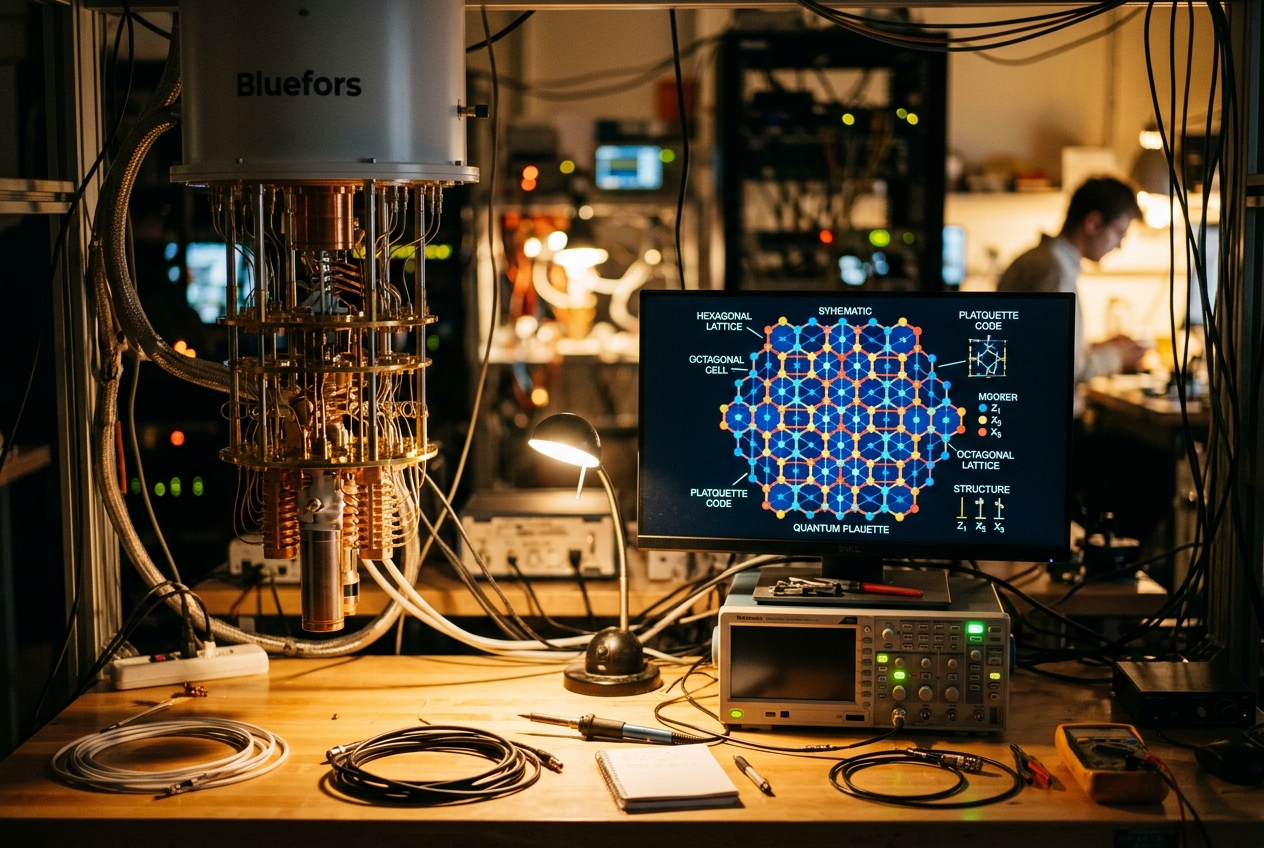
Yet inside the experimental laboratories building these machines, the immediate barrier to this revolutionary power is not a lack of quantum theory, but an unforgiving physical reality: quantum information is extraordinarily fragile. The slightest whisper of environmental thermal noise, electromagnetic jitter, or cosmic radiation corrupts a quantum bit in fractions of a millisecond. To build a quantum machine that can run algorithms of meaningful depth, physicists must construct "logical qubits"—virtual, highly protected information carriers assembled from dozens or hundreds of flawed physical qubits working in orchestrated concert.
For nearly two decades, the leading blueprint for this protection has been the two-dimensional surface code. But the surface code harbors a quiet, punishing architectural bottleneck: performing basic quantum logic on its encoded data requires an elaborate choreography of geometric slicing and physical overhead known as lattice surgery.
Now, an elegant alternative rooted in algebraic topology and graph theory is seizing center stage: topological color codes. By mapping quantum information onto three-colorable geometric lattices, color codes achieve what standard surface codes cannot—the native, instantaneous execution of the foundational set of quantum computational operations across an entire processor. Understanding how these codes work is understanding how humanity may finally bridge the chasm between noisy laboratory prototypes and scalable, world-changing quantum computing.
1. Opening Hook — Why You Should Care
To understand the magnitude of the quantum computing challenge, consider the sheer scale of the error correction tax. In classical microprocessors, a silicon transistor fails once every $10^{17}$ operations—a reliability so immense that software engineers spend their careers never having to think about hardware bit-flips. In sharp contrast, today's best physical quantum processors suffer an error roughly once every $1,000$ operations.
If you attempt to simulate a complex pharmaceutical molecule or calculate the electronic structure of a room-temperature superconductor on an uncorrected quantum processor, the calculation dissolves into random thermodynamic noise before the second step of the algorithm finishes. Error correction is not a mere optimization in quantum computing; it is the entire enterprise.
+-----------------------------------------------------------------------------------+
|                            THE FAULT-TOLERANCE PARADOX                            |
|                                                                                   |
|  Unprotected Physical Qubits:      Error rate ~ 1 in 1,000 operations             |
|  Scientific & Industrial Target:    Error rate ~ 1 in 1,000,000,000,000 operations |
|                                                                                   |
|  The Gap: 9 orders of magnitude of noise suppression required via active QEC.     |
+-----------------------------------------------------------------------------------+
For years, the engineering consensus favored the standard surface code, primarily because its simple square-grid layout matched the physical manufacturing constraints of early superconducting chips. However, running an actual quantum program requires more than just storing information safely; it requires manipulating it through quantum logic gates. On standard surface codes, executing the basic operations known as the Clifford group cannot be done simply by applying physical pulses to the qubits in parallel. Instead, the code patches must be laboriously merged, split, and routed across physical chip real estate, or supplemented by massive ancillary factories that generate and distill specialized quantum states.
Topological color codes solve this systemic bottleneck at the architectural root. By changing the geometric symmetry of the underlying lattice, color codes allow an entire block of quantum information to undergo fundamental logic transformations in a single, parallel clock cycle. The practical consequence is breathtaking: color codes can slash the total physical qubit count and execution time needed for mission-critical quantum algorithms by orders of magnitude.
2. The Idea in Plain English
To grasp how a topological color code protects information, we must first discard the classical intuition of memory. In everyday computing, if you want to protect a bit stored as a 0 or 1, you can simply make three copies: 000 or 111. If one bit accidentally flips to 010, a simple majority vote identifies the error and restores the correct data.
In the quantum domain, two strict physical laws prevent this naive approach:
1. The No-Cloning Theorem: It is fundamentally impossible to create an identical copy of an unknown, arbitrary quantum state without destroying it.
2. Measurement Collapse: Looking directly at a quantum bit that is spinning in a superposition collapses its delicate state into a classical 0 or 1, erasing the very quantum information you intended to protect.
       CLASSICAL REPETITION:                 QUANTUM ENTANGLED ENCODING:

         [ 0 ] -> [ 0 ][ 0 ][ 0 ]              |psi> -> Non-local distribution across
                                                        a topological lattice
         Measure individual bits               Measure collective topological parity
         (Direct observation allowed)          (Individual states remain hidden)
Quantum error correction overcomes this dilemma through non-local entanglement. Instead of storing quantum information inside a single physical particle, the data is smeared non-locally across an entire network of entangled qubits situated on a geometric lattice.
Imagine a large tiled floor made of hexagonal tiles, like a giant honeycomb. We place physical qubits at the corners (vertices) where the tiles meet. Next, we paint the hexagonal tiles using exactly three colors—Red, Green, and Blue—such that no two neighboring tiles share the same color. In graph theory, this structure is known as a three-colorable, trivalent planar lattice.
In standard surface codes, half of the tiles on the board check exclusively for bit-flip errors (analogous to a classical coin flipping from heads to tails), while the other half check exclusively for phase-flip errors (a purely quantum distortion where the wave-like sign of the superposition reverses).
In a topological color code, every single colored tile performs both checks simultaneously on the exact same group of surrounding qubits. The three colors act as three interwoven coordinate systems. When an environmental disturbance strikes a physical qubit, it triggers warning alarms—known as syndrome defects—on the colored plaquettes touching that vertex.
Because the three colors must always balance each other algebraically, errors reveal themselves as pairs of matching colored signals. Deciding how to fix the error becomes equivalent to tracing paths between colored dots on a map, leaving the encoded logical information perfectly insulated from the surrounding environment.
3. How It Actually Works — The Mechanics
To appreciate the theoretical elegance and practical mechanics of 2D and 3D topological color codes, we must examine their algebraic formulation, their syndrome decoding cycle, and the deep symmetry principles that govern fault-tolerant quantum logic.
           A 6.6.6 HEXAGONAL COLOR CODE PLAQUETTE

                         (v1)-------(v2)
                         /             \
                       /                 \
                     (v6)   [ Red Face ]  (v3)
                       \    S_f^X, S_f^Z  /
                         \             /
                         (v5)-------(v4)

             Qubits live on vertices (v1..v6).
             Both X and Z checks occupy the face.
The Stabilizer Algebra on Trivalent Lattices
Let $\mathcal{G} = (\mathcal{V}, \mathcal{E}, \mathcal{F})$ define a two-dimensional cellular embedding on a closed surface or planar disk with boundaries, where $\mathcal{V}$ is the set of vertices, $\mathcal{E}$ is the set of edges, and $\mathcal{F}$ is the set of faces (plaquettes).
For $\mathcal{G}$ to define a valid 2D color code, it must satisfy two topological criteria: 1. Trivalency: Every vertex $v \in \mathcal{V}$ has a degree of exactly 3 (three edges meet at every vertex). 2. 3-Colorability of Faces: The faces $\mathcal{F}$ can be partitioned into three disjoint subsets $\mathcal{F}_R, \mathcal{F}_G, \mathcal{F}_B$ (Red, Green, Blue) such that any two faces sharing an edge $e \in \mathcal{E}$ have distinct colors.
Common lattices satisfying these properties include the classic ${6,6,6}$ regular honeycomb lattice and the ${4,8,8}$ Archimedean semi-regular lattice (composed of squares and octagons).
Physical qubits are positioned on the vertices $\mathcal{V}$. For every face $f \in \mathcal{F}$, we define two stabilizer generators, one constructed entirely from Pauli-$X$ operators and the other from Pauli-$Z$ operators acting on the physical qubits situated on the boundary vertices $\partial f$ of that face:
$$S_f^X = \bigotimes_{v \in \partial f} X_v, \qquad S_f^Z = \bigotimes_{v \in \partial f} Z_v$$
Because the lattice is trivalent and 3-colorable, every face $f$ contains an even number of vertices (e.g., 6 vertices for a hexagon, 4 or 8 for squares and octagons), and any two adjacent faces $f$ and $f'$ share either zero vertices or exactly two vertices (a single shared edge).
Since Pauli operators commute on disjoint qubits and anti-commute on the same qubit ($XZ = -ZX$), the overlap between any two face stabilizers involves an even number of anti-commuting terms ($(-1)^2 = +1$). Consequently, all stabilizer generators commute unconditionally:
$$[S_f^P, S_{f'}^{P'}] = 0 \quad \forall f, f' \in \mathcal{F}, \quad P, P' \in {X, Z}$$
The code space $\mathcal{C}$ is defined as the joint $+1$ eigenspace of all face stabilizers:
$$\mathcal{C} = \left{ |\psi\rangle \in \mathcal{H}^{\otimes |\mathcal{V}|} \;\middle|\; S_f^X |\psi\rangle = |\psi\rangle, \; S_f^Z |\psi\rangle = |\psi\rangle \quad \forall f \in \mathcal{F} \right}$$
+-----------------------------------------------------------------------------------+
|               STRUCTURAL COMPARISON: SURFACE CODES VS. COLOR CODES                |
+-----------------------------------------------------------------------------------+
| Property                  | Standard 2D Surface Code  | 2D Topological Color Code |
+---------------------------+---------------------------+---------------------------+
| Qubit Placement           | Edges of square lattice   | Vertices of 3-color graph |
| Stabilizer Structure      | Vertex (X) & Face (Z)     | Face hosts BOTH (X and Z) |
| Lattice Requirements      | 2-colorable quad mesh     | Trivalent, 3-colorable    |
| Transversal Hadamard      | No (requires surgery)     | Yes (native bit-wise H)   |
| Transversal Phase S Gate  | No (requires distillation)| Yes (on 4.8.8 lattices)   |
| Transversal CNOT Gate     | Transversal between blocks| Transversal between blocks|
| Syndrome Graph Topology   | 2 independent dual graphs | 3-color hypergraph        |
+-----------------------------------------------------------------------------------+
The Transversal Clifford Advantage
The defining triumph of 2D topological color codes is their ability to perform the full single-qubit Clifford group—comprising the Hadamard gate $H$, the Phase gate $S$, and the two-qubit Controlled-NOT ($\text{CNOT}$) gate—transversally.
A quantum logic gate is transversal if it can be applied to a logical qubit by executing independent physical single-qubit gates on each physical qubit in the code block in parallel ($U_{\text{logical}} = \bigotimes_{v=1}^n U_v$). Transversal operations are inherently fault-tolerant: because no physical gate interacts across different qubits within the same code block, a single physical hardware failure during the gate execution cannot cascade into a catastrophic multi-qubit error.
       TRANSVERSAL GATE EXECUTION (FAULT-TOLERANT BY DEFINITION)

       Logical Qubit A:   (q1)   (q2)   (q3)   ...   (qn)
                           |      |      |            |
                         [ U ]  [ U ]  [ U ]        [ U ]  <-- Independent pulses
                           |      |      |            |
       Output State:      (q1')  (q2')  (q3')  ...   (qn')

       *Notice: No horizontal coupling. Errors cannot spread across qubits!*
In standard 2D surface codes, applying a bit-wise physical Hadamard transformation maps $X \leftrightarrow Z$. But because $X$-stabilizers live on vertices (stars) while $Z$-stabilizers live on faces (plaquettes), a physical Hadamard transforms the code into a geometrically shifted dual lattice. The logical state cannot remain in place; it requires physical reconfiguration.
In a 2D color code, because $S_f^X$ and $S_f^Z$ reside on the exact same physical vertices of face $f$, applying a physical Hadamard gate $H = \frac{1}{\sqrt{2}}\begin{pmatrix} 1 & 1 \ 1 & -1 \end{pmatrix}$ to every vertex simultaneously maps $S_f^X \leftrightarrow S_f^Z$. The stabilizer group is mapped directly back onto itself invariant under permutation, executing a fault-tolerant logical Hadamard in a single clock cycle.
Furthermore, on self-dual color code geometries (such as triangular color codes on 4.8.8 or 6.6.6 lattices with appropriate boundary colorings), the phase gate $S = \begin{pmatrix} 1 & 0 \ 0 & i \end{pmatrix}$ and the two-qubit $\text{CNOT}$ gate between identical code patches are also strictly transversal.
The Eastin-Knill Limit and 3D Gauge Fixing
A celebrated foundational result in theoretical quantum physics is the Eastin-Knill Theorem, which proves that no quantum error-correcting code can implement a universal set of quantum gates exclusively through transversal operations.
To achieve universal quantum computation, any code must supplement its transversal operations with a non-Clifford gate, such as the $T$-gate ($T = \text{diag}(1, e^{i\pi/4})$), which provides the critical non-linearity required for quantum supremacy.
Surface codes must generate these $T$-gates through Magic State Distillation—a process where hundreds of imperfect ancillary physical qubits are consumed in a specialized verification circuit to produce a single high-purity $T$-state, creating massive computational overhead.
Topological color codes provide a breathtaking structural workaround: Gauge Fixing in 3D Color Codes. In three dimensions, color codes can be formulated on 4-colorable, 4-valent spatial lattices (such as tetrahedral cellulations). In 3D color codes: - The entire Clifford group is no longer transversal in a single static gauge. - Instead, the non-Clifford $T$-gate becomes strictly transversal in 3D!
By dynamically switching the gauge degrees of freedom between a 2D color code slice (which supports transversal Clifford operations) and a 3D color code volume (which supports transversal $T$-gates), a quantum computer can achieve universal fault-tolerant computation without needing magic state distillation factories. This technique, pioneered by quantum theorist Héctor Bombín, represents one of the most mathematically profound paradigms in quantum information theory.
+-----------------------------------------------------------------------------------+
|                        UNIVERSALITY VIA DIMENSIONAL GAUGE FIXING                  |
|                                                                                   |
|      2D Color Code Subsystem                     3D Color Code Structure          |
|   +---------------------------+               +-----------------------------+     |
|   | Transversal Gates:        |   Gauge       | Transversal Gates:          |     |
|   | { H, S, CNOT } (Clifford) | <-----------> | { T, CNOT } (Non-Clifford)  |     |
|   +---------------------------+   Switching   +-----------------------------+     |
|                                                                                   |
|   Result: Full universal quantum computation without magic state factories!       |
+-----------------------------------------------------------------------------------+
The Syndrome Decoding Cycle
Detecting errors in a color code requires measuring all stabilizer generators periodically without disturbing the data. In a physical processor, this is achieved by entangling each colored plaquette with an auxiliary ancilla qubit located at the plaquette's center.
When a physical error strikes a qubit at vertex $v$, it flips the eigenvalues of all adjacent plaquettes of different colors that anti-commute with that error. Because every vertex is touched by three distinct colored faces (Red, Green, Blue), an isolated Pauli error creates a signature triad of syndrome defects.
                         R (Red Defect)
                        / \
                       /   \
                      /  v  \  <-- Error on vertex v
                     /       \
     (Green Defect) G---------B (Blue Defect)
Decoding this error syndrome requires matching and neutralizing these defects. Because the syndrome space is a 3-color hypergraph rather than a simple 2-endpoint graph, decoding color codes was historically considered computationally harder than surface codes.
However, modern quantum computing leverages the Restriction Decoder: 1. The 3-color syndrome is projected into two independent sub-graphs: the Red-Green restriction and the Red-Blue restriction. 2. On each restricted sub-graph, the syndrome defects reduce precisely to pairs of endpoints, identical to the syndrome graphs of standard surface codes. 3. The processor solves these sub-problems in polynomial time using the Minimum Weight Perfect Matching (MWPM) algorithm or modern Union-Find decoders. 4. The individual solutions are combined algebraically to generate a global correction operator $C \in \mathcal{P}_n$.
Under phenomenological noise models, 2D color codes exhibit fault-tolerant error thresholds between $1.5\%$ and $2.0\%$, while under realistic circuit-level noise, their threshold sits between $0.6\%$ and $0.9\%$. While this circuit threshold is marginally lower than the surface code's $\sim 1.0\%$, the color code's massive savings in gate compilation and transversal Clifford logic more than compensate for the slight threshold difference.
4. Real-World Applications Today
The theoretical promises of topological color codes are actively escaping textbooks and entering hardware testbeds across the international quantum computing sector. As quantum architectures mature between 2024 and 2026, several world-leading institutions are deploying color code principles on physical processors:
+-----------------------------------------------------------------------------------+
|               WHERE TOPOLOGICAL COLOR CODES ARE BEING DEPLOYED                    |
+-----------------------------------------------------------------------------------+
| Institution / Enterprise | Hardware Modality   | Strategic Quantum Objective      |
+--------------------------+---------------------+----------------------------------+
| Quantinuum               | Trapped-Ion         | Transversal Clifford execution   |
| Harvard Univ. / QuEra    | Neutral Atoms       | Reconfigurable logical arrays    |
| IBM Quantum              | Superconducting     | Heavy-hex color code compilation |
| PsiQuantum               | Silicon Photonics   | 3D cluster state gauge-fixing    |
+-----------------------------------------------------------------------------------+
1. Quantinuum (Trapped-Ion Architecture)
Quantinuum has utilized its high-fidelity H1 and H2 trapped-ion quantum processors to physically demonstrate fault-tolerant logical operations using triangular 2D color codes. - The Challenge: Physical superconducting chips struggle with color codes because physical qubits must connect to 3 or 4 neighbors, complicating 2D planar lithography. - The Trapped-Ion Advantage: Quantinuum's trapped ions are held in electromagnetic traps and shuttled physically across the chip, providing arbitrary all-to-all physical connectivity. This allows them to measure weight-6 and weight-8 plaquette stabilizers with record-low cross-talk, demonstrating fully fault-tolerant transversal $H$ and $S$ gates on encoded logical qubits.
2. Harvard University, MIT, and QuEra Computing (Neutral-Atom Arrays)
In breakthrough research published in Nature, a collaboration led by Harvard University, MIT, and QuEra Computing demonstrated an algorithmic quantum processor containing up to 48 logical qubits using neutral rubidium atoms controlled by optical tweezer arrays. - The Application: The team dynamically shuttled entangled atom ensembles to create transversal entangling gates between color code blocks, performing complex fault-tolerant algorithms including deep Clifford circuits and entanglement teleportation. - The Advantage: The ability to mechanically rearrange atoms mid-circuit eliminates the geometric locality constraints that once made 2D and 3D color code syndrome extraction challenging.
3. IBM Quantum (Superconducting Processors & Qiskit)
Researchers within the IBM Quantum ecosystem are investigating hybrid color-code and surface-code compilation routines on heavy-hexagonal lattice processors. - The Application: Using Qiskit's open-source error correction framework, developers and researchers model how 2D color code patches can be embedded into low-degree superconducting planar grids to run transversal Clifford-heavy subroutines, such as quantum Fourier transforms and syndrome check validation. - The Advantage: Significantly reducing the total circuit depth required for near-term chemical simulations of battery materials and catalyst molecules.
4. PsiQuantum (Fault-Tolerant Silicon Photonics)
PsiQuantum is developing a commercial utility-scale quantum computer using single photons traveling through micro-fabricated silicon photonic waveguides. - The Application: Because photons move at the speed of light and cannot be stored indefinitely in static memory cells, PsiQuantum utilizes Fusion-Based Quantum Computing, weaving photonic resource states into a continuous 3D topological cluster state. - The Advantage: The 3D lattice topologies being engineered directly mirror 3D color codes, allowing topological gauge fixing to produce non-Clifford operations continuously across the time dimension without requiring physical matter-based memory registers.
5. What This Means for You
It is easy to view debates over quantum error-correcting codes as esoteric mathematical squabbles between academic physicists. But the choice between a surface code and a topological color code directly dictates when quantum computing will transition from a billion-dollar laboratory experiment into an industrial reality that touches your daily life.
       WITHOUT COLOR CODES:
       [ Million-Qubit Magic State Factories ] ---> Decades to Fault-Tolerance

       WITH TOPOLOGICAL COLOR CODES:
       [ Compact Transversal Architecture ]    ---> Years to Scalable Utility
Consider the timeline for developing next-generation clean energy technologies. Designing an artificial catalyst to replicate the natural efficiency of the nitrogenase enzyme (used by bacteria to make fertilizer at room temperature) could replace the energy-intensive Haber-Bosch process, which currently consumes roughly 2% of the entire world's energy supply. Simulating that single enzyme's active chemical core requires a quantum computer capable of executing millions of error-free quantum gates.
Under old fault-tolerant designs relying solely on surface codes and magic state factories, such a simulation demanded a warehouse-sized machine with millions of physical qubits. Topological color codes dramatically streamline that architecture, drastically reducing the physical qubit count and computational runtime needed for commercial-scale simulations.
For the average citizen, this architectural leap accelerates the arrival of: - Revolutionary Materials: Ultra-dense solid-state batteries for electric vehicles that charge in minutes and last for decades. - Precision Oncology: Drug compounds designed in silico with sub-atomic atomic precision, eliminating years of trial-and-error animal testing. - Post-Quantum Cybersecurity: An urgent, concrete timetable for financial institutions and governments to deploy quantum-resistant encryption before legacy public-key infrastructure is rendered obsolete.
The mathematical symmetries discovered inside these abstract three-color grids are laying the actual engineering tracks for the 21st century's computational revolution.
6. Today's Takeaway
Further Reading and Authoritative Resources
- Explore the foundations of stabilizer formalism on the Wikipedia Quantum Error Correction Portal.
- Read the seminal paper on topological quantum computation and color codes on the arXiv Quantum Physics Archive.
- Learn how to program stabilizer circuits interactively through IBM Quantum Learning & Qiskit.
- Review the MIT course materials on fault-tolerant quantum algorithms at MIT OpenCourseWare.
- Explore experimental neutral-atom logical qubit milestones published directly in Nature.