Choi-Jamiołkowski Isomorphism: Unifying Quantum Channels and Bipartite Entangled States Via Channel-State Duality
The defining race of twenty-first-century physics is not merely the construction of larger quantum processors, but the mastery of quantum noise. Every prospective breakthrough promised by quantum computation—from the synthesis of room-temperature superconductors and catalysts for carbon capture to Shor’s polynomial-time factoring of RSA cryptography—hinges on quantum error correction. Yet, an uncorrected quantum computer is exceptionally vulnerable. A stray magnetic fluctuation, an infinitesimal thermal gradient, or a stray microwave photon can alter quantum phases, corrupting calculations in microseconds.
Before physicists can correct errors, they must solve a fundamental diagnostic problem: how do you completely characterize an unknown, noisy physical process without testing an infinite continuum of quantum states? In classical computing, debugging a digital logic gate is straightforward—one measures discrete binary outputs across a finite truth table. In the quantum realm, a physical operation is an open dynamical process that can deform an infinite continuum of superpositions in uncountably many ways.
The mathematical master key to this problem was forged independently by Erling Størmer, Man-Duen Choi, and Andrzej Jamiołkowski. Known today as the Choi-Jamiołkowski Isomorphism (or channel-state duality), this foundational theorem establishes a bijective equivalence between dynamical quantum operations and static physical quantum states. By passing one half of an entangled particle pair through a black-box quantum channel, the entire dynamical fingerprint of that channel is permanently mapped into the spatial geometry of the resulting two-particle state.
Without this isomorphism, modern quantum engineering would lack the mathematical apparatus required for quantum process tomography, gate fidelity verification, and fault-tolerance threshold certification across superconducting, trapped-ion, and photonic architectures.
THE IDEA IN PLAIN ENGLISH
To build an intuition for channel-state duality, imagine you are tasked with stress-testing a mysterious optical lens inside a sealed chamber. The lens could rotate light, warp focus, dim brightness, or introduce chaotic scattering.
One brute-force method of testing the lens is to shine every possible color, angle, and polarization of light through it one by one, recording how each beam is altered. Because light polarization occupies a continuous sphere of possibilities (the Bloch sphere), testing every state individually would require an infinite sequence of measurements.
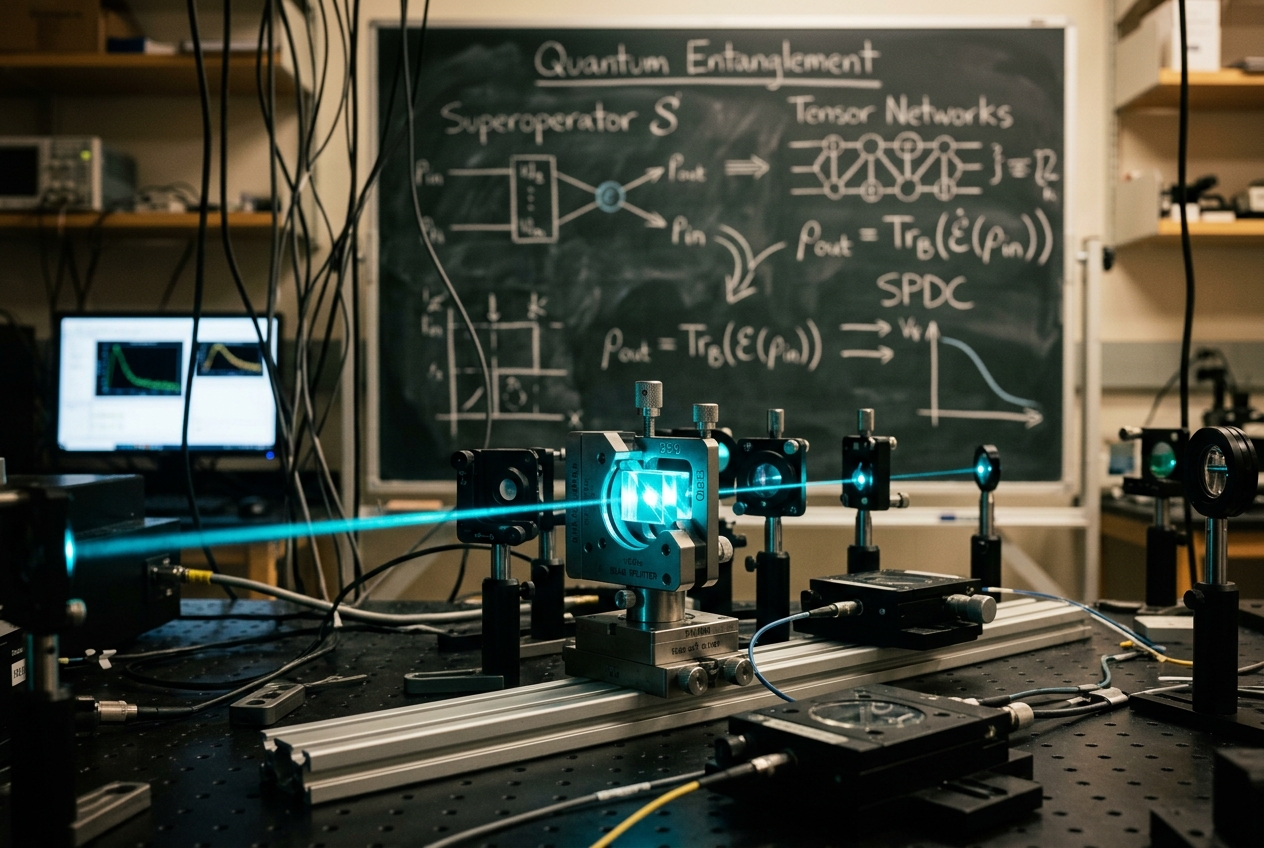
Channel-state duality provides an elegant alternative. Instead of sending single beams through the lens sequentially across time, you generate pairs of twins: twin photons that are maximally entangled. Entanglement creates a perfect correlation where neither photon possesses a fixed polarization on its own, yet together they embody all polarizations simultaneously.
You keep one twin photon safely outside the chamber in a pristine vacuum, and you send the other twin photon through the mysterious lens. When the second twin emerges, the lens has altered its properties. However, because it was intimately entangled with its twin outside, the transformation is captured in the joint correlation between the two particles.
By performing standard measurements on this stationary, two-particle state, you extract the entire mathematical description of the lens. You have transformed an active, dynamical operation occurring over time into a frozen, static geometric state distributed across space.
HOW IT ACTUALLY WORKS — THE MECHANICS OF CHANNEL-STATE DUALITY
To formalize this duality, we define the mathematical spaces governing quantum transformations. Let $\mathcal{H}_A$ and $\mathcal{H}_B$ denote finite-dimensional complex Hilbert spaces of dimension $d_A$ and $d_B$, with $\mathcal{L}(\mathcal{H})$ representing the space of linear operators acting on $\mathcal{H}$.
A physically realizable quantum transformation is formalized as a Completely Positive Trace-Preserving (CPTP) map, commonly termed a quantum channel:
$$\mathcal{E}: \mathcal{L}(\mathcal{H}_A) \to \mathcal{L}(\mathcal{H}_B)$$
1. Canonical Mathematical Construction
The isomorphism proceeds by preparing a canonical, unnormalized maximally entangled state $|\Omega\rangle \in \mathcal{H}_A \otimes \mathcal{H}_A$, or equivalently the normalized Bell state $|\Phi^+\rangle$:
$$|\Phi^+\rangle = \frac{1}{\sqrt{d}} \sum_{i=0}^{d-1} |i\rangle_A \otimes |i\rangle_B$$
where ${|i\rangle}$ forms an orthonormal basis for $\mathcal{H} \cong \mathbb{C}^d$. The Choi matrix $J(\mathcal{E}) \in \mathcal{L}(\mathcal{H}_B \otimes \mathcal{H}_A)$, associated with the linear map $\mathcal{E}$, is generated by applying the channel $\mathcal{E}$ to the first subsystem while leaving the second subsystem untouched via the identity superoperator $\mathcal{I}_A$:
$$J(\mathcal{E}) = (\mathcal{E} \otimes \mathcal{I}A)(|\Phi^+\rangle\langle\Phi^+|) = \frac{1}{d} \sum{i,j=0}^{d-1} \mathcal{E}(|i\rangle\langle j|) \otimes |i\rangle\langle j|$$
This explicit formula packs the action of $\mathcal{E}$ on every elementary matrix unit $|i\rangle\langle j|$ into orthogonal matrix blocks of a single bipartite density operator.
2. Equivalence of Complete Positivity and Positive Semi-Definiteness
A linear map $\mathcal{E}$ is defined as positive if it maps positive semi-definite operators to positive semi-definite operators: $\rho \ge 0 \implies \mathcal{E}(\rho) \ge 0$. However, simple positivity is insufficient to describe physical quantum operations. If a system $A$ is entangled with an inert spectator system $R$, the composite map $\mathcal{E} \otimes \mathcal{I}_R$ must yield valid, non-negative quantum states for arbitrary auxiliary dimensions $d_R$.
A map is completely positive (CP) if and only if:
$$(\mathcal{E} \otimes \mathcal{I}R)(\rho{AR}) \ge 0 \quad \forall \, d_R \in \mathbb{N}, \; \forall \, \rho_{AR} \ge 0$$
A classic counterexample of a positive map that fails complete positivity is the matrix transposition map $\mathcal{T}(\rho) = \rho^T$. While $\rho^T$ preserves eigenvalues and hermiticity for isolated states, applying $\mathcal{T} \otimes \mathcal{I}$ to the maximally entangled state $|\Phi^+\rangle\langle\Phi^+|$ yields the partial transpose operator:
$$(\mathcal{T} \otimes \mathcal{I})(|\Phi^+\rangle\langle\Phi^+|) = \frac{1}{d} \sum_{i,j} |j\rangle\langle i| \otimes |i\rangle\langle j| = \frac{1}{d} \mathbb{F}$$
where $\mathbb{F}$ is the swap operator. The eigenvalues of the swap operator are $+1/d$ (symmetric subspace) and $-1/d$ (antisymmetric subspace). The existence of negative eigenvalues demonstrates that transposition cannot occur as a physical process in nature.
Theorem (Choi, 1975): A linear map $\mathcal{E}: \mathcal{L}(\mathcal{H}_A) \to \mathcal{L}(\mathcal{H}_B)$ is completely positive if and only if its Choi matrix is positive semi-definite: $$J(\mathcal{E}) \ge 0$$
Proof sketch of necessity and sufficiency: 1. Necessity ($\implies$): If $\mathcal{E}$ is completely positive, then by definition $(\mathcal{E} \otimes \mathcal{I})(|\Phi^+\rangle\langle\Phi^+|) \ge 0$, because $|\Phi^+\rangle\langle\Phi^+|$ is a valid positive semi-definite density operator on $\mathcal{H}A \otimes \mathcal{H}_A$. Thus, $J(\mathcal{E}) \ge 0$ is immediate. 2. Sufficiency ($\impliedby$): Assume $J(\mathcal{E}) \ge 0$. Because $J(\mathcal{E})$ is a positive semi-definite operator on $\mathcal{H}_B \otimes \mathcal{H}_A$, it can be expanded via the spectral theorem into a sum of non-negative rank-1 projectors: $$J(\mathcal{E}) = \sum_k \lambda_k |\psi_k\rangle\langle\psi_k|, \quad \lambda_k \ge 0$$ Each bipartite vector $|\psi_k\rangle \in \mathcal{H}_B \otimes \mathcal{H}_A$ can be systematically mapped to a linear operator $K_k: \mathcal{H}_A \to \mathcal{H}_B$ through the relation: $$|\psi_k\rangle = (K_k \otimes I)|\Phi^+\rangle$$ Substituting this back into the channel evaluation demonstrates that the action of $\mathcal{E}$ on an arbitrary input state $\rho$ expands as: $$\mathcal{E}(\rho) = \sum_k K_k \rho K_k^\dagger$$ Since each term $K_k \rho K_k^\dagger$ is positive semi-definite whenever $\rho \ge 0$, the composite map $(\mathcal{E} \otimes \mathcal{I}_R)(\rho{AR})$ is guaranteed to remain positive semi-definite for any dimension $d_R$. Complete positivity is thereby proven.
3. The Trace-Preserving Condition
For a quantum channel to conserve probability, the trace of the output state must equal the trace of the input state for all density matrices: $\mathrm{Tr}(\mathcal{E}(\rho)) = \mathrm{Tr}(\rho) = 1$. In terms of the Choi representation, taking the partial trace over the output system $\mathcal{H}_B$ yields a direct constraint on the input reference system:
$$\mathrm{Tr}_B(J(\mathcal{E})) = \frac{1}{d_A} I_A$$
When normalized as a physical bipartite density matrix $\rho_{\mathcal{E}} = J(\mathcal{E})$, the reduced state on the auxiliary reference register is completely mixed: $\mathrm{Tr}B(\rho{\mathcal{E}}) = \frac{1}{d} I_A$.
4. Derivation of the Kraus Representation Theorem
The spectral decomposition of the Choi matrix provides an explicit algorithm for finding the Kraus operators (or operation elements) of any arbitrary CPTP map without heuristic ansatzes.
Given the spectral resolution $J(\mathcal{E}) = \sum_{k=1}^{r} |\tilde{\psi}_k\rangle\langle\tilde{\psi}_k|$ where $|\tilde{\psi}_k\rangle = \sqrt{\lambda_k} |\psi_k\rangle$ and $r = \mathrm{rank}(J(\mathcal{E})) \le d_A d_B$, we expand each vector in the computational basis:
$$|\tilde{\psi}k\rangle = \sum{i=0}^{d_B-1} \sum_{j=0}^{d_A-1} c_{ij}^{(k)} |i\rangle_B \otimes |j\rangle_A$$
We construct the matrix elements of the $k$-th Kraus operator $K_k$ directly via index unflattening:
$$\langle i | K_k | j \rangle = \sqrt{d} \, c_{ij}^{(k)}$$
This yields the canonical Sudarshan-Kraus representation:
$$\mathcal{E}(\rho) = \sum_{k=1}^{r} K_k \rho K_k^\dagger \quad \text{with} \quad \sum_{k=1}^{r} K_k^\dagger K_k = I_A$$
The rank of the Choi matrix, $\mathrm{rank}(J(\mathcal{E}))$, defines the Kraus rank of the channel—the minimum number of environmental interaction modes required to simulate the channel’s open system dynamics.
WORKED CALCULATIONS FOR CANONICAL QUANTUM NOISE CHANNELS
To illustrate the mathematical machinery in practice, we compute the explicit Choi matrices and Kraus decompositions for the two most pervasive error channels in quantum hardware.
Example 1: The Qubit Depolarizing Channel
The single-qubit depolarizing channel models uniform isotropic noise, replacing a qubit with the maximally mixed state with probability $p$, while preserving the original state with probability $1-p$:
$$\mathcal{E}_{\text{dep}}(\rho) = (1-p)\rho + p \frac{I}{2} = \left(1 - \frac{3p}{4}\right)\rho + \frac{p}{4}(X\rho X + Y\rho Y + Z\rho Z)$$
Let us calculate its Choi matrix using the two-qubit Bell state $|\Phi^+\rangle = \frac{1}{\sqrt{2}}(|00\rangle + |11\rangle)$:
$$J(\mathcal{E}{\text{dep}}) = (\mathcal{E}{\text{dep}} \otimes \mathcal{I})(|\Phi^+\rangle\langle\Phi^+|)$$
Expanding $|\Phi^+\rangle\langle\Phi^+| = \frac{1}{2}(|00\rangle\langle00| + |00\rangle\langle11| + |11\rangle\langle00| + |11\rangle\langle11|)$, we evaluate the channel's action on each matrix component:
- $\mathcal{E}_{\text{dep}}(|0\rangle\langle0|) = (1-p)|0\rangle\langle0| + \frac{p}{2}(|0\rangle\langle0| + |1\rangle\langle1|) = \left(1-\frac{p}{2}\right)|0\rangle\langle0| + \frac{p}{2}|1\rangle\langle1|$
- $\mathcal{E}_{\text{dep}}(|1\rangle\langle1|) = \frac{p}{2}|0\rangle\langle0| + \left(1-\frac{p}{2}\right)|1\rangle\langle1|$
- $\mathcal{E}_{\text{dep}}(|0\rangle\langle1|) = (1-p)|0\rangle\langle1|$
- $\mathcal{E}_{\text{dep}}(|1\rangle\langle0|) = (1-p)|1\rangle\langle0|$
Assembling these blocks into the $4 \times 4$ bipartite matrix ordered in the computational basis ${|00\rangle, |01\rangle, |10\rangle, |11\rangle}$:
$$J(\mathcal{E}_{\text{dep}}) = \frac{1}{2} \begin{pmatrix} 1 - \frac{p}{2} & 0 & 0 & 1-p \ 0 & \frac{p}{2} & 0 & 0 \ 0 & 0 & \frac{p}{2} & 0 \ 1-p & 0 & 0 & 1 - \frac{p}{2} \end{pmatrix}$$
This result represents an isotropic state—a convex combination of the pure maximally entangled Bell projector and the maximally mixed identity background:
$$J(\mathcal{E}_{\text{dep}}) = (1-p)|\Phi^+\rangle\langle\Phi^+| + \frac{p}{4} I_4$$
The eigenvalues of $J(\mathcal{E}{\text{dep}})$ are readily extracted: - $\lambda_1 = 1 - \frac{3p}{4}$ (associated with eigenvector $|\Phi^+\rangle$) - $\lambda{2,3,4} = \frac{p}{4}$ (associated with the remaining three orthogonal Bell states $|\Psi^+\rangle, |\Psi^-\rangle, |\Phi^-\rangle$)
Complete positivity requires all eigenvalues $\lambda_i \ge 0$, which yields the physical parameter bound $0 \le p \le \frac{4}{3}$. The upper bound $p = 4/3$ corresponds to the complete depolarization map that completely erases all input quantum information.
Example 2: The Amplitude Damping Channel
The amplitude damping channel models the non-unitary energy relaxation of a two-level atom or superconducting transmon qubit emitting a photon to its cold environment ($|1\rangle \to |0\rangle$) with decay probability $\gamma \in [0, 1]$.
The standard operational Kraus operators for this channel are:
$$E_0 = \begin{pmatrix} 1 & 0 \ 0 & \sqrt{1-\gamma} \end{pmatrix}, \quad E_1 = \begin{pmatrix} 0 & \sqrt{\gamma} \ 0 & 0 \end{pmatrix}$$
Evaluating the channel across basis matrix elements: - $\mathcal{E}{\text{amp}}(|0\rangle\langle0|) = |0\rangle\langle0|$ - $\mathcal{E}{\text{amp}}(|1\rangle\langle1|) = \gamma |0\rangle\langle0| + (1-\gamma)|1\rangle\langle1|$ - $\mathcal{E}{\text{amp}}(|0\rangle\langle1|) = \sqrt{1-\gamma}|0\rangle\langle1|$ - $\mathcal{E}{\text{amp}}(|1\rangle\langle0|) = \sqrt{1-\gamma}|1\rangle\langle0|$
Constructing the Choi matrix via block substitution:
$$J(\mathcal{E}_{\text{amp}}) = \frac{1}{2} \begin{pmatrix} 1 & 0 & 0 & \sqrt{1-\gamma} \ 0 & 0 & 0 & 0 \ 0 & 0 & \gamma & 0 \ \sqrt{1-\gamma} & 0 & 0 & 1-\gamma \end{pmatrix}$$
We verify the trace-preserving condition by computing the partial trace over the output register $B$ (summing the $2 \times 2$ diagonal sub-blocks):
$$\mathrm{Tr}B(J(\mathcal{E}{\text{amp}})) = \frac{1}{2} \left[ \begin{pmatrix} 1 & 0 \ 0 & 0 \end{pmatrix} + \begin{pmatrix} \gamma & 0 \ 0 & 1-\gamma \end{pmatrix} \right] = \frac{1}{2} \begin{pmatrix} 1+\gamma & 0 \ 0 & 1-\gamma \end{pmatrix} \ne \frac{1}{2} I$$
Notice that taking the partial trace over system $A$ (the right-hand spectator register):
$$\mathrm{Tr}A(J(\mathcal{E}{\text{amp}})) = \frac{1}{2} \begin{pmatrix} 1 & 0 \ 0 & 0 \end{pmatrix} + \frac{1}{2} \begin{pmatrix} 0 & 0 \ 0 & \gamma \end{pmatrix} + \frac{1}{2} \begin{pmatrix} 0 & 0 \ 0 & 1-\gamma \end{pmatrix} + \frac{1}{2} \begin{pmatrix} 0 & 0 \ 0 & 0 \end{pmatrix} = \frac{1}{2} \begin{pmatrix} 1 & 0 \ 0 & 1 \end{pmatrix} = \frac{1}{2} I_2$$
This confirms that the trace-preserving condition $\mathrm{Tr}_A(J(\mathcal{E})) = \frac{1}{d} I_B$ holds precisely.
Diagonalizing this matrix reveals non-zero eigenvalues $\lambda_0 = 1 + \sqrt{1-\gamma + \gamma - \gamma} = \frac{1 + \sqrt{1-\gamma^2 + \dots}}{2}$, directly recovering the two Kraus operators $E_0$ and $E_1$.
REAL-WORLD APPLICATIONS TODAY (2024–2026)
Channel-state duality is not merely an abstract structural theorem; it serves as the computational engine for characterization and verification protocols across leading industrial and academic quantum computing initiatives.
1. Quantum Process Tomography (QPT) and Gate Certification
- Institutions: IBM Quantum and the National Institute of Standards and Technology (NIST).
- The Objective: Reconstructing complete mathematical descriptions of multi-qubit physical logic gates (such as native Cross-Resonance and CZ gates) on superconducting transmon chips.
- The Dual Advantage: In standard QPT, experimentalists prepare an informationally complete set of input states, send them through the gate, and perform state tomography on the outputs. Reconstructing the raw process matrix $\chi$ often produces non-physical matrices with negative probabilities due to finite measurement sampling shot noise. By mapping the problem to the Choi matrix, experimentalists formulate reconstruction as a Semidefinite Program (SDP): finding the closest valid density matrix $J(\mathcal{E}) \ge 0$ satisfying trace preservation. This guarantees that reconstructed gates respect physical laws.
2. Characterization of Non-Markovian Leakage and Crosstalk
- Institution: Google Quantum AI.
- The Objective: Diagnosing spatial crosstalk and non-computational state leakage on 72+ qubit Sycamore and Willow processors.
- The Dual Advantage: Physical qubits are multi-level systems where energy can leak from the computational subspace ${|0\rangle, |1\rangle}$ into higher parasitic levels like $|2\rangle$. Google researchers analyze the spectral decomposition of experimental Choi matrices to isolate unitary gate rotations from incoherent non-unitary leakage modes. The rank of the reconstructed Choi matrix directly identifies how many distinct environmental noise channels are simultaneously corrupting the processor.
3. High-Fidelity Entangling Gate Verification
- Institution: Quantinuum.
- The Objective: Validating two-qubit Mølmer-Sørensen entangling gates with physical fidelities surpassing the $99.9\%$ fault-tolerant threshold on trapped-ion architectures (such as the H1 and H2 systems).
- The Dual Advantage: Using channel-state duality, the entanglement fidelity $F_e(\mathcal{E})$ of a quantum gate is computed directly as the quantum state fidelity between the experimental Choi state $\rho_{\mathcal{E}}$ and the target unitary Choi state $|\Phi_U\rangle$: $$F_e(\mathcal{E}) = \langle \Phi_U | \rho_{\mathcal{E}} | \Phi_U \rangle$$ This establishes an equivalence between measuring gate fidelity and performing bipartite state verification, bypassing costly numerical integrations of master equations.
4. Quantum Communication Channel Capacity Bounds
- Institutions: MIT Center for Theoretical Physics and the Harvard Quantum Initiative.
- The Objective: Calculating the fundamental capacity limits of repeaterless optical fiber networks and satellite free-space links for Quantum Key Distribution (QKD).
- The Dual Advantage: Computing the quantum capacity $Q(\mathcal{E})$ of a channel requires optimizing coherent information over infinite channel uses due to non-additivity. By applying the Choi-Jamiołkowski isomorphism, theorists translate entropic bounds on the Choi state—such as its conditional quantum entropy and coherent information—into strict upper bounds on private communication rates, establishing theoretical limits documented across Nature Physics and Physical Review Letters.
WHAT THIS MEANS FOR YOU
For non-specialists, the Choi-Jamiołkowski isomorphism might appear as an esoteric piece of functional analysis. However, its practical implications govern the timeline for practical, fault-tolerant quantum computers.
Consider the development of targeted cancer therapeutics and enzyme design. Simulating the electronic structure of the active cofactor in Nitrogenase (FeMoco)—which could transform industrial fertilizer production and eliminate up to 2% of worldwide carbon emissions—demands a quantum processor capable of executing over one billion logical quantum gates without a single uncorrected error.
Fault-tolerant error-correcting codes, such as surface codes, work by constantly measuring syndromes to detect and reverse errors. If the noise affecting the qubits is asymmetric—for instance, if phase-flip errors occur ten times more frequently than bit-flip errors—decoding algorithms must be calibrated to those exact noise parameters.
The Choi-Jamiołkowski isomorphism provides the exact mathematical language used by hardware teams to calibrate these real-time decoders. By transforming noisy operations into measurable states, quantum engineers can continuously extract noise profiles, adjust error-correcting thresholds, and bridge the gap between noisy experimental prototypes and fault-tolerant computation.
TODAY'S TAKEAWAY
The Choi-Jamiołkowski Isomorphism establishes a foundational principle of quantum information theory: every physical transformation occurring through time corresponds to an entangled quantum state existing across space. By transforming dynamical operations into static bipartite density matrices, channel-state duality translates questions about open quantum dynamics, non-unitary noise, and gate fidelities into the linear algebra of density operators—underpinning modern quantum tomography, device benchmarking, and the architecture of fault-tolerant computing.