Cat Qubits: Engineering Biased-Noise Bosonic States and Driven-Dissipative Stabilization for Scalable Error Correction
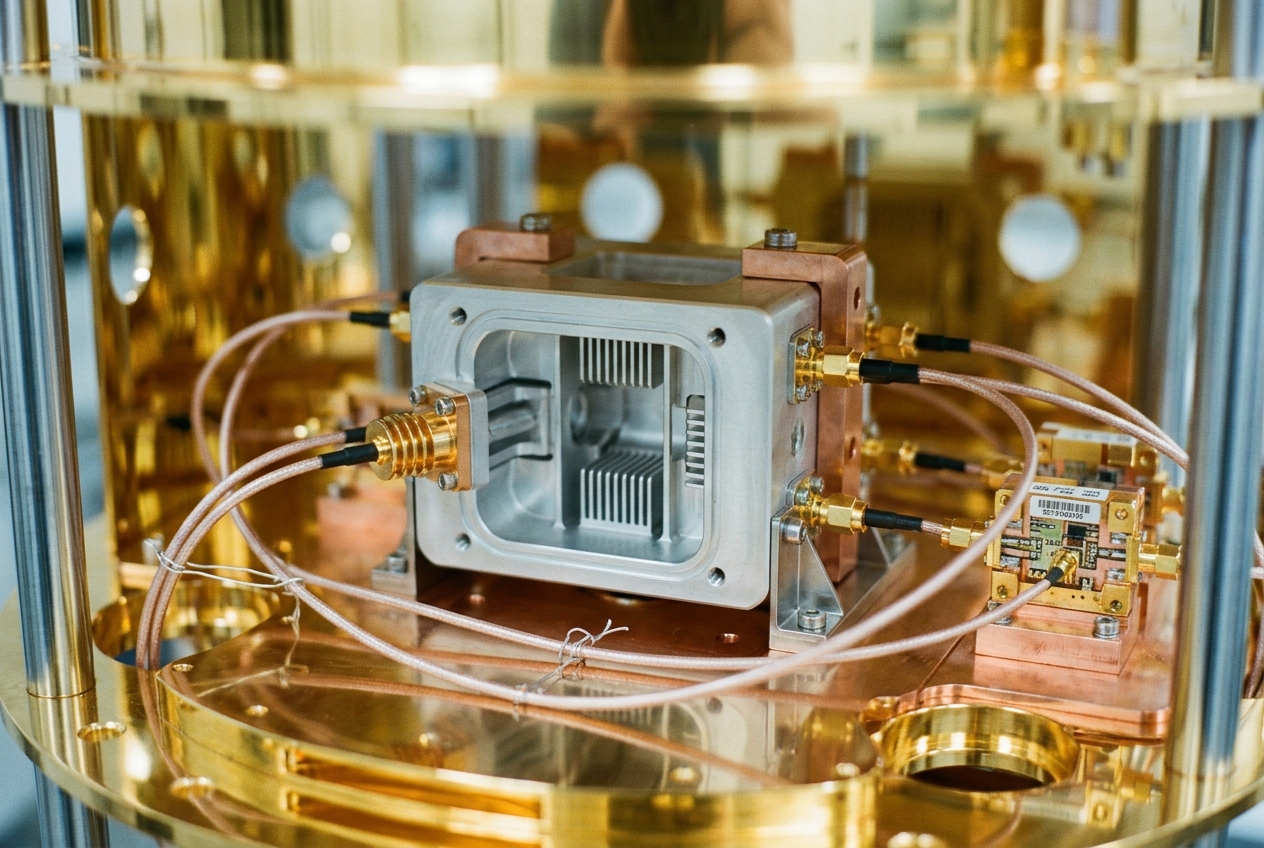
1. Opening Hook — Why You Should Care
Every digital transaction safeguarding the modern world—from real-time banking clearances and encrypted state communications to medical records and global supply chains—rests on a fragile mathematical asymmetry. It takes a conventional computer seconds to multiply two prime numbers together, but millions of years to reverse the process and extract the underlying factors. A fully operational, fault-tolerant quantum computer could dissolve that asymmetry in an afternoon.
Yet, for decades, humanity has faced an engineering impasse known as the "qubit overhead crisis." In standard quantum architectures, the basic units of quantum information—qubits—are so acutely sensitive to thermal fluctuations, electromagnetic stray fields, and material impurities that preserving a single pristine "logical" qubit requires surrounding it with a protective buffer of hundreds, or even thousands, of noisy "physical" qubits. Under this conventional paradigm, constructing a machine capable of breaking modern cryptographic standards or simulating life-saving molecular reactions would demand millions of physical components operating in cryogenic synchrony: an engineering challenge tantamount to building an aircraft carrier out of watch springs.
+-------------------------------------------------------------------------------+
|                       THE QUANTUM OVERHEAD CRISIS                             |
|                                                                               |
|  Standard Transmon Architecture:                                              |
|  [ 1,000 to 10,000 Unstable Physical Qubits ] ---> [ 1 Logical Qubit ]        |
|  * Requires massive 2D surface code decoding and relentless active tracking   |
|                                                                               |
|  Autonomous Cat Qubit Architecture:                                           |
|  [ ~10 to 50 Asymmetric Bosonic Qubits ]      ---> [ 1 Logical Qubit ]        |
|  * Hardware-level bit-flip suppression collapses error correction into 1D     |
+-------------------------------------------------------------------------------+
The cat qubit represents an elegant and profound departure from this brute-force approach. Rather than combating environmental noise by sheer multiplication of physical hardware, researchers have discovered how to trap quantum information within the continuous motion of microwave photons inside superconducting cavities. By exploiting the physics of driven-dissipative quantum systems, these "cat states" autonomously extinguish the most devastating category of quantum error at the single-component level. This breakthrough does not merely advance laboratory physics; it dramatically compresses the timeline and hardware footprint required to bring practical, transformative quantum computing into reality.
2. The Idea in Plain English
To grasp how a cat qubit operates, one must first dismantle the prevailing metaphor of quantum computation. A standard quantum bit is frequently described as a coin spinning in mid-air—existing in a simultaneous blend, or superposition, of heads (the state $0$) and tails (the state $1$) until an observation forces it to land. While intuitive, this picture conceals an uncomfortable reality: the slightest gust of wind, thermal vibration, or stray electric field will knock the spinning coin over, corrupting the computation long before any useful result can be extracted.
Physicists categorize these corrupting events into two distinct failure modes: 1. Bit-flip errors: The coin accidentally flips from heads to tails (a swap between $0$ and $1$). 2. Phase-flip errors: The timing of the spin is nudged out of phase (reversing the sign of the quantum superposition without altering its numerical readout).
In ordinary superconducting quantum circuits, such as standard transmon processors detailed across industry research at IBM Quantum, bit-flips and phase-flips occur with equal, unforgiving frequency. The system suffers from symmetric noise.
                    THE CLASSICAL ANALOGY: TWO STABLE VALLEYS

            Valley Alpha |α⟩                     Valley Minus-Alpha |-α⟩
                (State 0)                               (State 1)
                   \                                       /
                    \   High Energy Tunneling Barrier     /
                     \           /\                      /
                      \_________/  \____________________/
                           Phase-Space Distance = 2α
The cat qubit re-imagines the problem by replacing the fragile spinning coin with a physical system possessing infinite degrees of freedom: a harmonic oscillator, analogous to a frictionless pendulum or a sustained tone of light reverberating between two mirrors. In this continuous landscape—known as phase space—one can establish two macroscopic, out-of-phase oscillation patterns. Think of these as two deep, separate valleys in a landscape: the pendulum swinging vigorously to the left represents the state $|\alpha\rangle$ (Logical $0$), while the pendulum swinging with identical energy to the right represents the state $|-\alpha\rangle$ (Logical $1$).
Named after Erwin Schrödinger’s famous thought experiment, a Schrödinger cat state is the quantum superposition of these two distinct, macroscopic oscillations existing simultaneously. Because the two oscillating states are separated by a wide energetic and geometric gulf in phase space, an environmental perturbation cannot casually flip the pendulum from left to right. To cause a bit-flip, the environment would need to coordinate a massive, instantaneous transfer of energy to push the oscillator across the intervening barrier. By making the oscillation larger, the probability of a bit-flip drops exponentially to near-zero, leaving only phase-flips to be corrected by external software.
3. How It Actually Works — The Mechanics
To translate this physical intuition into a functioning processor, experimentalists utilize continuous-variable bosonic systems realized in superconducting microwave cavities, engineered via circuit quantum electrodynamics (cQED).
Continuous-Variable Bosonic Encodings
In a bosonic microwave cavity, electromagnetic fields are quantized into discrete energy packets called photons. Rather than isolating the two lowest energy rungs of an artificial atom, a cat qubit harnesses the infinite-dimensional Hilbert space of a single resonant mode. Within this space, coherent states—denoted by $|\alpha\rangle$—represent the closest quantum approximation to classical sinusoidal waves, characterized by a complex amplitude $\alpha$ whose squared magnitude $|\alpha|^2$ denotes the mean photon number.
When two coherent states of opposing phases are superposed, they form even ($+$) and odd ($-$) cat states:
$$\vert \mathcal{C}_\alpha^\pm \rangle = \frac{1}{\sqrt{2(1 \pm e^{-2\vert\alpha\vert^2})}} \left( \vert \alpha \rangle \pm \vert -\alpha \rangle \right)$$
Equation 1: The mathematical formulation of even and odd cat states, representing macroscopic superpositions of classical microwave field amplitudes separated in phase space.
These states form an orthonormal logical basis where the computational states are defined as $|0_L\rangle \approx |\alpha\rangle$ and $|1_L\rangle \approx |-\alpha\rangle$.
+-------------------------------------------------------------------------------+
|                       DRIVEN-DISSIPATIVE STABILIZATION                        |
|                                                                               |
|   Parametric Microwave Drive (Pair Injection)                                 |
|                 ====== 2hν =====>                                             |
|                                     [ High-Q Storage Cavity ]                 |
|                 <===== 2 Photons ==    (Kerr Resonator)                       |
|   Engineered Non-Linear Dissipation via ATS/SNAIL                             |
|                                                                               |
|   Result: The system autonomously purges single-photon leakage without        |
|   destroying the delicate quantum superposition between |α⟩ and |-α⟩.         |
+-------------------------------------------------------------------------------+
Driven-Dissipative Stabilization
Left unassisted, single photons inevitably leak out of any physical cavity due to material losses, causing the coherent state amplitude to decay toward the vacuum state $|0\rangle$. To counteract this loss, physicists engineer an autonomous stabilization mechanism using two-photon driven dissipation.
Using non-linear superconducting elements—such as Asymmetrically Threaded SQUIDs (ATS) or Superconducting Non-linear Asymmetric Inductive Elements (SNAILs)—the cavity is subjected to a continuous parametric microwave drive that injects microwave energy strictly in pairs of photons, while simultaneously coupling the cavity to an engineered cold reservoir that extracts photons strictly in pairs.
This dynamical equilibrium is described by an engineered Lindblad jump operator acting on the system's density matrix:
$$L_{2\text{ph}} = \sqrt{\kappa_2} \left( a^2 - \alpha^2 \right)$$
Equation 2: The driven-dissipative Lindblad operator, where $a$ is the photon annihilation operator, $\alpha$ is the target coherent amplitude, and $\kappa_2$ is the two-photon dissipation rate.
Under this continuous interaction, any state deviating from the two-dimensional manifold spanned by ${|\alpha\rangle, |-\alpha\rangle}$ experiences rapid, autonomous damping back into the cat subspace at a rate $\kappa_2$. The two stable states $|\alpha\rangle$ and $|-\alpha\rangle$ act as dynamical attractors in phase space. If a stray photon is lost, the driven-dissipative engine restores the amplitude without revealing whether the state was in $|\alpha\rangle$ or $|-\alpha\rangle$, preserving the logical superposition entirely intact without requiring active measurement.
The Proof of Exponential Noise Bias
The defining structural triumph of the cat qubit is its extreme noise asymmetry. Because the wavepackets of $|\alpha\rangle$ and $|-\alpha\rangle$ are centered at antipodal points in phase space, their overlap decays exponentially with the squared distance between them, which is directly proportional to the average photon population $\bar{n} = |\alpha|^2$.
      NOISE SCALING COMPARISON: BIT-FLIP SUPPRESSION VS. PHASE-FLIP PENALTY

   Error Rate
       ^
       |   Phase-Flip Rate Γ_Z (Linear Growth: ~ α²)
       |               /
       |              /
       |             /
       |            /
       |           /
       |          /________________________________________
       |         /
       |        /
       |       /     Bit-Flip Rate Γ_X (Exponential Suppression: ~ e^(-2α²))
       |      /____________________________________________....
       +------------------------------------------------------------> Mean Photons (|α|²)
              |α|² = 2          |α|² = 6             |α|² = 12
A bit-flip requires an environmental noise operator to transport the system across the classical phase-space barrier separating $|\alpha\rangle$ and $|-\alpha\rangle$. Under stabilized two-photon dissipation, the rate of logical bit-flips $\Gamma_X$ scales exponentially with photon number:
$$\Gamma_X \propto \exp\left(-2\vert\alpha\vert^2\right) = \exp(-2\bar{n})$$
Equation 3: The exponential suppression of the bit-flip error rate as a function of the average cavity photon number $\bar{n}$.
Conversely, the loss of single photons induces phase diffusion. Because a cavity containing $\bar{n}$ photons interacts with single-photon loss channels proportionally to its energy, the phase-flip rate $\Gamma_Z$ increases only linearly:
$$\Gamma_Z \approx 2\kappa_1 \vert\alpha\vert^2 = 2\kappa_1 \bar{n}$$
By tuning the mean photon number from $\bar{n} = 4$ to $\bar{n} = 12$, experimentalists can suppress bit-flip rates by more than six orders of magnitude—pushing bit-flip lifetimes from milliseconds to hours—at the cost of a modest, linear increase in the phase-flip rate. The noise becomes overwhelmingly biased toward phase errors.
Bias-Preserving Logical Gates
To compute with biased-noise qubits without surrendering their inherent protection, every quantum logic gate must be strictly bias-preserving. If a gate operation were to convert a common phase-flip into a catastrophic bit-flip, the autonomous hardware protection would be immediately undone.
- Fault-Tolerant Phase Rotations ($Z$-rotations): Executed trivially by applying a linear longitudinal drive $a^\dagger + a$, which rotates the relative phase between $|\alpha\rangle$ and $|-\alpha\rangle$ without displacing the states across the phase-space barrier.
- Bias-Preserving Controlled-NOT (CNOT): Implemented by conditionally rotating the target cat qubit in phase space by an angle of $\pi$ conditioned on the state of the control cat qubit. Throughout this continuous topological rotation, the energetic barrier separating the computational states is maintained, ensuring phase noise never leaks into bit-flip channels.
- Toffoli and Non-Clifford Gates: By exploiting non-linear three-wave mixing, one can implement bias-preserving Toffoli gates natively, furnishing a universal, fault-tolerant gate set without relying on resource-intensive magic-state distillation routines.
+-------------------------------------------------------------------------------+
|                    COLLAPSING THE ERROR CORRECTION OVERHEAD                   |
|                                                                               |
|  Standard Unbiased Noise:                   Biased Cat Qubit Noise:           |
|  2D Surface Code Lattice (d x d)            1D Phase-Flip Repetition Code     |
|                                                                               |
|       O---O---O---O---O                          O---O---O---O---O            |
|       | X | Z | X | Z |                          | Z | Z | Z | Z |            |
|       O---O---O---O---O                          O---O---O---O---O            |
|       | Z | X | Z | X |                                                       |
|       O---O---O---O---O                     * Bit-flips fixed by hardware     |
|       * Requires d² physical qubits         * Only 1D Z-syndromes needed      |
|       * Massive routing complexity          * Linear O(d) physical scaling    |
+-------------------------------------------------------------------------------+
Implications for Quantum Error Correction
In conventional architectures subject to symmetric noise, error correction requires a two-dimensional grid of physical qubits organized into a topological surface code. In this regime, achieving a logical error rate suitable for complex algorithms requires a code distance $d \approx 25$ to $30$, demanding $d^2 \approx 1,000$ physical transmons per logical qubit.
Because cat qubits eradicate bit-flips at the hardware level, the error-correction task simplifies fundamentally. One can discard the complex two-dimensional surface code in favor of a simple one-dimensional repetition code that corrects exclusively for phase-flips.
This reduction collapses the physical qubit footprint by up to two orders of magnitude: * Footprint: A logical qubit requires only a single chain of $d \approx 10$ to $40$ cat states. * Syndrome Measurement: Classical processing overhead is drastically simplified because the decoder only tracks a single error syndrome species in one dimension. * Routing: Cryogenic wiring and control line routing bottlenecks are substantially reduced.
Architectural Comparisons: Cat Qubits vs. Transmons vs. GKP States
| Metric / Dimension | Standard Transmon Qubits | GKP (Gottesman-Kitaev-Preskill) States | Cat Qubits (Driven-Dissipative) |
|---|---|---|---|
| Physical Encoding | Non-linear 2-level LC circuit | Grid states in oscillator phase space | Superposition of coherent states in cavity |
| Hardware Protection | None (Symmetric noise) | Continuous shift errors along $q$ and $p$ | Autonomous exponential bit-flip suppression |
| Noise Bias | None ($T_1 \approx T_2$, symmetric) | Moderate / Symmetric drift | Extreme ($T_X \gg T_Z$, highly biased) |
| QEC Code Requirement | 2D Surface Code ($d \times d$) | 2D Surface / Concatenated Codes | 1D Repetition Code (Phase-flips only) |
| Physical Overhead | $1,000 - 10,000$ per logical qubit | $100 - 500$ per logical qubit | $10 - 50$ per logical qubit |
| Primary Vulnerability | Dielectric loss, flux/charge noise | Complex state preparation & non-Gaussian ops | High-frequency single-photon loss rate $\kappa_1$ |
4. Real-World Applications Today
The transition of cat qubits from foundational theoretical physics to industrial implementations is currently accelerating across leading research hubs and commercial ventures:
+-------------------------------------------------------------------------------+
|                       GLOBAL CAT QUBIT DEVELOPMENTS                           |
|                                                                               |
|   [ Alice & Bob ]         ---> Boson 4 Chip & 1D Repetition Code Trials       |
|   [ AWS Center for QC ]   ---> Micro-architectures for Biased-Noise Bosons    |
|   [ Yale Quantum Inst. ]  ---> Fundamental Coherent Cavity Control & cQED     |
|   [ Inria / ENS Paris ]   ---> Dissipation Engineering & Real-Time Decoders   |
+-------------------------------------------------------------------------------+
1. Fault-Tolerant Cryptanalytic Hardware (Alice & Bob)
The French quantum computing startup Alice & Bob, spun out of the prestigious physics laboratories at the École Normale Supérieure (ENS) and Inria, has centered its entire hardware roadmap on cat qubits. In collaborative research published in Nature, the company demonstrated continuous-wave stabilized cat qubits exhibiting bit-flip lifetimes exceeding several minutes on their proprietary quantum processing units. By eliminating bit-flips autonomously, Alice & Bob's architecture aims to run Shor's factoring algorithm with tens of thousands of physical cat components rather than the millions required by conventional transmon arrays.
2. Scalable Cloud Architecture (AWS Center for Quantum Computing)
The AWS Quantum Technologies team, based at the California Institute of Technology (Caltech), has published foundational architectural blueprints explicitly utilizing cat qubits in high-Q superconducting acoustic and microwave resonators. Their engineering strategy pairs driven-dissipative bosonic cavities with electro-acoustic resonators to construct modular, biased-noise quantum nodes. The ultimate objective is to deliver cloud-accessible fault-tolerant processors that bypass the wiring bottlenecks currently paralyzing multi-thousand-qubit planar architectures.
                    MODULAR CAT-RESONATOR CLOUD CELL

     +---------------------------------------------------+
     |              Cryogenic Microwave Shield           |
     |                                                   |
     |   +-------------------+   +-------------------+   |
     |   | High-Q Cat Cavity |===| Parametric ATS    |   |
     |   | (Data Storage)    |   | (2-Photon Pump)   |   |
     |   +-------------------+   +-------------------+   |
     |             ||                      ||            |
     |   +-------------------------------------------+   |
     |   | 1D Interconnect Bus (Phase Error Synergies)|  |
     |   +-------------------------------------------+   |
     +---------------------------------------------------+
3. Precision Enzyme & Catalyst Simulation (Pharmaceutical Consortia)
Contemporary pharmaceutical drug design is critically constrained by the inability of classical supercomputers to calculate the ground-state energies of transition-metal complexes, such as the nitrogenase FeMoco cluster responsible for biological nitrogen fixation. Utilizing cat qubits, academic consortia at the Yale Quantum Institute and partner institutions are compiling high-fidelity quantum chemistry algorithms optimized for biased-noise systems. The dramatic reduction in required error-mitigation gates allows complex, multi-orbital molecular simulations to run on early fault-tolerant machines, promising radical leaps in catalyst engineering and synthetic fertilisation.
4. Advanced Material Discovery & Battery Chemistry
Understanding lithium dendrite formation and designing high-temperature superconductors require tracking intricate electronic entanglement across dense lattice models. Cat-qubit systems provide native, hardware-efficient bosonic modes capable of directly simulating vibrational phonons and electron-phonon couplings in solid-state systems. By mapping crystal-lattice vibrational modes directly onto bosonic microwave cavities, researchers can simulate novel quantum materials with significantly fewer compilation steps than required on discrete spin-qubit registers.
5. What This Means for You
To the non-specialist, debates over whether a quantum computer is built from transmons, trapped ions, or bosonic cat states might seem like insular academic pedantry. In truth, this distinction determines precisely when quantum technology will escape the cleanrooms of physics institutes and fundamentally reshape daily life.
+-------------------------------------------------------------------------------+
|                       THE TIMELINE COMPRESSION IMPACT                         |
|                                                                               |
|  Conventional Trajectory:                                                     |
|  * 1-2 Million Physical Qubits Required                                       |
|  * Massive Industrial Cryogenics & Facilities Needed                          |
|  * Estimated Horizon: 15 to 25 Years                                          |
|                                                                               |
|  Cat Qubit Trajectory:                                                        |
|  * 10,000 to 50,000 Physical Components Required                              |
|  * Standard Dilution Refrigerators Sufficient                                 |
|  * Estimated Horizon: 5 to 10 Years                                           |
+-------------------------------------------------------------------------------+
The practical bottleneck of quantum computing has never been purely theoretical; it is an industrial supply-chain crisis. Cooling and controlling a million individual quantum components requires warehouse-sized dilution refrigerators, billions of dollars of microwave cabling, and energy requirements comparable to regional data centers.
By handling half of the quantum error correction challenge autonomously inside the physics of the resonator itself, cat qubits compress the required hardware infrastructure by an order of magnitude.
- Cybersecurity & Personal Privacy: The cryptographic standards protecting your private medical records, banking passwords, and sensitive emails will face viable quantum decryption far sooner than previously projected. The urgent global push toward post-quantum cryptography is no longer a distant consideration for the 2040s, but an immediate imperative for this decade.
- Everyday Materials & Medicine: The timeline for discovering ambient-temperature superconductors, dramatically lighter electric vehicle batteries, and custom-targeted cancer therapeutics has moved forward. The transition from pure digital computation to exact quantum simulation of chemistry is rapidly approaching practical reality.