BQP Complexity Class: Defining Computational Power, Oracle Separations, and the Boundaries of Quantum Polynomial Time
1. Opening Hook — Why You Should Care
The cryptographic architecture safeguarding the global financial apparatus, state secrets, and private digital communications rests entirely on an implicit compromise with mathematical intractability. When you initiate an encrypted bank transfer or exchange an authenticated message, security is guaranteed not by mathematical impossibility, but by computational friction: the underlying mathematical problems—such as prime factorisation and the computation of discrete logarithms—would require millions of years for classical supercomputers to invert.
Quantum computing fundamentally dismantles this paradigm. A fault-tolerant quantum computer running Shor's algorithm will unravel these mathematical foundations in a matter of hours. Yet this technological upheaval is not merely the byproduct of a machine that executes classical operations at higher clock speeds; it is the physical manifestation of an entirely distinct computational realm known in complexity theory as BQP (Bounded-Error Quantum Polynomial-Time).
Understanding BQP is not simply an academic exercise for theoretical computer scientists. It marks the precise mathematical perimeter of what physical reality permits us to compute efficiently. The boundaries of BQP govern whether future supercomputers will design life-saving catalysts from pure quantum mechanical principles, unravel high-temperature superconductivity, or forever remain constrained by the exponential geometries of nature.
2. The Idea in Plain English
To understand what makes BQP unique, we must first abandon the prevailing myth that quantum computers solve problems by testing every conceivable answer simultaneously in parallel universes. The true mechanism of quantum computing is far more subtle and elegant: it is an architecture built on physical wave interference.
Consider a classical deterministic computer as a machine navigating a branching maze. At every intersection, the machine chooses a single corridor based on fixed logical rules. A classical randomized computer (governed by the complexity class BPP, or Bounded-Error Probabilistic Polynomial-Time) flips a coin at each intersection, selecting paths probabilistically. In both scenarios, the probabilities assigned to different outcomes are positive numbers that must add up to one. If ten paths lead to dead ends, their probabilities accumulate, making failure more likely.
A quantum computer, by contrast, operates on quantum amplitudes. An amplitude is a complex number that possesses both a magnitude and a direction in the complex plane, behaving exactly like a physical wave. When multiple computational trajectories lead to the same intermediate state, their amplitudes can reinforce one another through constructive interference—where peaks meet peaks—or extinguish one another through destructive interference—where peaks meet troughs.
A problem resides within BQP if a quantum algorithm can deliberately choreograph these complex interference patterns across a polynomial number of steps. The algorithm orchestrates destructive interference across the astronomical number of incorrect paths, causing their amplitudes to cancel out to zero, while constructively focusing the amplitude onto the correct solution. Upon measurement, the quantum wave collapses, yielding the right answer with overwhelming probability.
3. How It Actually Works — The Mechanics
To define BQP with mathematical rigor, theoretical computer scientists do not examine physical hardware like superconducting transmons or trapped ions; instead, they define BQP through the framework of uniform families of quantum circuits, as documented across literature cataloged by the Complexity Zoo and MIT OpenCourseWare.
Formal Circuit Definition and Uniformity
A formal decision language $L \subseteq {0,1}^$ belongs to the complexity class BQP if there exists a polynomial-time classical Turing machine $M$ that, on input $1^n$ (a string of $n$ ones representing the problem size), outputs the classical description of a quantum circuit $C_n$. This property of polynomial-time uniformity* ensures that the computational power resides intrinsically within the quantum circuit dynamics rather than being smuggled in via an uncomputable or exponentially complex circuit layout.
The generated circuit $C_n$ satisfies three explicit criteria: 1. Size Bound: The total number of quantum gates and auxiliary qubits (ancillae) in $C_n$ is strictly bounded by a polynomial function $p(n)$. 2. Universal Gate Discretization: The circuit is composed exclusively of elementary gates drawn from a standard universal gate set—such as the Clifford+T library (Hadamard, Phase $S$, Controlled-NOT, and $T = \pi/8$ gates). By the Solovay-Kitaev theorem, any continuous unitary transformation can be approximated to precision $\epsilon$ with an overhead scaling only polylogarithmically in $1/\epsilon$. 3. Acceptance Thresholds: When initialized on an $n$-bit input state $|x\rangle$ padded with polynomial ancillae $|0\dots0\rangle$, the circuit executes a sequence of unitary operations and performs a projective measurement on the first output qubit:
$$\Pr[C_n(x) \text{ accepts}] \ge \frac{2}{3} \quad \text{if } x \in L$$
$$\Pr[C_n(x) \text{ accepts}] \le \frac{1}{3} \quad \text{if } x \notin L$$
The choice of the constant $2/3$ (or an error tolerance of $1/3$) is arbitrary. Provided the separation between the acceptance probabilities for "yes" and "no" instances is bounded by any inverse polynomial $1/p(n)$, the algorithm can be boosted to near-certainty.
By executing the quantum circuit $k$ independent times and selecting the majority answer, the overall probability of error decays exponentially according to the Chernoff bound:
$$\Pr[\text{Majority Vote Fails}] \le \exp\left(-\frac{k \cdot \delta^2}{2}\right)$$
This rapid error suppression guarantees that a polynomial increase in repetitions yields an exponentially small failure rate, placing quantum decision-making on an unshakeable statistical foundation.
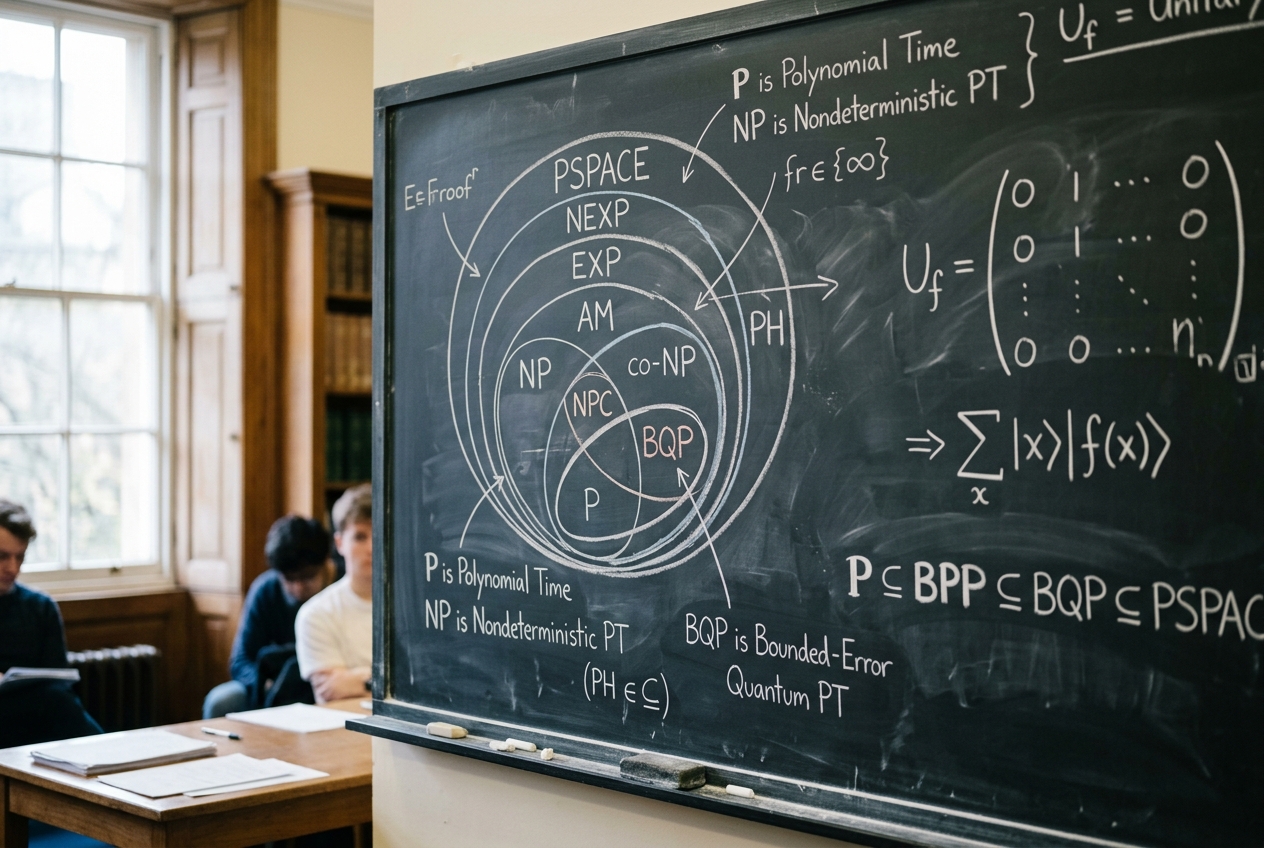
The Classical Hierarchy: $P \subseteq BPP \subseteq BQP \subseteq PSPACE$
BQP occupies a central structural position in structural complexity theory, bounded from below by classical randomized computing and from above by polynomial-space deterministic computing.
The containment $P \subseteq BPP \subseteq BQP$ is straightforward. Any deterministic algorithm ($P$) is a trivial case of a randomized algorithm ($BPP$). Furthermore, any classical randomized algorithm can be directly simulated by a quantum circuit: classical reversible logic gates (such as the three-bit Toffoli gate) can be implemented unitarily, while random coin flips are generated natively by applying a single Hadamard gate to a zero-state qubit and measuring the output.
The upper bound $BQP \subseteq PSPACE$ demonstrates that quantum computers do not possess infinite computational capacity. Any quantum circuit executing $T$ gates on $q$ qubits can be modeled on a classical computer using a matrix-multiplication path integral.
The probability amplitude of reaching a particular computational basis state is the sum over all possible intermediate computational paths of the products of transition matrices. A classical Turing machine can evaluate this sum recursively using depth-first search, reusing memory across trajectories. Because this calculation requires storing only the current path depth and running amplitudes, it consumes an amount of memory proportional to a polynomial function of $n$, confirming that quantum computing can be simulated within classical polynomial space.
Entering the Counting Classes: $BQP \subseteq AWPP \subseteq PP$
During the late 1990s, pioneering work by Leonard Adleman, Jonathan DeMarrais, and Ming-Deh Huang (1997), followed by Lance Fortnow and Michael Rogers (1999), established tighter classical classical upper bounds on quantum computing. They proved that BQP is contained within counting complexity classes that sit well below PSPACE.
The class PP (Probabilistic Polynomial-Time) represents decision problems solvable by a probabilistic Turing machine that accepts with probability strictly greater than $1/2$ for "yes" instances and at most $1/2$ for "no" instances. While practical decision-making cannot rely on PP (since distinguishing an acceptance probability of $1/2 + 2^{-n}$ from $1/2$ requires exponential repetitions), PP is computationally immense, encompassing both NP and co-NP by Toda's Theorem.
Fortnow and Rogers established that $BQP \subseteq PP$, and refined this containment to AWPP (Almost-Wide Probabilistic Polynomial-Time). The mechanics of this proof exploit the algebraic structure of quantum amplitudes.
Because quantum gate operations in a discrete universal set can be normalized as rational or algebraic numbers, the complex transition amplitude for an entire circuit can be encoded as the difference between two classical counting problems (a complexity class known as GapP). Because AWPP precisely models counting problems where the gap between positive and negative computational paths is robustly bounded, it captures BQP cleanly:
$$BQP \subseteq AWPP \subseteq PP \subseteq PSPACE$$
This containment proves that quantum computing is fundamentally a structured, bounded form of algebraic counting.
The Frontier of NP and the BBBV Theorem
One of the most persistent misconceptions in modern science is the belief that quantum computers will effortlessly solve NP-complete problems—such as the Boolean Satisfiability problem (3-SAT) or the Traveling Salesperson Problem. The computational class NP (Nondeterministic Polynomial-Time) contains problems whose proposed solutions can be verified in classical polynomial time, but whose discovery may require searching through an exponential space of candidates.
Theoretical computer science strongly conjectures that:
$$\mathbf{NP \not\subseteq BQP}$$
The definitive theoretical foundation for this conjecture was established in the landmark 1997 paper by Charles Bennett, Ethan Bernstein, Gilles Brassard, and Umesh Vazirani—known universally as the BBBV Theorem.
The BBBV theorem analyzed the limits of quantum search over an unstructured database using a black-box oracle. For a search space of $N = 2^n$ unstructured elements, classical algorithms require $\Omega(N)$ queries in the worst case to locate a unique target.
Grover's quantum algorithm can identify the target in $O(\sqrt{N})$ queries using amplitude amplification. The BBBV theorem proved rigorously that Grover's algorithm is optimal: no quantum algorithm can solve the unstructured search problem in fewer than $\Omega(\sqrt{N})$ queries.
Because general NP-complete problems possess no known global algebraic symmetries, a generic quantum solver cannot bypass brute-force search with an exponential acceleration. A quadratic speedup replaces a search of $2^{128}$ operations with $2^{64}$—a notable enhancement, but fundamentally insufficient to transform exponential complexity into polynomial tractability.
Oracle Separations and the Transcending of the Polynomial Hierarchy
To prove that quantum computing offers capabilities strictly beyond classical randomized computation, theoretical computer scientists turned to relativized complexity (oracle separations), with foundational papers published in the journal Nature and archived in Wikipedia's complexity annals.
In 1994, Daniel Simon introduced an oracle problem that proved the first exponential separation between quantum and classical randomized complexity. In Simon's problem, one is given a black-box function $f: {0,1}^n \rightarrow {0,1}^n$ with the promise that there exists a secret bitstring $s$ such that $f(x) = f(y)$ if and only if $x \oplus y \in {0^n, s}$.
Classically, discovering the hidden XOR-mask $s$ requires sampling inputs until a collision is found, a task bounded by the Birthday Paradox to $\Omega(2^{n/2})$ queries.
In BQP, however, a quantum circuit can evaluate $f(x)$ on an equal superposition of all inputs, apply a Hadamard transform across the registers, and measure an orthogonal vector $y$ satisfying $y \cdot s = 0 \pmod 2$. By repeating this quantum procedure only $O(n)$ times, a user obtains a system of linear equations that can be solved on a classical computer in polynomial time. Simon's algorithm provided the direct conceptual blueprint for Peter Shor's polynomial-time factoring algorithm.
In 2018, Ran Raz and Avishay Tal resolved a decades-old open conjecture by establishing an oracle separation between BQP and the entire Polynomial Hierarchy (PH)—the infinite classical tower of complexity classes that generalizes P, NP, and alternating quantifiers ($\exists \forall \exists \dots$).
Building upon Scott Aaronson's formulation of the Forrelation problem (which measures how strongly a Boolean function is correlated with the Fourier transform of another), Raz and Tal proved that Forrelation can be solved with a single quantum query in BQP, whereas any classical algorithm situated at any constant level of the Polynomial Hierarchy requires an exponential number of queries:
$$\Omega\left(\frac{2^{n/6}}{n}\right)$$
This monumental result proved that the computational power of quantum mechanics is not merely an incremental extension of classical non-determinism, but an entirely distinct mathematical dimension that cuts orthogonally across classical complexity hierarchies.
The Refutation of the Extended Church-Turing Thesis
The existence of BQP delivers a profound philosophical verdict on the foundations of physics and computation.
For decades, the standard computational model of physical reality was governed by the Extended (or Strong) Church-Turing Thesis (ECTT). The original Church-Turing thesis posited that any function computable by any physical machine can be computed by a standard Turing machine. The Extended Church-Turing Thesis went further, declaring that:
Any physically realizable computational process can be simulated by a classical probabilistic Turing machine with at most a polynomial slowdown.
If BQP contains problems that are provably or conditionally intractable within BPP—such as Shor's factoring algorithm or Raz-Tal Forrelation—then the Extended Church-Turing Thesis is fundamentally false.
Nature does not compute using classical probabilities over discrete state spaces. The physical universe executes its continuous state transitions across complex linear vector spaces governed by unitary evolution. The discovery of BQP refutes the classical thesis, elevating quantum complexity theory from an engineering framework to a fundamental law of physics.
4. Real-World Applications Today (2024–2026)
The abstract mechanics of BQP are actively transitioning from mathematical proofs into enterprise research programs across industry and academia. Leading organizations are targeting problems that map cleanly into BQP's unique algebraic structures, leveraging platforms provided by IBM Quantum and academic partners worldwide.
1. Post-Quantum Cryptography (NIST / Cloudflare / Apple)
- The Initiative: The international migration of digital security infrastructure from legacy public-key cryptosystems to post-quantum standards, including ML-KEM (Kyber) and ML-DSA (Dilithium), recently finalized by the US National Institute of Standards and Technology (NIST).
- The Quantum Advantage: Shor's algorithm provides a rigorous, polynomial-time solution for prime factorization and discrete logarithms, placing standard RSA, Diffie-Hellman, and elliptic-curve cryptography definitively inside BQP. By transitioning to high-dimensional lattice problems (which are conjectured to reside outside BQP), global networks ensure immunity against both future quantum decryptors and retrospective "harvest-now, decrypt-later" intelligence operations.
2. Quantum Chemistry and Catalyst Design (BASF / Google Quantum AI)
- The Initiative: Simulating the catalytic iron-molybdenum cofactor (FeMoco) of the nitrogenase enzyme to engineer room-temperature, low-pressure industrial fertilizer synthesis, replacing the century-old, carbon-heavy Haber-Bosch process.
- The Quantum Advantage: Describing the strongly correlated electron orbitals of complex transition-metal molecules requires classical computers to track matrices that scale exponentially with every added electron orbital. Quantum Phase Estimation (QPE) maps the electronic molecular Hamiltonian directly onto quantum registers, calculating ground-state energies in polynomial time within BQP.
3. Materials Science & Superconductivity (RIKEN / Quantinuum)
- The Initiative: Mapping the phase diagrams of two-dimensional Fermi-Hubbard models to synthesize room-temperature superconductors and design high-capacity solid-state battery electrolytes.
- The Quantum Advantage: Using high-fidelity trapped-ion and neutral-atom processors, researchers simulate dynamic many-body entanglement that cannot be approximated by classical Tensor Network or Quantum Monte Carlo methods due to the catastrophic fermionic sign problem.
4. Aerodynamic Simulation & Industrial PDEs (Airbus / Pasqal)
- The Initiative: Solving massive coupled systems of partial differential equations governing turbulent aerodynamic boundary layers and multi-physics structural stress models.
- The Quantum Advantage: Utilizing quantum linear system solvers (such as the Harrow-Hassidim-Lloyd / HHL algorithm and quantum Hamiltonian simulation), the computational complexity scales logarithmically with matrix dimension $N$, transforming problems that require petabyte-scale classical cluster memory into tractable polylogarithmic quantum circuits.
5. What This Means for You
It is easy to view complexity classes like BQP as mathematical abstractions detached from daily human experience. In reality, the boundaries of BQP directly shape the digital and physical environment you inhabit.
       HOW BQP RESHAPES YOUR DAILY HORIZON

       🔐 Security: Every authenticated web connection is shifting
          to post-quantum algorithms to defend against BQP decryption.

       💊 Medicine: Molecular therapies will be computationally designed
          atom-by-atom in days, bypassing years of laboratory trial-and-error.

       🔋 Climate: High-density batteries and green chemical catalysts
          will emerge from exact quantum electronic simulations.
Your personal privacy is already undergoing an invisible architectural overhaul. Every time your smartphone updates its operating system or connects to an online banking portal via modern transport-layer security (TLS), it is increasingly exchanging cryptographic keys using post-quantum lattice algorithms. This modernization is a proactive defense against the mathematical certainty that classical encryption resides within BQP's destructive perimeter.
Beyond data protection, the true dividends of BQP will be physical. The medicines you take, the batteries powering your vehicles, and the fertilizers sustaining global agriculture have historically been developed through laborious laboratory trial-and-error, constrained by classical supercomputers' inability to simulate multi-electron interactions.
By operating natively within BQP, quantum computation converts the simulation of molecular chemistry from an intractable computational impasse into a predictable engineering workflow. The material fabric of 21st-century civilization—from energy networks to molecular medicine—will be designed within the polynomial contours of the quantum realm.
6. Today's Takeaway
BQP represents a fundamental realignment of our understanding of computation. It proves that the universe does not calculate using the linear, binary mechanics of classical switches, but through the rich, geometric interference of quantum waves. By charting the territory of BQP—bounded firmly beneath PSPACE, encompassing BPP, cutting orthogonally across the Polynomial Hierarchy, and halting cleanly before the brute-force horizon of NP-completeness—we do not merely discover a faster way to process data; we uncover the fundamental algebraic grammar through which nature computes.