Blind Quantum Computing: Securing Cloud Quantum Calculations Through Measurement Masking and Entangled Cluster States
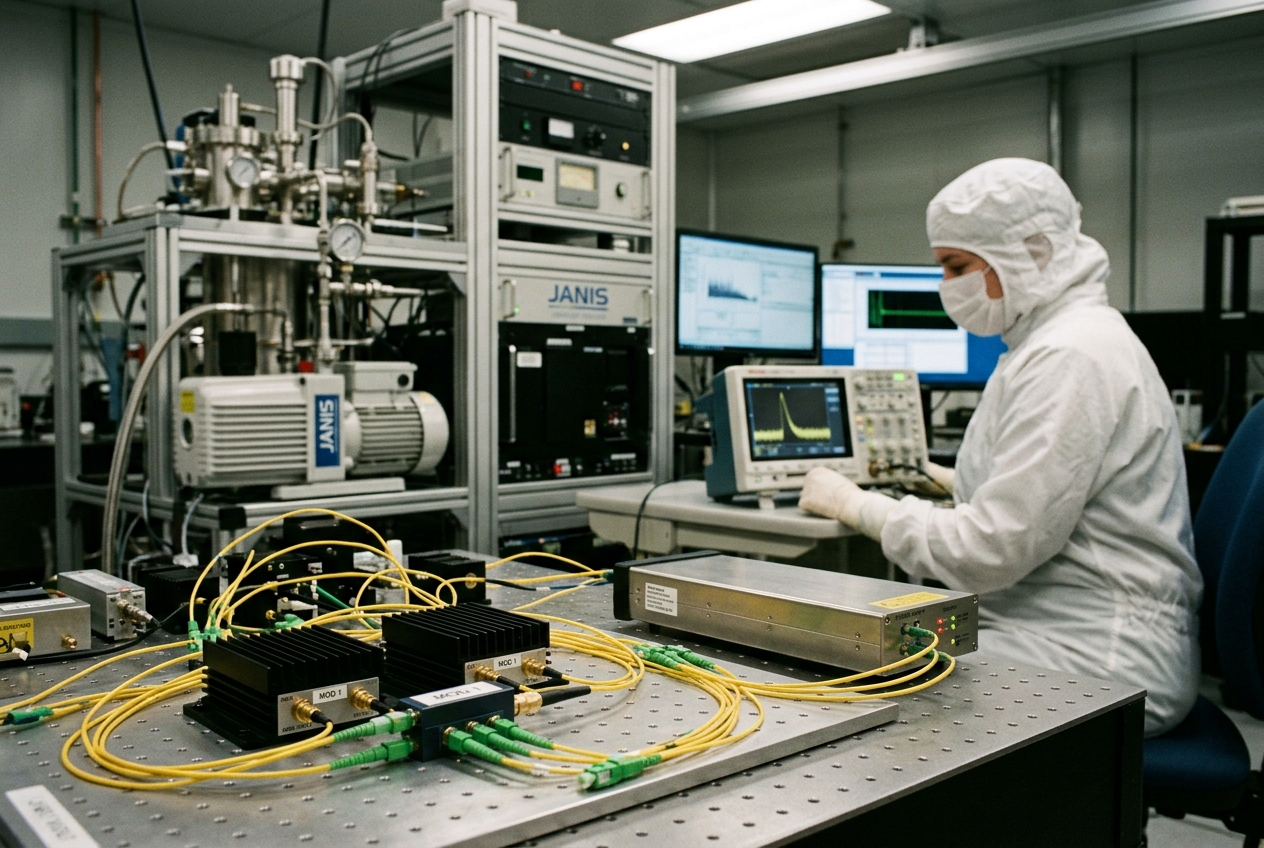
The most valuable secrets in the modern world—from proprietary cancer therapeutics and defense encryption keys to macroeconomic trading algorithms—are migrating to the cloud. Today, when an enterprise sends sensitive workloads to a remote data center, it must trust that the cloud provider’s hardware isolation, hypervisors, and administrative protocols will prevent espionage. Tomorrow, this paradigm will break entirely.
When fault-tolerant quantum computers arrive, they will not sit beneath office desks or run inside smartphones. Because quantum processors require dilution refrigerators chilled to fractions of a degree above absolute zero and complex laser arrays, virtually all quantum computational power will be centralized in massive cloud facilities operated by a handful of tech giants and sovereign nations.
+-----------------------------------------------------------------------------------+
| THE QUANTUM DELEGATION PARADOX                                                    |
| How can a resource-limited user delegate a proprietary quantum calculation to a   |
| powerful, potentially adversarial cloud server without revealing the input data,  |
| the algorithm being executed, or the resulting output?                            |
+-----------------------------------------------------------------------------------+
If you wish to simulate an unpatented molecular compound or crack a cryptographic puzzle using a quantum mainframe, you must transmit your quantum instructions across the network. In a conventional computing environment, whoever owns the server can inspect the registers, log the memory states, and reconstruct your trade secret. For classical machines, solving this requires unwieldy mathematical shields that slow performance to a crawl. But quantum mechanics provides an unexpected escape hatch.
Through an ingenious protocol known as Universal Blind Quantum Computing (UBQC), physics permits a lightweight user—armed with nothing more than a rudimentary single-photon emitter—to command a multi-billion-dollar quantum supercomputer to execute arbitrary calculations while keeping the host completely blind to what it is computing, what data it is using, and what answer it produces.
THE IDEA IN PLAIN ENGLISH
To understand how a computation can be kept secret from the very computer performing it, consider an analogy: the locked glove box.
Imagine you need a master jeweler to cut a priceless, irregular diamond. You cannot afford the specialist cutting machinery yourself, but you also do not trust the jeweler not to swap your diamond for a fake or study its flaws to clone it. To solve this, you place the diamond inside a specialized, opaque manipulation box fitted with internal tools and thick mechanical gloves. You seal the box with your private padlock and send it to the jeweler.
The jeweler can insert their hands into the gloves and operate the cutting wheel according to your step-by-step shouted instructions: "Rotate the blade five degrees left; apply pressure for three seconds." Because the box is opaque and the coordinate system of the tools inside was calibrated to a secret offset known only to you, the jeweler has no idea what shape they are cutting, what the diamond looks like, or what final gem emerges from the dust. When the work is done, the box is returned to you, still locked, containing the finished gem.
                          BLIND COMPUTATION ANALOGY

     CLIENT (Lightweight)                         SERVER (Quantum Cloud)
   +----------------------+                     +-------------------------+
   | Knows secret angles  | -- Rotated Qubits ->| Builds Entangled State  |
   | Computes offsets     |                     | (The "Glove Box")       |
   | Decrypts outcomes    | <- Masked Results - | Performs Blind Measures |
   +----------------------+                     +-------------------------+
In quantum mechanics, this process is known as Measurement-Based Quantum Computation (MBQC). Unlike traditional quantum computing—where logical gates are applied sequentially to stationary qubits like notes on a musical staff—measurement-based computation begins by creating a massive, universal web of entangled particles called a cluster state.
Think of a cluster state as a raw block of marble. The calculation is not performed by moving parts around; rather, it is performed by methodically chipping away at the marble through individual particle measurements. Each time a qubit in the web is measured, it collapses, transferring its quantum information into its neighbors according to the chosen measurement angle. By the time the final qubit is measured, the remaining unmeasured particles hold the final answer to the mathematical problem.
Blind quantum computing turns this marble-chipping process into an unbreakable cipher. The client generates individual quantum particles, injects a secret rotation into each one, and sends them through an optical fiber to the server. The server weaves them into a cluster state, but because every particle is rotated by an unknown angle, the server cannot tell which way is up. The client then instructs the server to measure the particles one by one at specific angles. To the server, the angles and the measurement outcomes look like pure, uniform randomness. To the client, they trace out a precise, deterministic quantum algorithm.
HOW IT ACTUALLY WORKS — THE MECHANICS
The theoretical cornerstone of this field is the Broadbent-Fitzsimons-Kashefi (BFK) protocol, formulated in 2009. The protocol demonstrates how an almost-classical client—possessing only the ability to prepare single qubits in the horizontal plane of the Bloch sphere—can achieve information-theoretically secure delegated computation on a remote server.
                               THE BFK PROTOCOL

 [1. PREPARE]         [2. ENTANGLE]                [3. ADAPTIVE MEASUREMENT]
 Client sends:        Server applies CZ gates:     Client computes masked angle:
 |+θ⟩ = (|0⟩+e^{iθ}|1⟩)/√2  ===> Brickwork Cluster ===> δ = φ' + θ + rπ
 (θ ∈ {0, π/4, ..., 7π/4})   State                 Server measures & returns b'
1. State Preparation: The Client's Secret Angles
The client begins by generating a sequence of single qubits, each prepared in an equatorial state on the quantum sphere:
$$\left|+_\theta\right\rangle = \frac{1}{\sqrt{2}}\left(|0\rangle + e^{i\theta}|1\rangle\right)$$
Here, $\theta$ is a secret phase chosen uniformly at random from the discrete set of eight angles:
$$\Theta = \left{0, \frac{\pi}{4}, \frac{\pi}{2}, \frac{3\pi}{4}, \pi, \frac{5\pi}{4}, \frac{3\pi}{2}, \frac{7\pi}{4}\right}$$
Because the client sends these qubits to the server one at a time across a quantum communication channel, and because the quantum no-cloning theorem prevents the server from copying the unknown quantum state to measure it repeatedly, the server cannot determine $\theta$. To the server's detectors, each incoming qubit is described by a maximally mixed density matrix—the quantum equivalent of absolute static.
2. Entanglement: Generating the Brickwork Cluster
Upon receiving the stream of blinded qubits, the server arranges them on a two-dimensional grid known as a brickwork state. The server then applies Controlled-Z (CZ) gates between adjacent qubits according to the predefined brickwork topology:
$$CZ = |0\rangle\langle0| \otimes I + |1\rangle\langle1| \otimes Z$$
This entangling operation knits the independent qubits into a universal cluster state. Crucially, the server executes this step blindly: the entanglement geometry is fixed and public, but the actual quantum correlations running through the lattice are locked behind the client's secret $\theta$ parameters.
                         BRICKWORK CLUSTER TOPOLOGY

                  ( 1 ) ---- ( 2 ) ---- ( 3 ) ---- ( 4 )
                    |                     |
                  ( 5 ) ---- ( 6 ) ---- ( 7 ) ---- ( 8 )
                               |                     |
                  ( 9 ) ---- (10) ---- (11) ---- (12)

     [Horizontal lines: Time flow | Vertical lines: Entangling CZ links]
3. Adaptive Measurement and Outcome Blinding
To drive the computation forward, the client calculates a series of measurement angles for each node in the cluster. Let $\phi$ represent the ideal measurement angle required by the target quantum algorithm. Because quantum measurements are inherently probabilistic, previous measurement outcomes dictate changes to future angles—a process called feed-forward correction. The client computes the adapted angle $\phi'$, which accounts for the accumulated Pauli-X and Pauli-Z byproduct operators.
To hide this operational angle from the server, the client applies a two-layer mask:
$$\delta = \phi' + \theta + r\pi$$
In this governing equation: - $\phi'$ is the algorithm's actual, adapted rotation angle. - $\theta$ is the secret preparation phase embedded in that specific qubit during Step 1. - $r \in {0, 1}$ is a fresh random bit generated on the client's classical computer.
The client transmits the masked angle $\delta$ across a standard classical internet connection. The server rotates its measurement apparatus to angle $\delta$ in the $X$-$Y$ plane, measures the physical qubit, and receives a binary measurement outcome $s \in {0, 1}$.
+-----------------------------------------------------------------------------------+
| THE ONE-TIME PAD OF QUANTUM MEASUREMENT                                           |
| Because θ is chosen uniformly from eight equatorial angles, the transmitted       |
| instruction δ reveals zero mutual information regarding the true angle φ'.        |
| Simultaneously, the random bit r flips the observed outcome s into a one-time     |
| padded result, rendering the server's measurement log pure statistical noise.     |
+-----------------------------------------------------------------------------------+
The server reports $s$ back to the client. The client then decrypts the true computational outcome $s'$ using their private bit:
$$s' = s \oplus r$$
The decrypted bit $s'$ is integrated into the client's classical tracking register to determine subsequent measurement angles $\phi'$ for downstream nodes in the brickwork state.
4. Verification and Trap Qubits
A critical vulnerability in delegated computing is malicious sabotage: how can the client verify that the server followed instructions rather than injecting errors or returning fabricated results?
Universal Blind Quantum Computing solves this by weaving invisible trap qubits into the brickwork fabric. The client randomly designates certain nodes in the cluster as isolated single-qubit states chosen from the computational basis ${|0\rangle, |1\rangle}$ or specific equatorial eigenstates. Surrounding these traps, the client places "dummy" qubits that decouple the trap from the rest of the cluster during the server's $CZ$ operations.
                         TRAP QUBIT EMBEDDING

                  [Comp] ---- [Comp] ---- [Dummy]
                    |                       |
                  [Comp] ---- [Dummy] --- [ TRAP ]  <-- Unentangled eigenstate
                    |                       |
                  [Comp] ---- [Comp] ---- [Dummy]

     [Server measures TRAP at δ; client verifies if outcome matches secret state]
Because the server cannot distinguish a computational qubit from a trap qubit, any unauthorized measurement or deviation from the requested angles will disrupt the known deterministic outcomes of the trap qubits with a calculable probability. If a single trap fails, the client aborts the session, knowing the server is either faulty or malicious.
5. Blind Quantum Computing vs. Classical Fully Homomorphic Encryption
It is instructive to contrast UBQC with classical Fully Homomorphic Encryption (FHE). Classical FHE allows a server to evaluate arithmetic circuits over encrypted ciphertexts. However, classical FHE suffers from two major limitations:
- Computational Hardness Dependencies: Classical FHE relies on unproven mathematical assumptions, such as the hardness of Learning With Errors (LWE) over high-dimensional lattices. If an algorithmic breakthrough solves LWE, the privacy of the encrypted data evaporates retroactively.
- Extreme Computational Overhead: Evaluating deep arithmetic circuits homomorphically requires complex "bootstrapping" operations to clean accumulated noise, introducing slowdown factors of $10^4$ to $10^6$.
In contrast, UBQC provides information-theoretic security. Its privacy is guaranteed directly by the laws of quantum mechanics, specifically the uncertainty principle and the no-cloning theorem. Even a server with infinite classical and quantum computational power cannot extract the underlying algorithm from the masked angles $\delta$, because the transmitted data is mathematically identical to a one-time pad.
| Dimension | Classical Fully Homomorphic Encryption | Universal Blind Quantum Computing (UBQC) |
|---|---|---|
| Security Foundation | Computational hardness (e.g., Ring-LWE) | Information-theoretic (Quantum Physics) |
| Client Hardware | Standard classical CPU | Single-photon source / polarization rotator |
| Computational Overhead | Massive ($10^4\times$ to $10^6\times$ slowdown) | Linear scaling with cluster state size |
| Future Proofing | Vulnerable to future mathematical breakthroughs | Unconditionally secure across all time |
REAL-WORLD APPLICATIONS TODAY
Blind Quantum Computing is no longer just a blackboard thought experiment. Between 2024 and 2026, experimental physicists and quantum computing enterprises achieved functional implementations across live quantum networks.
                          DISTRIBUTED BQC ECOSYSTEM

   [Biopharma / Finance]         [Quantum Internet]          [Server Supercomputer]
   +--------------------+       +-------------------+       +---------------------+
   | Lightweight Client | ----> | Low-loss Fiber    | ----> | Trapped-Ion /       |
   | Polarized Photons  |       | Quantum Repeaters |       | Superconducting     |
   | Secret Local Seed  | <---- | Optical Switches  | <---- | Processor Matrix    |
   +--------------------+       +-------------------+       +---------------------+
1. Secure Pharmaceutical Molecular Design
- Key Players: Consortia including Boehringer Ingelheim, academic medical centers, and cloud hardware providers via the IBM Quantum Network.
- The Challenge: Designing complex enzyme inhibitors requires simulating the electronic ground states of transition metal complexes. These simulations are intractable on classical supercomputers. However, the exact atomic geometry of a drug candidate represents billions of dollars in intellectual property; pharmaceutical firms cannot risk sending these structures in plaintext to a third-party quantum data center.
- The Quantum Advantage: Using measurement-based blind computing protocols, chemical research teams encode the molecular Hamiltonian into a blinded cluster state. The quantum server carries out the ground-state energy estimation via the variational quantum eigensolver (VQE) algorithm without ever learning the chemical structure, bond angles, or target receptor identity.
2. High-Frequency Algorithmic Finance and Portfolio Arbitrage
- Key Players: Quantitative finance teams and banking institutions testing on the Rigetti Computing and Quantinuum cloud platforms.
- The Challenge: Deploying quantum combinatorial optimization algorithms (such as the Quantum Approximate Optimization Algorithm, or QAOA) to balance multi-asset portfolios and identify arbitrage opportunities across fragmented markets.
- The Quantum Advantage: A proprietary trading strategy loses its entire alpha if an intermediary detects the objective function or asset weighting. UBQC allows financial institutions to run QAOA optimizations on cloud-hosted trapped-ion systems while masking the covariance matrices and payoff structures behind local Pauli rotations.
3. Photonic Blind Quantum Computing Over Fiber Networks
- Key Players: The University of Oxford’s Department of Physics, in collaboration with the UK National Quantum Technologies Programme, published landmark results in Physical Review Letters demonstrating verification-capable blind quantum computing over commercial telecommunication fibers.
- The Challenge: Interfacing a minimal client device with a remote multi-qubit server over standard telecommunications infrastructure, where optical losses and phase noise threaten to scramble the quantum phase $\theta$.
- The Quantum Advantage: Researchers constructed a setup where the client utilizes a compact, room-temperature optical module to emit polarized single photons down a standard fiber link. The server receives these photons, couples them into a photonic processor memory array, and executes blind cluster measurements. This proves that clients do not need cryogenic coolers to securely utilize cloud quantum computers.
+-----------------------------------------------------------------------------------+
| MILESTONE DISCOVERY: OXFORD PHOTONIC DEMONSTRATION                                |
| Experimental teams demonstrated that a user with a simple room-temperature fiber  |
| transmitter can execute certified blind quantum computations on a remote server   |
| with unconditional security and real-time malicious-server detection.             |
+-----------------------------------------------------------------------------------+
4. Defense and Sovereign Satellite Communications
- Key Players: Government research bodies, including the US Defense Advanced Research Projects Agency (DARPA) and the European Quantum Communication Infrastructure (EuroQCI) initiative.
- The Challenge: Processing classified satellite reconnaissance data and breaking intercepted adversary ciphers without exposing intelligence targets or cryptographic keys to commercial vendors hosting the quantum supercomputers.
- The Quantum Advantage: By utilizing free-space satellite-to-ground quantum optical links, field stations can generate single-qubit states and beam them directly to sovereign orbital quantum repeaters, enabling zero-trust quantum computation from anywhere on Earth.
WHAT THIS MEANS FOR YOU
For the average citizen, the rise of blind quantum computing represents the difference between a future of total digital surveillance and an architecture of absolute privacy.
                           THE PRIVACY PROGRESSION

     ERA 1: Plaintext Era       ERA 2: Classical Cloud     ERA 3: Blind Quantum Era
     (Local Desktops)           (Server Knows All)         (Zero-Trust Physics)
   +----------------------+   +----------------------+   +--------------------------+
   | Data stays at home   |   | Data processed in    |   | Cloud computes blindly;  |
   | Computing power low  |   | plaintext on remote  |   | physical laws guarantee  |
   |                      |   | server architectures |   | absolute user privacy    |
   +----------------------+   +----------------------+   +--------------------------+
Consider your personal medical data. Within the next two decades, medicine will shift toward whole-genome personalized therapeutics. To identify which custom synthetic protein will cure a specific condition without triggering toxic side effects, your personal DNA sequence will need to be processed through a quantum simulation engine.
In an unsecured cloud framework, uploading your genetic sequence exposes your biological blueprint to data brokers, health insurance algorithms, and potential state surveillance. But with blind quantum computing integrated into client-side devices, a desktop medical terminal could generate single-photon quantum states representing your genomic data, transmit them to a medical research mainframe, and receive the therapeutic molecule structure.
The supercomputing server does the heavy lifting, but it never sees your DNA, never learns your name, and cannot reconstruct the disease being treated. You receive the cure while retaining absolute ownership of your genetic code.
+-----------------------------------------------------------------------------------+
| YOUR PERSONAL STAKE                                                               |
| Blind Quantum Computing ensures that the most profound technological revolution   |
| in human history—the ability to simulate nature at the subatomic level—does not   |
| require us to surrender our fundamental right to digital privacy.                 |
+-----------------------------------------------------------------------------------+
Furthermore, UBQC fundamentally decentralizes power. It prevents the companies that own quantum hardware from becoming monopolistic gatekeepers of intellectual discovery. An independent inventor or a researcher in a developing nation can design a revolutionary material, run the simulations on a corporate quantum supercomputer, and retain complete, mathematically ironclad secrecy over their invention.
TODAY'S TAKEAWAY
Universal Blind Quantum Computing achieves what classical computer science thought impossible: the ability to outsource complex, life-altering computations to an untrusted supercomputer while keeping the data, the algorithm, and the output completely invisible. By replacing mathematical assumptions with the physical laws of quantum mechanics, UBQC ensures that the coming quantum age will not be an era of central data exploitation, but one where ultimate computational power and unconditional privacy can finally coexist.
Further Reading and Authoritative Resources
- Explore the foundations of quantum information at the MIT OpenCourseWare Quantum Physics Directory.
- Learn about the technical implementation of measurement-based computation on Wikipedia's Blind Quantum Computation Guide.
- Access open-source quantum programming tools and cloud access via IBM Quantum.
- Read the latest peer-reviewed research on quantum network security in Nature Physics and Physical Review Letters.