Barren Plateaus: Diagnosing Exponential Gradient Vanishing and Trainability Bottlenecks in Variational Quantum Circuits
1. Opening Hook — Why You Should Care
The global race to build commercial quantum computers is routinely framed as an engineering marathon: tame physical noise, string together thousands of superconducting qubits, and let quantum mechanics solve the unsolvable. We are promised room-temperature superconductors, catalysts capable of pulling industrial fertilizer production out of the fossil-fuel era, and molecular simulations that could compress a decade of pharmaceutical oncology research into an afternoon.
Yet inside the world’s leading quantum computing laboratories, a quieter and far more fundamental crisis has emerged. It is not an issue of noisy hardware or fragile cryogenic refrigerators. It is a mathematical barrier built into the very geometry of quantum information itself.
When scientists attempt to teach a quantum computer how to solve an optimization or machine learning problem, they rely on hybrid quantum-classical algorithms. A classical optimizer adjusts adjustable parameters—represented as microscopic logic gates—on a quantum processor, iteratively guiding the system toward an answer. But when these algorithms scale from small laboratory demonstrations of five or ten qubits to practically useful sizes of fifty or a hundred qubits, the mathematical landscape changes drastically.
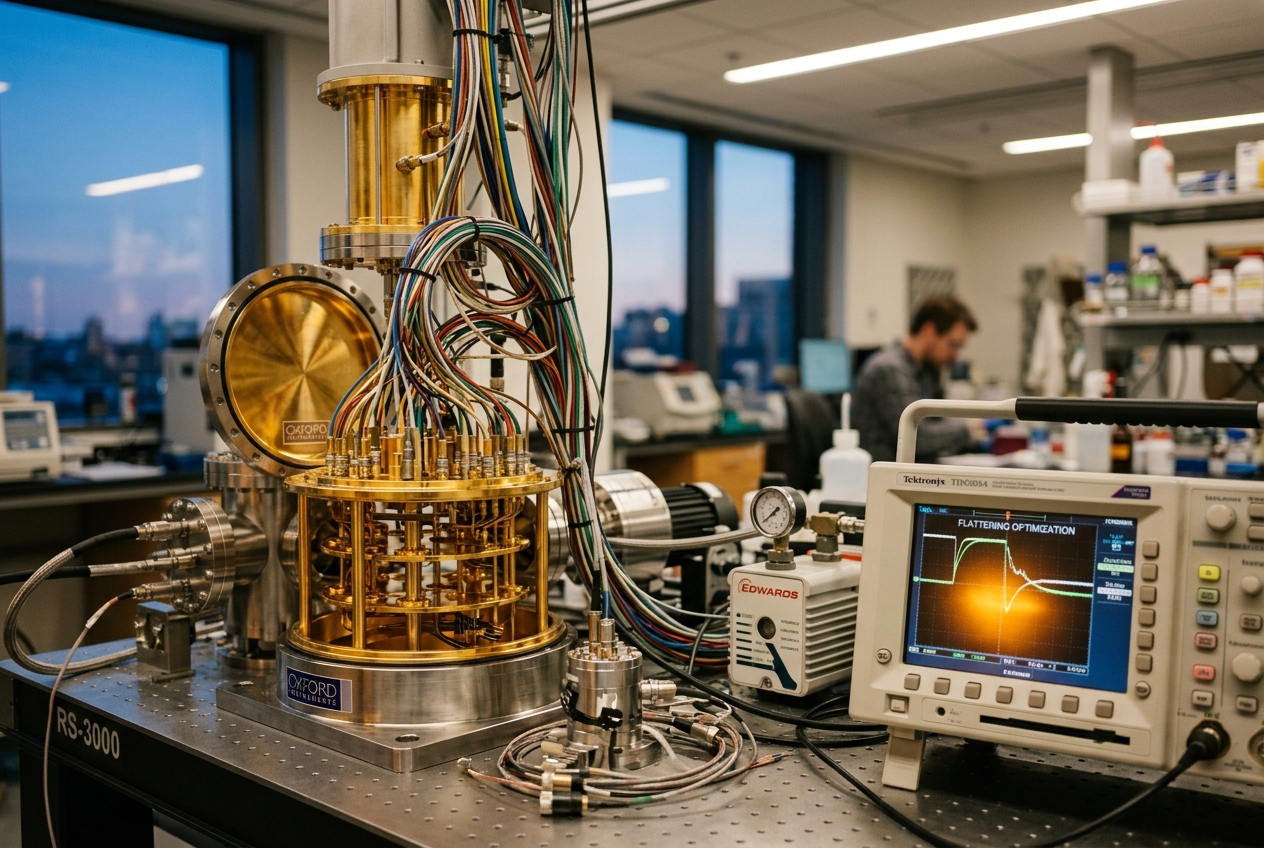
The hills and valleys that algorithms need to navigate suddenly flatten into an infinite, featureless desert. Gradients vanish into microscopic noise. The classical optimizer cannot determine whether turning a parameter left or right brings it any closer to the solution. The algorithm is stranded on what physicists call a barren plateau.
Unless researchers solve this mathematical phenomenon, the multi-billion-pound investment in near-term quantum software risks grinding to a halt before producing a single commercially viable application.
2. The Idea in Plain English
To understand what a barren plateau is, consider how traditional machine learning works. Imagine placing a hiker blindfolded in the Scottish Highlands and tasking them with finding the lowest point in a deep glen. Armed only with an altimeter and the ability to feel the slope beneath their boots, the hiker takes a step in each direction, senses which way slopes downward, and proceeds downhill. This step-by-step descent is the mechanical intuition behind gradient descent, the mathematical engine powering modern artificial intelligence.
In classical machine learning, the terrain is uneven, furrowed with contours, gullies, and ravines. Even if the hiker encounters a local dip or a temporary plateau, taking a sufficiently broad step will reveal a downward slope.
Now imagine transporting that same hiker to an entirely different world: a hyper-dimensional salt flat stretching across millions of miles. On this plain, the altitude across billions of square leagues varies by less than the diameter of a single atomic nucleus.
If the hiker takes a step forward, their instruments read zero change in elevation. If they step backward, left, or right, the reading remains identical to forty decimal places. There is indeed a deepest point—a single microscopic crevasse tucked somewhere in the vastness—but the surrounding landscape provides zero directional slope to guide them toward it.
This is the exact predicament of a parameterized quantum circuit. A single quantum bit, or qubit, does not simply hold a classical 0 or 1; it occupies a continuum of possibilities across the surface of a three-dimensional sphere. When two qubits interact, their combined mathematical state lives in a four-dimensional space. With three qubits, it spans eight dimensions. By the time an algorithm uses fifty qubits, the state space expands into more than one quadrillion dimensions ($2^{50}$).
When a quantum circuit is initialized with random parameters, it spreads its quantum state evenly across this hyper-dimensional space. Because high-dimensional geometry is counter-intuitive, almost the entirety of this vast volume concentrates tightly around a uniform average. The cost landscape becomes mathematically flat everywhere. The variance between any two points is so minuscule that measuring it requires an impossible number of experimental trials.
3. How It Actually Works — The Mechanics
To formalize this breakdown, physicists model quantum learning algorithms as Parameterized Quantum Circuits (PQCs), also termed quantum neural networks. In this architecture, a register of qubits begins in a known reference state, undergoes a sequence of quantum logic gates whose angles are tuned by parameters, and is finally measured against an observable property to calculate an objective cost.
The Parameterized Cost Landscape
The expected energy or cost of a quantum circuit is determined by applying a parameterized unitary operation $U(\boldsymbol{\theta})$ to an initial zero state $|0^{\otimes n}\rangle$, and computing the expectation value of a target Hamiltonian operator $H$, representing the physical problem:
$$E(\boldsymbol{\theta}) = \langle 0^{\otimes n} | U^\dagger(\boldsymbol{\theta}) H U(\boldsymbol{\theta}) | 0^{\otimes n} \rangle$$
Here, $\boldsymbol{\theta} = (\theta_1, \theta_2, \dots, \theta_L)$ represents the vector of continuous rotation angles across all circuit layers. The goal of the classical optimization routine is to navigate the cost landscape $E(\boldsymbol{\theta})$ by computing partial derivatives with respect to each parameter $\theta_k$, using these gradients to update the circuit toward the ground state of $H$.
The McClean Proof: Exponential Gradient Vanishing
In a landmark 2018 study published in Nature Communications, researchers Jarrod McClean, Sergio Boixo, Vadim Smelyanskiy, Ryan Babbush, and Hartmut Neven uncovered the mathematical inevitability of the plateau.
They evaluated what happens when the parameterized circuit $U(\boldsymbol{\theta})$ possesses sufficient depth and randomness to explore the space of all possible quantum operations uniformly. Mathematically, this corresponds to the circuit forming a unitary 2-design—an ensemble of operations that mimics the statistical properties of the uniform Haar measure over the special unitary group $\mathbb{SU}(2^n)$ up to second moments.
Using Haar integration over high-dimensional transformation groups, McClean and his co-authors proved that while the average gradient across the landscape is precisely zero, the variance of the partial derivatives decays exponentially with the number of qubits $n$:
$$\mathrm{Var}_{\boldsymbol{\theta}}\left[ \frac{\partial E(\boldsymbol{\theta})}{\partial \theta_k} \right] \in \mathcal{O}\left( \frac{1}{2^n} \right)$$
This mathematical result represents an existential scaling wall. In physical terms, variance measures how much the gradient fluctuates from zero. If the variance decays as $2^{-n}$, the slope of the landscape at any randomly chosen coordinate is bounded by roughly $\pm \sqrt{2^{-n}} = 2^{-n/2}$.
This phenomenon is fundamentally rooted in concentration of measure on high-dimensional spheres, often formalized through Lévy’s Lemma. In spaces of vast dimensions, continuous functions that depend on many independent variables concentrate almost all of their probability density within an infinitesimally thin band around their mean value.
The Locality of Observables: Global vs. Local Costs
Following McClean's discovery, a crucial distinction was identified by Marco Cerezo, Akira Sone, Tyler Volkoff, Lukasz Cincio, and Patrick Coles at Los Alamos National Laboratory, published in Nature Communications. They demonstrated that barren plateaus are heavily dictated by the locality of the cost function.
If an algorithm utilizes a global observable—meaning it attempts to compare the state of all $n$ qubits simultaneously against a target state (such as the projector $|0\dots0\rangle\langle0\dots0|$)—the landscape exhibits a barren plateau even for extremely shallow circuits of depth $\mathcal{O}(1)$. The algorithm tries to distinguish two quantum states in a Hilbert space so vast that their inner product is almost guaranteed to be zero everywhere.
Conversely, if the algorithm employs a local observable composed of sums of operators acting on only one or two neighboring qubits at a time, the cost function preserves gradient information:
$$H_{\text{local}} = \sum_{j=1}^{n} h_j \otimes I_{\bar{j}}$$
For circuits of shallow depth—specifically logarithmic depth $\mathcal{O}(\log n)$ with local connectivity—Cerezo et al. proved that local cost functions yield gradient variances that scale only polynomially:
$$\mathrm{Var}\left[ \frac{\partial E_{\text{local}}}{\partial \theta_k} \right] \in \Omega\left( \frac{1}{\mathrm{poly}(n)} \right)$$
This polynomial scaling ensures that the required number of quantum measurements grows reasonably with system size, keeping shallow circuits trainable.
Entanglement and Noise-Induced Barren Plateaus
Beyond circuit depth and observable locality, two additional physical mechanisms trigger optimization collapse:
- Entanglement-Induced Plateaus: When an ansatz generates extensive multi-qubit entanglement, information becomes deeply scrambled across non-local degrees of freedom. Even in shallow circuits, if sub-blocks of the circuit generate volume-law entanglement across bipartite cuts, the reduced density matrix of local subsystems rapidly thermalizes into a maximally mixed state, suppressing gradients.
- Noise-Induced Barren Plateaus (NIBPs): In real-world hardware, interaction with the environment introduces quantum noise—such as phase damping, bit flips, and energy relaxation. Samson Wang and colleagues demonstrated that non-unitary noise channels contract the quantum state toward the maximally mixed state identity matrix $I/2^n$ at an exponential rate with respect to circuit depth. Unlike depth-induced plateaus, noise-induced barren plateaus cannot be resolved simply by switching to local cost functions; they impose a strict upper limit on circuit depth in the absence of full quantum error correction.
4. Architectural Remedies: Escaping the Void
To break out of these mathematical dead ends, quantum information theorists are pioneering new architectural designs that constrain quantum circuits to meaningful sub-regions of Hilbert space.
Identity Block Initialization
Rather than selecting initial parameter values at random across $[0, 2\pi)$, circuits can be initialized such that alternating layers of quantum gates mathematically cancel each other out, setting $U(\boldsymbol{\theta}) \approx I$. Because the circuit starts near the identity operator, it avoids the Haar-random distribution entirely, maintaining steep local gradients in the initial training steps.
Geometric Quantum Machine Learning (GQML)
Rather than employing generic, unstructured quantum circuits (often termed "hardware-efficient ansätze"), modern approaches incorporate the inherent symmetries of the physical problem. By constructing equivariant quantum circuits whose operations commute with the symmetry group $G$ of the target system (such as translational symmetry in crystal lattices or rotational symmetry in molecules), the search space is restricted to a compact invariant subspace. This prevents the quantum state from diffusing across the entire Hilbert space, preserving trainable gradients across arbitrary system depths.
Layer-by-Layer and Progressive Growing
Borrowing techniques from classical deep learning, practitioners train a small, shallow subset of parameters to convergence before appending and unfreezing subsequent layers. By keeping the active circuit depth shallow throughout the optimization trajectory, the algorithm circumvents deep Haar-random state scrambling.
5. Real-World Applications Today (2024–2026)
The challenge of barren plateaus is being actively addressed across industry and academia. Leading research organizations are applying gradient-preserving methods to real problems:
1. Pharmaceutical Molecular Simulation
- Institutions: Boehringer Ingelheim & Google Quantum AI
- Objective: Simulating the ground-state electronic configurations of metalloenzyme active sites, which are critical for designing next-generation covalent enzyme inhibitors.
- The Quantum Advantage: Classical supercomputers struggle to model the strongly correlated multi-reference electron systems found in transition metal complexes. By using Unitary Coupled Cluster (UCCSD) ansätze tailored to molecular orbital symmetries rather than random circuits, researchers avoid barren plateaus and can calculate binding affinities with chemical accuracy.
2. Industrial Chemistry and Catalyst Design
- Institutions: BASF & IBM Quantum
- Objective: Modeling the catalytic split of atmospheric nitrogen into ammonia under ambient conditions, aiming to replace the energy-intensive Haber-Bosch process.
- The Quantum Advantage: By utilizing shallow-depth, symmetry-conserving circuits within IBM's Qiskit Runtime environment, researchers decompose complex global chemical Hamiltonians into strictly local observable measurements, maintaining polynomial optimization convergence on utility-scale noisy processors.
3. Financial Portfolio Risk and Generative Modeling
- Institutions: JPMorgan Chase & Zapata AI
- Objective: Quantum generative modeling for continuous-time asset pricing and extreme-event tail-risk simulation.
- The Quantum Advantage: Financial probability distributions exhibit high-dimensional non-linear correlations. Using Quantum Tensor Networks (Tree Tensor Operators and Matrix Product States) as restricted parameter architectures, quantitative researchers prevent state-space diffusion, achieving stable training dynamics without encountering barren plateaus.
4. Solid-State Battery Electrolyte Discovery
- Institutions: Mercedes-Benz R&D & PsiQuantum
- Objective: Mapping lithium-ion transport dynamics through novel ceramic solid-state electrolytes to accelerate the development of non-flammable, high-energy-density electric vehicle batteries.
- The Quantum Advantage: Applying geometric quantum machine learning directly encodes the spatial point-group symmetries of the crystalline lattice into the optical quantum circuits, ensuring that parameter updates follow physically realistic pathways with well-conditioned gradient flows.
6. What This Means for You
For the curious observer, the discovery and ongoing resolution of barren plateaus marks a vital shift in the quantum computing narrative: the discipline is transitioning from speculative hype to rigorous engineering reality.
If quantum algorithms had continued to rely on brute-force random circuit optimization, the field would have hit an insurmountable wall as soon as quantum processors scaled beyond fifty qubits. We would possess machines capable of holding immense quantum memory, but with no mathematical steering mechanism to find answers within them.
The solutions emerging today—grounded in symmetry, group theory, and physics-informed circuit design—mean that quantum algorithms are becoming structured, predictable, and physically motivated.
For the broader public, this technical breakthrough directly influences the timeline for practical returns on quantum investments: * Targeted Medicine: Ensuring that molecular simulation algorithms can scale to real pharmaceutical targets without failing during parameter optimization. * Energy Infrastructure: Accelerating the discovery of materials for solid-state batteries and carbon-capture filters by making quantum chemistry calculations tractable. * Computational Security: Revealing the structural limits of quantum neural networks, helping cryptographers understand where quantum methods genuinely offer speedups and where classical algorithms remain competitive.
7. Today's Takeaway
Further Reading and Foundational Sources
- McClean et al., "Barren plateaus in quantum neural network training landscapes," Nature Communications (2018)
- Cerezo et al., "Cost function dependent barren plateaus in shallow parameterized quantum circuits," Nature Communications (2021)
- IBM Quantum Documentation: Variational Quantum Algorithms and Mitigation Strategies
- MIT OpenCourseWare: Advanced Quantum Mechanics and Hilbert Space Formalisms
- ArXiv Quantum Physics Archive: Foundations of Geometric Quantum Machine Learning
- Haar Measure and Group Invariant Integration Theory