Wudang Taiyi Five Elements Qigong: Helical Kinetic Spirals, Visceral Organ Resonance, and Daoist Longevity Daoyin
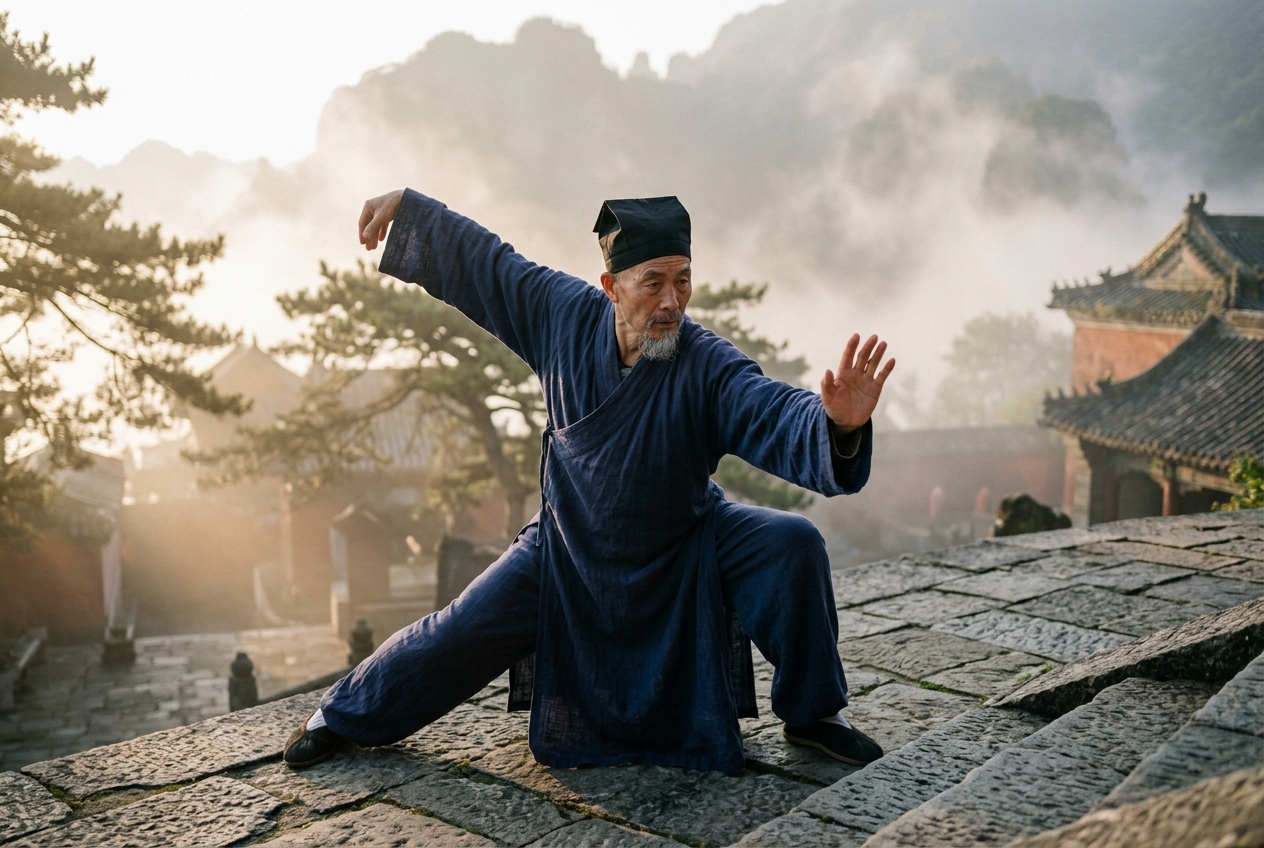
At its heart, the practice coordinates your physical movements with deep belly breathing—what traditional practitioners call Dantian respiration, which simply means expanding and contracting the lower abdomen two inches below the navel—to calm your nervous system and restore physical vitality. In the vocabulary of Traditional Chinese Medicine (TCM), this deliberate interplay of physical form (Xing), breath (Qi), and focused intention (Yi) clears stagnant pathways throughout the body's energetic anatomy, transforming physical fatigue into resilient, balanced health.
The Five Dynamic Archetypes of Taiyi Wuxing Gong
Step-by-Step Practice Guide
The complete classical form of Wudang Taiyi Five Elements Qigong comprises thirteen primary postures arranged across five distinct animal archetypes, each embodying one of the cosmological Five Phases (Wu Xing). Below is the complete step-by-step didactic protocol for learning the fundamental transitional cycle that connects these elemental movements into an unbroken kinetic loop.
1. Foundational Posture: The Primordial Stance (Wuji Zhuang)
- Structural Setup: Stand with your feet parallel, separated by precisely the width of your shoulders. Distribute your body weight evenly across the tripod of each foot—the base of the big toe, the base of the pinky toe, and the center of the calcaneus (heel).
- Pelvic Alignment: Tuck your tailbone subtly forward and downward as if resting against a high barstool. This eliminates excessive lumbar lordosis and opens the "Gate of Vitality" (Mingmen, GV-4) in your lower spine.
- Axial Decompression: Imagine a silk cord suspended from the crown of your head (Baihui, GV-20), gently drawing your cervical vertebrae upward while your shoulders settle downward like melting wax. Rest your tongue softly against the hard palate behind your upper front teeth.
2. The Five Elemental Postural Transitions
========================================================================================
ELEMENTAL & BIOMECHANICAL ALIGNMENT MATRIX
========================================================================================
PHASE   ARCHETYPE   ZANG ORGAN   DOMINANT MOVEMENT          FASCIAL TARGET
----------------------------------------------------------------------------------------
Water   Tortoise    Kidneys      Axial Flexion / Sinking     Superficial Back Line
Wood    Dragon      Liver        Helical Torsion / Twisting  Spiral Line & Lateral Chain
Fire    Crane       Heart        Thoracic Elevation / Wing   Deep Front Line & Pectorals
Earth   Snake       Spleen       Low Orbital Gliding         Functional Visceral Fascia
Metal   Tiger       Lungs        Scapular Force / Rooting    Arm Meridian Fascial Slings
========================================================================================
Movement I: The Submerged Tortoise Draws into Its Shell (Water Phase — Kidneys)
- Inhale (Reverse Abdominal Breathing): Draw the lower abdominal wall inward toward the lumbar spine while maintaining an expanded perineum and pelvic diaphragm.
- Kinetic Path: Slowly bend your knees into a moderate squat. Sink your hips straight down, allowing your spine to round gently from the sacrum through the thoracic curve. Sweep both arms forward and inward, curving the forearms into a defensive circular shield in front of your chest with your palms facing inward toward your heart.
- Organ Compression: Feel the front of your ribcage softly compress while your lower back broadens, stretching the renal fascia and the quadratus lumborum muscles across the kidney region.
- Exhale: Relax the abdominal wall outward, sink further into the heels, and press the palms downward past the hips toward the earth, visualizing physical tension draining through the bubbling spring point (Yongquan, KI-1) in the soles of your feet.
Movement II: The Azure Dragon Coils Its Celestial Spire (Wood Phase — Liver)
- Weight Transfer: Shift 70% of your body weight onto your right leg, pivoting your left foot onto its ball to form an empty stance (Xubu).
- Helical Winding: Rotate your pelvic girdle 45 degrees to the right. Initiate the movement not from the shoulders, but from the rotational torque of your lower core.
- Arm Dynamic: Allow your right arm to spiral upward in an ascending arc, palm turning outward at eye level, while the left arm threads across your midline toward your right hip like a coiling serpent.
- Inhale/Exhale Cadence: Inhale as the spine twists and extends along its vertical axis; exhale as you settle deeper into the right hip, elongating the lateral myofascial chain from the outer left ankle to the tips of the right fingers.
Movement III: The Immortal Crane Spreads Its Wings (Fire Phase — Heart)
- Ascent: Shift your weight centrally and rise slowly onto the balls of both feet, or lift the left knee toward hip height in a single-legged equilibrium stance (Duli Bu).
- Chest Expansion: Float both arms out to the sides in an expansive, soaring arc. Keep the elbows soft and lower than the wrists, allowing the shoulder blades (scapulae) to glide toward the midline of the back without hiking upward toward your ears.
- Breath Coordination: Inhale fully through your nose, expanding the thoracic cage in three dimensions—front, sides, and back. Feel the sternum elevate, releasing pressure on the cardiac notch and stretching the fascia of the pectoralis minor and anterior neck.
- Exhale: Lower the foot softly to the floor, sinking the hips while floating the hands down through the midline of the body to settle back at the lower abdomen.
Movement IV: The Coiling Snake Glides Through the Grass (Earth Phase — Spleen/Stomach)
- Low Orbit: Step your left foot laterally into a wide horse stance (Mabu). Shift your weight smoothly into a deep lateral lunge (Pubu), sliding your center of mass horizontally across the floor without bobbing up and down.
- Visceral Churning: As you glide toward the left, rotate your torso toward the left knee while sweeping your right palm in a low horizontal circle across the pelvic basin, mimicking a continuous kneading motion across the abdomen.
- Somatic Target: The spleen and stomach receive a direct, gentle shearing force from the contracting oblique musculature and descending diaphragm, stimulating gastric motility.
Movement V: The Fierce Tiger Pounces to Seize Its Prey (Metal Phase — Lungs)
- Grounding & Press: Step forward into a dynamic bow stance (Gongbu), driving power from your rear heel through the hips into the palms.
- Scapular Articulation: Spread your fingers wide into curved "tiger claws" (Huzhua). Extend your arms forward at shoulder height, intensely protracting the scapulae forward while pressing the palms outward with firm, elastic tension.
- Breath & Sound: Exhale forcefully through the nose or with a soft, resonant sub-vocalized sound ("Haa" or "Shang"), feeling the intra-thoracic pressure stabilize the spine while the lung meridians along the inner arms are stimulated under active fascial tension.
========================================================================================
DIAGNOSTIC TROUBLESHOOTING & SENSORY SENSATIONS
========================================================================================
ERROR / HABIT               MECHANICAL CONSEQUENCE      CORRECTIVE ADJUSTMENT
----------------------------------------------------------------------------------------
Knee Collapse Inward        Medial meniscus stress,     Track patella directly over
                            breaks pelvic floor line    second toe; engage gluteus medius.

Elevated Shoulders          Tension in upper trapezius, Drop scapulae downward; widen
                            constricts vagal breathing  underarm space ("holding an egg").

Lumbar Hyper-extension      Pinches lumbar facets and   Tuck tailbone, relax lower back,
                            constricts renal vessels    broaden Mingmen point.

Holding Breath on Twists    Spikes blood pressure,      Use continuous, audible nasal
                            locks fascial sliding       breathing matched to movement pace.
----------------------------------------------------------------------------------------
SOMATIC SENSATION           PHYSIOLOGICAL MECHANISM     CLINICAL SIGNIFICANCE
----------------------------------------------------------------------------------------
Deep Palm Warmth            Peripheral vasodilation     Sympathetic down-regulation,
                            from nitric oxide release   enhanced microvascular flow.

Tingling in Fingertips      Nerve glide along deep      Decompression of thoracic outlet
                            fascial arm lines           and peripheral neural pathways.

Belly Gurgling (Borborygmi) Enteric nervous activation  Parasympathetic dominance,
                            and peristaltic massage     improved digestive function.

Floating Heavy Weight       Tensegrity alignment and    Neuromuscular relaxation and
                            proprioceptive grounding    vestibular recalibration.
========================================================================================
Why It Works: The Biomechanical and Neurological Science
The health benefits of Wudang Taiyi Five Elements Qigong, once described exclusively through esoteric metaphors of energetic meridians, are increasingly validated by contemporary biomechanics, neuroscience, and connective tissue research.
+---------------------------------------------------------------------------------------+
| RESEARCH SUMMARY: PHYSIOLOGICAL MECHANISMS OF TAIYI WUXING GONG                       |
+---------------------------------------------------------------------------------------+
| • Synovial Fluid Mobilization: Continuous multi-planar rotation produces pressure     |
|   differentials across joint capsules, drawing nutrient-rich synovial fluid into      |
|   avascular articular cartilage to combat osteoarthritis.                             |
|                                                                                       |
| • Fascial Tensegrity & Shearing: Continuous helical movements prevent cross-linking   |
|   between collagen fibrils and stimulate hyaluronic acid hydration along Myers'       |
|   Spiral and Deep Front Lines.                                                        |
|                                                                                       |
| • Autonomic Balance & Vagal Tone: Slow diaphragmatic respiration (4-6 breaths/min)    |
|   enhances respiratory sinus arrhythmia and Heart Rate Variability (HRV).             |
|                                                                                       |
| • Visceral Hydrostatic Pumping: Rhythmic oscillation of intra-abdominal pressure       |
|   enhances portal vein return and lymphatic drainage across the abdominal cavity.     |
+---------------------------------------------------------------------------------------+
1. Helical Biomechanics and Fascial Tensegrity
Traditional Western exercise often isolates movement into single planes—flexion and extension in the sagittal plane, abduction and adduction in the frontal plane. In contrast, Taiyi Wuxing Gong operates almost entirely through tri-planar, continuous helical spirals.
According to modern myofascial models such as those articulated in Tom Myers’ Anatomy Trains, human movement is mediated through continuous networks of fascial connective tissue. The spiraling movements of the Dragon and Snake forms engage the Spiral Line and Deep Front Line, shearing the fascial planes against one another. This sliding action stimulates fibroblasts to produce hyaluronic acid, which lubricates the tissues, reduces chronic musculoskeletal pain, and prevents the pathological cross-linking of collagen fibers associated with aging and sedentary lifestyles.
Furthermore, these rotational movements gently decompress the intervertebral discs. By alternating axial twisting with gentle spinal flexion and extension, the practice creates a hydrodynamic pumping effect that facilitates the imbibition of fluid and nutrients into the avascular discs of the spine, as highlighted in spinal biomechanics literature on NCBI PubMed.
2. Autonomic Nervous System Regulation and Vagal Stimulation
The coordinated breathing patterns of Taiyi Qigong directly alter autonomic nervous tone. When you practice reverse abdominal breathing at a slow cadence of approximately 4.5 to 6 breaths per minute, you stimulate the pulmonary stretch receptors and the mechanoreceptors of the diaphragm.
This mechanical stimulus is transmitted via the vagus nerve to the solitary tract in the brainstem, triggering a down-regulation of sympathetic nervous system activity ("fight-or-flight") and an up-regulation of parasympathetic tone ("rest-and-digest"). This transition is clinically measurable via increases in Heart Rate Variability (HRV) and reductions in serum cortisol and inflammatory cytokines, as documented by research hosted on the National Center for Biotechnology Information.
3. Visceral Organ Pumping and Microcirculatory Dynamics
The visceral organs are suspended within the peritoneal cavity, enveloped by specialized visceral fascia. The alternating compressive and expansive postures of the Five Animals function as a mechanical pump for internal blood and lymphatic circulation: * The Tortoise and Tiger rhythmically compress and release the retroperitoneal space housing the kidneys and adrenal glands, assisting renal filtration and venous return through the inferior vena cava. * The Dragon and Snake apply lateral torsion to the right and left hypochondriac regions, intermittently compressing the liver and spleen. This helps flush blood through the hepatic portal system and enhances lymphatic circulation throughout the abdominal cavity.
As recognized by the National Qigong Association, this internal massage encourages optimal visceral motility, reduces abdominal blood pooling, and promotes systemic physiological equilibrium.
Classical Lineage & Historical Context
The historical origin of Wudang Taiyi Five Elements Qigong reflects China's rich synthesis of Daoist internal alchemy (Neidan), martial theory, and classical somatic medicine.
========================================================================================
HISTORICAL TRANSMISSION CHRONOLOGY
========================================================================================
ERA               KEY FIGURE / MILESTONE              CONTRIBUTION TO PRACTICE
----------------------------------------------------------------------------------------
Song / Yuan Era   Master Zhang Sanfeng                Synthesis of Neidan meditation,
                  Mount Wudang Sanctuaries            Daoyin somatic arts, and martial form.

Ming Dynasty      Daoist Priest Shou Yin              Codification of the 13 Postures of
(Hongzhi Era)     Wudang Purple Cloud Temple          Taiyi Wuxing Quan for monastic health.

Late Qing Dynasty Grandmaster Han Wanshou             Preservation of the lineage within
(19th–20th C.)    Secular Lineage Custodian           the imperial martial tradition.

Modern Era        National Cultural Heritage &        Global dissemination as a medical
(20th C.–Pres.)   Academic Somatic Science            and therapeutic Qigong system.
========================================================================================
The system traces its roots to the sacred peaks of the Wudang Mountains in Hubei Province, an epicenter of Daoist contemplation dedicated to Xuanwu (the Dark Warrior Emperor of the North). During the Ming Dynasty (1368–1644), inside the Purple Cloud Temple (Zixiao Gong), Daoist Master Shou Yin synthesized the philosophical principles of the Yijing (Book of Changes) and Wuxing Five Phase Theory with the internal martial methods developed by legendary Daoist sage Zhang Sanfeng.
Unlike martial arts designed primarily for combat, Taiyi Wuxing Gong was developed inside monastic cloisters as a dedicated system of internal cultivation (Xing Ming Shuang Xiu—the simultaneous refinement of physical form and spiritual consciousness). It drew heavily upon the Han Dynasty Wuqinxi (Five Animal Frolics) created by the physician Hua Tuo, but refined those primal movements into seamless, circular, non-combative choreographies designed to preserve the physical health of monks during prolonged periods of seated meditation.
For centuries, this knowledge remained a strictly guarded esoteric system, passed down through closed master-disciple lineages. In the twentieth century, Grandmaster Han Wanshou, the eighth-generation lineage holder, broke with historical secrecy and began teaching the form publicly. Today, it stands as one of the quintessential expressions of Wudang internal arts, recognized worldwide for its therapeutic power and somatic sophistication.
Today’s Practice Commitment
To experience the physiological benefits of Wudang Taiyi Five Elements Qigong, commit to practicing the foundational movement sequence tomorrow morning before breakfast or your first cup of coffee:
+---------------------------------------------------------------------------------------+
| YOUR 7-MINUTE MORNING SOMATIC PROTOCOL                                                |
+---------------------------------------------------------------------------------------+
| 1. The Primordial Stance (Wuji): Stand silently for 60 seconds, tuning into breath    |
|    and structural alignment.                                                          |
| 2. Tortoise & Crane Cycle: Perform 3 slow repetitions of the sinking Tortoise,         |
|    followed by the ascending Crane (2 minutes).                                       |
| 3. Dragon & Snake Spirals: Complete 3 alternating helical twists to each side,        |
|    letting your breath lead your spine (2 minutes).                                   |
| 4. Tiger Grounding: Practice 4 deep forward rooting presses, exhaling tension into     |
|    the floor (1 minute).                                                              |
| 5. Return to Stillness: Place both palms over your lower abdomen, close your eyes,    |
|    and take 5 deep belly breaths, observing the warmth and tingling in your hands      |
|    (1 minute).                                                                        |
+---------------------------------------------------------------------------------------+
Notice the subtle shifts in your posture, mental clarity, and energetic baseline throughout the rest of your day. By investing just seven focused minutes in these circular, helical dynamics, you reconnect your modern nervous system to a centuries-old tradition of longevity and embodied balance.