Ma Bu Horse Stance Qigong: Isometric Quadriceps Recruitment, Pelvic Girdle Stabilization, and Ground Reaction Force Anchoring in Classical Martial Daoyin
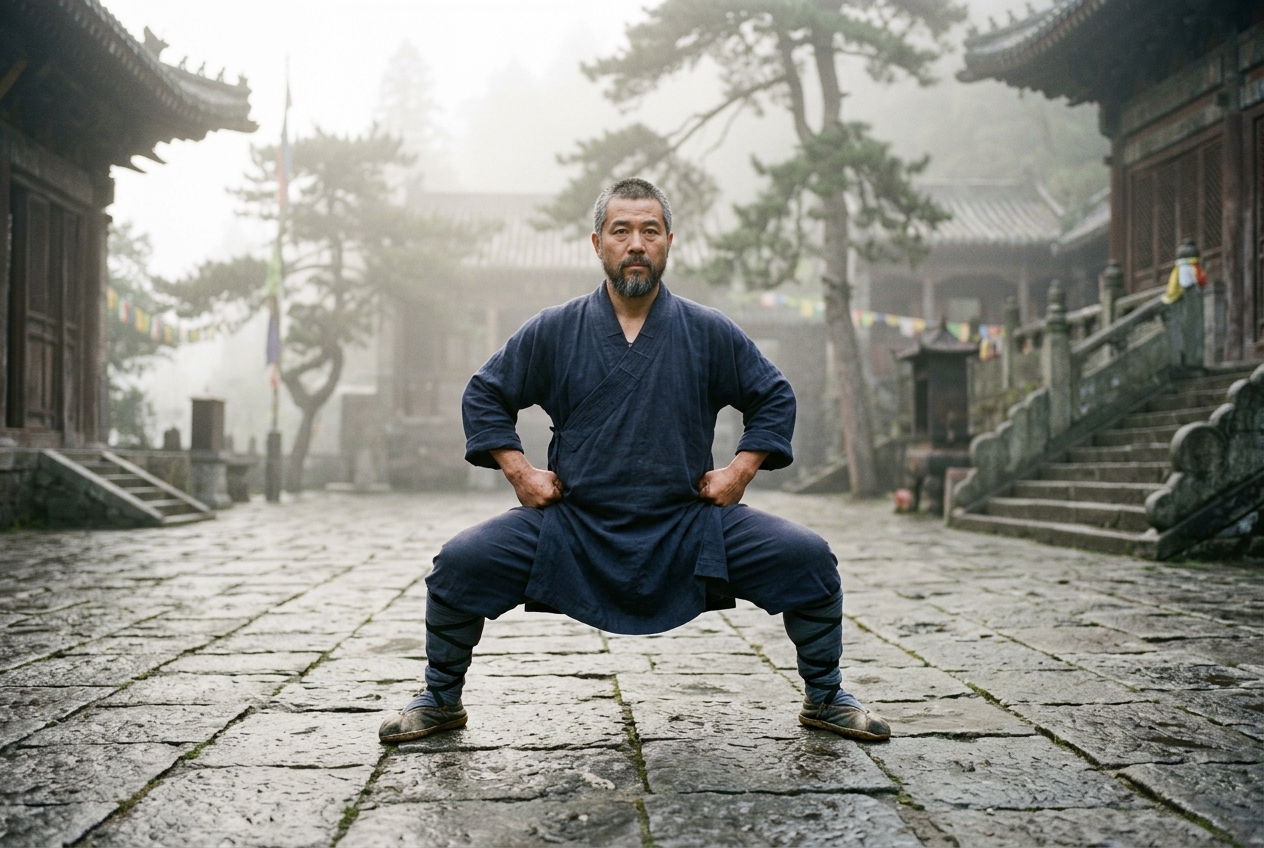
In traditional Chinese movement systems, this posture serves as the primary gateway to both external martial prowess and internal longevity cultivation. It is classified simultaneously as a foundational martial stance and as an advanced form of Zhan Zhuang (standing pole meditation). Where modern fitness emphasizes muscular exhaustion through repetitive motion, Ma Bu cultivates structural efficiency: aligning bones and fascial lines so that external force is conducted effortlessly into the earth. Before ancient masters ever taught a disciple to strike, throw, or circulate subtle internal energy, the student spent months—often years—anchoring their lower basin (Xia Pan), learning to turn the lower limbs into immovable architectural pillars rooted deep into the soil.
Step-by-Step Practice Guide
Mastering Ma Bu requires meticulous attention to structural vectors. A millimeter of misalignment at the foot propagates into shear stress at the knee and compression in the lumbar spine. Follow these sequential stages to establish an anatomically sound and energetically resonant root.
1. The Architectural Setup
- Foot Spacing & Parallel Geometry: Stand tall, then pivot on your heels and toes sequentially until your feet are spaced approximately two shoulder-widths apart (roughly three foot-lengths of clear space between your insteps). Ensure that the outer lateral edges of both feet are strictly parallel to one another. Beginners instinctively flare their toes outward to relieve hip tension; resist this tendency, as parallel placement is mandatory to lock the ankle joint into stable dorsiflexion and activate the deep lateral rotators of the hip.
- The Descent: Hinge simultaneously at the coxofemoral (hip) joints and knees, lowering your pelvis directly downward along a vertical plumb line. Strive to lower your hips until your femurs approach parallel with the floor. If you are a beginner, descending to a 45-degree knee angle is entirely sufficient; structural integrity must never be sacrificed for depth.
- Knee Tracking: Actively press your knees outward so they track precisely over the second and third toes of each foot. Never allow the knees to collapse inward into a valgus angle, nor allow them to drift past the anterior boundary of your toes. Your shins should remain as close to vertical as your ankle mobility permits.
- Pelvic Alignment and Opening the Mingmen: Execute a subtle posterior pelvic tilt by drawing your pubic bone slightly upward toward your navel while relaxing your coccyx (tailbone) straight down as if weighted by a plumb bob. This crucial movement flattens the natural lordotic curve of the lumbar spine, decompressing the L4–S1 vertebrae and expanding the classical Mingmen (Life Gate / GV-4) point across your lower back.
- Upper Body Suspension: Keep the chest relaxed, broad, and slightly concave (Han Xiong); never puff the ribcage forward. Tuck the chin slightly to align the cervical vertebrae, feeling as though the vertex of your skull (Baihui / GV-20) is suspended from an invisible thread in the heavens. Rest your hands over the lower abdomen, extend them forward in an isometric circle as if hugging an ancient pine tree, or rest the fists lightly at the hip crests.
2. Breath and Somatic Coordination
- Nasal Diaphragmatic Respiration: Seal your lips lightly and press the tip of your tongue against the hard palate just behind the upper front teeth, completing the circuit between the Conception and Governing vessels (Ren Mai and Du Mai).
- Breathing into the Lower Basin: Inhale smoothly through your nose for a four-second count, directing the expansion not into your chest, but circumferential into your lower belly, lateral flanks, and lower back—an area situated approximately two inches below your navel known as the lower Dantian.
- Perineal Tonicity: As you exhale smoothly through the nose for a four-to-six-second count, maintain structural stability while gently drawing the pelvic floor (Huiyin / CV-1) subtly upward, synchronizing the deep transverse abdominis with the pelvic diaphragm.
- Ground Reaction Anchoring: With every exhalation, mentally guide your physiological weight down through the tibia, across the arches of your feet, and into the Yongquan (Bubbling Spring / KID-1) acupoint located in the depression behind the ball of the foot.
3. Common Biomechanical Errors and Corrections
- Error: Valgus Knee Collapse. Sinking lower by allowing the knees to cave inward toward the midline.
Correction: Engage the gluteus medius and external hip rotators; imagine tearing the floor apart between your feet without moving the soles. - Error: Lumbar Hyperlordosis (Duck Butt). Sticking the buttocks out backward, creating high shearing forces across the lumbar discs.
Correction: Tuck the tailbone downward, engage the rectus abdominis, and flatten the lower back until the lumbar spine feels long, open, and supported. - Error: Anterior Weight Drift. Rising onto the balls of the feet with heels lifting or unweighted.
Correction: Distribute body weight evenly across the "tripod of the foot"—the base of the big toe, the base of the little toe, and the calcaneus (heel).
4. Navigating Internal Sensations
As the hold extends past one minute, observe the cascade of somatic feedback without panic: * Thermal Waves (Internal Heat): An intense, spreading warmth in the thighs, abdomen, and palms indicates capillary vasodilation and increased microcirculation driven by sustained muscular exertion and parasympathetic engagement. * Fasciculations and Shaking: Involuntary muscular trembling in the quadriceps and adductors is a natural sign of motor unit recruitment and central nervous system adaptation to sustained isometric tension. When the tremors occur, deepen your exhalations and sink half an inch lower rather than collapsing upward. * Myofascial Heaviness and Rootedness: A profound sense of hydraulic weight descending into the feet, accompanied by lightness and spaciousness in the upper torso and skull.
Why It Works: The Somatic and Neuromuscular Science
To the Western clinical observer, Ma Bu is a masterclass in static biomechanical loading, fascial tensegrity, and autonomic nervous system recalibration. Far from being a mere test of willpower, the stance engages specific neuromuscular pathways that promote systemic structural resilience according to contemporary orthopedic and physiological literature cataloged by the National Center for Biotechnology Information.
1. Isometric Neuromuscular Adaptation and Piezoelectric Loading
Holding an angled squat without joint movement forces the quadriceps complex (rectus femoris, vastus lateralis, vastus medialis oblique, and vastus intermedius) into prolonged, uninterrupted isometric contraction. Unlike isotonic training, where muscles alternate between concentric shortening and eccentric lengthening, isometric holds eliminate the resting phase of the contraction cycle. This creates localized intramuscular hypoxia, triggering rapid recruitment of high-threshold motor units and stimulating substantial mitochondrial biogenesis.
Simultaneously, the sustained gravitational load transferred through the femoral neck, acetabulum, and tibial shaft activates the piezoelectric effect within the skeletal matrix. As formulated by Wolff's law, mechanical compression across bone tissue generates microscopic electrical potentials that stimulate osteoblasts to deposit new hydroxyapatite crystals. This process dramatically increases trabecular and cortical bone mineral density across the femoral neck and lumbar spine—regions highly susceptible to osteopenia and age-related degradation.
2. Fascial Tensegrity and the Deep Front Line
In the anatomical paradigm popularized by modern fascia researchers, Ma Bu serves as the ultimate functional integration of the Deep Front Line (DFL). This deep myofascial meridian originates under the plantar surfaces of the toes, ascends through the posterior tibialis, travels up the medial intermuscular septum of the thigh via the adductor magnus and longus, wraps through the pelvic floor and psoas major, integrates with the respiratory diaphragm, and ascends along the anterior longitudinal ligament of the spine to the cranium.
By securing the feet in a parallel vector and depressing the pelvis, the practitioner stretches and tensions the adductor complex and pelvic floor under load. Rather than relying solely on isolated muscular strength, the body settles into a state of structural tensegrity (tensional integrity). The fascial sheaths absorb and distribute gravitational forces through the entire connective matrix, relieving the knee joints of isolated mechanical load and distributing stress across an unbroken elastic kinetic chain.
3. Intra-Abdominal Pressure and Autonomic Down-Regulation
The combination of a flattened lumbar spine, contracted transverse abdominis, and lowered respiratory diaphragm generates a pressurized hydraulic cylinder within the peritoneal cavity. This elevated intra-abdominal pressure (IAP) stabilizes the spine without spinal compression, unloading the intervertebral discs.
Crucially, maintaining slow, diaphragmatic nasal breathing against this isometric pressure acts as a powerful mechanical stimulant for the vagus nerve. While the lower body operates under intense sympathetic exertion, the slow exhalations and relaxed upper torso stimulate cardiac vagal tone, lowering the systemic heart rate and improving heart rate variability (HRV). The practitioner learns to inhabit a rare physiological state: intense muscular work coupled with profound neurological tranquility.
Classical Lineage & Context: From Shaolin Daoyin to Daoist Neigong
The historical origins of the Horse Stance are inseparable from the cross-pollination of monastic physical culture and battlefield martial arts across Chinese history.
The Crucible of Shaolin Martial Daoyin
While early animal-mimicry exercises for longevity (Daoyin) date back to pre-Han dynasty shamanic traditions, the formalization of Ma Bu as the sovereign posture for lower-body conditioning occurred at the Northern Shaolin Temple in Henan province. Tradition attributes the foundational shift in monastic training to the arrival of Bodhidharma (Da Mo) in the fifth to sixth centuries CE. Witnessing the physical debility of monks subjected to endless seated meditation, Bodhidharma synthesized the legendary Yijin Jing (Muscle-Tendon Changing Classic) and Xisui Jing (Marrow Cleansing Classic).
Within the Shaolin pedagogical framework, Ma Bu was recognized as the supreme foundation of Xia Pan (the lower basin). Novice disciples were not permitted to practice striking, leaping, or weaponry until their horse stance was unshakeable. Monastic lore recounts monks holding Ma Bu with burning incense sticks placed beneath their thighs and buttocks, or balancing full bowls of water atop their knees and crown. This was not institutional sadism, but precise somatic engineering: a warrior whose lower limbs were welded to the earth could neither be uprooted by a charging cavalryman nor knocked off balance on uneven terrain.
Daoist Internal Alchemy and the Architecture of Rooting
Simultaneously, within the Daoist monasteries of Mount Wudang and the internal lineages of Taijiquan, Xingyiquan, and Baguazhang, Ma Bu was refined from an external conditioning tool into a sophisticated vessel for internal energetic alchemy (Neigong).
Daoist philosophy posited that the human body acts as a conduit between Heaven (Tian, Yang) and Earth (Di, Yin). The lower Dantian—the energetic furnace located in the pelvic basin—serves as the reservoir of pre-heaven original essence (Yuan Qi). In normal sedentary posture, this energetic reservoir is scattered, leaking upward through an overactive, stressed intellect.
By widening the stance, anchoring the feet into the earth via the Yongquan gates, and opening the Mingmen gate through pelvic tilting, the Daoist adept created an open vessel capable of condensing and storing vitality. The stance was no longer held with rigid, aggressive muscular tension, but with Song (松)—an alert, supple release of all non-essential effort. Through Song, the physical body yields so completely to gravity that ground reaction forces bounce back upward through the skeletal frame, manifesting as the legendary "iron root" capable of neutralizing incoming physical vectors without overt exertion.
Evidence-Based Health Benefits
The therapeutic value of Ma Bu and associated standing Qigong methods is recognized globally across integrative medicine, supported by the World Health Organization Traditional Medicine frameworks and the clinical standards promoted by the National Qigong Association.
| Physiological Domain | Primary Mechanism of Action | Clinical / Functional Outcome |
|---|---|---|
| Postural Rehabilitation | Isometric pelvic floor & transverse abdominis co-activation | Decompression of lumbosacral junction (L4–S1); remediation of lower crossed syndrome. |
| Osteogenic Health | Piezoelectric bone loading under static compressive gravity | Increased bone mineral density across femoral neck, trochanter, and vertebral bodies. |
| Autonomic Regulation | Vagal nerve stimulation via diaphragmatic breath under load | Enhanced heart rate variability (HRV); systematic down-regulation of baseline cortisol. |
| Cardiovascular Capacity | Microvascular shear stress & collateral capillary recruitment | Reductions in resting systolic/diastolic blood pressure via peripheral vasodilation. |
| Kinetic Equilibrium | Somatosensory & plantar mechanoreceptor activation | Dramatic enhancement in dynamic balance, proprioception, and geriatric fall prevention. |
Biomechanical Comparison of Postural Stances
Understanding the mechanical differences between standing configurations allows practitioners to tailor their training to specific somatic goals:
| Parameter | High Meditative Horse Stance | Deep Classical Martial Ma Bu | Natural Natural Stance (Wuji) |
|---|---|---|---|
| Knee Flexion Angle | 30° – 45° | 80° – 90° (Femurs horizontal) | 5° – 10° (Micro-flexed) |
| Stance Width | 1.5 × Shoulder-width | 2.0 – 2.5 × Shoulder-width | 1.0 × Shoulder-width |
| Primary Physical Demand | Fascial line integration & mental stillness | Maximum isometric quadriceps & hip strength | Skeletal stacking & zero-effort gravity release |
| Target Energy Center | Lower Dantian condensation | Xia Pan rooting & Kidney meridian vitality | Central axis (Zhong Mai) vertical alignment |
| Optimal Duration | 10 to 30 minutes | 1 to 5 minutes | 15 to 60 minutes |
Progressive Training Protocols and Safety Considerations
To practice Ma Bu safely without creating patellofemoral inflammation or lumbar strain, practitioners should follow a structured, progressive hierarchy that prioritizes joint health over ego-driven depth.
The 21-Day Progressive Rooting Protocol
- Week 1 (Foundation): Set feet 1.5 shoulder-widths apart. Descend to a high 30-degree knee bend. Focus entirely on foot parallelism, pelvic tuck, and smooth nasal diaphragmatic breathing. Perform three sets of 45 seconds daily, resting 60 seconds between sets.
- Week 2 (Deepening): Widen feet to 2.0 shoulder-widths. Descend to a 45-to-60-degree knee bend. Introduce intentional Yongquan grounding and subtle Huiyin (pelvic floor) engagement on each exhalation. Perform four sets of 60 seconds daily.
- Week 3 (Integration): Maintain double shoulder-width. Lower hips toward a 75-degree angle. Strive for absolute stillness, relaxing unnecessary shoulder and facial tension. Complete three sets of 90 to 120 seconds daily.
Absolute Contraindications and Modifications
- Acute Patellar Tendinopathy or Meniscal Tears: Avoid deep knee flexion; practice high-stance Wuji standing or perform the posture with back support against a smooth wall to eliminate shearing forces.
- Uncontrolled Hypertension: Avoid holding the breath under any circumstances (Valsalva maneuver); keep the stance shallow to prevent abrupt blood pressure spikes.
- Advanced Glaucoma or Inguinal Hernia: High intra-abdominal pressure must be moderated; practice with natural breathing in a higher, gentle stance.
Today's Practice Commitment
Tomorrow morning, before reaching for your phone or brewing your first cup of coffee, dedicate exactly three minutes to your physical and energetic foundation:
- Step your feet into a parallel, comfortable 1.5-shoulder-width stance.
- Sink into a modest 45-degree horse stance, rest your palms over your lower belly, and close your eyes halfway.
- Complete twenty slow, uninterrupted diaphragmatic breaths into your lower Dantian, mentally sending your weight deep into the floor beneath you.
- When the trembling arises in your thighs, smile inwardly, relax your jaw, exhale down to your feet, and hold for three more breaths before slowly standing up.
Notice how your body carries itself through the rest of the day. You will find that when your roots are driven deep into the earth, no storm of the modern world can knock you off balance.