Entanglement Witnesses: Detecting Non-Separable States and Bound Entanglement Via Hyperplane Separation
The cryptographic protocols safeguarding global banking ledgers, national defence communications, and confidential healthcare records rely on mathematical problems—such as prime factorization and discrete logarithms—that would require a classical supercomputer millennia to unravel. A fault-tolerant quantum computer, executing algorithms that exploit the non-local correlations of quantum mechanics, could solve these problems in mere hours.
Yet an existential question looms over every laboratory in the world racing to build these machines: when a quantum processor claims to harness dozens, hundreds, or thousands of qubits, how can experimentalists verify that the device is genuinely leveraging quantum entanglement, rather than mimicking it through classical statistical noise, thermal fluctuations, or classical crosstalk?
Characterising a quantum system in its entirety requires a procedure known as quantum state tomography. Tomography reconstructs the full quantum density matrix $\rho$ by measuring an exhaustive battery of non-commuting observables. However, this brute-force method faces a catastrophic mathematical barrier: its experimental complexity scales as $\mathcal{O}(d^4)$ in Hilbert space dimension $d$. For an $N$-qubit processor where $d = 2^N$, a 10-qubit register requires over one million distinct measurement configurations; a 50-qubit processor would require more measurement runs than there are atoms in the observable universe.
                                HILBERT SPACE GEOMETRY

   +-------------------------------------------------------------------------+
   |  D(H): Set of All Density Operators                                     |
   |                                                                         |
   |                   Hyperplane: Tr(W \sigma) = 0                          |
   |                   ~~~~~~~~~~~~~~~~~~~~~~~~~~~~~                         |
   |                  /                             \                        |
   |                 /   S: Closed Convex Set        \                       |
   |                /    of Separable States          \                      |
   |               |                                   |                     |
   |               |     \sigma = \sum p_i \rho_i      |                     |
   |               |                                   |                     |
   |                \    Tr(W \sigma) >= 0            /                      |
   |                 \                               /                       |
   |                  \                             /                        |
   |                   ~~~~~~~~~~~~~~~~~~~~~~~~~~~~~                         |
   |                                                                         |
   |        * \rho (Entangled State)                                         |
   |          Tr(W \rho) < 0  <--- DETECTED!                                 |
   +-------------------------------------------------------------------------+
To break this bottleneck, quantum information theorists turned to functional analysis and convex geometry. The result is the entanglement witness: a specialised mathematical observable that acts as a geometric scalpel, slicing through the state space to certify genuine quantum entanglement with a mere handful of local measurements, bypassing full state reconstruction entirely.
1. The Idea in Plain English: Slicing the Space of Quantum States
To understand how an entanglement witness operates without getting lost in mathematical abstractions, consider a physical analogy.
Imagine you are tasked with identifying whether an exotic culinary emulsion contains an ultra-rare botanical extract. You could perform an exhaustive, atom-by-atom mass spectrometry of the entire dish—an expensive, destructive, and practically impossible undertaking. Alternatively, you could add a single targeted chemical reagent that remains completely inert in the presence of all conventional culinary ingredients, but triggers an unmistakable luminescence if, and only if, the target botanical compound is present.
An entanglement witness is the quantum mechanical equivalent of that chemical reagent.
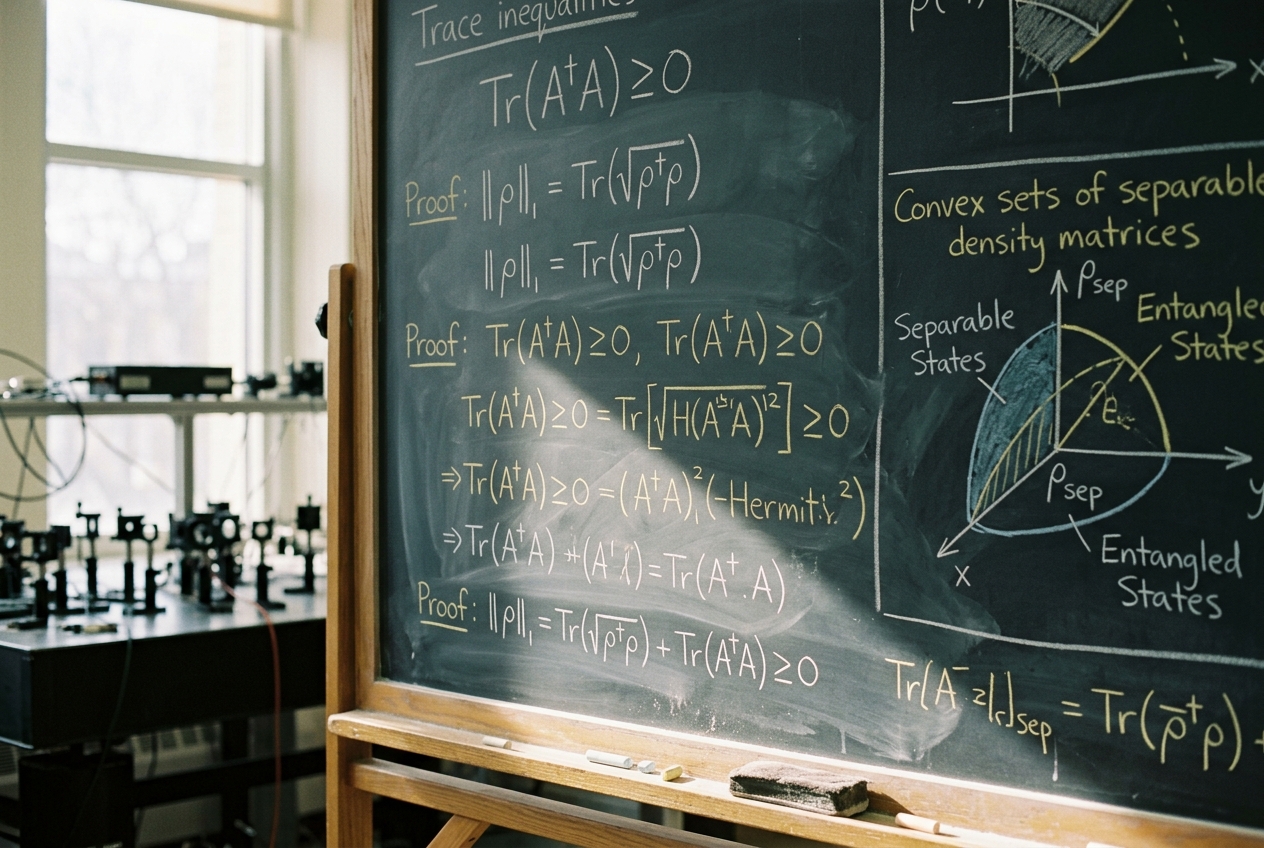
In quantum mechanics, the mathematical space representing every possible state of a physical system is structured like a multi-dimensional convex body. A geometric shape is called convex if, whenever you choose any two points inside it, the straight line connecting them remains entirely within the shape.
The collection of all "separable" states—states whose correlations can be fully explained by classical shared randomness, like two coins flipped from the same hand—forms a compact, closed convex set. We designate this set $\mathcal{S}$.
===============================================================================
                     CLASSICAL VS. ENTANGLED CORRELATIONS
===============================================================================
  Separable State (\sigma \in S):
  Can be prepared by Local Operations and Classical Communication (LOCC).
  Correlations are classical; state lives inside the convex set S.

Entangled State (\rho \notin S):
  Possesses non-local quantum coherence that cannot be generated classically.
  State sits strictly outside the convex set S.
===============================================================================
Surrounding this classical island is the vast ocean of all possible quantum states, $\mathcal{D}(\mathcal{H})$, which includes entangled states. If an experimental state $\rho$ is genuinely entangled, it sits strictly outside the convex island of separable states $\mathcal{S}$.
Because the island of classical states is convex, the celebrated Hahn-Banach theorem of functional analysis guarantees that one can always place a flat, linear barrier—a hyperplane—between the classical island and the outlier point.
An entanglement witness is simply the physical observable representing that geometric dividing line. When measured, it outputs an expectation value. By mathematical construction: - Any state lying on or inside the classical island produces a positive or zero value ($\geq 0$). - Any state lying on the far side of the hyperplane produces a strictly negative value ($< 0$).
A negative experimental measurement therefore serves as an unambiguous signature: the system is definitively entangled.
2. How It Actually Works: The Geometric & Mathematical Mechanics
To formalise this intuition for quantum information processing, we construct the rigorous mathematical framework underpinning witness operators, their optimization, and their ability to detect subtle forms of quantum correlation where standard algebraic tests fail.
The Limits of Tomography and the Peres-Horodecki (PPT) Criterion
Let $\mathcal{H} = \mathcal{H}_A \otimes \mathcal{H}_B$ denote a bipartite Hilbert space of dimension $d = d_A \times d_B$. The state space $\mathcal{D}(\mathcal{H})$ consists of density operators $\rho$ satisfying $\rho = \rho^\dagger$, $\rho \ge 0$, and $\text{Tr}(\rho) = 1$. A state $\sigma \in \mathcal{D}(\mathcal{H})$ is defined as separable if and only if it admits a convex decomposition:
$$\sigma = \sum_{k} p_k \, \rho_k^A \otimes \rho_k^B, \quad p_k \ge 0, \quad \sum_k p_k = 1$$
where $\rho_k^A \in \mathcal{D}(\mathcal{H}_A)$ and $\rho_k^B \in \mathcal{D}(\mathcal{H}_B)$. The set of all such states, $\mathcal{S}$, is convex and compact in the trace-class topology.
Historically, the standard analytical test for separability has been the Peres-Horodecki criterion, also known as the Positive Partial Transpose (PPT) condition. Taking the partial transpose with respect to subsystem $B$ transforms matrix elements in a product basis according to:
$$\langle i_A, j_B | \rho^{T_B} | k_A, l_B \rangle = \langle i_A, l_B | \rho | k_A, j_B \rangle$$
If $\sigma$ is separable, its partial transpose $\sigma^{T_B}$ is necessarily positive semi-definite ($\sigma^{T_B} \ge 0$).
However, for higher dimensions ($d_A \times d_B > 6$), this equivalence collapses. There exist states that possess a positive partial transpose ($\rho^{T_B} \ge 0$) yet cannot be decomposed as a convex sum of product states. These are known as PPT entangled states or bound entangled states—entanglement from which no pure maximally entangled states can be distilled via Local Operations and Classical Communication (LOCC).
                      THE DIMENSIONAL FRONTIER OF PPT

  Hilbert Space Dim        PPT Criterion Status
  -------------------------------------------------------------
  2 x 2 (Two Qubits)       Necessary & Sufficient (No Bound Entanglement)
  2 x 3 (Qubit-Qutrit)     Necessary & Sufficient (No Bound Entanglement)
  3 x 3 (Two Qutrits)      INSUFFICIENT (Bound Entangled States Exist!)
  2 x 4 (Qubit-Ququart)    INSUFFICIENT (Bound Entangled States Exist!)
  N-Qubit (N >= 3)         INSUFFICIENT (Bound Entangled States Exist!)
Because the PPT criterion cannot detect bound entangled states, algebraic tests are fundamentally incomplete for higher-dimensional Hilbert spaces. Geometric separation is required.
Hyperplane Separation and the Formal Witness Operator
The existence of entanglement witnesses is a direct consequence of the Hahn-Banach Separation Theorem applied to the real Banach space of Hermitian operators $\mathcal{B}h(\mathcal{H})$ equipped with the Hilbert-Schmidt inner product $\langle X, Y \rangle{\text{HS}} = \text{Tr}(X Y)$.
Because $\mathcal{S}$ is a closed convex subset of $\mathcal{B}_h(\mathcal{H})$, for any entangled density matrix $\rho \notin \mathcal{S}$, there exists a continuous linear functional that strictly separates $\rho$ from $\mathcal{S}$. By the Riesz representation theorem, this functional corresponds to a Hermitian operator $W = W^\dagger \in \mathcal{B}_h(\mathcal{H})$ such that:
$$\text{Tr}(W \sigma) \ge 0 \quad \forall \, \sigma \in \mathcal{S}, \qquad \text{and} \qquad \text{Tr}(W \rho) < 0$$
The hyperplane defined by the affine subspace ${ X \in \mathcal{B}_h(\mathcal{H}) : \text{Tr}(W X) = 0 }$ acts as the decision boundary. The quantity $|\text{Tr}(W \rho)|$ quantifies the depth of violation, serving as an operational lower bound on the entanglement of formation and the geometric measure of entanglement.
===============================================================================
                    FUNDAMENTAL WITNESS CONDITIONS
===============================================================================
  1. Hermiticity:             W = W^\dagger
  2. Non-Negative on S:       \langle a, b | W | a, b \rangle >= 0   \forall |a, b\rangle
  3. Indefinite Spectrum:     W must possess at least one negative eigenvalue
  4. Detection Condition:     Tr(W \rho) < 0   ===>   \rho is Entangled
===============================================================================
Decomposable vs. Non-Decomposable Witnesses
The distinction between different classes of witness operators reveals the deep connection between functional analysis and quantum bound entanglement:
- Decomposable Witnesses: A witness operator $W$ is termed decomposable if it can be written in the form: $$W = P + Q^{T_B}$$ where $P \ge 0$ and $Q \ge 0$ are positive semi-definite operators, and $Q^{T_B}$ is the partial transpose of $Q$.
If we evaluate the expectation value of a decomposable witness on any state $\rho$ with a positive partial transpose ($\rho^{T_B} \ge 0$), we find: $$\text{Tr}(W \rho) = \text{Tr}(P \rho) + \text{Tr}(Q^{T_B} \rho) = \text{Tr}(P \rho) + \text{Tr}(Q \rho^{T_B}) \ge 0$$ Consequently, decomposable witnesses can only detect states with a Negative Partial Transpose (NPT). They are structurally blind to bound entanglement.
- Non-Decomposable Witnesses: A witness $W$ is non-decomposable if it cannot be expressed as $P + Q^{T_B}$ for any positive semi-definite $P, Q$. Non-decomposable witnesses correspond to tangent hyperplanes that isolate PPT entangled states from $\mathcal{S}$, providing the only known linear method for experimentally verifying bound entanglement in physical systems.
                    WITNESS TAXONOMY & CAPABILITY

               +----------------------------------------+
               |        All Entanglement Witnesses       |
               +-------------------+--------------------+
                                   |
                  +----------------+----------------+
                  |                                 |
        +---------v-----------+          +----------v----------+
        | Decomposable (W)    |          | Non-Decomposable (W)|
        | W = P + Q^{T_B}     |          | W != P + Q^{T_B}    |
        | Detects: NPT States |          | Detects: PPT Bound  |
        |                      |          | Entangled States    |
        +---------------------+          +---------------------+
Construction of Canonical Pure-State Witnesses
When experimentalists target a specific entangled pure state $|\psi\rangle \in \mathcal{H}_A \otimes \mathcal{H}_B$, how do they construct the optimal witness operator?
Consider an arbitrary pure entangled state $|\psi\rangle$. We formulate the canonical witness as:
$$W = \alpha I - |\psi\rangle\langle\psi|$$
where $I$ is the identity operator on $\mathcal{H}$, and $\alpha$ is a real scalar. To satisfy the separability constraint $\text{Tr}(W \sigma) \ge 0$ for all $\sigma \in \mathcal{S}$, we evaluate the expectation value over all product states $|a, b\rangle = |a\rangle \otimes |b\rangle$:
$$\text{Tr}(W |a, b\rangle\langle a, b|) = \alpha - |\langle a, b | \psi \rangle|^2 \ge 0$$
To make the witness as sensitive as possible—detecting the maximum volume of noisy states surrounding $|\psi\rangle$—we choose $\alpha$ to be the strict maximum squared overlap between $|\psi\rangle$ and the set of unentangled product states:
$$\alpha = \max_{|a, b\rangle \in \mathcal{H}_A \otimes \mathcal{H}_B} |\langle a, b | \psi \rangle|^2$$
The parameter $\alpha$ represents the classical fidelity threshold. If an experimentally prepared density matrix $\rho$ achieves a target fidelity $F(\rho, \psi) = \langle \psi | \rho | \psi \rangle > \alpha$, then:
$$\text{Tr}(W \rho) = \alpha \text{Tr}(\rho) - \langle \psi | \rho | \psi \rangle = \alpha - F(\rho, \psi) < 0$$
proving that $\rho$ is entangled.
                     CANONICAL WITNESS DERIVATION

  Target Pure State:            |\psi\rangle
  Maximum Product Overlap:      \alpha = \max_{|a,b\rangle} |\langle a,b|\psi\rangle|^2
  Canonical Witness Operator:   W = \alpha I - |\psi\rangle\langle\psi|

  Separable State Threshold:    Tr(W \sigma) >= 0  ===>  Fidelity <= \alpha
  Entanglement Detection:       Tr(W \rho) < 0    <===> Fidelity > \alpha
For the two-qubit maximally entangled Bell state $|\Phi^+\rangle = \frac{1}{\sqrt{2}}(|00\rangle + |11\rangle)$, the maximum overlap with any product state is $\alpha = 1/2$. The corresponding Bell witness is:
$$W_{\Phi^+} = \frac{1}{2}I - |\Phi^+\rangle\langle\Phi^+|$$
Any experimental state exhibiting a fidelity $F > 0.5$ with respect to $|\Phi^+\rangle$ is certified as genuinely entangled.
Local Decomposition for Laboratory Architectures
An experimental apparatus cannot measure the non-local projection operator $|\psi\rangle\langle\psi|$ in a single shot without an entangling unitary circuit. Instead, experimentalists decompose $W$ into a linear combination of tensor products of single-qubit Pauli matrices ($\sigma_x, \sigma_y, \sigma_z$) and the identity $I$:
$$W = \sum_{i_1, i_2, \dots, i_N \in {0, x, y, z}} c_{i_1 i_2 \dots i_N} \left( \sigma_{i_1} \otimes \sigma_{i_2} \otimes \dots \otimes \sigma_{i_N} \right)$$
where the real coefficients are determined by the Hilbert-Schmidt projection:
$$c_{i_1 \dots i_N} = \frac{1}{2^N} \text{Tr}\left( W \left[ \sigma_{i_1} \otimes \dots \otimes \sigma_{i_N} \right] \right)$$
For the Bell state $|\Phi^+\rangle$, substituting the density operator into $W_{\Phi^+} = \frac{1}{2}I - |\Phi^+\rangle\langle\Phi^+|$ yields:
$$W_{\Phi^+} = \frac{1}{4} \left( I \otimes I - \sigma_x \otimes \sigma_x + \sigma_y \otimes \sigma_y - \sigma_z \otimes \sigma_z \right)$$
Instead of reconstructing the 15 independent parameters of a two-qubit density matrix via full state tomography, the experimenter only measures three local observable settings: $\langle \sigma_x \otimes \sigma_x \rangle$, $\langle \sigma_y \otimes \sigma_y \rangle$, and $\langle \sigma_z \otimes \sigma_z \rangle$.
===============================================================================
              TOMOGRAPHY VS. WITNESS MEASUREMENT COMPLEXITY
===============================================================================
  System Architecture       Full State Tomography        Witness Measurement
  ---------------------------------------------------------------------------
  2-Qubit Bell State        15 observables (9 settings)  3 local settings
  N-Qubit GHZ State         4^N - 1 parameters           N + 1 local settings
  N-Qubit Cluster State     Exponential (3^N settings)   2 local settings
===============================================================================
For an $N$-qubit Greenberger-Horne-Zeilinger (GHZ) state, $|\text{GHZ}_N\rangle = \frac{1}{\sqrt{2}}(|0\rangle^{\otimes N} + |1\rangle^{\otimes N})$, the fidelity threshold is $\alpha = 1/2$. The canonical witness decomposes into:
$$W_{\text{GHZ}} = \frac{1}{2}I - |\text{GHZ}N\rangle\langle\text{GHZ}_N| = \frac{1}{2}I - \frac{1}{2}\left( \frac{I^{\otimes N} + \sigma_z^{\otimes N}}{2} + \prod{k=1}^N \frac{\sigma_x^{(k)} + i \sigma_y^{(k)}}{2} + \text{h.c.} \right)$$
This reduces the verification of genuine multipartite entanglement from $3^N$ measurement settings down to just $N+1$ collective settings, enabling direct scalability on modern noisy intermediate-scale quantum (NISQ) devices.
3. Real-World Applications Today (2024–2026)
Entanglement witnesses are not merely theoretical constructs; they are the gold standard for state validation across cutting-edge quantum hardware platforms worldwide.
+-----------------------------------------------------------------------------+
|               FRONTIER EXPERIMENTAL PLATFORMS USING WITNESSES               |
+-----------------------------------------------------------------------------+
|                                                                             |
|  [Superconducting Qubits]      [Trapped Ion Chains]      [Photonic Chips]   |
|   IBM Quantum / Heron           Quantinuum / H2-Series    USTC / QuTech     |
|   * Scalable GHZ validation     * Non-equilibrium phases  * Satellite QKD   |
|   * Stabilizer error tracking   * 30+ ion entanglement    * High-dim states |
|                                                                             |
+-----------------------------------------------------------------------------+
A. Superconducting Quantum Processors (IBM Quantum Learning)
- Institution/Platform: IBM Quantum, deploying high-coherence architectures such as the Heron and Condor processors.
- Objective: Verifying Genuine Multipartite Entanglement (GME) across graph states and heavy-hexagonal lattice layouts containing over 100 coupled superconducting transmon qubits.
- Quantum Advantage: Full state tomography for 100 qubits would require $\sim 10^{60}$ measurements, taking billions of years. By synthesizing graph-state stabilizer witnesses derived from local syndrome operators, IBM engineers verify multi-qubit entanglement across the processor in milliseconds, providing instant benchmarks for gate calibration and quantum error mitigation.
B. Satellite-Based Quantum Key Distribution (Nature npj Quantum Information)
- Institution/Platform: University of Science and Technology of China (USTC) and the Micius quantum satellite consortium.
- Objective: Real-time certification of polarization-entangled photon pairs transmitted over 1,200-kilometer space-to-ground optical links.
- Quantum Advantage: Atmospheric turbulence and optical diffraction severely limit photon collection rates. Entanglement witnesses allow ground stations to certify the security of the quantum communication channel using minimal photon counts, detecting potential eavesdropping attempts without exhausting the tight photon link budget.
C. Trapped-Ion Quantum Simulators (MIT OpenCourseWare Quantum Physics)
- Institution/Platform: Quantinuum (H-Series hardware) and the University of Maryland / Joint Quantum Institute.
- Objective: Detecting dynamical entanglement phase transitions in one-dimensional and two-dimensional chains of up to 32 ytterbium and barium ions.
- Quantum Advantage: When simulating non-equilibrium quantum matter or frustrated magnetism, entanglement grows rapidly across the ion chain. Measuring collective spin witnesses enables researchers to detect topological order and many-body entanglement signatures directly from global laser fluorescence readouts.
D. Cluster-State Generation for Optical Quantum Computing (Nature Physics)
- Institution/Platform: PsiQuantum and Xanadu Quantum Technologies.
- Objective: Constructing continuous-variable and discrete-variable 2D cluster states—the fundamental computational resource for measurement-based quantum computing (MBQC).
- Quantum Advantage: Continuous generation of optical cluster states requires on-the-fly verification before single-qubit projective measurements destroy the cluster. Stabilizer-based witness operators evaluate entanglement quality within nanosecond optical clock cycles, ensuring fault-tolerant threshold compliance.
4. What This Means for You
While the mathematical formulation of hyperplane separation in Hilbert spaces may seem distant from daily life, entanglement witnesses provide the foundational verification layer for the quantum technologies that will shape the next decade:
+-----------------------------------------------------------------------------+
|                           PRACTICAL IMPLICATIONS                            |
+-----------------------------------------------------------------------------+
|  1. Unhackable Data Security: Guarantees that encryption keys generated via  |
|     QKD networks are genuinely quantum and free from interception.          |
|                                                                             |
|  2. Reliable Pharmaceutical Design: Ensures that quantum molecular          |
|     simulators model complex enzymes using authentic quantum coherence.      |
|                                                                             |
|  3. Verifiable Quantum Cloud Computing: Enables clients to audit remote     |
|     hardware, certifying that paid computations run on real quantum states. |
+-----------------------------------------------------------------------------+
-
Guaranteed Cybersecurity: As quantum communication networks expand into commercial telecommunications, entanglement witnesses act as the digital notary. When you connect to a quantum-secured network, witness protocols run continuously in the background, verifying that the physical link is entangled and that no eavesdropper has intercepted the encryption keys.
-
Accelerated Drug and Materials Discovery: Simulating complex catalytic chemical reactions—such as biological nitrogen fixation for fertilizers or lithium-electrolyte interfaces for next-generation batteries—requires simulating deeply entangled electron configurations. Entanglement witnesses ensure that quantum hardware maintains the fragile coherence needed to deliver accurate, reliable molecular insights.
-
Trust and Auditing in Cloud Quantum Computing: When enterprises pay cloud providers to run algorithms on quantum processors, entanglement witnesses provide an efficient, vendor-independent audit mechanism to verify that the remote hardware is genuinely operating in the quantum regime rather than executing classical approximations.
5. Today's Takeaway
Entanglement is the defining currency of quantum advantage, yet its fragile nature makes it notoriously difficult to detect in high-dimensional systems where brute-force tomography fails and algebraic tests falter.
By mapping the verification problem onto the elegant geometry of convex sets, entanglement witnesses use hyperplanes to separate classical correlations from genuine quantum coherence.
With a targeted set of local measurements, they provide an experimental shortcut that transforms a mathematically intractable challenge into a rapid, scalable, and indispensable diagnostic for quantum technologies worldwide.