Chen Tuan Sleeping Qigong: Lateral Recumbent Postural Alignment, Nocturnal Dantian Consolidation, and Shen Internalization in Daoist Daoyin
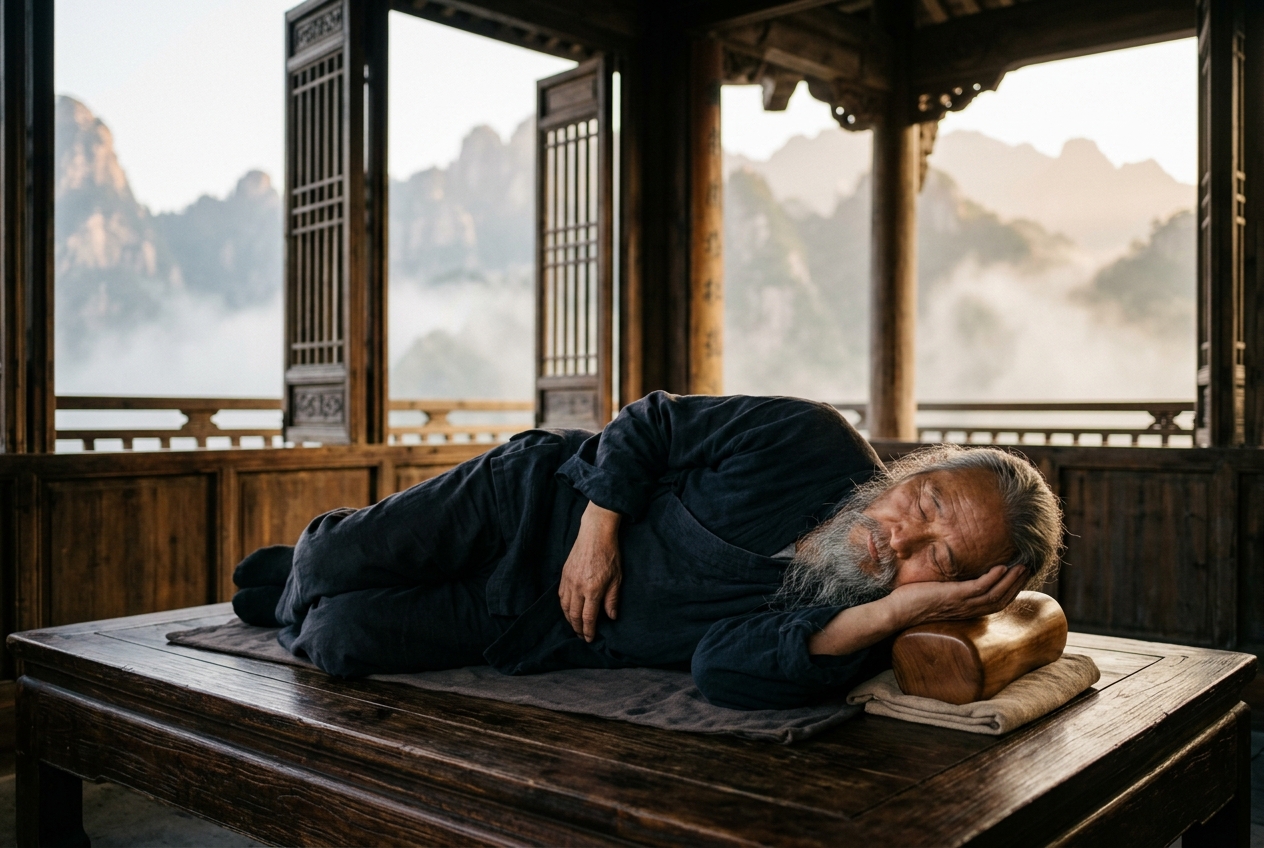
Within the framework of Traditional Chinese Medicine (TCM), the method bridges the vital reservoir of physical vitality (Jing, 精), the breath and circulatory dynamics of life energy (Qi, 气), and the luminous awareness of mind and spirit (Shen, 神). Through intentional positioning and quiet breath entrainment, mental agitation is coaxed out of overstimulated cerebral centers and anchored deep within the visceral core. Clinical and somatic organizations such as the National Qigong Association have long recognized these classical recumbent disciplines as foundational tools for systemic regulation, offering modern individuals a potent antidote to chronic sensory overload, nocturnal hyperarousal, and musculoskeletal compression.
Biomechanical Architecture of the Sleeping Dragon: A Step-by-Step Practice Guide
The foundational posture of Chen Tuan's system is the Right Lateral Recumbent Posture (You Ce Wo, 右侧卧), historically favored for its hemodynamic advantages over left-side or supine sleeping. Setting up the posture requires deliberate attention to the kinetic chain, ensuring that joints are neither hyper-extended nor compressed, but suspended in a state of balanced structural tensegrity.
       [Head/Cervical Support] ~ Neutral Alignment
             o  <-- Tongue to hard palate
            /|\ <-- Top hand over Lower Dantian (Guanyuan)
           / | \
 [Spine: Gentle 'C' Bow] === (Intervertebral decompression)
         /   |
   (Top Leg) | (Bottom Leg)
      /      |     \
  Flexed ~90°|   Flexed ~30°
 (Pelvic opening) (Psoas release)
1. Structural Setup and Postural Geometry
- The Foundation and Cervical Support: Recline on your right side. Position an ergonomic pillow beneath your head with sufficient height to keep your cervical spine in absolute neutral alignment—parallel to the surface of the bed—thereby preventing lateral neck flexion or impingement of the brachial plexus.
- The Arm Matrix: Rest your right ear and cheek in the open hollow of your right palm, or position the right forearm flat against the pillow with the palm cradling the jawline, keeping the elbow bent at approximately 90 degrees. Your left arm descends across the torso; place your open left palm gently over the lower abdomen, covering the lower energetic center (Xia Dantian, 下丹田) around the acupuncture point Guanyuan (CV-4), located three finger-widths below the navel.
- Asymmetric Pelvic-Lower Limb Flexion: Keep your bottom (right) leg elongated along the bed with a slight 30-degree flexion at the hip and knee to avoid joint locking. Bring your top (left) leg forward, flexing both the left hip and left knee to approximately 80 to 90 degrees. Allow the inner surface of the left knee and lower leg to rest comfortably upon the mattress or atop a thin support cushion placed between the knees. This deliberate asymmetry rotates the upper pelvis forward, gently opening the sacroiliac joint and eliminating shear stress across the lumbosacral junction (L5-S1).
- The Spinal Bow: Allow the entire vertebral column from the sacrum to the occiput to adopt a subtle, organic "C-curve" reminiscent of a resting dragon. Avoid rigid military straightness; the intention is to encourage gentle passive traction between adjacent vertebrae.
- The Oromandibular Lock: Close your lips softly without clenching your teeth. Place the tip of your tongue against the hard palate just behind the upper incisors, activating the classical "Magpie Bridge" (Qiao, 桥) that functionally unites the anterior Conception Vessel (Ren Mai) and posterior Governing Vessel (Du Mai).
2. Nocturnal Respiration and Embryonic Breath Entrainment
Once the structural container is established, respiratory awareness shifts from effortful thoracic expansion to effortless lower-abdominal excursion, initiating the state known as Embryonic Breathing (Taixi, 胎息):
- Inhalation (Subtle Visceral Filling): Inhale smoothly and silently through the nostrils for a count of four to five seconds. Direct the incoming breath not into the chest, but downward into the pelvic basin. Feel the lower abdomen gently expand outward into your resting left palm, gently mobilizing the pelvic floor and lower lumbar spine.
- The Micro-Pause: At the top of the inhalation, hold no mechanical tension. Pause in soft awareness for one to two seconds, experiencing the stillness before the exhalation unfolds.
- Exhalation (Complete Systemic Release): Allow the air to leave through the nostrils over six to eight seconds. Rather than pushing the air out, allow the elastic recoil of the diaphragm and abdominal wall to release naturally. As the breath leaves, visualize physical warmth, mental friction, and metabolic fatigue descending through the body and discharging through the soles of the feet.
- Embryonic Attenuation: Over successive cycles (typically 12 to 36 breath repetitions), make the breath progressively quieter, longer, and more refined until the physical movement of the ribcage becomes nearly imperceptible, mirroring the suspended, autonomous respiration of an embryo.
3. Diagnostic Alignment Checks and Common Adjustments
- Error 1: Excessive Thoracic Torsion: Twisting the upper chest flat toward the ceiling while the hips remain on their side produces rotary shear across the thoracolumbar junction. Correction: Ensure the sternum and navel are oriented along the same plane, tilted slightly downward toward the mattress.
- Error 2: Compression of the Axillary Neurovascular Bundle: Tucking the bottom arm directly under the torso can occlude the brachial artery and pinch the median and ulnar nerves. Correction: Draw the right shoulder blade slightly forward and outward, allowing the arm to rest adjacent to the head rather than trapped beneath the weight of the chest.
- Error 3: Paradoxical or Forced Upper Chest Breathing: Clavicular lifting activates sympathetic distress networks. Correction: Place your mental focus entirely on the warmth underneath the left hand resting on the lower belly; allow the chest to remain completely still and hollow.
4. Proprioceptive Sensations and Clinical Interpretations
During the transition into deep stillness, practitioners frequently encounter distinct somatic markers: * Microvascular Warmth (Re, 热): A distinct sensation of gentle radiant heat beneath the left hand and across the lower abdomen or lumbar region indicates local vasodilation and increased microvascular perfusion in the splanchnic circulation. * Bioelectric Tingling (Ma, 麻): Subtle buzzing or tingling sensations along the spine, fingertips, or soles of the feet reflect the release of peripheral fascial adhesions and neurological decompressive discharge. * Gravitational Heaviness and Sinking (Chen, 沉): An overwhelming feeling of somatic density, as if sinking directly into the mattress, signifies widespread musculoskeletal tonus reduction and the rapid down-regulation of the central nervous system. * Fascial Unwinding and Crepitus: Gentle, involuntary twitches or micro-adjustments along the paraspinal muscles signal the re-equilibration of hypertonic postural stabilizers.
The Physiological Matrix: Neurobiology, Biomechanics, and Fascial Dynamics
The clinical efficacy of Chen Tuan’s Sleeping Qigong aligns seamlessly with contemporary neurophysiology, cardiopulmonary dynamics, and biomechanical science. Rather than operating purely in the realm of esoteric symbolism, the Sleeping Dragon posture functions as a precision-engineered ergonomic intervention.
+-------------------------------------------------------------------------+
|                  AUTONOMIC & HEMODYNAMIC PATHWAYS                       |
|                                                                         |
|  [Right Lateral Decubitus] ----> Optimizes Inferior Vena Cava Perfusion |
|  [Asymmetric Hip Flexion]  ----> Decompresses Psoas & Lumbosacral Disc  |
|  [Slow Diaphragmatic Breath]---> Activates Vagal Brake (High HRV)       |
|  [Shen Internalization]    ----> Suppresses Default Mode Network        |
|                                                                         |
|     ====> Result: Rapid Entry into Stage 3 NREM (Slow-Wave Sleep)       |
+-------------------------------------------------------------------------+
Autonomic Vagal Modulation and Cardiopulmonary Entrainment
The sustained prolongation of the expiratory phase (exceeding inhalation by a 1:1.5 or 1:2 ratio) directly stimulates the pulmonary stretch receptors and activates the visceral afferent fibers of the vagus nerve. According to research published in the National Center for Biotechnology Information (NCBI PubMed), deliberate slow diaphragmatic breathing significantly amplifies respiratory sinus arrhythmia (RSA), elevating Heart Rate Variability (HRV) metrics—most notably high-frequency power (HF-HRV). This physiological shift engages the "vagal brake" upon the sinoatrial node, blunting sympathetic adrenergic outflow, lowering baseline blood pressure, and priming the central nervous system for rapid entry into restorative Stage 3 Non-Rapid Eye Movement (NREM) slow-wave sleep.
       [Inhalation: 4s] ---> Subtle Visceral Filling (Dantian)
             |
       [Pause: 1-2s]     ---> Autonomic Equanimity / Interoception
             |
       [Exhalation: 7s]  ---> Vagal Stimulation / RSA Activation / High HRV
Hemodynamics and Visceral Decompression in Right Lateral Decubitus
Lying specifically on the right lateral decubitus provides substantial hemodynamic and anatomical benefits: 1. Cardiac Unloading: In the right lateral position, the heart rests medial to the right lung, minimizing mechanical compression against the left chest wall and pericardium. This facilitates unimpeded ventricular filling and reduces nocturnal extrasystoles. 2. Inferior Vena Cava and Hepato-Portal Return: The right-sided orientation places the inferior vena cava in a dependent, structurally uncompressed position relative to the heavy abdominal viscera. Venous return from the lower extremities and mesenteric beds flows smoothly back to the right atrium without encountering visceral resistance. 3. Gastric Motility and Pyloric Transit: Anatomically, the stomach's greater curvature swings to the left while the pylorus empties toward the right. Right lateral positioning facilitates gravity-assisted gastric emptying into the duodenum, significantly attenuating nocturnal gastroesophageal reflux and intra-gastric pressures.
Biomechanics of Asymmetric Spinal Decompression
In conventional supine or symmetrical lateral sleeping, the lumbar spine often rests in hyper-lordosis or lateral tilt, causing chronic nocturnal loading of the facet joints and paraspinal musculature. In the Sleeping Dragon posture, the 90-degree flexion of the upper hip and knee acts as a biomechanical lever. This rotation slackens the ipsilateral psoas major and rectus femoris muscles, neutralizes anterior pelvic tilt, and widens the intervertebral foramina across the lumbar and lumbosacral spine (L1-S1). The resulting negative intradiscal pressure encourages nocturnal fluid rehydration of the nucleus pulposus, alleviating nerve root compression and restoring lumbar spine health as recognized across modern orthopedic rehabilitation and global health frameworks like the World Health Organization Traditional Medicine Strategy.
[Lumbar Intervertebral Foramina: Opened via Pelvic Rotation]
         _---_
       /       \   <-- Nucleus Pulposus Rehydration
      |  (Disc) |  <-- Relief of L5-S1 Facet Compression
       \ _--- _/
Fascial Tensegrity and Fluid Dynamics
The continuous gentle bow of the spine engages the superficial back line and deep front line of the human fascial network. Diaphragmatic excursion in this decumbent state induces a mechanical pumping action—often termed the "respiratory visceral pump"—which mobilizes interstitial fluids, stimulates the cisterna chyli for enhanced lymphatic drainage, and increases local microcirculatory perfusion throughout the mesenteric tissues.
Neurological Transposition: Shen Internalization and the Kan-Li Axis
From an energetic and neurocognitive perspective, waking consciousness is dominated by outward sensory processing and high-frequency beta-band electroencephalographic activity driven by the Default Mode Network (DMN). In Daoist alchemy, this state is characterized as Li (离, Fire)—the volatile, ascending Yang energy of the Heart and intellect.
When the practitioner anchors their visual, auditory, and interoceptive awareness into the lower abdomen (Dantian), this corresponds to the harmonization of Kan (坎, Water—the foundational Yin essence of the Kidneys) and Li (Fire). Neurologically, this process manifests as: * Sensory Gating and Thalamocortical De-excitation: Retracting focal attention from visual and auditory cortical inputs silences external scanning loops. * Insular Activation: Concentrating on the visceral sensations of abdominal warmth and pulse activates the anterior insular cortex, substituting conceptual narrative loops with pure interoceptive sensing. * Alpha-Theta Wave Synchronization: Within minutes, cortical oscillations transition from jagged beta waves into coherent alpha (8–12 Hz) and theta (4–8 Hz) rhythms, dissolving somatic anxiety and clearing a path for neurochemically rich, deep restorative sleep. For further reading on autonomic regulation, consult the clinical overview on the parasympathetic nervous system.
===========================================================================
               THE KAN-LI (WATER-FIRE) INTEGRATION AXIS
===========================================================================
  CORTICAL AROUSAL (Li / Fire / Heart)       --> Mental hyperarousal, Beta Waves
             |
             |   [Shen Internalization: Breath descending to Navel]
             V
  VISCERAL STILLNESS (Kan / Water / Kidneys) --> Interoceptive stillness, Alpha/Theta
===========================================================================
Clinical Indications, Precautions, and Structural Contraindications
While Chen Tuan Sleeping Qigong is inherently non-invasive and therapeutic, specific musculoskeletal or cardiovascular pathologies require clinical adaptation or contraindication:
| Condition / Pathology | Clinical Risk Profile | Practice Adaptation / Modification |
|---|---|---|
| Severe Rotator Cuff Tendinopathy / Shoulder Impingement | Direct axial compression on the right shoulder joint can exacerbate bursitis or tendon tears. | Place a supportive contour pillow in front of the chest; rest the right arm slightly forward rather than bent beneath the head. |
| Advanced Hip Osteoarthritis / Labral Tears | 90-degree flexion and internal rotation of the top leg can pinch the anterior femoral acetabulum. | Reduce top leg flexion to 45 degrees; place a firm pillow between knees to maintain neutral hip abduction. |
| Obstructive Sleep Apnea (OSA) | Unstable cervical positioning can induce oropharyngeal airway collapse. | Maintain strict cervical neutrality with a structured orthopedic pillow; ensure the chin remains gently tucked, never hyper-extended. |
| Severe Gastroesophageal Reflux Disease (GERD) | While right lateral sleep aids gastric transit, immediate post-prandial right decubitus can occasionally relax the lower esophageal sphincter. | Allow a minimum of 2.5 hours between the last meal and practice; elevate the head of the mattress by 15 degrees if necessary. |
| Third-Trimester Pregnancy | Sustained right-lateral positioning may exert slight pressure on the inferior vena cava compared to left-sided positioning. | Mirror the entire practice onto the left lateral side (Zuo Ce Wo), maintaining full pelvic and abdominal cushion support. |
Lineage, Legend, and Historical Context: The Legacy of Chen Tuan
The origin of conscious sleep alchemy is inextricably bound to the semi-legendary figure of Chen Tuan (c. 871–989 CE), venerated in Daoist history as Master Xiyi (希夷先生, "Master of the Inaudible and Invisible"). Living across the turbulent transition between the Five Dynasties and Ten Kingdoms period and the founding of the Song Dynasty, Chen Tuan chose the path of an eremitic scholar-sage, eventually taking up residence amidst the sheer granite precipices of Mount Hua (Huashan, 华山) in Shaanxi Province.
       /\
      /  \        MOUNT HUA (HUASHAN)
     /    \       Eremitic sanctuary of Chen Tuan
    /  /\  \      Birthplace of Sleeping Qigong (Shui Gong)
   /  /  \  \     and Internal Alchemical Integration (Neidan)
  /  /    \  \
Historical chronicles record that Emperor Taizu of Song sought Chen Tuan's political counsel and spiritual wisdom. Yet, when imperial emissaries arrived at Mount Hua, they frequently found the hermit in an unbroken state of meditative sleep that reportedly lasted weeks or months at a time. Far from an escapist slumber or lethargic stupor, Chen Tuan's sleep was an advanced manifestation of Internal Alchemy (Neidan, 内丹). He perfected methods to enter the deepest delta-wave sleep states while retaining unclouded somatic and spiritual awareness, effectively dissolving the boundary between waking meditation and nocturnal restoration.
Chen Tuan synthesized core tenets of the Yijing (Book of Changes), the longevity principles of the Huainanzi, and classical Daoyin gymnastics into a cohesive system of twelve recumbent postures, the cornerstone of which is the Sleeping Dragon. His lineage deeply influenced the subsequent development of the Complete Realization (Quanzhen, 全真) school of Daoism, the White Cloud Monastery traditions of Beijing, and the internal martial art of Liuhebafa (Water Boxing), which draws its supple, fluid power directly from Chen Tuan's somatic principles. To explore the broader evolutionary context of these practices, see the scholarly survey of Daoist meditation.
Tonight's Practice Commitment: A 15-Minute Protocol
To experience the restorative benefits of Chen Tuan Sleeping Qigong, commit to practicing the following sequence tonight before transitioning into natural sleep:
- Preparation (2 Minutes): Turn off all digital screens at least thirty minutes before bed. Dim the lights, ventilate your sleeping space with cool, fresh air, and sit on the edge of your bed for sixty seconds to consciously disconnect from the day's obligations.
- Somatic Alignment (3 Minutes): Recline onto your right side in the Sleeping Dragon posture. Verify your anatomical alignment:
- Head and Neck: Supported in neutral alignment.
- Upper Limb: Right hand cupping the jawline/ear; left hand resting flat over the lower abdomen (Guanyuan, CV-4).
- Pelvis and Legs: Bottom leg extended at a gentle 30-degree angle; top leg drawn up to approximately 90 degrees with the knee grounded on the bed or a pillow.
- Mouth: Tongue resting quietly at the roof of the mouth behind the upper teeth.
- Breath Regulation and Dantian Anchoring (10 Minutes):
- Begin cycling through 24 complete breaths using lower-abdominal breathing.
- Inhale silently for four counts, feeling your lower belly expand against your left palm.
- Pause for one count in tranquil stillness.
- Exhale softly for seven counts, releasing all residual tension from your skull, eyes, shoulders, and spine.
- Allow the mind to rest entirely within the rhythmic rise and fall of the lower belly, surrendering to the sensation of physical sinking.
- Effortless Transition: Once you have completed the 24 cycles, release all conscious breath counting. If your body spontaneously shifts during the night, allow it to move naturally without judgment. The neuro-musculoskeletal imprint formed during these initial fifteen minutes will continue to anchor your autonomic nervous system in deep, parasympathetic rejuvenation throughout the night.