Bacon-Shor Codes: Eliminating Multi-Qubit Syndrome Overhead and Harnessing Gauge Qubits in Subsystem Architectures
1. Opening Hook — Why You Should Care
Every transaction securing global commerce—from the encrypted transmission of your credit card details to the cryptographic handshake between intergovernmental defense servers—rests upon the deliberate computational inefficiency of classical algorithms. Modern digital privacy relies on mathematical problems, such as factoring large semiprimes or calculating discrete logarithms, that would require a supercomputer running continuously for millennia to resolve. A fully fault-tolerant quantum computer could unpick these mathematical locks in mere hours. Beyond cybersecurity, the same machinery could simulate molecular quantum dynamics with atomic precision, transforming the synthesis of room-temperature superconductors, industrial carbon capture materials, and targeted molecular oncology therapeutics.
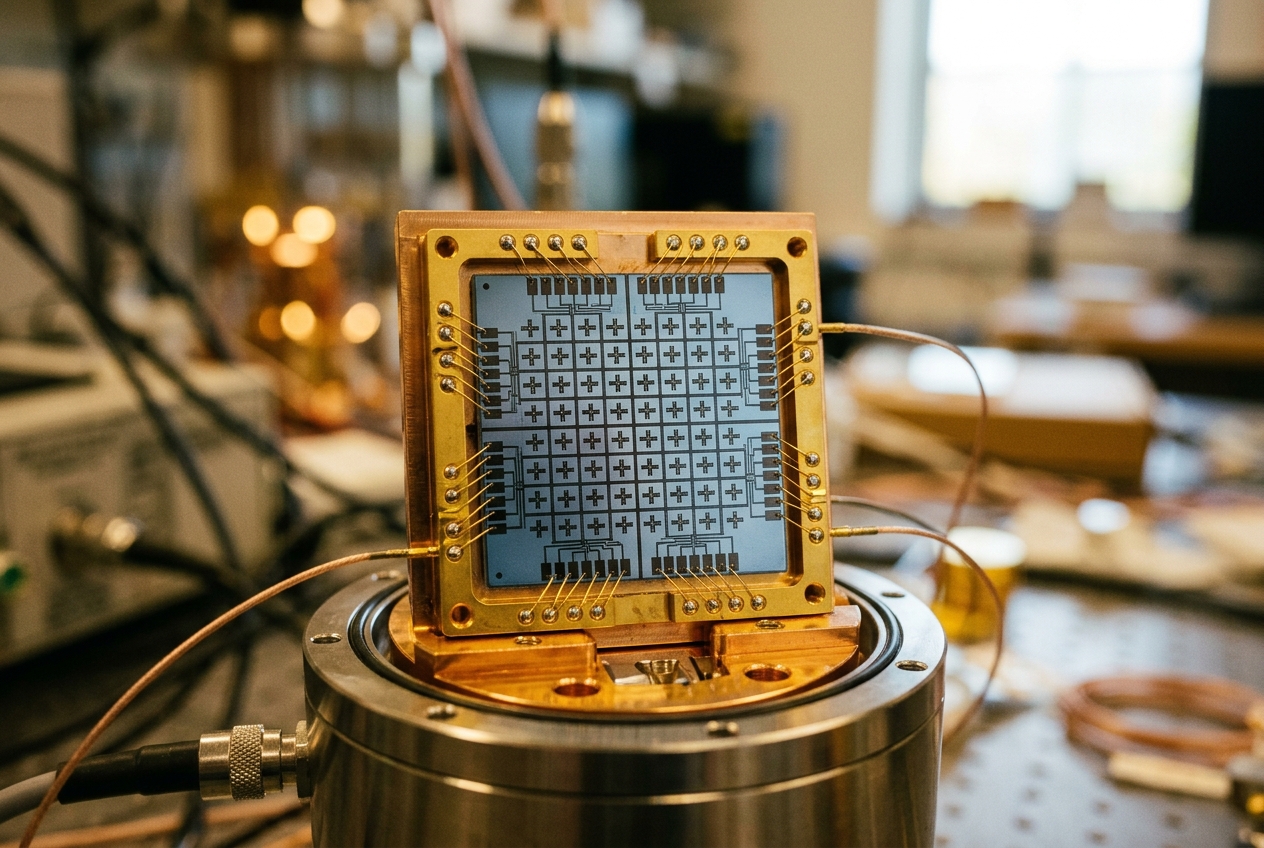
Yet, despite billions of dollars invested across academia and deep-tech enterprises, the world’s most advanced quantum processors remain perpetually paralyzed by environmental noise. The fundamental computational unit of these machines, the quantum bit or qubit, is unimaginably delicate. Stray electromagnetic pulses, minuscule temperature fluctuations measured in millikelvins, and even cosmic rays passing through a silicon substrate can corrupt a quantum calculation in millionths of a second.
For decades, the standard scientific prescription for this vulnerability has been quantum error correction: spreading the delicate information of a single "logical" qubit across dozens or hundreds of entangled physical qubits. But conventional error-correction protocols extract a punishing engineering toll. They demand that quantum processors execute complex, simultaneous measurements across large webs of four, six, or eight interconnected qubits at once. In real physical hardware, attempting these sprawling multi-qubit measurements invariably creates the very noise, electronic crosstalk, and gate errors that scientists are trying to eliminate.
Enter the Bacon-Shor subsystem code. Conceived by physicist Dave Bacon and rooted in earlier foundational insights by Peter Shor, this framework provides a profoundly elegant escape from the engineering bottleneck of quantum fault tolerance. Rather than forcing quantum hardware to perform impossibly complex multi-particle acrobatics, Bacon-Shor codes divide the quantum world into three distinct domains: a pristine vault for logical data, a sacrificial "gauge" chamber designed to absorb unmeasured noise, and an external diagnostic layer. In doing so, they reduce the catastrophic burden of quantum error correction to simple, pairwise interactions between immediate geometric neighbors.
2. The Idea in Plain English
To understand why quantum error correction is notoriously difficult—and why subsystem codes represent such a conceptual leap forward—one must first appreciate the peculiar fragility of quantum information.
A classical bit resembles a household light switch: it sits unambiguously in either an "off" position (0) or an "on" position (1). If you want to protect a classical message against random electrical spikes that might accidentally flip a switch, the solution is simple redundancy. You repeat the bit three times: instead of sending 0, you send 000. If stray noise flips the middle bit to produce 010, a classical computer inspects all three switches, applies a majority-rules vote, and instantly restores the intended 0.
A qubit, however, is fundamentally different. It behaves not like a static switch, but like a perfectly balanced coin spinning in mid-air. While in motion, it exists in a superposition—a continuous quantum state combining both heads and tails simultaneously with complex-valued probabilities. Furthermore, two or more spinning coins can become entangled, their physical orientations intimately correlated across space.
This quantum fluidity creates two insurmountable obstacles for classical-style redundancy:
- The No-Cloning Theorem: Fundamental quantum mechanics prohibits making an identical, independent copy of an unknown, arbitrary quantum state. You cannot simply duplicate a spinning coin onto backup coins.
- Measurement Collapse: If you look directly at a spinning coin to inspect whether an error has occurred, your observation instantly destroys the delicate superposition, forcing the coin to land flat as either a definite 0 or a definite 1.
The foundational breakthrough of quantum error correction was discovering that one can diagnose errors without inspecting the data directly. Instead of reading individual qubits, processors measure collective properties—known as parity checks or stabilizers. This is analogous to asking whether two adjacent spinning coins are rotating in the same direction or in opposite directions, without ever checking which face is pointing up.
+-----------------------------------------------------------------------------+
|                     THE QUANTUM SUBSYSTEM DECOMPOSITION                     |
|                                                                             |
|   Physical Hilbert Space (2^n) = Logical (2^k) (x) Gauge (2^g) (x) Syndrome |
|                                                                             |
|   +-----------------------+  +-----------------------+  +-----------------+ |
|   |   LOGICAL SUBSYSTEM   |  |    GAUGE SUBSYSTEM    |  |     SYNDROME    | |
|   | (Pristine Computation)|  | (Sacrificial Buffer)  |  | (Error Signals)| |
|   |                       |  |                       |  |                 | |
|   | Protected quantum     |  | Degrees of freedom    |  | Parity checks   | |
|   | data used to run      |  | allowed to fluctuate  |  | extracted via   | |
|   | algorithms.           |  | freely; absorbs local |  | weight-2 gauge  | |
|   |                       |  | circuit noise.        |  | combinations.   | |
|   +-----------------------+  +-----------------------+  +-----------------+ |
+-----------------------------------------------------------------------------+
In standard quantum error-correcting codes, every unused degree of freedom across a network of physical qubits is rigidly constrained by these parity checks. If an error-correcting code uses nine physical qubits to protect one logical qubit, the remaining eight degrees of freedom must be continuously monitored via active, multi-qubit stabilizer measurements.
Subsystem codes discard this rigid obsession with total control. As formalized in advanced curricula on MIT OpenCourseWare, a subsystem code mathematically decomposes the total quantum space into three distinct compartments:
- The Logical Subsystem ($2^k$): The protected vault containing the essential computational data we wish to manipulate and preserve.
- The Gauge Subsystem ($2^g$): A sacrificial internal buffer. These are auxiliary degrees of freedom that the algorithm intentionally ignores. Whether a gauge qubit flips, rotates, or succumbs to environmental noise, the logical data in the vault remains mathematically unaltered.
- The Syndrome Subsystem ($2^s$): The diagnostic readout channels that reveal the presence and coordinates of environmental physical errors.
By introducing gauge degrees of freedom, the Bacon-Shor code eliminates the requirement to measure complex, sprawling stabilizer operators directly. Instead, the quantum computer only ever measures small, friendly, two-qubit gauge operators between immediate physical neighbors. The collective global stabilizer signals are then mathematically reconstructed by multiplying these local measurements together in software.
3. How It Actually Works — The Mechanics
To see the mathematical beauty of this scheme in action, imagine arranging physical qubits in a flat, rectangular two-dimensional grid consisting of $m$ rows and $n$ columns. The simplest non-trivial example that can detect and correct any arbitrary single-qubit error is the symmetric $3 \times 3$ lattice, comprising 9 physical qubits ($n_{\text{phys}} = 9$).
                      THE 3x3 BACON-SHOR CODE LATTICE

         Column 1           Column 2           Column 3
     +--------------+   +--------------+   +--------------+
R1:  |  Qubit (1,1) |===|  Qubit (1,2) |===|  Qubit (1,3) |
     +--------------+   +--------------+   +--------------+
            ||                 ||                 ||
            ||                 ||                 ||
     +--------------+   +--------------+   +--------------+
R2:  |  Qubit (2,1) |===|  Qubit (2,2) |===|  Qubit (2,3) |
     +--------------+   +--------------+   +--------------+
            ||                 ||                 ||
            ||                 ||                 ||
     +--------------+   +--------------+   +--------------+
R3:  |  Qubit (3,1) |===|  Qubit (3,2) |===|  Qubit (3,3) |
     +--------------+   +--------------+   +--------------+

Legend:
     ===  Horizontal Pauli-X Gauge Checks (X_(r,c) (x) X_(r,c+1))
     ||   Vertical Pauli-Z Gauge Checks   (Z_(r,c) (x) Z_(r+1,c))
The Gauge Group and Local Measurements
In a Bacon-Shor code, we define our error-detecting machinery using the mathematical language of the Pauli group—specifically the bit-flip operator ($X$), the phase-flip operator ($Z$), and their combination ($Y = iXZ$).
Instead of measuring four-qubit or six-qubit stabilizers, the hardware executes only two elementary types of local, nearest-neighbor operations:
- Horizontal Bit-Flip Checks: Along every row, the hardware measures the pairwise operator $X_{r, c} X_{r, c+1}$ across adjacent horizontal qubits.
- Vertical Phase-Flip Checks: Along every column, the hardware measures the pairwise operator $Z_{r, c} Z_{r+1, c}$ across adjacent vertical qubits.
These pairwise operators generate what mathematicians term the gauge group, denoted as $\mathcal{G}$. Notice a crucial physical property: a horizontal $X$-type check and a vertical $Z$-type check that share a qubit do not commute—they interfere with each other if measured simultaneously. In a standard stabilizer code, non-commuting operators are strictly forbidden. But in a subsystem code, this non-commutativity is harmless because it only randomizes the internal gauge subsystem, leaving the logical data in the vault entirely untouched.
Reconstructing the Global Stabilizers
How does a quantum processor detect an error if it only measures localized pairs that jumble up the gauge subsystem? The answer lies in the algebraic center of the gauge group. The true stabilizer group $\mathcal{S}$, which detects errors on the logical qubit, consists of all operators that commute with every single element in the gauge group.
In an $m \times n$ Bacon-Shor lattice, the global stabilizer generators are simply composite products of the local gauge checks. The $Z$-type stabilizers are constructed by multiplying vertical pairs across two adjacent columns:
$$S_k^{(Z)} = \prod_{r=1}^m \left( Z_{r, k} \, Z_{r, k+1} \right) = \left( \bigotimes_{r=1}^m Z_{r, k} \right) \left( \bigotimes_{r=1}^m Z_{r, k+1} \right)$$
Similarly, the $X$-type stabilizers are formed by multiplying horizontal pairs across two adjacent rows:
$$S_r^{(X)} = \prod_{c=1}^n \left( X_{r, c} \, X_{r+1, c} \right) = \left( \bigotimes_{c=1}^n X_{r, c} \right) \left( \bigotimes_{c=1}^n X_{r+1, c} \right)$$
This mathematical structure yields an enormous experimental benefit: zero-overhead syndrome extraction. An experimental quantum processor never needs to entangle four qubits simultaneously to measure a high-weight stabilizer. The control system merely measures the local two-body gauge operators sequentially and multiplies their classical outcomes together in software to determine the stabilizer eigenvalues ($+1$ or $-1$).
+-----------------------------------------------------------------------------+
|                      SYNDROME RECONSTRUCTION MECHANISM                      |
|                                                                             |
|   Step 1: Hardware measures weight-2 local gauge pairs                      |
|           g_1 = Z_(1,1) Z_(2,1),  g_2 = Z_(2,1) Z_(3,1)                     |
|           g_3 = Z_(1,2) Z_(2,2),  g_4 = Z_(2,2) Z_(3,2)                     |
|                                                                             |
|   Step 2: Classical control software takes the product:                     |
|           S_1^(Z) = g_1 * g_2 * g_3 * g_4 = (Z_11 Z_21 Z_31)(Z_12 Z_22 Z_32)|
|                                                                             |
|   Result: Global 6-qubit column parity extracted via 2-qubit operations!    |
+-----------------------------------------------------------------------------+
Bare Versus Dressed Logical Operators
Because the logical information lives within an isolated subsystem, the operators used to manipulate our encoded data come in two distinct flavors:
- Bare Logical Operators: Minimal strings of physical Pauli gates that act exclusively on the logical subsystem. For an $m \times n$ lattice, the bare logical Pauli-X operator is a uniform horizontal line of $X$ gates across any single row, while the bare logical Pauli-Z operator is a uniform vertical line of $Z$ gates down any single column:
$$\bar{X}L = \bigotimes{c=1}^n X_{r, c} \quad (\text{for any chosen row } r), \qquad \bar{Z}L = \bigotimes{r=1}^m Z_{r, c} \quad (\text{for any chosen column } c)$$
- Dressed Logical Operators: Any operator formed by multiplying a bare logical operator by an element of the gauge group $\mathcal{G}$. Because gauge operators act as the identity on the logical subsystem, a dressed operator performs the exact same computational logic on the encoded qubit, but it may have a larger physical footprint across the chip.
Worked Example: The 9-Qubit ($3 \times 3$) Code
To ground these concepts, consider the complete operational parameters of the $3 \times 3$ Bacon-Shor code:
- Physical Qubits ($n$): $3 \times 3 = 9$.
- Logical Encoded Qubits ($k$): $1$.
- Gauge Qubits ($g$): $(m-1)(n-1) = (3-1)(3-1) = 4$.
- Stabilizer Generators ($s$): $(m-1) + (n-1) = 2 + 2 = 4$.
- Total Dimension Invariant: $n = k + g + s \implies 9 = 1 + 4 + 4$.
- Code Distance ($d$): $3$ (capable of detecting any 2 arbitrary physical errors, and correcting any single-qubit error).
+-----------------------------------------------------------------------------+
|                     9-QUBIT BACON-SHOR ERROR DECODING TABLE                 |
+--------------------+-----------------------+--------------------------------+
| Stabilizer Syndrome| Detected Physical     | Corrective Action              |
| (S_1^Z, S_2^Z)     | Error Location        |                                |
+--------------------+-----------------------+--------------------------------+
| (+1, +1)           | No Bit-Flip Error     | No correction required         |
| (-1, +1)           | Error in Column 1     | Apply X to any qubit in Col 1  |
| (-1, -1)           | Error in Column 2     | Apply X to any qubit in Col 2  |
| (+1, -1)           | Error in Column 3     | Apply X to any qubit in Col 3  |
+--------------------+-----------------------+--------------------------------+
| Stabilizer Syndrome| Detected Physical     | Corrective Action              |
| (S_1^X, S_2^X)     | Error Location        |                                |
+--------------------+-----------------------+--------------------------------+
| (+1, +1)           | No Phase-Flip Error   | No correction required         |
| (-1, +1)           | Error in Row 1        | Apply Z to any qubit in Row 1  |
| (-1, -1)           | Error in Row 2        | Apply Z to any qubit in Row 2  |
| (+1, -1)           | Error in Row 3        | Apply Z to any qubit in Row 3  |
+--------------------+-----------------------+--------------------------------+
Notice the sheer simplicity of the decoding step: if a bit-flip error occurs on qubit $(2, 1)$, the column stabilizer syndrome $(S_1^Z, S_2^Z)$ reads $(-1, +1)$, indicating that an error has occurred somewhere within Column 1. Remarkably, the classical decoder does not even need to isolate whether the error happened on row 1, row 2, or row 3! Applying a corrective $X$ gate to any physical qubit in Column 1 restores the logical subsystem completely; any discrepancy between which row was touched merely alters the irrelevant gauge subsystem.
Bacon-Shor Codes Versus Planar Surface Codes
In contemporary quantum architecture, Bacon-Shor codes are most frequently compared against planar surface codes. Both share a 2D nearest-neighbor layout, but their operational trade-offs differ significantly:
+-----------------------------------------------------------------------------+
|             ARCHITECTURAL COMPARISON: BACON-SHOR VS. SURFACE CODES          |
+------------------------+--------------------------+-------------------------+
| Metric                 | Bacon-Shor Code (d=3)    | Planar Surface Code(d=3)|
+------------------------+--------------------------+-------------------------+
| Syndrome Extraction    | Local Weight-2 Pairs     | Weight-4 Plaquettes     |
| Ancilla Complexity     | Low (Simple routing)     | High (Complex routing)  |
| Circuit Depth per Cycle| Minimal                  | Moderate to High        |
| Error Threshold        | ~0.2% - 0.5%             | ~1.0% (Higher tolerance)|
| Fault-Tolerant Gates   | Transversal Clifford     | Requires Magic State    |
|                        | via Gauge Fixing         | Distillation / Lattice  |
|                        |                          | Surgery                 |
+------------------------+--------------------------+-------------------------+
While surface codes boast a higher mathematical error threshold (tolerating individual gate error rates up to ~1%), their requirement for 4-body plaquette measurements creates significant microwave routing congestion and parasitic crosstalk in hardware. Bacon-Shor codes trade away a portion of the raw threshold in exchange for dramatic operational simplifications: shorter circuit depths, simpler calibration schedules, and the ability to perform transversal logic gates through a technique known as gauge fixing (temporarily measuring gauge operators to transform the subsystem code into an asymmetric stabilizer code).
4. Real-World Applications Today
The unique architectural advantages of Bacon-Shor subsystem codes are actively driving experimental milestones across several premier quantum computing platforms:
1. Trapped-Ion Quantum Computing (IonQ & Duke University)
In trapped-ion systems, atomic ions (such as ytterbium or barium) are suspended in ultra-high vacuum by electromagnetic fields and manipulated via precision laser pulses. In a landmark demonstration published in Nature, a research consortium led by Duke University and IonQ successfully implemented a fault-tolerant Bacon-Shor code on a 13-qubit trapped-ion processor. Because laser-mediated entangling gates are exceptionally clean when executed between pairs of ions, Bacon-Shor weight-2 checks allowed the team to demonstrate that an error-corrected logical qubit could outperform the physical fidelity of its underlying constituent physical components—a milestone known as achieving the "break-even" threshold.
2. Superconducting Transmon Processors (IBM Quantum Ecosystem)
Superconducting platforms, such as those programmed via IBM Quantum Learning, rely on microscopic lithographic circuits cooled to 15 millikelvins inside dilution refrigerators. Because superconducting chips are strictly planar, running four-body stabilizer circuits often introduces debilitating microwave frequency collisions. Research groups utilize Bacon-Shor subsystem codes on heavy-hexagonal and square lattice layouts to minimize circuit depth, running fast, two-body gauge cycles that prevent high-frequency noise from accumulating between computational pulses.
3. Neutral Atom Arrays (QuEra Computing & Harvard University)
Neutral atom quantum architectures trap hundreds of individual rubidium or cesium atoms in arrays of optical tweezers focused by laser beams. By driving atoms into high-energy Rydberg states, processors execute rapid two-qubit entangling gates. Teams at Harvard and QuEra utilize subsystem codes to perform non-destructive error diagnosis and dynamic reconfiguration. Because subsystem codes do not require rigid continuous monitoring of every single qubit, neutral atom processors can shuttle atoms across the focal plane to execute transversal logical gates without causing decoherence cascades.
4. Quantum Chemistry & Nitrogen Fixation Modeling (Industrial Consortia)
At the algorithmic tier, companies such as BASF, Boeing, and quantum software startups are designing fault-tolerant routines to simulate the active site of nitrogenase—the iron-molybdenum cofactor (FeMoco) enzyme that catalyzes ambient nitrogen fixation. Simulating this single molecule classically would require supercomputers larger than any built today. Subsystem codes represent a primary candidate architecture for the memory registers in these quantum chemistry processors, because their lightweight syndrome extraction routines maximize the duration that molecular wavefunctions can be held in coherent memory.
5. What This Means for You
It is easy to view quantum error correction as an esoteric debate over abstract linear algebra, isolated inside physics laboratories and cryogenics cleanrooms. In reality, the realization of robust subsystem error correction is the exact technological pivot that will divide theoretical science fiction from societal transformation.
For everyday citizens, the immediate stakes center on three foundational pillars:
- Digital Security and Financial Infrastructure: Within the next decade, nation-states and corporations will likely possess quantum devices capable of running Shor's algorithm. Without quantum error correction, these machines remain noisy laboratory curiosities. With fault-tolerant architectures like Bacon-Shor codes, they will render legacy public-key cryptography (RSA and elliptic-curve cryptography) obsolete overnight. Understanding the timeline of quantum error correction is the exact metric that dictates how rapidly global banking, telecommunications, and government records must transition to post-quantum cryptographic standards.
- Next-Generation Pharmaceuticals: Today, bringing a new drug from chemical discovery to clinical approval takes over a decade and costs billions of dollars, largely because simulating how a complex protein folds around a small drug candidate is computationally intractable on classical computers. Fault-tolerant logical qubits will enable exact, in silico molecular modeling, collapsing the timeline for designing custom cancer immunotherapies, targeted antiviral inhibitors, and treatments for degenerative neurological conditions.
- Clean Energy and Materials Science: The industrial Haber-Bosch process, which manufactures synthetic fertilizer by breaking the resilient chemical bonds of atmospheric nitrogen, consumes roughly 1% to 2% of the entire planet's annual energy supply. A quantum computer capable of simulating the biological nitrogenase enzyme could unlock low-temperature, energy-efficient chemical catalysts, drastically reducing global carbon emissions and revitalizing agricultural sustainability.
6. Today's Takeaway
+-----------------------------------------------------------------------------+
|                              CORE TAKEAWAY                                  |
|                                                                             |
|   Bacon-Shor subsystem codes prove that perfection is the enemy of          |
|   progress in quantum engineering. By deliberately abandoning control       |
|   over unneeded gauge degrees of freedom, we convert impossibly             |
|   complex multi-particle measurements into simple, nearest-neighbor         |
|   checks—providing a realistic, low-overhead highway to fault-tolerant      |
|   quantum computing.                                                        |
+-----------------------------------------------------------------------------+
The defining genius of the Bacon-Shor subsystem code is its philosophical embrace of quantum indifference. Where classical intuition demands complete surveillance over every moving component, quantum mechanics reveals that trying to control everything inevitably destroys the computational fabric you seek to protect. By partitioning the quantum state into a sacred logical core and a sacrificial gauge buffer, subsystem codes replace fragile, complex hardware operations with simple pairwise measurements. In doing so, they provide one of our most elegant, practical roadmaps toward building silent, resilient quantum supercomputers out of a noisy quantum world.
Further Reading & Authoritative References
- Bacon, D. (2006). Operator quantum error-correcting subsystems for self-correcting quantum memories. Physical Review Letters, 95(23), 230504.
- Egan, L., et al. (2021). Fault-tolerant control of an error-corrected qubit. Nature, 598(7880), 281–286.
- IBM Quantum Learning Platform. Fundamentals of Quantum Error Correction and Fault Tolerance. Accessible via Qiskit Education.
- MIT OpenCourseWare (Course 8.370). Quantum Computation and Quantum Information Architecture. Accessible via MIT OCW.
- Poulin, D. (2005). Stabilizer Formalism for Operator Quantum Error Correction. Physical Review Letters, 95(23), 230501.
- Wikipedia Contributors. Quantum Error Correction and Subsystem Codes. Wikipedia: Quantum Error Correction.