Yin Qiao Mai Heel Vessel: Plantar Arch Tensegrity, Inner Leg Fascial Vectoring, and Somatic Vitality Reservoir Dynamics in Classical Neigong
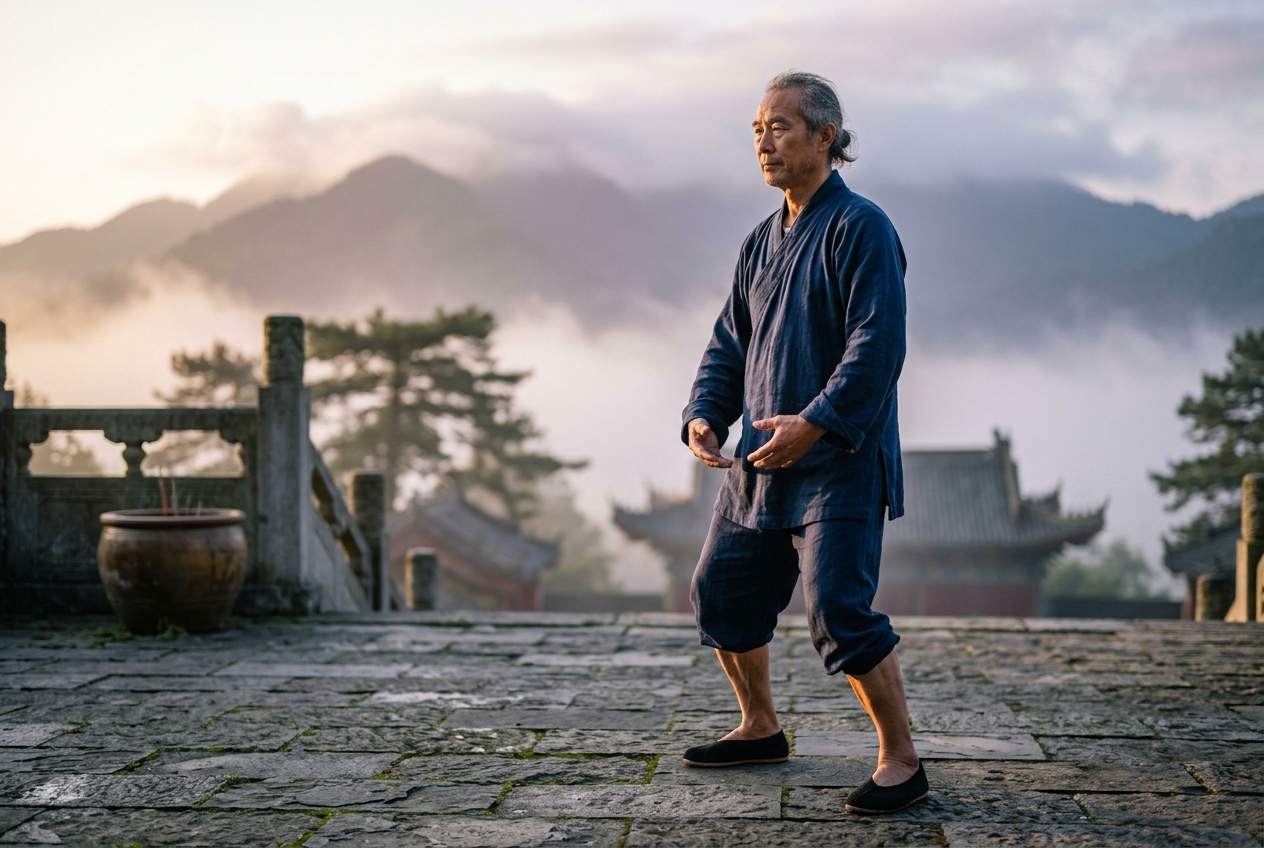
1. Establishing the Tripod Base and the Medial Calcaneal Arch
Begin in a relaxed standing posture with your feet strictly parallel, outer edges pointing straight forward rather than turned out. Imagine the sole of each foot as an architectural tripod consisting of three load-bearing points: the base of the big toe (first metatarsal head), the base of the little toe (fifth metatarsal head), and the center of the heel (calcaneus).
Direct your awareness to the inner quadrant of the heel, directly below the medial malleolus (the inner ankle bone). This is the anatomical origin of the Yin Qiao Mai and the precise location of the acupoint Zhaohai (KI-6, "Shining Sea"). Without curling your toes or rolling your knees outward, subtly suction the center of the sole—Yongquan (KI-1, "Bubbling Spring")—gently upward. This micro-action creates an elastic dome in the medial longitudinal arch, engaging the tibialis posterior muscle and pre-stressing the deep fascial line of the inner leg.
2. The Medial Column and the Pelvic Floor Suspension
With the medial arches vaulted and firm, unlock your knee joints by allowing them to soften forward by two to three millimeters. Do not let the knees collapse inward toward each other; maintain a buoyant, open arc across the inner thighs, a classical alignment termed Yuan Dang (Rounding the Crotch).
Feel a continuous seam of light structural engagement ascending from Zhaohai (KI-6), past the Xi-Cleft point Jiaoxin (KI-8), up through the medial knee joint (Yingu, KI-10), and along the deep adductor muscles of the inner thigh. As this line arrives at the groin (Kua), allow the pelvis to settle naturally. Gently suspend the perineum—the anatomical center of the pelvic floor and the acupoint Huiyin (CV-1)—with the slightest hint of tone, as though drawing a delicate silk thread upward toward your navel.
3. Torso Alignment and the Upward Vector to the Eyes
From the pelvic basin, the Yin Qiao Mai ascends through the deep core of the body, running parallel to the central thrusting vessel (Chong Mai) through the lower abdomen and chest, passing through the supraclavicular fossa (Quepen, ST-12), climbing alongside the throat and carotid artery, traversing the cheek, and terminating at the inner canthus of the eye at Jingming (BL-1, "Bright Eyes").
To align this upper trajectory, gently tuck the chin backward by a millimeter to lengthen the cervical spine, imagining the crown of your head (Baihui, GV-20) suspended from above by a fine cord. Relax your facial muscles. Soften the gaze, allowing your peripheral vision to expand while resting your attention lightly behind the bridge of your nose at the inner corners of both eyes. The tongue rests lightly against the hard palate behind the upper front teeth, completing the circuit of the central vessels.
4. The Diaphragmatic Yin-Qiao Reservoir Pump
Once the structural column is organized, synchronize the pathway with rhythmic lower belly respiration (Dantian breathing): - On the Inhalation (4 to 5 seconds): Breathe smoothly through the nose. Feel the lower abdomen expand three-dimensionally—forward, outward into the flanks, and back into the kidneys (Mingmen). Concurrently, feel the upward drawing of the arches of the feet and the subtle ascension of cool, grounding energy from Zhaohai (KI-6) up the inner legs, through the pelvic floor, ascending the core to bathe the throat and brighten the eyes at Jingming (BL-1). - On the Exhalation (5 to 6 seconds): Allow the breath to sink slowly back down through the central axis. Release all residual tension in the chest, shoulders, and hips, feeling your physical weight effortlessly drain down through the adductors, down the medial shins, and consolidate like liquid lead into the inner heels, anchoring deep into the subterranean floor.
5. Navigating Common Pitfalls
- The Collapsed Arch (Pronation): Beginners often confuse relaxing the lower body with collapsing the inner ankles inward. This crushes the Zhaohai point, compresses the tibial nerve, and blocks the vessel. Correction: Maintain active contact at the base of the little toe to stabilize the lateral foot while lifting the medial dome.
- The Locked Tailbone: Forcibly tucking the pelvis under flattens the natural lumbar lordosis and creates chronic tension across the groin and hamstrings. Correction: Think of "releasing" or "hanging" the sacrum vertically downward under gravity rather than thrusting the pelvis forward.
- Shoulder Elevation: Holding tension in the trapezius muscles constricts the supraclavicular passage (Quepen, ST-12). Correction: Consciously widen the collarbones and imagine your shoulder blades melting like warm wax down your back into your rear pockets.
6. Somatosensory Milestones and Sensations
As the Yin Qiao Mai becomes patent and charged with circulation, practitioners consistently report distinct physiological landmarks: - Heaviness and Rooting (Chen): The sensation that your legs have become dense, stable, and deeply rooted like the trunk of an ancient oak tree, making your balance virtually unshakeable. - Warm Micro-Currents (Re): A noticeable warmth or gentle tingling sensation blooming across the medial malleolus, wrapping around the inner knees, and pooling in the lower abdomen or perineum. - Visual Clarity and Shen Consolidation: Because the vessel terminates at Jingming (BL-1) and enters the brain, a spontaneous moistening of the dry eyes occurs, accompanied by a drop in mental chatter and an immediate sensation of cool, quiet mental clarity.
The Biomechanical and Neurological Science of Rooting
What classical Daoist masters described through energetic conduits aligns with remarkable precision with modern fascia research and neurobiology. To understand why opening the Yin Qiao Mai exerts such profound systemic effects, one must examine the intersection of biotensegrity, motor control, and the autonomic nervous system.
+--------------------------------------------------------------------------------+
|                        BIOMECHANICAL & FASCIAL PARALLEL                        |
+--------------------------------------------------------------------------------+
|  TCM Channel: Yin Qiao Mai            Anatomical Equivalent: Deep Front Line  |
|  * Zhaohai (KI-6) & Jiaoxin (KI-8)   -> Tibialis Posterior, Flexor Hallucis    |
|  * Yingu (KI-10)                      -> Pes Anserinus & Sartorius Insertion   |
|  * Groin & Kua Pathway                -> Adductor Magnus / Longus & Brevis    |
|  * Huiyin (CV-1)                      -> Pelvic Diaphragm & Levator Ani       |
|  * Torso & Throat Trajectory          -> Anterior Longitudinal Ligament /      |
|                                          Scalenes & Longus Colli               |
+--------------------------------------------------------------------------------+
In structural kinesiology, the trajectory of the Yin Qiao Mai corresponds almost point-for-point to the Deep Front Line (DFL) described in Thomas Myers' myofascial meridians framework. According to research indexed in the National Center for Biotechnology Information (NCBI / PMC) on Fascial Tensegrity, fascial networks act as continuous, body-wide networks of mechanosensitive tissue that transmit mechanical load and modulate structural tone faster than neural pathways.
The medial longitudinal arch of the foot is suspended by the dynamic sling of the tibialis posterior and flexor hallucis longus tendons. When these tissues maintain balanced tensegrity, they prevent overpronation and stabilize the knee joint along the medial compartment, specifically guarding the vastus medialis oblique (VMO) and the pes anserinus against excessive shearing forces. This stabilization propagates upward: the adductor group interfaces directly with the obturator internus and the pubococcygeus muscles of the pelvic floor.
When you align the inner arches and gently engage Huiyin in standing meditation, you create a hydraulic piston between the pelvic floor and the respiratory diaphragm. This synchronized movement modulates intra-abdominal pressure (IAP), massaging the visceral organs and increasing venous and lymphatic return from the lower extremities back to the heart.
Furthermore, studies published through NCBI / PMC on Proprioception and Postural Balance demonstrate that the plantar surface of the foot and the deep fascial beds of the calf contain the human body's highest concentrations of Ruffini corpuscles and interstitial mechanoreceptors. Activating the medial calcaneus and the Zhaohai zone down-regulates the sympathetic fight-or-flight response, shifting the autonomic nervous system into parasympathetic dominance.
By grounding the physical body, the vessel acts as a neurological brake against excessive sympathetic tone, lowering cortisol, increasing heart rate variability (HRV), and promoting the physiological rest state that ancient scholars called the preservation of Jing.
Classical Lineage, Neidan Alchemy, and Li Shizhen’s Insights
The theoretical and experiential lineage of the Yin Qiao Mai stretches back over two millennia to the foundational canons of Chinese medicine: the Huangdi Neijing (The Yellow Emperor's Inner Classic, c. 2nd century BCE) and the Nan Jing (The Classic of Difficulties, c. 1st century CE). In Chapters 28 and 29 of the Nan Jing, the master physician Qin Yueren (Bian Que) articulates the reciprocal relationship between the Yin Qiao Mai and its counterpart, the Yang Qiao Mai (Yang Heel Vessel):
"The Yang Heel Vessel begins at the heel, follows the outer ankle, and ascends to the wind pool points; the Yin Heel Vessel begins at the heel, follows the inner ankle, and ascends to the throat, crossing the inner canthus. When the Yang Qiao is diseased, the muscles on the exterior are tight while those on the interior are loose; when the Yin Qiao is diseased, the muscles on the interior are tight while those on the exterior are loose... When Yin is in excess, the eyes are prone to close and one falls asleep."
This classical diagnosis highlights the role of the Qiao vessels as the master regulators of muscular reciprocal inhibition and the sleep-wake cycle (somnolence vs. insomnia). In clinical frameworks endorsed by the World Health Organization (WHO) Traditional Medicine, balancing the Yin and Yang Qiao vessels remains a premier protocol for treating unilateral neurological disorders, motor asymmetries, chronic postural distortion, and circadian sleep disturbances.
       +-------------------------------------------------------------+
       |         POLARITY DYNAMICS OF THE STEPPING VESSELS           |
       +-------------------------------------------------------------+
       | Attribute         | Yin Qiao Mai        | Yang Qiao Mai     |
       |-------------------|---------------------|-------------------|
       | Master Acupoint   | Zhaohai (KI-6)      | Shenmai (BL-62)   |
       | Paired Coupler    | Lieque (LU-7)       | Houxi (SI-3)      |
       | Anatomical Bias   | Medial / Inversion  | Lateral / Eversion|
       | Muscular Tone     | Adductors / Flexors | Abductors / Ext.  |
       | Diurnal Function  | Night / Somnolence  | Day / Alertness   |
       | Energetic Nature  | Consolidates Jing   | Disperses Wei Qi  |
       +-------------------------------------------------------------+
The understanding of the Yin Qiao Mai achieved its deepest alchemical and medical synthesis during the Ming Dynasty under the brush of the legendary physician, naturalist, and polymath Li Shizhen (1518–1593 CE). In his seminal 1578 masterwork, Qi Jing Ba Mai Kao (奇經八脈考, Study of the Eight Extraordinary Vessels), Li Shizhen revolutionized internal medicine and Daoist internal alchemy (Neidan) by demonstrating that the extraordinary meridians are not merely clinical adjuncts for acupuncture needles, but the primary internal conduits cultivated by adepts seeking spiritual realization and physical immortality.
Li Shizhen wrote:
"The twelve regular channels flow along the surface and nourish the organs like rivers; the Eight Extraordinary Vessels are the great reservoirs and lakes. When the regular rivers are full, they overflow into the extraordinary vessels... The Yin Qiao is the hidden pathway through which the pure prenatal Jing of the kidneys rises from the abyss of the heels into the lower Dantian, flows through the furnace of Huiyin, and ascends through the jade pillar to nourish the brain (Niwan) and brighten the spirit (Shen). Those who cultivate the golden elixir must first open this gate."
In the lineage of Daoist internal cultivation, particularly within the Southern Dragon Gate (Longmen) and Complete Reality (Quanzhen) schools, the Yin Qiao Mai is recognized as the "Root of the Tree of Life." Daoist alchemical texts like Zhang Boduan’s Wuzhen Pian (Understanding Reality) emphasize that without grounding the celestial Yang energy into the subterranean Yin vessel of the legs, any attempt to circulate energy through the Microcosmic Orbit (Xiao Zhou Tian) risks "fire rising without water"—manifesting as hypertension, dizziness, emotional agitation, and mental delusion.
In the internal martial arts of Taijiquan, Baguazhang, and Xingyiquan, mastering the Yin Qiao Mai became the trade secret of legendary masters. By sinking the weight into the Zhaohai points and maintaining the integrity of the inner leg seam, martial artists generated explosive, recoil-free kinetic power (Fajin) rooted in the earth, while remaining completely relaxed (Song) and impossible to uproot.
For additional classical perspectives and community practice resources, the National Qigong Association serves as a broad clearinghouse for practitioners exploring these traditional lineages.
Today’s Practice Commitment: The Five-Minute Morning Root
Do not leave this practice on the screen. The physiological and energetic benefits of the Yin Qiao Mai compound through regular, direct experiential training.
Tomorrow morning, before your first cup of coffee or checking your phone, commit to just five minutes of conscious Yin Qiao standing:
- Stand barefoot on a level floor. Establish the three-point tripod on each sole and gently vault the medial arch at Zhaohai (KI-6).
- Soften your knees, relax the Kua, and suspend the perineum at Huiyin (CV-1).
- Align your crown, rest your tongue on your palate, and soften your gaze at the inner eye canthi at Jingming (BL-1).
- Take thirty slow, deep diaphragmatic breaths, feeling the cool, grounding earth energy rise along the inner legs on every inhale, and feeling tension drain into the solid core of the inner heels on every exhale.
As you step away from those five minutes and move into your day, notice how your feet greet the earth, how easily your spine stays upright without tension, and whether a calm, unwavering clarity steadies your mind through the hours ahead.