Yang Wei Mai Linking Vessel: Exterior Fascial Chains, Wei Qi Fortification, and Dynamic Yang Network Integration in Classical Neigong
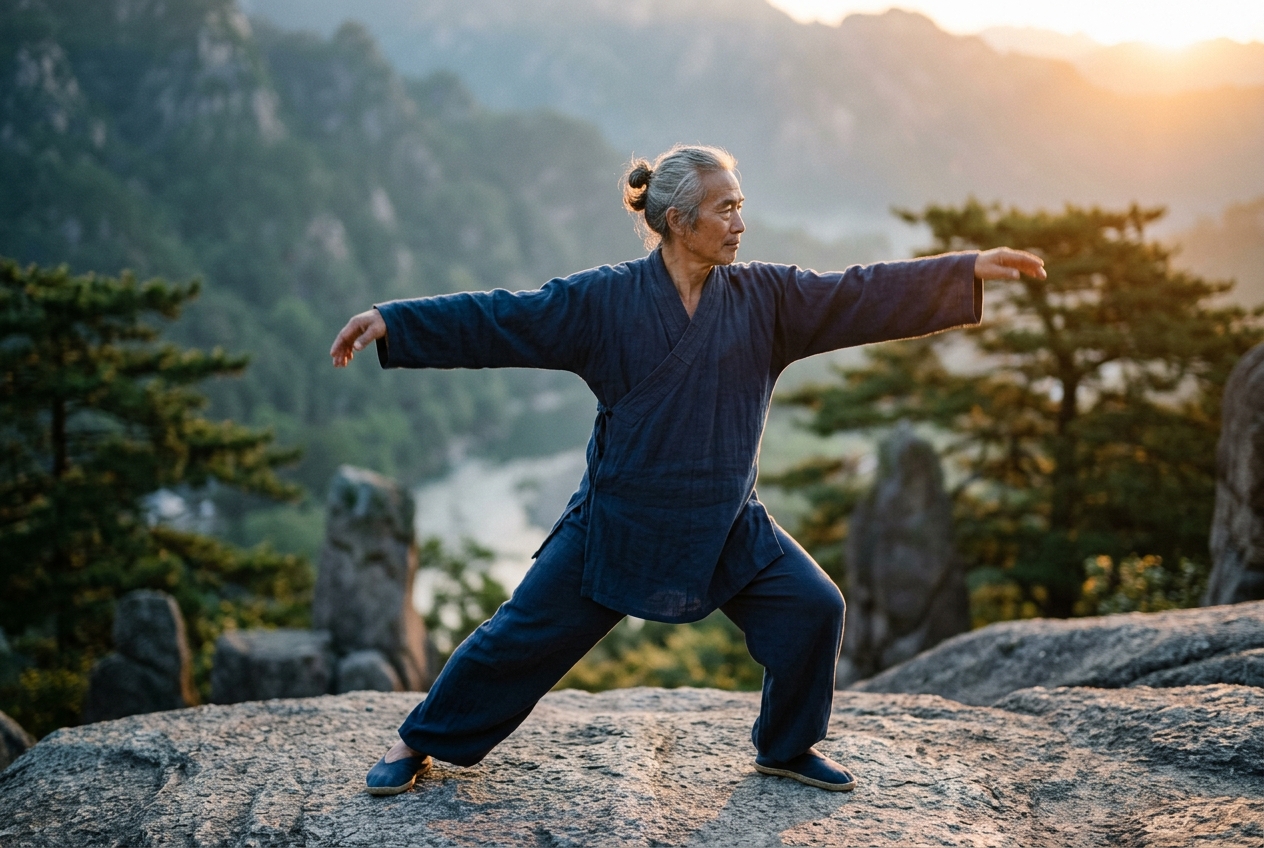
The word Wei (維) historically denotes a thick mooring rope, a net, or the structural corner-cables that hold a marquee tent erect against gale-force winds. Within the context of classical Daoist Neigong and medical Qigong, the Yang Wei Mai is the living harness that binds together the body’s exterior Yang energy networks: the Greater Yang (Taiyang), Lesser Yang (Shaoyang), and Bright Yang (Yangming). Its primary task is the distribution, modulation, and kinetic vectoring of Wei Qi—the dynamic, electro-magnetic defensive shield that flows through the skin, fascia, and superficial musculature.
When the Yang Linking Vessel is supple, open, and robust, the human system effortlessly negotiates environmental stressors, temperature swings, atmospheric pressure shifts, and pathogenic invasions. When it stagnates or loses tensile integrity, an individual becomes hypersensitive to draft and climate, suffers from alternating bouts of somatic chills and fever, experiences chronic tension along the lateral neck and shoulders, and struggles with an acute sense of psychological and spatial vulnerability.
Classical Trajectory, Resonance Points, and Energetic Physiology
Understanding the classical anatomical journey of the Yang Wei Mai requires tracing an elaborate kinetic pathway that traverses the lateral aspects of the lower extremity, climbs the flank, laces through the shoulder girdle, and terminates deep within the brainstem.
+-------------------------------------------------------------------------------+
|                       YANG WEI MAI CLINICAL ARCHITECTURE                      |
+-------------------------------------------------------------------------------+
| Master Point:      Waiguan (SJ-5 / Outer Gate)   — Forearm Dorsum             |
| Coupled Point:     Zulinqi (GB-41 / Foot Tears)  — Lateral Foot Dorsum        |
| Origin Point:      Jinmen (BL-63 / Golden Gate)  — Lateral Calcaneal Margin   |
| Xi-Cleft Point:    Yangjiao (GB-35 / Yang Junc.) — Lateral Lower Leg          |
| Cranial Terminal:  Fengfu (DU-16 / Palace of Wind)— Suboccipital Depression   |
+-------------------------------------------------------------------------------+
The vessel originates energetically at the point Jinmen (BL-63, "Golden Gate"), situated on the lateral aspect of the foot, directly inferior to the lateral malleolus in a depression anterior to the calcaneus. From this grounding anchor point, the meridian climbs along the lateral margin of the fibula, passing through Yangjiao (GB-35, "Yang Intersection"), which serves as the vessel's Xi-Cleft (accumulation) resonance point where acute pathogenic stagnation gathers and can be therapeutically purged.
Ascending past the lateral knee joint, the pathway tracks the iliotibial tract to intersect Juliao (GB-29) at the lateral hip joint, stabilizing the pelvis. From the hip, it sweeps diagonally across the hypochondriac region and lateral flank, making vital contact with the posterior ribs before traversing the posterior axillary fold and the posterior aspect of the shoulder blade at Naoshu (SI-10). It crosses the scapular spine to reach Tianliao (SJ-15) and crests the muscular summit of the trapezius at Jianjing (GB-21).
From the shoulder girdle, the pathway ascends the lateral column of the neck, enters the retroauricular crease at Fengchi (GB-20, "Wind Pool"), climbs over the temporal and parietal bones of the cranium—making contact with points such as Touwei (ST-8) at the corner of the forehead—and loops backward across the calvarium to culminate at Fengfu (DU-16, "Palace of Wind") and Yamen (DU-15) directly beneath the external occipital protuberance at the base of the skull.
The classical regulation of this expansive circuit is governed through a precise point pair:
- The Master Confluence Point — Waiguan (SJ-5, "Outer Gate"): Located two finger-widths above the dorsal wrist crease, between the radius and ulna. Waiguan acts as the primary electrical switchboard that opens the entire exterior Yang matrix, releasing internal heat, clearing external pathogens, and unlocking tension throughout the neck, shoulders, and lateral rib cage.
- The Coupled Point — Zulinqi (GB-41, "Foot Overlooking Tears"): Situated on the dorsum of the foot, in the depression distal to the junction of the fourth and fifth metatarsal bones. When paired with Waiguan, Zulinqi anchors the ascending Yang current, harmonizes the lateral kinetic chain, and regulates the Dai Mai (Girdling Vessel), ensuring that energetic charge does not rise uncontrollably into the cranium.
In classical medical theory documented in the foundational canons of Traditional Chinese Medicine, the physiological mandate of the Yang Wei Mai is summarized by the ancient maxim: "The Yang Wei dominates the exterior." When external climatic forces (wind, cold, damp, summer heat) assault the physical form, the Yang Wei Mai coordinates the physiological response. If the vessel is deficient, the defensive Wei Qi collapses inward, causing persistent shivering, aversion to wind, and an inability to maintain core body temperature.
Conversely, if external pathogens become trapped within the transitional layer between the exterior and interior (the classical Shaoyang or Lesser Yang stage), the patient manifests alternating sensations of intense heat and shivering chills, accompanied by bitter taste in the mouth, hypochondriac fullness, and mental agitation. Mobilizing the Yang Wei Mai resolves this constitutional gridlock by reopening the communication lines between the surface tissues and the inner organs.
Fascial Tensegrity and Modern Kinetic Chains
The classical pathway of the Yang Wei Mai corresponds with extraordinary fidelity to the structural maps developed in modern biomechanics, specifically Thomas Myers' concept of human myofascial lines. Far from being arbitrary philosophical constructs, the trajectories of the extraordinary vessels outline real, continuous sheaths of collagenous connective tissue that transmit mechanical strain across the musculoskeletal system.
The anatomical trajectory of the Yang Wei Mai mirrors the integration of two major kinetic pathways: the Lateral Line (LL) and portions of the Spiral Line (SPL) and Superficial Back Line (SBL):
- The Lateral Foundation: Beginning with the peroneal longus and brevis muscles on the lateral lower leg (encompassing Jinmen BL-63 and Yangjiao GB-35), tensile force travels up the fibular collateral ligament into the dense, fibrous band of the iliotibial (IT) tract.
- The Pelvic-Flank Nexus: The IT band anchors directly into the tensor fasciae latae and gluteus maximus at Juliao (GB-29), transitioning mechanical load into the lateral abdominal wall—specifically the external and internal oblique abdominal musculature.
- The Thoracocervical Bridge: The kinetic vector climbs across the serratus anterior and rhomboid network into the posterior deltoid, infraspinatus (Naoshu SI-10), and the upper fibers of the trapezius (Jianjing GB-21).
- The Cranial Dome: Tensile loading culminates through the splenius capitis, sternocleidomastoid, and the galea aponeurotica (the epicranial aponeurosis covering the skull), terminating at the suboccipital triangle (Fengfu DU-16).
In the language of biotensegrity, the body operates not as a stack of compression-bearing bones, but as a continuous-tension, discontinuous-compression structure. Every time you perform a dynamic rotational spiral of the upper extremity combined with a contralateral pivot of the pelvis, you apply a helical pre-stress to this lateral myofascial wrapper.
This functional loading triggers mechanotransduction—a biological process whereby physical strain on cellular membranes stimulates fibroblasts to remodel collagen, optimize interstitial fluid dynamics, and emit coherent piezoelectric currents. Peer-reviewed research available via the NCBI PubMed Database indicates that acupuncture meridians correspond closely with connective tissue cleavage planes, where electrical conductivity and hydraulic communication are significantly higher than in adjacent tissues.
Activating the Yang Wei Mai through classical Daoyin movements creates an unbroken kinetic wave that wrings out metabolic waste from dehydrated fascial planes, boosts lymphatic clearance, and generates a responsive outer structural lattice capable of absorbing mechanical shock without localized joint degradation.
Step-by-Step Practice Guide: "The Dragon Coils the Outer Wall"
The following classical Daoyin exercise, known historically as Pan Long Hu Wei ("Coiling the Dragon to Protect the Exterior"), is an authentic Qigong method designed to systematically stretch, purge, and charge the Yang Wei Mai kinetic chain.
1. Foundational Stance Setup (Wuji Alignment)
- Stand with your feet parallel, exactly shoulder-width apart, weight evenly distributed between the ball of the foot and the heel.
- Unlock your knees slightly (approx. 5–10 degrees of flexion) and allow your tailbone to sink downward as if resting against a tall stool. This releases tension in the lumbar spine and opens the sacrum.
- Suspend the crown of your head from above by gently tucking the chin, lengthening the suboccipital space at Fengfu (DU-16).
- Rest the tip of your tongue against the upper palate just behind your front teeth. Breathe in and out entirely through your nose.
2. The Preparatory Point Wake-Up
- Before beginning the movement, bring the thumb of your right hand to press firmly into Waiguan (SJ-5) on your left forearm (two finger-widths above the dorsal wrist crease). Rotate your left wrist three times clockwise and three times counter-clockwise while applying steady, comfortable pressure.
- Switch hands and repeat for the right Waiguan.
- Firmly tap the outer border of both feet against the floor three times to awaken Jinmen (BL-63).
3. The Core Movement Sequence
- Step 1 — The Grounded Shift (Inhale): Inhale slowly over 4 seconds into your lower abdomen (Dantian). As you inhale, shift 70% of your body weight smoothly onto your left leg, pressing the outer heel and lateral blade of your left foot (Jinmen BL-63) firmly into the earth.
- Step 2 — The Lateral Spiral (Inhale Continues): Begin turning your torso 45 degrees to the left from your waist. As your torso turns, rotate your left arm in a dynamic outward corkscrew: internally rotate the shoulder slightly, then supinate the forearm so the palm turns toward the sky, and finally flex the wrist back so the dorsal surface—where Waiguan (SJ-5) sits—faces outward away from your body at shoulder height.
- Step 3 — The Contralateral Brace (Exhale): Exhale smoothly over 6 seconds through your nose. As you exhale, sweep your right palm across the front of your chest at nipple height, pressing the palm outward toward the left, creating a continuous lateral expansion across the upper back and shoulder blades (Naoshu SI-10 and Jianjing GB-21).
- Step 4 — Cranial Locking (Exhale Continues): Turn your head to glance back over your left shoulder toward your trailing left heel. This subtle rotation applies a gentle traction across the lateral neck, engaging Fengchi (GB-20) and Fengfu (DU-16). You should feel a continuous, unbroken line of elastic tension running from the outer left ankle, through the hip, up the rib cage, across the shoulder, and into the skull.
- Step 5 — Return to Center (Inhale): Inhale over 4 seconds, allowing your arms to soften, your head to return to the front, and your weight to settle evenly back into the center Wuji stance.
- Step 6 — Symmetrical Execution: Repeat the entire sequence to the right side, shifting your weight onto your right foot, spiraling the right arm, sweeping the left hand across, and glancing over the right shoulder.
- Repetition Cadence: Perform 8 complete cycles (4 to each side), moving like silk unspooling from a cocoon—without sudden acceleration, jerking, or muscular gripping.
4. Common Beginner Mistakes and Exact Corrections
- Mistake 1: Collapsing the Lateral Ankle. Beginners often let the outer blade of the weighted foot lift off the floor during the twist, collapsing the ankle inward (pronation).
- Correction: Actively anchor the base of the little toe and the outer heel into the floor. The stretch must originate from Jinmen (BL-63); if the foot rolls inward, the entire kinetic chain goes slack.
- Mistake 2: Shrugging the Shoulders. Lifting the shoulder toward the ear during the arm spiral pinches the neck muscles and creates tension.
- Correction: Intentionally drop your shoulder blade (scapular depression) down your back before rotating your arm. The sensation should be an elongated opening along the side of the neck, not a compressed muscular cramp.
- Mistake 3: Over-Twisting the Knee. Forcing the torso to turn by twisting the knee joint can strain the medial collateral ligament.
- Correction: Keep your weighted knee aligned directly over your second toe. The rotation must occur in the hip joint (kua) and the thoracic spine, keeping the knee stable and tracking safely.
5. Somatic Sensations to Monitor
- Warmth and Tingling: A distinct warm, prickly, or carbonated sensation spreading along the lateral margins of the arms, ribs, and legs indicates the activation of capillary beds and the release of stagnant Wei Qi.
- Elastic Buoyancy (Peng Jin): As the fascial matrix aligns, your limbs will feel less like rigid levers and more like inflated rubber tires—springy, light, and structurally stable.
- Suboccipital Release: You may experience a sudden sense of mental clarity, accompanied by spontaneous yawning or deep sighing, as tension at Fengfu (DU-16) unwinds and cerebral venous drainage normalizes.
Why It Works: The Neurobiology and Fascial Science
Modern exercise physiology, neuroscience, and autonomic medicine offer clear explanations for the profound systemic effects produced by Yang Wei Mai Qigong practices.
1. Autonomic Regulation and Heart Rate Variability (HRV)
The slow, 4-second inhalation paired with a 6-second exhalation creates a resonant respiratory frequency of 0.1 Hz (six breaths per minute). Clinical literature published through the National Center for Biotechnology Information demonstrates that 0.1 Hz breathing synchronizes heart rate fluctuations with respiratory sinus arrhythmia, maximizing vagal nerve stimulation and boosting heart rate variability (HRV).
By turning the head and gently engaging the suboccipital musculature at Fengfu (DU-16) and Fengchi (GB-20), this practice stimulates the vagus nerve (Cranial Nerve X) as it exits the jugular foramen near the base of the skull, transitioning the autonomic nervous system out of chronic sympathetic hyper-arousal ("fight-or-flight") into parasympathetic recovery ("rest-and-digest").
2. Mechanotransduction and Immune Competence
The immune-modulating role attributed to Wei Qi in classical medical texts finds its contemporary parallel in the relationship between mechanical tissue stress and lymphatic circulation. Unlike the vascular system, which relies on the heart to pump blood, the lymphatic system depends entirely on muscular contraction, respiratory pressure differentials, and fascial shear planes to circulate lymph throughout the body.
The diagonal torsion created by "Coiling the Dragon" exerts a wringing effect on the deep lymphatic channels in the axillary and inguinal nodes. This physical displacement helps mobilize macrophages, natural killer (NK) cells, and white blood cells throughout the superficial and deep fascial layers, matching the classical view of the Yang Wei Mai as the primary barrier against environmental pathogens.
3. Thermoregulation and Hypothalamic Homeostasis
The classical link between the Yang Wei Mai and alternating hot/cold sensations corresponds directly with the autonomic nervous system's control of peripheral vasomotor tone. When individuals experience stress, sympathetic hyper-activation causes vasoconstriction in peripheral capillary beds, leading to cold hands, cold feet, and internal heat congestion.
By systematically opening the micro-vascular networks of the extremities through point activation at Waiguan (SJ-5) and Zulinqi (GB-41), this practice helps normalize peripheral blood flow, balancing core-to-surface heat dissipation and supporting the body's thermoregulatory equilibrium governed by the hypothalamus.
Classical Lineage, Historical Alchemy, and Textual Foundations
The functional theory of the Yang Wei Mai represents centuries of clinical observation and esoteric Daoist cultivation, codified in foundational medical and alchemical treatises.
The earliest systematic treatise detailing the vessel is the Nan Jing (The Classic of Difficult Issues), composed during the late Han dynasty (c. 1st–2nd century CE). In the landmark Twenty-Eighth Difficult Issue, the text sets down the core diagnostic criteria for extraordinary vessel pathologies:
"The Yang Link connects all the Yang channels... when the Yang Linking Vessel is diseased, it produces bitter chills and intense fever."
Centuries later, during the Jin dynasty, the scholar-physician Huangfu Mi expanded this anatomical understanding in his seminal work, the Zhen Jiu Jia Yi Jing (The Systematic Classic of Acupuncture and Moxibustion, 282 CE), systematically cataloging the specific resonance points where the vessel intersects the Gallbladder, Sanjiao, Bladder, Small Intestine, Stomach, and Governor vessels.
However, the complete synthesis of medical application and internal alchemical transformation (Neidan) reached its height during the Ming Dynasty under the master physician Li Shizhen (1518–1593 CE). In his definitive 1578 monograph, the Qijing Bamai Kao (An Examination of the Eight Extraordinary Vessels), Li Shizhen drew directly from Daoist meditative traditions (such as the Shangqing and Quanzhen lineages) to explain that the Extraordinary Vessels remain dormant and compressed in everyday life.
Only through focused meditation (Yinian), diaphragmatic respiration, and dynamic postural Daoyin can these deep reservoirs be opened to absorb overflow energy from the primary channels.
+-------------------------------------------------------------------------------+
|                       HISTORICAL CANONICAL REFERENCES                         |
+-------------------------------------------------------------------------------+
| Text: Nan Jing (Classic of Difficult Issues)                                  |
| Date: c. 1st - 2nd Century CE (Han Dynasty)                                   |
| Core Maxim: "The Yang Link connects all the Yang channels; when broken,      |
|              chills and fevers contend."                                      |
+-------------------------------------------------------------------------------+
| Text: Qijing Bamai Kao (Study of the Eight Extraordinary Vessels)             |
| Author: Li Shizhen (1578 CE, Ming Dynasty)                                    |
| Core Maxim: "The twelve channels are the rivers; the extraordinary vessels    |
|              are the great lakes and oceans that store the celestial Qi."     |
+-------------------------------------------------------------------------------+
In internal alchemy schools, the Yang Wei Mai was often described as the "Golden Net" or the "Heavenly Web." Alchemists realized that before an adept could safely condense internal energy in the lower belly or circulate the Microcosmic Orbit (Xiao Zhoutian), the external energetic framework of the physical body had to be sealed and structurally unified.
If the Yang Wei Mai contained tears, stagnations, or energetic leaks, the practitioner’s vitality would simply disperse into the environment whenever challenged by cold drafts, atmospheric changes, or emotional turmoil.
Modern training curriculums maintained by institutions like the National Qigong Association and global health bodies such as the World Health Organization Traditional Medicine Programme continue to recognize these classical methods as valuable, non-invasive approaches to musculoskeletal health, balance training, and self-directed vitality.
Somato-Psychic Dimensions: Boundary Regulation and Spatial Sovereignty
In classical somatic psychology, every physical pathway mirrors an internal emotional dynamic. Because the Yang Wei Mai establishes the physical boundary between the internal physiology and the outside world, it governs an individual’s psychological boundaries, their resilience under environmental stress, and their sense of personal space.
When the Yang Wei Mai is energetically depleted or mechanically collapsed, an individual often displays distinct psychological patterns: * Sensory and Spatial Overwhelm: The person feels chronically assaulted by loud noises, bright lights, chaotic environments, and the emotional demands of others. Without a functioning "energetic perimeter," they absorb external tension like an unfiltered sponge. * Defensive Hyper-Vigilance: To compensate for a weak energetic boundary, the nervous system over-activates, tightening the trapezius, neck, and jaw muscles (Jianjing GB-21 and Fengchi GB-20) into a rigid muscular armor. * Difficulty Adapting to Change: The individual experiences anxiety when confronted with sudden shifts in schedule, new social environments, or fluctuating weather conditions, feeling unmoored and unprotected.
Conversely, a fully cultivated and responsive Yang Wei Mai establishes an effortless sense of outward psycho-emotional sovereignty. The practitioner does not need to withdraw from the world behind walls of muscular tension or psychological avoidance.
Instead, their bodily perimeter functions like a resilient, semi-permeable membrane: open to healthy sensory exchange and genuine connection, yet fully capable of deflecting stress and environmental pressures. The mind remains clear and centered in its core, anchored by the grounded tension of a balanced physical frame.
Today's Practice Commitment: The 7-Minute Morning Alignment
To integrate the principles of the Yang Wei Mai into your daily routine, commit to the following simple, structured 7-minute practice every morning before your first cup of tea or coffee:
- Minute 1: The Wuji Grounding: Stand in the neutral Wuji posture. Lengthen the crown of your head upward at Fengfu (DU-16) while softening your knees. Take six deep, resonant belly breaths (4 seconds in, 6 seconds out).
- Minute 2: Acupressure Wake-Up: Firmly massage Waiguan (SJ-5) on your left forearm for 30 seconds while rolling your ankle to stimulate Jinmen (BL-63). Repeat on the opposite side for 30 seconds.
- Minutes 3 to 6: Active Daoyin: Perform 8 full, deliberate cycles of "The Dragon Coils the Outer Wall" (4 repetitions on the left side, 4 on the right side), emphasizing the continuous spiral from the outer foot all the way to the crown of the head.
- Minute 7: Boundary Integration: Return to the neutral standing posture. Close your eyes, let your arms hang, and visualize a resilient, warm, golden field of Wei Qi surrounding your physical frame like a tailored cloak. Take three slow, grounding breaths to seal the practice.
As you step into your day, notice how this brief morning practice shifts your posture, your sensitivity to cold drafts, your physical balance, and your emotional resilience. By cultivating the Yang Linking Vessel, you transform your physical structure into an adaptable, protective shield—grounded in the earth, open to the world, and anchored in vitality.