Yang Qiao Mai Heel Vessel: Lateral Kinetic Chains, Cranio-Ocular Alignment, and Dynamic Yang Vectoring in Classical Neigong
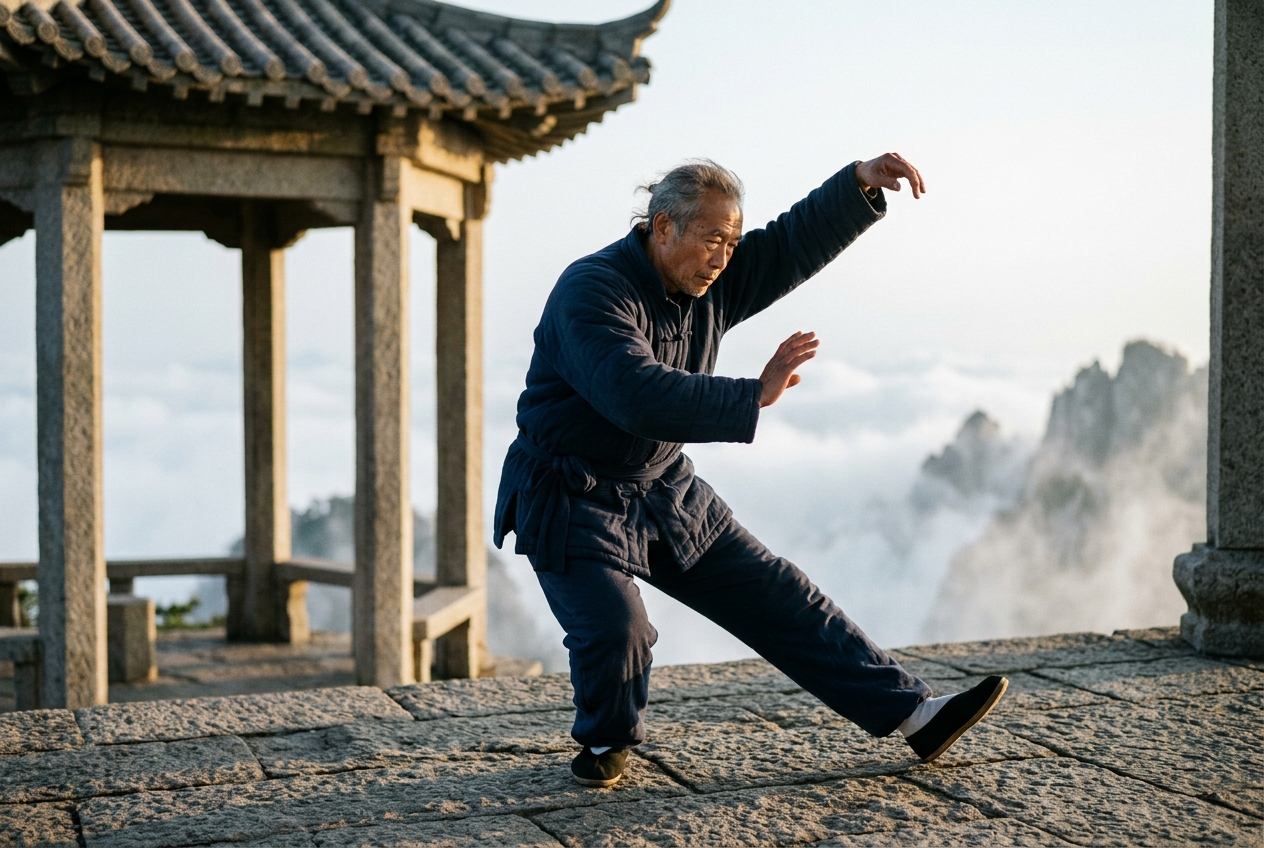
The vessel originates at the master confluence point Shenmai (BL-62), situated in the depression directly below the lateral malleolus on the outer calcaneus. From this foundational anchor on the outer heel, the trajectory unfolds through several distinct anatomical tiers:
- The Retromalleolar and Fibular Ascent: The pathway courses postero-superiorly behind the lateral malleolus, intersecting Fuyang (BL-59)—its classical Xi-Cleft (accumulation) point, located three cun superior to the lateral malleolus on the posterior border of the fibula. It ascends along the lateral fascial compartment of the lower leg, communicating functionally with the Gallbladder meridian at Yanglingquan (GB-34).
- The Coxafemoral Pivot: Ascending the lateral margin of the iliotibial band and the biceps femoris, the vessel pierces the deep muscular fascia of the hip at the greater trochanter, intersecting Huantiao (GB-30), where it anchors pelvic stability and pelvic-femoral kinetic transmission.
- The Hypochondriac and Costal Highway: The vessel courses superiorly along the posterolateral flank and ribcage, crossing the floating rib region near Jingmen (GB-25) and traversing the lateral thoracic wall.
- The Scapulohumeral Confluence: Continuing over the posterior axillary fold, it penetrates Naoshu (SI-10) on the inferior border of the scapular spine, before looping antero-superiorly over the acromion via Jianyu (LI-15) and Jugu (LI-16).
- The Craniofacial and Ocular Culmination: Ascending the lateral neck across the platysma and sternocleidomastoid, the vessel crosses the cheek to the corner of the mouth at Dicang (ST-4), climbs the nasolabial sulcus through Juliao (ST-3), passes the infraorbital margin at Chengqi (ST-1), and converges decisively at the inner canthus of the eye at Jingming (BL-1). At Jingming, the Yang Qiao Mai establishes an essential anatomical and energetic anastomosis with its functional polarity, the Yin Qiao Mai (Yin Motility Vessel), and the Bladder channel.
- The Occipital Submersion: From the inner eye, the vessel's collateral branches arc over the vertex of the cranium and descend into the suboccipital triangle, terminating deeply at Fengchi (GB-20) and entering the cranial cavity to communicate directly with the brain (Nao) and the vestibular apparatus.
As recorded in the twenty-ninth difficulty of the Nan Jing: "When the Yang Qiao is diseased, the Yang is tight while the Yin is slack." When excess metabolic or mechanical tension accumulates along this outer trajectory, the lateral musculature shortens, pulling the skeletal architecture into eversion, lateral rigidity, and hyper-vigilance, while the medial structures become inhibited and flaccid.
Modern Biomechanical Correspondences: The Lateral Myofascial Line
In contemporary structural integration and movement science, the trajectory of the Yang Qiao Mai exhibits an astonishing one-to-one correspondence with the Lateral Line (LL) elucidated by Thomas Myers in his foundational work on myofascial meridians and Anatomy Trains. The human body is not a collection of isolated levers acting in isolation; rather, it operates as a continuous biotensegrity matrix enveloped in fascia.
The Lateral Line begins on the lateral midfoot and calcaneus via the tendons of the fibularis longus and fibularis brevis (precisely at Shenmai BL-62 and Fuyang BL-59). It travels up the lateral compartment of the lower leg, passes the fibular head (Yanglingquan GB-34), and merges directly into the iliotibial tract (ITT) and the lateral intermuscular septum of the thigh. At the hip, it integrates the tensor fasciae latae (TFL) and the gluteus maximus and medius (Huantiao GB-30), forming a dynamic lateral sling that stabilizes the pelvis over the femoral head during single-leg support.
Ascending past the iliac crest, the myofascial fibers arrange themselves in a distinct crisscross lattice across the torso: the lateral abdominal obliques weave seamlessly into the external and internal intercostal muscles (traversing the lateral ribcage near Jingmen GB-25 and the lateral thoracics). In the cervical and cranial zones, the chain terminates in the sternocleidomastoid (SCM) and splenius capitis, inserting into the mastoid process and occipital ridge adjacent to Fengchi (GB-20), with fascial continuities wrapping across the epicranial aponeurosis toward the orbital fascia of the eye.
Abductor-Adductor Reciprocal Inhibition
Biomechanical balance in standing and walking requires an ongoing neurological conversation between the abductor chain on the outer leg (governed by the Yang Qiao Mai / Lateral Line) and the adductor chain on the inner leg (governed by the Yin Qiao Mai / Deep Front Line). Through Sherrington's law of reciprocal innervation, hypertonicity in the lateral fibular and gluteal compartments neurologically downregulates and weakens the adductor magnus, gracilis, and medial gastrocnemius. In Neigong practice, if a practitioner stands with collapsed arches and rigid, over-contracted lateral hips, the Yang Qiao Mai becomes chronic and rigid ("Yang is tight"), preventing the descent of Qi to the bubbling well (Yongquan, KI-1) on the sole of the foot. Opening the vessel restores balanced lateral-medial biotensegrity.
Neuro-Ocular Motor Tone and the Circadian Sleep-Wake Cycle
The Yang Qiao Mai's convergence at Jingming (BL-1) with the Yin Qiao Mai holds profound neurobiological significance. In classical Chinese medicine, the Qiao vessels are the primary arbiters of the circadian rhythm. As the Lingshu notes in Chapter 71: "When Yang Qi reaches its peak, it enters the Yang Qiao Mai; the eyes remain open and cannot sleep. When Yin Qi reaches its peak, it enters the Yin Qiao Mai; the eyes close."
Modern neurophysiology confirms that ocular motor tension, head stabilization, and cortical arousal are intimately linked through the Vestibulo-Ocular Reflex (VOR) and the Ascending Reticular Activating System (ARAS). Research archived by the National Center for Biotechnology Information (NCBI) illustrates how proprioceptive afferent feedback from the suboccipital muscles (adjacent to Fengchi GB-20) and the extraocular motor control loops directly modulate autonomic arousal and vigilance.
When you activate the lateral myofascial line and extend through the suboccipital and ocular fascia, you stimulate the sympathetic-adjacent arousal networks that govern daytime wakefulness. Conversely, harmonizing the Yang Qiao Mai with the Yin Qiao Mai allows the autonomic nervous system to downregulate from hyper-adrenergic vigilance into deep parasympathetic restoration, a core objective of traditional and integrative medicine protocols.
Step-by-Step Neigong Somatic Practice Guide
The following protocol details the precise somatic methodology for opening, vectoring, and harmonizing the Yang Qiao Mai through static Zhan Zhuang (Pole Standing) and dynamic lateral weight shifts.
1. Foundation and Structural Setup (Zhan Zhuang)
- Plantar Foot Placement: Position your feet perfectly parallel, separated by the exact width of your lateral acromion processes. Your toes must point straight forward; any external rotation shortens the fibular fascia and creates false tension in the greater trochanter.
- Plantar Lateral Rooting: Shift your awareness into the contact points of your feet. Distribute your weight so that sixty percent rests on the calcaneus. Intentionally engage the outer edge of each foot from the base of the fifth metatarsal back to the lateral heel (Shenmai, BL-62), without letting the ball of the big toe lift. You should feel the lateral longitudinal arch lift into a resilient spring.
- Trochanteric Sinking (Song Kua): Soften the knee joints by two to three degrees without allowing them to migrate past the toes or collapse inward. Release the inguinal folds (Kua) and drop the sacrum vertically down, as if resting the tailbone on a high barstool. This releases the deep lateral hip rotators around Huantiao (GB-30) while maintaining tone along the outer iliotibial band.
- Cranial Crown Suspension (Baihui): Lengthen the cervical spine by drawing the chin slightly back and gently lifting the apex of the skull (Baihui, DU-20). Imagine an unbroken silk thread pulling upward from the suboccipital ridge (Fengchi, GB-20), creating vertical space between each vertebra while dropping your shoulder blades into Jianyu (LI-15).
- The Embryonic Eye Vector: Soften your gaze. Direct your internal attention through the inner corners of your eyes (Jingming, BL-1), allowing your visual field to expand into a wide 180-degree panoramic awareness. This instantly releases chronic strain in the extraocular muscles and calms the central nervous system.
2. Breath Coordination and Energetic Vectoring
Coordinate your respiration using classical Reverse Abdominal Breathing (Ni Fu Shi Hu Xi):
- Inhalation (The Yang Wave): Inhale slowly through the nose over a count of five seconds. As the breath enters, gently draw the lower abdomen (two inches below the navel, the Xia Dantian) slightly inward toward the spine while lifting the perineum (Huiyin, RN-1). Simultaneously, draw your somatic awareness upward along the outer seams of your legs: from BL-62, up the fibular line (BL-59 / GB-34), across the greater trochanter (GB-30), up the lateral ribcage (GB-25), across the shoulders (LI-15), and up the lateral neck to the inner canthus of the eyes (BL-1). Feel the entire lateral myofascial sheath expand with elastic tension.
- Exhalation (The Yin Return & Harmonization): Exhale smoothly through the nose over a count of six seconds. Relax the lower abdomen, allowing it to expand naturally outward, and soften the pelvic floor. Cascade the energetic awareness down the medial seam of the body—down the throat, the chest, the inner thighs, and the medial malleolus (Zhaohai, KI-6, the master point of the Yin Qiao Mai)—anchoring the energy securely into the kidney channel's bubbling spring point (Yongquan, KI-1).
3. Dynamic Lateral Weight-Shift Sequence (Kai He & Heng Bu)
- While maintaining your structural alignment, inhale and slowly transfer eighty percent of your weight into your left leg over a duration of four seconds.
- As you settle into the left hip (Kua), ensure the left knee does not bow outwards past the lateral edge of the left foot. Instead, screw the left heel into the earth, actively loading the left Shenmai (BL-62) and Huantiao (GB-30) chain. The left lateral body becomes full, solid, and charged with structural elasticity (Yang).
- Simultaneously, allow the right leg to become buoyant and insubstantial (Yin). The medial pathway of the right leg remains soft and connected through Zhaohai (KI-6).
- Exhale and glide horizontally across the pelvic plane into the right leg, transitioning the load smoothly across the sacrum without bobbing upward. As the right leg accepts the load, the right Shenmai anchors into the ground, and the right lateral line charges with structural support.
- Repeat this horizontal oscillation for 12 to 24 cycles, experiencing the reciprocal polarity shift between the Yang and Yin Motility vessels.
Practitioner Diagnostics: Errors, Sensations, and Corrections
To ensure safety, structural efficiency, and authentic internal cultivation, cross-reference your somatic experience against this clinical diagnostic matrix:
| Observed Fault / Error | Biomechanical Consequence | Energetic Pathology (TCM) | Corrective Somatic Adjustment |
|---|---|---|---|
| Foot Eversion / Flaring (Toes angled outward > 15°) | Compresses fibular head, shortens IT band, disables inner foot arch. | Jammed Qi at Shenmai (BL-62); hyperactivity in Gallbladder meridian. | Re-align feet to dead parallel; anchor the base of the 1st and 5th metatarsals evenly. |
| Lateral Knee Bowing (Knee tracks past lateral ankle) | Shearing forces on lateral collateral ligament; collapses pelvic floor. | Stagnation at Yanglingquan (GB-34); leakage of lateral Peng Jin. | Spiral the femur internally while opening the groin (Kua); keep knee tracking directly over 2nd toe. |
| Pelvic Sway / Hip Popping (Hip pushes out past foot plane) | Over-stretches gluteus medius, compresses L5-S1 facet joints. | Disconnection of Huantiao (GB-30) from costal anchor Jingmen (GB-25). | Sink the sitz bones straight downward; maintain an unbroken vertical plumb line from armpit to heel. |
| Suboccipital Jamming (Chin tilted upward, neck compressed) | Compresses vertebral arteries, hyper-excites the sympathetic ARAS. | Fire rising to the head; agitation at Fengchi (GB-20) and Jingming (BL-1). | Lengthen the back of the neck; gently suspend Baihui (DU-20) as if the ears are being lifted from above. |
Somatic Sensations and What They Mean
During accurate cultivation of the Yang Qiao Mai, you will encounter distinct somatic markers:
- Thermic Radiance along the Outer Seam: A distinct, spreading sensation of warmth along the lateral calf, outer thigh, and over the acromion indicates fascial hydration, microvascular vasodilation, and the release of chronic stagnant tension in the lateral kinetic chain.
- Electromyographic Tingling / Micro-currents: Fine buzzing or tingling around Shenmai (BL-62) and radiating to the lateral three toes is a hallmark of peripheral nerve decompression (particularly the superficial fibular nerve) and the activation of interstitial bioelectric signaling.
- Suboccipital Release and Ocular Expansion: A sudden sensation of cool clarity behind the eyeballs, accompanied by involuntary deeper breathing and spontaneous salivary secretion, signals that suboccipital tension at GB-20 has released, resetting ocular motor tone and rebalancing the autonomic nervous system.
The Science of Biotensegrity, Fascial Elasticity, and Autonomics
Why does a set of standing postures and lateral micro-shifts produce such profound shifts in physical balance, mental clarity, and autonomic equilibrium? Modern exercise physiology, connective tissue research, and neurobiology provide clear, testable explanations.
Biotensegrity and the Extracellular Matrix
The human musculoskeletal framework is governed by principles of biotensegrity—a structural paradigm wherein rigid compression struts (bones) float within a continuous tension network of viscoelastic soft tissue (muscles, tendons, and the fascial extracellular matrix). When you practice conscious lateral rooting through the Yang Qiao Mai, you optimize the pretension of the lateral fascial sheath. Rather than relying on continuous muscular exertion to stay upright, your body stores and releases elastic strain energy through the collagenous network of the iliotibial band and the thoracolumbar-abdominal fascia. This drastically reduces the metabolic cost of posture, eliminating chronic postural fatigue.
Autonomic Regulation and Heart Rate Variability
Chronic stress locks the human organism into a perpetual state of hyper-arousal, characterized by shallow apical breathing, clenched jaw muscles, hypertonic suboccipitals, and contracted lateral hip stabilizers. By consciously grounding the lateral heel and opening the Yang Qiao Mai from Shenmai (BL-62) up to Jingming (BL-1), the practitioner downregulates excessive sympathetic outflow.
Clinical research indexed on PubMed consistently demonstrates that slow, diaphragmatic Neigong practices combined with structural alignment enhance Heart Rate Variability (HRV)—the definitive biomarker of autonomic resilience and parasympathetic vagal tone. When the eyes widen and suboccipital tension drops, the vagus nerve is liberated at the jugular foramen, facilitating systemic recovery and emotional equilibrium.
Classical Lineage, Historical Context, and Daoist Internal Alchemy
The systematic cultivation of the Eight Extraordinary Vessels is not a modern innovation; it represents one of the highest crests of Daoist internal alchemy (Neidan) and imperial medical science. While primary organ meridians were extensively cataloged for clinical acupuncture in the Han Dynasty classic Huangdi Neijing, the internal energetics of the extraordinary vessels were preserved primarily within esoteric Daoist lineages such as the Shangqing (Supreme Clarity) and Quanzhen Dragon Gate (Longmen) traditions.
In 1578 CE, the legendary Ming Dynasty polymath and physician Li Shizhen published his seminal treatise, the Qi Jing Ba Mai Kao (Study of the Eight Extraordinary Vessels). Master Li made an indispensable assertion that transformed internal cultivation:
"The twelve regular channels flow like rivers through the plains, but the Eight Extraordinary Channels are the deep lakes and reservoirs of the body. When the rivers are full, they overflow into the lakes... Cultivators of the Dao who do not understand the extraordinary vessels are like builders attempting to construct a palace without a foundation."
Li Shizhen detailed how masters of internal alchemy utilize the Yang Qiao Mai as a dynamic conduit to circulate Yang Qi from the lower earth gates to the upper celestial gates of the head. In Daoist martial traditions such as Wudang internal arts and modern lineages represented by organizations like the National Qigong Association (NQA), opening the Yang Qiao Mai is considered essential for developing lateral agility, light-stepping abilities (Qinggong), and impenetrable whole-body structural expansion (Peng).
By unifying Shenmai (the vessel's master point) with its paired opening vessel—the Dai Mai (Girdling Vessel, anchored at Zulinqi, GB-41)—the practitioner weaves a protective energetic web around the physical perimeter of the body, creating an internal buffer against external pathogen factors and biomechanical collapse.
Today's Practice Commitment: A 10-Minute Morning Awakening Protocol
To integrate the profound structural, neurological, and energetic benefits of the Yang Qiao Mai into your daily life, commit to the following 10-minute protocol every morning immediately upon waking, prior to consuming caffeine or checking digital devices:
- Minutes 1–3: Plantar Awakening & Alignment: Stand barefoot on a flat, unpadded surface. Establish your parallel shoulder-width stance. Spend two minutes rocking gently between the ball of the foot and the heel, gradually settling sixty percent of your weight onto the lateral heel at Shenmai (BL-62).
- Minutes 4–7: Yang Qiao Zhan Zhuang: Drop into your standing posture. Suspend Baihui (DU-20), sink the hips at Huantiao (GB-30), and soften your gaze at Jingming (BL-1). Engage in four minutes of smooth Reverse Abdominal Breathing, consciously tracing the ascending Yang wave from heel to eye on every inhale, and grounding down through the medial arches on every exhale.
- Minutes 8–10: Lateral Dynamic Oscillations: Perform two minutes of slow, unbroken lateral weight transfers. Sense the alternating loading of the fibular line and the iliotibial band as your body glides like a wave across the horizontal plane.
Notice the immediate shift in your physical state over the subsequent hour: your posture will feel effortless, your breathing will settle deep into the lower abdomen, your peripheral vision will be crisp and clear, and your mental clarity will reflect the balanced, wakeful vitality of an aligned Yang Motility Vessel.