Yin Wei Mai & Yang Wei Mai Meridian Pathways: Governing Interior Cohesion, Exterior Defense Coordination, and Emotional Resilience in Traditional Chinese Medicine
1. Opening Scene — A Moment You’ll Recognise
You have just stepped out of a high-pressure meeting into a biting evening wind. Your shoulders are hunched toward your ears, your throat feels scratchy, and an unsettling chill darts across the base of your skull. At the exact same moment, an aching flutter tightens in your chest—a knot of unspoken frustration and old, familiar self-doubt that you thought you had outgrown. Within twenty minutes, you find yourself caught in an uncanny somatic double-bind: simultaneously coming down with a physical bug and wrestling with a wave of deep, ungrounded melancholy.
Modern biomedicine tends to bifurcate this moment. The chills, stiff neck, and sudden sensitivity to draft are catalogued as autonomic thermoregulatory strain or an incipient viral prodrome. The tightness in the chest and surge of emotional fatigue are assigned to the nervous system’s sympathetic stress response.
Yet in Traditional Chinese Medicine (TCM), this simultaneous collapse of outer resilience and inner peace is understood as a single, coordinated breakdown within a specialized bio-energetic network: the Linking Vessels (Wei Mai, 維脈).
The Chinese character Wei (維) represents a cord, a net, or a binding thread—the structural weaving that holds a fabric together. When your internal holding network (Yin Wei Mai) loses its cohesion, you experience emotional fragmentation, heartache, and an inability to process biographical time. When your external defensive perimeter (Yang Wei Mai) falters, your body can no longer mediate environmental transitions, leaving you vulnerable to invading pathogens, fluctuating fevers, and chronic physical defensiveness.
To understand how our bodies link what we feel on the inside with how we survive on the outside, we must explore the fascinating physiology of these two extraordinary pathways.
2. What This Organ System Does: The Bio-Energetic Network of the Linking Vessels
To grasp the function of the Linking Vessels, one must look beyond the twelve Primary Meridians (Zheng Jing), which circulate nutrients, fluids, and vital energy (Qi) through daily metabolic and organ cycles. The Linking Vessels belong to the elite family of the Eight Extraordinary Vessels (Qi Jing Ba Mai). Rather than governing direct organ metabolism, these extraordinary vessels operate as deep physiological reservoirs, constitutional regulators, and architects of psycho-emotional development across the human lifespan.
The seminal second-century medical classic, the Nan Jing (The Classic of Difficult Issues), provides the foundational diagnostic framework for these channels in Chapter 29:
"The Yang Wei and Yin Wei tie together and hold the network of all channels. If they fail to link and coordinate, a person becomes exhausted, bewildered, and loses their internal anchoring... When the Yang Wei is diseased, bitter chills and burning fevers alternate. When the Yin Wei is diseased, it brings sudden heart pain and deep internal sorrow."
The Yin Wei Mai: The Inner Weaver of Blood and Soul
The Yin Wei Mai (Yin Linking Vessel) is the energetic seamstress of the interior. Its anatomical and energetic pathway originates on the medial lower leg at point Zhubin (KI9, "Guest House"), ascends along the inner thigh, intersects the lower abdominal channels of the Spleen (Taiyin), crosses the Liver (Jueyin) at the costal margin at Qimen (LR14), traverses the center of the chest to connect with the Pericardium and Heart (Shaoyin), and finally ascends to the throat at Tiantu (CV22) and Lianquan (CV23).
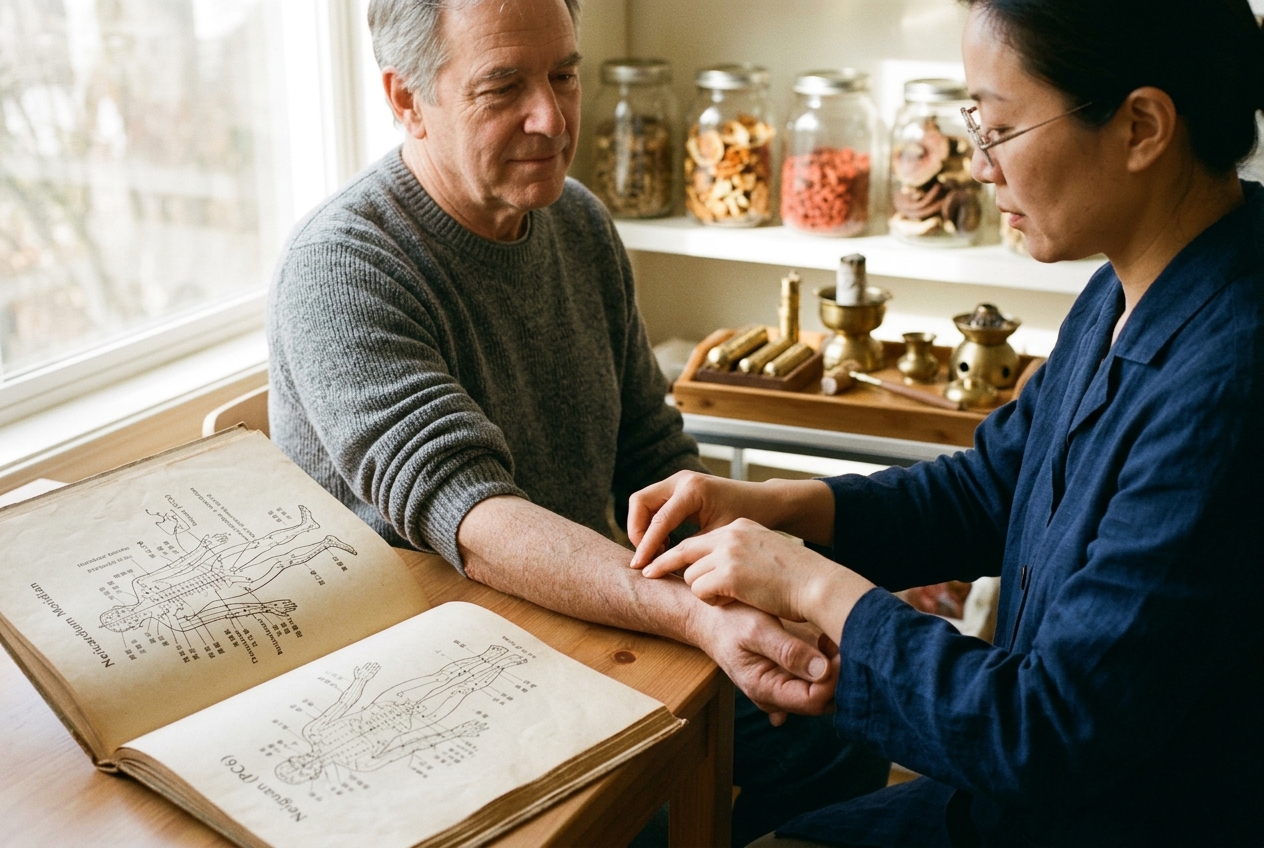
Through this pathway, the Yin Wei Mai gathers, connects, and harmonizes all the Yin channels of the body. Its core physiological responsibilities include: 1. Nourishing and Distributing Blood (Xue): In TCM, Blood is the dense, nutrient-rich fluid that anchors our consciousness and moistens our tissues. The Yin Wei Mai ensures that Blood circulates smoothly to nourish the physical heart and the cerebral cortex. 2. Housing the Spirit (Heart Shen): Shen represents our conscious awareness, capacity for self-reflection, and emotional coherence. By supporting the Heart and Pericardium, the Yin Wei Mai allows a person to metabolize emotional experiences over time, preventing past emotional wounds from coagulating into somatic distress. 3. Master Point Coupling: The master point of the Yin Wei Mai is Neiguan (PC6), situated on the inner forearm. When stimulated, it unbinds the chest, regulates heart rate variability, and soothes autonomic stress cascades via the vagus nerve, as supported by contemporary neurocardiological investigations published in NCBI PubMed.
The Yang Wei Mai: The Outer Guardian of Somatic Boundaries
In direct dynamic balance stands the Yang Wei Mai (Yang Linking Vessel), the administrator of somatic boundaries and environmental adaptation. Arising on the lateral heel at Jinmen (BL63), this channel travels up the lateral aspect of the leg via Yangjiao (GB35), scales the posterolateral hip and flank, climbs across the shoulder blade and trapezius at Jianjing (GB21), wraps around the temporal regions of the skull, crosses the forehead, and dives into the nape of the neck at Fengfu (GV16).
The Yang Wei Mai coordinates all six Yang meridians (Urinary Bladder, Gallbladder, Stomach, Small Intestine, San Jiao, and Large Intestine). Its functional imperatives include: 1. Regulating Defensive Energy (Wei Qi): Wei Qi is the dynamic, warming energy that circulates in the skin and fascia to defend the organism against climatic extremes (wind, cold, damp, heat) and infectious agents. The Yang Wei Mai deploys and balances this defensive matrix. 2. Managing Transitional States and the Shao Yang Mechanism: When an environmental pathogen penetrates beyond the skin but has not fully entered the digestive core, it becomes trapped in the half-interior, half-exterior zone (Shao Yang). The Yang Wei Mai governs this junction, preventing the hallmark oscillations of alternating fever and chills, ear pressure, and temporal headaches. 3. Stabilizing Musculoskeletal Posture: Because the channel laces across the lateral kinetic chain—from the ankles through the iliotibial band to the neck—it stabilizes our physical structure against external kinetic forces. 4. Master Point Coupling: The master point of the Yang Wei Mai is Waiguan (TE5), located on the dorsal aspect of the forearm. Activating Waiguan mobilizes outer defenses, clears pathogenic heat, and releases tension across the lateral seams of the body, a mechanism highlighted in research on Meridian Channels and Neuroendocrine Integration.
3. How You Can Feel It: Signs of Balance and Imbalance
When the Yin and Yang Linking Vessels are functioning in seamless concert, you move through life with both physical adaptability and emotional stability. You can step into adverse weather without catching a cold; you can navigate stressful interpersonal interactions without experiencing lingering panic or somatic tension.
When these vessels fall out of harmony, however, clear physical and psychological markers emerge.
The Yin Wei Mai Experience: The Internal Disconnect
An imbalance in the Yin Wei Mai is fundamentally an illness of internal disconnection and temporal entrapment. Individuals with Yin Wei dysregulation often feel "ungrounded" in their own biographies.
- Emotional Signs: A recurring sensation of sudden grief or anxiety that strikes without clear external provocation; persistent melancholy; feeling disconnected from your purpose; harboring unresolved resentment or nostalgia that paralyzes present action.
- Physical Sensations: A distinct sense of tightness, flutter, or emptiness behind the sternum; a feeling of a constriction or "plum-pit" in the throat (Mei He Qi); digestive churn triggered instantly by emotional distress; insomnia characterized by waking up at 1:00 to 3:00 AM with a racing mind and dry mouth.
The Yang Wei Mai Experience: The Breached Boundary
An imbalance in the Yang Wei Mai is an illness of external friction and compromised defense.
- Emotional Signs: Chronic hypervigilance; feeling easily overwhelmed by noisy environments, bright lights, or crowds; an inability to say "no" or maintain personal boundaries, leading to sudden physical exhaustion.
- Physical Sensations: Waking up with stiff, achy shoulders and a locked neck (the Jianjing GB21 reflex); sudden bouts of shivering followed by internal flushes of heat; recurring temporal headaches; ringing in the ears (tinnitus); lateral hip pain that flares when walking on uneven terrain.
60-Second Self-Assessment: Evaluating Your Linking Network
Take a moment to sit quietly and observe your current somatic state:
- Check Your Internal Horizon (Yin Wei): Place one hand over the center of your chest. Close your eyes and take three slow, unforced breaths. Does your chest feel spacious, warm, and receptive? Or do you feel a subtle band of constriction, an emotional ache, or an urge to sigh deeply? (Sighing and constriction point toward Yin Wei tension).
- Check Your External Perimeter (Yang Wei): Slowly turn your head from left to right, then gently roll your shoulders back. Do the lateral muscles of your neck and upper back move with supple ease? Or do they feel like taut steel cables, sensitive to the temperature of the room? (Rigidity and draft-sensitivity point toward Yang Wei strain).
4. Qigong & Movement Practice: "Weaving the Inner Sanctuary and Outer Shield"
This gentle, equipment-free movement practice—derived from classical Medical Qigong traditions—is designed to consciously activate and harmonize both Linking Vessels. It alternates between opening the Yin pathway along the chest and anterior forearms and expanding the Yang protective field along the back, shoulders, and dorsal forearms.
Setup & Posture
- Stance: Stand with your feet flat on the floor, shoulder-width apart. Unlock your knees slightly so your pelvis settles naturally.
- Spine: Imagine a silk cord suspended from the crown of your head, gently lengthening your neck and spine.
- Breath: Breathe exclusively through your nose, allowing your belly to expand softly on each inhalation.
Step-by-Step Movement Instructions
Phase 1: Gathering the Yin (Nourishing the Inner Pass)
- Starting Position: Rest your hands in front of your lower abdomen, palms facing upward, fingers loosely pointing toward one another.
- The Inhalation (4 Counts): As you inhale slowly, draw your hands upward along the midline of your body toward your heart center.
- The Wrist Alignment: As your hands reach the chest (Danzhong, CV17), rotate your wrists so the inner aspects of your forearms—where the Neiguan (PC6) points reside—face directly toward your heart.
- Somatic Focus: Feel an open, soothing warmth spreading across your chest, calming the heart rate and gathering your emotional awareness into a quiet, protected inner sanctuary.
Phase 2: Projecting the Yang (Expanding the Outer Shield)
- The Transition: At the top of the breath, pause for a natural 2-count suspension. Rotate your palms outward so the backs of your wrists—where the Waiguan (TE5) points reside—face outward into the room.
- The Exhalation (6 Counts): Slowly press your hands forward and gently outward to a 45-degree angle, extending your arms without locking your elbows.
- Somatic Focus: As you exhale, imagine smoothing out a resilient, flexible energetic shield across your upper back, shoulders, and surrounding your entire body. Feel the tension draining from your neck down into the earth.
Phase 3: Returning to the Matrix
- The Inhalation (4 Counts): Sweep your arms outward in a gentle arc and bring your palms back down toward your lower abdomen.
- Settling: Rest your attention in your lower abdomen (Dantian) for one full, relaxed breath.
Dosage & Sensations
- Repetitions: Perform 8 to 12 continuous cycles (approximately 5 to 7 minutes).
- What to Look For: A distinct sensation of warmth in the centers of your palms, a spontaneous deepening of the breath, a relaxation of the jaw and trapezius muscles, and an immediate reduction in feelings of mental urgency.
5. Acupressure Points You Can Try Today
Acupressure offers a direct, non-invasive method for resetting Linking Vessel tension. By working with the master points and the primary cleft point of these channels, you can rapidly recalibrate your body’s internal emotional processing and external defensive tone.
1. Neiguan (Pericardium 6, PC6) — "The Inner Pass"
The Master Point of the Yin Wei Mai
  Location: Inner forearm, 2 cun (3 finger-widths) proximal to the wrist crease,
            between the tendons of palmaris longus and flexor carpi radialis.
- How to Locate It: Turn your palm facing up. Place the three middle fingers of your opposite hand across your inner wrist crease. Just below your index finger, in the exact center of your forearm, feel for the groove between the two prominent tendons.
- How to Apply Pressure: Use the tip of your thumb to apply firm, steady pressure directly into the groove. You should feel a dull, spreading sensation that may travel toward your palm or up your arm. Maintain this pressure while taking slow, deep abdominal breaths for 2 to 3 minutes per arm.
- Everyday Uses: Instant relief from stress-induced heart palpitations, acute waves of anxiety, car sickness, nausea, insomnia, and that suffocating sensation of emotional overwhelm.
2. Waiguan (Triple Energizer 5, TE5 / San Jiao 5) — "The Outer Pass"
The Master Point of the Yang Wei Mai
  Location: Dorsal forearm, 2 cun (3 finger-widths) proximal to the back wrist crease,
            in the depression between the radius and ulna bones.
- How to Locate It: Turn your palm facing down. Place three finger-widths of your opposite hand across the back of your wrist crease. In the midline of the forearm, between the two arm bones (radius and ulna), press into the distinct soft hollow.
- How to Apply Pressure: Apply moderate to firm pressure with your thumb, using gentle circular kneading. You can simultaneously circle your wrist to facilitate the release of stagnant tension along the Gallbladder and Triple Energizer Channels. Hold for 1 to 2 minutes on each side.
- Everyday Uses: Releasing acute neck and shoulder stiffness, stopping a tension headache or migraine in its tracks, alleviating ear fullness, and strengthening your physical resilience when you feel vulnerable to catching a cold.
3. Zhubin (Kidney 9, KI9) — "The Guest House"
The Xi-Cleft (Accumulation) Starting Point of the Yin Wei Mai
  Location: Medial lower leg, 5 cun (roughly one hand-width plus two finger-widths)
            above the inner ankle bone, at the lower fleshy border of the calf muscle.
- How to Locate It: Find the highest tip of your medial malleolus (inner ankle bone). Measure approximately 5 cun up the inner leg, resting right along the lower curve of the calf muscle (gastrocnemius), about an inch behind the back edge of the shin bone (tibia).
- How to Apply Pressure: Grasp your lower leg with your fingers around the shin and place your thumb directly on Zhubin. Press firmly toward the center of the leg bone. Breathe deeply for 2 minutes on each leg.
- Everyday Uses: Known classically as the great emotional detoxification point. It is used to release accumulated emotional toxicity, deep-seated grief, inherited stress patterns, and chronic lower-leg cramps.
6. Food & Lifestyle: Small Changes for Today
Nourishing the Linking Vessels does not require rare, inaccessible herbal compounds. Because the Yin Wei Mai depends upon rich Blood (Xue) to ground the spirit, and the Yang Wei Mai relies upon vigorous Defensive Energy (Wei Qi) to secure the perimeter, targeted adjustments to everyday diet and daily rhythms yield profound clinical benefits.
1. Dietary Foundations for the Yin Wei Mai: Blood-Building & Spirit-Calming
- Prioritize Warm, Dark, Mineral-Rich Foods: Blood requires warm digestion to be manufactured efficiently. Shift away from cold, raw salads toward slow-simmered stews, cooked spinach, roasted beetroot, black beans, lentils, and eggs.
- Integrate Natural Blood Tonics: A warm bowl of rolled oats topped with stewed apples, a teaspoon of black sesame seeds, and a handful of goji berries (widely available in standard supermarkets) directly nourishes the Spleen and Kidney, supporting the Yin Wei Mai's blood-anchoring role.
- What to Minimize: Limit excess caffeine and late-night alcohol. Both act as thermal heaters in TCM, consuming the body's Yin fluids, drying the Blood, and leaving the Heart Shen unmoored at night.
2. Dietary Foundations for the Yang Wei Mai: Aromatic Boundary Defense
- Utilize Gentle Warming Aromatics: To ensure your Wei Qi can dynamically adjust to weather changes, incorporate mild, dispersing culinary herbs: fresh ginger root, scallions (particularly the white bulb portion), garlic, and thyme. A simple tea made by simmering three thin slices of fresh ginger and a cinnamon stick for 10 minutes acts as an effective tonic for the Yang Wei Mai.
- What to Minimize: Avoid consuming iced drinks and frozen treats, particularly during autumn and winter. Cold inputs shock the Stomach (Yangming), forcing the body to divert its Wei Qi from the skin and muscles down into the core simply to maintain basal temperature.
3. Lifestyle Architecture: Protecting the Gates
- Guard the "Wind Gate": The Yang Wei Mai converges at the base of the skull and upper neck (Fengfu GV16 and Fengchi GB20). These points are classically termed "Wind Gates" because draft and sudden temperature drops enter here to trigger muscle spasms and headaches. Adopt the simple habit of wearing a light scarf in drafty, air-conditioned rooms or during seasonal transitions.
- Establish a Digital Twilight: The Yin Wei Mai regenerates when the eyes and brain are freed from stimulating visual inputs. Blue light directly depletes Liver and Heart Blood. Institute a strict cutoff for digital screens 45 minutes before sleep to allow your Shen to settle back into its internal resting place.
7. Today’s Takeaway
The most profound realization offered by the Linking Vessels is that your internal emotional landscape and your external physiological boundaries are not separate systems—they are two sides of a single woven fabric.
Whenever you feel overwhelmed by the demands of the world, or lost in the shadows of personal worry, take five minutes to practice the Dual-Gate Forearm Compression. By simultaneously pressing the Inner Pass (PC6) and the Outer Pass (TE5), you restore the bridge between your inner sanctuary and your outer world, reminding your body that it is safe within itself, and fully capable of meeting whatever comes from the outside.