Twelve Sinew Channels (Jing Jin) Meridian Pathways: Governing Myofascial Integrity, Biomechanical Posture, and Musculoskeletal Defense in Traditional Chinese Medicine
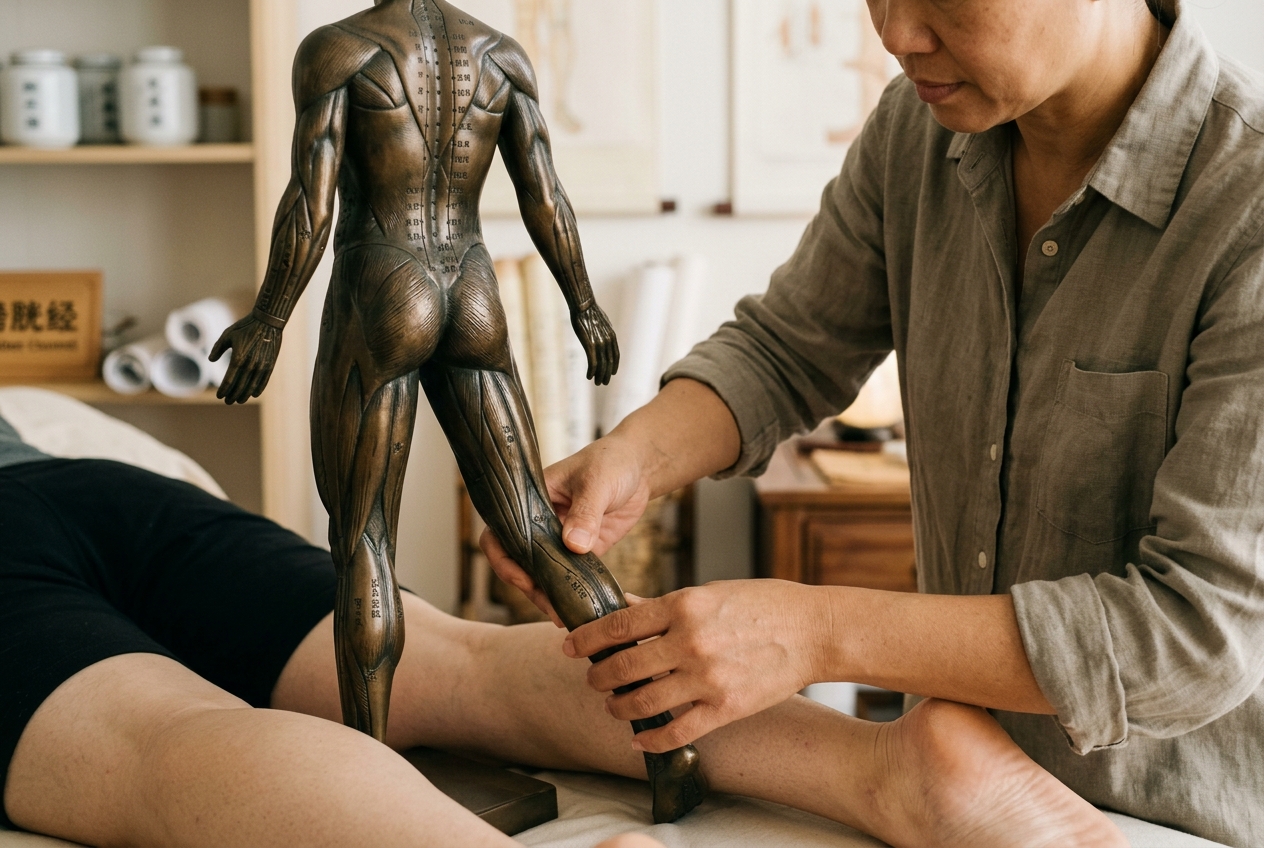
1. Opening Scene — A Moment You'll Recognise
You step off a high curb unexpectedly, your right heel jarring against the asphalt. The sudden jolt travels upward instantly, yet it is not your ankle that complains. By late afternoon, a dull, nagging tension has clamped itself across your lower back, crept up the column of your erector spinae, and fastened behind the crest of your left brow as a pounding tension headache. Conventional anatomical logic—treating muscles as isolated, origin-to-insertion levers—struggles to explain why a mechanical impact at the calcaneus manifests hours later as an orbital ache. Yet in the living body, tension is rarely a localized event; it is an uninterrupted wave traveling through an intricate, continuous structural matrix.
In Traditional Chinese Medicine (TCM), this phenomenon is neither mysterious nor anomalous. You have just experienced the kinetic pathway of the Leg Taiyang Sinew Channel (Zu Taiyang Jing Jin), an unbroken anatomical continuum running from the lateral aspect of the fifth digit, up the posterior calf and hamstrings, across the sacrum, ascending the dual dorsal tracks of the spine, over the cranial vault, and terminating at the root of the nose.
For more than two millennia, classical Chinese medicine recognized that beneath the skin lies an interconnected architectural web governing locomotion, posture, structural shock absorption, and external physiological defense. Rather than viewing musculoskeletal injuries as localized dysfunctions, classical texts conceptualized the body as an integrated tensegrity network. Understanding this system offers profound insights into how we store biomechanical stress, why chronic pain migrates across seemingly unrelated joints, and how targeted somatic practices can restore structural vitality.
+-----------------------------------------------------------------------------------------+
|                                KINETIC CASCADE OF JING JIN                              |
|                                                                                         |
|  [ Heel Strike / Ankle Jolt ]                                                           |
|               |                                                                         |
|               v (Ascending mechanical shear through plantar aponeurosis & Achilles)     |
|  [ Gastrocnemius / Hamstring Strain ]                                                   |
|               |                                                                         |
|               v (Force transmission through sacrotuberous ligament & thoracolumbar)    |
|  [ Lumbar Fascial Splinting & Erector Spinae Spasm ]                                    |
|               |                                                                         |
|               v (Ascending kinetic line over galea aponeurotica to frontalis)            |
|  [ Suboccipital Constriction & Supraorbital Tension Headache ]                          |
+-----------------------------------------------------------------------------------------+
2. What This Organ System Does: The Anatomy and Physiology of the Twelve Sinew Channels
To comprehend how the body manages movement and environmental resilience, classical physicians formulated the theory of the Twelve Sinew Channels (Shi Er Jing Jin 十二經筋). First systematically documented in Chapter 13 of the seminal Han Dynasty treatise, the Huangdi Neijing Ling Shu (The Yellow Emperor’s Inner Classic: Spiritual Pivot), the Jing Jin constitute the superficial, myofascial, and tendinomuscular manifestations of the primary meridian system.
While the primary channels (Jing Mai) penetrate deeply to nourish the internal organs (Zang-Fu) and circulate nutritive energy (Ying Qi), the Sinew Channels possess distinct anatomical and physiological characteristics:
+--------------------------+------------------------------------+------------------------------------+
| CHARACTERISTIC           | PRIMARY CHANNELS (JING MAI)        | SINEW CHANNELS (JING JIN)          |
+--------------------------+------------------------------------+------------------------------------+
| Tissue Substrate         | Vascular/neurochemical pathways   | Fascial sheets, tendons, ligaments |
| Visceral Penetration     | Direct entry into Zang-Fu organs  | No visceral entry; somatic shield  |
| Flow Direction           | Cyclic (organ-to-organ circuits)   | Centripetal (extremities to axial) |
| Dominant Vital Substance | Ying Qi (Nutritive) & Blood        | Wei Qi (Defensive) & Interstitial  |
| Binding Sites (Jie)      | Acupuncture points along track     | Major articulations & bony ridges  |
+--------------------------+------------------------------------+------------------------------------+
Morphological Trajectories: Centripetal Flow and Joint "Bindings" (Jie)
The morphology of the Jing Jin follows a strict spatial logic. Every sinew channel originates at the distal extremities—specifically at the nail beds and tips of the toes and fingers, corresponding to the Jing-Well (Jing Xue) points. From these peripheral epicenters, they trace broad, ribbon-like fascial bands that move centripetally (from the limbs inward toward the trunk, spine, head, and thoracic cage).
Crucially, as these channels cross bony bridges, they concentrate and anchor into thick fibrous nodes termed Bindings (Jie 結). These Jie correspond directly to retinacula, joint capsules, tendon insertions, and major aponeuroses. For instance: * The three Foot Yang Sinew Channels (Taiyang, Shaoyang, Yangming) originate at the toes, bind firmly at the malleoli of the ankle, ascend the lateral and anterior aspects of the leg, bind at the lateral knee and patellar tendon, consolidate at the greater trochanter and pelvic rim, and converge axially on the facial bones and cranium. * The three Hand Yang Sinew Channels bind at the dorsum of the wrist, the olecranon process of the elbow, the acromioclavicular joint of the shoulder, and attach to the temporal bone, mandibular angle, and occiput. * The Yin Sinew Channels bind at the medial malleoli, medial condyles of the tibia, pubic symphysis, thoracic wall, and the ventral diaphragm.
Unlike the primary meridians, the Jing Jin do not penetrate the Zang-Fu viscera directly. Instead, they spread out over the superficial musculoskeletal envelope—what classical medical theory describes as the Cou Li (the interstitial space between muscle fibers and subcutaneous tissue). They form a continuous protective sheath, enveloping the skeleton and internal viscera like a living biometric armor.
                      CENTRIPETAL SINEW ARCHITECTURE

            [ Cranium / Face / Mandible / Thorax ]  <-- (Termination)
                           ^
                           |
                     [ Major Jie ] (Joint Bindings: Hip / Shoulder)
                           ^
                           |
                     [ Middle Jie ] (Joint Bindings: Knee / Elbow)
                           ^
                           |
                     [ Distal Jie ] (Joint Bindings: Ankle / Wrist)
                           ^
                           |
        [ Jing-Well Points at Extremities: Toes & Fingers ] <-- (Origination)
The Conduit for Defensive Wei Qi
Physiologically, the Jing Jin serve as the primary conduit for Defensive Qi (Wei Qi). Derived from the transformation of food essences by the Spleen and aerated by the Lungs, Wei Qi is thermal, dynamic, and uncontained by blood vessels. It courses through the superficial connective tissues, performing two vital functions: 1. Thermoregulation and Immune Defense: Circulating Wei Qi warms the muscles, governs the opening and closing of sweat pores, and repels external environmental pathogens such as Wind (Feng), Cold (Han), and Dampness (Shi). 2. Biomechanic Dampening and Shock Absorption: The sinew channels distribute kinetic forces evenly across the myofascial matrix. When external force or repetitive strain impacts a limb, the Jing Jin distribute this tension along an entire line, preventing acute catastrophic failure of individual joints.
Modern Biomechanical Parallels: Thomas Myers’ Anatomy Trains
This ancient schema astonishingly anticipates modern discoveries in fascial anatomy. Pioneer researcher Thomas Myers, in his renowned framework Anatomy Trains, mapped the continuous fascial planes that distribute strain and coordinate global movement across the human body.
+------------------------------------+---------------------------------------------------+
| CLASSICAL SINEW CHANNEL (JING JIN) | WESTERN MYOFASCIAL MERIDIAN (ANATOMY TRAINS)      |
+------------------------------------+---------------------------------------------------+
| Leg Taiyang (Urinary Bladder)      | Superficial Back Line (Plantar fascia to Scalp)   |
| Leg Yangming (Stomach)             | Superficial Front Line (Extensor digitorum to SCM)|
| Leg Shaoyang (Gallbladder)         | Lateral Line (Peroneals, IT Band, Obliques)       |
| Leg Taiyin / Jueyin (Spleen/Liver) | Deep Front Line (Tibialis post., Adductors, Psoas)|
| Hand Yang Channels                 | Superficial & Deep Back Arm Lines                 |
| Hand Yin Channels                  | Superficial & Deep Front Arm Lines                |
+------------------------------------+---------------------------------------------------+
Modern histological and orthopedic research confirms that muscles rarely terminate neatly on bone; rather, up to 40% of muscular contractile force is transmitted laterally into surrounding fascial planes and connective sheets. Classical Chinese doctors grasped this macroscopic biomechanical continuum empirically, codifying it in the twelve distinct trajectories of the Jing Jin.
3. How You Can Feel It: Signs of Balance, Imbalance, and Somatic Pathology
When the Sinew Channels are healthy, Wei Qi flows smoothly, tissues remain hydrated and supple, and joints glide effortlessly through their full physiological range. Force transmits seamlessly across the body without localized friction or mechanical wear.
When the system falls out of equilibrium, structural and physiological patterns deteriorate into what classical medicine classifies as Bi Syndrome (Bi Zheng 痺證)—painful obstruction caused by stagnation of Qi, blood, and interstitial fluid, or by the entrapment of environmental pathogens in the superficial fascia.
+-----------------------------------------------------------------------------------------+
|                                    BI SYNDROME TYPOLOGY                                 |
|                                                                                         |
|  [ WIND BI (Xing Bi) ]  --> Migratory, shifting pain moving erratically between joints  |
|  [ COLD BI (Tong Bi) ]  --> Severe, fixed, piercing pain; aggravated by cold, relieved |
|                             by heat; characterized by ischemic fascial contracture      |
|  [ DAMP BI (Zhuo Bi) ]  --> Heavy, sodden, swollen joints; persistent localized ache;  |
|                             associated with chronic fascial densification & edema       |
|  [ HEAT BI (Re Bi) ]    --> Redness, swelling, heat, burning inflammation in the peri-  |
|                             articular connective tissues                                |
+-----------------------------------------------------------------------------------------+
Everyday Signs of Imbalance
- The “Banded” Tension Pattern: Rather than feeling an ache isolated to a single muscle belly, you feel a tight, restrictive band pulling along an entire limb (e.g., from the outer hip, down the lateral thigh, to the lateral ankle along the Leg Shaoyang track).
- Unexplained Postural Compensation: A stiff, restricted big toe joint (Leg Taiyin/Jueyin) causes an unconscious tilt of the pelvis, producing ipsilateral lower back tension and contralateral neck pain.
- Hyper-Reactivity to Temperature and Weather: Joints that ache, stiffen, or throb hours before a cold rain arrives indicate depleted superficial Wei Qi, permitting Wind and Dampness to settle into the fibrous Jie (bindings).
- Myofascial Trigger Points and Ashi Nodes: Small, hyperirritable nodules in taut bands of fascia that refer pain elsewhere when pressed. In the 7th century, the master physician Sun Simiao codified these as Ashi Points (阿是穴)—tender trigger locations that elicit a characteristic somatic recognition ("Ah, yes, that is the exact spot").
Rapid Somatosensory Self-Assessment
You can assess the structural integrity and kinetic continuity of your own Jing Jin right now using this three-part movement screen:
+---------------------------------------------------------------------------------------+
|                       THREE-POINT SINEW KINETIC MOBILITY SCREEN                       |
+---------------------------------------------------------------------------------------+
| 1. POSTERIOR SINEW CONTINUITY (Leg Taiyang / Superficial Back Line)                   |
|    - Action: Stand with feet together, knees softly straight; slowly roll the chin down|
|      the chest, vertebra by vertebra, reaching toward the floor.                      |
|    - Imbalance Check: Do you feel an abrupt wall of restriction behind your knees or  |
|      in your lower back? Does the tension pull into your neck or scalp? A healthy line|
|      curves uniformly like a composite arch bow without focal hinge breaks.           |
|                                                                                       |
| 2. LATERAL SPIRAL AND STABILISATION (Leg Shaoyang / Lateral Line)                      |
|    - Action: Stand on your right foot, raise the left knee to hip height, and gently  |
|      reach your left arm overhead while side-bending your torso slightly to the left.  |
|    - Imbalance Check: Does your right outer ankle collapse or shake violently? Does   |
|      your lateral hip pinch? This indicates fascial densification or motor instability|
|      along the Gallbladder Sinew Channel.                                             |
|                                                                                       |
| 3. ANTERIOR CHEST AND UPPER LIMB (Hand Yin / Front Arm Lines)                         |
|    - Action: Extend both arms out laterally at shoulder height, rotate wrists backward|
|      so palms face behind you, spread the fingers wide, and gently draw arms back.    |
|    - Imbalance Check: Do you feel a sharp, cord-like pull traveling from your pectorals|
|      through the biceps into the thumb and index finger? This reflects chronic fascial|
|      shortening of the Lung and Pericardium sinew tracks from desk posture.           |
+---------------------------------------------------------------------------------------+
4. Qigong & Somatic Movement Practice: Unwinding the Sinew Channels (Daoyin Yi Jin Jing)
To restore elasticity to the Jing Jin, nourish the Jie bindings, and flood the superficial tissues with warming Wei Qi, ancient Daoist physicians developed Daoyin (導引 - Guiding and Pulling) and the famous Yi Jin Jing (易筋經 - Muscle-Tendon Changing Classic).
The following practice, "Plucking a Star and Exchanging the Constellations" (Zhai Xing Huan Dou Shi), utilizes continuous fascial pre-tensioning, rotational spiral torque, and diaphragmatic mechanics to stretch and release the Yin and Yang sinew lines of both the upper and lower extremities.
                  "PLUCKING A STAR" DYNAMIC FASCIAL SPIRAL

                           (Top Hand: Plucking Palm)
                                     / \
                                    /   \  <-- Spiral fascial line open
                                   (  o  )     across trunk & neck
                                   /  |  \
                                  /   |   \
                                 /    |    \
                                /     |     \
                               /      |      \
                              (       |       )
                               \     / \     /
                 (Back Hand) -->\   /   \   /<-- (Rooted Stance:
                  anchored behind  /     \        Spiraling through arches)
                  sacrum          /       \
Step-by-Step Exercise Protocol
+----------------------------------------------------------------------------------------+
| PRACTICE: ZHAI XING HUAN DOU SHI (PLUCKING A STAR AND EXCHANGING THE CONSTELLATIONS)   |
+----------------------------------------------------------------------------------------+
| DURATION: 8 to 10 minutes (6 to 8 deliberate repetitions per side)                     |
| PURPOSE:  Unwinds fascial densification across the Yangming and Taiyang sinew channels |
+----------------------------------------------------------------------------------------+
Step 1: Starting Position and Grounding (Zhan Zhuang Setup)
- Stand with your feet parallel, hip-width apart. Let your weight sink evenly through the tripods of both feet (base of the big toe, base of the little toe, and center of the heel).
- Soften the knees slightly without collapsing them inward; imagine resting your sacrum on the edge of a high stool.
- Lengthen the spine upward from the crown (Baihui point), tucking the chin by a fraction of an inch to decompress the suboccipital hinge. Let your arms hang loosely at your sides.
- Take three slow, unforced breaths into the lower abdomen (Dan Tian), feeling the lower rib cage expand circumferentially.
Step 2: The Coiled Initiation (Inhale)
- Shift 60% of your body weight onto your right foot, maintaining an active arch.
- As you begin a slow, smooth nasal inhalation (4 seconds), initiate a gentle rotation of your torso from the pelvis toward your right side (approximately 45 degrees).
- Allow your right arm to trace a wide, sweeping arc upward in front of your chest. Turn the right palm toward your face as it ascends, spiraling the forearm outward (supination), engaging the Hand Yang sinew continuum.
- Simultaneously, sweep your left arm behind your back, resting the back of your left hand flat against the lumbar spine/sacrum (Ming Men area), fingers pointing downward.
Step 3: The Full Fascial Stretch and Gaze (Hold / Peak Expansion)
- Continue reaching the right arm diagonally upward and overhead until the elbow is softly extended but not locked.
- Form an open, soft hook with the right hand—fingers spread and gently cupped, as if grasping a glowing star from the sky.
- Turn your head smoothly to gaze upward at the palm of your right hand.
- Feel the unbroken line of tension: from the lateral edge of your rooted right foot, up the calf, across the hip, through the lateral abdominal wall and latissimus dorsi, traversing the armpit, and extending out through the tips of the fingers.
- Hold this fully expanded geometric architecture for 2 to 3 seconds at the top of the inhalation, allowing gentle mechanotransductive stretch across the collagen network.
Step 4: The Dissolving Descent (Exhale)
- Begin a slow, measured exhalation through the nose (6 seconds).
- Slowly unwind the torso back toward the center. Relax the right hand from its cupped shape and allow the right arm to drift weightlessly downward along the midline of the body, as if descending through warm water.
- Simultaneously, release the left arm from behind your back and bring it back to your side.
- Re-center your weight symmetrically over both feet in the neutral starting posture.
Step 5: Mirror Repetition and Cadence
- Immediately transition into the opposite side: shift weight to the left foot, sweep the left arm overhead, place the right hand behind the sacrum, and gaze upward into the left palm.
- Perform 6 complete cycles per side (12 total movements). Keep the movement fluid, uninterrupted, and devoid of muscular strain; prioritize smooth connective continuity over maximum joint excursion.
Sensations and Physiological Indicators
- What to Look For: Within 3 to 4 repetitions, you should experience a distinct spreading warmth across the interscapular region and down the arms, accompanied by a subtle tingling or buzzing sensation in the fingertips. This indicates the mobilization of Wei Qi and microvascular vasodilation in the superficial fascia.
- Structural Release: You may experience spontaneous micro-adjustments or popping sounds in the costovertebral or thoracic joints as chronic fascial torsion releases. If you feel sharp, pinching joint pain, reduce your range of motion immediately; the sensation should be a pleasant, diffuse elastic release (Suan Chang - sour distension).
5. Classical Clinical Methodologies & Acupressure Points You Can Try Today
In the clinical treatment of sinew channel pathologies, acupuncturists apply classical needle manipulation techniques specifically formulated in the Ling Shu for connective tissue rather than deep viscera: * Hegu Needling (Hegu Ci 合谷刺): Inserting the needle into muscle bellies and fanning it out laterally in multiple directions (resembling a chicken's claw) to release hypertonic muscle contracts and dense fascial adhesions. * Joint Needling (Guan Ci 關刺): Superficial perpendicular insertion directly adjacent to the Jie (tendinous bindings), targeting tenoperiosteal junctions without puncturing joint capsules. * Thermotherapy & Cupping: Applying direct moxibustion (burning Artemisia vulgaris) to drive out cold contraction, followed by glass fire cupping (Ba Guan) to mechanically decompress adhered fascial planes and draw fresh blood into the hypoperfused Cou Li layers.
+---------------------------------------------------------------------------------------+
|                     CLINICAL PROTOCOLS FOR SINEW DYSFUNCTION                          |
+---------------------------------------------------------------------------------------+
|  TECHNIQUE   | TISSUE TARGET          | MECHANISM & THERAPEUTIC EFFECT                |
+---------------------------------------------------------------------------------------+
|  Hegu Ci     | Taut bands & TrPs      | Multi-directional fanning releases mechanical |
|  (Claw)      | in muscle bellies      | cross-links and resets motor endplate spasm   |
|              |                        |                                               |
|  Guan Ci     | Tenoperiosteal bounds  | Decompresses peri-articular Jie bindings;     |
|  (Joint)     | near articular nodes   | stimulates mechanoreceptors & synovial repair |
|              |                        |                                               |
|  Ba Guan     | Superficial fascia &   | Negative pressure suction lifts dermis from   |
|  (Cupping)   | Cou Li interstitial space| deep fascia, shearing micro-adhesions       |
+---------------------------------------------------------------------------------------+
For daily self-care, you can utilize targeted manual stimulation on key master points along the primary sinew trajectories to relieve myofascial pain, clear stagnation, and regulate Wei Qi.
                KEY ACUPRESSURE ANCHORS FOR THE SINEWS

        (Hand Yangming Axis)                     (Leg Yang Axis)
             LI 11 [Quchi]                         GB 34 [Yanglingquan]
             (Outer Elbow)                         (Lateral Lower Knee)
                   |                                        |
                   v                                        v
             LI 4 [Hegu]                           BL 60 [Kunlun]
             (First Web Space)                     (Behind Outer Ankle)
Point 1: Yanglingquan (Gallbladder 34 / GB-34) — "Yang Mound Spring"
- Systemic Function: Celebrated as the Hui-Meeting Point of the Sinews (Jin Hui), GB-34 is the primary systemic point in Chinese medicine for treating all tendinomuscular disorders, ligamentous sprains, muscular contractures, and fascial stiffness across the entire body.
- Anatomical Location: On the lateral (outer) aspect of the lower leg, in the soft, tender depression located approximately one finger-breadth anterior and inferior to the prominence of the head of the fibula.
- Application Technique: Sit comfortably with knees bent at 90 degrees. Place the thumb of your hand on the outer lower leg and palpate the bony knob of the fibular head. Slide your thumb slightly forward and down into the natural fleshy valley. Apply firm, steady perpendicular pressure while performing small circular friction motions.
- Dosage & Duration: Maintain steady, moderate pressure (reaching a dull, deep ache that may radiate down the lateral calf) for 2 to 3 minutes per side.
- Clinical Indications: Sciatica, IT band friction syndrome, lateral knee pain, stiff neck, chronic shoulder tension, and general muscular rigidity.
Point 2: Hegu (Large Intestine 4 / LI-4) — "Joining Valleys"
- Systemic Function: The master point for the Hand Yangming Sinew Channel, controlling the myofascial lines traversing the dorsal hand, forearm, anterior deltoid, neck, jaw, and face. It clears external wind pathogens and exerts a powerful analgesic effect on the upper body.
- Anatomical Location: On the dorsum of the hand, between the first and second metacarpal bones, situated at the midpoint of the second metacarpal bone on its radial (thumb) side.
- Application Technique: Place your opposite thumb on the top of the hand in the web space and your index finger on the palm side. Angle your thumb pressure inward toward the bone of the index finger, rather than pressing straight down into the fleshy web. Apply firm, rhythmic pulsing pressure.
- Dosage & Duration: 1 to 2 minutes on each hand, breathing deeply. (Note: Contraindicated during pregnancy due to its downward-draining action).
- Clinical Indications: Tension headaches, temporomandibular joint (TMJ) dysfunction, stiff neck, rotator cuff pain, and sinus congestion.
Point 3: Kunlun (Urinary Bladder 60 / BL-60) — "Kunlun Mountains"
- Systemic Function: A major distal anchor point for the Leg Taiyang Sinew Channel (the primary posterior kinetic chain). It acts as a kinetic "drainage valve," releasing downstream myofascial strain from the occiput, cervical spine, and lumbar erectors.
- Anatomical Location: On the lateral aspect of the ankle, in the deep hollow situated directly between the prominence of the lateral malleolus (outer ankle bone) and the Achilles tendon.
- Application Technique: Grasp the back of your ankle between your thumb and index finger. Squeeze your thumb into the depression just behind the outer ankle bone. Apply moderate, sustained pressure while slowly flexing and extending your foot (pointing toes up and down) to actively floss the fascial tract through the point.
- Dosage & Duration: 2 minutes per side.
- Clinical Indications: Acute lower back spasms, sciatica, suboccipital tension headaches, tight calves, and plantar heel pain.
6. Food, Hydration & Lifestyle: Restoring Connective Tissue Vitality
In traditional organ theory, the physical health of the sinews (Jing Jin) is governed primarily by two internal organs: 1. The Liver (Gan): Stores the Blood and moistens the tendons and ligaments. When Liver Blood is abundant, connective tissues remain pliable, resilient, and elastic. When Liver Blood or Yin is depleted, sinews become dry, brittle, prone to tearing, cramping, and morning stiffness. 2. The Spleen (Pi): Dominates the muscles and the transformation of fluids. A robust Spleen generates healthy interstitial fluids that lubricate the fascial planes, enabling smooth gliding between adjacent muscular compartments.
To nourish the fascia and maintain the defensive barrier of Wei Qi, apply these simple dietary and lifestyle modifications using accessible, whole-food strategies.
+-----------------------------------------------------------------------------------------+
|                         FASCIAL NOURISHMENT PROTOCOL MATRIX                             |
+-----------------------------------------------------------------------------------------+
| CATEGORY       | STRATEGY (ADD)                         | RESTRICTION (REDUCE)          |
+-----------------------------------------------------------------------------------------+
| Connective     | Slow-simmered bone broths, rich in     | Ultra-processed refined fats; |
| Tissue Matrix  | natural gelatin, glycine, and proline;  | excessive refined sugars that |
|                | stewed tendon, marrow, and cartilage   | accelerate collagen cross-link|
|                |                                        | stiffening (glycation/AGEs)   |
|                |                                        |                               |
| Blood & Yin    | Dark leafy greens (spinach, kale),     | Excessive coffee, alcohol, and|
| Moistening     | black sesame seeds, goji berries,      | harsh chemical stimulants that|
|                | beetroot, steamed eggs, black beans    | dehydrate Liver Blood & fluid |
|                |                                        |                               |
| Thermogenesis  | Fresh ginger, turmeric, rosemary,      | Iced drinks, raw/cold salads  |
| & Wei Qi Flow  | cinnamon, scallions, and warm broths   | consumed in cold environments |
|                | to disperse cold fascial stasis        | that cause microvascular spasm|
|                |                                        |                               |
| Fascial Hygro- | Warm filtered water with a pinch of    | Unbuffered plain distilled    |
| dynamics       | unrefined sea salt & a splash of lemon | water chugged rapidly without |
|                | to optimize cellular hydration uptake  | mineral/electrolyte cofactors |
+-----------------------------------------------------------------------------------------+
Daily Lifestyle Interventions for Sinew Health
+---------------------------------------------------------------------------------------+
| 1. THERMAL PRESERVATION PROTOCOL (PROTECTING THE JIE BINDINGS)                        |
|    - The superficial Jing Jin are vulnerable to environmental Wind-Cold invasion.     |
|    - Crucial Habit: Avoid exposing sweaty, open-pore skin to cold air-conditioning    |
|      drafts immediately after exercise. Protect the cervical spine (the convergence   |
|      site of all Yang sinews) and lower back with light layers in breezy climates.    |
|                                                                                       |
| 2. INTERSTITIAL HYDRATION & MOVEMENT HYGIENE                                          |
|    - Fascia is a thixotropic gel-state matrix: it becomes viscous, stiff, and adhered |
|      when stationary, but liquefies, hydrates, and glides smoothly when warmed and    |
|      moved dynamically.                                                               |
|    - Crucial Habit: Break up static sitting every 45 minutes with 60 seconds of gentle|
|      spinal undulating, joint rolling (ankles, wrists, hips), or deep squatting to    |
|      re-hydrate the dry connective tissue sheets.                                     |
|                                                                                       |
| 3. EVENING EPSOM SALT SOAKS (MAGNESIUM & WARMTH)                                      |
|    - Dissolve 2 cups of magnesium sulfate (Epsom salts) in a warm bath. Soak for 20   |
|      minutes before bed. The combination of heat (dispersing Cold Bi) and transdermal |
|      magnesium relaxes hypertonic neuromuscular junctions and restores elasticity     |
|      to the superficial fascia along the dorsal sinew chains.                         |
+---------------------------------------------------------------------------------------+
7. Today's Takeaway: Your 5-Minute Micro-Reset
The most potent step you can take today for your sinew system requires no equipment, no financial investment, and less than five minutes of your time.
Stand upright, kick off your shoes, and perform a slow, mindful dynamic spinal roll down toward your toes, pausing for three full breaths at your natural threshold to invite gentle elastic expansion through your entire posterior chain (the Leg Taiyang Sinew Channel).
As you smoothly unroll your spine to return to standing, immediately apply firm circular thumb pressure to GB-34 (Yanglingquan) on both outer knees for 60 seconds, followed by drinking a large mug of warm water infused with a thin slice of fresh ginger and a pinch of mineral sea salt.
By decompressing the kinetic line, activating the systemic master switch for your tendons, and supplying warmth to your superficial Wei Qi, you immediately break the cycle of fascial densification—restoring grace, resilience, and effortless mobility to your living structural frame.
Authoritative References and Academic Sources
- World Health Organization (WHO) Traditional Medicine Strategy & Nomenclature
- National Center for Biotechnology Information (NCBI): Anatomy, Fascia Connective Tissue
- PubMed Central: Biomechanics of Acupuncture Needling and Fascial Mechanotransduction
- Wikipedia: Fascial Anatomy, Continuous Sheaths, and Tensegrity
- Wikipedia: Traditional Meridian Theory and Clinical Points