Que Qiao Magpie Bridge: Lingual-Palatal Coupling, Salivary Nectar Secretion, and Ren-Du Circuit Completion in Classical Neigong
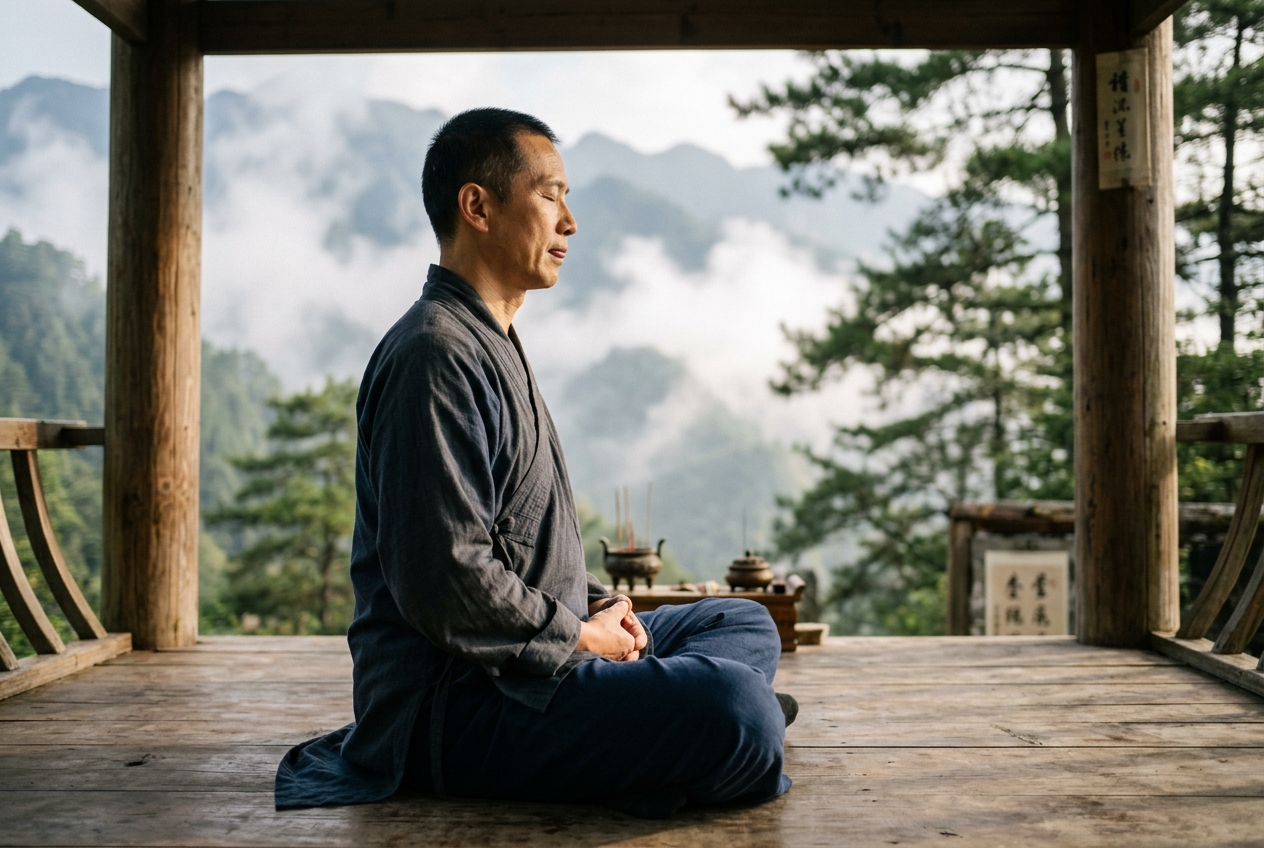
By placing the tip of your tongue against a specific junction on the roof of your mouth, you close the upper gap, allowing energy and fluid to circulate smoothly between the head and the lower belly without stagnating or overheating the brain. In traditional systems, this completed circuit forms the foundation of the Microcosmic Orbit (Xiao Zhou Tian), transforming ordinary breath and bodily secretions into vital restorative energy.
Anatomy of the Biomechanical Circuit: Upper and Lower Bridges
To understand the necessity of the Magpie Bridge, one must examine the bioenergetic topography of the human body as codified in classical acupuncture and internal arts mapped by the National Qigong Association. The primary vessel of yang energy, the Du Mai (Governing Vessel), originates deep within the lower abdomen, emerges at the perineum (Huiyin, Ren-1), traces posteriorly through the tailbone (Changqiang, Du-1), and ascends through the spine and cranium before terminating inside the mouth at Du-28 (Yinjiao), located on the superior labial frenulum at the junction of the upper gum and lip.
Conversely, the primary reservoir of yin energy, the Ren Mai (Conception Vessel), originates in the pelvic cavity, emerges anteriorly at the perineum, and courses upward along the midline of the abdomen, sternum, and throat, terminating at Ren-24 (Chengjiang) in the mentolabial groove beneath the lower lip.
========================================================================
                      THE TWO MAGPIE BRIDGES
========================================================================
 1. Shang Que Qiao (Upper Magpie Bridge):
    - Anatomical Site: Lingual-palatal contact (Incisive papilla / soft palate).
    - Energetic Termini: Du-28 (Yinjiao) <---> Ren-24 (Chengjiang).
    - Primary Function: Permits Yang Qi to descend into Yin channels;
      activates cranial nerve salivatory reflex ("Jade Nectar").

2. Xia Que Qiao (Lower Magpie Bridge):
    - Anatomical Site: Pelvic diaphragm / Perineal body (Huiyin).
    - Energetic Termini: Ren-1 (Huiyin) <---> Du-1 (Changqiang).
    - Primary Function: Seals pelvic base; prevents loss of Yuan Qi;
      initiates ascending dorsal propulsion through the Weilü gate.
========================================================================
Without somatic intervention, a distinct physical hiatus exists between the oral terminus of Du Mai and the oral commencement of Ren Mai. Daoist neigong classifies this physical separation as the Upper Magpie Bridge (Shang Que Qiao / 上鹊桥).
Simultaneously, at the base of the trunk, the Lower Magpie Bridge (Xia Que Qiao / 下鹊桥) spans the perineal floor between Huiyin (Ren-1) and Changqiang (Du-1). When an adept aligns the physical structure, elevates the pelvic diaphragm, and seals the lingual apparatus against the palate, these two anatomical gaps close. The severed circuits fuse into an unbroken torus of bioelectrical and fascial continuity.
Step-by-Step Practice Guide
Executing the Upper and Lower Magpie Bridges requires millimeter-level precision, balanced muscular tone, and steady neuro-somatic awareness. Follow this protocol to establish the connection safely and effectively.
1. Structural Posture Setup (Xu Ling Ding Jin)
- Settle onto your seat with your ischial tuberosities (sitting bones) grounded evenly.
- Suspend the vertex of your head (Baihui, Du-20) toward the ceiling as though drawn upward by a silk thread. This gently tucks the chin, lengthens the suboccipital musculature, and uncompresses the cranial base, neutralizing excessive cervical lordosis.
- Release the temporomandibular joints; your molars should never touch. Maintain a three-millimeter space of stillness between the upper and lower teeth.
2. Upper Bridge: The Three Palatal Stations (Shang Que Qiao)
Depending on your phase of cultivation, the lingual placement rests at one of three distinct anatomical coordinates along the roof of the mouth:
- The Wind Position (Xuan Ding / Alveolar Ridge): Place the flat dorsal surface of the tongue tip directly onto the incisive papilla, just behind the maxillary central incisors. This is the foundational position for calming the central nervous system, establishing basic circuit closure, and settling agitated thoughts.
- The Fire Position (Tian Chi / Hard Palate): Slide the tongue tip back along the midline to the apex of the hard palatal vault. This station stimulates the cranial bones and intensifies energetic ascent when clearing blockages along the spine.
- The Water Position (Yu Zhu / Hard-Soft Palate Junction): Draw the tongue further posteriorly until the rigid bone of the hard palate gives way to the pliable, fleshy mucous membrane of the soft palate (velum). The contact here must be as delicate as a butterfly resting on water. This junction triggers profound parasympathetic glandular secretions and is the classical seat of internal alchemy.
       [ Incisors ]
            |
      (1) [ Wind Position: Incisive Papilla ]
            \
        (2) [ Fire Position: Hard Palate Vault ]
              \
          (3) [ Water Position: Hard-Soft Palate Junction ]
                \
                 [ Velum / Uvula ]
3. Lower Bridge: Pelvic Floor Engagement (Xia Que Qiao)
- Coordinate with the breath: on every inhalation, gently draw the perineal center (Huiyin, located midway between the anus and the external genitalia) upward and inward by approximately ten to fifteen percent of your maximum muscular effort.
- Avoid clenching the gluteal muscles, external sphincters, or thighs. The engagement must be a micro-elevation of the levator ani and pubococcygeus muscles, drawing the pelvic diaphragm upward like a soft internal suction cup.
- On the exhalation, maintain a minute, soft tone within the pelvic floor rather than dropping it abruptly, preserving the continuity of the lower bridge.
4. Breathwork Coordination (Ni Fu Shi Xi / Reverse Abdominal Breathing)
- Inhale through the nose into the lower abdomen while gently drawing the lower abdominal wall (the area two inches below the navel, or Xia Dantian) inward toward the spine. Simultaneously, feel the subtle upward draw of the Lower Magpie Bridge (Huiyin).
- Allow the energetic current to ascend from the coccyx (Weilü), through the thoracic spine between the shoulder blades (Jiaji), past the occiput (Yuzhen), over the crown of the head (Baihui), and down to the Upper Magpie Bridge at the roof of the mouth.
- Exhale slowly through the nose: relax the abdominal wall outward while keeping the tongue affixed to the palate. Let the pooled energy cascade down the throat, breastbone, and central abdominal line back into the lower belly.
5. Harvesting and Swallowing the "Jade Nectar" (Yin Jin Yu Ye)
As the tongue rests softly against the hard-soft palate junction, the salivary glands will begin to release a light, clear, non-viscous fluid, referred to classically as Jade Nectar (Jin Jin Yu Ye / 金津玉液).
========================================================================
            THE THREE-PHASE JADE NECTAR SWALLOWING PROTOCOL
========================================================================
 Phase 1: The Gathering (Hao Chi)
   - Accumulate the fluid naturally beneath the tongue without forced sucking.
   - Lightly click the upper and lower teeth together 36 times (Kou Chi)
     to stimulate glandular resonance, then swirl the saliva 9 times.

Phase 2: The Three-Stage Descent
   - Separate the accumulated fluid mentally and physically into three boluses.
   - Swallow the first third: Track it mentally as a cooling stream passing
     through the throat to quench thoracic and cardiac heat (Xin Huo).
   - Swallow the second third: Track it as it descends past the solar plexus
     (Zhong Dantian), harmonizing the stomach and spleen.
   - Swallow the final third: Direct it forcefully with intent (Yi) deep into
     the lower belly (Xia Dantian), anchoring the Yuan Qi into the kidneys.

Phase 3: The Resonant Anchor
   - Conclude with three quiet abdominal breaths, visualizing the lower belly
     as a glowing, warm cauldron storing the refined vital essence.
========================================================================
Diagnostic Checkpoints: Identifying and Rectifying Mechanical Errors
Even experienced practitioners frequently fall victim to subtle biomechanical errors that restrict energetic circulation, generate somatic hypertonicity, and elevate arterial blood pressure. Use the following diagnostic checkpoints to audit your practice:
+--------------------------+------------------------------+-------------------------------+
| Mechanical Error         | Somatic Symptom              | Corrective Protocol           |
+--------------------------+------------------------------+-------------------------------+
| Hypertonic Jaw Clenching | Temporal headaches, tight    | Drop jaw slightly; maintain   |
| (Masseter activation)    | neck, restricted swallowing  | 3mm space between molars;     |
|                          |                              | visualize space behind ears.  |
+--------------------------+------------------------------+-------------------------------+
| Tongue Pressing Tension  | Sore tongue root, tightness  | Use feather-touch contact;    |
| (Genioglossus strain)    | in submental tissues         | maintain a light mucosal seal |
|                          |                              | rather than active pressure.  |
+--------------------------+------------------------------+-------------------------------+
| Cervical Lordosis        | Occipital pressure, buzzing  | Lengthen Baihui upward; drop  |
| ("Broken crane neck")    | in ears, cranial heat        | chin 5 degrees; open space at |
|                          |                              | the C0-C1 atlanto-occipital.  |
+--------------------------+------------------------------+-------------------------------+
| Hyper-contracted Pelvis  | Pelvic pain, constipation,   | Reduce contraction to 10-15%; |
| (Gluteal/sphincter grip) | blocked Qi at the sacrum     | isolate levator ani softly.   |
+--------------------------+------------------------------+-------------------------------+
- The Lingual Weight Check: If you feel the muscles beneath your chin hardening when placing the tongue, you are pressing too aggressively. The tongue should adhere via a subtle capillary mucosal suction rather than active muscular force. Think of resting a leaf upon the surface of a still pond.
- The Occipital Gate Check (Yuzhen): Place your hand at the base of your skull. If the back of your neck feels shortened or deeply grooved, your chin is lifted too high. Draw the chin slightly back and down until the suboccipital muscles feel soft, long, and open.
Why It Works — The Neuro-Somatic Science
The biomechanical bridging of the palate and pelvic floor is not merely a symbolic or energetic visualization; it triggers well-documented neuro-anatomical and autonomic adaptations that transform physiological function.
                      [ Superior / Inferior Salivatory Nuclei ]
                                        |
                  +---------------------+---------------------+
                  |                                           |
         (Trigeminal Nerve - CN V)                   (Hypoglossal Nerve - CN XII)
         Sensory afferents from palate               Motor efferents to lingual root
                  \                                           /
                   +-------------------+---------------------+
                                       |
                     [ Glandular Parasympathetic Outflow ]
                     - Submandibular & Sublingual Glands
                     - Serous secretion ("Jade Nectar")
                     - Downward Vagal (CN X) Entrainment
1. Trigeminal-Hypoglossal Entrainment
The roof of the mouth and the anterior two-thirds of the tongue possess dense sensory innervation through branches of the Trigeminal Nerve (Cranial Nerve V), specifically the nasopalatine and lingual nerves. The motor innervation of the intrinsic and extrinsic lingual muscles is orchestrated by the Hypoglossal Nerve (Cranial Nerve XII).
When the tongue contacts the palatal mucosa at the hard-soft junction, it closes a specialized sensorimotor loop within the brainstem. Sensory afferents from the trigeminal system project directly into the trigeminal spinal and main sensory nuclei, which communicate with the hypoglossal nucleus and the solitary tract (nucleus tractus solitarii / NTS). This biofeedback loop downregulates hyperactive sympathetic tone across the cervical spinal nerves, quietening the fight-or-flight response within seconds of contact.
2. Autonomic Glandular Activation and "Jade Nectar" Production
Lingual-palatal contact stimulates the superior and inferior salivatory nuclei in the pons and medulla. Parasympathetic efferent fibers traveling via the chorda tympani (a branch of Cranial Nerve VII, the Facial Nerve) and the glossopharyngeal nerve (Cranial Nerve IX) synapse on the submandibular and otic ganglia.
This parasympathetic cascade induces profuse secretion from the sublingual, submandibular, and parotid glands. Unlike stress-induced sympathetic saliva—which is thick, mucus-heavy, and sparse—parasympathetically stimulated saliva is watery, clear, and rich in: * Alpha-amylase and lingual lipase: Initiating carbohydrate and lipid catabolism before swallowing. * Lysozyme, lactoferrin, and secretory IgA: Bolstering mucosal immune defenses. * Epidermal Growth Factor (EGF): Promoting esophageal, gastric, and intestinal mucosal repair. * Bicarbonate ions: Neutralizing systemic acid loads and cooling gastrointestinal inflammation.
When this enzymatically rich fluid is swallowed in three phases, it mechanically and biochemically soothes the mucosal lining of the esophagus and stomach, downregulating splanchnic sympathetic tone and physically cooling visceral irritation.
3. Fascial Continuity: The Deep Front Line
In structural myofascial anatomy, the tongue represents the cranial terminus of Thomas Myers' Deep Front Line—the deepest fascial sheath of the body. This continuous myofascial web runs from the plantar surfaces of the toes, up the deep posterior compartment of the lower leg, through the popliteal space, along the adductor group, across the pelvic floor (the levator ani and pubococcygeus), through the anterior longitudinal ligament of the spine, along the pericardium, through the scalenes and longus colli, and anchors into the hyoid apparatus, styloid process, and the tongue.
[ Plantar Fascia ] ---> [ Deep Posterior Leg ] ---> [ Adductor Group ]
                                                          |
[ Lingual Musculature / Tongue ] <--- [ Pericardium / Scalenes ] <--- [ Pelvic Floor / Huiyin ]
When you stabilize the Lower Magpie Bridge (Huiyin) and anchor the Upper Magpie Bridge (tongue to palate), you establish active, responsive tension throughout the entire Deep Front Line. This fascial integration stabilizes the axial skeleton, decompresses the lumbar spine, maximizes intra-abdominal pressure regulation during diaphragmatic respiration, and increases heart rate variability (HRV), as substantiated in clinical studies accessible through the National Center for Biotechnology Information.
Classical Lineage & Context
The imagery of the Magpie Bridge originates in classical Chinese mythology and astronomical observation, specifically the legend of the Cowherd (Niulang, representing the star Altair) and the Weaver Maiden (Zhinü, representing the star Vega). Separated throughout the year by the vast, impassable celestial expanse of the Silver River (the Milky Way), the lovers are permitted to reunite only once annually—on the seventh night of the seventh lunar month (Qixi)—when a flock of sympathetic magpies gathers from across the cosmos, locking wings together to form a living bridge over the starry abyss.
       [ Zhinü / Weaver Maiden (Vega) ]       [ Niulang / Cowherd (Altair) ]
                     \                                      /
                      \    ~~~~~~~~~~~~~~~~~~~~~~~~~~~~    /
                       \~~~   The Silver River (Milky Way)  ~~~/
                           \                              /
                            \    [ THE MAGPIE BRIDGE ]   /
                             \   (Flock of Magpies)     /
                              ==========================
Daoist internal alchemists (Neidan-jia) of the Tang (618–907 CE) and Song (960–1279 CE) Dynasties adopted this celestial allegory as an operative anatomical blueprint for the human vessel, a system later recognized globally under the frameworks compiled by the World Health Organization Traditional Medicine.
In seminal alchemical treatises such as the Taiyi Jinhua Zongzhi (太乙金華宗旨, The Secret of the Golden Flower) and Zhang Boduan’s 11th-century masterpiece Wuzhen Pian (悟真篇, Awakening to Reality), master practitioners observed that when vital energy (Qi) is gathered and propelled up the dorsal spine, it must cross three hazardous narrow passes known as the Three Back Gates (San Guan / 三关): 1. The Tailbone Gate (Weilü Guan): The lower coccygeal sphincter where primal vitality is unlocked. 2. The Spinal Gate (Jiaji Guan): The mid-thoracic region between the shoulder blades opposite the heart, where fiery emotional blockages reside. 3. The Jade Pillow Gate (Yuzhen Guan): The dense occipital threshold where energy enters the cranial vault (Niwan).
========================================================================
            THE THREE BACK GATES (SAN GUAN) OF ASCENT
========================================================================
 (1) WEILÜ GUAN (Tailbone Gate / Sacrococcygeal Hiatus)
     - Challenge: Cold stagnation, sluggish inertia of foundational Jing.
     - Solution: Engagement of the Lower Magpie Bridge (Huiyin micro-lift).

(2) JIAJI GUAN (Spinal Gate / Thoracic T5-T6 Junction)
     - Challenge: Emotional blockages, chest constriction, trapped Qi.
     - Solution: Relaxation of the rhomboids, scapular softening, and
       unimpeded diaphragmatic expansion.

(3) YUZHEN GUAN (Jade Pillow Gate / Occipital Base C0-C1)
     - Challenge: Compression of cranial nerves, intracranial vascular
       congestion, ocular pressure.
     - Solution: Suspension of the crown (Xu Ling Ding Jin) and tucking of
       the chin to physically open the foramen magnum.
========================================================================
Once the fiery Yang Qi ascends past the Jade Pillow and illuminates the upper brain, it generates immense intracranial heat. If trapped in the head without a descending pathway, this ascending fire produces symptoms of internal imbalance: severe dizziness, temporal throbbing, hypertension, insomnia, and sensory agitation—a pathological condition termed in Chinese medicine as Qi-deviation or "fire escaping upward" (Shang Huo).
To avert this crisis, the adept deploys the Upper Magpie Bridge. The tongue bridges the palatal cleft, allowing the gathered cerebral energy to transform into cool, glistening Yin saliva (Jade Nectar). Guided by intention and physical peristalsis down the Conception Vessel, the cooled fluid extinguishes visceral heat and returns to the Lower Dantian to replenish primordial essence (Jing), as documented in the broader history of Daoist Neidan.
Today's Practice Commitment
To transform theoretical comprehension into tangible somatic mastery, commit to the following ten-minute integration protocol daily for the next seven days:
+-----------------------------------------------------------------------+
|                YOUR 10-MINUTE DAILY PRACTICE PROTOCOL                 |
+-----------------------------------------------------------------------+
| Schedule: Immediately upon waking, before breakfast or caffeine.     |
|                                                                       |
| 00:00 - 02:00: Postural Alignment & Bridge Placement                  |
|   - Sit tall; suspend Baihui; lengthen the back of the neck.          |
|   - Place tongue tip at the Hard-Soft Palate Junction (Water Station).|
|   - Maintain 3mm clearance between upper and lower molars.            |
|                                                                       |
| 02:00 - 07:00: Microcosmic Orbit Reverse Respiration                  |
|   - Inhale 4 seconds: Draw lower belly and perineum (Huiyin) inward;  |
|     feel warmth ascend the spine through the Three Gates to crown.    |
|   - Exhale 6 seconds: Relax abdomen softly; feel the cool stream      |
|     descend the front of the body across the palatal bridge.          |
|                                                                       |
| 07:00 - 09:00: Jade Nectar Gathering and Three-Stage Swallow          |
|   - Accumulate the pool of saliva at the floor of the mouth.          |
|   - Click the teeth 36 times (Kou Chi) and swirl the liquid 9 times.  |
|   - Swallow in three deliberate, mindful stages, tracking its cool    |
|     descent directly into the lower belly cauldron (Xia Dantian).     |
|                                                                       |
| 09:00 - 10:00: Stillness & Energetic Storage                          |
|   - Rest hands over the navel, breathe naturally into the belly,      |
|     and seal the gathered vitality within your core.                  |
+-----------------------------------------------------------------------+
Observe your mental clarity, the quality of your digestion, and your baseline autonomic calm throughout the day. By consciously uniting the Upper and Lower Magpie Bridges, you transform two disconnected anatomical channels into an infinite, self-replenishing loop of vital health.