Fifteen Luo-Connecting Channels (Luo Mai) Meridian Pathways: Governing Collateral Circulation, Emotional Somatization, and Yuan-Luo Point Synergy in Traditional Chinese Medicine
1. Opening Scene — A Moment You'll Recognise
Consider an afternoon when, under the sustained duress of unexpressed frustration or chronic mental fatigue, you notice a sudden, inexplicable physical constellation: a localized throbbing along the lateral border of your forearm, a persistent tightness catching in the throat that resists every swallow, or a cluster of microscopic, purple-hued spider veins newly blooming across the medial aspect of your ankle. You have not suffered physical trauma, nor does routine diagnostic imaging reveal a structural lesion. Yet the body registers an undeniable physical holding pattern—a tangible knot where emotional residue, vascular tone, and neuromuscular tension converge.
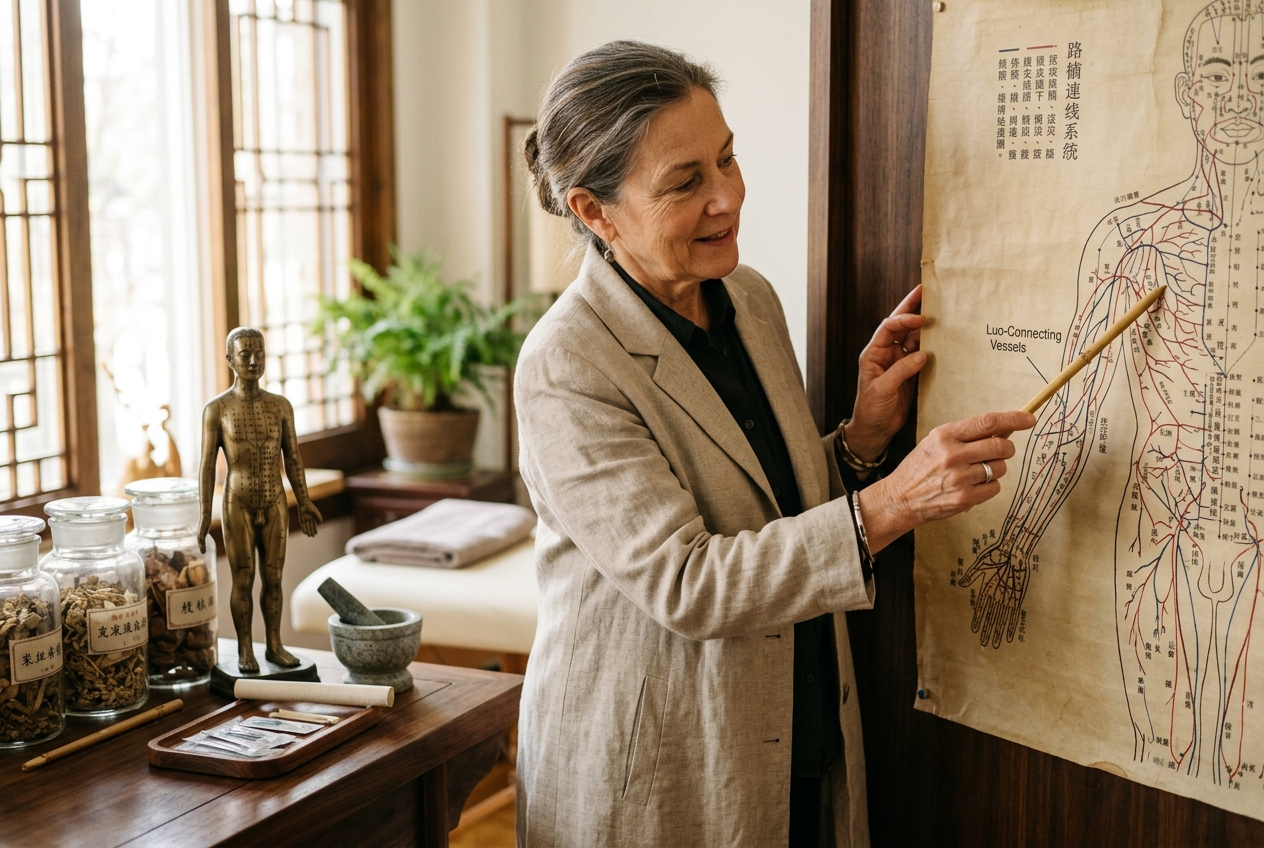
In classical East Asian medicine, these subtle manifestations are neither random nor purely psychological. They represent the active physiological theater of the Luo Mai (絡脈), or the Fifteen Luo-Connecting Channels. Described over two millennia ago in the foundational canons of the Huangdi Neijing (The Yellow Emperor's Inner Classic), the Luo vessels operate as an intricate, responsive micro-network. They branch off from the primary conduits (Jing Mai) to govern microvascular perfusion, equilibrate paired internal organs, and, crucially, act as dynamic physiological holding reservoirs that sequester emotional and environmental strain before it can compromise deeper vital structures.
Bridging the gap between the lyrical prose of the Han dynasty and contemporary clinical science, exploring the Luo-Connecting channels reveals profound parallels with endothelial autoregulation, fascial continuum mechanics, and the neurovascular cascades that govern psychosomatic health.
2. What This Organ System Does: The Fifteen Luo-Connecting Channels
To understand the Luo-Connecting channels is to appreciate the body's sophisticated architecture of systemic equilibrium and functional redundancy. While the primary meridians (Jing Mai) are conventionally conceptualized as deep, longitudinal trunks circulating nutritive Ying Qi and protective Wei Qi through the core visceral systems, the Luo Mai represent the expansive, horizontal, and collateral networks that permeate the interstitial fabric, reaching the superficial cutaneous layers and the fine microvasculature.
The Classical Foundation: Lingshu Chapter 10
The formal taxonomy of the Luo vessels is systematically articulated in Chapter 10 (Jingmai) of the Spiritual Pivot (Lingshu). Classical theory delineates precisely fifteen distinct Luo-Connecting vessels: 1. Twelve channels corresponding to the bilateral primary Zang-Fu organ pathways. 2. Two channels emerging from the primary extraordinary vessels along the sagittal midline: the Ren Mai (Conception Vessel) Luo at Jiuwei (CV15) and the Du Mai (Governor Vessel) Luo at Changqiang (GV1). 3. The Great Luo of the Spleen (Pi Zhi Da Luo) originating at Dabao (SP21), which oversees and binds the entire collateral network across the thorax, hypochondrium, and peripheral flesh. (Later classical commentators, such as Wang Bing, also recognized the Great Luo of the Stomach, Xuli, which communicates directly with the apical pulse and systemic circulation).
Transverse vs. Longitudinal Luo Architecture
Functionally, the collateral network bifurcates into two distinct anatomical and energetic modalities:
- The Transverse Luo (Heng Luo): These short, functional anastomoses bridge interior-exterior coupled organ systems (e.g., the Lung of Hand-Taiyin with the Large Intestine of Hand-Yangming). In clinical strategy, the Transverse Luo provides the pathway for the classical "Host-Guest" (Zhu-Ke) pairing method, wherein the primary affected organ's Yuan-Source point is coupled with the Luo-Connecting point of its paired channel to dynamically shunt excess energy, vent heat, or nourish metabolic deficiency across the visceral divide.
- The Longitudinal Luo (Zong Luo): These extensive branches diverge from the primary pathway at the Luo point, pursuing unique anatomical trajectories that often reach the head, sensory orifices, chest, and epigastrium. Rather than merely connecting paired channels, Longitudinal Luo vessels serve as protective biological conduits. When an individual encounters pathogenic factors—whether environmental extremes or unresolved psycho-emotional conflicts—the Longitudinal Luo absorbs and traps the disturbance, preventing pathogen entry into the vital Zang organs.
Over time, if emotional turbulence remains unresolved, the Longitudinal Luo fills to capacity, precipitating tangible structural shifts: vascular stasis, localized tissue hypoxia, and palpable nodular consolidations.
Modern Biomedical Correlates: Microcirculation and Fascial Tension
Contemporary physiological investigations published via NCBI PubMed demonstrate that classical Luo-Connecting pathways correlate closely with the body's microcirculation and neurovascular bundles. Modern biophysical mapping demonstrates that acupoints designated as Luo-Connecting points exhibit: * Markedly higher capillary loop densities. * Elevated microvascular perfusion velocities. * Rich aggregations of unmyelinated free nerve endings, peptidergic perivascular fibers, and mast cells embedded within the loose connective tissue matrices.
When somatic stress or emotional suppression persists, sympathetic hyperactivity induces chronic vasoconstriction in the terminal arteriolar beds. This local ischemia stimulates mast-cell degranulation and fascial thickening—mirroring the exact mechanisms of blood stasis (Xue Yu) and collateral obstruction documented in ancient Chinese medical manuals. The WHO Traditional Medicine guidelines recognize these anatomical and physiological frameworks as vital contributors to integrated holistic care.
3. How You Can Feel It: Signs of Balance and Imbalance
The health of your Luo collateral network is displayed directly on the surface of your body. In the diagnostic framework of the Lingshu, the practitioner evaluates the Luo vessels through visual inspection of superficial venules (Wang Luo) and precise palpation along the channel pathways (Qie Luo).
Because the Luo vessels manage blood and somatic emotion, disharmonies exhibit a polar presentation: Repletion (Fullness / Shi) versus Vacuity (Emptiness / Xu).
Diagnostic Semiology: Reading the Body's Collaterals
- Visible Telangiectasias and Vascular Engorgement: * Crimson / Bright Red Threads: Indicate acute heat, inflammatory microvascular dilation, or active, agitated emotional distress. * Deep Purple / Cyanotic Venules: Represent chronic microvascular blood stasis (Xue Yu), prolonged ischemic compression, or emotional trauma that has been somatically sequestered for months or years. * Green / Blue Hue: Signifies cold-induced vasoconstriction, pain syndromes, or deep-seated spasticity within the connective tissue.
- Palpable Nodular Stasis: * Gentle, flat-finger palpation along the deep fascial planes surrounding Luo points frequently reveals small, rice-grain-sized indurations or fibrous bands. These reflect chronic myofascial trigger points, interstitial fluid stagnation, and the somatic crystallization of unexpressed psychological stress.
Self-Assessment: Evaluating Your Collateral Integrity
- The Cervicothoracic & Throat Axis (Lung / Heart Luo): Do you experience chronic tension in the base of the neck, wrist tenderness near the radial styloid, or a persistent sensation of emotional constriction across the center of your chest? Repletion presents as sudden vocal strain, hot palms, or acute emotional reactivity; Vacuity presents as chronic shortness of breath, frequent yawning, cold extremities, or quiet melancholy.
- The Gastrointestinal & Fascial Axis (Stomach / Spleen Luo): Do you suffer from pervasive, heavy muscular aches across the entire ribcage and trunk, or mental rumination coupled with swelling in the lower limbs? Repletion of the Great Luo of Spleen (SP21) yields diffuse musculoskeletal pain across the entire body; Vacuity yields flaccidity, loose joint sensation, and total muscular fatigue.
4. Qigong & Movement Practice: "Coiling the Silk Collaterals"
To regulate the microvascular bed, release fascial cross-linking, and mobilize stagnant Qi and blood within the Fifteen Luo channels, we utilize a specialized dynamic movement: Coiling the Silk Collaterals (Chan Luo Gong). This form coordinates spiral myofascial torsion with diaphragmatic breathing to systematically wring out and replenish interstitial fluids across the transverse and longitudinal pathways.
Step-by-Step Execution Guide
Setup and Alignment
- Stand with feet shoulder-width apart, knees slightly softened, pelvis neutrally aligned, and the crown of the head lifted toward the ceiling (Baihui suspended).
- Rest the tongue lightly against the hard palate behind the upper teeth.
- Let your arms hang naturally at your sides, cultivating a state of relaxed vigilance (Song).
The Movement Pattern
- The Inhalation (Gathering and Winding): * Over a slow 4-second nasal inhalation, sink your weight slightly into your right foot while turning the torso 45 degrees to the right from the waist (Dantian). * Simultaneously, draw the left arm across the torso in an ascending spiral, supinating the forearm so the palm turns skyward, stretching the flexor surface (the Yin Luo conduits of the Lung, Pericardium, and Heart). * Simultaneously extend the right arm downward and backward, pronating the forearm so the dorsal surface tightens (the Yang Luo conduits of the Large Intestine, Sanjiao, and Small Intestine).
- The Apex Hold (Collateral Compression): * At the top of the inhalation, pause for 2 seconds. Gently extend through the fingertips, creating a gentle, full-body helical twist across the thoracic cage and costal margins (activating Dabao, SP21). Feel the spiral tension compressing the superficial tissues.
- The Exhalation (Flushing and Release): * Exhale smoothly through slightly parted lips over 6 seconds as you untwist the torso back through the center. * Allow the arms to uncoil gracefully, visualizing fresh, oxygenated blood and bright Qi surging through the microcapillaries of the arms, chest, and lateral rib cage.
- Reciprocal Transition: * Inhale again over 4 seconds, shifting weight into the left foot, turning the torso 45 degrees to the left, and reversing the arm positions.
Duration and Sensory Markers
- Repetitions: Complete 8 full bilateral cycles (16 total spiral movements), once or twice daily.
- Sensory Feedback: Look for a fine, prickling warmth across the palms and fingertips, a mild flush across the skin of the forearms, and a palpable sensation of open breathing across the intercostal spaces. This indicates the resolution of peripheral vasospasm and the restoration of laminar flow through the superficial collaterals.
5. Acupressure Points You Can Try Today: Key Luo-Connecting Portals
The following table provides clinical details for five primary Luo-Connecting acupuncture points that can be stimulated with manual acupressure to resolve clinical patterns of channel repletion, emotional stagnation, and microcirculatory compromise.
Precision Application Protocols
1. Lieque (LU7) — "Broken Sequence" (Lung Channel Luo)
- Precise Anatomical Location: Interlock the thumbs and index fingers of both hands in a natural handshake clasp. The tip of your index finger will land directly in a distinct bony cleft just above the styloid process of the radius bone, approximately 1.5 cun proximal to the primary wrist crease.
- Manipulation Method: Apply firm, hook-shaped pressure with the tip of your thumb, angling the pressure proximally toward the elbow. Maintain continuous pressure with gentle micro-rotations for 2 to 3 minutes per wrist while taking slow, deep diaphragmatic breaths.
- Clinical Utilities: As the command point for the head and neck and the Luo point of the Lung, LU7 vents interior constraint, relieves tension headaches and stiff neck, and facilitates the somatic processing of suppressed sadness, grief, and throat constriction.
2. Pianli (LI6) — "Veering Passageway" (Large Intestine Channel Luo)
- Precise Anatomical Location: With your elbow bent and palm facing your chest, measure three finger-widths (2 cun) plus one thumb-width (totaling 3 cun) up the forearm from the anatomical "snuffbox" (the hollow between the two wrist extensor tendons). The point lies along the line connecting the base of the index finger to the lateral elbow crease.
- Manipulation Method: Press with the flat pad of your thumb until a spreading, dull ache is felt. Hold for 90 seconds, then pulse the pressure (press for 3 seconds, release for 1 second) across a 2-minute cycle.
- Clinical Utilities: By activating the Transverse Luo pathway to the Lung, LI6 regulates the peripheral fluid gates, relieving morning facial puffiness, sinus congestion, upper airway stagnation, and ringing in the ears (tinnitus).
3. Tongli (HT5) — "Penetrating the Interior" (Heart Channel Luo)
- Precise Anatomical Location: Turn your palm upward. Locate the transverse wrist crease. Trace along the pinky side (ulnar border) precisely 1 thumb-width (1 cun) up the forearm from the inner crease, sitting just on the radial (inner) side of the flexor carpi ulnaris tendon.
- Manipulation Method: Use the tip of your opposite thumb to press perpendicularly into the groove alongside the tendon. Apply firm, steady, calming pressure for 2 minutes on each arm.
- Clinical Utilities: Connects directly with the heart, root of the tongue, and eyes via its Longitudinal pathway. It is indicated for sudden palpitations, voice loss or stuttering under stress, acute emotional shock, social anxiety, and nighttime restlessness.
4. Fenglong (ST40) — "Abundant Bulge" (Stomach Channel Luo)
- Precise Anatomical Location: Locate the midpoint of the lower leg between the lateral knee crease (lateral popliteal fold) and the tip of the outer ankle bone (lateral malleolus)—a total distance of 16 cun; the midpoint is 8 cun. Locate the sharp front edge of the shinbone (tibia), and place two finger-widths lateral to it, into the belly of the tibialis anterior muscle.
- Manipulation Method: Apply firm, deep, stationary pressure using your thumb or knuckles. You will encounter an unmistakable, intensely radiating sensation. Maintain pressure for 2 to 4 minutes while gently rotating the ankle of the treated leg.
- Clinical Utilities: Historically recognized as the premier empirical point for transforming "Phlegm" (Tan) in all its manifestations. In modern terms, it clears metabolic stagnation, reduces mental "brain fog", resolves lower extremity fluid heaviness, and calms somatized gastric tension.
5. Dabao (SP21) — "Great Enfolding" (The Great Luo of the Spleen)
- Precise Anatomical Location: Locate the mid-axillary line directly down from the center of the armpit. Count down to the 6th intercostal space (approximately level with the bottom of the breastbone/xiphoid process in males, or along the lower bra-line ribbon in females, about a hand's span below the axilla).
- Manipulation Method: Cross your forearms over your chest to place your fingertips gently onto both sides of your ribcage simultaneously. Press inward into the intercostal spaces with circular, moderate pressure, pairing the motion with long, sighing exhalations for 2 minutes.
- Clinical Utilities: As the master portal that oversees all peripheral collaterals, SP21 is stimulated when there is generalized, diffuse musculoskeletal aching across the entire body, joint looseness, chronic fibromyalgia-like discomfort, or profound psycho-emotional exhaustion where one feels overwhelmed by life's burdens.
6. Food & Lifestyle: Microvascular Nutrition and Tissue Flow
To support the physical substrata of the Luo-Connecting channels, dietary and lifestyle strategies must prioritize endothelial integrity, optimize blood viscosity, and prevent connective tissue dehydration.
Practical Nutritional Guidelines
- Infuse Natural Bioflavonoids & Anthocyanins: Consume deeply pigmented, astringent fruits such as dark cherries, blueberries, blackberries, and pomegranate. These fruits contain high concentrations of bioflavonoids that cross-link collagen, stabilize capillary permeability, and prevent superficial telangiectasia formation.
- Embrace Gentle Microcirculatory Spices: Integrate warming, blood-moving herbs into daily cooking. Fresh ginger root (Sheng Jiang), garlic, turmeric (Jiang Huang), rosemary, and moderate amounts of cinnamon bark gently disperse coldness from the Luo Mai and prevent platelet hyper-aggregation without over-drying internal fluids.
- Daily Therapeutic Brew (Hawthorn & Rosebud Infusion): Steep 5-6 dried Hawthorn berries (Shan Zha) and 3-4 dried Chinese rosebuds (Mei Gui Hua) in boiling water for 10 minutes. Hawthorn aids lipid digestion and coronary microcirculation, while rosebud gently opens stagnant Liver Qi and eases constriction in the chest collaterals.
- Minimize Stagnating dietary Factors: Greatly reduce chilled beverages, iced water, refined white sugars, and heavy industrial seed oils. In classical physiology, excess cold congeals the blood within the Luo Mai, while damaged oxidized fats transform into internal Dampness and Phlegm that obstructs Fenglong (ST40) and peripheral capillary beds.
Lifestyle and Somatic Hygiene
- Fascial Hydration and Positional Shifts: Avoid remaining seated without movement for longer than 45 minutes. Prolonged static compression occludes the microcapillary loops in the gluteal and lower-extremity collaterals. Stand, execute a 30-second spiral stretch, and drink mineral-rich, room-temperature water throughout the day.
- Thermal Hydrotherapy (Dry Brushing & Warm Foot Soaks): Engage in light skin dry-brushing using natural bristles, sweeping always toward the heart to mechanically stimulate the Sun Luo (superficial capillary branches). In the evening, soak your feet in warm water infused with a handful of Epsom salts and sliced fresh ginger for 15 minutes to draw excess cerebral blood down into the lower channels, calming the spirit (Shen).
7. Today's Takeaway
If you do only one thing today to harmonize your Fifteen Luo-Connecting Channels, perform this 5-Minute Reset:
Cross your arms over your chest, locate Dabao (SP21) along your lateral ribs, and apply firm, circular pressure with your fingertips while taking five long, audible sighing breaths. Immediately transition to clasping your hands to locate Lieque (LU7) on each wrist, massaging each point firmly for 90 seconds while gently rolling your shoulders and neck in slow, continuous circles.
This simple routine simultaneously releases the master collateral of your thoracic cage and opens the gateway to your cervicocranial circulation—instantly dispelling microvascular stagnation, discharging trapped emotional tension, and reconnecting your body's vital matrix.
Authoritative References and Scholarly Context
- Comprehensive anatomical indices and diagnostic taxonomies: Meridian Systems in Chinese Medicine
- Contemporary research on acupoint microperfusion and neurovascular anatomy: National Center for Biotechnology Information (NCBI PubMed)
- Global standards for clinical terminology and integration: WHO Traditional, Complementary and Integrative Medicine
- Classical translations and channel pathways: Huangdi Neijing Classical Canon Overview
- Microcirculatory models in biophysics and collateral vessels: Microcirculation Physiology & Biophysics